Behaviour Driven Development
  and thinking about testing


           Malcolm Tredinnick
      malcolm.tredinnick@gmail.com
Why have I asked you here today?


     1) Testing landscape
     2) A different way to think about this
     3) Code
Chapter I: The Testing Landscape
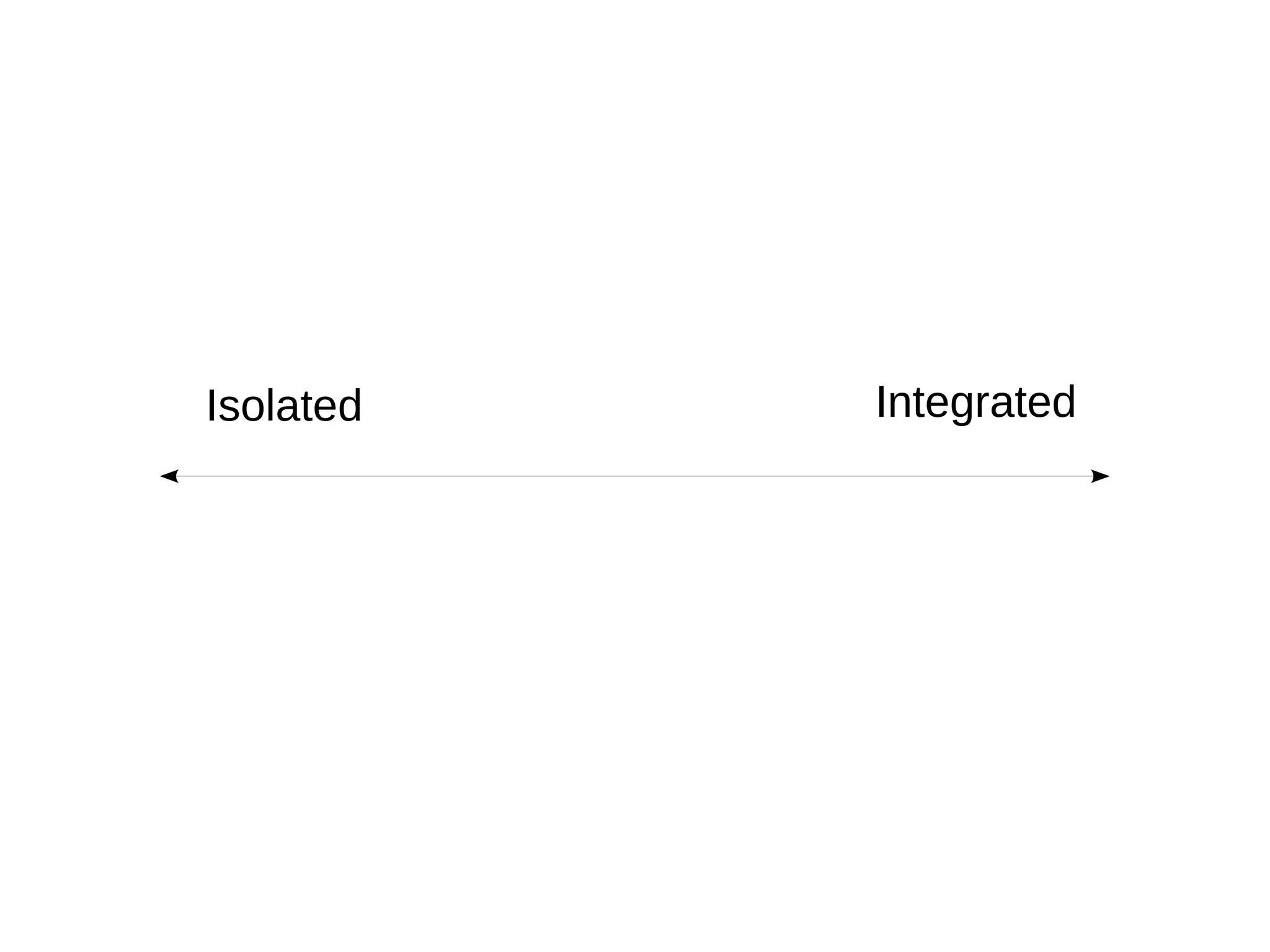
Isolated   Integrated
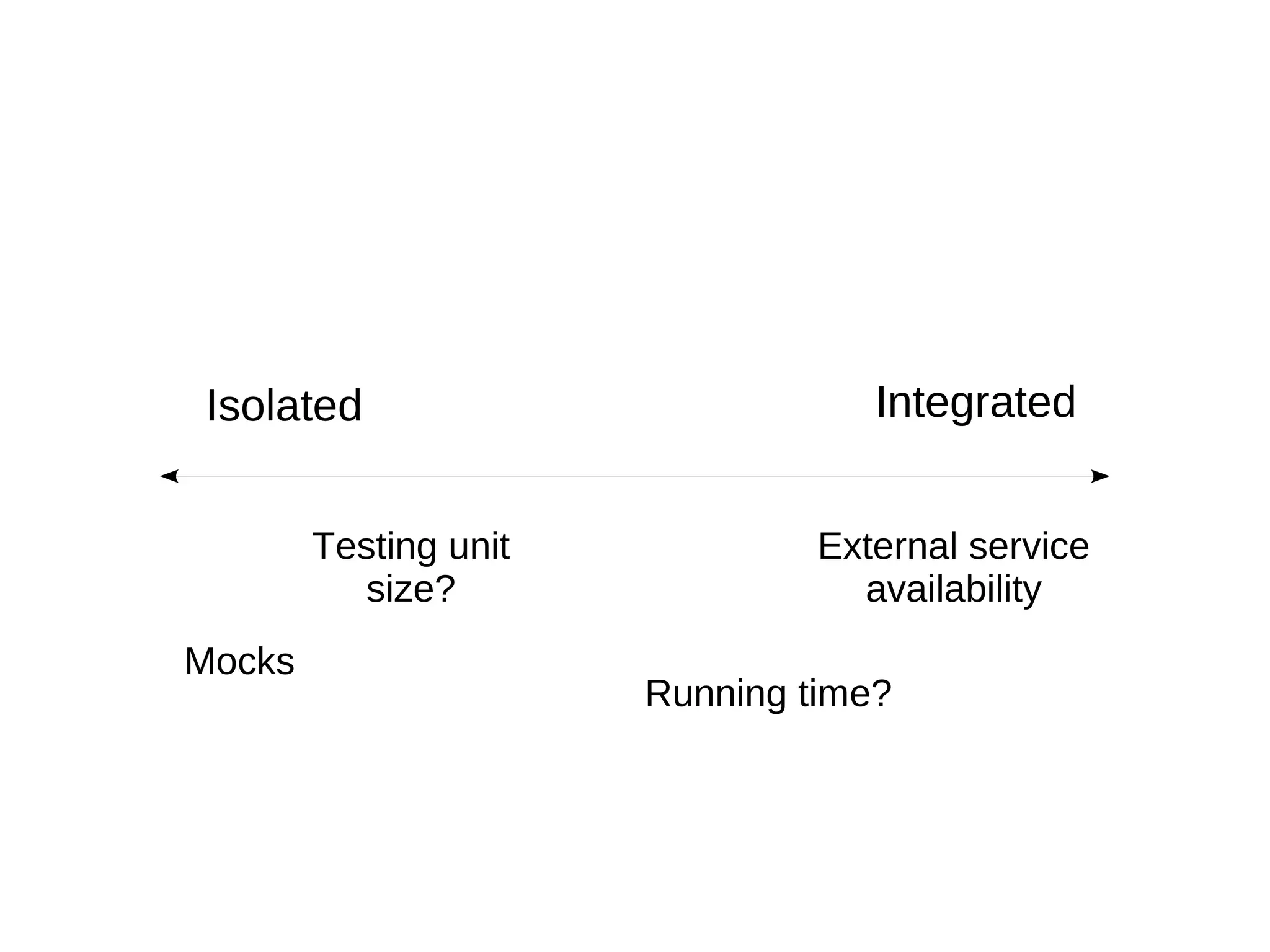
Isolated                           Integrated


        Testing unit            External service
           size?                  availability
Mocks
                       Running time?
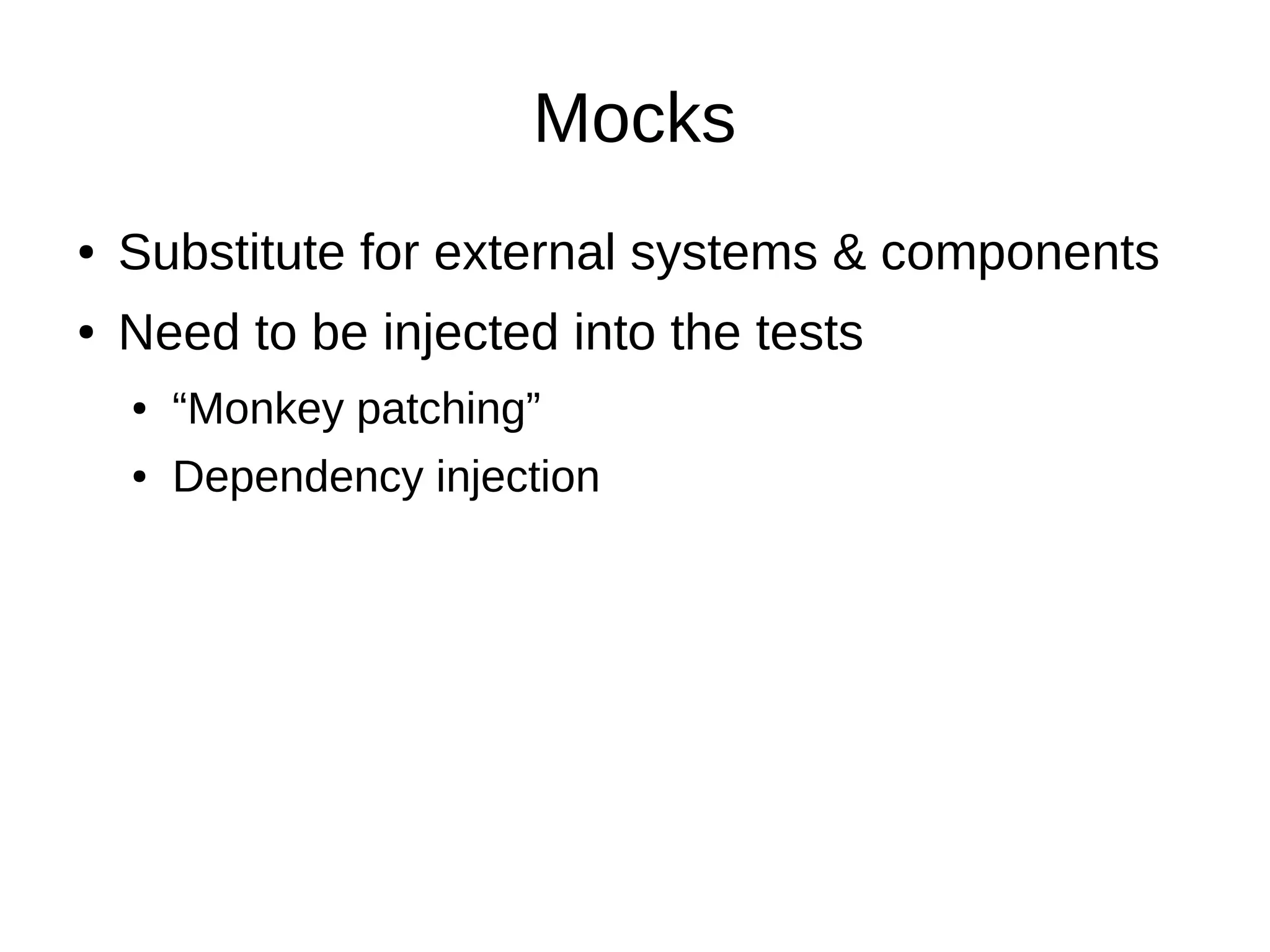
Mocks
●   Substitute for external systems & components
●   Need to be injected into the tests
    ●   “Monkey patching”
    ●   Dependency injection
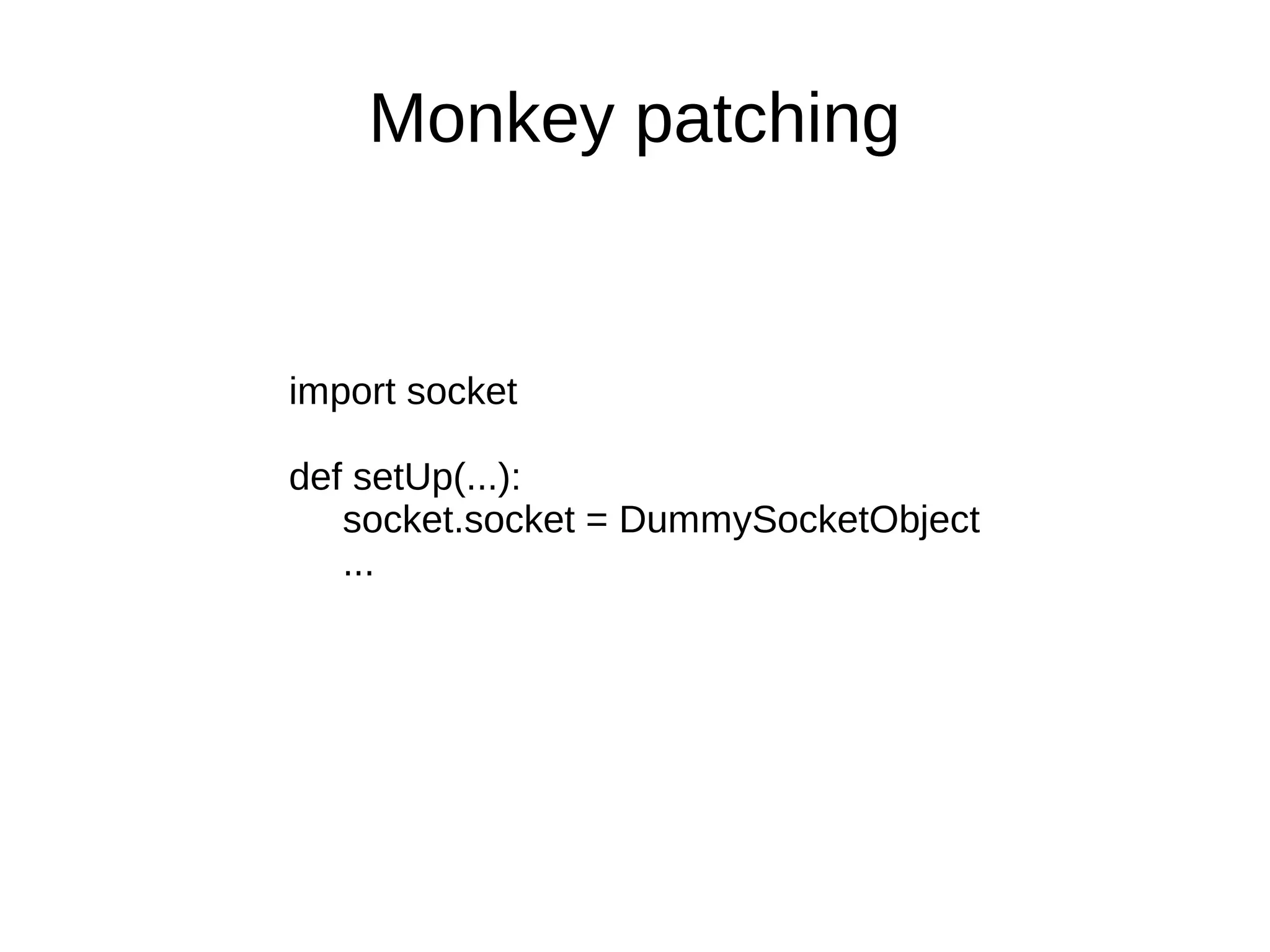
Monkey patching


import socket

def setUp(...):
   socket.socket = DummySocketObject
   ...
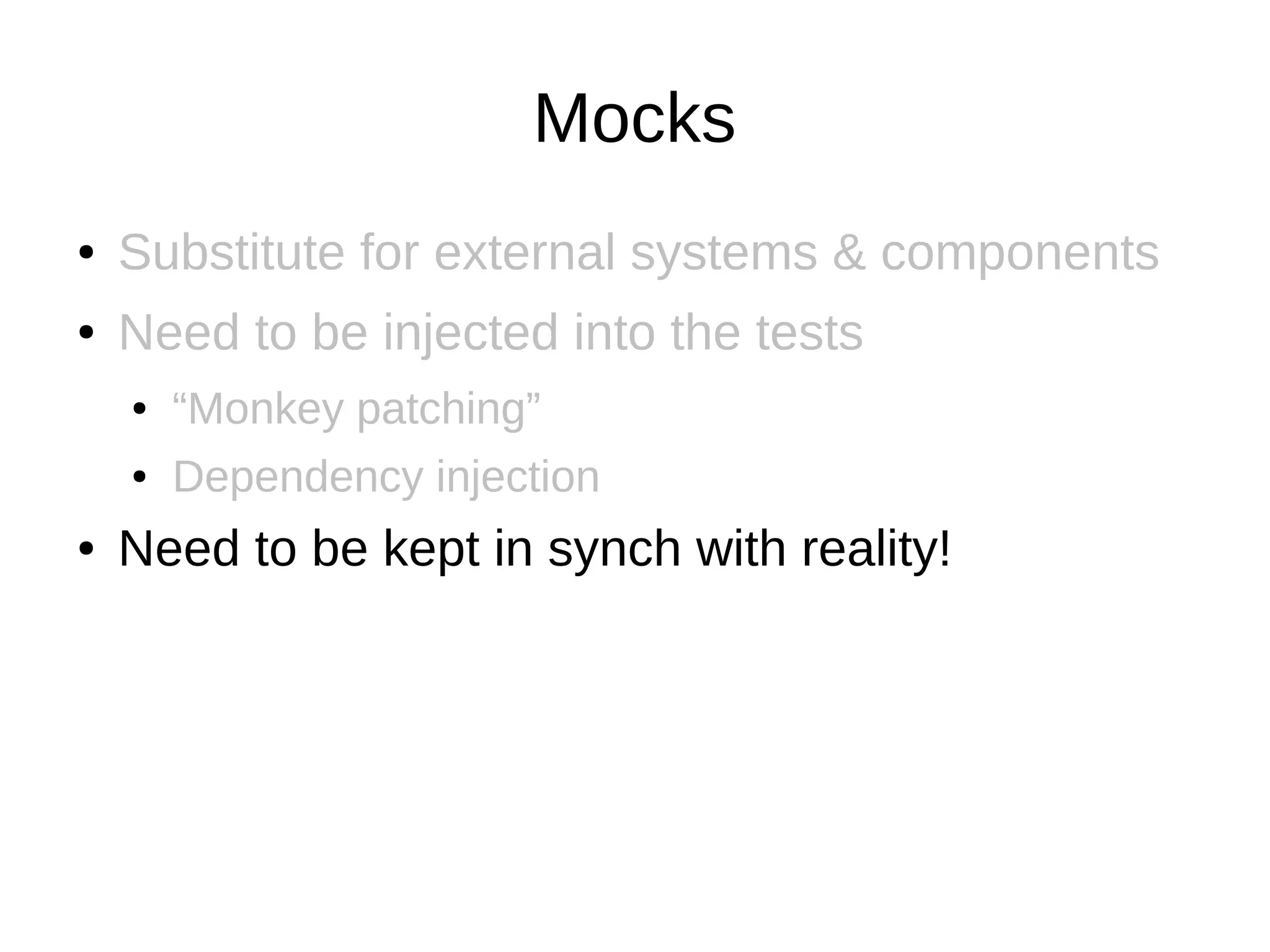
Mocks
●   Substitute for external systems & components
●   Need to be injected into the tests
    ●   “Monkey patching”
    ●   Dependency injection
●   Need to be kept in synch with reality!
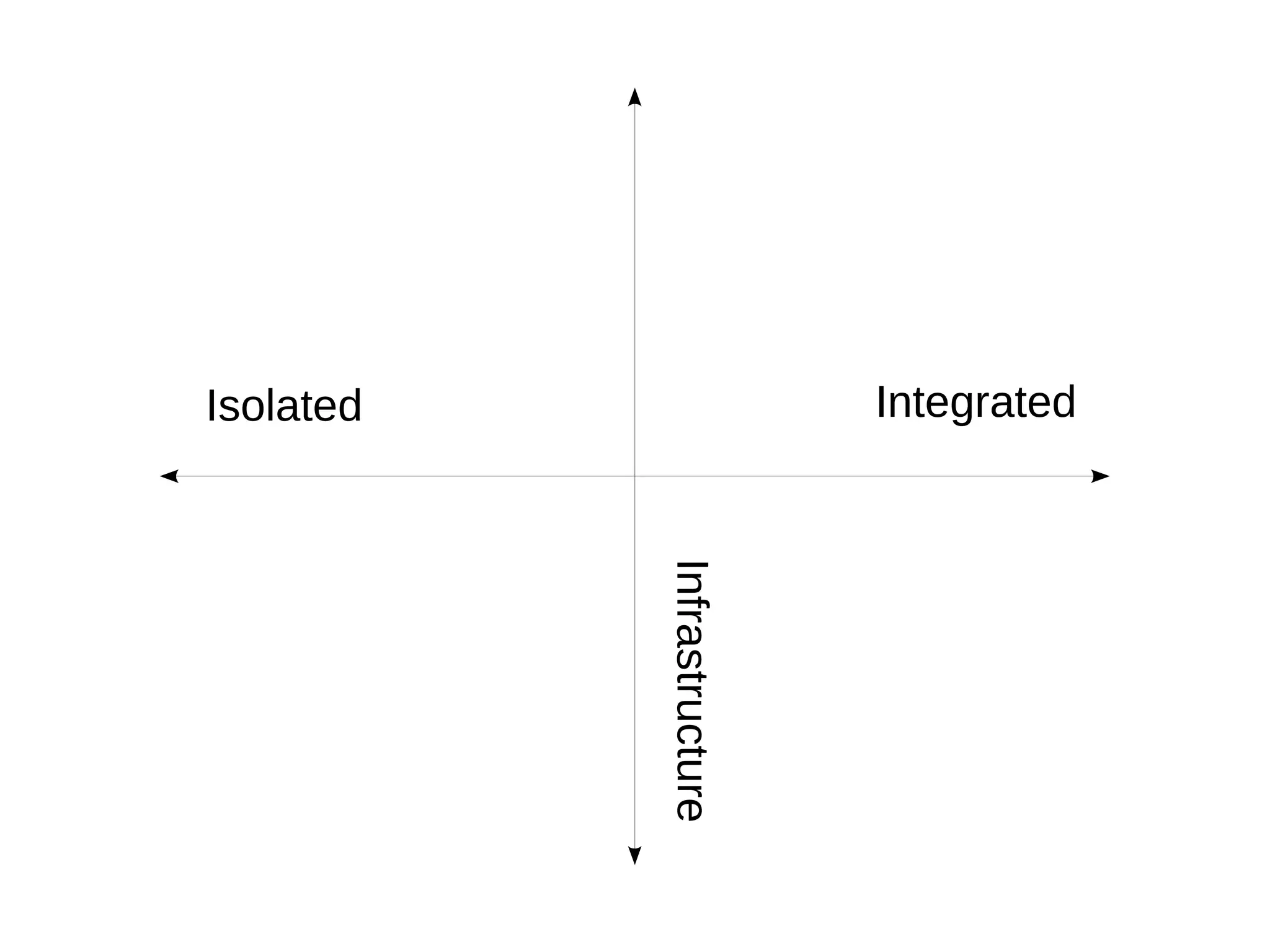
Isolated                    Integrated


           Infrastructure
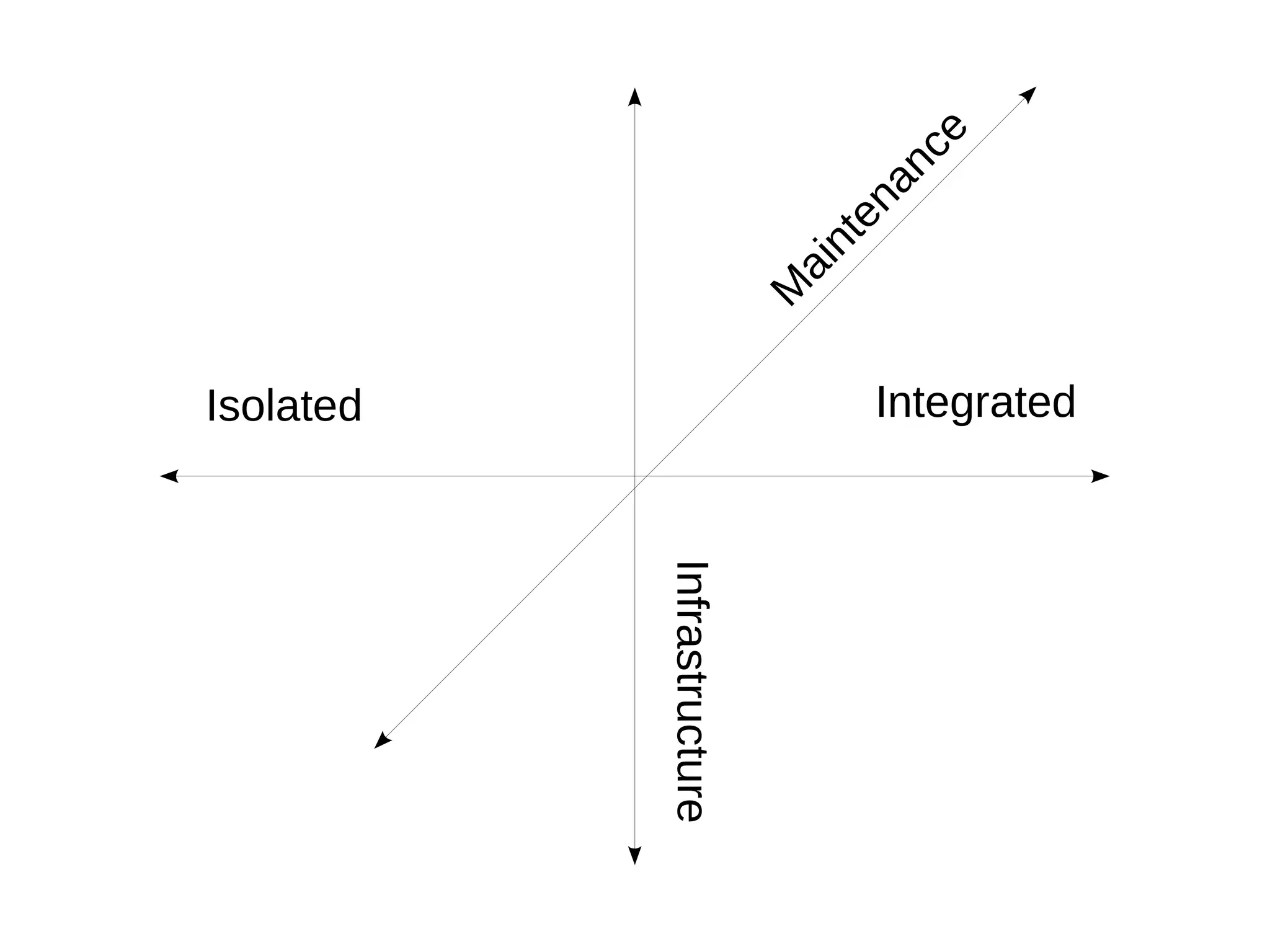
ce
                                     n
                                e na
                             nt
                             ai
                            M
Isolated                           Integrated


           Infrastructure
Testing Strategies


   Some of many...
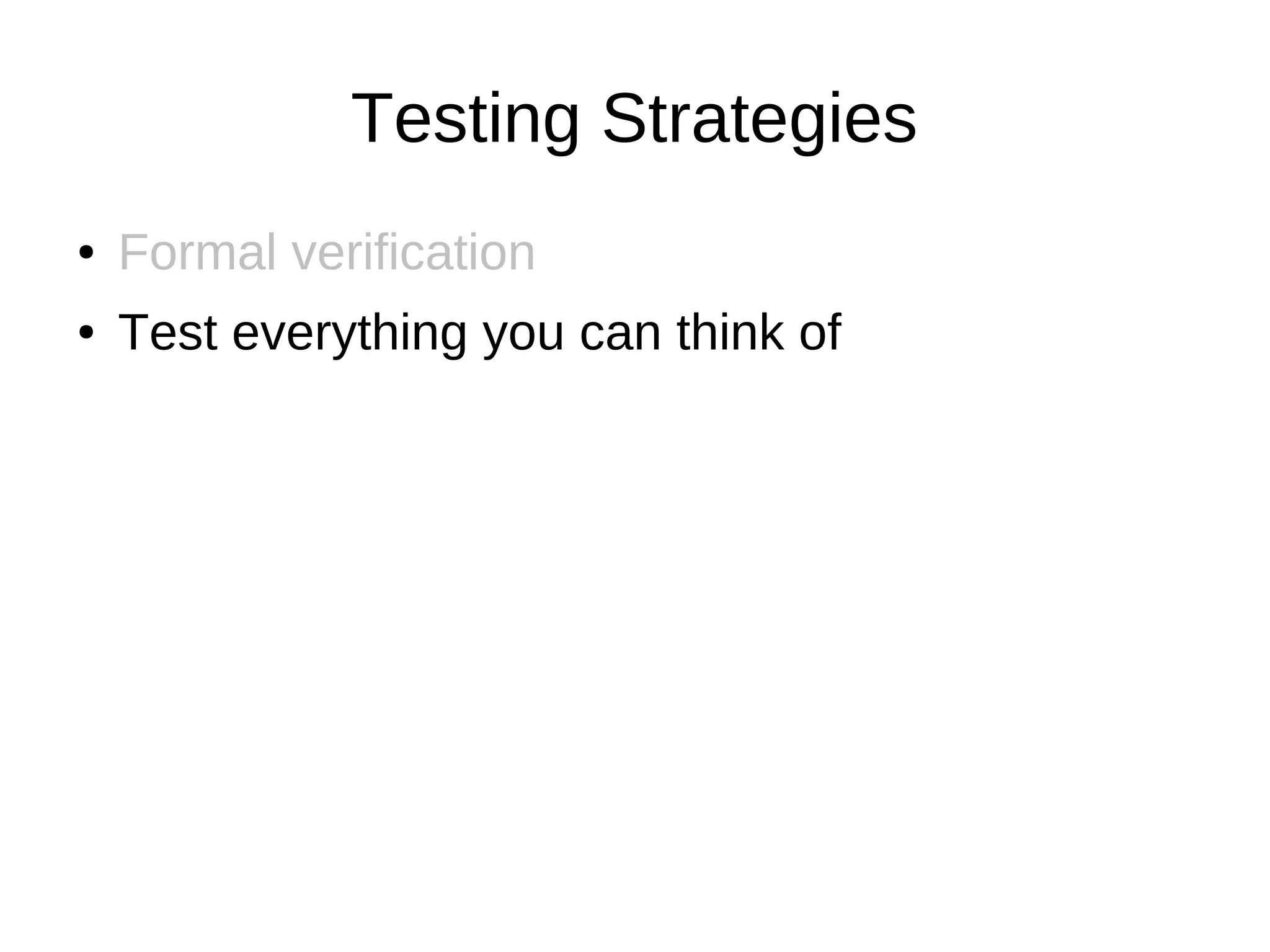
Testing Strategies
●   Formal verification
Testing Strategies
●   Formal verification
●   Test everything you can think of
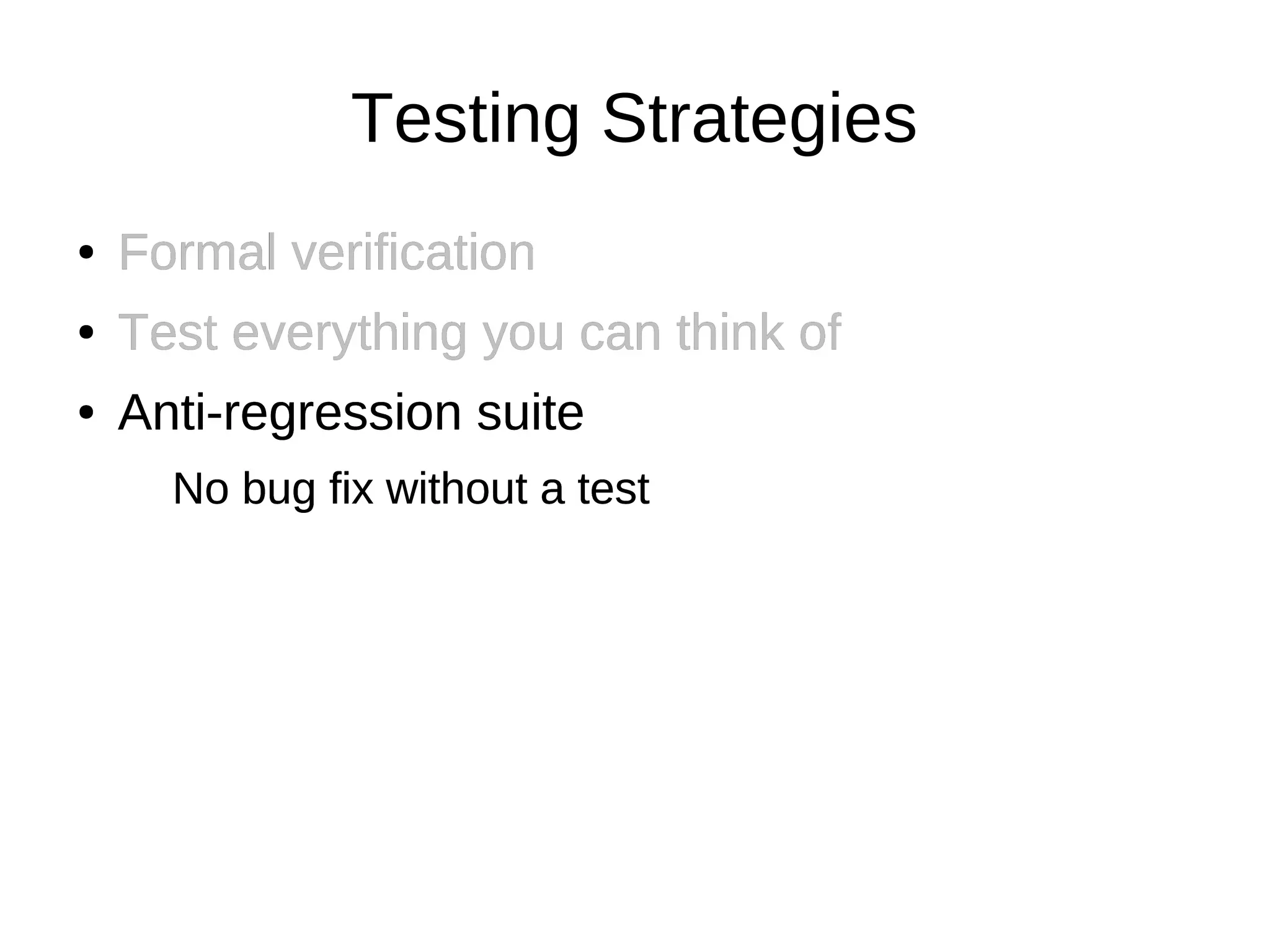
Testing Strategies
●   Formal verification
●   Test everything you can think of
●   Anti-regression suite
      No bug fix without a test
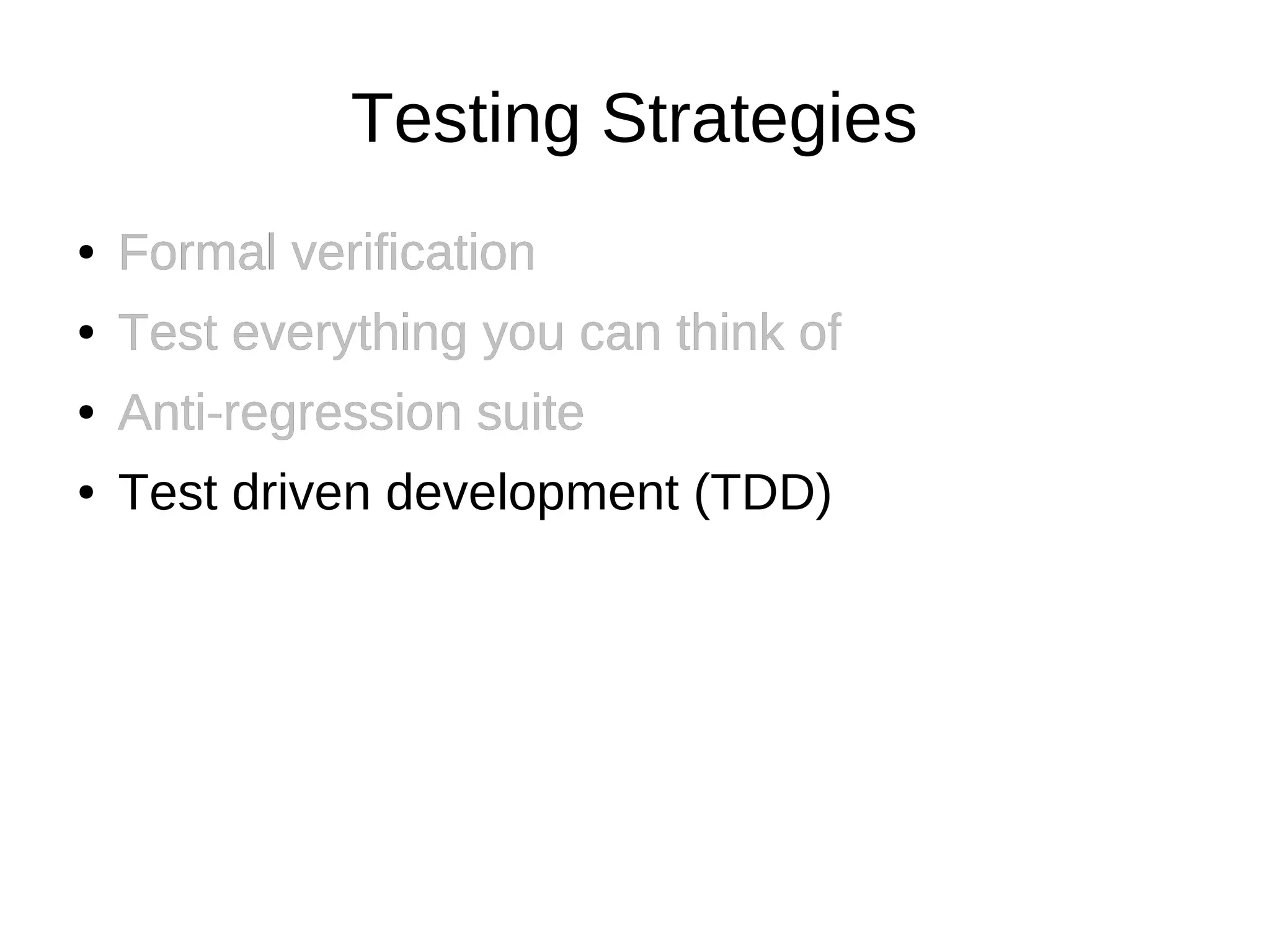
Testing Strategies
●   Formal verification
●   Test everything you can think of
●   Anti-regression suite
●   Test driven development (TDD)
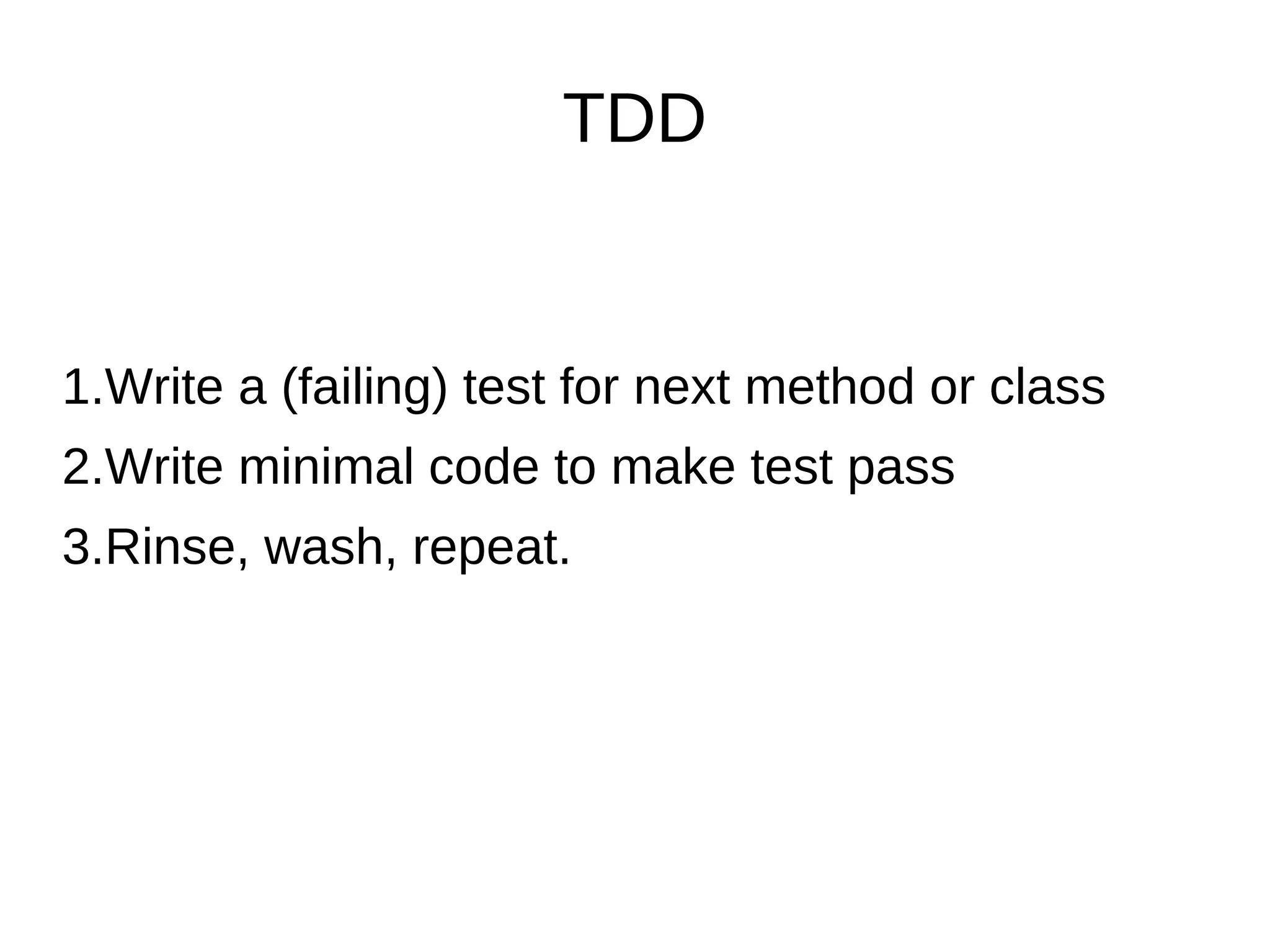
TDD


1.Write a (failing) test for next method or class
2.Write minimal code to make test pass
3.Rinse, wash, repeat.
Testing Strategies
●   Formal verification
●   Test everything you can think of
●   Anti-regression suite
●   Test driven development (TDD)
      “Specification, not verification”
Testing Strategies
●   Formal verification
●   Test everything you can think of
●   Anti-regression suite
●   Test driven development (TDD)
●   Documentation driven development (DDD?)
Testing Strategies
●   Formal verification
●   Test everything you can think of
●   Anti-regression suite
●   Test driven development (TDD)
●   Documentation driven development (DDD?)
●   Behaviour driven development (BDD)
Chapter II: A different way of thinking
Interlude: Creating systems...


          Specification
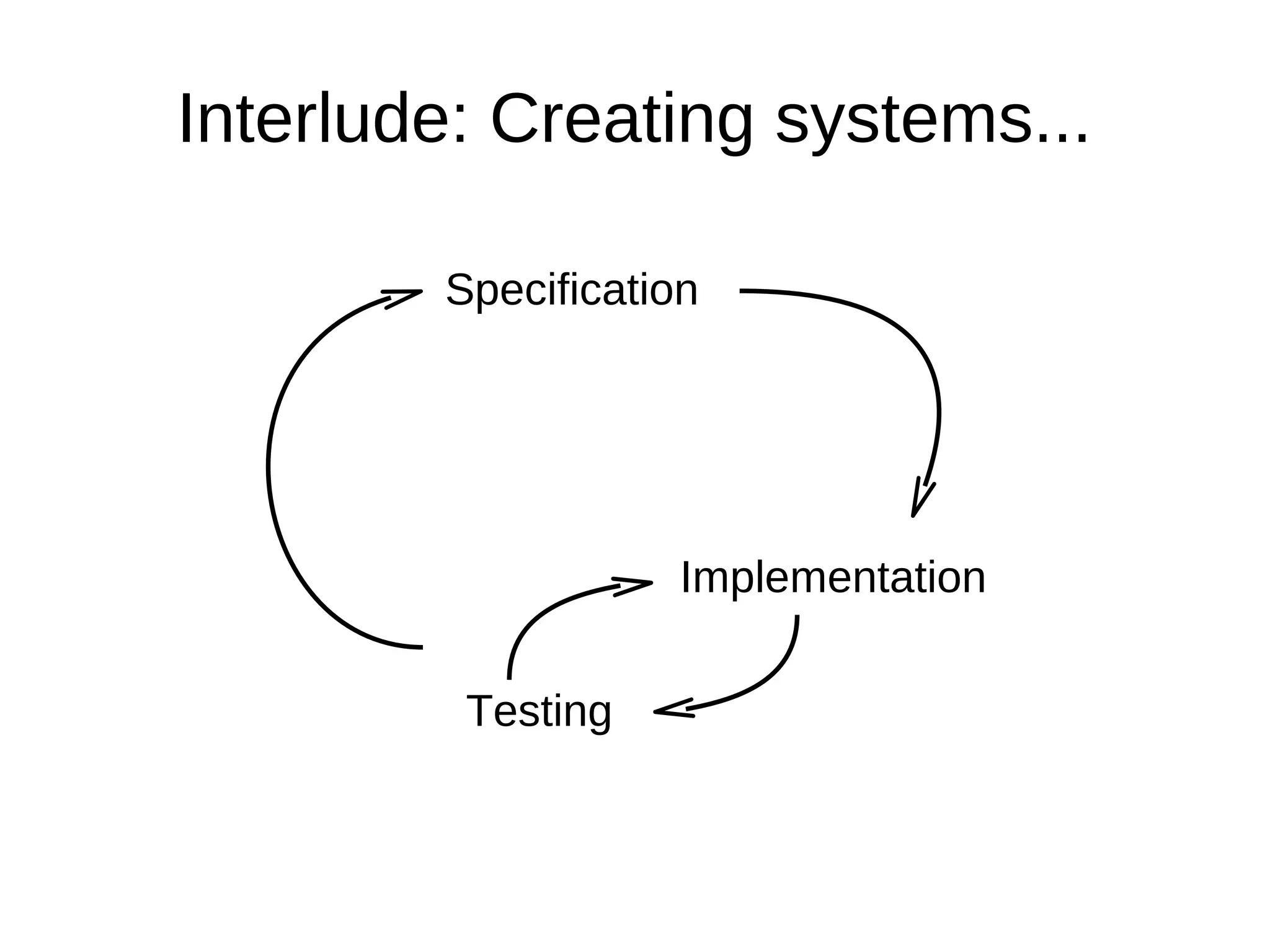
Interlude: Creating systems...

        Specification


                    Implementation

         Testing
Specification

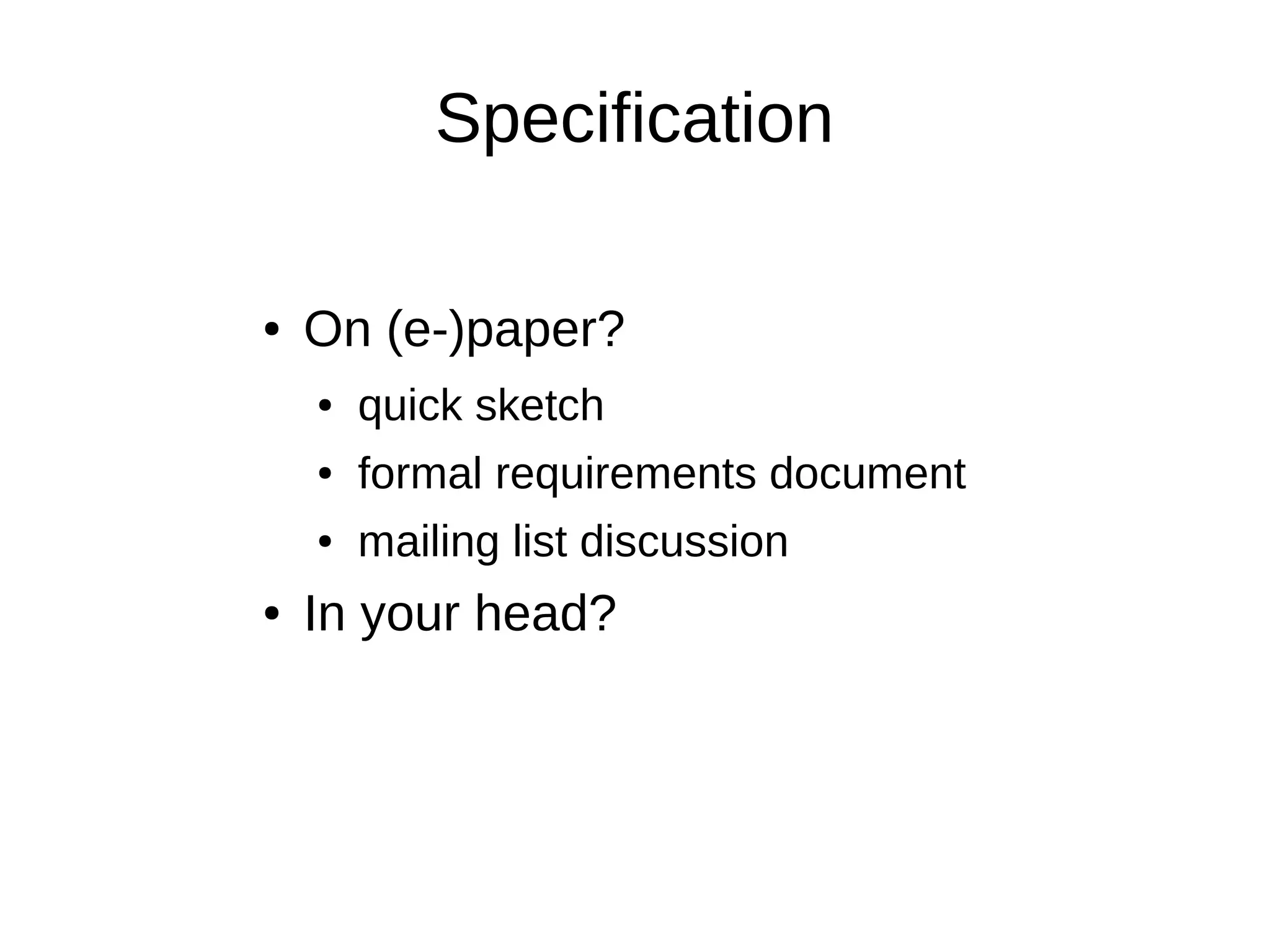
●   On (e-)paper?
    ●   quick sketch
    ●   formal requirements document
    ●   mailing list discussion
●   In your head?
Specification


●   Capturing the idea is probably good
●   “What was I thinking smoking when...?”
Specification


As a [user or role],

I want [feature]

so that [something happens]
Specification


As a maze creator,

I want to be able to specify dimensions

so that a new maze of the given size is created.
BDD


What is the next most important
thing the code should do?
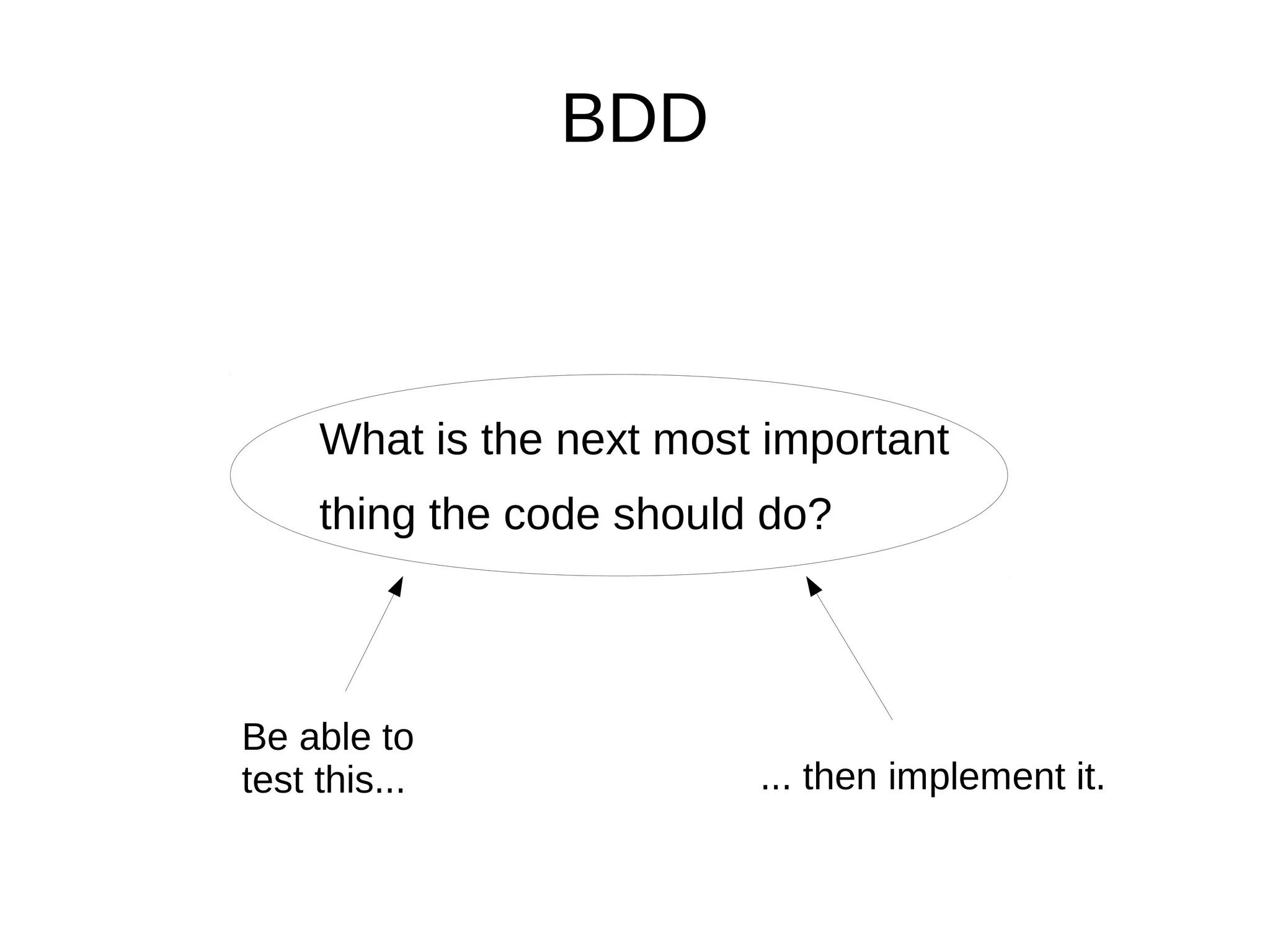
BDD


     What is the next most important
     thing the code should do?


Be able to
test this...              ... then implement it.
Scenario


Given that [initial context],

if and when [some event occurs]

then [ensure some outcomes]
Use case versus scenario


As a [user or role],          Given that [initial context],

I want [feature]              if and when [some event occurs]

so that [something happens]   then [ensure some outcomes]
Chapter III: Concrete code
Interlude: Naming things


 Language helps guide our brain.
 Focuses the mind.
 Perhaps too exclusively.
Interlude: Naming things


The Sapir-Whorf Hypothesis:
“[...] the structure of a language affects the ways in
which its speakers are able to conceptualise their
world [view].”
Example #1: Python's unittest module
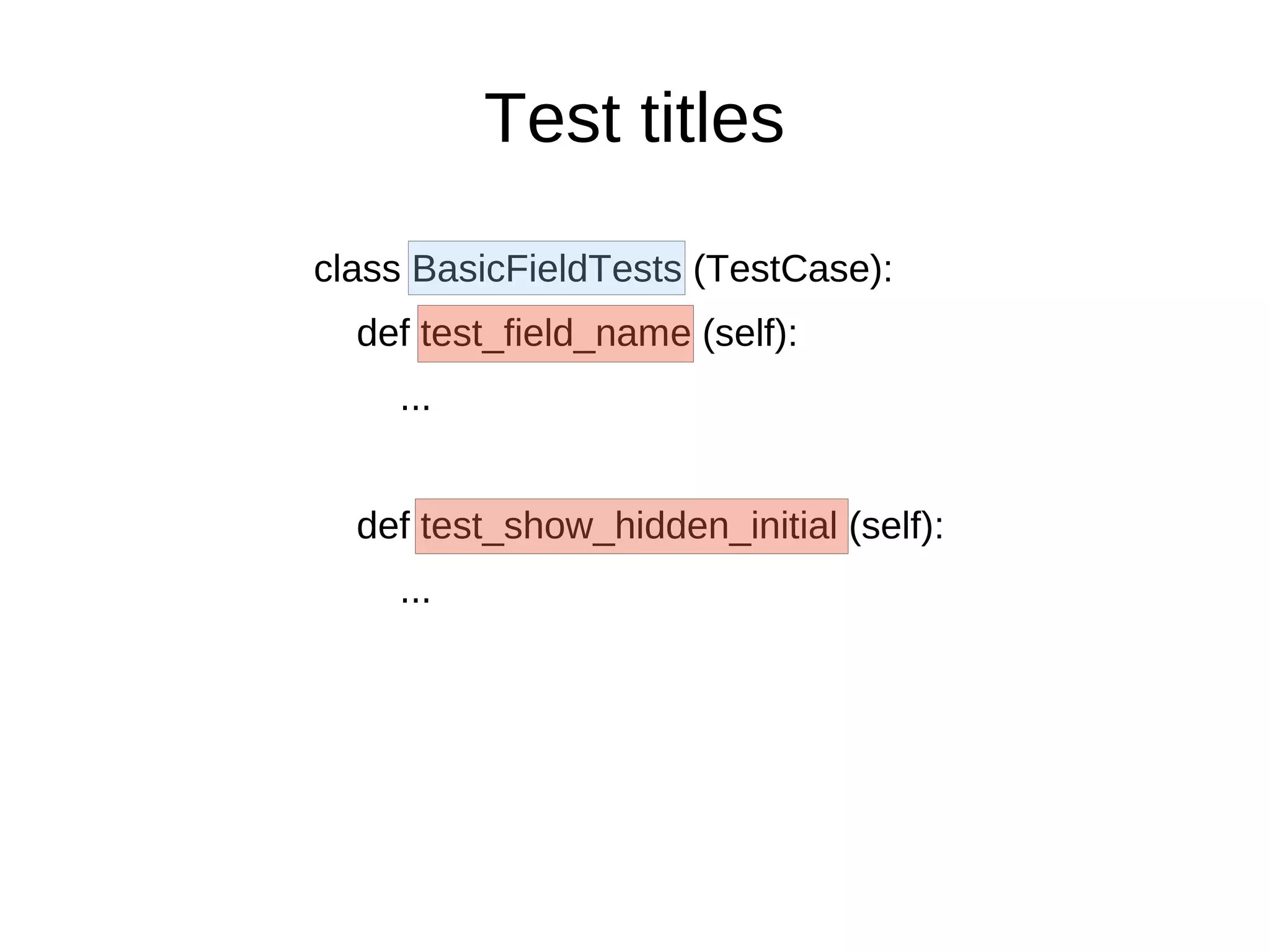
Test titles
class BasicFieldTests (TestCase):
  def test_field_name (self):
    ...


  def test_show_hidden_initial (self):
    ...
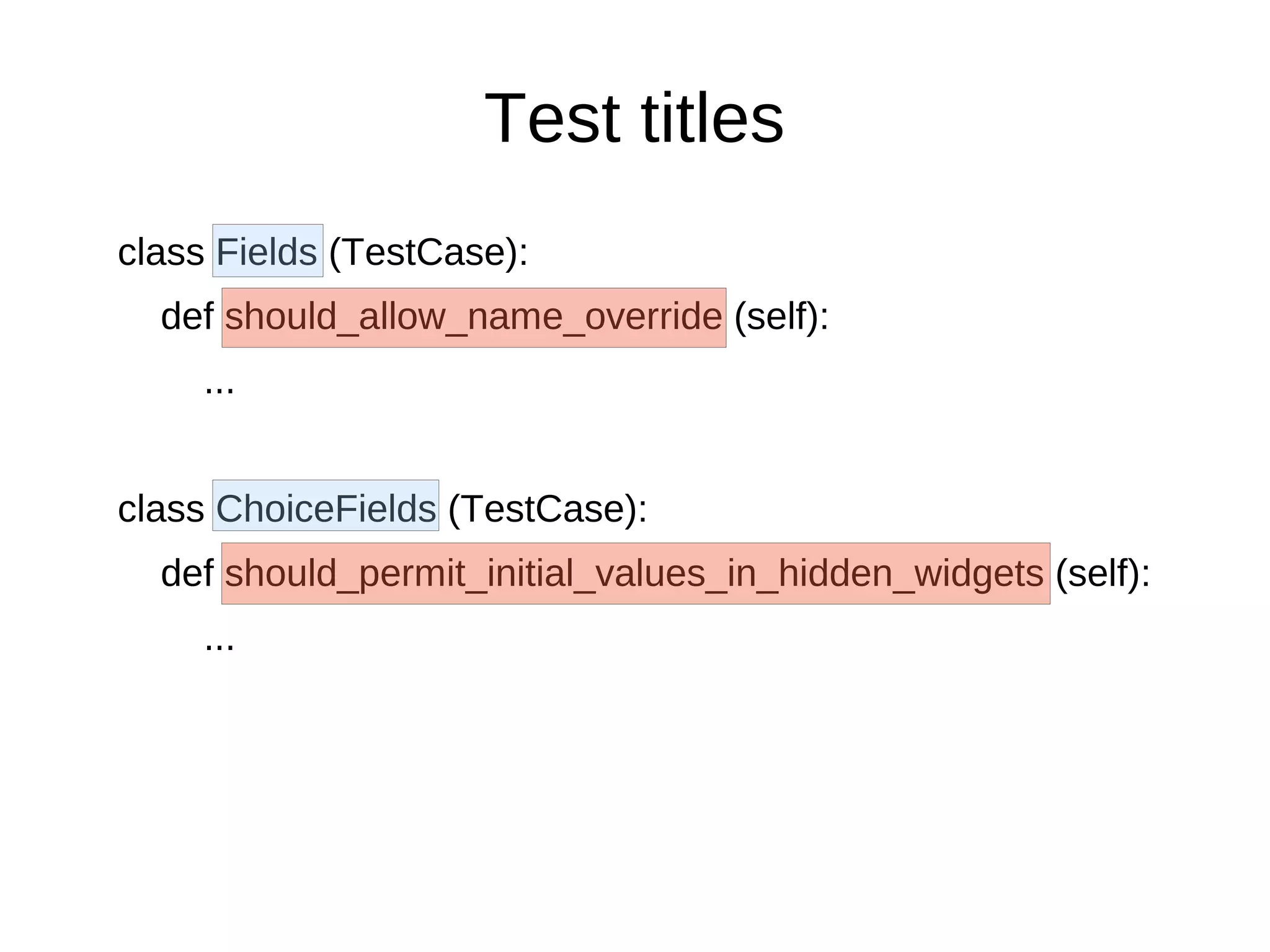
Test titles
class Fields (TestCase):
  def should_allow_name_override (self):
     ...


class ChoiceFields (TestCase):
  def should_permit_initial_values_in_hidden_widgets (self):
     ...
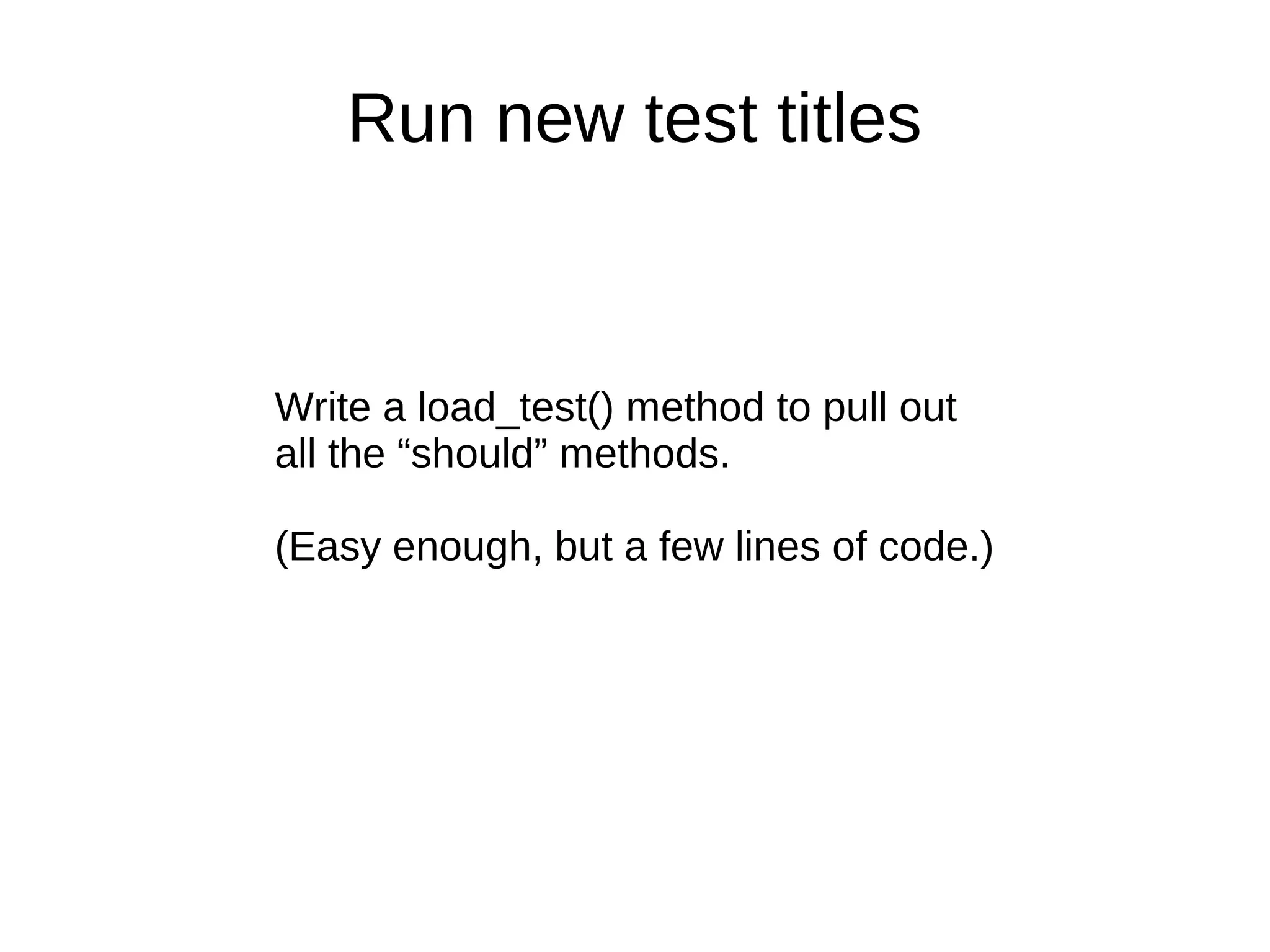
Run new test titles


Write a load_test() method to pull out
all the “should” methods.

(Easy enough, but a few lines of code.)
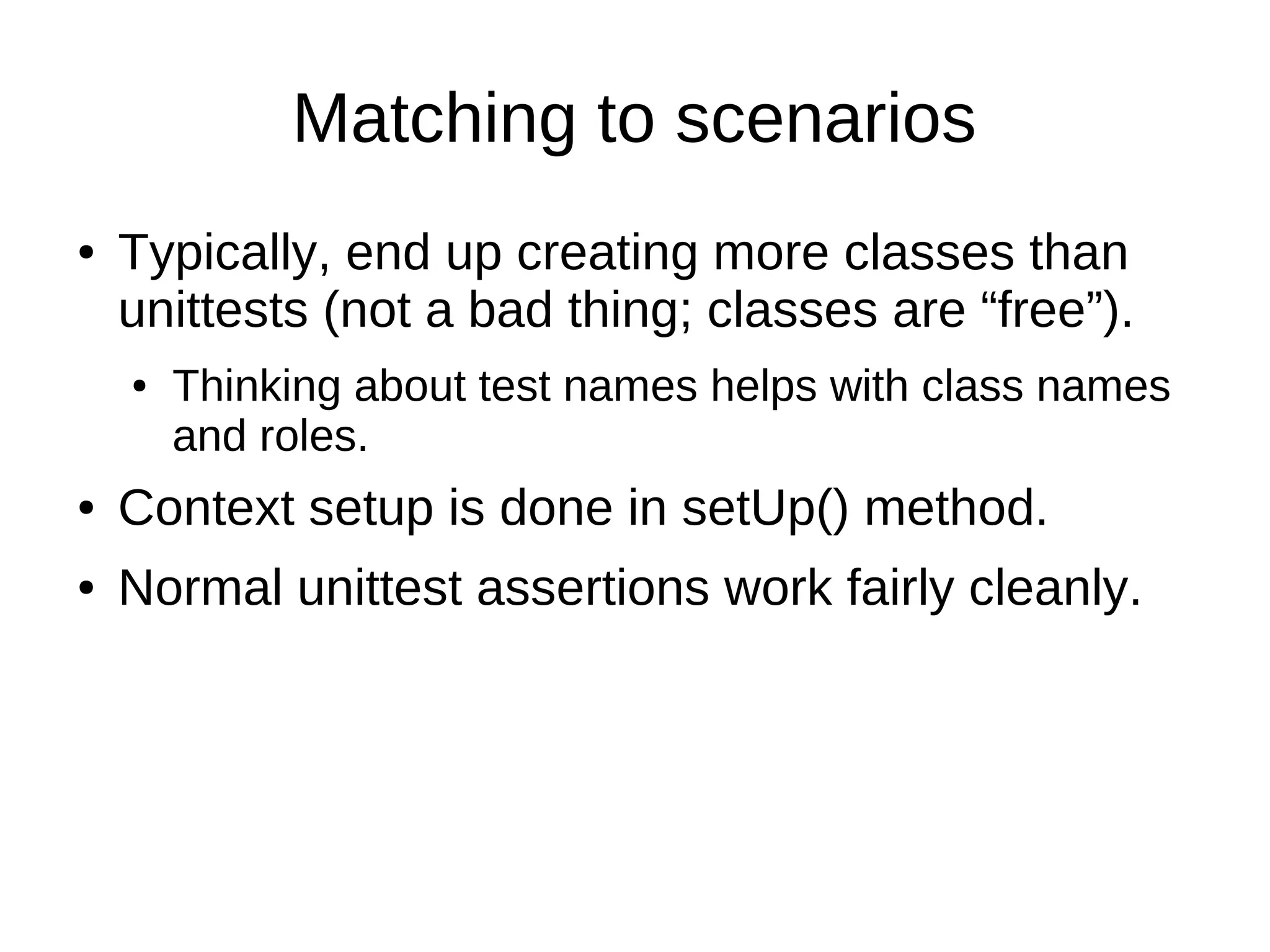
Matching to scenarios
●   Typically, end up creating more classes than
    unittests (not a bad thing; classes are “free”).
    ●   Thinking about test names helps with class names
        and roles.
●   Context setup is done in setUp() method.
●   Normal unittest assertions work fairly cleanly.
Example #2: Doctests
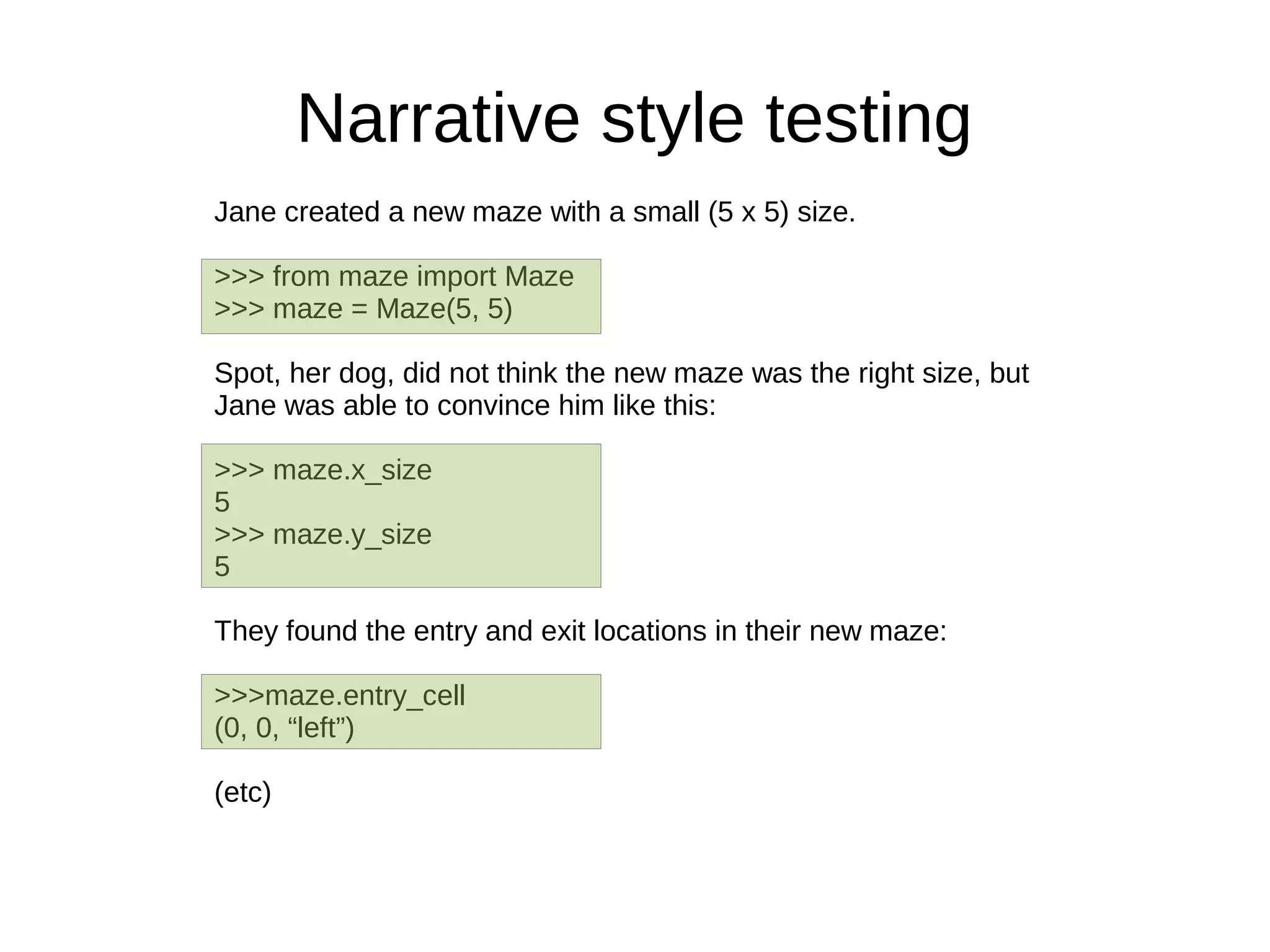
Narrative style testing
Jane created a new maze with a small (5 x 5) size.

>>> from maze import Maze
>>> maze = Maze(5, 5)

Spot, her dog, did not think the new maze was the right size, but
Jane was able to convince him like this:

>>> maze.x_size
5
>>> maze.y_size
5

They found the entry and exit locations in their new maze:

>>>maze.entry_cell
(0, 0, “left”)

(etc)
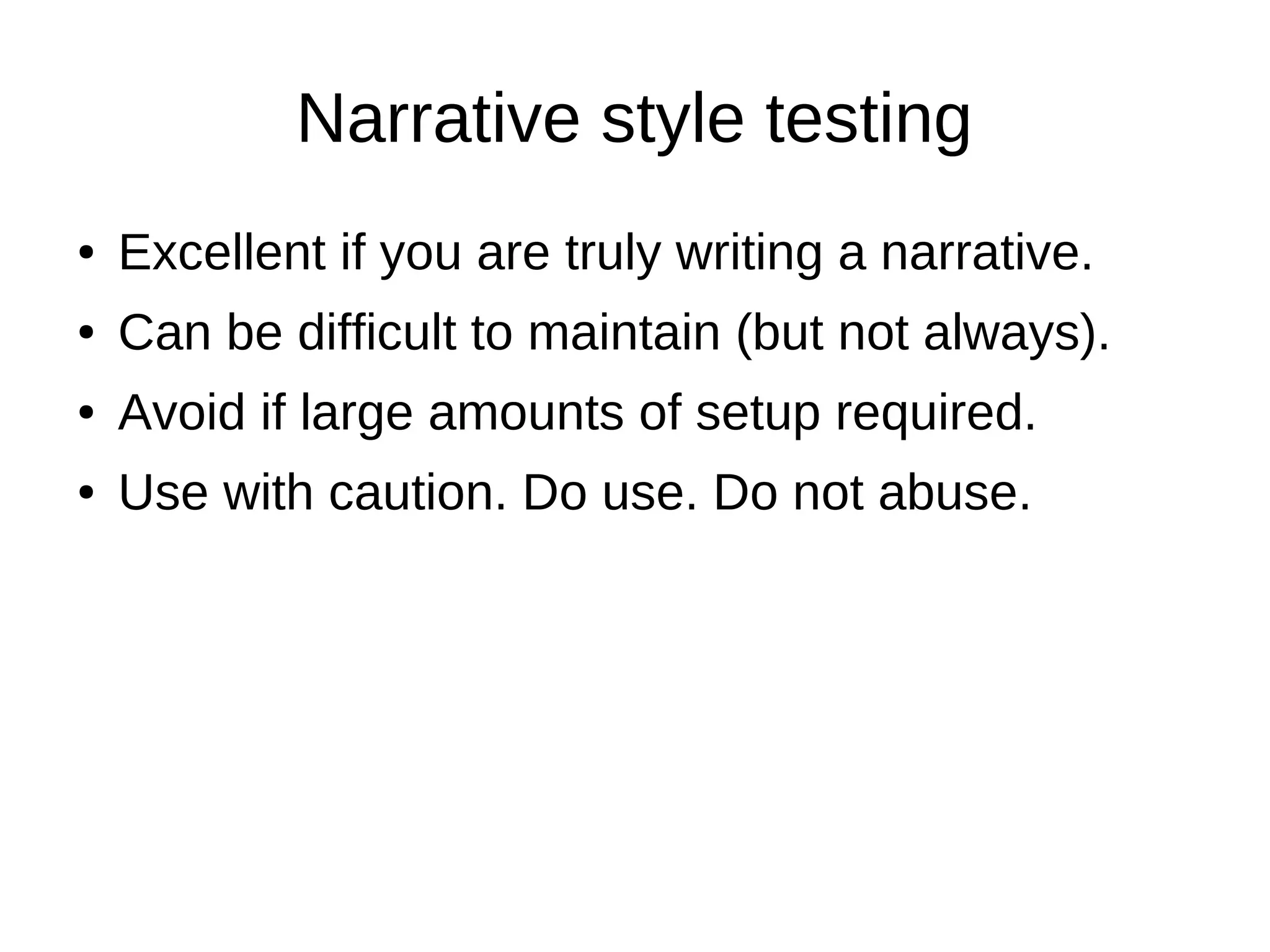
Narrative style testing
●   Excellent if you are truly writing a narrative.
●   Can be difficult to maintain (but not always).
●   Avoid if large amounts of setup required.
●   Use with caution. Do use. Do not abuse.
Example #3: Domain specific languages
DSL packages


●   Lettuce
●   Freshen


                  Both available through PyPI
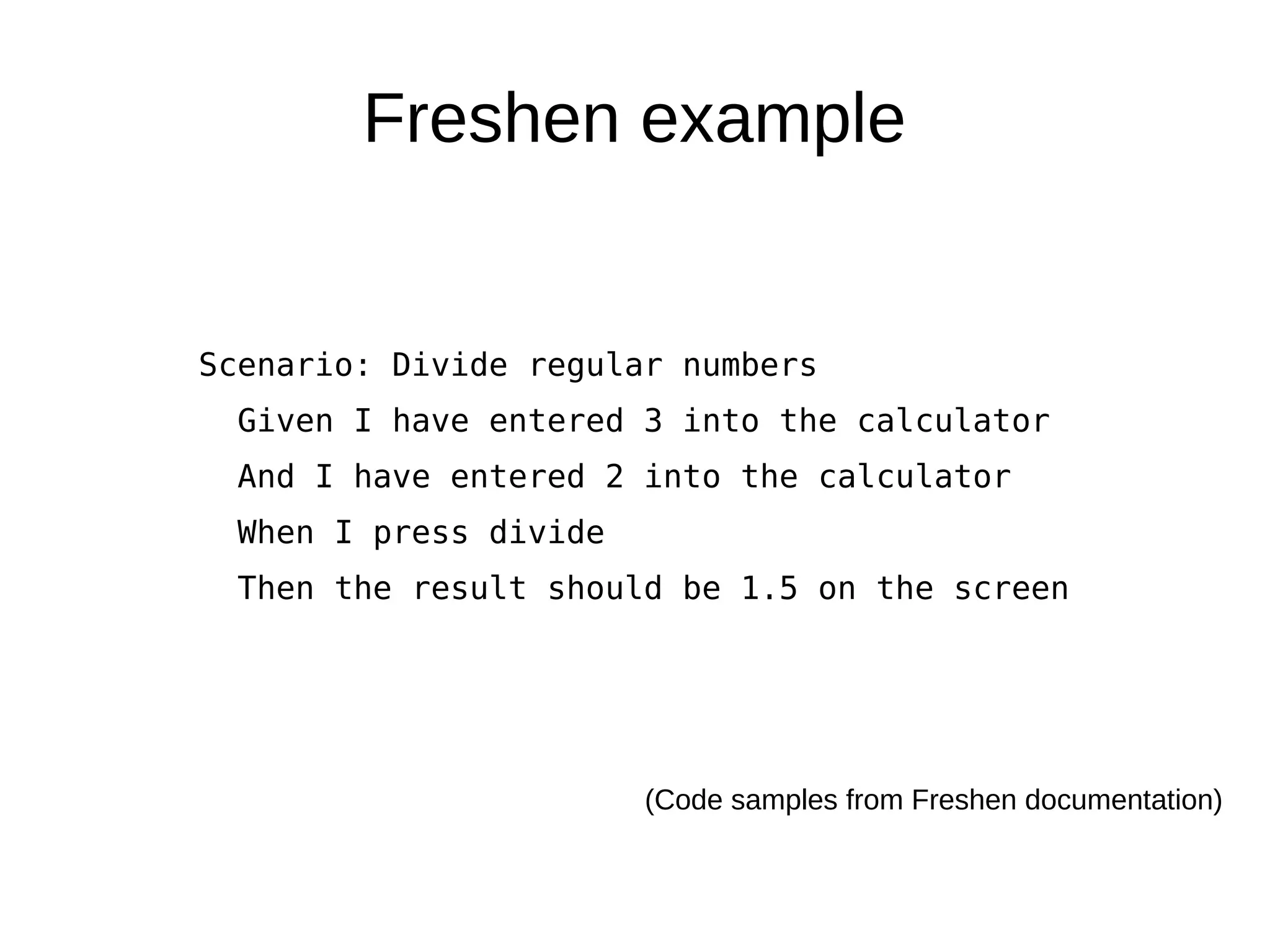
Freshen example


Scenario: Divide regular numbers
  Given I have entered 3 into the calculator
  And I have entered 2 into the calculator
  When I press divide
  Then the result should be 1.5 on the screen


                        (Code samples from Freshen documentation)
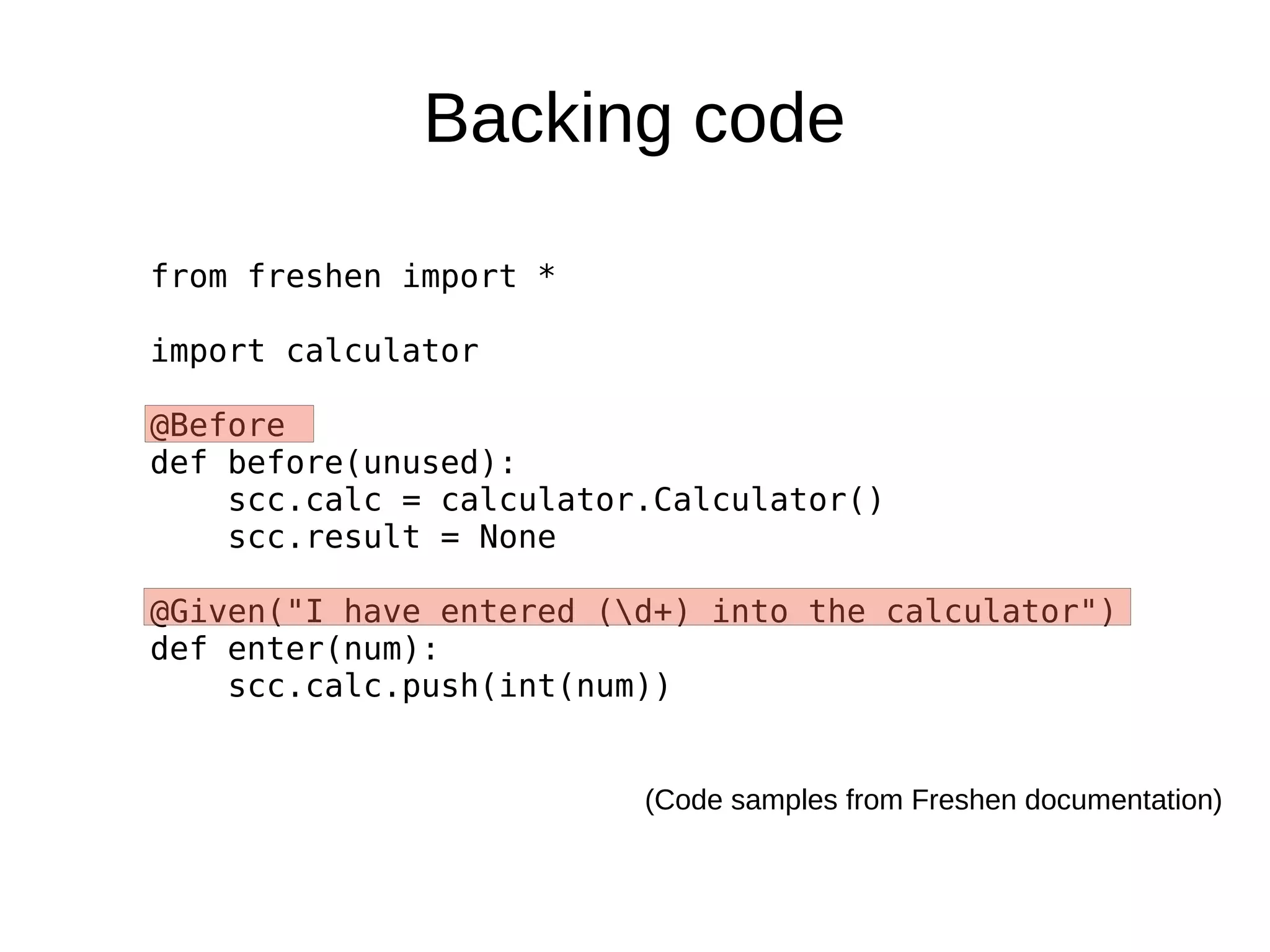
Backing code

from freshen import *

import calculator

@Before
def before(unused):
    scc.calc = calculator.Calculator()
    scc.result = None

@Given("I have entered (d+) into the calculator")
def enter(num):
    scc.calc.push(int(num))


                         (Code samples from Freshen documentation)
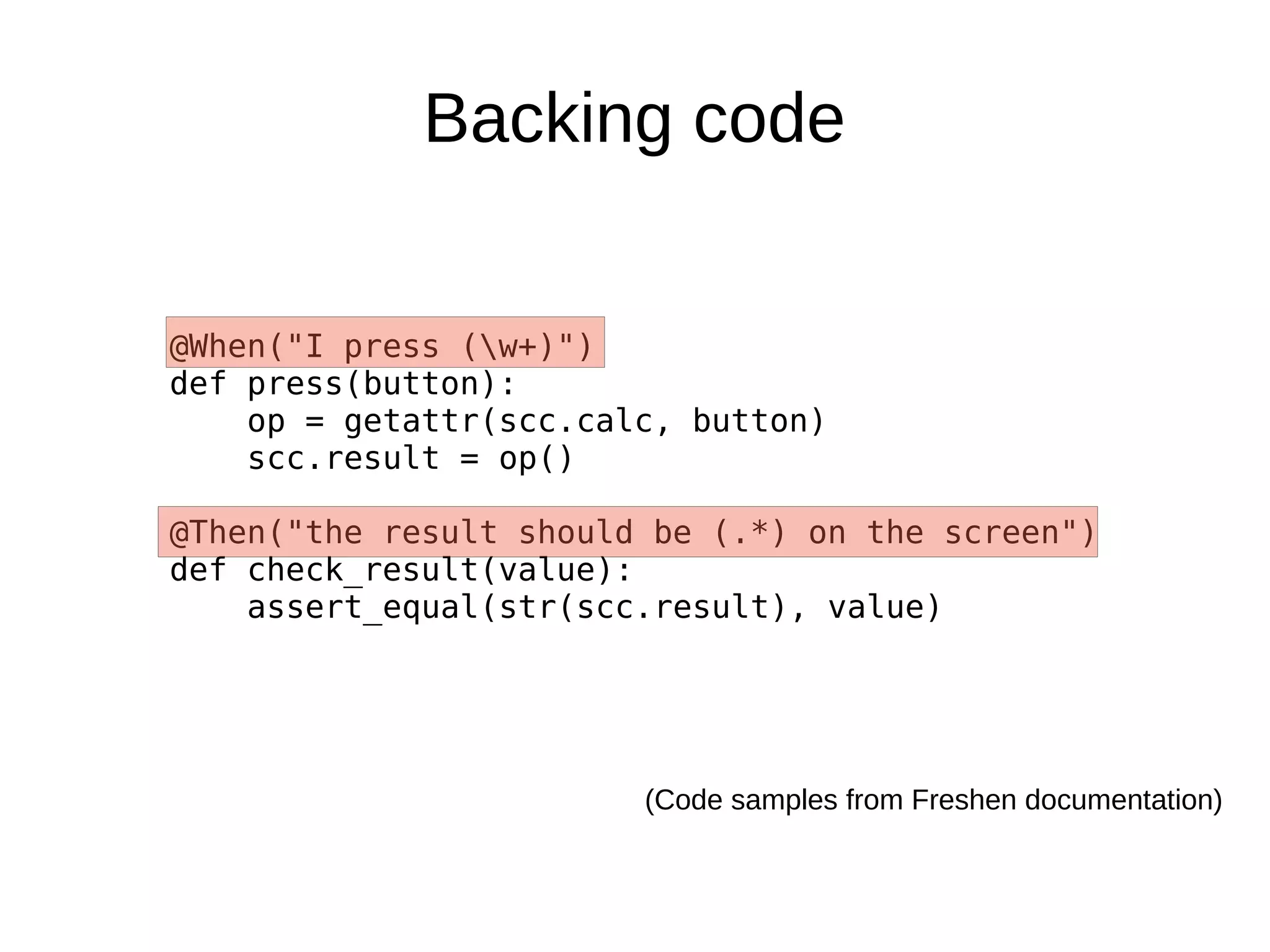
Backing code


@When("I press (w+)")
def press(button):
    op = getattr(scc.calc, button)
    scc.result = op()

@Then("the result should be (.*) on the screen")
def check_result(value):
    assert_equal(str(scc.result), value)


                        (Code samples from Freshen documentation)
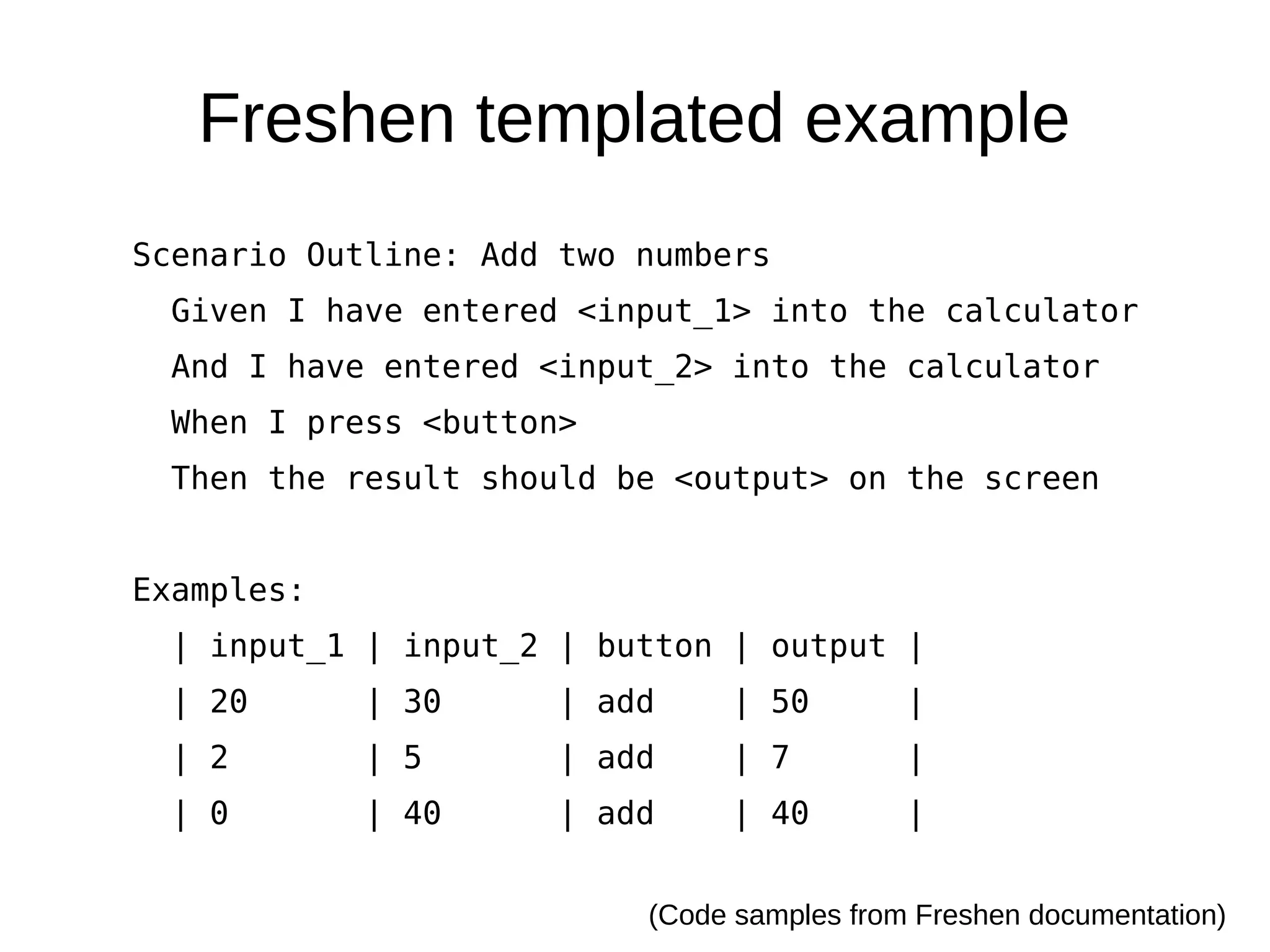
Freshen templated example
Scenario Outline: Add two numbers
  Given I have entered <input_1> into the calculator
  And I have entered <input_2> into the calculator
  When I press <button>
  Then the result should be <output> on the screen


Examples:
  | input_1 | input_2 | button | output |
  | 20      | 30      | add    | 50         |
  | 2       | 5       | add    | 7          |
  | 0       | 40      | add    | 40         |


                          (Code samples from Freshen documentation)
Conclusions(?)
●   Behavioural tests are worth trying
●   Question the way you think from time to time
●   Are your tests' purpose clear to future you?
https://github.com/malcolmt/bdd-and-testing-talk


            malcolm.tredinnick@gmail.com
                     @malcolmt

Bdd and-testing

  • 1.
    Behaviour Driven Development and thinking about testing Malcolm Tredinnick malcolm.tredinnick@gmail.com
  • 2.
    Why have Iasked you here today? 1) Testing landscape 2) A different way to think about this 3) Code
  • 3.
    Chapter I: TheTesting Landscape
  • 4.
    Isolated Integrated
  • 5.
    Isolated Integrated Testing unit External service size? availability Mocks Running time?
  • 6.
    Mocks ● Substitute for external systems & components ● Need to be injected into the tests ● “Monkey patching” ● Dependency injection
  • 7.
    Monkey patching import socket defsetUp(...): socket.socket = DummySocketObject ...
  • 8.
    Mocks ● Substitute for external systems & components ● Need to be injected into the tests ● “Monkey patching” ● Dependency injection ● Need to be kept in synch with reality!
  • 9.
    Isolated Integrated Infrastructure
  • 10.
    ce n e na nt ai M Isolated Integrated Infrastructure
  • 11.
    Testing Strategies Some of many...
  • 12.
    Testing Strategies ● Formal verification
  • 13.
    Testing Strategies ● Formal verification ● Test everything you can think of
  • 14.
    Testing Strategies ● Formal verification ● Test everything you can think of ● Anti-regression suite No bug fix without a test
  • 15.
    Testing Strategies ● Formal verification ● Test everything you can think of ● Anti-regression suite ● Test driven development (TDD)
  • 16.
    TDD 1.Write a (failing)test for next method or class 2.Write minimal code to make test pass 3.Rinse, wash, repeat.
  • 17.
    Testing Strategies ● Formal verification ● Test everything you can think of ● Anti-regression suite ● Test driven development (TDD) “Specification, not verification”
  • 18.
    Testing Strategies ● Formal verification ● Test everything you can think of ● Anti-regression suite ● Test driven development (TDD) ● Documentation driven development (DDD?)
  • 19.
    Testing Strategies ● Formal verification ● Test everything you can think of ● Anti-regression suite ● Test driven development (TDD) ● Documentation driven development (DDD?) ● Behaviour driven development (BDD)
  • 20.
    Chapter II: Adifferent way of thinking
  • 21.
  • 22.
  • 23.
    Interlude: Creating systems... Specification Implementation Testing
  • 24.
    Specification ● On (e-)paper? ● quick sketch ● formal requirements document ● mailing list discussion ● In your head?
  • 25.
    Specification ● Capturing the idea is probably good ● “What was I thinking smoking when...?”
  • 26.
    Specification As a [useror role], I want [feature] so that [something happens]
  • 27.
    Specification As a mazecreator, I want to be able to specify dimensions so that a new maze of the given size is created.
  • 28.
    BDD What is thenext most important thing the code should do?
  • 29.
    BDD What is the next most important thing the code should do? Be able to test this... ... then implement it.
  • 30.
    Scenario Given that [initialcontext], if and when [some event occurs] then [ensure some outcomes]
  • 31.
    Use case versusscenario As a [user or role], Given that [initial context], I want [feature] if and when [some event occurs] so that [something happens] then [ensure some outcomes]
  • 32.
  • 33.
    Interlude: Naming things Language helps guide our brain. Focuses the mind. Perhaps too exclusively.
  • 34.
    Interlude: Naming things TheSapir-Whorf Hypothesis: “[...] the structure of a language affects the ways in which its speakers are able to conceptualise their world [view].”
  • 35.
    Example #1: Python'sunittest module
  • 36.
    Test titles class BasicFieldTests(TestCase): def test_field_name (self): ... def test_show_hidden_initial (self): ...
  • 37.
    Test titles class Fields(TestCase): def should_allow_name_override (self): ... class ChoiceFields (TestCase): def should_permit_initial_values_in_hidden_widgets (self): ...
  • 38.
    Run new testtitles Write a load_test() method to pull out all the “should” methods. (Easy enough, but a few lines of code.)
  • 39.
    Matching to scenarios ● Typically, end up creating more classes than unittests (not a bad thing; classes are “free”). ● Thinking about test names helps with class names and roles. ● Context setup is done in setUp() method. ● Normal unittest assertions work fairly cleanly.
  • 40.
  • 41.
    Narrative style testing Janecreated a new maze with a small (5 x 5) size. >>> from maze import Maze >>> maze = Maze(5, 5) Spot, her dog, did not think the new maze was the right size, but Jane was able to convince him like this: >>> maze.x_size 5 >>> maze.y_size 5 They found the entry and exit locations in their new maze: >>>maze.entry_cell (0, 0, “left”) (etc)
  • 42.
    Narrative style testing ● Excellent if you are truly writing a narrative. ● Can be difficult to maintain (but not always). ● Avoid if large amounts of setup required. ● Use with caution. Do use. Do not abuse.
  • 43.
    Example #3: Domainspecific languages
  • 44.
    DSL packages ● Lettuce ● Freshen Both available through PyPI
  • 45.
    Freshen example Scenario: Divideregular numbers Given I have entered 3 into the calculator And I have entered 2 into the calculator When I press divide Then the result should be 1.5 on the screen (Code samples from Freshen documentation)
  • 46.
    Backing code from freshenimport * import calculator @Before def before(unused): scc.calc = calculator.Calculator() scc.result = None @Given("I have entered (d+) into the calculator") def enter(num): scc.calc.push(int(num)) (Code samples from Freshen documentation)
  • 47.
    Backing code @When("I press(w+)") def press(button): op = getattr(scc.calc, button) scc.result = op() @Then("the result should be (.*) on the screen") def check_result(value): assert_equal(str(scc.result), value) (Code samples from Freshen documentation)
  • 48.
    Freshen templated example ScenarioOutline: Add two numbers Given I have entered <input_1> into the calculator And I have entered <input_2> into the calculator When I press <button> Then the result should be <output> on the screen Examples: | input_1 | input_2 | button | output | | 20 | 30 | add | 50 | | 2 | 5 | add | 7 | | 0 | 40 | add | 40 | (Code samples from Freshen documentation)
  • 49.
    Conclusions(?) ● Behavioural tests are worth trying ● Question the way you think from time to time ● Are your tests' purpose clear to future you?
  • 50.
    https://github.com/malcolmt/bdd-and-testing-talk malcolm.tredinnick@gmail.com @malcolmt