An IoT Software Architecture
for an Evacuable Building
Architecture
Henry Muccini1, Claudio Arbib1, Paul Davidsson2,
Mahyar T. Moghaddam1
1 University of L’Aquila
2 Malmo University, Sweden
Slides available on my SlideShare account
Henry Muccini @HICSS 2019
2
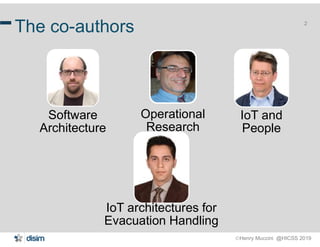
The co-authors
Software
Architecture
Operational
Research
IoT and
People
IoT architectures for
Evacuation Handling
Henry Muccini @HICSS 2019
3
Context and Research Questions
RQ1: Which are the optimal building
dimensions/structures for a safe emergency
evacuation?
RQ2: How to minimize the time to evacuate
people in a building?
Context: safe emergency
evacuation in a closed space
Henry Muccini @HICSS 2019
4
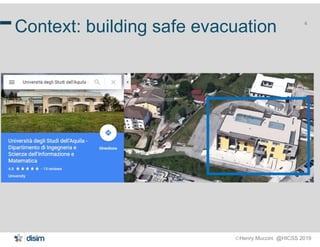
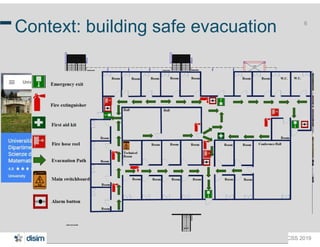
Context: building safe evacuation
Henry Muccini @HICSS 2019
5
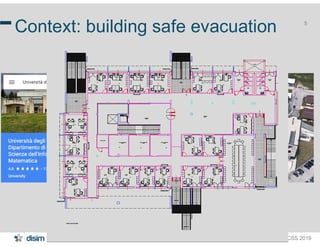
Context: building safe evacuation
Henry Muccini @HICSS 2019
6
Context: building safe evacuation
Henry Muccini @HICSS 2019
7
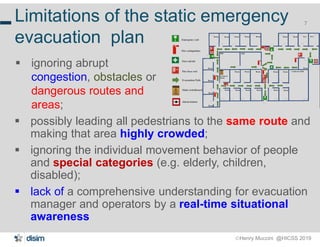
Limitations of the static emergency
evacuation plan
 possibly leading all pedestrians to the same route and
making that area highly crowded;
 ignoring the individual movement behavior of people
and special categories (e.g. elderly, children,
disabled);
 lack of a comprehensive understanding for evacuation
manager and operators by a real-time situational
awareness
 ignoring abrupt
congestion, obstacles or
dangerous routes and
areas;
Henry Muccini @HICSS 2019
8
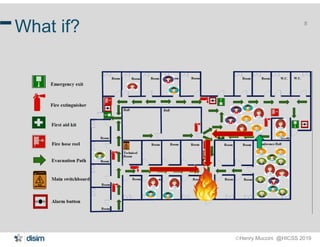
What if?
Henry Muccini @HICSS 2019
9
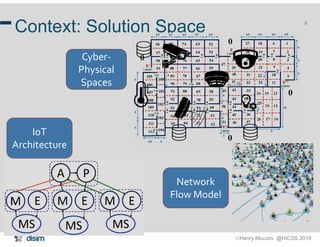
Context: Solution Space
Cyber-
Physical
Spaces
IoT
Architecture
Network
Flow Model
Henry Muccini @HICSS 2019
10
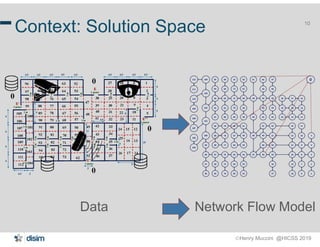
Context: Solution Space
Data Network Flow Model
Henry Muccini @HICSS 2019
11
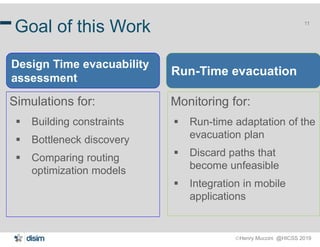
Goal of this Work
Simulations for:
 Building constraints
 Bottleneck discovery
 Comparing routing
optimization models
Monitoring for:
 Run-time adaptation of the
evacuation plan
 Discard paths that
become unfeasible
 Integration in mobile
applications
Design Time evacuability
assessment
Run-Time evacuation
Henry Muccini @HICSS 2019
12
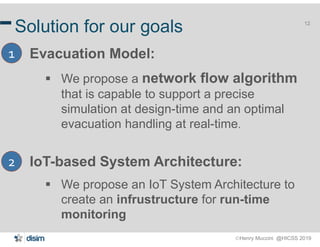
Solution for our goals
Evacuation Model:
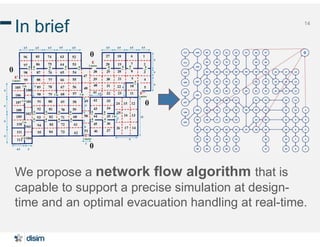
 We propose a network flow algorithm
that is capable to support a precise
simulation at design-time and an optimal
evacuation handling at real-time.
IoT-based System Architecture:
 We propose an IoT System Architecture to
create an infrustructure for run-time
monitoring
1
2
13
Evacuation Model
Network Flow Algorithm
14
In brief
We propose a network flow algorithm that is
capable to support a precise simulation at design-
time and an optimal evacuation handling at real-time.
15
Network Flow Algoritm
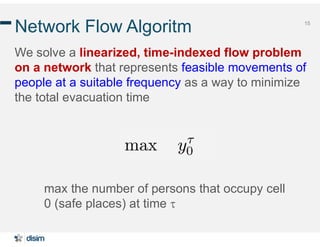
We solve a linearized, time-indexed flow problem
on a network that represents feasible movements of
people at a suitable frequency as a way to minimize
the total evacuation time
max the number of persons that occupy cell
0 (safe places) at time 
16
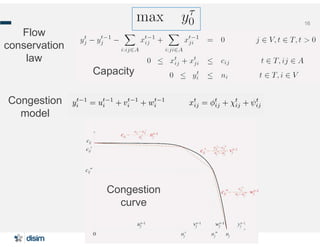
Flow
conservation
law
Capacity
Congestion
model
Congestion
curve
17
Model Construction
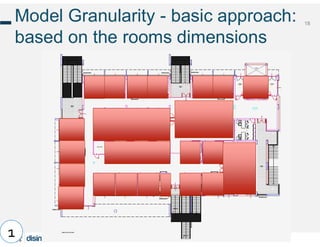
The model construction requires to explicitly
set a number of parameters:
1. Model granularity
2. Walking Velocity
3. Door capacity
4. Cell capacity
18
Model Granularity - basic approach:
based on the rooms dimensions
1
19
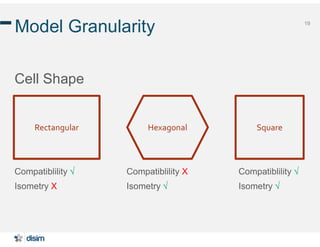
Model Granularity
Cell Shape
Compatiblility √ Compatiblility X Compatiblility √
Isometry X Isometry √ Isometry √
Rectangular Hexagonal Square
20
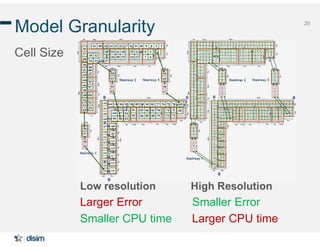
Model Granularity
Cell Size
Low resolution High Resolution
Larger Error Smaller Error
Smaller CPU time Larger CPU time
21
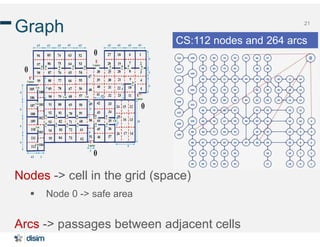
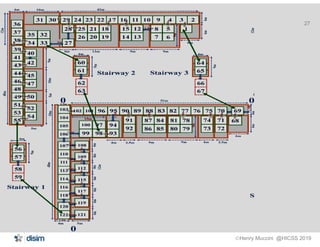
Graph
Nodes -> cell in the grid (space)
 Node 0 -> safe area
Arcs -> passages between adjacent cells
CS:112 nodes and 264 arcs
22
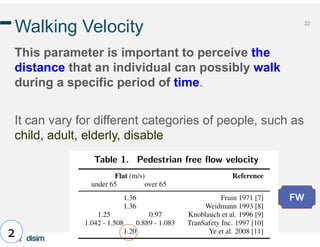
Walking Velocity
This parameter is important to perceive the
distance that an individual can possibly walk
during a specific period of time.
It can vary for different categories of people, such as
child, adult, elderly, disable
2
FW
23
Door capacity
Door capacity = how many people «p» may pass
through a door of size «d», every second «s»
Daamen et al. [12] focuses on the relationship
between door capacity, user composition and stress
level
 1.03 p/d/s - 3.23 p/d/s (d=1 meter)
 resulting from a literature review
 In our case, and since t = 5 seconds
 pessimistic – optimistic: 5 – 16 pp/d=1/s=5
3
CS: 5 – 16 pp/d=1/s=5
24
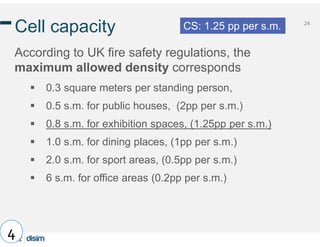
Cell capacity
According to UK fire safety regulations, the
maximum allowed density corresponds
 0.3 square meters per standing person,
 0.5 s.m. for public houses, (2pp per s.m.)
 0.8 s.m. for exhibition spaces, (1.25pp per s.m.)
 1.0 s.m. for dining places, (1pp per s.m.)
 2.0 s.m. for sport areas, (0.5pp per s.m.)
 6 s.m. for office areas (0.2pp per s.m.)
4
CS: 1.25 pp per s.m.
25
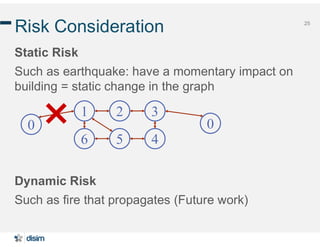
Risk Consideration
Static Risk
Such as earthquake: have a momentary impact on
building = static change in the graph
Dynamic Risk
Such as fire that propagates (Future work)
1 2 3
46 5
00
26
IoT-based System Architecture
IoT infrustructure for run-time monitoring
Henry Muccini @HICSS 2019
27
Henry Muccini @HICSS 2019
28
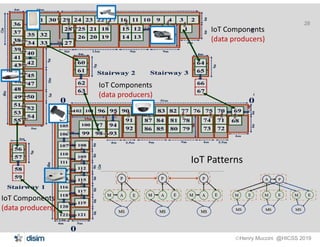
IoT Patterns
IoT Components
(data producers)
IoT Components
(data producers)
IoT Components
(data producers)
Henry Muccini @HICSS 2019
29
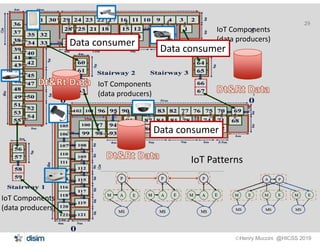
IoT Patterns
IoT Components
(data producers)
IoT Components
(data producers)
IoT Components
(data producers)
Data consumer
Data consumer
Data consumer
Henry Muccini @HICSS 2019
30
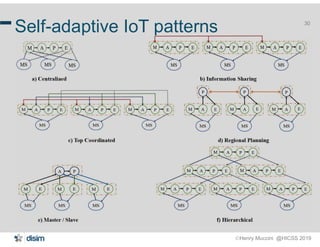
Self-adaptive IoT patterns
Henry Muccini @HICSS 2019
31
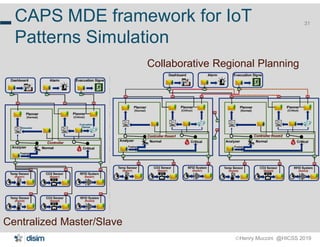
CAPS MDE framework for IoT
Patterns Simulation
Centralized Master/Slave
Collaborative Regional Planning
32
Simulation
Henry Muccini @HICSS 2019
33
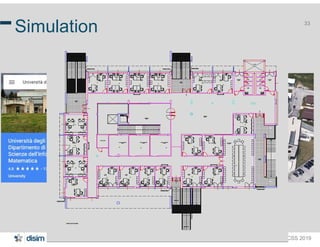
Simulation
34
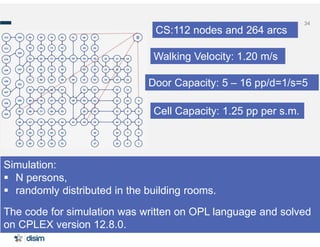
CS:112 nodes and 264 arcs
Walking Velocity: 1.20 m/s
Door Capacity: 5 – 16 pp/d=1/s=5
Cell Capacity: 1.25 pp per s.m.
Simulation:
 N persons,
 randomly distributed in the building rooms.
The code for simulation was written on OPL language and solved
on CPLEX version 12.8.0.
35
Simulated Cases
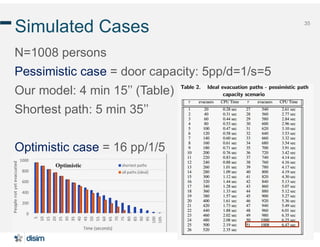
N=1008 persons
Pessimistic case = door capacity: 5pp/d=1/s=5
Our model: 4 min 15’’ (Table)
Shortest path: 5 min 35’’
Optimistic case = 16 pp/1/5
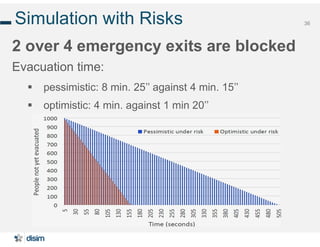
36Simulation with Risks
2 over 4 emergency exits are blocked
Evacuation time:
 pessimistic: 8 min. 25’’ against 4 min. 15’’
 optimistic: 4 min. against 1 min 20’’
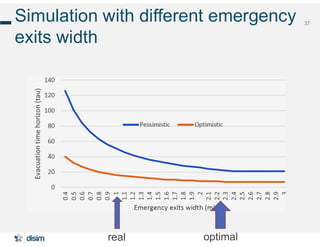
37
Simulation with different emergency
exits width
real optimal
38
Ongoing and Future Work
39
Microscopic Flow Modeling
 Based on Individuals Movements
 Reaction time, Grouping, Social Attachment
Fire propagation:
 has a nature of (run-time) arc removal
 maximize the amount of people in the safe node
Optimization/Simulation Approach
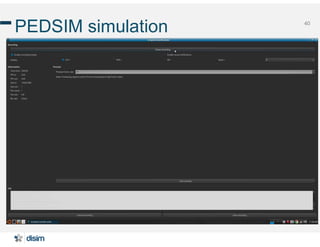
 We implemented our algo into PEDSIM
Smart City
40
PEDSIM simulation
41
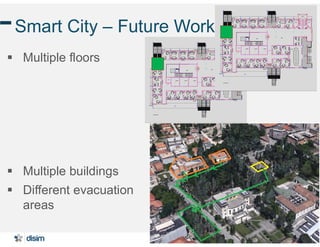
Smart City – Future Work
 Multiple floors
 Multiple buildings
 Different evacuation
areas
42
Research topic in collaboration with
An IoT Software Architecture
for an Evacuable Building
Architecture
Henry Muccini1, Claudio Arbib1, Paul Davidsson2,
Mahyar T. Moghaddam1
1 University of L’Aquila
2 Malmo University, Sweden
Slides available on my SlideShare account

An IoT Software Architecture for an Evacuable Building Architecture

  • 1.
    An IoT SoftwareArchitecture for an Evacuable Building Architecture Henry Muccini1, Claudio Arbib1, Paul Davidsson2, Mahyar T. Moghaddam1 1 University of L’Aquila 2 Malmo University, Sweden Slides available on my SlideShare account
  • 2.
    Henry Muccini @HICSS2019 2 The co-authors Software Architecture Operational Research IoT and People IoT architectures for Evacuation Handling
  • 3.
    Henry Muccini @HICSS2019 3 Context and Research Questions RQ1: Which are the optimal building dimensions/structures for a safe emergency evacuation? RQ2: How to minimize the time to evacuate people in a building? Context: safe emergency evacuation in a closed space
  • 4.
    Henry Muccini @HICSS2019 4 Context: building safe evacuation
  • 5.
    Henry Muccini @HICSS2019 5 Context: building safe evacuation
  • 6.
    Henry Muccini @HICSS2019 6 Context: building safe evacuation
  • 7.
    Henry Muccini @HICSS2019 7 Limitations of the static emergency evacuation plan  possibly leading all pedestrians to the same route and making that area highly crowded;  ignoring the individual movement behavior of people and special categories (e.g. elderly, children, disabled);  lack of a comprehensive understanding for evacuation manager and operators by a real-time situational awareness  ignoring abrupt congestion, obstacles or dangerous routes and areas;
  • 8.
    Henry Muccini @HICSS2019 8 What if?
  • 9.
    Henry Muccini @HICSS2019 9 Context: Solution Space Cyber- Physical Spaces IoT Architecture Network Flow Model
  • 10.
    Henry Muccini @HICSS2019 10 Context: Solution Space Data Network Flow Model
  • 11.
    Henry Muccini @HICSS2019 11 Goal of this Work Simulations for:  Building constraints  Bottleneck discovery  Comparing routing optimization models Monitoring for:  Run-time adaptation of the evacuation plan  Discard paths that become unfeasible  Integration in mobile applications Design Time evacuability assessment Run-Time evacuation
  • 12.
    Henry Muccini @HICSS2019 12 Solution for our goals Evacuation Model:  We propose a network flow algorithm that is capable to support a precise simulation at design-time and an optimal evacuation handling at real-time. IoT-based System Architecture:  We propose an IoT System Architecture to create an infrustructure for run-time monitoring 1 2
  • 13.
  • 14.
    14 In brief We proposea network flow algorithm that is capable to support a precise simulation at design- time and an optimal evacuation handling at real-time.
  • 15.
    15 Network Flow Algoritm Wesolve a linearized, time-indexed flow problem on a network that represents feasible movements of people at a suitable frequency as a way to minimize the total evacuation time max the number of persons that occupy cell 0 (safe places) at time 
  • 16.
  • 17.
    17 Model Construction The modelconstruction requires to explicitly set a number of parameters: 1. Model granularity 2. Walking Velocity 3. Door capacity 4. Cell capacity
  • 18.
    18 Model Granularity -basic approach: based on the rooms dimensions 1
  • 19.
    19 Model Granularity Cell Shape Compatiblility√ Compatiblility X Compatiblility √ Isometry X Isometry √ Isometry √ Rectangular Hexagonal Square
  • 20.
    20 Model Granularity Cell Size Lowresolution High Resolution Larger Error Smaller Error Smaller CPU time Larger CPU time
  • 21.
    21 Graph Nodes -> cellin the grid (space)  Node 0 -> safe area Arcs -> passages between adjacent cells CS:112 nodes and 264 arcs
  • 22.
    22 Walking Velocity This parameteris important to perceive the distance that an individual can possibly walk during a specific period of time. It can vary for different categories of people, such as child, adult, elderly, disable 2 FW
  • 23.
    23 Door capacity Door capacity= how many people «p» may pass through a door of size «d», every second «s» Daamen et al. [12] focuses on the relationship between door capacity, user composition and stress level  1.03 p/d/s - 3.23 p/d/s (d=1 meter)  resulting from a literature review  In our case, and since t = 5 seconds  pessimistic – optimistic: 5 – 16 pp/d=1/s=5 3 CS: 5 – 16 pp/d=1/s=5
  • 24.
    24 Cell capacity According toUK fire safety regulations, the maximum allowed density corresponds  0.3 square meters per standing person,  0.5 s.m. for public houses, (2pp per s.m.)  0.8 s.m. for exhibition spaces, (1.25pp per s.m.)  1.0 s.m. for dining places, (1pp per s.m.)  2.0 s.m. for sport areas, (0.5pp per s.m.)  6 s.m. for office areas (0.2pp per s.m.) 4 CS: 1.25 pp per s.m.
  • 25.
    25 Risk Consideration Static Risk Suchas earthquake: have a momentary impact on building = static change in the graph Dynamic Risk Such as fire that propagates (Future work) 1 2 3 46 5 00
  • 26.
    26 IoT-based System Architecture IoTinfrustructure for run-time monitoring
  • 27.
  • 28.
    Henry Muccini @HICSS2019 28 IoT Patterns IoT Components (data producers) IoT Components (data producers) IoT Components (data producers)
  • 29.
    Henry Muccini @HICSS2019 29 IoT Patterns IoT Components (data producers) IoT Components (data producers) IoT Components (data producers) Data consumer Data consumer Data consumer
  • 30.
    Henry Muccini @HICSS2019 30 Self-adaptive IoT patterns
  • 31.
    Henry Muccini @HICSS2019 31 CAPS MDE framework for IoT Patterns Simulation Centralized Master/Slave Collaborative Regional Planning
  • 32.
  • 33.
    Henry Muccini @HICSS2019 33 Simulation
  • 34.
    34 CS:112 nodes and264 arcs Walking Velocity: 1.20 m/s Door Capacity: 5 – 16 pp/d=1/s=5 Cell Capacity: 1.25 pp per s.m. Simulation:  N persons,  randomly distributed in the building rooms. The code for simulation was written on OPL language and solved on CPLEX version 12.8.0.
  • 35.
    35 Simulated Cases N=1008 persons Pessimisticcase = door capacity: 5pp/d=1/s=5 Our model: 4 min 15’’ (Table) Shortest path: 5 min 35’’ Optimistic case = 16 pp/1/5
  • 36.
    36Simulation with Risks 2over 4 emergency exits are blocked Evacuation time:  pessimistic: 8 min. 25’’ against 4 min. 15’’  optimistic: 4 min. against 1 min 20’’
  • 37.
    37 Simulation with differentemergency exits width real optimal
  • 38.
  • 39.
    39 Microscopic Flow Modeling Based on Individuals Movements  Reaction time, Grouping, Social Attachment Fire propagation:  has a nature of (run-time) arc removal  maximize the amount of people in the safe node Optimization/Simulation Approach  We implemented our algo into PEDSIM Smart City
  • 40.
  • 41.
    41 Smart City –Future Work  Multiple floors  Multiple buildings  Different evacuation areas
  • 42.
    42 Research topic incollaboration with
  • 43.
    An IoT SoftwareArchitecture for an Evacuable Building Architecture Henry Muccini1, Claudio Arbib1, Paul Davidsson2, Mahyar T. Moghaddam1 1 University of L’Aquila 2 Malmo University, Sweden Slides available on my SlideShare account