Human Behaviour Centred Design
Developing a Software
System for Cultural Heritage
Julie Dugdale1, Mahyar T. Moghaddam2,3, and Henry Muccini2,4
1 University Grenoble Alps, France, 2 Università degli Studi dell’Aquila, Italy
3 Inria Grenoble Rhône-Alpes, 4 nExpecto S.r.l
2
Our concern
We are concerned with the
modeling, analysis and simulation
of human (expected and real)
behavior to design our ICT
applications
3
Where does this need come
from?
4
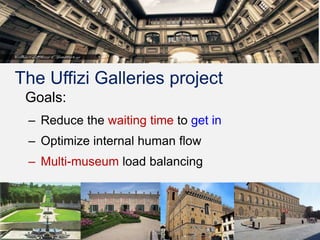
The Uffizi Galleries project
Goals:
– Reduce the waiting time to get in
– Optimize internal human flow
– Multi-museum load balancing
Henry Muccini – ICSE SEIS 2020 - Human Behaviour Centred Design: Developing a Software System for Cultural Heritage
5
Henry Muccini – ICSE SEIS 2020 - Human Behaviour Centred Design: Developing a Software System for Cultural Heritage
6
We have been called to
engineer and develop a
system to solve such a
problem
Henry Muccini – ICSE SEIS 2020 - Human Behaviour Centred Design: Developing a Software System for Cultural Heritage
7
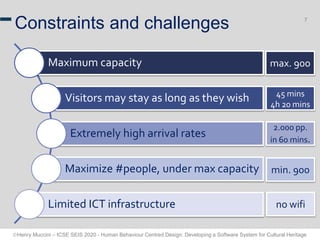
Constraints and challenges
Maximum capacity
Visitors may stay as long as they wish
Extremely high arrival rates
Maximize #people, under max capacity
Limited ICT infrastructure
max. 900
45 mins
4h 20 mins
2.000 pp.
in 60 mins.
min. 900
no wifi
8
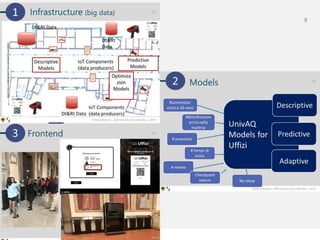
3 Components
Henry Muccini – ICSE SEIS 2020 - Human Behaviour Centred Design: Developing a Software System for Cultural Heritage
9
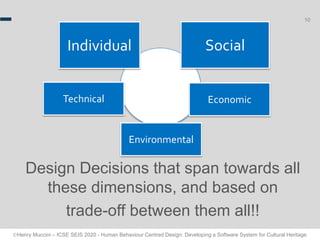
For doing so, we had to take
into serious account social,
and individual aspects,
together with technical,
economic, and more
Henry Muccini – ICSE SEIS 2020 - Human Behaviour Centred Design: Developing a Software System for Cultural Heritage
10
Design Decisions that span towards all
these dimensions, and based on
trade-off between them all!!
Individual Social
Technical
Environmental
Economic
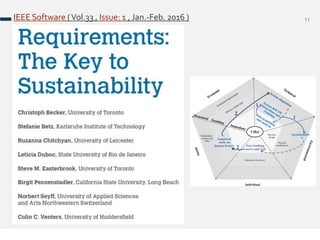
11IEEE Software (Vol.33 , Issue: 1 , Jan.-Feb. 2016 )
12
13
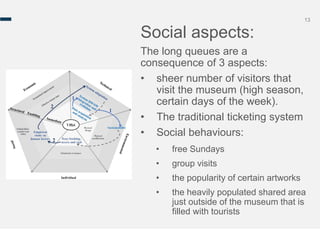
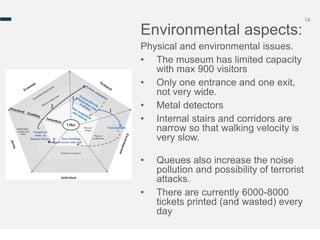
Social aspects:
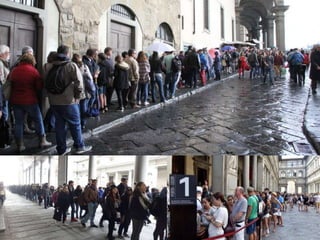
The long queues are a
consequence of 3 aspects:
• sheer number of visitors that
visit the museum (high season,
certain days of the week).
• The traditional ticketing system
• Social behaviours:
• free Sundays
• group visits
• the popularity of certain artworks
• the heavily populated shared area
just outside of the museum that is
filled with tourists
14
Environmental aspects:
Physical and environmental issues.
• The museum has limited capacity
with max 900 visitors
• Only one entrance and one exit,
not very wide.
• Metal detectors
• Internal stairs and corridors are
narrow so that walking velocity is
very slow.
• Queues also increase the noise
pollution and possibility of terrorist
attacks.
• There are currently 6000-8000
tickets printed (and wasted) every
day
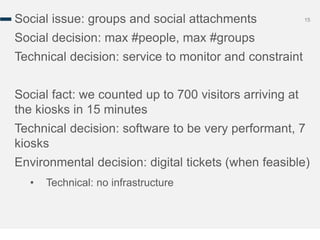
15Social issue: groups and social attachments
Social decision: max #people, max #groups
Technical decision: service to monitor and constraint
Social fact: we counted up to 700 visitors arriving at
the kiosks in 15 minutes
Technical decision: software to be very performant, 7
kiosks
Environmental decision: digital tickets (when feasible)
• Technical: no infrastructure
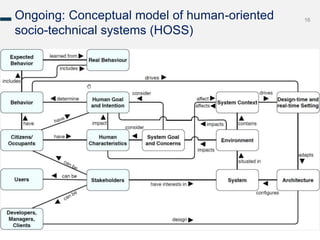
16Ongoing: Conceptual model of human-oriented
socio-technical systems (HOSS)
17
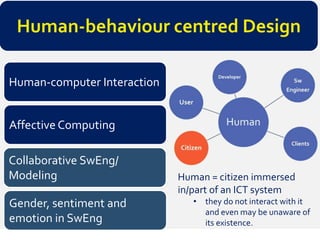
Human-behaviour centred Design
Human-computer Interaction
Gender, sentiment and
emotion in SwEng
Collaborative SwEng/
Modeling
Affective Computing
Human = citizen immersed
in/part of an ICT system
• they do not interact with it
and even may be unaware of
its existence.
Human Behaviour Centred
Design: Developing a Software
System for Cultural Heritage
Julie Dugdale1, Mahyar T. Moghaddam2,3, and Henry Muccini2,4
1 University Grenoble Alps, France, 2 Università degli Studi dell’Aquila, Italy
3 Inria Grenoble Rhône-Alpes, 4 nExpecto S.r.l
19
rappresentante Consiglio Studentesco
Antonella Nuzzaci
Adriano Filipponi
Chiara Staiti
Alessandra

Human Behaviour Centred Design

  • 1.
    Human Behaviour CentredDesign Developing a Software System for Cultural Heritage Julie Dugdale1, Mahyar T. Moghaddam2,3, and Henry Muccini2,4 1 University Grenoble Alps, France, 2 Università degli Studi dell’Aquila, Italy 3 Inria Grenoble Rhône-Alpes, 4 nExpecto S.r.l
  • 2.
    2 Our concern We areconcerned with the modeling, analysis and simulation of human (expected and real) behavior to design our ICT applications
  • 3.
    3 Where does thisneed come from?
  • 4.
    4 The Uffizi Galleriesproject Goals: – Reduce the waiting time to get in – Optimize internal human flow – Multi-museum load balancing
  • 5.
    Henry Muccini –ICSE SEIS 2020 - Human Behaviour Centred Design: Developing a Software System for Cultural Heritage 5
  • 6.
    Henry Muccini –ICSE SEIS 2020 - Human Behaviour Centred Design: Developing a Software System for Cultural Heritage 6 We have been called to engineer and develop a system to solve such a problem
  • 7.
    Henry Muccini –ICSE SEIS 2020 - Human Behaviour Centred Design: Developing a Software System for Cultural Heritage 7 Constraints and challenges Maximum capacity Visitors may stay as long as they wish Extremely high arrival rates Maximize #people, under max capacity Limited ICT infrastructure max. 900 45 mins 4h 20 mins 2.000 pp. in 60 mins. min. 900 no wifi
  • 8.
  • 9.
    Henry Muccini –ICSE SEIS 2020 - Human Behaviour Centred Design: Developing a Software System for Cultural Heritage 9 For doing so, we had to take into serious account social, and individual aspects, together with technical, economic, and more
  • 10.
    Henry Muccini –ICSE SEIS 2020 - Human Behaviour Centred Design: Developing a Software System for Cultural Heritage 10 Design Decisions that span towards all these dimensions, and based on trade-off between them all!! Individual Social Technical Environmental Economic
  • 11.
    11IEEE Software (Vol.33, Issue: 1 , Jan.-Feb. 2016 )
  • 12.
  • 13.
    13 Social aspects: The longqueues are a consequence of 3 aspects: • sheer number of visitors that visit the museum (high season, certain days of the week). • The traditional ticketing system • Social behaviours: • free Sundays • group visits • the popularity of certain artworks • the heavily populated shared area just outside of the museum that is filled with tourists
  • 14.
    14 Environmental aspects: Physical andenvironmental issues. • The museum has limited capacity with max 900 visitors • Only one entrance and one exit, not very wide. • Metal detectors • Internal stairs and corridors are narrow so that walking velocity is very slow. • Queues also increase the noise pollution and possibility of terrorist attacks. • There are currently 6000-8000 tickets printed (and wasted) every day
  • 15.
    15Social issue: groupsand social attachments Social decision: max #people, max #groups Technical decision: service to monitor and constraint Social fact: we counted up to 700 visitors arriving at the kiosks in 15 minutes Technical decision: software to be very performant, 7 kiosks Environmental decision: digital tickets (when feasible) • Technical: no infrastructure
  • 16.
    16Ongoing: Conceptual modelof human-oriented socio-technical systems (HOSS)
  • 17.
    17 Human-behaviour centred Design Human-computerInteraction Gender, sentiment and emotion in SwEng Collaborative SwEng/ Modeling Affective Computing Human = citizen immersed in/part of an ICT system • they do not interact with it and even may be unaware of its existence.
  • 18.
    Human Behaviour Centred Design:Developing a Software System for Cultural Heritage Julie Dugdale1, Mahyar T. Moghaddam2,3, and Henry Muccini2,4 1 University Grenoble Alps, France, 2 Università degli Studi dell’Aquila, Italy 3 Inria Grenoble Rhône-Alpes, 4 nExpecto S.r.l
  • 19.
    19 rappresentante Consiglio Studentesco AntonellaNuzzaci Adriano Filipponi Chiara Staiti Alessandra

Editor's Notes

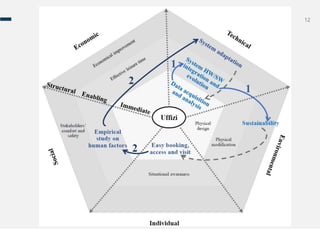
  • #12 5 dimensions The diagram supports interactive collaboration among stakeholders to discover, document, and validate the system’s potential effects. Direct: immediate opportunities and effects created by the physical existence of a system and the processes involved in its design and production. Enabling: effects arising from its application and usage. Structural: aggregate effects from wide-scale use of a system over time.
  • #18 HCI = human, input, output HCI in the mid-end ‘60s (first mouse 64) when computers became more «personal» HCI -> Interaction Design -> User Experience
  • #21 HCI = human, input, output HCI in the mid-end ‘60s (first mouse 64) when computers became more «personal» HCI -> Interaction Design -> User Experience
  • #23 Affective Computing: to bridge the gap between human emotions and computational technology. machine recognition modeling of human emotional expression, including the invention of new software tools to help people gather, communicate, and express emotional information and to better manage and understand the ways emotion impacts health, social interaction, learning, memory, and behavior.
  • #24 Book 2010 IEEE Software 2018
  • #25 2019