



Model Based Testing Tools  International Islamic University Department of Computer Science Presenters: Muhammad Husnain   &   Muhammad Waseem
Outline Introduction What is MBT How mostly MBTT Works Benefits of MBTT Problems of MBTT Current State Tools in Industry Software Tools for MBT Conclusion References
Model   Based Testing One way to generate test cases   automatically is “model-based testing” where a model of the system is used for test case generation.
Model   Based Testing “ Model-based testing is a testing technique where the  runtime behavior  of an implementation under test is  checked against  predictions made by a formal specification, or  model .” - Colin Campbell, Microsoft Research In other words: A model describes how a system should behave in response to an action. Supply the action and see if the system responds as you expect.
Models Simply, a model of software is a depiction of its behavior. Behavior can be described in terms   of the  input sequences accepted by the system,  the actions,  conditions,  output logic, or the   flow of data through the application’s modules and routines. B y  U sing  M odeling  a shareable, reusable, precise description of the system  is acquired.
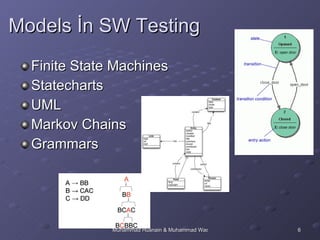
Models İn SW Testing Finite State Machines Statecharts UML Markov Chains Grammars
How Mostly MBTT Works?
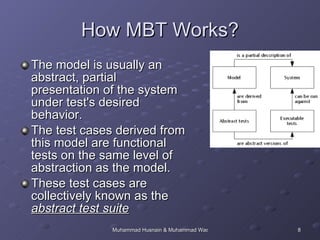
How MBT Works? The model is usually an abstract, partial presentation of the system under test's desired behavior.  The test cases derived from this model are functional tests on the same level of abstraction as the model.  These test cases are collectively known as the  abstract test suite
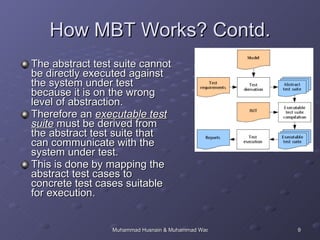
How MBT Works? Contd. The abstract test suite cannot be directly executed against the system under test because it is on the wrong level of abstraction.  Therefore an  executable test suite  must be derived from the abstract test suite that can communicate with the system under test.  This is done by mapping the abstract test cases to concrete test cases suitable for execution.
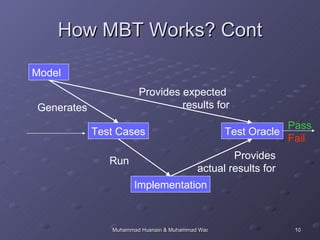
How MBT Works? Cont Model Implementation Test Oracle Test Cases Run  Provides actual results for Provides expected  results for Generates Pass Fail
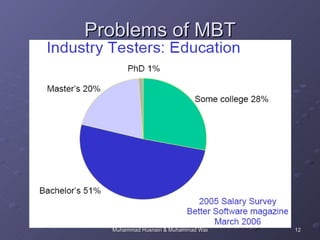
Problems of MBT
Problems of MBT
Limitations of Executable UML methodology: relative immaturity limited availability of tools lack of a concrete standard syntax for action languages.  We believe that these shortcomings will be solved as the technology matures.
Motivation behind MBTT Testing is expensive 30-50% of development costs Poor testing is VERY expensive Down time Maintenance costs Rework Law suits Model Based Testing promises Increased effectiveness of testing Similar or decreased costs Reuse of design artifacts
Benefits of MBT
Benefits of MBT Contd. Cost A typical test engineer  Earns €41 500 ($50 000 USD) per year Works 40 to 50 hours per week A typical test machine Costs €250 ($300 USD) per year to buy and operate Can work 100 hours per week
Benefits of MBT Shorter schedules, lower cost, and better quality Enhanced communication between developers and testers Early exposure of ambiguities in specification and design Capability to automatically generate many non-repetitive and useful tests Test harness to automatically run generated tests Eases the updating of test suites for changed requirements Capability to evaluate regression test suites Capability to assess software quality   These benefits all require an initial investment in tools and training.
Current State of MBT in Industry
Current State of MBT in Industry IBM Research Most projects were done by PhD Holders Very Little was successful (Just in the Lab, never actually went into market) Too Complicated to use and analyze Microsoft Research The Spec# programming system is a new attempt at a more cost effective way to develop and maintain high-quality software
Current State of MBT in Industry Spec# is a computer language which includes and extends C# Adds pre/post conditions, contracts Adds high-level data types with convenient notations Adds logical quantifiers like FORALL and EXISTS A Spec# model is just a program!  You can run it like a C# program It can call framework code You can explore it (run all of its possible behavior) which is how we do MBT with Spec#
Current State of MBT in Industry (Spec Explorer) A model exploration and testing tool for .NET:  Authoring of models in Word  Model exploration (generating FSM) FSM visualization FSM traversal and test suite generation Automatic implementation binding Online test-suite execution and offline test-suite code generation
Software Tools for MBT
Tools we are going to discuss: Conformiq Test Generator Leirios Test Generator Reactis Tester TorX AsmL MaTeLo
SpecTest TOSTER Bridge Point iUMLite Prosasim PathMATE Tools we are going to discuss:
Software Tools for MBT Conformiq Test Generator  is a model-based testing tool using  UML  state charts that represent testing strategies
Leirios  Test Generator Leirios  Test Generator  is a model-based testing tool that generates tests automatically from deterministic system specifications
Reactis Tester Reactis Tester  is another model-based testing tool that focuses on control systems  Works with MATLAB Tool downloaded AND available
AsmL AsmL Test Tool  can generate tests directly from an AsmL model
AsmL is the Abstract State Machine Language. It is an executable specification language based on the theory of  Abstract State Machines . The current version, AsmL 2 (AsmL for Microsoft .NET), is embedded into Microsoft Word and Microsoft Visual Studio.NET. It uses XML and Word for literate specifications.  It is fully interoperable with other .NET languages. AsmL generates .NET assemblies which can either be executed from the command line, linked with other .NET assemblies, or packaged as COM components.  AsmL
TOSTER TOSTER   ( T he  O bject-oriented  S oftware  T esting  Environment )   a test generation and execution system produced by the Warsaw University of Technology. It incorporates technology for mapping the information in UML diagrams to the source code of an application. It also generates and runs test cases based on expected results derived from the UML state diagrams. There appear to be two test generation algorithms, but no explicit testing directives.
SpecTest SpecTest  is an automatic test case generator from George Mason University. It accepts models written in SCR or UML, and generates test cases based on a choice of two coverage criteria, with a further two planned for implementation.
iUMLite   www.kc.com iUML Modeler that providing users with the ability to build complete and consistent executable UML models. iUML Simulator that providing users with the ability to execute, test and debug these executable UML models.
Limitations of  iUMLite  free version: Capacity restrictions are placed on the models that can be constructed and executed, specifically a maximum of: --)  3 Versions per Domain --) 15 Classes per Domain version cont……..
Documentations can only be produced in HTML format The import/export facilities for moving models and components between databases are not available. Only one user at a time may access a given database. The code generator provided can only be used for the purposes of executing the models in the iUML Simulator. It cannot be used to deliver target software. Similarly, iUMLite does not come with the iCCG Configurable Code Generation capability. The freely available copy of their tool is not capable of any code generation though. Limitations of  iUMLite  free version:
How to get License It is not greatly easy to acquire an evaluation version of this tool. In order to evaluate the software, a form has to be filled from the company’s web-site. After filling and submitting the form, the company will again enter in contact with the prospective evaluator in order to ask further questions. The license key given is tied to the serial number of the hard disk, therefore it can’t be transferred to another computer.
TestMaster TestMaster is an automated test program generator that includes a GUI development environment that is ideal for building models at both abstract and implementation dependent levels. http://www.teradyne.com/prods/sst/product_center/sstprod.html http://www.dnaent.com
MaTeLo Usage Model Editor  is a first MaTeLo module which let you create a project, design and edit a usage model of the system under test.  Testor  is the second MaTeLo module which let you automatically generate test cases by browsing the usage model and following one path or another by randomly selecting transitions according to their occurring probability. Testor finally can help you manage the test campaign and get some information about it such as coverage, system reliability or Mean Time To Failure.
What is a usage model?  A usage model represents the interactions between a system and its users. .  A MaTeLo usage model is an extended Markov chain for test and validation purposes. It’s a state diagram where a transition from a state to another is related to a system input and its activation frequency in the current state.  A chain is made of 2 specific states: Invoke and Terminate. Those states usually represent the system start and stop.  Chains can be nested, in order to get a hierarchical model.
USAGE MODEL STRUCTURE When to perform the MaTeLo model?  Ideally, the best moment to design your usage model is when you’ll have written about 2/3 of your system’s specifications.  Eventually, you can update your model just before the test campaign to ensure that your model consistency with the specification at this time.
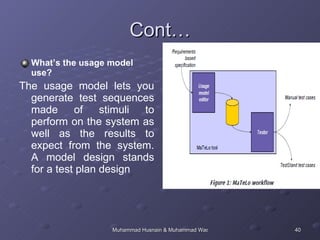
Cont… What’s the usage model use? The usage model lets you generate test sequences made of stimuli to perform on the system as well as the results to expect from the system. A model design stands for a test plan design
How to model?  The most useful entry documents for MaTeLo modeling are the system’s functional specifications. Ideally, this specification will be made of Use Cases, which will dramatically reduce the system understanding effort.  modeling should consider the main validation aims, in order to better focus on those aims. Such aims could be: reliability, performance, robustness …  A chain should not be too sequential (wrong model) and avoid redundancy.
Elementary Modeling Rules:  There can only be one transition going out the A state and entering the B state. (except for conditional transitions)  No transition should enter the Invoke state, and no transition should go out from the Terminate state.  A sub-chain respects the same design rules as the main chain.
Profiles Management   It is possible to use one or more usage profiles . Profiles make it possible to model various behaviors of SUT and thus obtain different tests according to the usage frequencies allocated to the transitions according to the selected profile.
Testor  Testor  is the second module of the MaTeLo system dedicated to the automatic generation of the Test Plans and to the Test Campaign Analysis.
Typical use of Testor  1.Use Testor to open a test project created by UM Editor.  2.  Use the first panel  to do the Model Checking and request a MC reporting, to analyze the parameters (stationary distribution, test case length and visiting probability).
Cont… 3. Use the second panel to generate a test suite. It’s possible to generate:  Most probable test suite  Random test suite  Limit test suite  Minimum test suite (only if your model does not include asynchronous or conditional elements)
Cont.. 4.  Use the third panel to enter manually or import the test execution for each system version of the SUT.  Debugging test: not described by a test suite, debugging test is a simple test like “launching the application”  Most probable test: one test for the most probable usage of the SUT Random Test (xN campaign)  Limit Test  Minimum test  Adding test: additional test, no generate by MaTeLo
Conformiq Conformiq Qtronic is a tool for both online testing of systems and for offline generation of test scripts It can use the model to directly test a running system or to generate test scripts that can be independently executed afterwards. Generated test scripts can be stored in version control system  tests can be sent to colleagues or to execute them independently
Are You Feeling Like This OK…. Let us Finish……….
Conclusion
Conclusion Modeling is not easy What details do you leave out? How do you check the model? There are no recipes for success What needs to happen Easier notation Incremental approach Pilots and examples
Questions Does tool cover stress testing? Does Tool cover how user friendly the system is or it only covers functionality? How do we guarantee that the generated expected outputs and inputs are enough and cover all the cases?  How to make for the errors and exceptions that may occur due to running the program on different environments and different OSs? How is automated generation of inputs and outputs work when an actual human interaction is required as part of the system testing?
References
References http://www.goldpractices.com/index.php http://en.wikipedia.org/wiki/Model-based_testing http://blogs.msdn.com/nihitk/articles/144664.aspx http://research.microsoft.com/specsharp/ http://react.cs.uni-sb.de/mbt2006/talks/mbt4 masses .pdf http://react.cs.uni-sb.de/mbt2006/talks/ModelBasedTestingSoberEvaluation.pdf http://aetgweb.argreenhouse.com/papers/1999-icse.pdf www.agedis.de Colin Campbell, Wolfgang Grieskamp,  Lev Nachmanson, Wolfram Schulte, Nikolai Tillmann, Margus Veanes “Spec Explorer: An Integrated Environment for Model-Based Testing.” Foundations of Software Engineering Microsoft Research, Redmond
References EXECUTABLE UML  by  Selo Sulistyo and Warsun Najib “ Towards Executable Aspect-Oriented UML models” By “Lidia Fuentes and Pablo Sánchez” ,March 12-13, 2007. http://www.eclipse.org/uml2/ http://www.magicdraw.com “ Model Driven Testing “ By Brian Berger, Majdi Abuelbassal, and Mohammad Hossain, 1997 VP-UML User’s Guide (Part 1)
Thanks

Presentation Of Mbt Tools

  • 1.
    Model Based TestingTools International Islamic University Department of Computer Science Presenters: Muhammad Husnain & Muhammad Waseem
  • 2.
    Outline Introduction Whatis MBT How mostly MBTT Works Benefits of MBTT Problems of MBTT Current State Tools in Industry Software Tools for MBT Conclusion References
  • 3.
    Model Based Testing One way to generate test cases automatically is “model-based testing” where a model of the system is used for test case generation.
  • 4.
    Model Based Testing “ Model-based testing is a testing technique where the runtime behavior of an implementation under test is checked against predictions made by a formal specification, or model .” - Colin Campbell, Microsoft Research In other words: A model describes how a system should behave in response to an action. Supply the action and see if the system responds as you expect.
  • 5.
    Models Simply, amodel of software is a depiction of its behavior. Behavior can be described in terms of the input sequences accepted by the system, the actions, conditions, output logic, or the flow of data through the application’s modules and routines. B y U sing M odeling a shareable, reusable, precise description of the system is acquired.
  • 6.
    Models İn SWTesting Finite State Machines Statecharts UML Markov Chains Grammars
  • 7.
  • 8.
    How MBT Works?The model is usually an abstract, partial presentation of the system under test's desired behavior. The test cases derived from this model are functional tests on the same level of abstraction as the model. These test cases are collectively known as the abstract test suite
  • 9.
    How MBT Works?Contd. The abstract test suite cannot be directly executed against the system under test because it is on the wrong level of abstraction. Therefore an executable test suite must be derived from the abstract test suite that can communicate with the system under test. This is done by mapping the abstract test cases to concrete test cases suitable for execution.
  • 10.
    How MBT Works?Cont Model Implementation Test Oracle Test Cases Run Provides actual results for Provides expected results for Generates Pass Fail
  • 11.
  • 12.
  • 13.
    Limitations of ExecutableUML methodology: relative immaturity limited availability of tools lack of a concrete standard syntax for action languages. We believe that these shortcomings will be solved as the technology matures.
  • 14.
    Motivation behind MBTTTesting is expensive 30-50% of development costs Poor testing is VERY expensive Down time Maintenance costs Rework Law suits Model Based Testing promises Increased effectiveness of testing Similar or decreased costs Reuse of design artifacts
  • 15.
  • 16.
    Benefits of MBTContd. Cost A typical test engineer Earns €41 500 ($50 000 USD) per year Works 40 to 50 hours per week A typical test machine Costs €250 ($300 USD) per year to buy and operate Can work 100 hours per week
  • 17.
    Benefits of MBTShorter schedules, lower cost, and better quality Enhanced communication between developers and testers Early exposure of ambiguities in specification and design Capability to automatically generate many non-repetitive and useful tests Test harness to automatically run generated tests Eases the updating of test suites for changed requirements Capability to evaluate regression test suites Capability to assess software quality   These benefits all require an initial investment in tools and training.
  • 18.
    Current State ofMBT in Industry
  • 19.
    Current State ofMBT in Industry IBM Research Most projects were done by PhD Holders Very Little was successful (Just in the Lab, never actually went into market) Too Complicated to use and analyze Microsoft Research The Spec# programming system is a new attempt at a more cost effective way to develop and maintain high-quality software
  • 20.
    Current State ofMBT in Industry Spec# is a computer language which includes and extends C# Adds pre/post conditions, contracts Adds high-level data types with convenient notations Adds logical quantifiers like FORALL and EXISTS A Spec# model is just a program! You can run it like a C# program It can call framework code You can explore it (run all of its possible behavior) which is how we do MBT with Spec#
  • 21.
    Current State ofMBT in Industry (Spec Explorer) A model exploration and testing tool for .NET: Authoring of models in Word Model exploration (generating FSM) FSM visualization FSM traversal and test suite generation Automatic implementation binding Online test-suite execution and offline test-suite code generation
  • 22.
  • 23.
    Tools we aregoing to discuss: Conformiq Test Generator Leirios Test Generator Reactis Tester TorX AsmL MaTeLo
  • 24.
    SpecTest TOSTER BridgePoint iUMLite Prosasim PathMATE Tools we are going to discuss:
  • 25.
    Software Tools forMBT Conformiq Test Generator is a model-based testing tool using UML state charts that represent testing strategies
  • 26.
    Leirios TestGenerator Leirios Test Generator is a model-based testing tool that generates tests automatically from deterministic system specifications
  • 27.
    Reactis Tester ReactisTester is another model-based testing tool that focuses on control systems Works with MATLAB Tool downloaded AND available
  • 28.
    AsmL AsmL TestTool can generate tests directly from an AsmL model
  • 29.
    AsmL is theAbstract State Machine Language. It is an executable specification language based on the theory of Abstract State Machines . The current version, AsmL 2 (AsmL for Microsoft .NET), is embedded into Microsoft Word and Microsoft Visual Studio.NET. It uses XML and Word for literate specifications. It is fully interoperable with other .NET languages. AsmL generates .NET assemblies which can either be executed from the command line, linked with other .NET assemblies, or packaged as COM components. AsmL
  • 30.
    TOSTER TOSTER ( T he O bject-oriented S oftware T esting Environment ) a test generation and execution system produced by the Warsaw University of Technology. It incorporates technology for mapping the information in UML diagrams to the source code of an application. It also generates and runs test cases based on expected results derived from the UML state diagrams. There appear to be two test generation algorithms, but no explicit testing directives.
  • 31.
    SpecTest SpecTest is an automatic test case generator from George Mason University. It accepts models written in SCR or UML, and generates test cases based on a choice of two coverage criteria, with a further two planned for implementation.
  • 32.
    iUMLite www.kc.com iUML Modeler that providing users with the ability to build complete and consistent executable UML models. iUML Simulator that providing users with the ability to execute, test and debug these executable UML models.
  • 33.
    Limitations of iUMLite free version: Capacity restrictions are placed on the models that can be constructed and executed, specifically a maximum of: --) 3 Versions per Domain --) 15 Classes per Domain version cont……..
  • 34.
    Documentations can onlybe produced in HTML format The import/export facilities for moving models and components between databases are not available. Only one user at a time may access a given database. The code generator provided can only be used for the purposes of executing the models in the iUML Simulator. It cannot be used to deliver target software. Similarly, iUMLite does not come with the iCCG Configurable Code Generation capability. The freely available copy of their tool is not capable of any code generation though. Limitations of iUMLite free version:
  • 35.
    How to getLicense It is not greatly easy to acquire an evaluation version of this tool. In order to evaluate the software, a form has to be filled from the company’s web-site. After filling and submitting the form, the company will again enter in contact with the prospective evaluator in order to ask further questions. The license key given is tied to the serial number of the hard disk, therefore it can’t be transferred to another computer.
  • 36.
    TestMaster TestMaster isan automated test program generator that includes a GUI development environment that is ideal for building models at both abstract and implementation dependent levels. http://www.teradyne.com/prods/sst/product_center/sstprod.html http://www.dnaent.com
  • 37.
    MaTeLo Usage ModelEditor is a first MaTeLo module which let you create a project, design and edit a usage model of the system under test. Testor is the second MaTeLo module which let you automatically generate test cases by browsing the usage model and following one path or another by randomly selecting transitions according to their occurring probability. Testor finally can help you manage the test campaign and get some information about it such as coverage, system reliability or Mean Time To Failure.
  • 38.
    What is ausage model? A usage model represents the interactions between a system and its users. . A MaTeLo usage model is an extended Markov chain for test and validation purposes. It’s a state diagram where a transition from a state to another is related to a system input and its activation frequency in the current state. A chain is made of 2 specific states: Invoke and Terminate. Those states usually represent the system start and stop. Chains can be nested, in order to get a hierarchical model.
  • 39.
    USAGE MODEL STRUCTUREWhen to perform the MaTeLo model? Ideally, the best moment to design your usage model is when you’ll have written about 2/3 of your system’s specifications. Eventually, you can update your model just before the test campaign to ensure that your model consistency with the specification at this time.
  • 40.
    Cont… What’s theusage model use? The usage model lets you generate test sequences made of stimuli to perform on the system as well as the results to expect from the system. A model design stands for a test plan design
  • 41.
    How to model? The most useful entry documents for MaTeLo modeling are the system’s functional specifications. Ideally, this specification will be made of Use Cases, which will dramatically reduce the system understanding effort. modeling should consider the main validation aims, in order to better focus on those aims. Such aims could be: reliability, performance, robustness … A chain should not be too sequential (wrong model) and avoid redundancy.
  • 42.
    Elementary Modeling Rules: There can only be one transition going out the A state and entering the B state. (except for conditional transitions) No transition should enter the Invoke state, and no transition should go out from the Terminate state. A sub-chain respects the same design rules as the main chain.
  • 43.
    Profiles Management It is possible to use one or more usage profiles . Profiles make it possible to model various behaviors of SUT and thus obtain different tests according to the usage frequencies allocated to the transitions according to the selected profile.
  • 44.
    Testor Testor is the second module of the MaTeLo system dedicated to the automatic generation of the Test Plans and to the Test Campaign Analysis.
  • 45.
    Typical use ofTestor 1.Use Testor to open a test project created by UM Editor. 2. Use the first panel to do the Model Checking and request a MC reporting, to analyze the parameters (stationary distribution, test case length and visiting probability).
  • 46.
    Cont… 3. Usethe second panel to generate a test suite. It’s possible to generate: Most probable test suite Random test suite Limit test suite Minimum test suite (only if your model does not include asynchronous or conditional elements)
  • 47.
    Cont.. 4. Use the third panel to enter manually or import the test execution for each system version of the SUT. Debugging test: not described by a test suite, debugging test is a simple test like “launching the application” Most probable test: one test for the most probable usage of the SUT Random Test (xN campaign) Limit Test Minimum test Adding test: additional test, no generate by MaTeLo
  • 48.
    Conformiq Conformiq Qtronicis a tool for both online testing of systems and for offline generation of test scripts It can use the model to directly test a running system or to generate test scripts that can be independently executed afterwards. Generated test scripts can be stored in version control system tests can be sent to colleagues or to execute them independently
  • 49.
    Are You FeelingLike This OK…. Let us Finish……….
  • 50.
  • 51.
    Conclusion Modeling isnot easy What details do you leave out? How do you check the model? There are no recipes for success What needs to happen Easier notation Incremental approach Pilots and examples
  • 52.
    Questions Does toolcover stress testing? Does Tool cover how user friendly the system is or it only covers functionality? How do we guarantee that the generated expected outputs and inputs are enough and cover all the cases? How to make for the errors and exceptions that may occur due to running the program on different environments and different OSs? How is automated generation of inputs and outputs work when an actual human interaction is required as part of the system testing?
  • 53.
  • 54.
    References http://www.goldpractices.com/index.php http://en.wikipedia.org/wiki/Model-based_testinghttp://blogs.msdn.com/nihitk/articles/144664.aspx http://research.microsoft.com/specsharp/ http://react.cs.uni-sb.de/mbt2006/talks/mbt4 masses .pdf http://react.cs.uni-sb.de/mbt2006/talks/ModelBasedTestingSoberEvaluation.pdf http://aetgweb.argreenhouse.com/papers/1999-icse.pdf www.agedis.de Colin Campbell, Wolfgang Grieskamp, Lev Nachmanson, Wolfram Schulte, Nikolai Tillmann, Margus Veanes “Spec Explorer: An Integrated Environment for Model-Based Testing.” Foundations of Software Engineering Microsoft Research, Redmond
  • 55.
    References EXECUTABLE UML by Selo Sulistyo and Warsun Najib “ Towards Executable Aspect-Oriented UML models” By “Lidia Fuentes and Pablo Sánchez” ,March 12-13, 2007. http://www.eclipse.org/uml2/ http://www.magicdraw.com “ Model Driven Testing “ By Brian Berger, Majdi Abuelbassal, and Mohammad Hossain, 1997 VP-UML User’s Guide (Part 1)
  • 56.

Editor's Notes

  • #10 An example of a model-based testing workflow. IXIT refers to "implementation extra information" and denotes here the total package of information that is needed when the abstract test suite is converted into an executable one. Typically it includes information about test harness, data mappings and SUT configuration.