Model-based Testing:
Taking BDD/ATDD to the Next Level
Robert V. Binder
System Verification Associates
rvbinder@sysverif.com
#MoreModelsLessTests

Chicago Quality Assurance Association
February 25, 2014
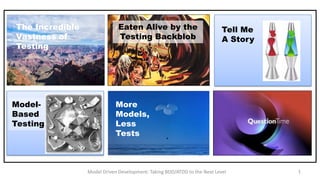
The Incredible
Vastness of
Testing

ModelBased
Testing

Eaten Alive by the
Testing Backblob

Tell Me
A Story

More Models,
More Tests
Less
Models,
Less
Tests

Model Driven Development: Taking BDD/ATDD to the Next Level

1
The Incredible
Vastness of Testing
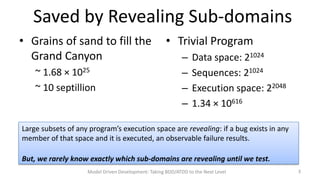
Saved by Revealing Sub-domains
• Grains of sand to fill the
Grand Canyon
~ 1.68 × 1025
~ 10 septillion

• Trivial Program
–
–
–
–

Data space: 21024
Sequences: 21024
Execution space: 22048
1.34 × 10616

Large subsets of any program’s execution space are revealing: if a bug exists in any
member of that space and it is executed, an observable failure results.

But, we rarely know exactly which sub-domains are revealing until we test.
Model Driven Development: Taking BDD/ATDD to the Next Level

3
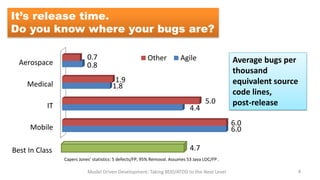
It’s release time.
Do you know where your bugs are?
Aerospace
Medical

IT

0.7
0.8

Other

Agile

1.9
1.8
4.4

5.0

6.0
6.0

Mobile
Best In Class

Average bugs per
thousand
equivalent source
code lines,
post-release

4.7
Capers Jones’ statistics: 5 defects/FP, 95% Removal. Assumes 53 Java LOC/FP .
Model Driven Development: Taking BDD/ATDD to the Next Level

4
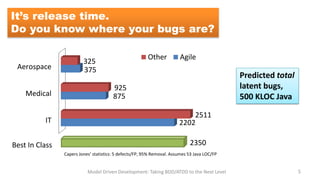
It’s release time.
Do you know where your bugs are?

Aerospace
Medical
IT

Best In Class

Other

325
375

Agile

Predicted total
latent bugs,
500 KLOC Java

925
875
2511
2202

2350
Capers Jones’ statistics: 5 defects/FP, 95% Removal. Assumes 53 Java LOC/FP
Model Driven Development: Taking BDD/ATDD to the Next Level

5
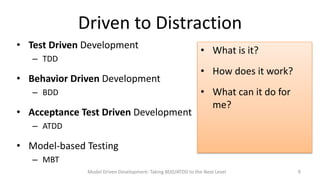
Driven to Distraction
• Test Driven Development
– TDD

• Behavior Driven Development
– BDD

• Acceptance Test Driven Development

• What is it?
• How does it work?
• What can it do for
me?

– ATDD

• Model-based Testing
– MBT
Model Driven Development: Taking BDD/ATDD to the Next Level

6
Eaten Alive
by the
Testing
Backblob
EATEN ALIVE BY THE TESTING
BACKBLOB
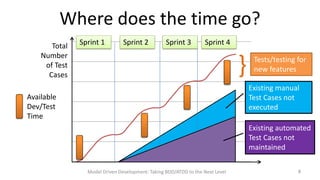
Where does the time go?
Total
Number
of Test
Cases

Sprint 1

Sprint 2

Sprint 3

Sprint 4

}

Tests/testing for
new features
Existing manual
Test Cases not
executed

Available
Dev/Test
Time

Existing automated
Test Cases not
maintained
Model Driven Development: Taking BDD/ATDD to the Next Level

8
The Attack of the BackBlob

http://www.youtube.com/watch?v=GODDLgM1gKo
Tell Me a Story

TELL ME A STORY
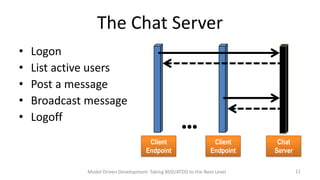
The Chat Server
•
•
•
•
•

Logon
List active users
Post a message
Broadcast message
Logoff

!!!
Client
Endpoint

Client
Endpoint

Model Driven Development: Taking BDD/ATDD to the Next Level

Chat
Server
11
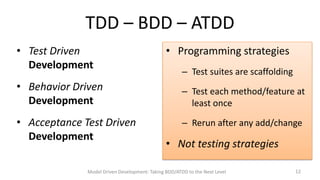
TDD – BDD – ATDD
• Test Driven
Development

• Behavior Driven
Development
• Acceptance Test Driven
Development

• Programming strategies
– Test suites are scaffolding
– Test each method/feature at
least once

– Rerun after any add/change

• Not testing strategies

Model Driven Development: Taking BDD/ATDD to the Next Level

12
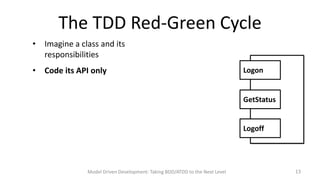
The TDD Red-Green Cycle
• Imagine a class and its
responsibilities
• Code its API only

Logon
Logon

GetStatus
GetStatus

Logoff
Logoff

Model Driven Development: Taking BDD/ATDD to the Next Level

13
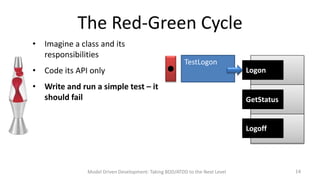
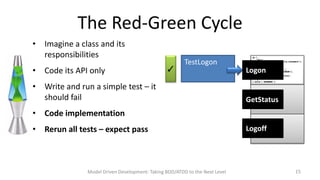
The Red-Green Cycle
• Imagine a class and its
responsibilities
• Code its API only



TestLogon

• Write and run a simple test – it
should fail

Logon

GetStatus

Logoff

Model Driven Development: Taking BDD/ATDD to the Next Level

14
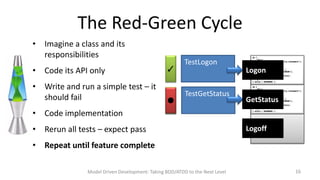
The Red-Green Cycle
• Imagine a class and its
responsibilities
• Code its API only



TestLogon

• Write and run a simple test – it
should fail

Logon

GetStatus

• Code implementation
• Rerun all tests – expect pass

Model Driven Development: Taking BDD/ATDD to the Next Level

Logoff

15
The Red-Green Cycle
• Imagine a class and its
responsibilities
• Code its API only
• Write and run a simple test – it
should fail






TestLogon
Logon
TestGetStatus

GetStatus

• Code implementation
• Rerun all tests – expect pass

Logoff

• Repeat until feature complete
Model Driven Development: Taking BDD/ATDD to the Next Level

16
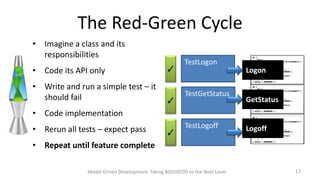
The Red-Green Cycle
• Imagine a class and its
responsibilities
• Code its API only
• Write and run a simple test – it
should fail





TestLogon
Logon
TestGetStatus

GetStatus

• Code implementation
• Rerun all tests – expect pass




TestLogoff

Logoff

• Repeat until feature complete
Model Driven Development: Taking BDD/ATDD to the Next Level

17
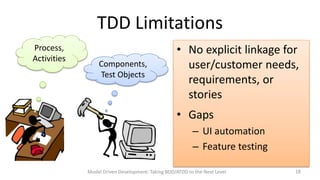
TDD Limitations
Process,
Activities

Components,
Test Objects

• No explicit linkage for
user/customer needs,
requirements, or
stories

• Gaps
– UI automation
– Feature testing
Model Driven Development: Taking BDD/ATDD to the Next Level

18
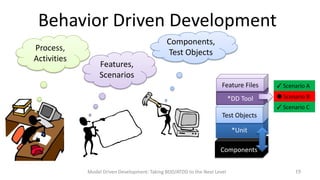
Behavior Driven Development
Process,
Activities

Components,
Test Objects
Features,
Scenarios
Feature Files

 Scenario A

*DD Tool

 Scenario B
 Scenario C

Test Objects
*Unit
Components
Model Driven Development: Taking BDD/ATDD to the Next Level

19
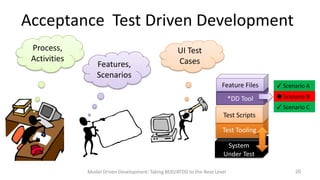
Acceptance Test Driven Development
Process,
Activities

Features,
Scenarios

UI Test
Cases
Feature Files

 Scenario A

*DD Tool

 Scenario B
 Scenario C

Test Scripts
Test Objects
Test Tooling
*Unit
System
Under Test
Model Driven Development: Taking BDD/ATDD to the Next Level

20
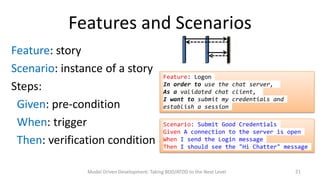
Features and Scenarios
Feature: story
Scenario: instance of a story
Steps:
Given: pre-condition
When: trigger
Then: verification condition

Feature: Logon
In order to use the chat server,
As a validated chat client,
I want to submit my credentials and
establish a session
Scenario: Submit Good
Given A connection to
When I send the Login
Then I should see the

Model Driven Development: Taking BDD/ATDD to the Next Level

Credentials
the server is open
message
"Hi Chatter" message

21
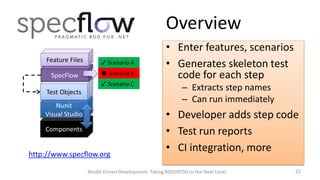
Overview
Feature Files

 Scenario A

SpecFlow

 Scenario B
 Scenario C

Test Objects
Nunit
Visual Studio
Components

http://www.specflow.org

• Enter features, scenarios
• Generates skeleton test
code for each step
– Extracts step names
– Can run immediately

• Developer adds step code
• Test run reports
• CI integration, more

Model Driven Development: Taking BDD/ATDD to the Next Level

22
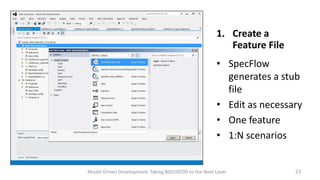
1. Create a
Feature File
• SpecFlow
generates a stub
file
• Edit as necessary
• One feature
• 1:N scenarios

Model Driven Development: Taking BDD/ATDD to the Next Level

23
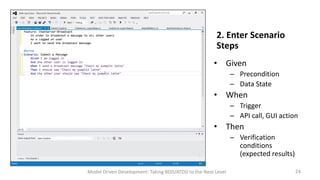
2. Enter Scenario
Steps
• Given
– Precondition
– Data State

• When
– Trigger
– API call, GUI action

• Then
– Verification
conditions
(expected results)
Model Driven Development: Taking BDD/ATDD to the Next Level

24
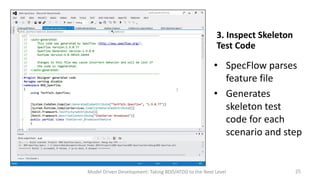
3. Inspect Skeleton
Test Code

• SpecFlow parses
feature file
• Generates
skeleton test
code for each
scenario and step

Model Driven Development: Taking BDD/ATDD to the Next Level

25
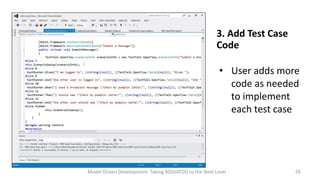
3. Add Test Case
Code
• User adds more
code as needed
to implement
each test case

Model Driven Development: Taking BDD/ATDD to the Next Level

26
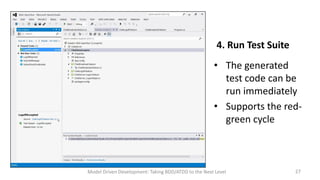
4. Run Test Suite
• The generated
test code can be
run immediately
• Supports the redgreen cycle

Model Driven Development: Taking BDD/ATDD to the Next Level

27
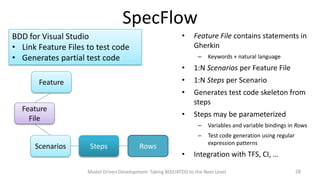
SpecFlow
•

BDD for Visual Studio
• Link Feature Files to test code
• Generates partial test code

Feature File contains statements in
Gherkin
–

Keywords + natural language

•
•

Generates test code skeleton from
steps

•

Feature
File

1:N Steps per Scenario

•

Feature

1:N Scenarios per Feature File

Steps may be parameterized

Steps

Rows

•

Variables and variable bindings in Rows

–

Scenarios

–

Test code generation using regular
expression patterns

Integration with TFS, CI, …

Model Driven Development: Taking BDD/ATDD to the Next Level

28
Modelbased
Testing
THE VERY MODEL OF A MODERN …
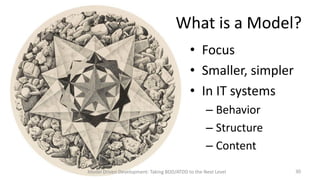
What is a Model?
• Focus
• Smaller, simpler
• In IT systems
– Behavior
– Structure
– Content
Model Driven Development: Taking BDD/ATDD to the Next Level

30
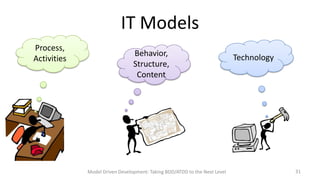
IT Models
Process,
Activities

Behavior,
Structure,
Content

Model Driven Development: Taking BDD/ATDD to the Next Level

Technology

31
IT Models
• Notional (design)
• As built (documentation)
• Test Models
– Similar to notional and as-built
– Unique aspects
Test Models
• Focus on aspects that
support testing goals
• Behavior
– Sequence and time

• Transformation
– Input, output function

• Verification (oracle)
• Coverage

• Risk Management
Model Driven Development: Taking BDD/ATDD to the Next Level

33
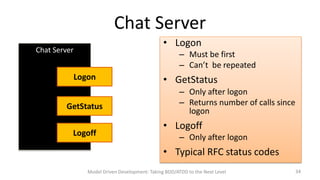
Chat Server
• Logon

Chat Server

– Must be first
– Can’t be repeated

Logon
GetStatus
Logoff

• GetStatus
– Only after logon
– Returns number of calls since
logon

• Logoff
– Only after logon

• Typical RFC status codes
Model Driven Development: Taking BDD/ATDD to the Next Level

34
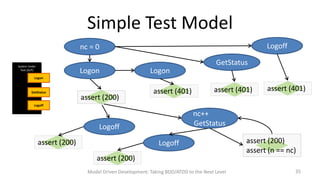
Simple Test Model
Logoff

nc = 0
GetStatus

System Under
Test (SUT)

Logon

Logon

Logon

GetStatus

assert (200)

assert (401)

assert (401)

assert (401)

Logoff

nc++
GetStatus

Logoff
assert (200)

Logoff
assert (200)
Model Driven Development: Taking BDD/ATDD to the Next Level

assert (200)
assert (n == nc)
35
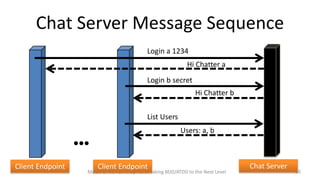
Chat Server Message Sequence
Login a 1234
Hi Chatter a
Login b secret
Hi Chatter b
List Users
Users: a, b
!!!
Client Endpoint

Client Endpoint

Model Driven Development: Taking BDD/ATDD to the Next Level

Chat Server

36
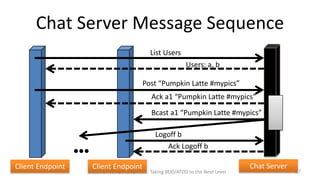
Chat Server Message Sequence
List Users
Users: a, b
Post “Pumpkin Latte #mypics”
Ack a1 “Pumpkin Latte #mypics”

Bcast a1 “Pumpkin Latte #mypics”
Logoff b
Ack Logoff b

!!!
Client Endpoint

Client Endpoint

Model Driven Development: Taking BDD/ATDD to the Next Level

Chat Server

37
Spec Explorer Demo
• Model-based testing tool
– Microsoft Research

– Used to test all MSFT APIs
– Robust and stable
– Visual Studio “power tool”

• C# code, not cartoons
• Generates standalone
executable test suite
Model Driven Development: Taking BDD/ATDD to the Next Level

38
1. Create Test
Model Actions
• [Rule] tags a
method for
exploration
• Requires defines
a exploration
precondition –
must be true to
explore
Model Driven Development: Taking BDD/ATDD to the Next Level

39
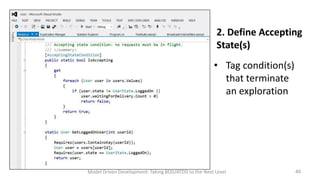
2. Define Accepting
State(s)
• Tag condition(s)
that terminate
an exploration

Model Driven Development: Taking BDD/ATDD to the Next Level

40
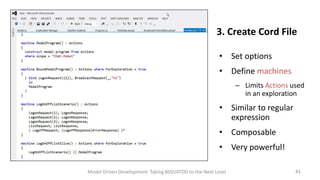
3. Create Cord File
• Set options
• Define machines
– Limits Actions used
in an exploration

• Similar to regular
expression
• Composable
• Very powerful!
Model Driven Development: Taking BDD/ATDD to the Next Level

41
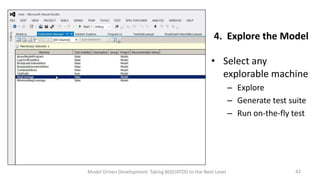
4. Explore the Model
• Select any
explorable machine
– Explore
– Generate test suite
– Run on-the-fly test

Model Driven Development: Taking BDD/ATDD to the Next Level

42
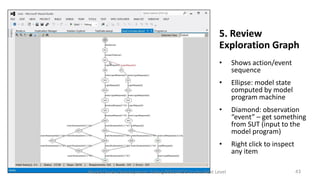
5. Review
Exploration Graph
•

Shows action/event
sequence

•

Ellipse: model state
computed by model
program machine

•

Diamond: observation
“event” – get something
from SUT (input to the
model program)

•

Right click to inspect
any item

Model Driven Development: Taking BDD/ATDD to the Next Level

43
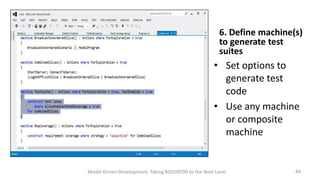
6. Define machine(s)
to generate test
suites

• Set options to
generate test
code
• Use any machine
or composite
machine

Model Driven Development: Taking BDD/ATDD to the Next Level

44
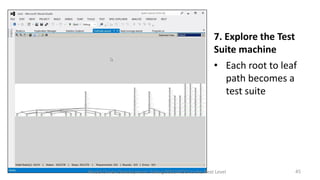
7. Explore the Test
Suite machine
• Each root to leaf
path becomes a
test suite

Model Driven Development: Taking BDD/ATDD to the Next Level

45
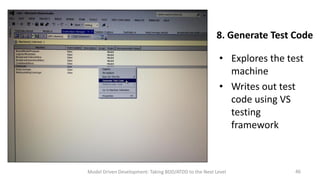
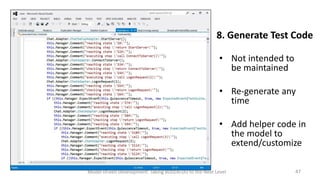
8. Generate Test Code
• Explores the test
machine
• Writes out test
code using VS
testing
framework

Model Driven Development: Taking BDD/ATDD to the Next Level

46
8. Generate Test Code
• Not intended to
be maintained
• Re-generate any
time
• Add helper code in
the model to
extend/customize
Model Driven Development: Taking BDD/ATDD to the Next Level

47
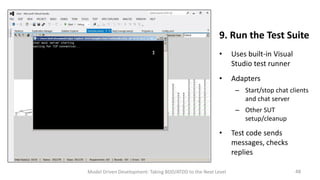
9. Run the Test Suite
•

Uses built-in Visual
Studio test runner

•

Adapters
– Start/stop chat clients
and chat server

– Other SUT
setup/cleanup

•

Model Driven Development: Taking BDD/ATDD to the Next Level

Test code sends
messages, checks
replies
48
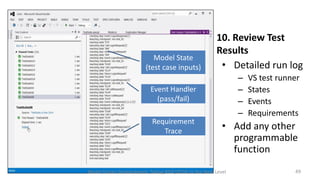
Model State
(test case inputs)

10. Review Test
Results
• Detailed run log
–
–
–
–

Event Handler
(pass/fail)
Requirement
Trace

VS test runner
States
Events
Requirements

• Add any other
programmable
function

Model Driven Development: Taking BDD/ATDD to the Next Level

49
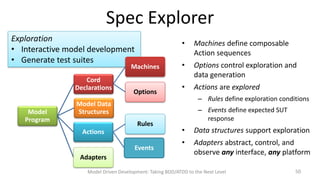
Spec Explorer
Exploration
• Interactive model development
• Generate test suites

•

Machines

Cord
Declarations
Model
Program

Options

Machines define composable
Action sequences

•

Options control exploration and
data generation

•

Actions are explored
– Rules define exploration conditions

Model Data
Structures

Rules
Actions
Events
Adapters

– Events define expected SUT
response

•

Data structures support exploration

•

Adapters abstract, control, and
observe any interface, any platform

Model Driven Development: Taking BDD/ATDD to the Next Level

50
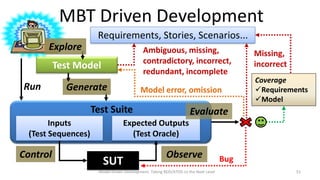
MBT Driven Development
Requirements, Stories, Scenarios...
Explore

Ambiguous, missing,
contradictory, incorrect,
redundant, incomplete

Test Model
Run

Generate

Model error, omission

Test Suite
Inputs
(Test Sequences)

Control

Missing,
incorrect
Coverage
Requirements
Model

Evaluate

Expected Outputs
(Test Oracle)

SUT

Observe

Model Driven Development: Taking BDD/ATDD to the Next Level

Bug
51
More Models, Less Tests

MORE MODELS, LESS TESTS
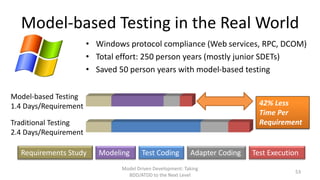
Model-based Testing in the Real World
• Windows protocol compliance (Web services, RPC, DCOM)
• Total effort: 250 person years (mostly junior SDETs)
• Saved 50 person years with model-based testing
Model-based Testing
1.4 Days/Requirement

42% Less
Time Per
Requirement

Traditional Testing
2.4 Days/Requirement
Requirements Study

Modeling

Test Coding

Adapter Coding

Model Driven Development: Taking
BDD/ATDD to the Next Level

Test Execution
53
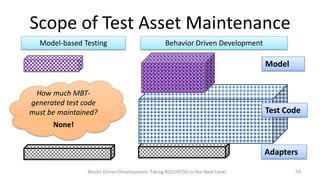
Scope of Test Asset Maintenance
Model-based Testing

Behavior Driven Development

Model
How much MBTgenerated test code
must be maintained?

Test Code

None!

Adapters
Model Driven Development: Taking BDD/ATDD to the Next Level

54
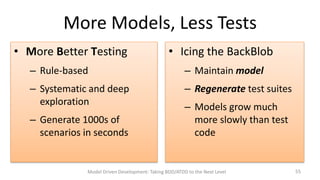
More Models, Less Tests
• More Better Testing

• Icing the BackBlob

– Rule-based

– Maintain model

– Systematic and deep
exploration

– Regenerate test suites

– Generate 1000s of
scenarios in seconds

– Models grow much
more slowly than test
code

Model Driven Development: Taking BDD/ATDD to the Next Level

55
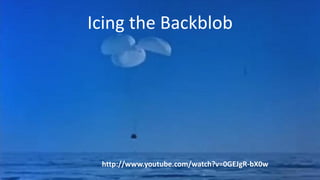
Icing the Backblob

http://www.youtube.com/watch?v=0GEJgR-bX0w
Q&A
#MoreModelsLessTests
rvbinder@sysverif.com

Model Driven Development: Taking BDD/ATDD to the Next Level

57
Learn More - MBT
•

UCCAT (User Conference on Advanced Automated Testing) Presentations

http://ucaat.etsi.org/2013/program_conf.html
•

2012 Model-based Testing User Survey

http://robertvbinder.com/wp-content/uploads/rvb-pdf/arts/MBT-User-Survey.pdf
•

Open Source MBT tools

http://www.robertvbinder.com/open-source-tools-for-model-based-testing/
•

Overview of MBT, list of commercial MBT tools

http://www.slideshare.net/robertvbinder/model-basedtestingignite
•

Spec Explorer

http://visualstudiogallery.msdn.microsoft.com/271d0904-f178-4ce9-956b-d9bfa4902745
http://msdn.microsoft.com/library/ee620411.aspx

•

Microsoft Open Protocol Project

http://cacm.acm.org/magazines/2011/7/109908-microsofts-protocol-documentation-program/fulltext#!
Model Driven Development: Taking
BDD/ATDD to the Next Level

58
Learn More: BDD, etc.
•

SpecFlow

http://www.specflow.org/
•

Using SpecFlow with WatiN

http://msdn.microsoft.com/en-us/magazine/gg490346.aspx
•

SpecFlow Quick Start

http://www.youtube.com/watch?v=SVwBz-ZTliw
•

Writing Cucumber Feature Files

https://github.com/cucumber/cucumber/wiki
•

Using Lava Lamps to indicate Build Status

https://wiki.jenkins-ci.org/display/JENKINS/Hudson+Build+Status+Lava+Lamps

Model Driven Development: Taking
BDD/ATDD to the Next Level

59
Content and Image Sources
Grand Canyon Time Lapse. Ezra Kamer
http://www.youtube.com/watch?v=NF6O6HuNJ0k

Contrast (Order and Chaos). M. C. Escher, 1950. National Gallery of
Canada
http://www.gallery.ca/en/see/collections/artwork.php?mkey=29270

The Blob, Theatre Scene. Fairview Productions, 1958.
http://www.youtube.com/watch?v=GODDLgM1gKo
http://www.imdb.com/title/tt0051418/

Order and Chaos II. M. C. Escher, 1955. National Gallery of Canada
http://www.gallery.ca/en/see/collections/artwork.php?mkey=41980

Defect densities:
• Capers Jones, Software Quality: Analysis and Guidelines for Success
• Robert E. Park. Software Size Measurement: A Framework for
Counting Source Statements. Technical Report CMU/SEI-92-TR-020.
Software Engineering Institute, Carnegie Mellon University

Spec Explorer. Microsoft
http://visualstudiogallery.msdn.microsoft.com/271d0904-f178-4ce9956b-d9bfa4902745

SpecFlow
http://www.specflow.org/

The Blob, Final Scene. Fairview Productions, 1958.
http://www.youtube.com/watch?v=0GEJgR-bX0w

Spec Explorer Chat Model. Microsoft.

All other content Copyright © Robert V. Binder, 2014.

Model Driven Development: Taking BDD/ATDD to the Next Level

60

Model-based Testing: Taking BDD/ATDD to the Next Level

  • 1.
    Model-based Testing: Taking BDD/ATDDto the Next Level Robert V. Binder System Verification Associates rvbinder@sysverif.com #MoreModelsLessTests Chicago Quality Assurance Association February 25, 2014
  • 2.
    The Incredible Vastness of Testing ModelBased Testing EatenAlive by the Testing Backblob Tell Me A Story More Models, More Tests Less Models, Less Tests Model Driven Development: Taking BDD/ATDD to the Next Level 1
  • 3.
  • 4.
    Saved by RevealingSub-domains • Grains of sand to fill the Grand Canyon ~ 1.68 × 1025 ~ 10 septillion • Trivial Program – – – – Data space: 21024 Sequences: 21024 Execution space: 22048 1.34 × 10616 Large subsets of any program’s execution space are revealing: if a bug exists in any member of that space and it is executed, an observable failure results. But, we rarely know exactly which sub-domains are revealing until we test. Model Driven Development: Taking BDD/ATDD to the Next Level 3
  • 5.
    It’s release time. Doyou know where your bugs are? Aerospace Medical IT 0.7 0.8 Other Agile 1.9 1.8 4.4 5.0 6.0 6.0 Mobile Best In Class Average bugs per thousand equivalent source code lines, post-release 4.7 Capers Jones’ statistics: 5 defects/FP, 95% Removal. Assumes 53 Java LOC/FP . Model Driven Development: Taking BDD/ATDD to the Next Level 4
  • 6.
    It’s release time. Doyou know where your bugs are? Aerospace Medical IT Best In Class Other 325 375 Agile Predicted total latent bugs, 500 KLOC Java 925 875 2511 2202 2350 Capers Jones’ statistics: 5 defects/FP, 95% Removal. Assumes 53 Java LOC/FP Model Driven Development: Taking BDD/ATDD to the Next Level 5
  • 7.
    Driven to Distraction •Test Driven Development – TDD • Behavior Driven Development – BDD • Acceptance Test Driven Development • What is it? • How does it work? • What can it do for me? – ATDD • Model-based Testing – MBT Model Driven Development: Taking BDD/ATDD to the Next Level 6
  • 8.
    Eaten Alive by the Testing Backblob EATENALIVE BY THE TESTING BACKBLOB
  • 9.
    Where does thetime go? Total Number of Test Cases Sprint 1 Sprint 2 Sprint 3 Sprint 4 } Tests/testing for new features Existing manual Test Cases not executed Available Dev/Test Time Existing automated Test Cases not maintained Model Driven Development: Taking BDD/ATDD to the Next Level 8
  • 10.
    The Attack ofthe BackBlob http://www.youtube.com/watch?v=GODDLgM1gKo
  • 11.
    Tell Me aStory TELL ME A STORY
  • 12.
    The Chat Server • • • • • Logon Listactive users Post a message Broadcast message Logoff !!! Client Endpoint Client Endpoint Model Driven Development: Taking BDD/ATDD to the Next Level Chat Server 11
  • 13.
    TDD – BDD– ATDD • Test Driven Development • Behavior Driven Development • Acceptance Test Driven Development • Programming strategies – Test suites are scaffolding – Test each method/feature at least once – Rerun after any add/change • Not testing strategies Model Driven Development: Taking BDD/ATDD to the Next Level 12
  • 14.
    The TDD Red-GreenCycle • Imagine a class and its responsibilities • Code its API only Logon Logon GetStatus GetStatus Logoff Logoff Model Driven Development: Taking BDD/ATDD to the Next Level 13
  • 15.
    The Red-Green Cycle •Imagine a class and its responsibilities • Code its API only  TestLogon • Write and run a simple test – it should fail Logon GetStatus Logoff Model Driven Development: Taking BDD/ATDD to the Next Level 14
  • 16.
    The Red-Green Cycle •Imagine a class and its responsibilities • Code its API only  TestLogon • Write and run a simple test – it should fail Logon GetStatus • Code implementation • Rerun all tests – expect pass Model Driven Development: Taking BDD/ATDD to the Next Level Logoff 15
  • 17.
    The Red-Green Cycle •Imagine a class and its responsibilities • Code its API only • Write and run a simple test – it should fail    TestLogon Logon TestGetStatus GetStatus • Code implementation • Rerun all tests – expect pass Logoff • Repeat until feature complete Model Driven Development: Taking BDD/ATDD to the Next Level 16
  • 18.
    The Red-Green Cycle •Imagine a class and its responsibilities • Code its API only • Write and run a simple test – it should fail   TestLogon Logon TestGetStatus GetStatus • Code implementation • Rerun all tests – expect pass   TestLogoff Logoff • Repeat until feature complete Model Driven Development: Taking BDD/ATDD to the Next Level 17
  • 19.
    TDD Limitations Process, Activities Components, Test Objects •No explicit linkage for user/customer needs, requirements, or stories • Gaps – UI automation – Feature testing Model Driven Development: Taking BDD/ATDD to the Next Level 18
  • 20.
    Behavior Driven Development Process, Activities Components, TestObjects Features, Scenarios Feature Files  Scenario A *DD Tool  Scenario B  Scenario C Test Objects *Unit Components Model Driven Development: Taking BDD/ATDD to the Next Level 19
  • 21.
    Acceptance Test DrivenDevelopment Process, Activities Features, Scenarios UI Test Cases Feature Files  Scenario A *DD Tool  Scenario B  Scenario C Test Scripts Test Objects Test Tooling *Unit System Under Test Model Driven Development: Taking BDD/ATDD to the Next Level 20
  • 22.
    Features and Scenarios Feature:story Scenario: instance of a story Steps: Given: pre-condition When: trigger Then: verification condition Feature: Logon In order to use the chat server, As a validated chat client, I want to submit my credentials and establish a session Scenario: Submit Good Given A connection to When I send the Login Then I should see the Model Driven Development: Taking BDD/ATDD to the Next Level Credentials the server is open message "Hi Chatter" message 21
  • 23.
    Overview Feature Files  ScenarioA SpecFlow  Scenario B  Scenario C Test Objects Nunit Visual Studio Components http://www.specflow.org • Enter features, scenarios • Generates skeleton test code for each step – Extracts step names – Can run immediately • Developer adds step code • Test run reports • CI integration, more Model Driven Development: Taking BDD/ATDD to the Next Level 22
  • 24.
    1. Create a FeatureFile • SpecFlow generates a stub file • Edit as necessary • One feature • 1:N scenarios Model Driven Development: Taking BDD/ATDD to the Next Level 23
  • 25.
    2. Enter Scenario Steps •Given – Precondition – Data State • When – Trigger – API call, GUI action • Then – Verification conditions (expected results) Model Driven Development: Taking BDD/ATDD to the Next Level 24
  • 26.
    3. Inspect Skeleton TestCode • SpecFlow parses feature file • Generates skeleton test code for each scenario and step Model Driven Development: Taking BDD/ATDD to the Next Level 25
  • 27.
    3. Add TestCase Code • User adds more code as needed to implement each test case Model Driven Development: Taking BDD/ATDD to the Next Level 26
  • 28.
    4. Run TestSuite • The generated test code can be run immediately • Supports the redgreen cycle Model Driven Development: Taking BDD/ATDD to the Next Level 27
  • 29.
    SpecFlow • BDD for VisualStudio • Link Feature Files to test code • Generates partial test code Feature File contains statements in Gherkin – Keywords + natural language • • Generates test code skeleton from steps • Feature File 1:N Steps per Scenario • Feature 1:N Scenarios per Feature File Steps may be parameterized Steps Rows • Variables and variable bindings in Rows – Scenarios – Test code generation using regular expression patterns Integration with TFS, CI, … Model Driven Development: Taking BDD/ATDD to the Next Level 28
  • 30.
  • 31.
    What is aModel? • Focus • Smaller, simpler • In IT systems – Behavior – Structure – Content Model Driven Development: Taking BDD/ATDD to the Next Level 30
  • 32.
    IT Models Process, Activities Behavior, Structure, Content Model DrivenDevelopment: Taking BDD/ATDD to the Next Level Technology 31
  • 33.
    IT Models • Notional(design) • As built (documentation) • Test Models – Similar to notional and as-built – Unique aspects
  • 34.
    Test Models • Focuson aspects that support testing goals • Behavior – Sequence and time • Transformation – Input, output function • Verification (oracle) • Coverage • Risk Management Model Driven Development: Taking BDD/ATDD to the Next Level 33
  • 35.
    Chat Server • Logon ChatServer – Must be first – Can’t be repeated Logon GetStatus Logoff • GetStatus – Only after logon – Returns number of calls since logon • Logoff – Only after logon • Typical RFC status codes Model Driven Development: Taking BDD/ATDD to the Next Level 34
  • 36.
    Simple Test Model Logoff nc= 0 GetStatus System Under Test (SUT) Logon Logon Logon GetStatus assert (200) assert (401) assert (401) assert (401) Logoff nc++ GetStatus Logoff assert (200) Logoff assert (200) Model Driven Development: Taking BDD/ATDD to the Next Level assert (200) assert (n == nc) 35
  • 37.
    Chat Server MessageSequence Login a 1234 Hi Chatter a Login b secret Hi Chatter b List Users Users: a, b !!! Client Endpoint Client Endpoint Model Driven Development: Taking BDD/ATDD to the Next Level Chat Server 36
  • 38.
    Chat Server MessageSequence List Users Users: a, b Post “Pumpkin Latte #mypics” Ack a1 “Pumpkin Latte #mypics” Bcast a1 “Pumpkin Latte #mypics” Logoff b Ack Logoff b !!! Client Endpoint Client Endpoint Model Driven Development: Taking BDD/ATDD to the Next Level Chat Server 37
  • 39.
    Spec Explorer Demo •Model-based testing tool – Microsoft Research – Used to test all MSFT APIs – Robust and stable – Visual Studio “power tool” • C# code, not cartoons • Generates standalone executable test suite Model Driven Development: Taking BDD/ATDD to the Next Level 38
  • 40.
    1. Create Test ModelActions • [Rule] tags a method for exploration • Requires defines a exploration precondition – must be true to explore Model Driven Development: Taking BDD/ATDD to the Next Level 39
  • 41.
    2. Define Accepting State(s) •Tag condition(s) that terminate an exploration Model Driven Development: Taking BDD/ATDD to the Next Level 40
  • 42.
    3. Create CordFile • Set options • Define machines – Limits Actions used in an exploration • Similar to regular expression • Composable • Very powerful! Model Driven Development: Taking BDD/ATDD to the Next Level 41
  • 43.
    4. Explore theModel • Select any explorable machine – Explore – Generate test suite – Run on-the-fly test Model Driven Development: Taking BDD/ATDD to the Next Level 42
  • 44.
    5. Review Exploration Graph • Showsaction/event sequence • Ellipse: model state computed by model program machine • Diamond: observation “event” – get something from SUT (input to the model program) • Right click to inspect any item Model Driven Development: Taking BDD/ATDD to the Next Level 43
  • 45.
    6. Define machine(s) togenerate test suites • Set options to generate test code • Use any machine or composite machine Model Driven Development: Taking BDD/ATDD to the Next Level 44
  • 46.
    7. Explore theTest Suite machine • Each root to leaf path becomes a test suite Model Driven Development: Taking BDD/ATDD to the Next Level 45
  • 47.
    8. Generate TestCode • Explores the test machine • Writes out test code using VS testing framework Model Driven Development: Taking BDD/ATDD to the Next Level 46
  • 48.
    8. Generate TestCode • Not intended to be maintained • Re-generate any time • Add helper code in the model to extend/customize Model Driven Development: Taking BDD/ATDD to the Next Level 47
  • 49.
    9. Run theTest Suite • Uses built-in Visual Studio test runner • Adapters – Start/stop chat clients and chat server – Other SUT setup/cleanup • Model Driven Development: Taking BDD/ATDD to the Next Level Test code sends messages, checks replies 48
  • 50.
    Model State (test caseinputs) 10. Review Test Results • Detailed run log – – – – Event Handler (pass/fail) Requirement Trace VS test runner States Events Requirements • Add any other programmable function Model Driven Development: Taking BDD/ATDD to the Next Level 49
  • 51.
    Spec Explorer Exploration • Interactivemodel development • Generate test suites • Machines Cord Declarations Model Program Options Machines define composable Action sequences • Options control exploration and data generation • Actions are explored – Rules define exploration conditions Model Data Structures Rules Actions Events Adapters – Events define expected SUT response • Data structures support exploration • Adapters abstract, control, and observe any interface, any platform Model Driven Development: Taking BDD/ATDD to the Next Level 50
  • 52.
    MBT Driven Development Requirements,Stories, Scenarios... Explore Ambiguous, missing, contradictory, incorrect, redundant, incomplete Test Model Run Generate Model error, omission Test Suite Inputs (Test Sequences) Control Missing, incorrect Coverage Requirements Model Evaluate Expected Outputs (Test Oracle) SUT Observe Model Driven Development: Taking BDD/ATDD to the Next Level Bug 51
  • 53.
    More Models, LessTests MORE MODELS, LESS TESTS
  • 54.
    Model-based Testing inthe Real World • Windows protocol compliance (Web services, RPC, DCOM) • Total effort: 250 person years (mostly junior SDETs) • Saved 50 person years with model-based testing Model-based Testing 1.4 Days/Requirement 42% Less Time Per Requirement Traditional Testing 2.4 Days/Requirement Requirements Study Modeling Test Coding Adapter Coding Model Driven Development: Taking BDD/ATDD to the Next Level Test Execution 53
  • 55.
    Scope of TestAsset Maintenance Model-based Testing Behavior Driven Development Model How much MBTgenerated test code must be maintained? Test Code None! Adapters Model Driven Development: Taking BDD/ATDD to the Next Level 54
  • 56.
    More Models, LessTests • More Better Testing • Icing the BackBlob – Rule-based – Maintain model – Systematic and deep exploration – Regenerate test suites – Generate 1000s of scenarios in seconds – Models grow much more slowly than test code Model Driven Development: Taking BDD/ATDD to the Next Level 55
  • 57.
  • 58.
  • 59.
    Learn More -MBT • UCCAT (User Conference on Advanced Automated Testing) Presentations http://ucaat.etsi.org/2013/program_conf.html • 2012 Model-based Testing User Survey http://robertvbinder.com/wp-content/uploads/rvb-pdf/arts/MBT-User-Survey.pdf • Open Source MBT tools http://www.robertvbinder.com/open-source-tools-for-model-based-testing/ • Overview of MBT, list of commercial MBT tools http://www.slideshare.net/robertvbinder/model-basedtestingignite • Spec Explorer http://visualstudiogallery.msdn.microsoft.com/271d0904-f178-4ce9-956b-d9bfa4902745 http://msdn.microsoft.com/library/ee620411.aspx • Microsoft Open Protocol Project http://cacm.acm.org/magazines/2011/7/109908-microsofts-protocol-documentation-program/fulltext#! Model Driven Development: Taking BDD/ATDD to the Next Level 58
  • 60.
    Learn More: BDD,etc. • SpecFlow http://www.specflow.org/ • Using SpecFlow with WatiN http://msdn.microsoft.com/en-us/magazine/gg490346.aspx • SpecFlow Quick Start http://www.youtube.com/watch?v=SVwBz-ZTliw • Writing Cucumber Feature Files https://github.com/cucumber/cucumber/wiki • Using Lava Lamps to indicate Build Status https://wiki.jenkins-ci.org/display/JENKINS/Hudson+Build+Status+Lava+Lamps Model Driven Development: Taking BDD/ATDD to the Next Level 59
  • 61.
    Content and ImageSources Grand Canyon Time Lapse. Ezra Kamer http://www.youtube.com/watch?v=NF6O6HuNJ0k Contrast (Order and Chaos). M. C. Escher, 1950. National Gallery of Canada http://www.gallery.ca/en/see/collections/artwork.php?mkey=29270 The Blob, Theatre Scene. Fairview Productions, 1958. http://www.youtube.com/watch?v=GODDLgM1gKo http://www.imdb.com/title/tt0051418/ Order and Chaos II. M. C. Escher, 1955. National Gallery of Canada http://www.gallery.ca/en/see/collections/artwork.php?mkey=41980 Defect densities: • Capers Jones, Software Quality: Analysis and Guidelines for Success • Robert E. Park. Software Size Measurement: A Framework for Counting Source Statements. Technical Report CMU/SEI-92-TR-020. Software Engineering Institute, Carnegie Mellon University Spec Explorer. Microsoft http://visualstudiogallery.msdn.microsoft.com/271d0904-f178-4ce9956b-d9bfa4902745 SpecFlow http://www.specflow.org/ The Blob, Final Scene. Fairview Productions, 1958. http://www.youtube.com/watch?v=0GEJgR-bX0w Spec Explorer Chat Model. Microsoft. All other content Copyright © Robert V. Binder, 2014. Model Driven Development: Taking BDD/ATDD to the Next Level 60