GENERAL CHEMISTRY-II (1412)
                                         S.I. # 5
                                      Practice Test 1

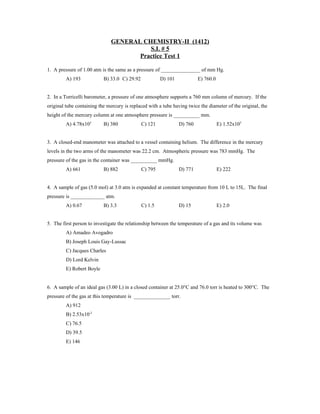
1. A pressure of 1.00 atm is the same as a pressure of _______________ of mm Hg.
         A) 193            B) 33.0 C) 29.92            D) 101            E) 760.0


2. In a Torricelli barometer, a pressure of one atmosphere supports a 760 mm column of mercury. If the
original tube containing the mercury is replaced with a tube having twice the diameter of the original, the
height of the mercury column at one atmosphere pressure is __________ mm.
         A) 4.78x10³       B) 380             C) 121            D) 760              E) 1.52x10³


3. A closed-end manometer was attached to a vessel containing helium. The difference in the mercury
levels in the two arms of the manometer was 22.2 cm. Atmospheric pressure was 783 mmHg. The
pressure of the gas in the container was __________ mmHg.
         A) 661            B) 882             C) 795            D) 771              E) 222


4. A sample of gas (5.0 mol) at 3.0 atm is expanded at constant temperature from 10 L to 15L. The final
pressure is _____________ atm.
         A) 0.67           B) 3.3             C) 1.5            D) 15               E) 2.0


5. The first person to investigate the relationship between the temperature of a gas and its volume was
         A) Amadeo Avogadro
         B) Joseph Louis Gay-Lussac
         C) Jacques Charles
         D) Lord Kelvin
         E) Robert Boyle


6. A sample of an ideal gas (3.00 L) in a closed container at 25.0°C and 76.0 torr is heated to 300°C. The
pressure of the gas at this temperature is ______________ torr.
         A) 912
         B) 2.53x10⁻²
         C) 76.5
         D) 39.5
         E) 146
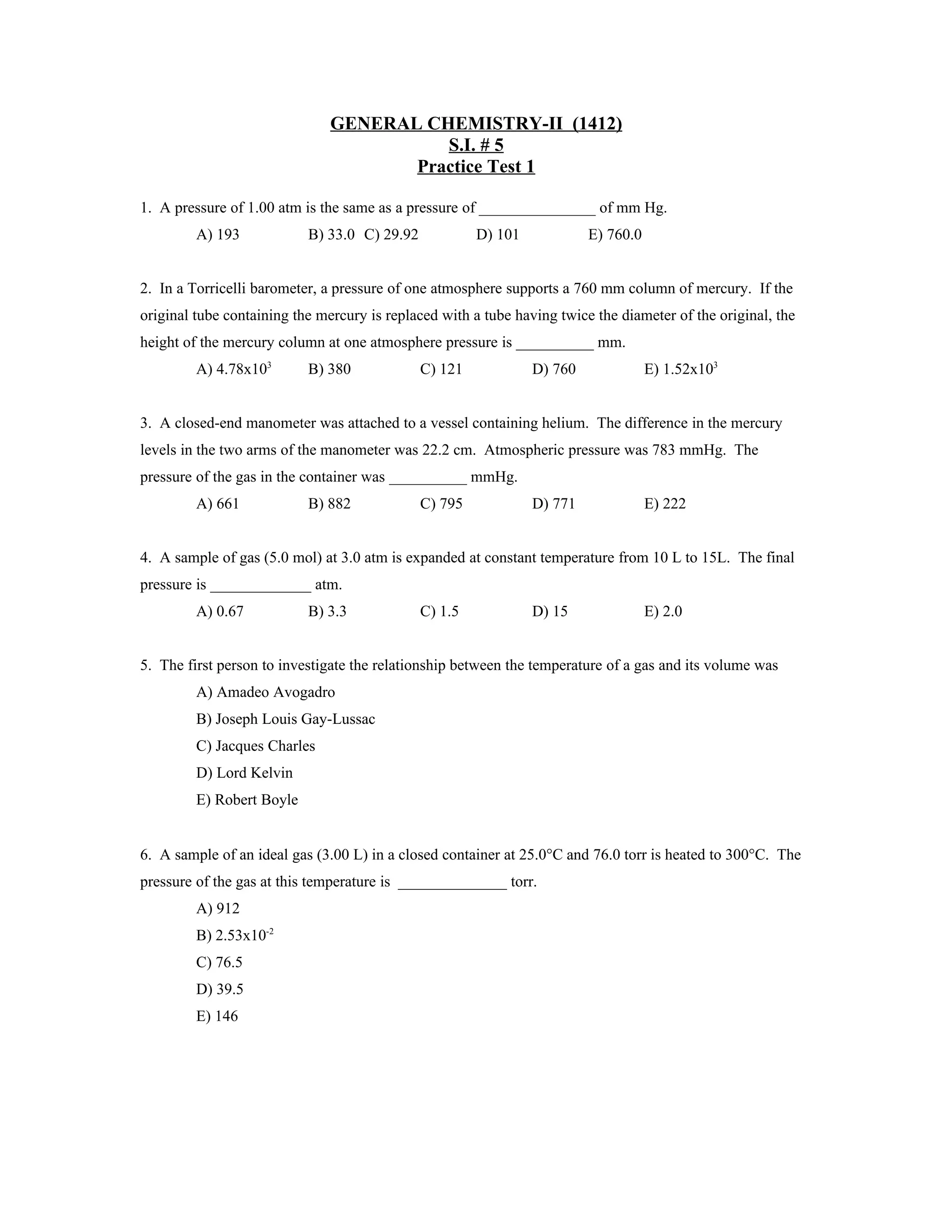
7. The molar volume of a gas at STP is ___________ L.
         A) 14.7           B) 62.36          C) 22.4            D) 0.08206        E) 1.00


8. The density of ammonia gas in a 4.32 L container at 837 torr and 45°C is _____________ g/L.
         A) 4.22x10⁻²
         B) 0.432
         C) 0.717
         D) 0.194
         E) 3.86
9. The molecular weight of a gas is _________ g/mol if 3.5 g of the gas occupies 2.1 L at STP.
         A) 5.5x10³        B) 41             C) 37              D) 2.7x10⁻²       E) 4.6x10²


10. The reaction of 50 mL of Cl2 gas with 50 mL of C2H4 gas via the equation:
         Cl2 (g) + C2H4 (g)  C2H4Cl2 (g)
will produce a total of __________mL of product if pressure and temperature are kept constant.

         A) 50             B) 25             C) 125             D) 100            E) 150


11. Since air is a mixture, it does not have a “molar mass.” However, for calculation purposes, it is
possible to speak of its “effective molar mass.” (An effective molar mass is a weighted average of the
molar masses of a mixture’s components.) If air at STP has a density of 1.285 g/L, its effective molar mass
is ___________ g/mol.
         A) 26.9           B) 28.8           C) 34.4            D) 31.4           E) 30.0


12. The volume of HCl gas required to react with excess magnesium metal to produce 6.82 L of hydrogen
gas at 2.19 atm and 35.0°C is ____________ L.
         A) 4.38           B) 3.41           C) 6.82            D) 13.6           E) 2.19


13. The thermal decomposition of potassium chlorate can be used to produce oxygen in the laboratory.
What volume (L) of O2 gas at 25°C and 1.00 atm pressure is produced by the decomposition of 7.5 g of
KClO3 (s)?
         A) 2.2            B) 3.7            C) 11              D) 7.5            E) 4.5


14. In a gas mixture of He, Ne, and Ar with a total pressure of 8.40 atm, the mole fraction of Ar is
____________ if the partial pressures of He and Ne are 1.50 and 2.00 atm respectively.

         A) 0.179          B) 0.238          C) 0.583           D) 0.417          E) 0.357

15. Of the following gasses, ________ will have the greatest rate of effusion at a given temperature.
         A. HBr B. NH3 C. HCl D. CH4                 E. Ar
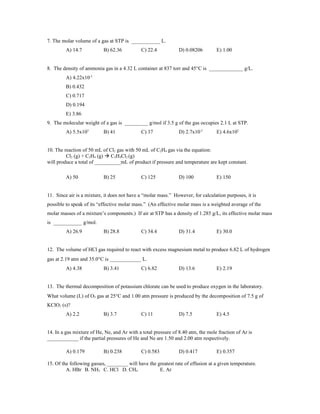
16. An ideal gas differs from a real gas in that the molecules of an ideal gas ______________.

         A) have a molecular weight of zero
         B) have no attraction for one another
         C) have an average molecular mass
         D) have appreciable molecular volumes
         E) have no kinetic energy


17. The van der Waals equation for real gases recognizes that ____________.
         A) the molecular attractions between particles of gas increases the pressure exerted by the gas
         B) molar volumes of gases of different types are the same
         C) gas particle have non-zero volumes and interact with each other
         D) the non-zero volumes of gas particles effectively increase the amount of “empty space”
                           between them
         E) all of the above statements are true


18. Which of the following exhibits dipole-dipole attraction between molecules?
         A) XeF4           B) AsH3             C) BCl3          D) Cl2             E) CO2


19. Of the following, ____________ has the highest boiling point.
         A) Br2            B) Cl2              C) O2            D) N2              E) H2


20. CO (5.00 g) and CO2 (5.00 g) were placed in a 750.0 mL container at 50.0°C. The partial pressure of
CO in the container was _____________ atm.
         A) 10.3           B) 6.31             C) 1.60          D) 4.02            E) 0.292


21. Which of the following molecules has hydrogen bonding as its only intermolecular force?
         A) HF
         B) C6H13NH2
         C) H2O
         D) C5H11OH
         E) None, all of the above exhibit dispersion forces.


22. In which of the following molecules is hydrogen bonding likely to be the most significant component
of the total intermolecular forces?
         A) CH3OH                     B) CH4             C) C6H13NH2      D) CO2              E) C5H11OH
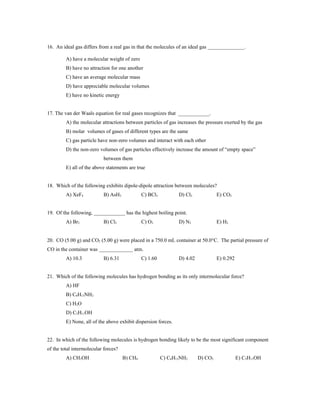
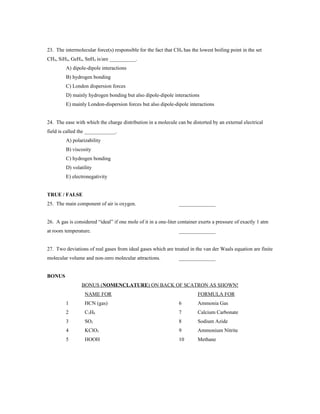
23. The intermolecular force(s) responsible for the fact that CH4 has the lowest boiling point in the set
CH4, SiH4, GeH4, SnH4 is/are __________.
         A) dipole-dipole interactions
         B) hydrogen bonding
         C) London dispersion forces
         D) mainly hydrogen bonding but also dipole-dipole interactions
         E) mainly London-dispersion forces but also dipole-dipole interactions


24. The ease with which the charge distribution in a molecule can be distorted by an external electrical
field is called the ____________.
         A) polarizability
         B) viscosity
         C) hydrogen bonding
         D) volatility
         E) electronegativity


TRUE / FALSE
25. The main component of air is oxygen.                        ______________


26. A gas is considered “ideal” if one mole of it in a one-liter container exerts a pressure of exactly 1 atm
at room temperature.                                            ______________


27. Two deviations of real gases from ideal gases which are treated in the van der Waals equation are finite
molecular volume and non-zero molecular attractions.            ______________


BONUS
                 BONUS (NOMENCLATURE) ON BACK OF SCATRON AS SHOWN!
                  NAME FOR                                                FORMULA FOR
         1        HCN (gas)                                     6         Ammonia Gas
         2        C3H8                                          7         Calcium Carbonate
         3        SO2                                           8         Sodium Azide
         4        KClO3                                         9         Ammonium Nitrite
         5        HOOH                                          10        Methane
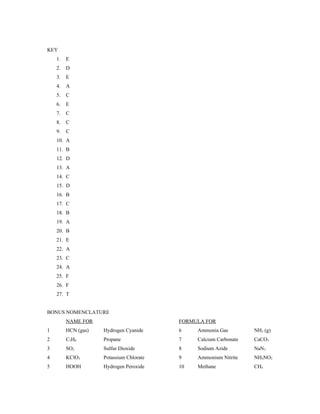
KEY
    1.   E
    2.   D
    3.   E
    4.   A
    5.   C
    6.   E
    7.   C
    8.   C
    9.   C
    10. A
    11. B
    12. D
    13. A
    14. C
    15. D
    16. B
    17. C
    18. B
    19. A
    20. B
    21. E
    22. A
    23. C
    24. A
    25. F
    26. F
    27. T


BONUS NOMENCLATURE
         NAME FOR                         FORMULA FOR
1        HCN (gas)   Hydrogen Cyanide     6    Ammonia Gas         NH3 (g)
2        C3H8        Propane              7    Calcium Carbonate   CaCO3
3        SO2         Sulfur Dioxide       8    Sodium Azide        NaN3
4        KClO3       Potassium Chlorate   9    Ammonium Nitrite    NH4NO2
5        HOOH        Hydrogen Peroxide    10   Methane             CH4
Practice test 1 Key

Practice test 1 Key

  • 1.
    GENERAL CHEMISTRY-II (1412) S.I. # 5 Practice Test 1 1. A pressure of 1.00 atm is the same as a pressure of _______________ of mm Hg. A) 193 B) 33.0 C) 29.92 D) 101 E) 760.0 2. In a Torricelli barometer, a pressure of one atmosphere supports a 760 mm column of mercury. If the original tube containing the mercury is replaced with a tube having twice the diameter of the original, the height of the mercury column at one atmosphere pressure is __________ mm. A) 4.78x10³ B) 380 C) 121 D) 760 E) 1.52x10³ 3. A closed-end manometer was attached to a vessel containing helium. The difference in the mercury levels in the two arms of the manometer was 22.2 cm. Atmospheric pressure was 783 mmHg. The pressure of the gas in the container was __________ mmHg. A) 661 B) 882 C) 795 D) 771 E) 222 4. A sample of gas (5.0 mol) at 3.0 atm is expanded at constant temperature from 10 L to 15L. The final pressure is _____________ atm. A) 0.67 B) 3.3 C) 1.5 D) 15 E) 2.0 5. The first person to investigate the relationship between the temperature of a gas and its volume was A) Amadeo Avogadro B) Joseph Louis Gay-Lussac C) Jacques Charles D) Lord Kelvin E) Robert Boyle 6. A sample of an ideal gas (3.00 L) in a closed container at 25.0°C and 76.0 torr is heated to 300°C. The pressure of the gas at this temperature is ______________ torr. A) 912 B) 2.53x10⁻² C) 76.5 D) 39.5 E) 146
  • 2.
    7. The molarvolume of a gas at STP is ___________ L. A) 14.7 B) 62.36 C) 22.4 D) 0.08206 E) 1.00 8. The density of ammonia gas in a 4.32 L container at 837 torr and 45°C is _____________ g/L. A) 4.22x10⁻² B) 0.432 C) 0.717 D) 0.194 E) 3.86 9. The molecular weight of a gas is _________ g/mol if 3.5 g of the gas occupies 2.1 L at STP. A) 5.5x10³ B) 41 C) 37 D) 2.7x10⁻² E) 4.6x10² 10. The reaction of 50 mL of Cl2 gas with 50 mL of C2H4 gas via the equation: Cl2 (g) + C2H4 (g)  C2H4Cl2 (g) will produce a total of __________mL of product if pressure and temperature are kept constant. A) 50 B) 25 C) 125 D) 100 E) 150 11. Since air is a mixture, it does not have a “molar mass.” However, for calculation purposes, it is possible to speak of its “effective molar mass.” (An effective molar mass is a weighted average of the molar masses of a mixture’s components.) If air at STP has a density of 1.285 g/L, its effective molar mass is ___________ g/mol. A) 26.9 B) 28.8 C) 34.4 D) 31.4 E) 30.0 12. The volume of HCl gas required to react with excess magnesium metal to produce 6.82 L of hydrogen gas at 2.19 atm and 35.0°C is ____________ L. A) 4.38 B) 3.41 C) 6.82 D) 13.6 E) 2.19 13. The thermal decomposition of potassium chlorate can be used to produce oxygen in the laboratory. What volume (L) of O2 gas at 25°C and 1.00 atm pressure is produced by the decomposition of 7.5 g of KClO3 (s)? A) 2.2 B) 3.7 C) 11 D) 7.5 E) 4.5 14. In a gas mixture of He, Ne, and Ar with a total pressure of 8.40 atm, the mole fraction of Ar is ____________ if the partial pressures of He and Ne are 1.50 and 2.00 atm respectively. A) 0.179 B) 0.238 C) 0.583 D) 0.417 E) 0.357 15. Of the following gasses, ________ will have the greatest rate of effusion at a given temperature. A. HBr B. NH3 C. HCl D. CH4 E. Ar
  • 3.
    16. An idealgas differs from a real gas in that the molecules of an ideal gas ______________. A) have a molecular weight of zero B) have no attraction for one another C) have an average molecular mass D) have appreciable molecular volumes E) have no kinetic energy 17. The van der Waals equation for real gases recognizes that ____________. A) the molecular attractions between particles of gas increases the pressure exerted by the gas B) molar volumes of gases of different types are the same C) gas particle have non-zero volumes and interact with each other D) the non-zero volumes of gas particles effectively increase the amount of “empty space” between them E) all of the above statements are true 18. Which of the following exhibits dipole-dipole attraction between molecules? A) XeF4 B) AsH3 C) BCl3 D) Cl2 E) CO2 19. Of the following, ____________ has the highest boiling point. A) Br2 B) Cl2 C) O2 D) N2 E) H2 20. CO (5.00 g) and CO2 (5.00 g) were placed in a 750.0 mL container at 50.0°C. The partial pressure of CO in the container was _____________ atm. A) 10.3 B) 6.31 C) 1.60 D) 4.02 E) 0.292 21. Which of the following molecules has hydrogen bonding as its only intermolecular force? A) HF B) C6H13NH2 C) H2O D) C5H11OH E) None, all of the above exhibit dispersion forces. 22. In which of the following molecules is hydrogen bonding likely to be the most significant component of the total intermolecular forces? A) CH3OH B) CH4 C) C6H13NH2 D) CO2 E) C5H11OH
  • 4.
    23. The intermolecularforce(s) responsible for the fact that CH4 has the lowest boiling point in the set CH4, SiH4, GeH4, SnH4 is/are __________. A) dipole-dipole interactions B) hydrogen bonding C) London dispersion forces D) mainly hydrogen bonding but also dipole-dipole interactions E) mainly London-dispersion forces but also dipole-dipole interactions 24. The ease with which the charge distribution in a molecule can be distorted by an external electrical field is called the ____________. A) polarizability B) viscosity C) hydrogen bonding D) volatility E) electronegativity TRUE / FALSE 25. The main component of air is oxygen. ______________ 26. A gas is considered “ideal” if one mole of it in a one-liter container exerts a pressure of exactly 1 atm at room temperature. ______________ 27. Two deviations of real gases from ideal gases which are treated in the van der Waals equation are finite molecular volume and non-zero molecular attractions. ______________ BONUS BONUS (NOMENCLATURE) ON BACK OF SCATRON AS SHOWN! NAME FOR FORMULA FOR 1 HCN (gas) 6 Ammonia Gas 2 C3H8 7 Calcium Carbonate 3 SO2 8 Sodium Azide 4 KClO3 9 Ammonium Nitrite 5 HOOH 10 Methane
  • 5.
    KEY 1. E 2. D 3. E 4. A 5. C 6. E 7. C 8. C 9. C 10. A 11. B 12. D 13. A 14. C 15. D 16. B 17. C 18. B 19. A 20. B 21. E 22. A 23. C 24. A 25. F 26. F 27. T BONUS NOMENCLATURE NAME FOR FORMULA FOR 1 HCN (gas) Hydrogen Cyanide 6 Ammonia Gas NH3 (g) 2 C3H8 Propane 7 Calcium Carbonate CaCO3 3 SO2 Sulfur Dioxide 8 Sodium Azide NaN3 4 KClO3 Potassium Chlorate 9 Ammonium Nitrite NH4NO2 5 HOOH Hydrogen Peroxide 10 Methane CH4