Chapter 6
Test Review
Chapter 6 Test Review

 1.

A ___________ can change shape
and volume.

 Answer

= gas
Chapter 6 Test Review
A

__________ has a different shape,
but the same volume n any container.

 Answer

= liquid
Chapter 6 Test Review
 ___________

is thermal energy moving
from one substance to another.

 Answer

= Heat
Chapter 6 Test Review
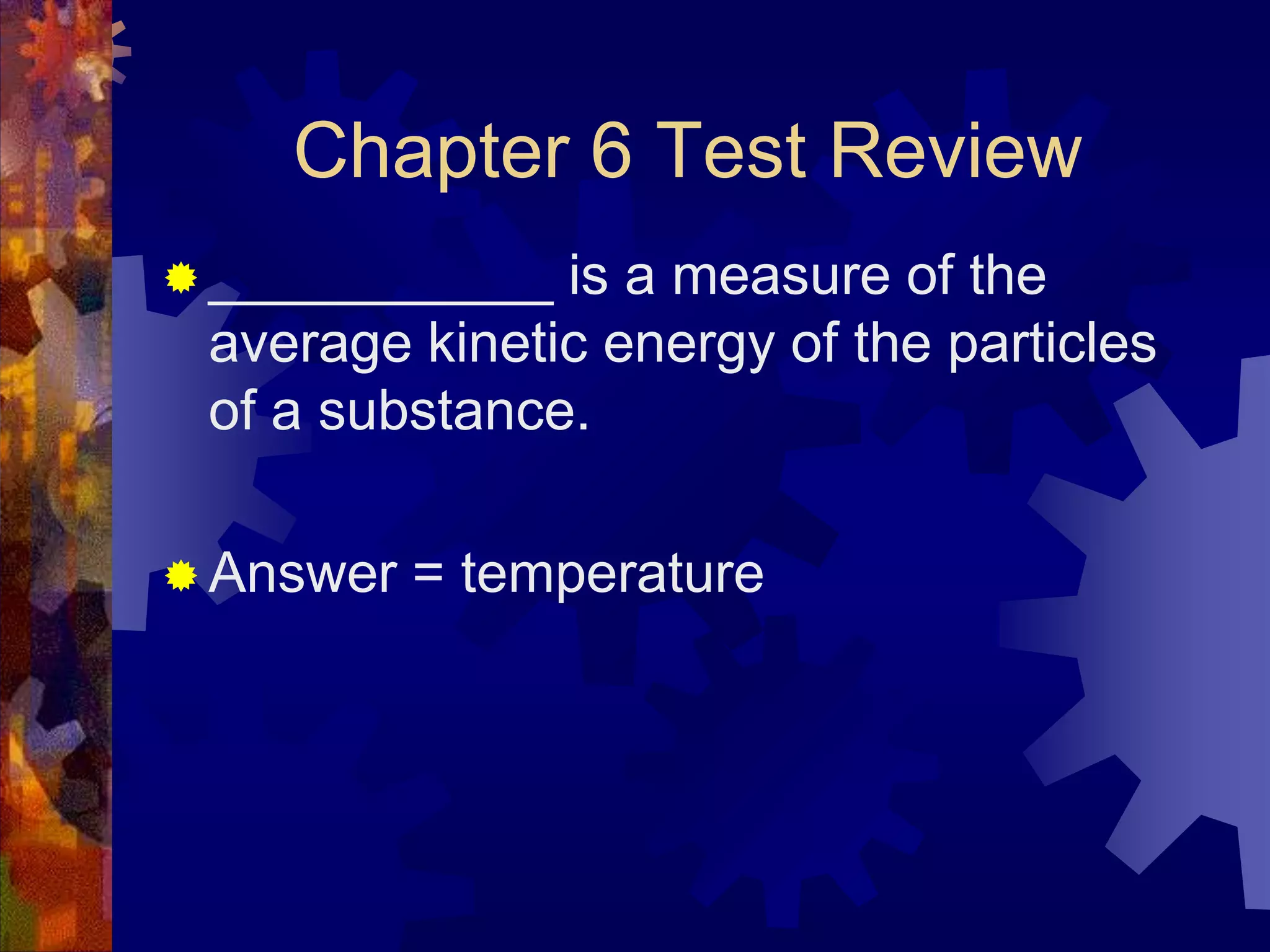
 ___________

is a measure of the
average kinetic energy of the particles
of a substance.

 Answer

= temperature
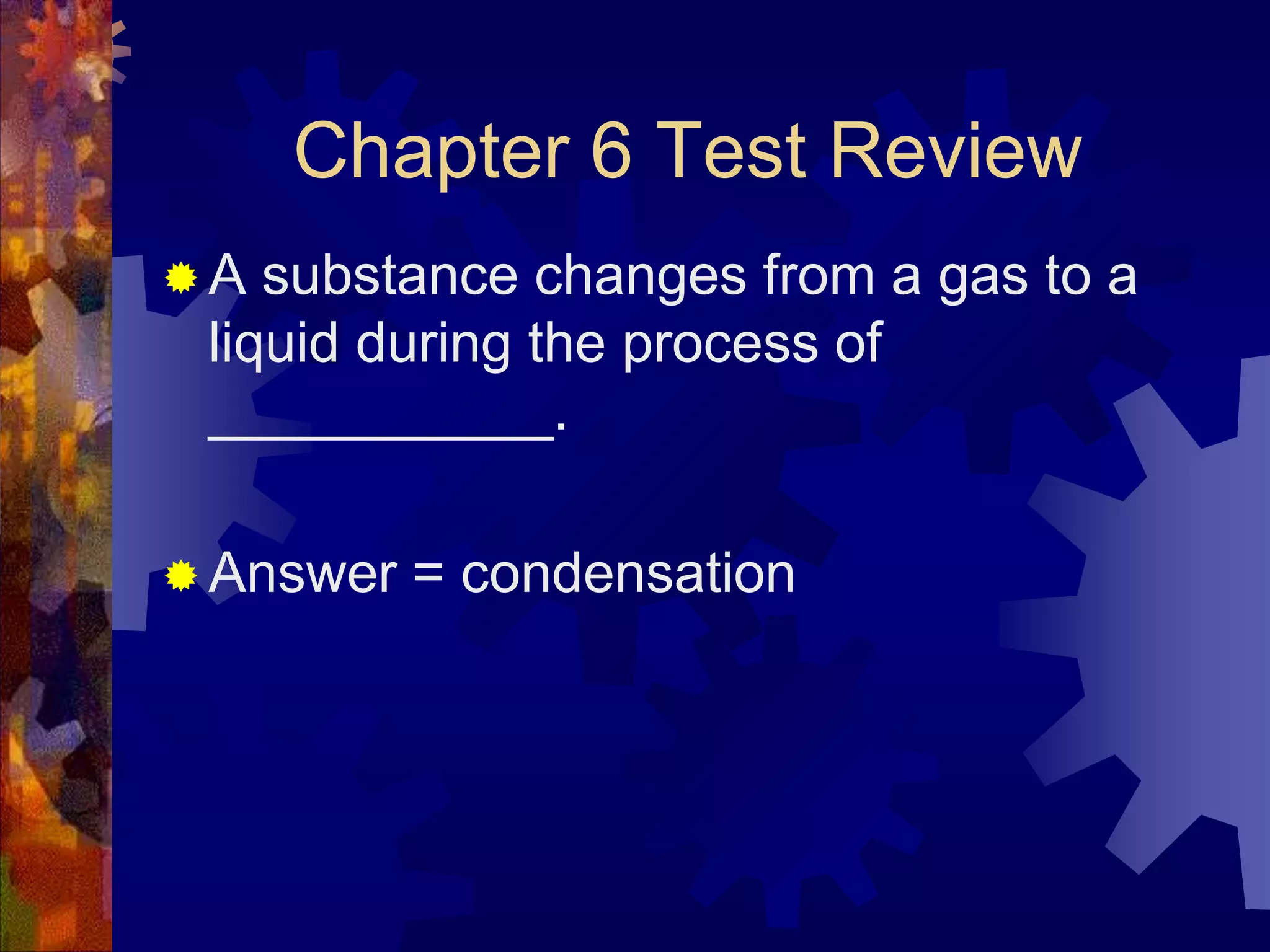
Chapter 6 Test Review
A

substance changes from a gas to a
liquid during the process of
___________.

 Answer

= condensation
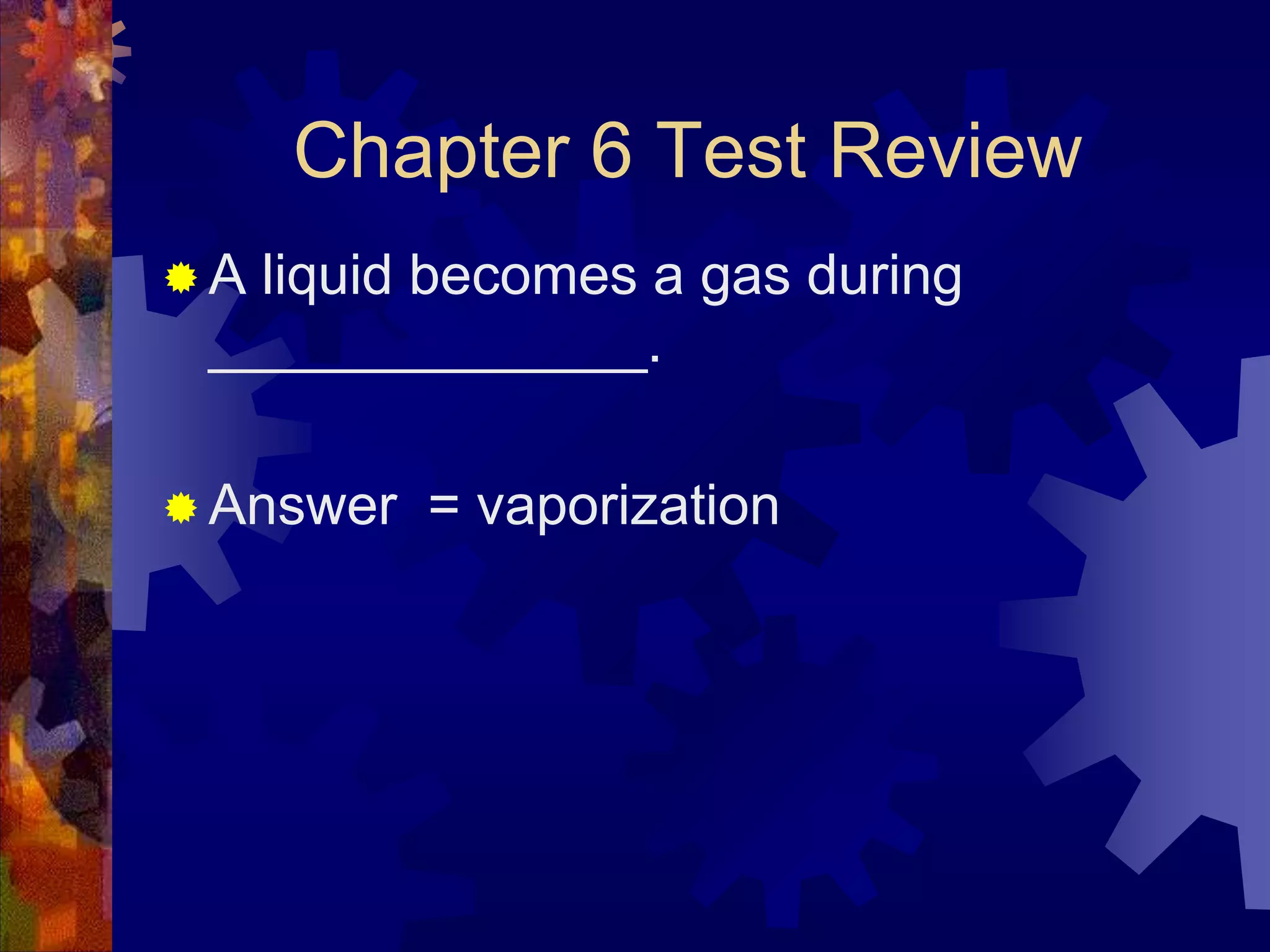
Chapter 6 Test Review
A

liquid becomes a gas during
______________.

 Answer

= vaporization
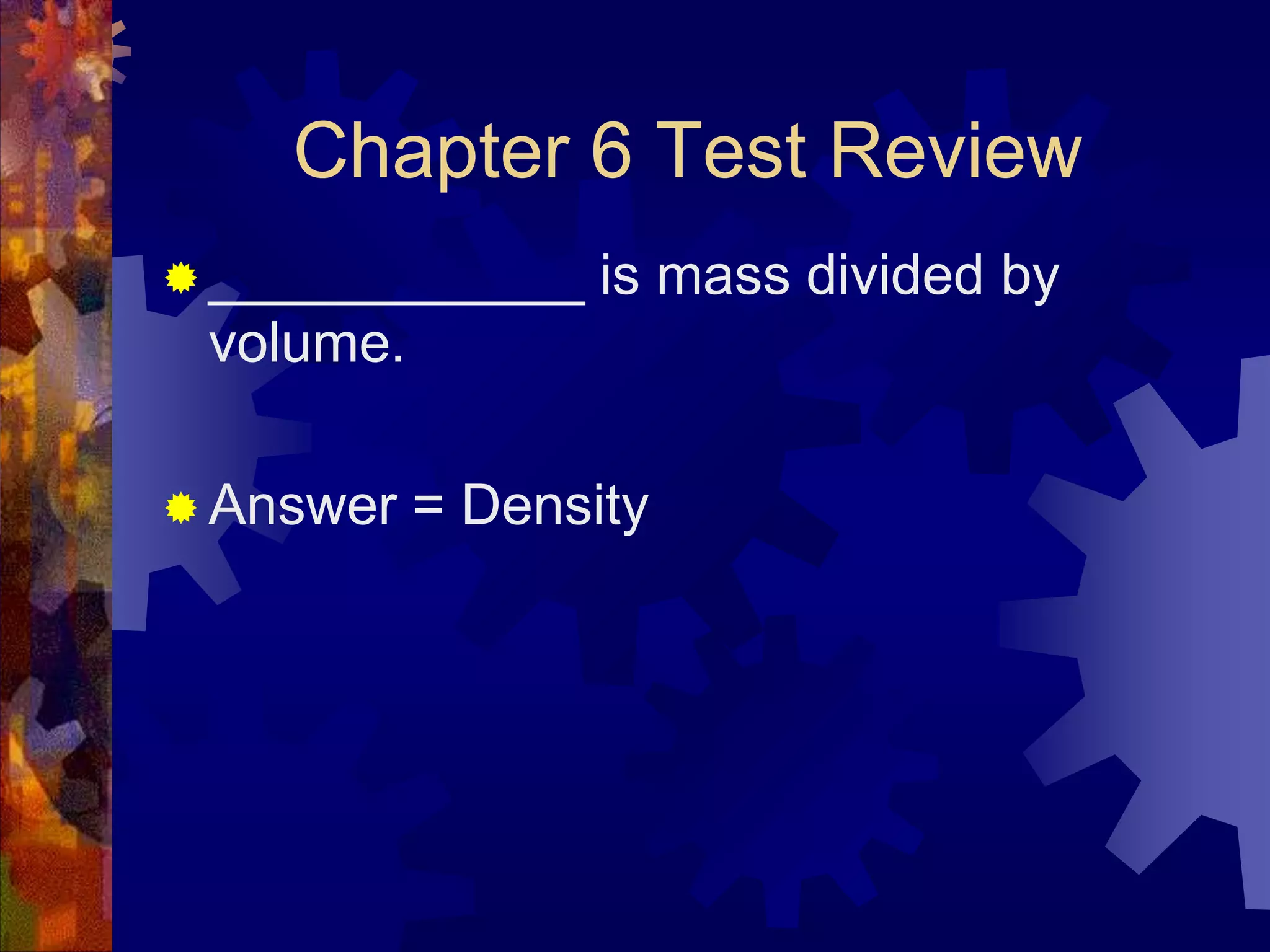
Chapter 6 Test Review
 ____________

is mass divided by

volume.
 Answer

= Density
Chapter 6 Test Review
 _____________

is force divided by

area.
 Answer

= pressure
Chapter 6 Test Review
 _______________

explains what
happens when force is applied to a
confined liquid.

 Answer

= Pascal’s Principal
Chapter 6 Test Review

D.

Which of these is a crystalline solid?
Glass
Sugar
Rubber
Plastic



Answer = B, Sugar



A.
B.
C.
Chapter 6 Test Review


Which description best describes a solid?
A. It has a definite shape and volume
B. It has a definite shape, but no definite
volume
C. It adjusts to the shape of its container
D. It can flow


Answer = A, definite shape and volume
Chapter 6 Test Review


D.

What property enables you to float a needle
on water?
Viscosity
Temperature
Surface tension
Crystal structure



Answer = C, surface tension

A.
B.
C.
Chapter 6 Test Review


D.

What happens to an object as its kinetic
energy increases?
It holds more tightly to nearby objects
Its mass increases
Its particles move more slowly
Its particles move faster



Answer = D, its particles move faster

A.
B.
C.
Chapter 6 Test Review


D.

During which process do particles of matter
release energy?
Melting
Freezing
Sublimation
Boiling



Answer = B, freezing

A.
B.
C.
Chapter 6 Test Review
 How

does water vapor in air form
clouds?
A. Melting
B. Evaporation
C. Condensation
D. Sublimation


Answer = C, condensation
Chapter 6 Test Review

D.

Which is a unit of pressure?
N
Kg
g/cm³
N/m²



Answer = D, N/m²



A.
B.
C.
Chapter 6 Test Review


D.

Which change results in an increase in gas
pressure in a balloon?
Decrease in temperature
Decrease in volume
Increase in volume
Increase in altitude



Answer = B, decrease in volume

A.
B.
C.
Chapter 6 Test Review


D.

In which case will an object float on a fluid?
Buoyant force is greater than weight
Buoyant force is less than weight
Buoyant force equals weight
Buoyant force equals zero



Answer = C, buoyant force equals weight

A.
B.
C.
Chapter 6 Test Review


D.

In which state of matter do particles say
close together, yet are able to move past
one another?
Solid
Gas
Liquid
Plasma



Answer = C, liquid

A.
B.

C.
Chapter 6 Test Review


D.

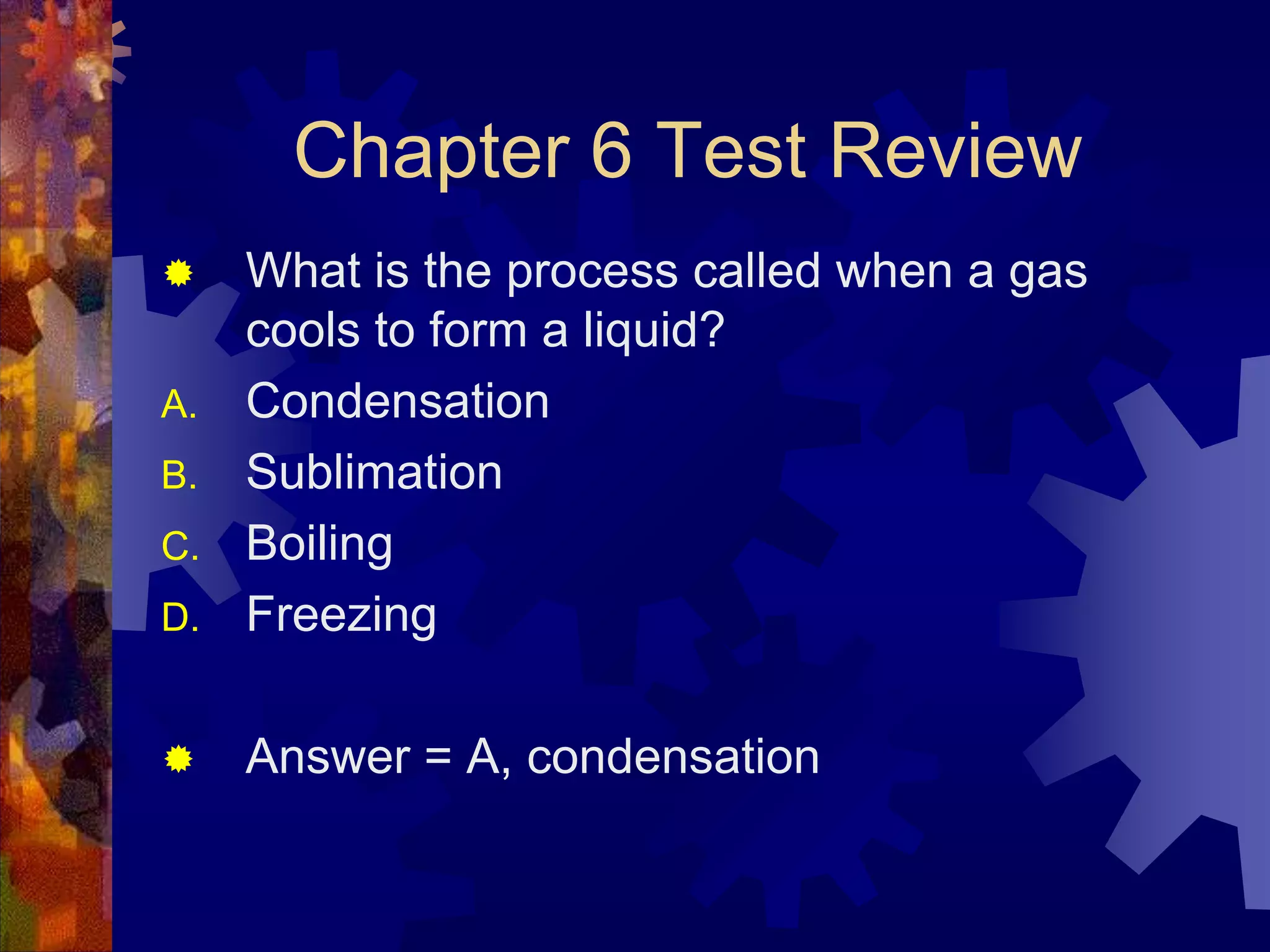
What is the process called when a gas
cools to form a liquid?
Condensation
Sublimation
Boiling
Freezing



Answer = A, condensation

A.
B.
C.
Chapter 6 Test Review


D.

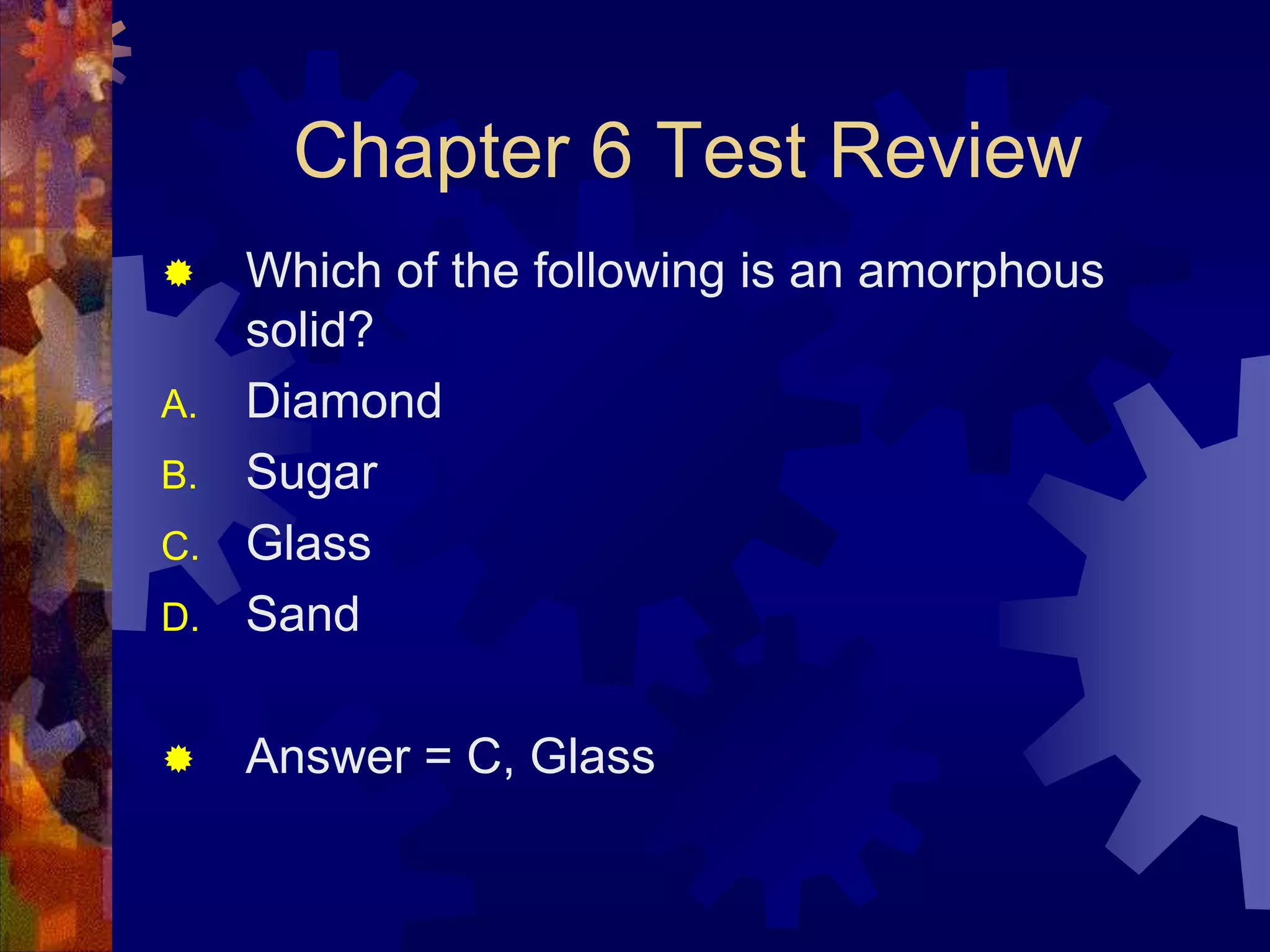
Which of the following is an amorphous
solid?
Diamond
Sugar
Glass
Sand



Answer = C, Glass

A.
B.
C.
Chapter 6 Test Review


A.
B.
C.
D.



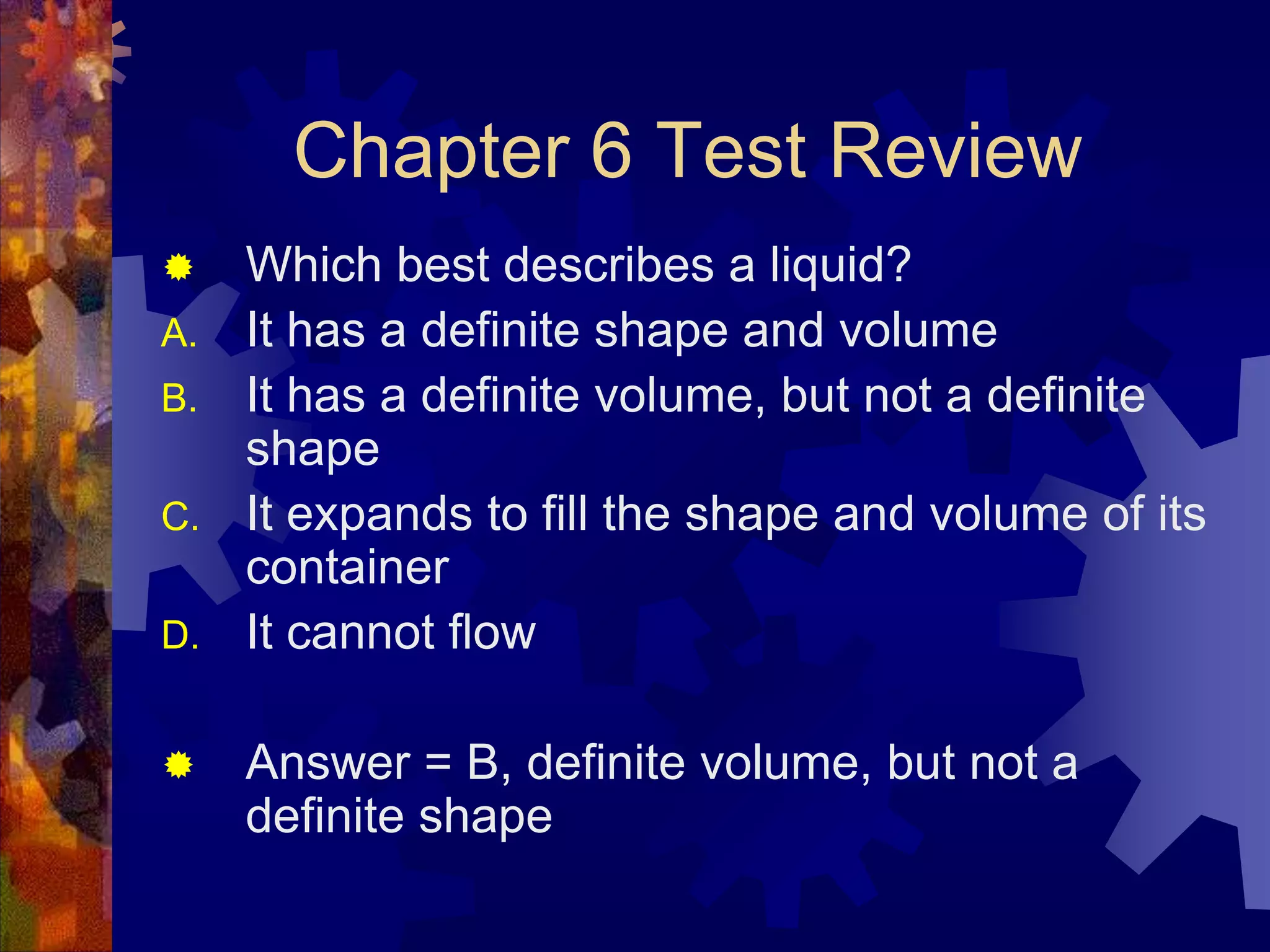
Which best describes a liquid?
It has a definite shape and volume
It has a definite volume, but not a definite
shape
It expands to fill the shape and volume of its
container
It cannot flow

Answer = B, definite volume, but not a
definite shape
Chapter 6 Test Review


D.

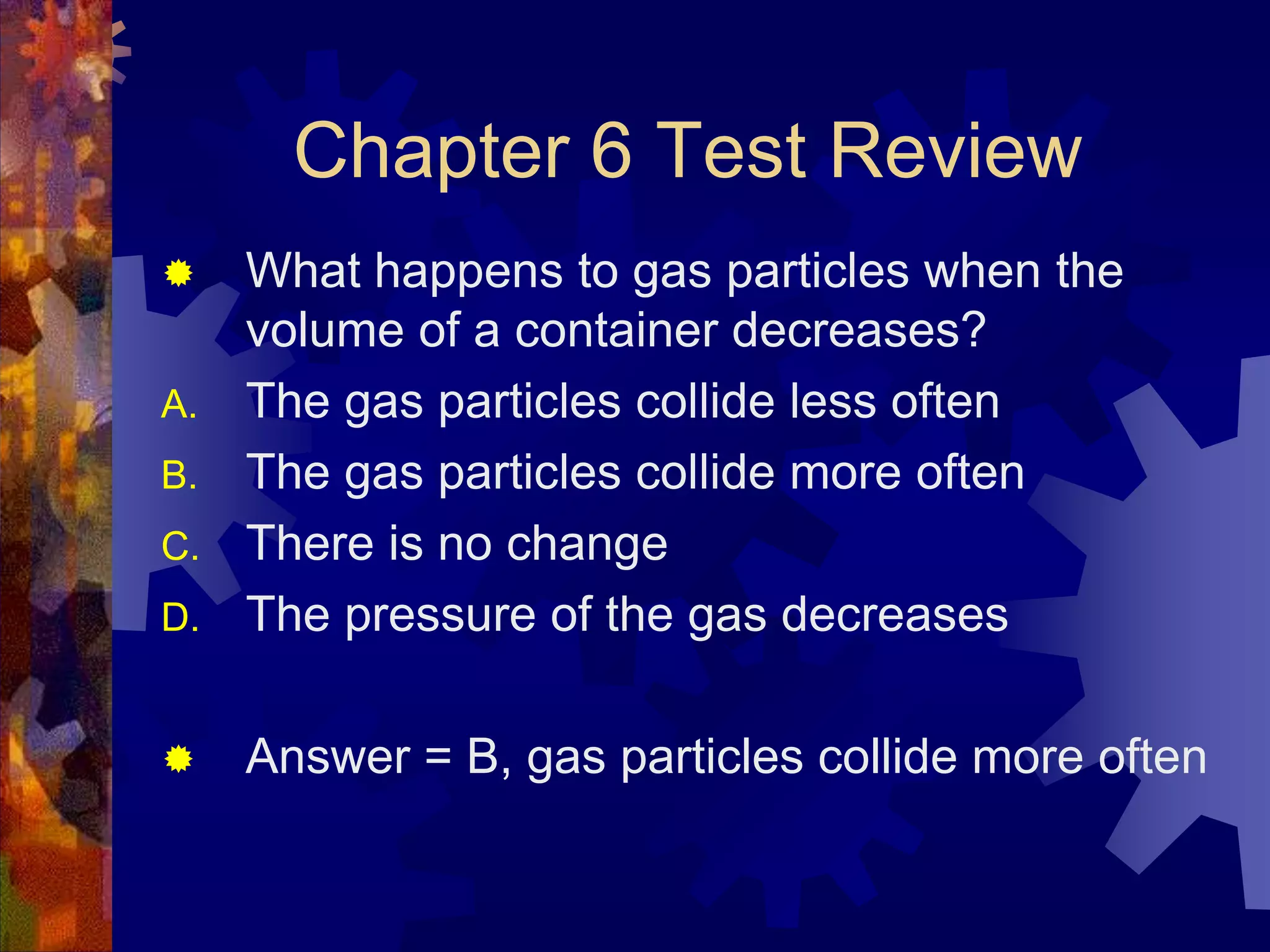
What happens to gas particles when the
volume of a container decreases?
The gas particles collide less often
The gas particles collide more often
There is no change
The pressure of the gas decreases



Answer = B, gas particles collide more often

A.
B.
C.
Chapter 6 Test Review


D.

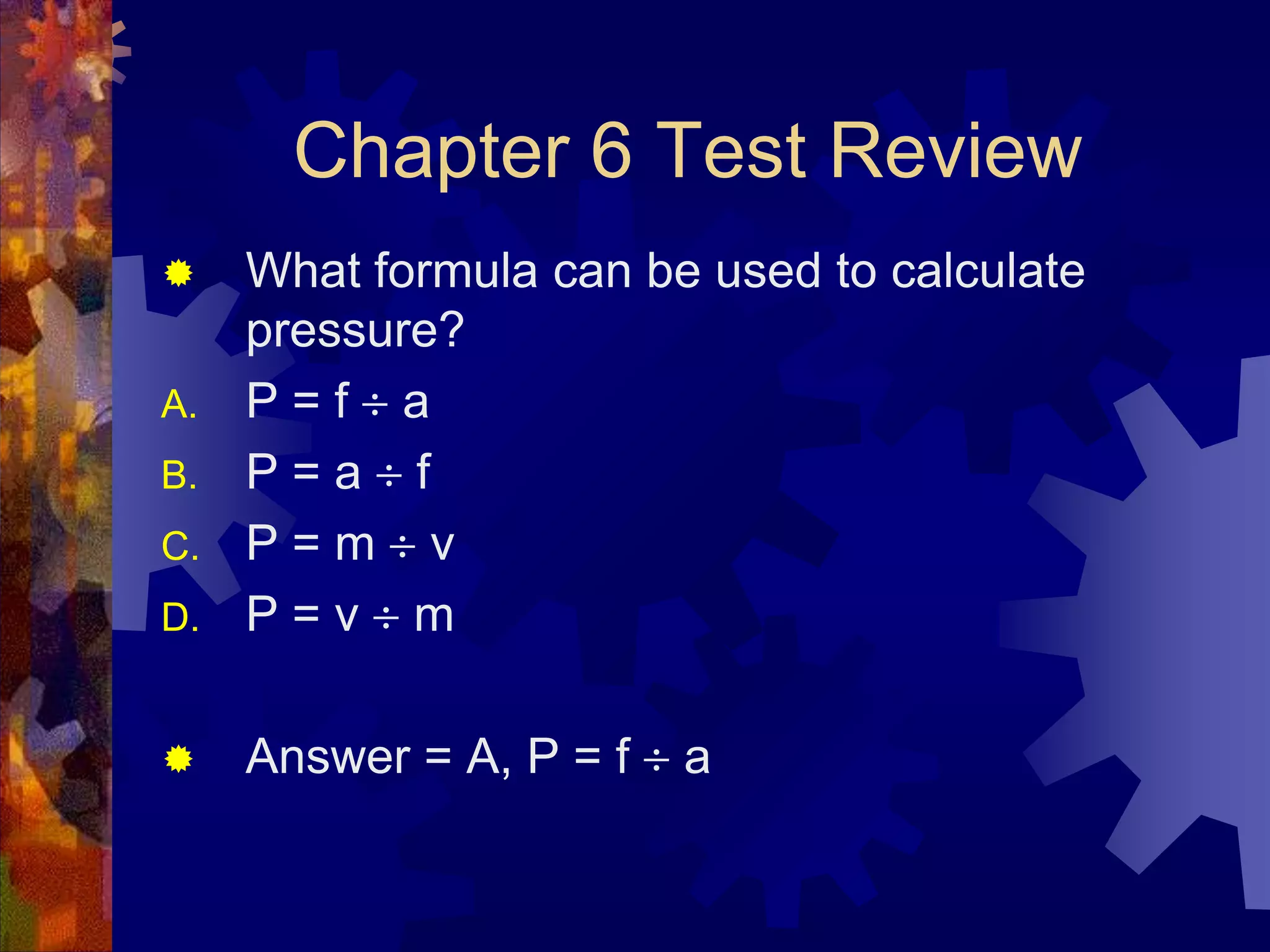
What formula can be used to calculate
pressure?
P=f a
P=a f
P=m v
P=v m



Answer = A, P = f

A.
B.
C.

a
Chapter 6 Test Review

A.
B.

C.
D.



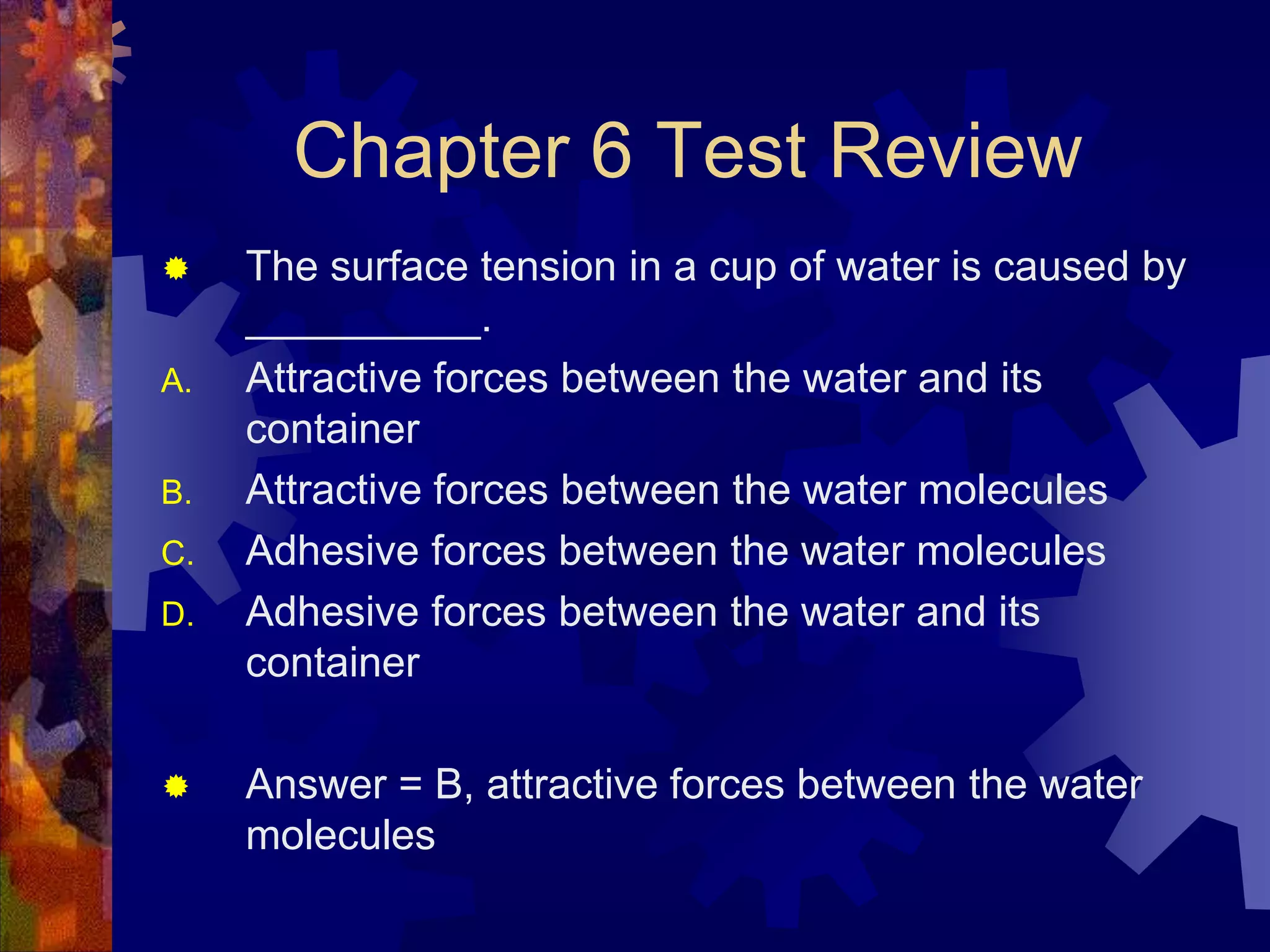
The surface tension in a cup of water is caused by
__________.
Attractive forces between the water and its
container
Attractive forces between the water molecules
Adhesive forces between the water molecules
Adhesive forces between the water and its
container

Answer = B, attractive forces between the water
molecules
Chapter 6 Test Review

D.

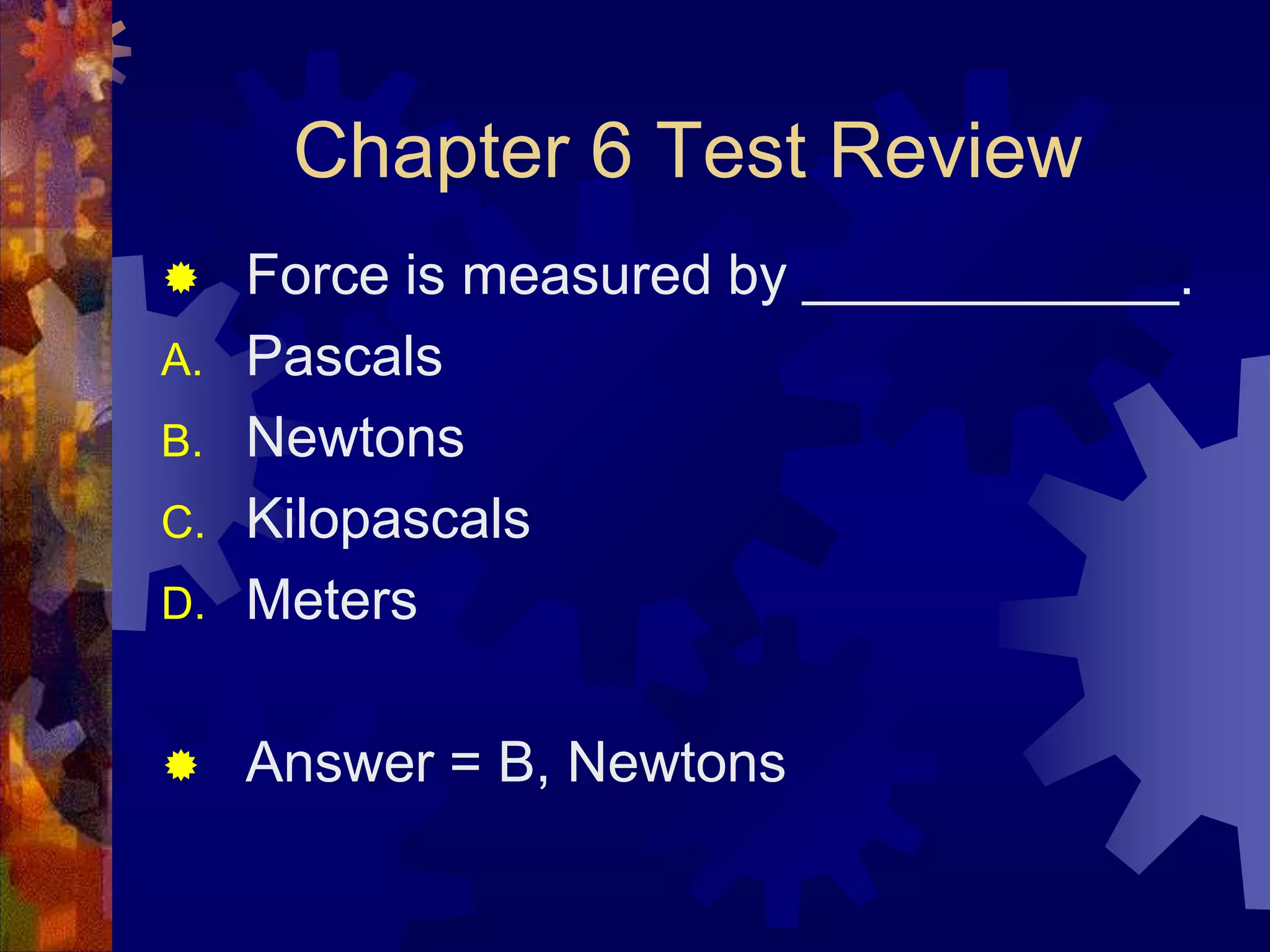
Force is measured by ____________.
Pascals
Newtons
Kilopascals
Meters



Answer = B, Newtons



A.
B.
C.
Chapter 6 Test Review

D.

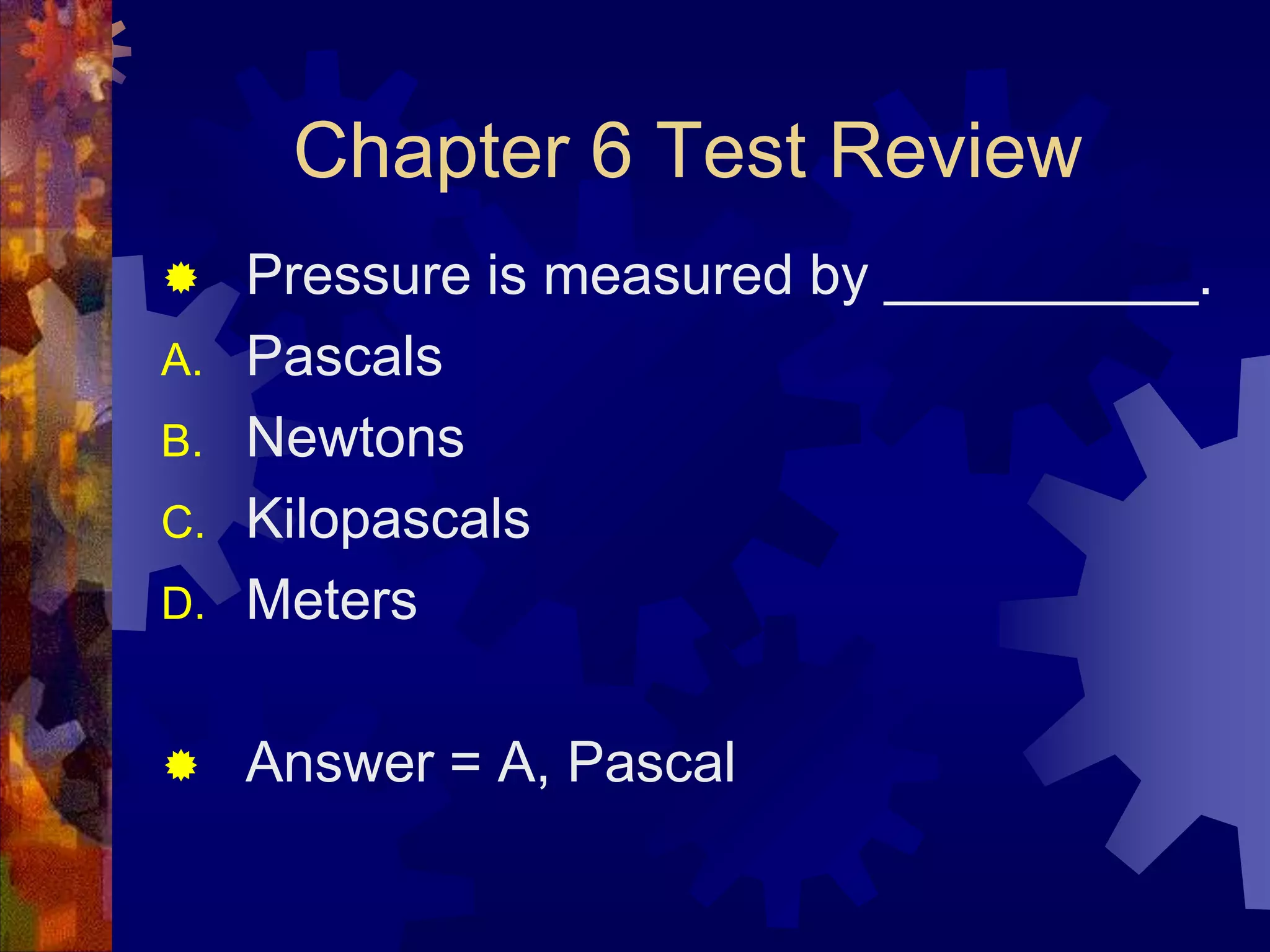
Pressure is measured by __________.
Pascals
Newtons
Kilopascals
Meters



Answer = A, Pascal



A.
B.
C.
Chapter 6 Test Review


D.

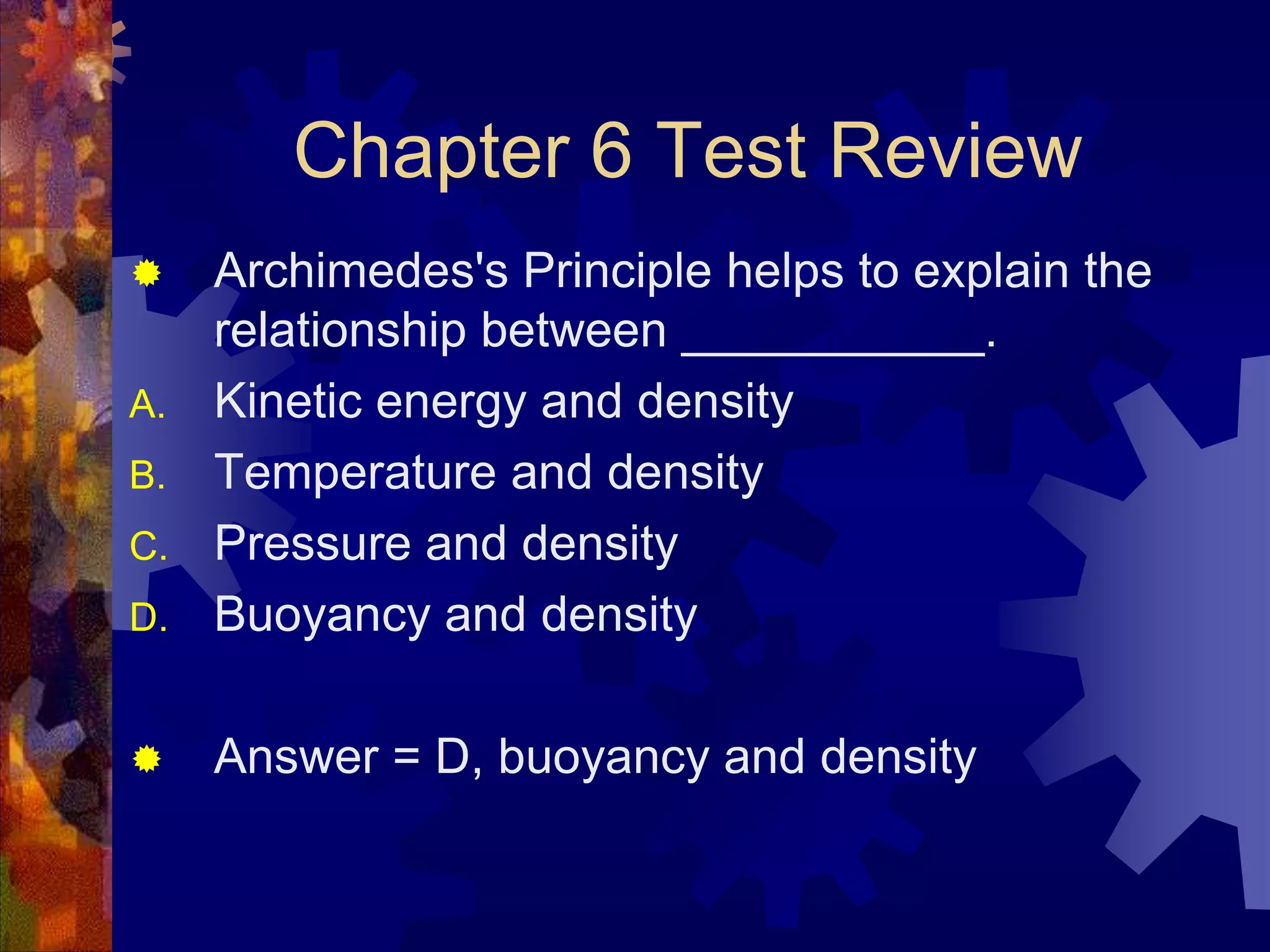
Archimedes's Principle helps to explain the
relationship between ___________.
Kinetic energy and density
Temperature and density
Pressure and density
Buoyancy and density



Answer = D, buoyancy and density

A.
B.
C.
Chapter 6 Test Review


D.

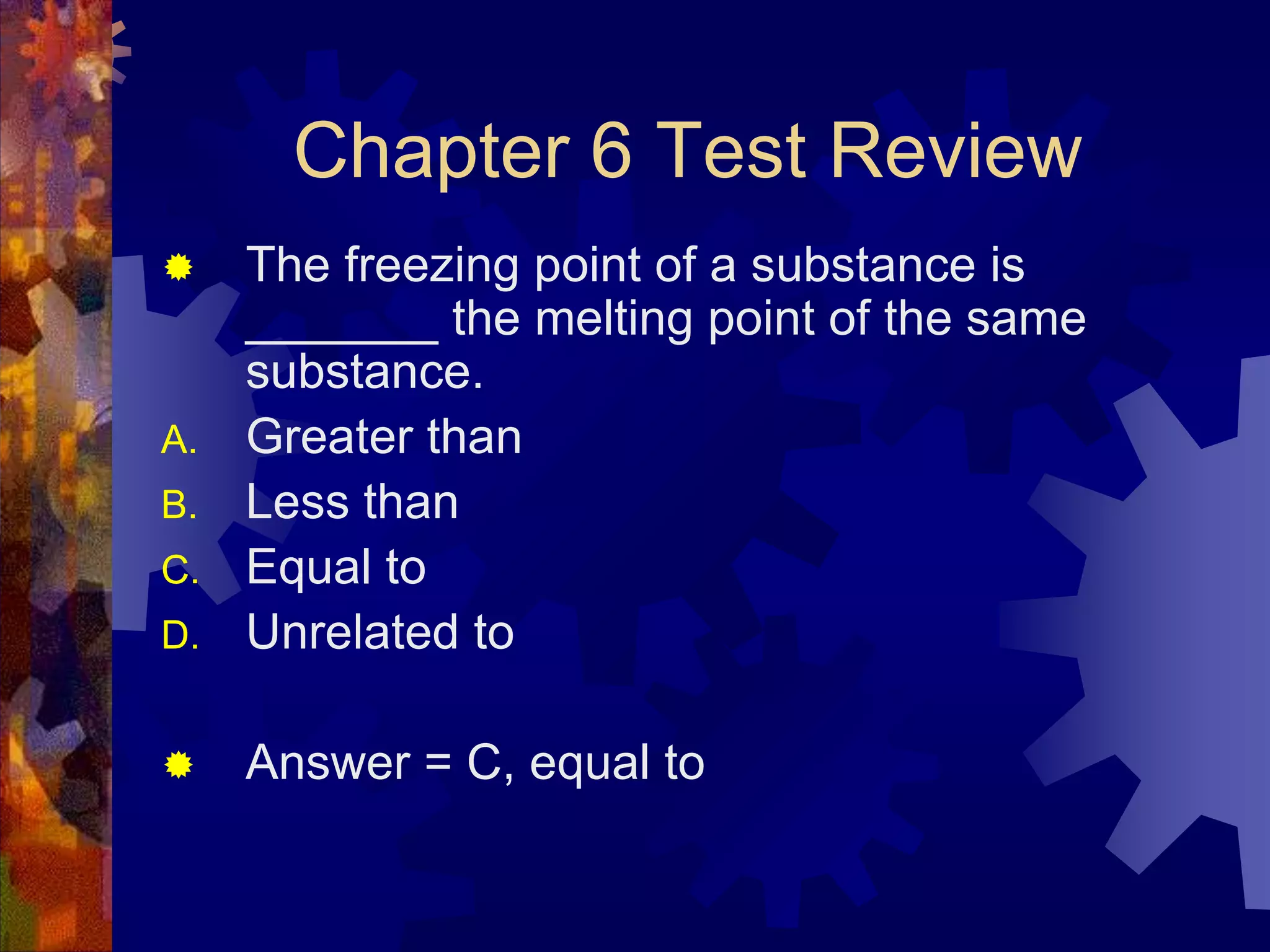
The freezing point of a substance is
_______ the melting point of the same
substance.
Greater than
Less than
Equal to
Unrelated to



Answer = C, equal to

A.
B.

C.
Chapter 6 Test Review

D.

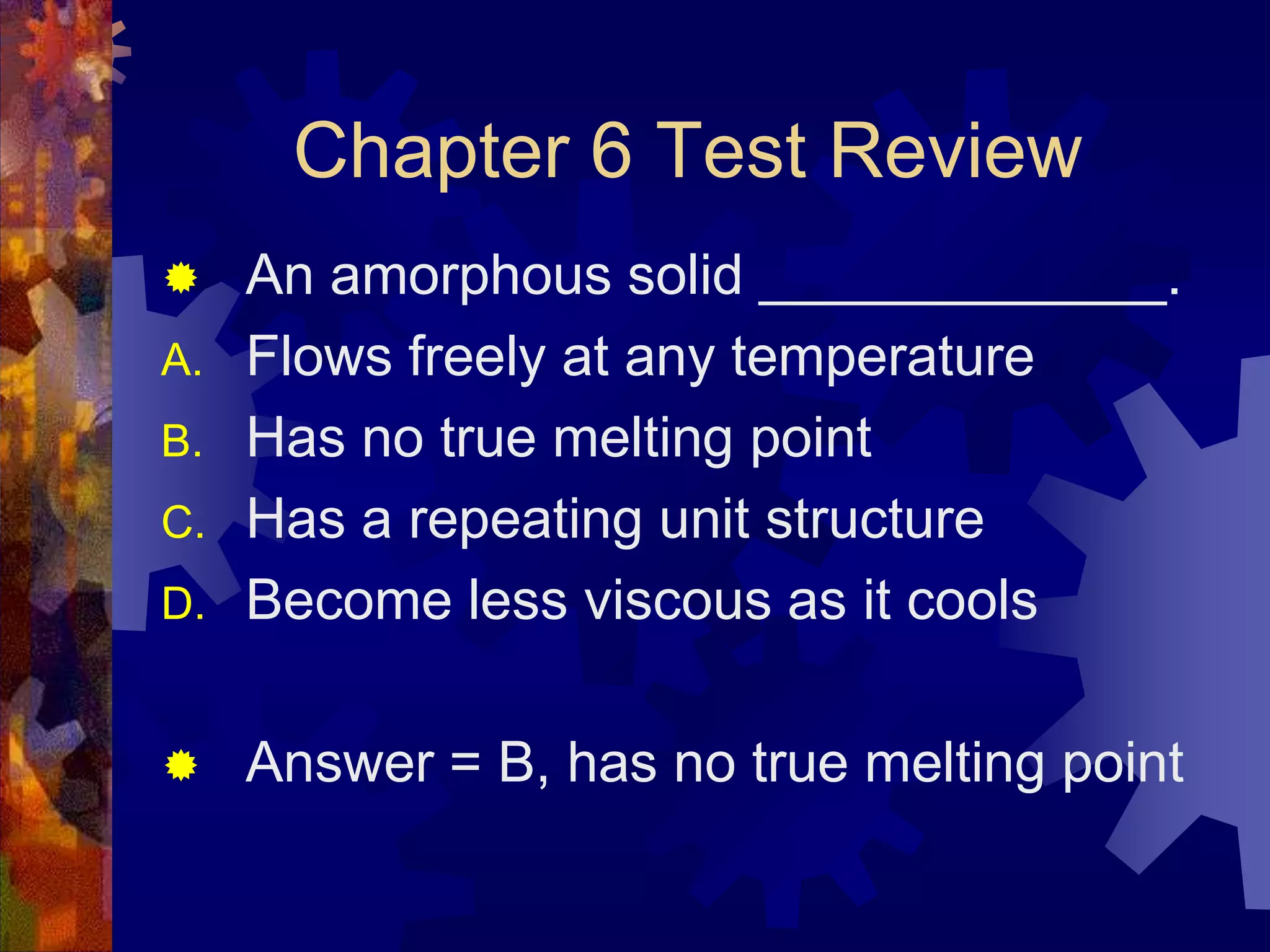
An amorphous solid _____________.
Flows freely at any temperature
Has no true melting point
Has a repeating unit structure
Become less viscous as it cools



Answer = B, has no true melting point



A.
B.
C.
Chapter 6 Test Review


D.

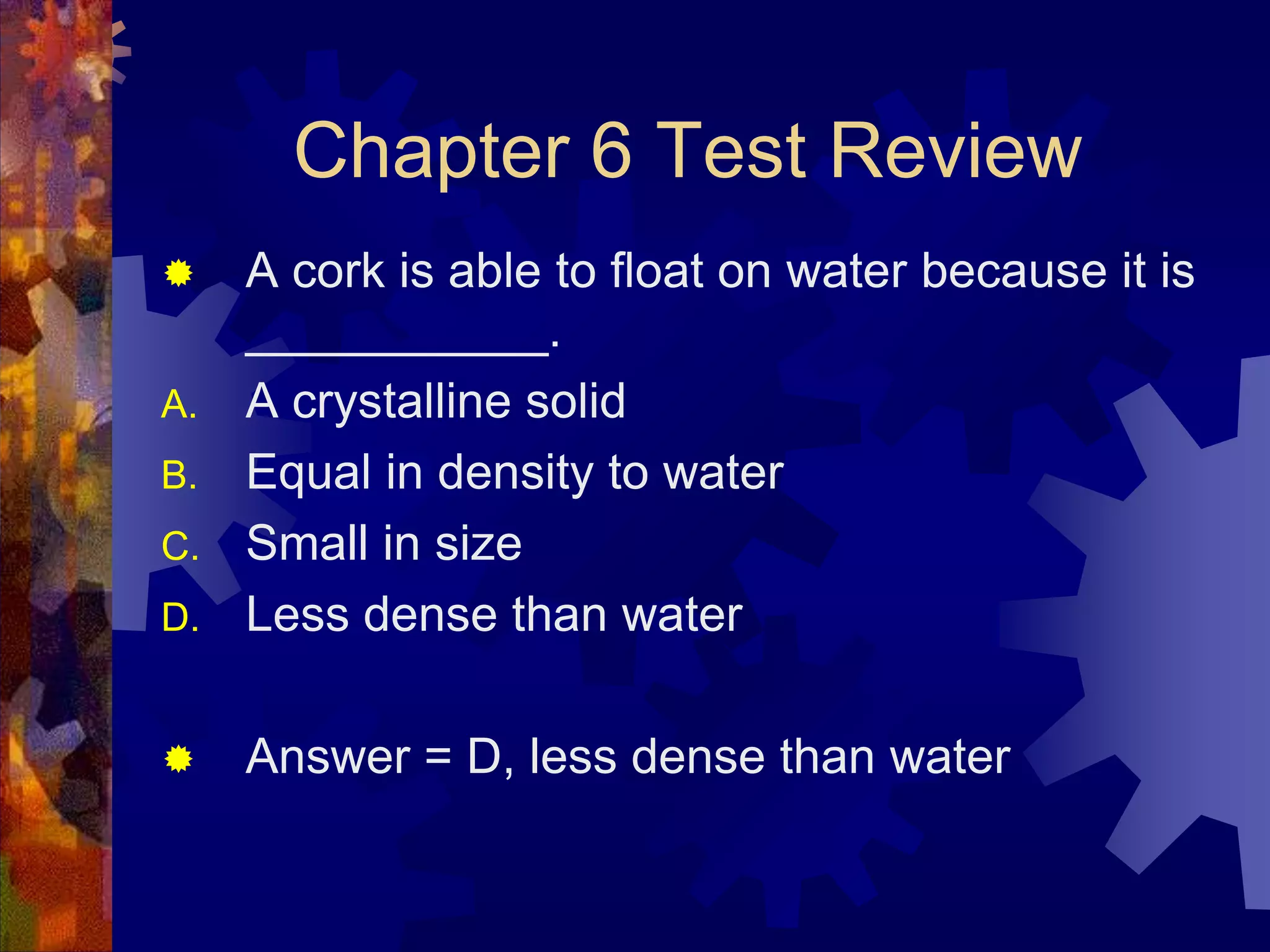
A cork is able to float on water because it is
___________.
A crystalline solid
Equal in density to water
Small in size
Less dense than water



Answer = D, less dense than water

A.
B.
C.
Chapter 6 Test Review


D.

The energy of moving particles is called
___________.
Kinetic energy
Latent energy
Atomic energy
Potential energy



Answer = A, kinetic energy

A.
B.
C.
Chapter 6 Test Review


D.

The _________ remains constant when a
liquid reaches its boiling point.
Temperature
Sound
Odor
Color



Answer = A, temperature

A.
B.
C.
Chapter 6 Test Review

D.

The higher the temperature of matter, the
________ the particles are moving.
Slower
Farther
Faster
Closer



Answer = C, faster


A.
B.
C.
Chapter 6 Test Review


D.

Different objects don’t heat at the same rate
because they have different ________.
Specific heats
Energy
Boiling points
Temperatures



Answer = A, specific heats

A.
B.
C.

Chapter 6 test_review Science

  • 1.
  • 2.
    Chapter 6 TestReview  1. A ___________ can change shape and volume.  Answer = gas
  • 3.
    Chapter 6 TestReview A __________ has a different shape, but the same volume n any container.  Answer = liquid
  • 4.
    Chapter 6 TestReview  ___________ is thermal energy moving from one substance to another.  Answer = Heat
  • 5.
    Chapter 6 TestReview  ___________ is a measure of the average kinetic energy of the particles of a substance.  Answer = temperature
  • 6.
    Chapter 6 TestReview A substance changes from a gas to a liquid during the process of ___________.  Answer = condensation
  • 7.
    Chapter 6 TestReview A liquid becomes a gas during ______________.  Answer = vaporization
  • 8.
    Chapter 6 TestReview  ____________ is mass divided by volume.  Answer = Density
  • 9.
    Chapter 6 TestReview  _____________ is force divided by area.  Answer = pressure
  • 10.
    Chapter 6 TestReview  _______________ explains what happens when force is applied to a confined liquid.  Answer = Pascal’s Principal
  • 11.
    Chapter 6 TestReview D. Which of these is a crystalline solid? Glass Sugar Rubber Plastic  Answer = B, Sugar  A. B. C.
  • 12.
    Chapter 6 TestReview  Which description best describes a solid? A. It has a definite shape and volume B. It has a definite shape, but no definite volume C. It adjusts to the shape of its container D. It can flow  Answer = A, definite shape and volume
  • 13.
    Chapter 6 TestReview  D. What property enables you to float a needle on water? Viscosity Temperature Surface tension Crystal structure  Answer = C, surface tension A. B. C.
  • 14.
    Chapter 6 TestReview  D. What happens to an object as its kinetic energy increases? It holds more tightly to nearby objects Its mass increases Its particles move more slowly Its particles move faster  Answer = D, its particles move faster A. B. C.
  • 15.
    Chapter 6 TestReview  D. During which process do particles of matter release energy? Melting Freezing Sublimation Boiling  Answer = B, freezing A. B. C.
  • 16.
    Chapter 6 TestReview  How does water vapor in air form clouds? A. Melting B. Evaporation C. Condensation D. Sublimation  Answer = C, condensation
  • 17.
    Chapter 6 TestReview D. Which is a unit of pressure? N Kg g/cm³ N/m²  Answer = D, N/m²  A. B. C.
  • 18.
    Chapter 6 TestReview  D. Which change results in an increase in gas pressure in a balloon? Decrease in temperature Decrease in volume Increase in volume Increase in altitude  Answer = B, decrease in volume A. B. C.
  • 19.
    Chapter 6 TestReview  D. In which case will an object float on a fluid? Buoyant force is greater than weight Buoyant force is less than weight Buoyant force equals weight Buoyant force equals zero  Answer = C, buoyant force equals weight A. B. C.
  • 20.
    Chapter 6 TestReview  D. In which state of matter do particles say close together, yet are able to move past one another? Solid Gas Liquid Plasma  Answer = C, liquid A. B. C.
  • 21.
    Chapter 6 TestReview  D. What is the process called when a gas cools to form a liquid? Condensation Sublimation Boiling Freezing  Answer = A, condensation A. B. C.
  • 22.
    Chapter 6 TestReview  D. Which of the following is an amorphous solid? Diamond Sugar Glass Sand  Answer = C, Glass A. B. C.
  • 23.
    Chapter 6 TestReview  A. B. C. D.  Which best describes a liquid? It has a definite shape and volume It has a definite volume, but not a definite shape It expands to fill the shape and volume of its container It cannot flow Answer = B, definite volume, but not a definite shape
  • 24.
    Chapter 6 TestReview  D. What happens to gas particles when the volume of a container decreases? The gas particles collide less often The gas particles collide more often There is no change The pressure of the gas decreases  Answer = B, gas particles collide more often A. B. C.
  • 25.
    Chapter 6 TestReview  D. What formula can be used to calculate pressure? P=f a P=a f P=m v P=v m  Answer = A, P = f A. B. C. a
  • 26.
    Chapter 6 TestReview  A. B. C. D.  The surface tension in a cup of water is caused by __________. Attractive forces between the water and its container Attractive forces between the water molecules Adhesive forces between the water molecules Adhesive forces between the water and its container Answer = B, attractive forces between the water molecules
  • 27.
    Chapter 6 TestReview D. Force is measured by ____________. Pascals Newtons Kilopascals Meters  Answer = B, Newtons  A. B. C.
  • 28.
    Chapter 6 TestReview D. Pressure is measured by __________. Pascals Newtons Kilopascals Meters  Answer = A, Pascal  A. B. C.
  • 29.
    Chapter 6 TestReview  D. Archimedes's Principle helps to explain the relationship between ___________. Kinetic energy and density Temperature and density Pressure and density Buoyancy and density  Answer = D, buoyancy and density A. B. C.
  • 30.
    Chapter 6 TestReview  D. The freezing point of a substance is _______ the melting point of the same substance. Greater than Less than Equal to Unrelated to  Answer = C, equal to A. B. C.
  • 31.
    Chapter 6 TestReview D. An amorphous solid _____________. Flows freely at any temperature Has no true melting point Has a repeating unit structure Become less viscous as it cools  Answer = B, has no true melting point  A. B. C.
  • 32.
    Chapter 6 TestReview  D. A cork is able to float on water because it is ___________. A crystalline solid Equal in density to water Small in size Less dense than water  Answer = D, less dense than water A. B. C.
  • 33.
    Chapter 6 TestReview  D. The energy of moving particles is called ___________. Kinetic energy Latent energy Atomic energy Potential energy  Answer = A, kinetic energy A. B. C.
  • 34.
    Chapter 6 TestReview  D. The _________ remains constant when a liquid reaches its boiling point. Temperature Sound Odor Color  Answer = A, temperature A. B. C.
  • 35.
    Chapter 6 TestReview D. The higher the temperature of matter, the ________ the particles are moving. Slower Farther Faster Closer  Answer = C, faster  A. B. C.
  • 36.
    Chapter 6 TestReview  D. Different objects don’t heat at the same rate because they have different ________. Specific heats Energy Boiling points Temperatures  Answer = A, specific heats A. B. C.