MODAL VERBS ENGLISH I
Introduction to modal auxiliary verbs These are the modal auxiliary verbs: can, could, may, might, shall, should, will, would, must, ought to. They are used with a great frequency. They express ideas such as willingness and ability, permission and refusal, obligation and prohibition, suggestion, necessity, promise and intention. All modal auxiliary verbs can express degress of certainty, probability, or possibility.
They have several characteristics: There is no –s in the third person. Ex: He can swim There is no do/does in the question. Ex: May I ask a question? There is no don’t/doesn’t in the negative. Ex:You shouldn’t tell lies. They are followed by an infinitive without to. The exception is ought to. Ex: It might rain They don’t really have past forms or ing forms. Other verbs are used instead:I had to work hard when I was young. /I would love to be able to ski. They can be used with perfect infinitives to refer to the past. Ex: You should have told me./ She must have been crazy.
CAN & CAN’T We use it to say that something is possible or that somebody has the ability to do something: Ex: She can go out tonight. (It is quite possible because of the circunstances) Ex: She can play the guitar (She has learnt how to play it). We use can’t to say that we feel sure something is not possible. Ex (-): You’ve just had lunch. You can’t be hungry. -For the past we use can’t have done. Ex: Jane walked past me without speaking. She can’t have seen me. -Couldn’t have is possible instead of can’t have: Ex: She couldn’t have seen me.
Could  We use could to say that somebody had the general ability or permission to do something: Ex: My grandfather could speak five languages. Ex: We were completely free. We could do what we wanted. We use could for general ability. But if we are talking about what happened in a particular situation, we use was/were able to … or managed to, not could: Ex: The fire spread through the building quickly but everybody was able to escape.
(Be) able to It is possible instead of can, but can is more usual: Are you able to speak any foreign language? Can has only two forms, the present “can” and the past “could”, so sometimes it is necessary to use be able to.  Ex: I haven´t been able to sleep recently.
MUST & MUSTN’T 1.We use must to say that we feel sure something is true: Ex (+): You’ve been travelling all day. You must be tired. -For the past we use “must have done”. Ex: The phone rang but I didn’t hear it. I must have been asleep. 2. We also use it to say that it is necessary to do something. In this case, we use it to give our personal feelings. Ex: She is a really nice person. You must meet her (I say this is necessary).
-You can use must to talk about the present or the future, not the past. Ex. We must go now. Ex: We must go tomorrow. 3. Mustn’t You musn’t do something, means that it is necessary that you do  not  do it (so don’t do it). Ex: You must keep it a secret. You mustn’t tell anyone.
Have to, have got to In the positive form, it is similar in meaning to must, but there are small differences between them. Have to is impersonal. We use it for facts, not for our personal feelings. You “have to” do something because of a rule or the situation: Ex: George can’t come out with us because he has to work. If you are not sure which to use, it is safer to use  have to .
-You can use  have to  in all for. In questions and negative sentences with have to, we normally use do/does/did:  The meaning of “don’t have to” is that it is not necessary to bedone.  Ex:  I’m not working tomorrow, so I don’t  have to get up early.
NEEDN’T -You needn’t do something means that it is not necessary that you do it, you don’t need to do it. Ex: We’ve got plenty of time. We needn’t hurry. -Instead of needn’t, you can use don’t/doesn’t need to, so you can say: -We needn’t hurry, or We don’t need to hurry.  Needn’t and don’t need to are similar to don’t have to.  Ex: We’ve got plenty of time. We don’t have to hurry.
-Compare didn’t need to and didn’t have (done) 1. I didn’t need to is that it it was not necessary for me to and I knew it at the time. Ex: I didn’t need to get up early, so I didn’t.  2.I needn’t have (done) something, is that I did something but now I know it was not necessary. Ex: I got up early because I had to get ready to go away. But in fact, it didn’t take me long to get ready. So, I needn’t have got up early. I could have stayed in bed longer.
MAY & MIGHT -We use may and might to say that something is a possibility. You can use may or might, so you can say:  Ex: It may be true, or It might be true. The negative forms are may not and might not, or mightn’t. For the past, we may have (done) or might have (done): Ex: She may have been asleep. Ex: She might have left it in the shop.
-Sometimes could has a similar meaning to may and might, but we only use might when the situation is not real. Ex: If I knew them better, I might invite them to dinner.  Ex: The phone’s ringing. It could be Tim ( or may or might).  -We use may and might to talk about possible actions or happenings in the future: Ex: I haven’t decided yet where to spend my holidays. I may go to Ireland (perhaps I will go to Ireland).
-We also use may/might be –ing form; Ex: Don’t phone at 8.30. I may/might be watching a film.
SHOULD - Should  is a good thing to do or the right thing to do. You can use should to give advice or to give an opinion . Ex: You look tired. You  should  go to bed. -Shouldn’t , it is not a good thing to do. Ex: You shouldn’t believe everything you read in the newspapers. Should is not as strong as must.  We use should to say that we expect something to happen.
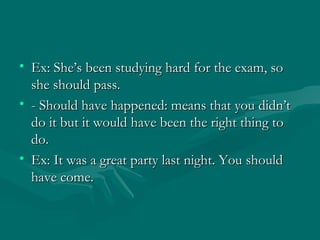
Ex: She’s been studying hard for the exam, so she should pass.  - Should have happened: means that you didn’t do it but it would have been the right thing to do.  Ex: It was a great party last night. You should have come.
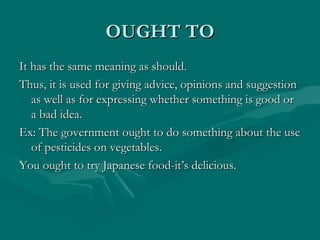
OUGHT TO It has the same meaning as should. Thus, it is used for giving advice, opinions and suggestion as well as for expressing whether something is good or a bad idea. Ex: The government ought to do something about the use of pesticides on vegetables. You ought to try Japanese food-it’s delicious.

Modal verbs

  • 1.
  • 2.
    Introduction to modalauxiliary verbs These are the modal auxiliary verbs: can, could, may, might, shall, should, will, would, must, ought to. They are used with a great frequency. They express ideas such as willingness and ability, permission and refusal, obligation and prohibition, suggestion, necessity, promise and intention. All modal auxiliary verbs can express degress of certainty, probability, or possibility.
  • 3.
    They have severalcharacteristics: There is no –s in the third person. Ex: He can swim There is no do/does in the question. Ex: May I ask a question? There is no don’t/doesn’t in the negative. Ex:You shouldn’t tell lies. They are followed by an infinitive without to. The exception is ought to. Ex: It might rain They don’t really have past forms or ing forms. Other verbs are used instead:I had to work hard when I was young. /I would love to be able to ski. They can be used with perfect infinitives to refer to the past. Ex: You should have told me./ She must have been crazy.
  • 4.
    CAN & CAN’TWe use it to say that something is possible or that somebody has the ability to do something: Ex: She can go out tonight. (It is quite possible because of the circunstances) Ex: She can play the guitar (She has learnt how to play it). We use can’t to say that we feel sure something is not possible. Ex (-): You’ve just had lunch. You can’t be hungry. -For the past we use can’t have done. Ex: Jane walked past me without speaking. She can’t have seen me. -Couldn’t have is possible instead of can’t have: Ex: She couldn’t have seen me.
  • 5.
    Could Weuse could to say that somebody had the general ability or permission to do something: Ex: My grandfather could speak five languages. Ex: We were completely free. We could do what we wanted. We use could for general ability. But if we are talking about what happened in a particular situation, we use was/were able to … or managed to, not could: Ex: The fire spread through the building quickly but everybody was able to escape.
  • 6.
    (Be) able toIt is possible instead of can, but can is more usual: Are you able to speak any foreign language? Can has only two forms, the present “can” and the past “could”, so sometimes it is necessary to use be able to. Ex: I haven´t been able to sleep recently.
  • 7.
    MUST & MUSTN’T1.We use must to say that we feel sure something is true: Ex (+): You’ve been travelling all day. You must be tired. -For the past we use “must have done”. Ex: The phone rang but I didn’t hear it. I must have been asleep. 2. We also use it to say that it is necessary to do something. In this case, we use it to give our personal feelings. Ex: She is a really nice person. You must meet her (I say this is necessary).
  • 8.
    -You can usemust to talk about the present or the future, not the past. Ex. We must go now. Ex: We must go tomorrow. 3. Mustn’t You musn’t do something, means that it is necessary that you do not do it (so don’t do it). Ex: You must keep it a secret. You mustn’t tell anyone.
  • 9.
    Have to, havegot to In the positive form, it is similar in meaning to must, but there are small differences between them. Have to is impersonal. We use it for facts, not for our personal feelings. You “have to” do something because of a rule or the situation: Ex: George can’t come out with us because he has to work. If you are not sure which to use, it is safer to use have to .
  • 10.
    -You can use have to in all for. In questions and negative sentences with have to, we normally use do/does/did: The meaning of “don’t have to” is that it is not necessary to bedone. Ex: I’m not working tomorrow, so I don’t have to get up early.
  • 11.
    NEEDN’T -You needn’tdo something means that it is not necessary that you do it, you don’t need to do it. Ex: We’ve got plenty of time. We needn’t hurry. -Instead of needn’t, you can use don’t/doesn’t need to, so you can say: -We needn’t hurry, or We don’t need to hurry. Needn’t and don’t need to are similar to don’t have to. Ex: We’ve got plenty of time. We don’t have to hurry.
  • 12.
    -Compare didn’t needto and didn’t have (done) 1. I didn’t need to is that it it was not necessary for me to and I knew it at the time. Ex: I didn’t need to get up early, so I didn’t. 2.I needn’t have (done) something, is that I did something but now I know it was not necessary. Ex: I got up early because I had to get ready to go away. But in fact, it didn’t take me long to get ready. So, I needn’t have got up early. I could have stayed in bed longer.
  • 13.
    MAY & MIGHT-We use may and might to say that something is a possibility. You can use may or might, so you can say: Ex: It may be true, or It might be true. The negative forms are may not and might not, or mightn’t. For the past, we may have (done) or might have (done): Ex: She may have been asleep. Ex: She might have left it in the shop.
  • 14.
    -Sometimes could hasa similar meaning to may and might, but we only use might when the situation is not real. Ex: If I knew them better, I might invite them to dinner. Ex: The phone’s ringing. It could be Tim ( or may or might). -We use may and might to talk about possible actions or happenings in the future: Ex: I haven’t decided yet where to spend my holidays. I may go to Ireland (perhaps I will go to Ireland).
  • 15.
    -We also usemay/might be –ing form; Ex: Don’t phone at 8.30. I may/might be watching a film.
  • 16.
    SHOULD - Should is a good thing to do or the right thing to do. You can use should to give advice or to give an opinion . Ex: You look tired. You should go to bed. -Shouldn’t , it is not a good thing to do. Ex: You shouldn’t believe everything you read in the newspapers. Should is not as strong as must. We use should to say that we expect something to happen.
  • 17.
    Ex: She’s beenstudying hard for the exam, so she should pass. - Should have happened: means that you didn’t do it but it would have been the right thing to do. Ex: It was a great party last night. You should have come.
  • 18.
    OUGHT TO Ithas the same meaning as should. Thus, it is used for giving advice, opinions and suggestion as well as for expressing whether something is good or a bad idea. Ex: The government ought to do something about the use of pesticides on vegetables. You ought to try Japanese food-it’s delicious.