MODAL VERBS
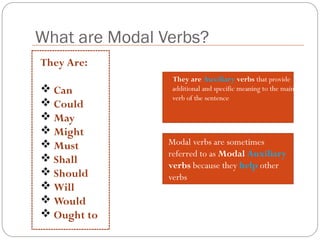
What are Modal Verbs?
They are Auxiliary verbs that provide
additional and specific meaning to the main
verb of the sentence
What are Modal Verbs?
They are Auxiliary verbs that provide
additional and specific meaning to the main
verb of the sentence
Modal verbs are sometimes
referred to as Modal Auxiliary
verbs because they help other
verbs
What are Modal Verbs?
They are Auxiliary verbs that provide
additional and specific meaning to the main
verb of the sentence
Modal verbs are sometimes
referred to as Modal Auxiliary
verbs because they help other
verbs
They Are:
 Can
 Could
 May
 Might
 Must
 Shall
 Should
 Will
 Would
 Ought to
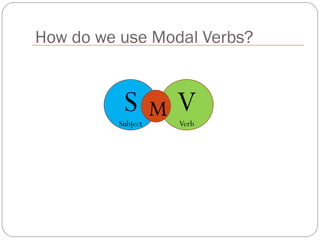
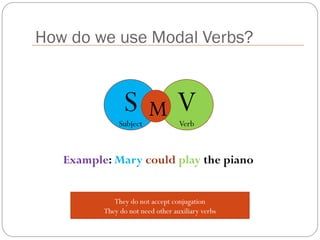
How do we use Modal Verbs?
MSSubject
VVerb
How do we use Modal Verbs?
MSSubject
VVerb
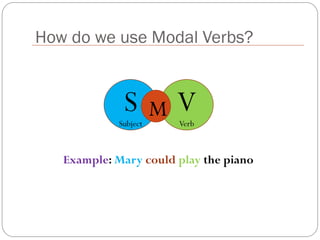
Example: Mary could play the piano
How do we use Modal Verbs?
MSSubject
VVerb
Example: Mary could play the piano
They do not accept conjugation
They do not need other auxiliary verbs
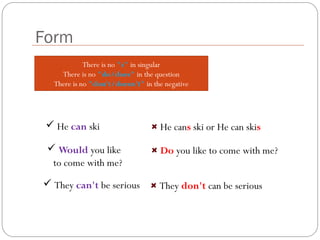
There is no "s" in singular
There is no "do/does" in the question
There is no "don't/doesn't" in the negative
Form
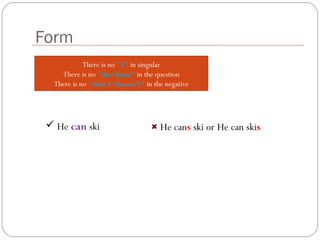
There is no "s" in singular
There is no "do/does" in the question
There is no "don't/doesn't" in the negative
Form
 He can ski He cans ski or He can skis
There is no "s" in singular
There is no "do/does" in the question
There is no "don't/doesn't" in the negative
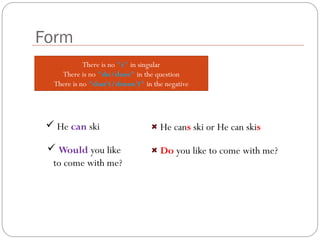
Form
 He can ski He cans ski or He can skis
 Would you like
to come with me?
Do you like to come with me?
There is no "s" in singular
There is no "do/does" in the question
There is no "don't/doesn't" in the negative
Form
 He can ski He cans ski or He can skis
 Would you like
to come with me?
Do you like to come with me?
 They can't be serious They don't can be serious
Form
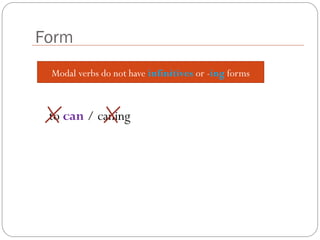
Modal verbs do not have infinitives or -ing forms
to can / caning
Form
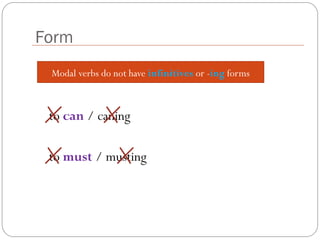
Modal verbs do not have infinitives or -ing forms
to can / caning
to must / musting
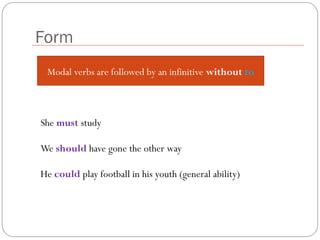
She must study
We should have gone the other way
He could play football in his youth (general ability)
Form
Modal verbs are followed by an infinitive without to
Form
Modal verbs do not have all the tenses
Form
Modal verbs do not have all the tenses
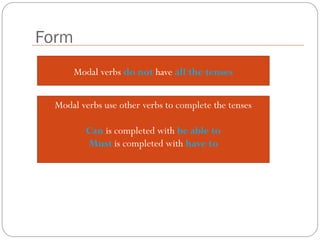
Modal verbs use other verbs to complete the tenses
Can is completed with be able to
Must is completed with have to
Form
Modal verbs do not have all the tenses
Modal verbs use other verbs to complete the tenses
Can is completed with be able to
Must is completed with have to
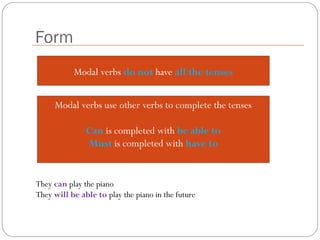
They can play the piano
They will be able to play the piano in the future
Form
Modal verbs do not have all the tenses
Modal verbs use other verbs to complete the tenses
Can is completed with be able to
Must is completed with have to
They can play the piano
They will be able to play the piano in the future
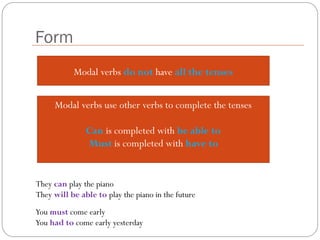
You must come early
You had to come early yesterday
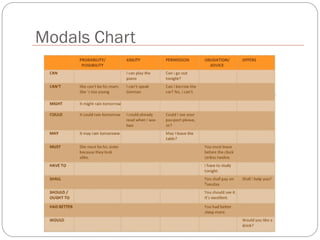
Modals Chart
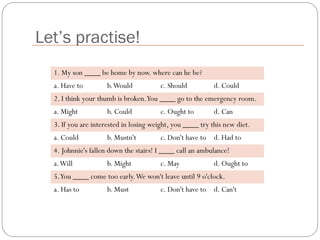
Let’s practise!
1. My son ____ be home by now. where can he be?
a. Have to b.Would c. Should d. Could
2. I think your thumb is broken.You ____ go to the emergency room.
a. Might b. Could c. Ought to d. Can
3. If you are interested in losing weight, you ____ try this new diet.
a. Could b. Mustn't c. Don't have to d. Had to
4. Johnnie's fallen down the stairs! I ____ call an ambulance!
a.Will b. Might c. May d. Ought to
5.You ____ come too early.We won't leave until 9 o'clock.
a. Has to b. Must c. Don't have to d. Can't
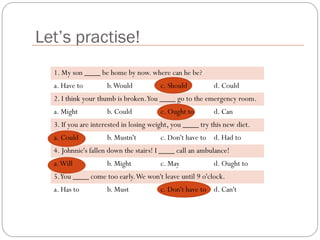
Let’s practise!
1. My son ____ be home by now. where can he be?
a. Have to b.Would c. Should d. Could
2. I think your thumb is broken.You ____ go to the emergency room.
a. Might b. Could c. Ought to d. Can
3. If you are interested in losing weight, you ____ try this new diet.
a. Could b. Mustn't c. Don't have to d. Had to
4. Johnnie's fallen down the stairs! I ____ call an ambulance!
a.Will b. Might c. May d. Ought to
5.You ____ come too early.We won't leave until 9 o'clock.
a. Has to b. Must c. Don't have to d. Can't
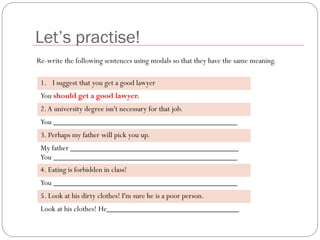
Let’s practise!
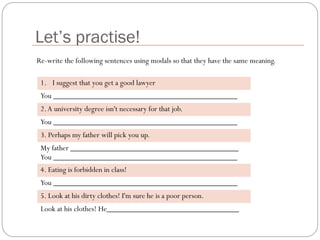
1. I suggest that you get a good lawyer
You ______________________________________________
2.A university degree isn't necessary for that job.
You ______________________________________________
3. Perhaps my father will pick you up.
My father __________________________________________
You ______________________________________________
4. Eating is forbidden in class!
You ______________________________________________
5. Look at his dirty clothes! I'm sure he is a poor person.
Look at his clothes! He_________________________________
Re-write the following sentences using modals so that they have the same meaning.
Let’s practise!
1. I suggest that you get a good lawyer
You should get a good lawyer.
2.A university degree isn't necessary for that job.
You ______________________________________________
3. Perhaps my father will pick you up.
My father __________________________________________
You ______________________________________________
4. Eating is forbidden in class!
You ______________________________________________
5. Look at his dirty clothes! I'm sure he is a poor person.
Look at his clothes! He_________________________________
Re-write the following sentences using modals so that they have the same meaning.
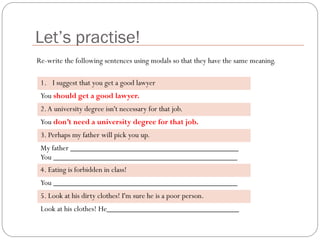
Let’s practise!
1. I suggest that you get a good lawyer
You should get a good lawyer.
2.A university degree isn't necessary for that job.
You don’t need a university degree for that job.
3. Perhaps my father will pick you up.
My father __________________________________________
You ______________________________________________
4. Eating is forbidden in class!
You ______________________________________________
5. Look at his dirty clothes! I'm sure he is a poor person.
Look at his clothes! He_________________________________
Re-write the following sentences using modals so that they have the same meaning.
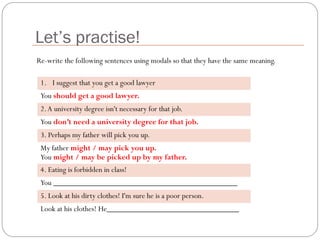
Let’s practise!
1. I suggest that you get a good lawyer
You should get a good lawyer.
2.A university degree isn't necessary for that job.
You don’t need a university degree for that job.
3. Perhaps my father will pick you up.
My father might / may pick you up.
You might / may be picked up by my father.
4. Eating is forbidden in class!
You ______________________________________________
5. Look at his dirty clothes! I'm sure he is a poor person.
Look at his clothes! He_________________________________
Re-write the following sentences using modals so that they have the same meaning.
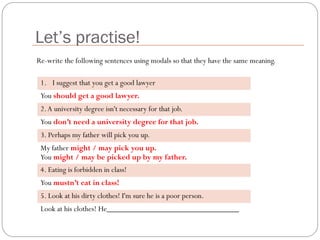
Let’s practise!
1. I suggest that you get a good lawyer
You should get a good lawyer.
2.A university degree isn't necessary for that job.
You don’t need a university degree for that job.
3. Perhaps my father will pick you up.
My father might / may pick you up.
You might / may be picked up by my father.
4. Eating is forbidden in class!
You mustn’t eat in class!
5. Look at his dirty clothes! I'm sure he is a poor person.
Look at his clothes! He_________________________________
Re-write the following sentences using modals so that they have the same meaning.
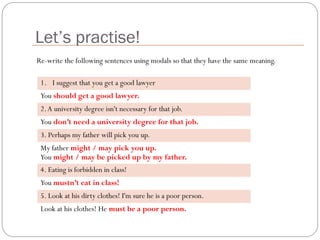
Let’s practise!
1. I suggest that you get a good lawyer
You should get a good lawyer.
2.A university degree isn't necessary for that job.
You don’t need a university degree for that job.
3. Perhaps my father will pick you up.
My father might / may pick you up.
You might / may be picked up by my father.
4. Eating is forbidden in class!
You mustn’t eat in class!
5. Look at his dirty clothes! I'm sure he is a poor person.
Look at his clothes! He must be a poor person.
Re-write the following sentences using modals so that they have the same meaning.
Modal verbs

Modal verbs

  • 1.
  • 2.
  • 3.
    What are ModalVerbs? They are Auxiliary verbs that provide additional and specific meaning to the main verb of the sentence
  • 4.
    What are ModalVerbs? They are Auxiliary verbs that provide additional and specific meaning to the main verb of the sentence Modal verbs are sometimes referred to as Modal Auxiliary verbs because they help other verbs
  • 5.
    What are ModalVerbs? They are Auxiliary verbs that provide additional and specific meaning to the main verb of the sentence Modal verbs are sometimes referred to as Modal Auxiliary verbs because they help other verbs They Are:  Can  Could  May  Might  Must  Shall  Should  Will  Would  Ought to
  • 6.
    How do weuse Modal Verbs?
  • 7.
    How do weuse Modal Verbs? MSSubject VVerb
  • 8.
    How do weuse Modal Verbs? MSSubject VVerb Example: Mary could play the piano
  • 9.
    How do weuse Modal Verbs? MSSubject VVerb Example: Mary could play the piano They do not accept conjugation They do not need other auxiliary verbs
  • 10.
    There is no"s" in singular There is no "do/does" in the question There is no "don't/doesn't" in the negative Form
  • 11.
    There is no"s" in singular There is no "do/does" in the question There is no "don't/doesn't" in the negative Form  He can ski He cans ski or He can skis
  • 12.
    There is no"s" in singular There is no "do/does" in the question There is no "don't/doesn't" in the negative Form  He can ski He cans ski or He can skis  Would you like to come with me? Do you like to come with me?
  • 13.
    There is no"s" in singular There is no "do/does" in the question There is no "don't/doesn't" in the negative Form  He can ski He cans ski or He can skis  Would you like to come with me? Do you like to come with me?  They can't be serious They don't can be serious
  • 14.
    Form Modal verbs donot have infinitives or -ing forms to can / caning
  • 15.
    Form Modal verbs donot have infinitives or -ing forms to can / caning to must / musting
  • 16.
    She must study Weshould have gone the other way He could play football in his youth (general ability) Form Modal verbs are followed by an infinitive without to
  • 17.
    Form Modal verbs donot have all the tenses
  • 18.
    Form Modal verbs donot have all the tenses Modal verbs use other verbs to complete the tenses Can is completed with be able to Must is completed with have to
  • 19.
    Form Modal verbs donot have all the tenses Modal verbs use other verbs to complete the tenses Can is completed with be able to Must is completed with have to They can play the piano They will be able to play the piano in the future
  • 20.
    Form Modal verbs donot have all the tenses Modal verbs use other verbs to complete the tenses Can is completed with be able to Must is completed with have to They can play the piano They will be able to play the piano in the future You must come early You had to come early yesterday
  • 21.
  • 22.
    Let’s practise! 1. Myson ____ be home by now. where can he be? a. Have to b.Would c. Should d. Could 2. I think your thumb is broken.You ____ go to the emergency room. a. Might b. Could c. Ought to d. Can 3. If you are interested in losing weight, you ____ try this new diet. a. Could b. Mustn't c. Don't have to d. Had to 4. Johnnie's fallen down the stairs! I ____ call an ambulance! a.Will b. Might c. May d. Ought to 5.You ____ come too early.We won't leave until 9 o'clock. a. Has to b. Must c. Don't have to d. Can't
  • 23.
    Let’s practise! 1. Myson ____ be home by now. where can he be? a. Have to b.Would c. Should d. Could 2. I think your thumb is broken.You ____ go to the emergency room. a. Might b. Could c. Ought to d. Can 3. If you are interested in losing weight, you ____ try this new diet. a. Could b. Mustn't c. Don't have to d. Had to 4. Johnnie's fallen down the stairs! I ____ call an ambulance! a.Will b. Might c. May d. Ought to 5.You ____ come too early.We won't leave until 9 o'clock. a. Has to b. Must c. Don't have to d. Can't
  • 24.
    Let’s practise! 1. Isuggest that you get a good lawyer You ______________________________________________ 2.A university degree isn't necessary for that job. You ______________________________________________ 3. Perhaps my father will pick you up. My father __________________________________________ You ______________________________________________ 4. Eating is forbidden in class! You ______________________________________________ 5. Look at his dirty clothes! I'm sure he is a poor person. Look at his clothes! He_________________________________ Re-write the following sentences using modals so that they have the same meaning.
  • 25.
    Let’s practise! 1. Isuggest that you get a good lawyer You should get a good lawyer. 2.A university degree isn't necessary for that job. You ______________________________________________ 3. Perhaps my father will pick you up. My father __________________________________________ You ______________________________________________ 4. Eating is forbidden in class! You ______________________________________________ 5. Look at his dirty clothes! I'm sure he is a poor person. Look at his clothes! He_________________________________ Re-write the following sentences using modals so that they have the same meaning.
  • 26.
    Let’s practise! 1. Isuggest that you get a good lawyer You should get a good lawyer. 2.A university degree isn't necessary for that job. You don’t need a university degree for that job. 3. Perhaps my father will pick you up. My father __________________________________________ You ______________________________________________ 4. Eating is forbidden in class! You ______________________________________________ 5. Look at his dirty clothes! I'm sure he is a poor person. Look at his clothes! He_________________________________ Re-write the following sentences using modals so that they have the same meaning.
  • 27.
    Let’s practise! 1. Isuggest that you get a good lawyer You should get a good lawyer. 2.A university degree isn't necessary for that job. You don’t need a university degree for that job. 3. Perhaps my father will pick you up. My father might / may pick you up. You might / may be picked up by my father. 4. Eating is forbidden in class! You ______________________________________________ 5. Look at his dirty clothes! I'm sure he is a poor person. Look at his clothes! He_________________________________ Re-write the following sentences using modals so that they have the same meaning.
  • 28.
    Let’s practise! 1. Isuggest that you get a good lawyer You should get a good lawyer. 2.A university degree isn't necessary for that job. You don’t need a university degree for that job. 3. Perhaps my father will pick you up. My father might / may pick you up. You might / may be picked up by my father. 4. Eating is forbidden in class! You mustn’t eat in class! 5. Look at his dirty clothes! I'm sure he is a poor person. Look at his clothes! He_________________________________ Re-write the following sentences using modals so that they have the same meaning.
  • 29.
    Let’s practise! 1. Isuggest that you get a good lawyer You should get a good lawyer. 2.A university degree isn't necessary for that job. You don’t need a university degree for that job. 3. Perhaps my father will pick you up. My father might / may pick you up. You might / may be picked up by my father. 4. Eating is forbidden in class! You mustn’t eat in class! 5. Look at his dirty clothes! I'm sure he is a poor person. Look at his clothes! He must be a poor person. Re-write the following sentences using modals so that they have the same meaning.