MODAL VERBS
What are modal verbs?
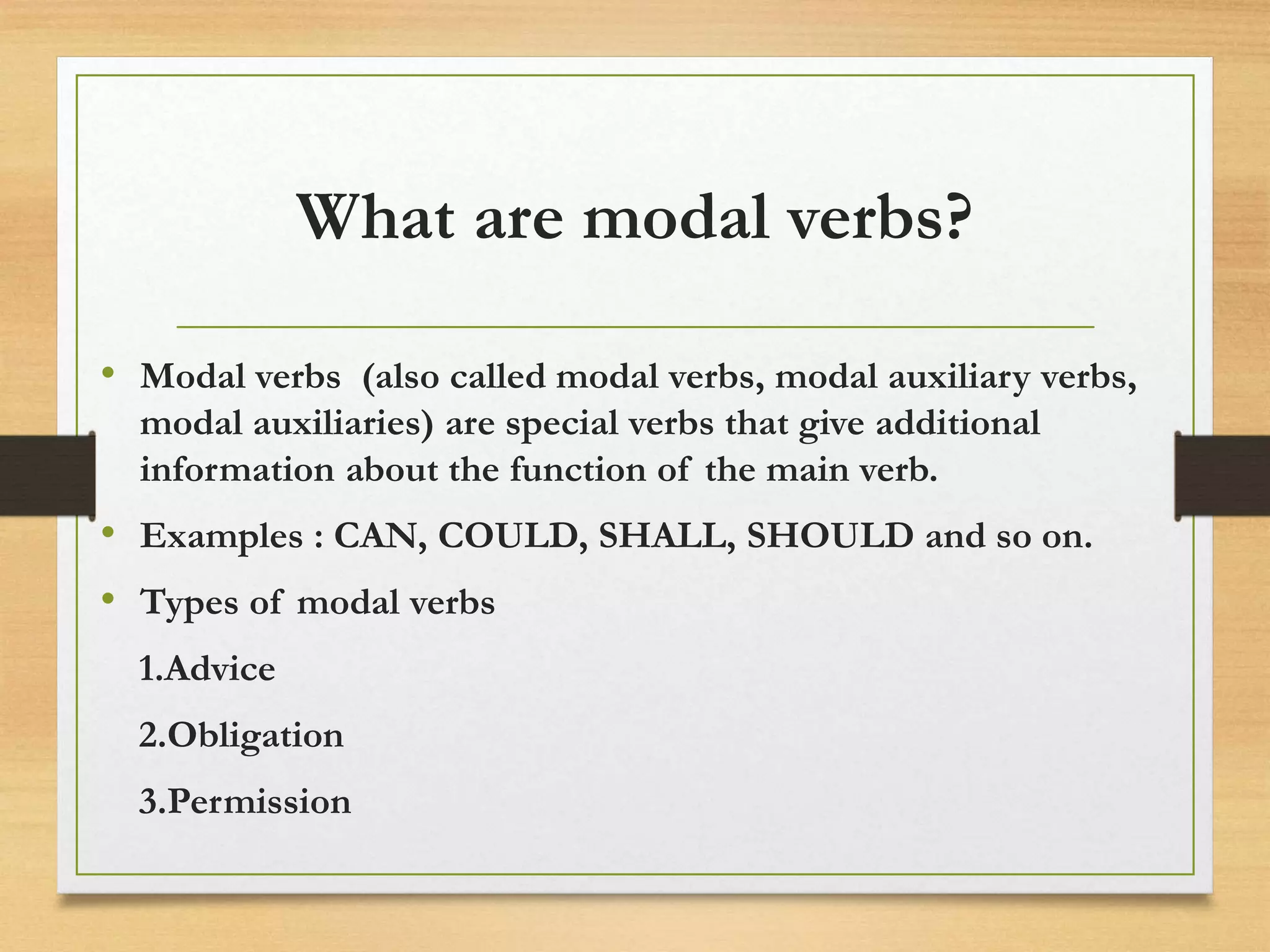
• Modal verbs (also called modal verbs, modal auxiliary verbs,
modal auxiliaries) are special verbs that give additional
information about the function of the main verb.
• Examples : CAN, COULD, SHALL, SHOULD and so on.
• Types of modal verbs
1.Advice
2.Obligation
3.Permission
Modals
• Modals in the present
: You should see a doctor.
• Modals in the past
: You should have seen a doctor
Advice
Modal Verbs OF
- Use to give advice and make recommendations.
- For example:
- I think you shouldn’t lazy to do your homework.
- We should wake up in early morning because we must go to school.
• Should is used for advice in the present.
• Should is used for advice in the past.
• For negative advice.
Should
Ought to
- Similar to should but less common speech and
usually not used in negative way
- For example:
- You ought not to steal your mother’s money.
- You ought to study hard for the bright future.
• For negative advice
Had better
- Stronger and more urgent than should or ought to, so it
used to give
stronger advice and warning
- For example:
- It looks like rain, you had better take an umbrella.
- She had better hurry up because the train leaves in 5
minutes.
• For negative advice
Obligation
Modal Verbs OF
Obligation
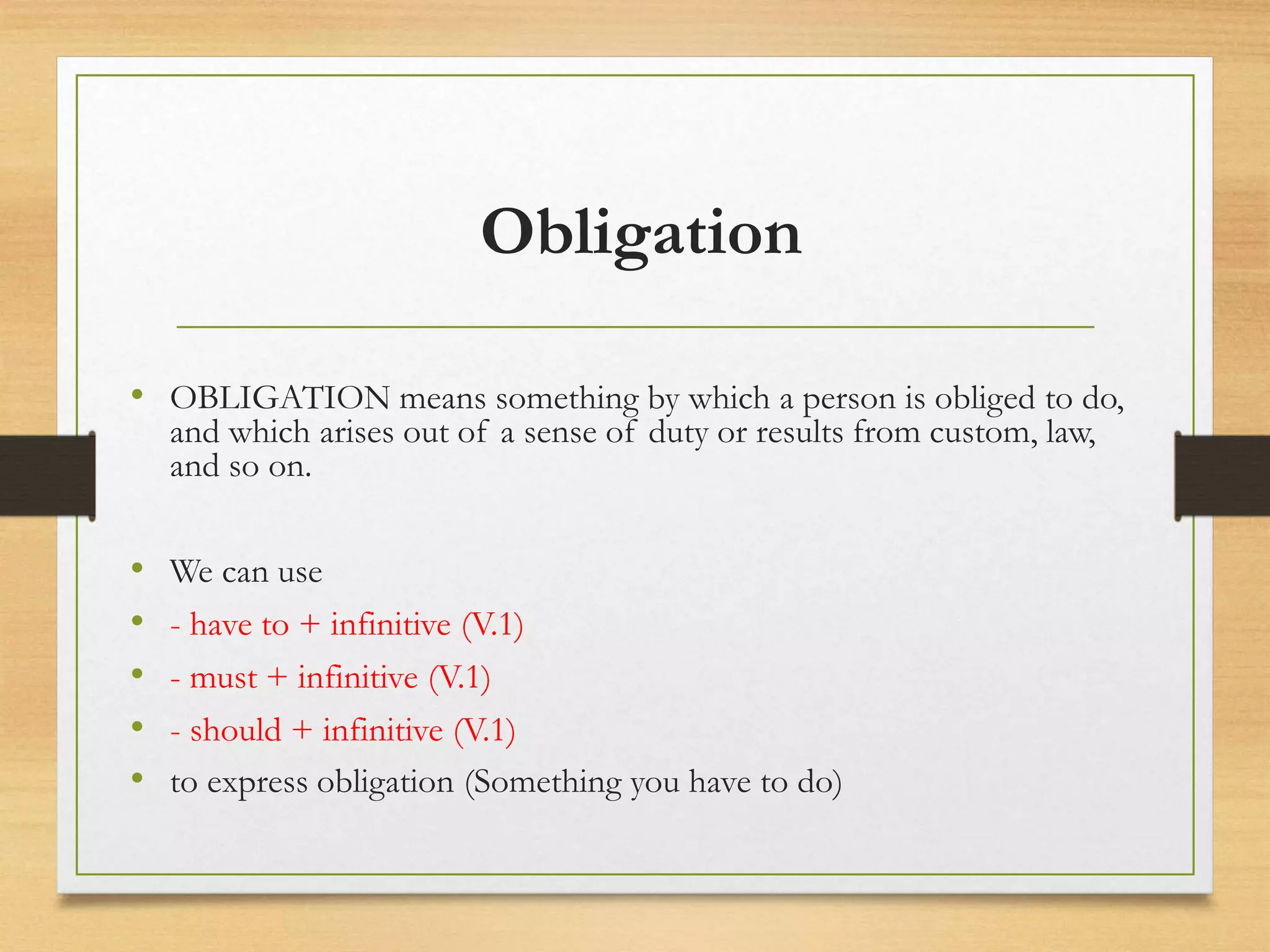
• OBLIGATION means something by which a person is obliged to do,
and which arises out of a sense of duty or results from custom, law,
and so on.
• We can use
• - have to + infinitive (V.1)
• - must + infinitive (V.1)
• - should + infinitive (V.1)
• to express obligation (Something you have to do)
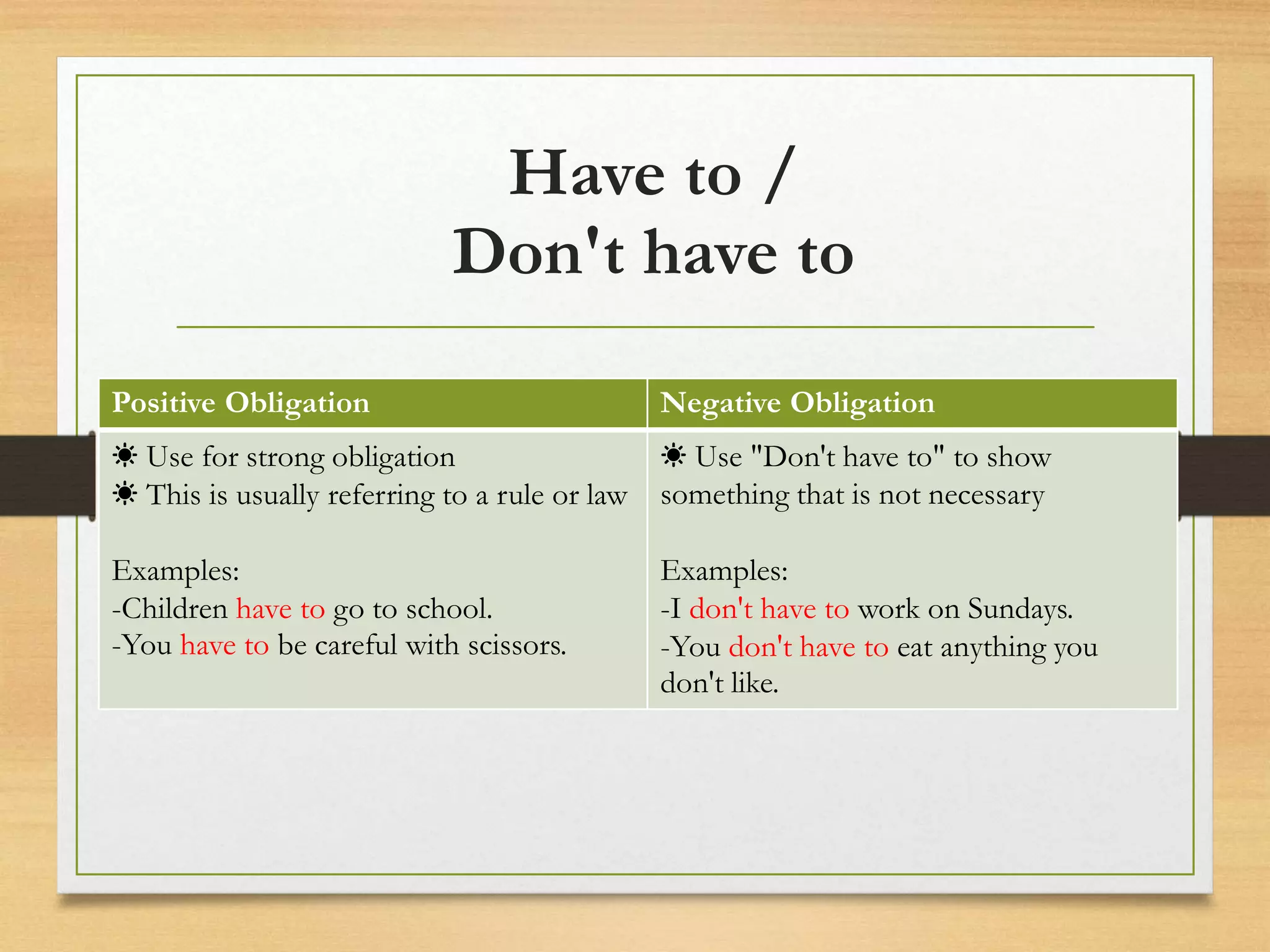
Have to /
Don't have to
Positive Obligation Negative Obligation
☀ Use for strong obligation
☀ This is usually referring to a rule or law
Examples:
-Children have to go to school.
-You have to be careful with scissors.
☀ Use "Don't have to" to show
something that is not necessary
Examples:
-I don't have to work on Sundays.
-You don't have to eat anything you
don't like.
Had to /
Didn't have to
Positive Obligation Negative Obligation
☀ Obligation in the past
Example:
-I had to wear a school uniform when I
was a child.
☀ No obligation in the past
Example:
-We didn't have to go to school on
Saturdays.
Must (Must Have) /
Mustn't
Positive Obligation Negative Obligation
☀ Strong obligation (possibly based on
the speaker's opinion)
: I must study today.
☀ It is formal and normally used in
writing
:You must use a pencil on the test.
☀ Logic/Certainty or strong probability.
: She must be hungry because she has
not eaten for 2 days.
☀ MUST HAVE: use in supposition
: I can't find my laptop, I must have left
it in the train.
☀ "Must not" shows something that
is prohibited
Examples:
-You mustn't smoke here.
-You mustn’t eat in the computer room.
(Food in the
computer room is prohibited.)
SPECIAL EXAMPLE
• Take care to distinguish correctly between "had to" and "must
have"
• They had to go to Thailand.
= They were obliged to go to Thailand.
Vs.
• They must have gone to Thailand.
= In my opinion, they have certainly gone to Thailand.
Should have + past participle /
Shouldn't have + past participle
Positive Obligation Negative Obligation
☀ A past action which didn't happen.
Example:
-You should have gone to bed earlier,
now you have missed the train.
☀ A past action which didn't happen.
Example:
-You shouldn't have taken that job, it
was a bad idea.
SPECIAL EXAMPLE
• Here is an example of the difference between 'have to' and 'must':
• -My doctor said that I have to stop smoking or I'll risk serious
problems. (I have no choice)
Vs.
• -I must stop smoking. It’s costing me too much money. (It’s my
decision)
NOTE TO SELF:
• Be careful about the difference between don't have to and
mustn't!
• Don't have to means you don't need to do something, but it's
fine if you want to do it:
• -I don't have to get up early at the weekend (of course, if I want
to get up early, that's fine, but I can stay in bed if I want).
• Mustn't means it's not allowed, or it's a bad idea:
• -You mustn't eat so much chocolate, you'll be sick.
Should (Ought to) /
Shouldn't
Positive Obligation Negative Obligation
Mild obligation
Advice
Logic/Conclusion
Examples:
-You should save some money.
-I ought to get a haircut
Mild negative obligation
Advice
Examples:
-You shouldn't smoke so much.
Should and ought to are more or less synonymous
Example:
-You should stop smoking. = You ought to stop smoking.
Permission
Modal Verbs OF
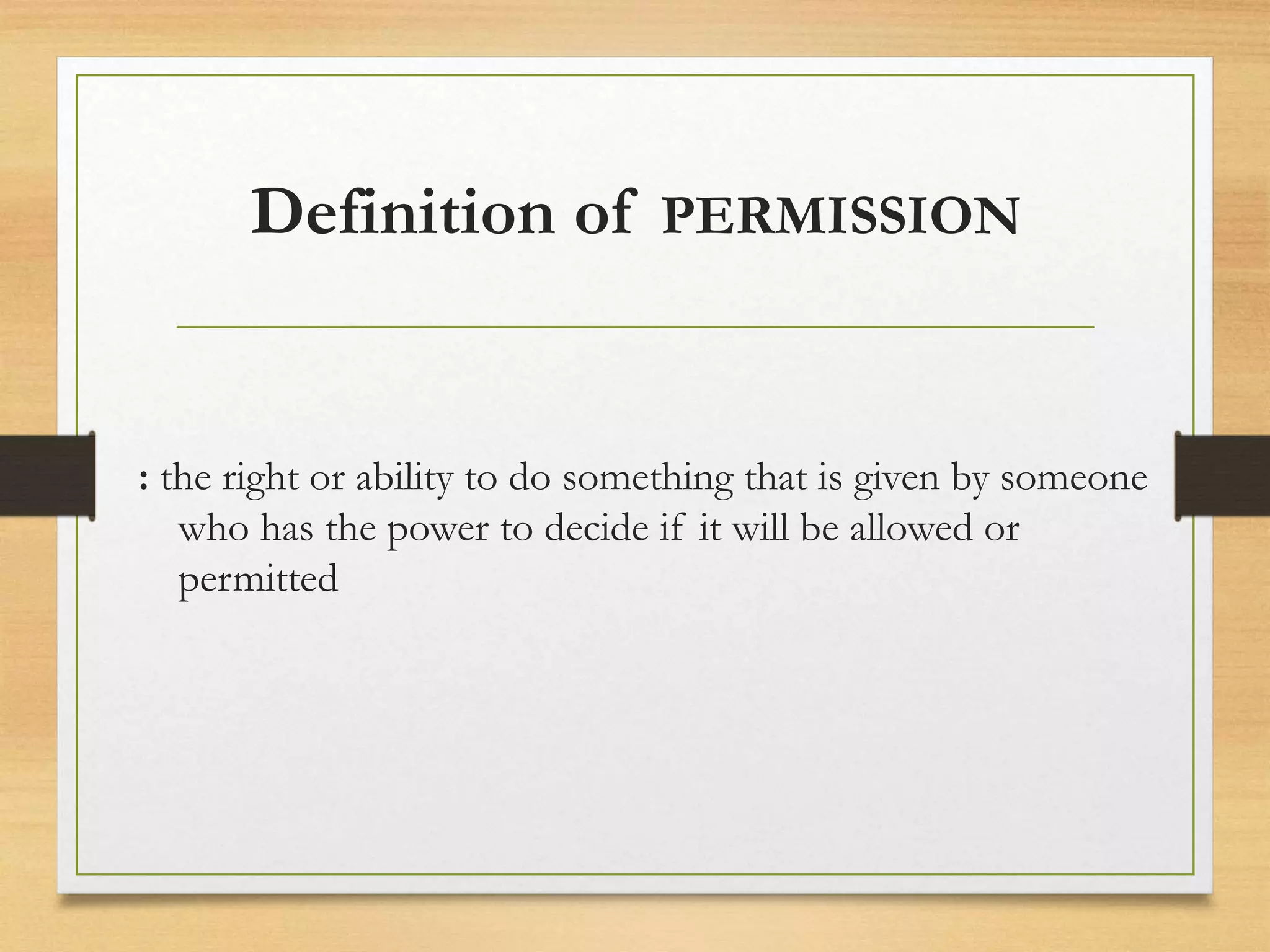
Definition of PERMISSION
: the right or ability to do something that is given by someone
who has the power to decide if it will be allowed or
permitted
Ask For Permission
• We often use “can” to ask for permission.
Ex. Can I go home now?
Can we eat this pizza?
• Could is more formal and polite than can.
Ex. Could I play a video games?
Could I smoke at the school?
• May is another more formal and polite way.
Ex. May I go to shopping?
May I drink water?
Give Permission
• We also often use “can” to give permission
Ex. You can go home now.
You can eat this pizza.
• Could is more formal and polite than can, and we use could to say that
something was permitted in the past
Ex. You could play a video games .
You could smoke at the school 15 years ago.
• May is more formal and polite way to give permission
Ex. You may go shopping.
You may drink water.
Refusing Permission
• We use “can’t” to say that something isn’t permitted.
Ex. You can’t go how now.
You can’t eat this pizza.
• We use “couldn’t” to say that something was not permitted in the past.
Ex. You couldn’t smoke in the bus.
You couldn’t do exercise in the toilet.
• We can also use “may” to say that something isn’t permitted too.
Ex. No, you may not.
TEST YOURSELF
• You don’t look very well, you __________ go to
work.
had better not
TEST YOURSELF
• Mrs. Johnnie's body was found in
the lounge just moments ago, and
it's still warm! Nobody has left the
mansion this evening, so the killer
______ be someone in this room.
It ______ be any one of us!!!
must
could
TEST YOURSELF
• She __________ get up early today, because it's
Sunday.
doesn’t have to
TEST YOURSELF
• You ______ tell anyone what I just told you. It's a
secret.
mustn’t
TEST YOURSELF
• Ned: ______ I borrow your lighter for a minute?
Sarah: Sure, no problem. Actually, you ______ keep it
if you want to. I've given up smoking.
Can
can
Thank you for listening.
Jitrapa Leetanasaksakul No.3
Tanasorn Pajchim No.7
Apichaya Wanwaisart No.11

Modal Verbs: Advice, Obligation, Permission

  • 1.
  • 2.
    What are modalverbs? • Modal verbs (also called modal verbs, modal auxiliary verbs, modal auxiliaries) are special verbs that give additional information about the function of the main verb. • Examples : CAN, COULD, SHALL, SHOULD and so on. • Types of modal verbs 1.Advice 2.Obligation 3.Permission
  • 3.
    Modals • Modals inthe present : You should see a doctor. • Modals in the past : You should have seen a doctor
  • 4.
  • 5.
    - Use togive advice and make recommendations. - For example: - I think you shouldn’t lazy to do your homework. - We should wake up in early morning because we must go to school. • Should is used for advice in the present. • Should is used for advice in the past. • For negative advice. Should
  • 6.
    Ought to - Similarto should but less common speech and usually not used in negative way - For example: - You ought not to steal your mother’s money. - You ought to study hard for the bright future. • For negative advice
  • 7.
    Had better - Strongerand more urgent than should or ought to, so it used to give stronger advice and warning - For example: - It looks like rain, you had better take an umbrella. - She had better hurry up because the train leaves in 5 minutes. • For negative advice
  • 8.
  • 9.
    Obligation • OBLIGATION meanssomething by which a person is obliged to do, and which arises out of a sense of duty or results from custom, law, and so on. • We can use • - have to + infinitive (V.1) • - must + infinitive (V.1) • - should + infinitive (V.1) • to express obligation (Something you have to do)
  • 10.
    Have to / Don'thave to Positive Obligation Negative Obligation ☀ Use for strong obligation ☀ This is usually referring to a rule or law Examples: -Children have to go to school. -You have to be careful with scissors. ☀ Use "Don't have to" to show something that is not necessary Examples: -I don't have to work on Sundays. -You don't have to eat anything you don't like.
  • 11.
    Had to / Didn'thave to Positive Obligation Negative Obligation ☀ Obligation in the past Example: -I had to wear a school uniform when I was a child. ☀ No obligation in the past Example: -We didn't have to go to school on Saturdays.
  • 12.
    Must (Must Have)/ Mustn't Positive Obligation Negative Obligation ☀ Strong obligation (possibly based on the speaker's opinion) : I must study today. ☀ It is formal and normally used in writing :You must use a pencil on the test. ☀ Logic/Certainty or strong probability. : She must be hungry because she has not eaten for 2 days. ☀ MUST HAVE: use in supposition : I can't find my laptop, I must have left it in the train. ☀ "Must not" shows something that is prohibited Examples: -You mustn't smoke here. -You mustn’t eat in the computer room. (Food in the computer room is prohibited.)
  • 13.
    SPECIAL EXAMPLE • Takecare to distinguish correctly between "had to" and "must have" • They had to go to Thailand. = They were obliged to go to Thailand. Vs. • They must have gone to Thailand. = In my opinion, they have certainly gone to Thailand.
  • 14.
    Should have +past participle / Shouldn't have + past participle Positive Obligation Negative Obligation ☀ A past action which didn't happen. Example: -You should have gone to bed earlier, now you have missed the train. ☀ A past action which didn't happen. Example: -You shouldn't have taken that job, it was a bad idea.
  • 15.
    SPECIAL EXAMPLE • Hereis an example of the difference between 'have to' and 'must': • -My doctor said that I have to stop smoking or I'll risk serious problems. (I have no choice) Vs. • -I must stop smoking. It’s costing me too much money. (It’s my decision)
  • 16.
    NOTE TO SELF: •Be careful about the difference between don't have to and mustn't! • Don't have to means you don't need to do something, but it's fine if you want to do it: • -I don't have to get up early at the weekend (of course, if I want to get up early, that's fine, but I can stay in bed if I want). • Mustn't means it's not allowed, or it's a bad idea: • -You mustn't eat so much chocolate, you'll be sick.
  • 17.
    Should (Ought to)/ Shouldn't Positive Obligation Negative Obligation Mild obligation Advice Logic/Conclusion Examples: -You should save some money. -I ought to get a haircut Mild negative obligation Advice Examples: -You shouldn't smoke so much. Should and ought to are more or less synonymous Example: -You should stop smoking. = You ought to stop smoking.
  • 18.
  • 19.
    Definition of PERMISSION :the right or ability to do something that is given by someone who has the power to decide if it will be allowed or permitted
  • 20.
    Ask For Permission •We often use “can” to ask for permission. Ex. Can I go home now? Can we eat this pizza? • Could is more formal and polite than can. Ex. Could I play a video games? Could I smoke at the school? • May is another more formal and polite way. Ex. May I go to shopping? May I drink water?
  • 21.
    Give Permission • Wealso often use “can” to give permission Ex. You can go home now. You can eat this pizza. • Could is more formal and polite than can, and we use could to say that something was permitted in the past Ex. You could play a video games . You could smoke at the school 15 years ago. • May is more formal and polite way to give permission Ex. You may go shopping. You may drink water.
  • 22.
    Refusing Permission • Weuse “can’t” to say that something isn’t permitted. Ex. You can’t go how now. You can’t eat this pizza. • We use “couldn’t” to say that something was not permitted in the past. Ex. You couldn’t smoke in the bus. You couldn’t do exercise in the toilet. • We can also use “may” to say that something isn’t permitted too. Ex. No, you may not.
  • 23.
    TEST YOURSELF • Youdon’t look very well, you __________ go to work. had better not
  • 24.
    TEST YOURSELF • Mrs.Johnnie's body was found in the lounge just moments ago, and it's still warm! Nobody has left the mansion this evening, so the killer ______ be someone in this room. It ______ be any one of us!!! must could
  • 25.
    TEST YOURSELF • She__________ get up early today, because it's Sunday. doesn’t have to
  • 26.
    TEST YOURSELF • You______ tell anyone what I just told you. It's a secret. mustn’t
  • 27.
    TEST YOURSELF • Ned:______ I borrow your lighter for a minute? Sarah: Sure, no problem. Actually, you ______ keep it if you want to. I've given up smoking. Can can
  • 28.
    Thank you forlistening. Jitrapa Leetanasaksakul No.3 Tanasorn Pajchim No.7 Apichaya Wanwaisart No.11