ENGLISH
COURSE
BY: CAMPO ELIAS SANCHEZ
WHAT ARE MODAL VERBS?
Modal verbs are special verbs which behave very differently from normal verbs. Here are some important
differences:
1Modal verbs do not take "-s" in the third person.
. Examples:
He can speak Chinese.
She should be here by 9:00.
2. You use "not" to make modal verbs negative, even in Simple Present and Simple Past.
Examples:
He should not be late.
They might not come to the party.
3. Many modal verbs cannot be used in the past tenses or the future tenses.
Examples:
He will can go with us. Not Correct
She musted study very hard. Not Correct
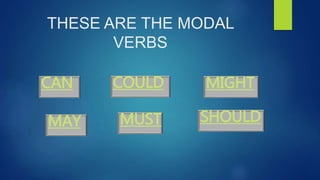
THESE ARE THE MODAL
VERBS
CAN
MUST SHOULD
MIGHT
MAY
COULD
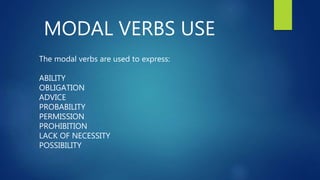
MODAL VERBS USE
The modal verbs are used to express:
ABILITY
OBLIGATION
ADVICE
PROBABILITY
PERMISSION
PROHIBITION
LACK OF NECESSITY
POSSIBILITY
CAN
Can is an auxiliary verb, a modal
auxiliary verb. We use can to:
Talk about possibility and ability
Make requests
Ask for or give permission
TALK ABOUT POSSIBILITY AND
ABILITY
to talk about what i.s possible, what we are able or free to do
 She can drive a car.
 John can speak Spanish.
 I cannot hear you. (I can't hear you.)
 Can you hear me?
CAN FOR REQUESTS AND ORDERS
We often use can in a question to ask somebody to do something. This is not
a real question - we do not really want to know if the person is able to do
something, we want them to do it! The use ofcan in this way is informal
(mainly between friends and family):
 Can you make a cup of coffee, please.
 Can you put the TV on.
 Can you come here a minute.
 Can you be quiet!
CAN FOR PERMISSION
We sometimes use can to ask or give permission for something:
 Can I smoke in this room?
 You can't smoke here, but you can smoke in the garden.
 (Note that we also use could, may, might for permission. The
use of can for permission is informal.)
COULD
Could is an auxiliary verb, a modal
auxiliary verb. We use could to:
talk about past possibility or ability
make requests
COULD FOR PAST POSSIBILITY OR
ABILITY
We use could to talk about what was possible in the past, what we were able
or free to do:
 I could swim when I was 5 years old.
 My grandmother could speak seven languages.
 When we arrived home, we could not open the door. (...couldn't open the
door.)
 Could you understand what he was saying?
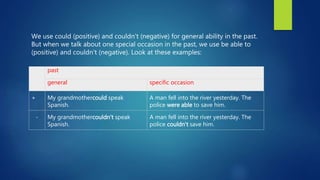
We use could (positive) and couldn't (negative) for general ability in the past.
But when we talk about one special occasion in the past, we use be able to
(positive) and couldn't (negative). Look at these examples:
past
general specific occasion
+ My grandmothercould speak
Spanish.
A man fell into the river yesterday. The
police were able to save him.
- My grandmothercouldn't speak
Spanish.
A man fell into the river yesterday. The
police couldn't save him.
COULD FOR REQUESTS
We often use could in a question to ask somebody to do
something. The use of could in this way is fairly polite (formal):
 Could you tell me where the bank is, please?
 Could you send me a catalogue, please?
MIGHT
"Might" is most commonly used to
express possibility. It is also often
used in conditional sentences.
English speakers can also use "might"
to make suggestions or requests,
although this is less common in
American English.
MIGHT FOR POSSIBILITY
 She might be on the bus. I think her car is having problems.
 She might have taken the bus. I'm not sure how she got to
work.
 She might take the bus to get home. I don't think Bill will be
able to give her a ride.
MIGHT FOR SUGGESTION
 You might have tried the cheese cake.
 You might try the cheesecake.
MIGHT FOR REQUEST
(British form)
 Might I have something to drink?
 Might I borrow the stapler
Requests usually refer to the near future.
MIGHT
CONDITIONAL OF MAY
 If I entered the contest, I might actually win.
 If I had entered the contest, I might actually have won.
 If I entered the contest tomorrow, I might actually win. Unfortunately, I
can't enter it.
MAY
May" is most commonly used to
express possibility. It can also be
used to give or request permission,
although this usage is becoming less
common.
MAY FOR
POSSIBILITY
 Jack may be upset. I can't really tell if he is annoyed or tired.
 Jack may have been upset. I couldn't really tell if he was
annoyed or tired.
 Jack may get upset if you don't tell him the truth.
MAY FOR PERMISSION
 You may leave the table now that you're finished with your
dinner.
You were allowed to leave the table after you finished your
dinner.
 You may leave the table when you finish your dinner.
 May I borrow your eraser?
 May I make a phone call?
Requests usually refer to the near future.
MUST
 "Must" is most commonly used to express
certainty. It can also be used to express
necessity or strong recommendation,
although native speakers prefer the more
flexible form "have to." "Must not" can be
used to prohibit actions, but this sounds very
severe; speakers prefer to use softer modal
verbs such as "should not" or "ought not" to
dissuade rather than prohibit.
MUST FOR CERTAINTY
 That must be Jerry. They said he was tall with bright red hair.
 That must have been the right restaurant. There are no other
restaurants on this street.
 That must not be Jerry. He is supposed to have red hair.
 That must not have been the right restaurant. I guess there is
another one around here somewhere.
MUST NOT FOR PROHIBITION
 You must not swim in that river. It's full of crocodiles.
 You must not forget to take your malaria medication while
your are in the tropics.
Prohibition usually refer to the near future.
MUST FOR STRONG
RECOMMENDATION
(Americans prefer the form "should.“)
 You must take some time off and get some rest.
 You should have taken some time off last week to get some rest.
 You should take some time off next week to get some rest.
 You mustn't drink so much. It's not good for your health.
You shouldn't have drunk so much. That caused the accident.
 You shouldn't drink at the party. You are going to be the
designated driver.
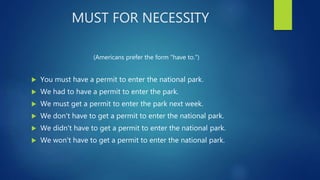
MUST FOR NECESSITY
(Americans prefer the form "have to.")
 You must have a permit to enter the national park.
 We had to have a permit to enter the park.
 We must get a permit to enter the park next week.
 We don't have to get a permit to enter the national park.
 We didn't have to get a permit to enter the national park.
 We won't have to get a permit to enter the national park.
SHOULD
Should is most commonly used to
make recommendations or give
advice. It can also be used to express
obligation as well as expectation.
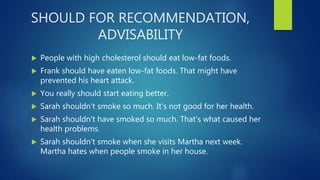
SHOULD FOR RECOMMENDATION,
ADVISABILITY
 People with high cholesterol should eat low-fat foods.
 Frank should have eaten low-fat foods. That might have
prevented his heart attack.
 You really should start eating better.
 Sarah shouldn't smoke so much. It's not good for her health.
 Sarah shouldn't have smoked so much. That's what caused her
health problems.
 Sarah shouldn't smoke when she visits Martha next week.
Martha hates when people smoke in her house.
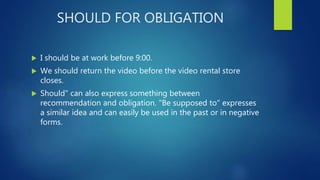
SHOULD FOR OBLIGATION
 I should be at work before 9:00.
 We should return the video before the video rental store
closes.
 Should" can also express something between
recommendation and obligation. "Be supposed to" expresses
a similar idea and can easily be used in the past or in negative
forms.
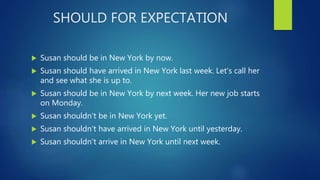
SHOULD FOR EXPECTATION
 Susan should be in New York by now.
 Susan should have arrived in New York last week. Let's call her
and see what she is up to.
 Susan should be in New York by next week. Her new job starts
on Monday.
 Susan shouldn't be in New York yet.
 Susan shouldn't have arrived in New York until yesterday.
 Susan shouldn't arrive in New York until next week.
EXERCISE ZONE
 http://www.eslgamesworld.com/members/games/grammar/basketball/mo
dals%20can%20must%20would/modals%20can%20must%20would.html
 http://www.englishpage.com/modals/interactivemodal1.htm
 http://www.englishpage.com/modals/interactivemodal3.htm
 http://www.englishpage.com/modals/interactivemodal7.htm
 http://www.englishpage.com/modals/interactivemodal8.htm

MODAL VERBS

  • 1.
  • 4.
    WHAT ARE MODALVERBS? Modal verbs are special verbs which behave very differently from normal verbs. Here are some important differences: 1Modal verbs do not take "-s" in the third person. . Examples: He can speak Chinese. She should be here by 9:00. 2. You use "not" to make modal verbs negative, even in Simple Present and Simple Past. Examples: He should not be late. They might not come to the party. 3. Many modal verbs cannot be used in the past tenses or the future tenses. Examples: He will can go with us. Not Correct She musted study very hard. Not Correct
  • 5.
    THESE ARE THEMODAL VERBS CAN MUST SHOULD MIGHT MAY COULD
  • 6.
    MODAL VERBS USE Themodal verbs are used to express: ABILITY OBLIGATION ADVICE PROBABILITY PERMISSION PROHIBITION LACK OF NECESSITY POSSIBILITY
  • 8.
    CAN Can is anauxiliary verb, a modal auxiliary verb. We use can to: Talk about possibility and ability Make requests Ask for or give permission
  • 9.
    TALK ABOUT POSSIBILITYAND ABILITY to talk about what i.s possible, what we are able or free to do  She can drive a car.  John can speak Spanish.  I cannot hear you. (I can't hear you.)  Can you hear me?
  • 10.
    CAN FOR REQUESTSAND ORDERS We often use can in a question to ask somebody to do something. This is not a real question - we do not really want to know if the person is able to do something, we want them to do it! The use ofcan in this way is informal (mainly between friends and family):  Can you make a cup of coffee, please.  Can you put the TV on.  Can you come here a minute.  Can you be quiet!
  • 11.
    CAN FOR PERMISSION Wesometimes use can to ask or give permission for something:  Can I smoke in this room?  You can't smoke here, but you can smoke in the garden.  (Note that we also use could, may, might for permission. The use of can for permission is informal.)
  • 12.
    COULD Could is anauxiliary verb, a modal auxiliary verb. We use could to: talk about past possibility or ability make requests
  • 13.
    COULD FOR PASTPOSSIBILITY OR ABILITY We use could to talk about what was possible in the past, what we were able or free to do:  I could swim when I was 5 years old.  My grandmother could speak seven languages.  When we arrived home, we could not open the door. (...couldn't open the door.)  Could you understand what he was saying?
  • 14.
    We use could(positive) and couldn't (negative) for general ability in the past. But when we talk about one special occasion in the past, we use be able to (positive) and couldn't (negative). Look at these examples: past general specific occasion + My grandmothercould speak Spanish. A man fell into the river yesterday. The police were able to save him. - My grandmothercouldn't speak Spanish. A man fell into the river yesterday. The police couldn't save him.
  • 15.
    COULD FOR REQUESTS Weoften use could in a question to ask somebody to do something. The use of could in this way is fairly polite (formal):  Could you tell me where the bank is, please?  Could you send me a catalogue, please?
  • 17.
    MIGHT "Might" is mostcommonly used to express possibility. It is also often used in conditional sentences. English speakers can also use "might" to make suggestions or requests, although this is less common in American English.
  • 18.
    MIGHT FOR POSSIBILITY She might be on the bus. I think her car is having problems.  She might have taken the bus. I'm not sure how she got to work.  She might take the bus to get home. I don't think Bill will be able to give her a ride.
  • 19.
    MIGHT FOR SUGGESTION You might have tried the cheese cake.  You might try the cheesecake.
  • 20.
    MIGHT FOR REQUEST (Britishform)  Might I have something to drink?  Might I borrow the stapler Requests usually refer to the near future.
  • 21.
    MIGHT CONDITIONAL OF MAY If I entered the contest, I might actually win.  If I had entered the contest, I might actually have won.  If I entered the contest tomorrow, I might actually win. Unfortunately, I can't enter it.
  • 22.
    MAY May" is mostcommonly used to express possibility. It can also be used to give or request permission, although this usage is becoming less common.
  • 23.
    MAY FOR POSSIBILITY  Jackmay be upset. I can't really tell if he is annoyed or tired.  Jack may have been upset. I couldn't really tell if he was annoyed or tired.  Jack may get upset if you don't tell him the truth.
  • 24.
    MAY FOR PERMISSION You may leave the table now that you're finished with your dinner. You were allowed to leave the table after you finished your dinner.  You may leave the table when you finish your dinner.  May I borrow your eraser?  May I make a phone call? Requests usually refer to the near future.
  • 26.
    MUST  "Must" ismost commonly used to express certainty. It can also be used to express necessity or strong recommendation, although native speakers prefer the more flexible form "have to." "Must not" can be used to prohibit actions, but this sounds very severe; speakers prefer to use softer modal verbs such as "should not" or "ought not" to dissuade rather than prohibit.
  • 27.
    MUST FOR CERTAINTY That must be Jerry. They said he was tall with bright red hair.  That must have been the right restaurant. There are no other restaurants on this street.  That must not be Jerry. He is supposed to have red hair.  That must not have been the right restaurant. I guess there is another one around here somewhere.
  • 28.
    MUST NOT FORPROHIBITION  You must not swim in that river. It's full of crocodiles.  You must not forget to take your malaria medication while your are in the tropics. Prohibition usually refer to the near future.
  • 29.
    MUST FOR STRONG RECOMMENDATION (Americansprefer the form "should.“)  You must take some time off and get some rest.  You should have taken some time off last week to get some rest.  You should take some time off next week to get some rest.  You mustn't drink so much. It's not good for your health. You shouldn't have drunk so much. That caused the accident.  You shouldn't drink at the party. You are going to be the designated driver.
  • 30.
    MUST FOR NECESSITY (Americansprefer the form "have to.")  You must have a permit to enter the national park.  We had to have a permit to enter the park.  We must get a permit to enter the park next week.  We don't have to get a permit to enter the national park.  We didn't have to get a permit to enter the national park.  We won't have to get a permit to enter the national park.
  • 32.
    SHOULD Should is mostcommonly used to make recommendations or give advice. It can also be used to express obligation as well as expectation.
  • 33.
    SHOULD FOR RECOMMENDATION, ADVISABILITY People with high cholesterol should eat low-fat foods.  Frank should have eaten low-fat foods. That might have prevented his heart attack.  You really should start eating better.  Sarah shouldn't smoke so much. It's not good for her health.  Sarah shouldn't have smoked so much. That's what caused her health problems.  Sarah shouldn't smoke when she visits Martha next week. Martha hates when people smoke in her house.
  • 34.
    SHOULD FOR OBLIGATION I should be at work before 9:00.  We should return the video before the video rental store closes.  Should" can also express something between recommendation and obligation. "Be supposed to" expresses a similar idea and can easily be used in the past or in negative forms.
  • 35.
    SHOULD FOR EXPECTATION Susan should be in New York by now.  Susan should have arrived in New York last week. Let's call her and see what she is up to.  Susan should be in New York by next week. Her new job starts on Monday.  Susan shouldn't be in New York yet.  Susan shouldn't have arrived in New York until yesterday.  Susan shouldn't arrive in New York until next week.
  • 36.
    EXERCISE ZONE  http://www.eslgamesworld.com/members/games/grammar/basketball/mo dals%20can%20must%20would/modals%20can%20must%20would.html http://www.englishpage.com/modals/interactivemodal1.htm  http://www.englishpage.com/modals/interactivemodal3.htm  http://www.englishpage.com/modals/interactivemodal7.htm  http://www.englishpage.com/modals/interactivemodal8.htm