MODAL VERBS
What are they?
Modal verbs are auxiliary verbs that can not function as a main verb, unlike the auxiliary verbs
"be", "do" and "have" that can function as a main verb.
Modal verbs express modality, ability, possibility, need or other condition. We use them for the
future and the conditional.
As complementary verbs that are, modal verbs do not work without another verb. This other
verb always goes after the modal verb and is in the base form (the infinitive without "to").
Modal verbs are not conjugated and do not have time
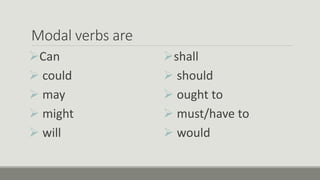
Modal verbs are
Can
 could
 may
 might
 will
shall
 should
 ought to
 must/have to
 would
USES
1. CAN: indicates ability or possibility.
Examples:
I can speak five languages
 We can work late tonight if you need us
 Bill and Tom can’t help you.
In interrogative phrases, the use of "can" can request permission or ask about possibilities.
Examples:
Can I have a glass of water?
Can you help me?
 Can they work late tonight?
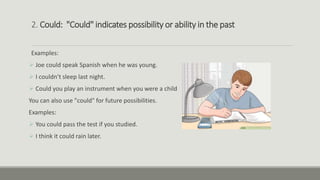
2. Could: "Could" indicates possibility or ability in the past
Examples:
 Joe could speak Spanish when he was young.
 I couldn’t sleep last night.
 Could you play an instrument when you were a child
You can also use "could" for future possibilities.
Examples:
 You could pass the test if you studied.
 I think it could rain later.
As "can", in interrogative phrases "could" can request permission or ask about the possibilities,
but it is more formal
Examples:
Could you pass the salt please?
Could you help me?
Could I be wrong?

Modal verbs

  • 1.
  • 2.
    What are they? Modalverbs are auxiliary verbs that can not function as a main verb, unlike the auxiliary verbs "be", "do" and "have" that can function as a main verb. Modal verbs express modality, ability, possibility, need or other condition. We use them for the future and the conditional. As complementary verbs that are, modal verbs do not work without another verb. This other verb always goes after the modal verb and is in the base form (the infinitive without "to"). Modal verbs are not conjugated and do not have time
  • 3.
    Modal verbs are Can could  may  might  will shall  should  ought to  must/have to  would
  • 4.
    USES 1. CAN: indicatesability or possibility. Examples: I can speak five languages  We can work late tonight if you need us  Bill and Tom can’t help you. In interrogative phrases, the use of "can" can request permission or ask about possibilities. Examples: Can I have a glass of water? Can you help me?  Can they work late tonight?
  • 5.
    2. Could: "Could"indicates possibility or ability in the past Examples:  Joe could speak Spanish when he was young.  I couldn’t sleep last night.  Could you play an instrument when you were a child You can also use "could" for future possibilities. Examples:  You could pass the test if you studied.  I think it could rain later.
  • 6.
    As "can", ininterrogative phrases "could" can request permission or ask about the possibilities, but it is more formal Examples: Could you pass the salt please? Could you help me? Could I be wrong?