1
Cloud Computing : Economics
Tutorial
Prof. Soumya K Ghosh
Department of Computer Science and Engineering
IIT KHARAGPUR
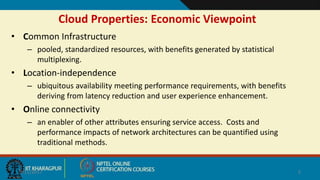
Cloud Properties: Economic Viewpoint
9/11/2017 2
• Common Infrastructure
– pooled, standardized resources, with benefits generated by statistical
multiplexing.
• Location-independence
– ubiquitous availability meeting performance requirements, with benefits
deriving from latency reduction and user experience enhancement.
• Online connectivity
– an enabler of other attributes ensuring service access. Costs and
performance impacts of network architectures can be quantified using
traditional methods.
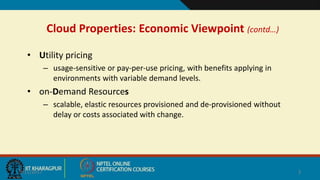
Cloud Properties: Economic Viewpoint (contd…)
9/11/2017 3
• Utility pricing
– usage-sensitive or pay-per-use pricing, with benefits applying in
environments with variable demand levels.
• on-Demand Resources
– scalable, elastic resources provisioned and de-provisioned without
delay or costs associated with change.
Utility Pricing in Detail
9/11/2017 4
D(t) demand for resources 0<t<T
P max (D(t)) : Peak Demand
A Avg (D(t)) : Average Demand
B Baseline (owned) unit cost
[BT : Total Baseline Cost]
C Cloud unit cost
[CT : Total Cloud Cost]
U (=C/B) Utility Premium
[For rental car example, U=4.5]
CT= 𝑈 ⨯ 𝐵 ⨯ 𝐷 𝑡 𝑑𝑡 = 𝐴 ⨯ 𝑈 ⨯
𝑇
0
B ⨯ T
BT= P ⨯ B ⨯ T
 Because the baseline should
handle peak demand
When is cloud cheaper than owning?
CT< BT A ⨯ U ⨯ B ⨯ T < P ⨯ B ⨯ T
U <
𝑃
𝐴
 When utility premium is less than ratio
of peak demand to Average demand
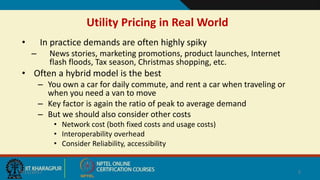
Utility Pricing in Real World
• In practice demands are often highly spiky
– News stories, marketing promotions, product launches, Internet
flash floods, Tax season, Christmas shopping, etc.
• Often a hybrid model is the best
– You own a car for daily commute, and rent a car when traveling or
when you need a van to move
– Key factor is again the ratio of peak to average demand
– But we should also consider other costs
• Network cost (both fixed costs and usage costs)
• Interoperability overhead
• Consider Reliability, accessibility
9/11/2017 5
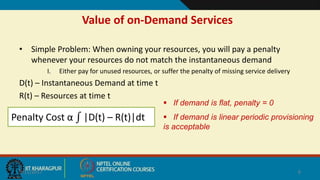
Value of on-Demand Services
9/11/2017 6
• Simple Problem: When owning your resources, you will pay a penalty
whenever your resources do not match the instantaneous demand
I. Either pay for unused resources, or suffer the penalty of missing service delivery
D(t) – Instantaneous Demand at time t
R(t) – Resources at time t
Penalty Cost α |D(t) – R(t)|dt
 If demand is flat, penalty = 0
 If demand is linear periodic provisioning
is acceptable
Penalty Costs for Exponential Demand
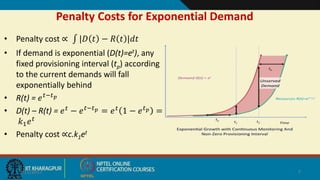
• Penalty cost ∝ |𝐷 𝑡 − 𝑅 𝑡 |𝑑𝑡
• If demand is exponential (D(t)=et), any
fixed provisioning interval (tp) according
to the current demands will fall
exponentially behind
• R(t) = 𝑒 𝑡−𝑡 𝑝
• D(t) – R(t) = 𝑒 𝑡 − 𝑒 𝑡−𝑡 𝑝 = 𝑒 𝑡 1 − 𝑒 𝑡 𝑝 =
𝑘1 𝑒 𝑡
• Penalty cost ∝c.k1et
9/11/2017 7
Assignment 1
Consider the peak computing demand for an organization is 120 units. The demand as a function of
time can be expressed as:
8
𝐷 𝑡 =
50 sin 𝑡 , 0 ≤ 𝑡 < 𝜋
2
20 sin 𝑡 , 𝜋
2 ≤ 𝑡 < 𝜋
The resource provisioned by the cloud to satisfy current demand at time t is given as:
𝑅 𝑡 = 𝐷 𝑡 + 𝛿. (
𝑑𝐷 𝑡
𝑑𝑡
)
where, 𝛿 is the delay in provisioning the extra computing recourse on demand
The cost to provision unit cloud resource for unit time is 0.9 units.
Calculate the penalty.
[Assume the delay in provisioning is 𝜋
12 time units and minimum demand is 0]
(Penalty: Either pay for unused resource or missing service delivery)
Assignment 2
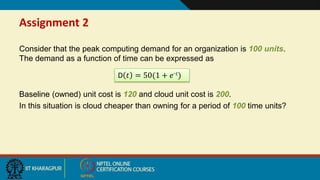
Consider that the peak computing demand for an organization is 100 units.
The demand as a function of time can be expressed as
Baseline (owned) unit cost is 120 and cloud unit cost is 200.
In this situation is cloud cheaper than owning for a period of 100 time units?
D 𝑡 = 50(1 + 𝑒
_ 𝑡)
Assignment 3
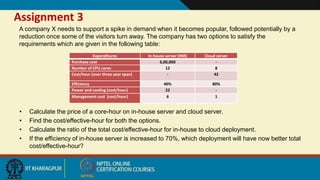
A company X needs to support a spike in demand when it becomes popular, followed potentially by a
reduction once some of the visitors turn away. The company has two options to satisfy the
requirements which are given in the following table:
Expenditures In-house server (INR) Cloud server
Purchase cost 6,00,000 -
Number of CPU cores 12 8
Cost/hour (over three year span) - 42
Efficiency 40% 80%
Power and cooling (cost/hour) 22 -
Management cost (cost/hour) 6 1
• Calculate the price of a core-hour on in-house server and cloud server.
• Find the cost/effective-hour for both the options.
• Calculate the ratio of the total cost/effective-hour for in-house to cloud deployment.
• If the efficiency of in-house server is increased to 70%, which deployment will have now better total
cost/effective-hour?
11

Mod05lec22(cloudonomics tutorial)

  • 1.
    1 Cloud Computing :Economics Tutorial Prof. Soumya K Ghosh Department of Computer Science and Engineering IIT KHARAGPUR
  • 2.
    Cloud Properties: EconomicViewpoint 9/11/2017 2 • Common Infrastructure – pooled, standardized resources, with benefits generated by statistical multiplexing. • Location-independence – ubiquitous availability meeting performance requirements, with benefits deriving from latency reduction and user experience enhancement. • Online connectivity – an enabler of other attributes ensuring service access. Costs and performance impacts of network architectures can be quantified using traditional methods.
  • 3.
    Cloud Properties: EconomicViewpoint (contd…) 9/11/2017 3 • Utility pricing – usage-sensitive or pay-per-use pricing, with benefits applying in environments with variable demand levels. • on-Demand Resources – scalable, elastic resources provisioned and de-provisioned without delay or costs associated with change.
  • 4.
    Utility Pricing inDetail 9/11/2017 4 D(t) demand for resources 0<t<T P max (D(t)) : Peak Demand A Avg (D(t)) : Average Demand B Baseline (owned) unit cost [BT : Total Baseline Cost] C Cloud unit cost [CT : Total Cloud Cost] U (=C/B) Utility Premium [For rental car example, U=4.5] CT= 𝑈 ⨯ 𝐵 ⨯ 𝐷 𝑡 𝑑𝑡 = 𝐴 ⨯ 𝑈 ⨯ 𝑇 0 B ⨯ T BT= P ⨯ B ⨯ T  Because the baseline should handle peak demand When is cloud cheaper than owning? CT< BT A ⨯ U ⨯ B ⨯ T < P ⨯ B ⨯ T U < 𝑃 𝐴  When utility premium is less than ratio of peak demand to Average demand
  • 5.
    Utility Pricing inReal World • In practice demands are often highly spiky – News stories, marketing promotions, product launches, Internet flash floods, Tax season, Christmas shopping, etc. • Often a hybrid model is the best – You own a car for daily commute, and rent a car when traveling or when you need a van to move – Key factor is again the ratio of peak to average demand – But we should also consider other costs • Network cost (both fixed costs and usage costs) • Interoperability overhead • Consider Reliability, accessibility 9/11/2017 5
  • 6.
    Value of on-DemandServices 9/11/2017 6 • Simple Problem: When owning your resources, you will pay a penalty whenever your resources do not match the instantaneous demand I. Either pay for unused resources, or suffer the penalty of missing service delivery D(t) – Instantaneous Demand at time t R(t) – Resources at time t Penalty Cost α |D(t) – R(t)|dt  If demand is flat, penalty = 0  If demand is linear periodic provisioning is acceptable
  • 7.
    Penalty Costs forExponential Demand • Penalty cost ∝ |𝐷 𝑡 − 𝑅 𝑡 |𝑑𝑡 • If demand is exponential (D(t)=et), any fixed provisioning interval (tp) according to the current demands will fall exponentially behind • R(t) = 𝑒 𝑡−𝑡 𝑝 • D(t) – R(t) = 𝑒 𝑡 − 𝑒 𝑡−𝑡 𝑝 = 𝑒 𝑡 1 − 𝑒 𝑡 𝑝 = 𝑘1 𝑒 𝑡 • Penalty cost ∝c.k1et 9/11/2017 7
  • 8.
    Assignment 1 Consider thepeak computing demand for an organization is 120 units. The demand as a function of time can be expressed as: 8 𝐷 𝑡 = 50 sin 𝑡 , 0 ≤ 𝑡 < 𝜋 2 20 sin 𝑡 , 𝜋 2 ≤ 𝑡 < 𝜋 The resource provisioned by the cloud to satisfy current demand at time t is given as: 𝑅 𝑡 = 𝐷 𝑡 + 𝛿. ( 𝑑𝐷 𝑡 𝑑𝑡 ) where, 𝛿 is the delay in provisioning the extra computing recourse on demand The cost to provision unit cloud resource for unit time is 0.9 units. Calculate the penalty. [Assume the delay in provisioning is 𝜋 12 time units and minimum demand is 0] (Penalty: Either pay for unused resource or missing service delivery)
  • 9.
    Assignment 2 Consider thatthe peak computing demand for an organization is 100 units. The demand as a function of time can be expressed as Baseline (owned) unit cost is 120 and cloud unit cost is 200. In this situation is cloud cheaper than owning for a period of 100 time units? D 𝑡 = 50(1 + 𝑒 _ 𝑡)
  • 10.
    Assignment 3 A companyX needs to support a spike in demand when it becomes popular, followed potentially by a reduction once some of the visitors turn away. The company has two options to satisfy the requirements which are given in the following table: Expenditures In-house server (INR) Cloud server Purchase cost 6,00,000 - Number of CPU cores 12 8 Cost/hour (over three year span) - 42 Efficiency 40% 80% Power and cooling (cost/hour) 22 - Management cost (cost/hour) 6 1 • Calculate the price of a core-hour on in-house server and cloud server. • Find the cost/effective-hour for both the options. • Calculate the ratio of the total cost/effective-hour for in-house to cloud deployment. • If the efficiency of in-house server is increased to 70%, which deployment will have now better total cost/effective-hour?
  • 11.