1
SCIENCE CLUB
Submitted to;
Mrs. SUSHAMAPRABHA L
Lecturer in Natural Science
Submitted by;
Ms. FAHIDA KHAN M F
Natural Science
Submitted on;
01/08/2015
2
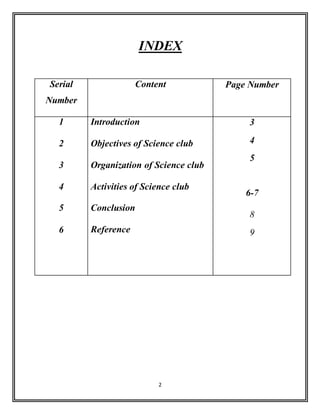
INDEX
Serial
Number
Content Page Number
1
2
3
4
5
6
Introduction
Objectives of Science club
Organization of Science club
Activities of Science club
Conclusion
Reference
3
4
5
6-7
8
9
3
INTRODUCTION
The scientific and technological advancement of today is a long
forward journey from stone age. As we live in an age of science, it is
essential that the students have a deep insight into the background of
science. People seem to possess the seeds of creativeness but climate
for its germination is absent. It is generally seen that our school
programs are not giving due place to scientific experiences and proper
environment. Schools lay too much of emphasis on rigidity and
traditionalism.
Each individual has his own interests, talents and abilities. Even
a progressive syllabus fails to cater to the needs of each. Science
educators, now a days are found to exhibit growing interest and means
of stimulating group participation and mobilizing interest in learning
science. Organizing science clubs is one among such activities.
Through activities of a science club, learning of science becomes
joyful. The science cub caters to freedom for expression, where as the
classroom atmosphere leads to conformity and repression. While
activity participating in a science club students organize thought and
translate these into action and thereby develop a zealous enthusiasm to
strive for the cause of scientific enterprise.
4
OBJECTIVES OF SCIENCE CLUB
 To develop a general interest in science
 To inculcate scientific attitude and provide opportunities for
training in scientific method
 To develop interest in scientific hobbies
 To develop habits of exploration and creative faculties
 To encourage individual and group activities
 To make the students and public science minded
 To stimulate active participation and initiative among students in
the learning process
 To keep the students in touch with the recent advances in science
 To provide challenging opportunities to the gifted
5
ORGANIZATION OF SCIENCE CLUB
A properly organized science club will be valuable aid to
teaching science and also a means of motivating the children for
learning science. The successful working of the club depends on the
persons who organize it and also on the interest and enthusiasm of
students. Though science club is run by the students for the students,
the science teacher is the pivot of all activities.
To begin with, the science teacher can explain the importance
and benefits of organizing science club and can arouse enthusiasm
among students. This discussion may be followed by a business
meeting in which office bearers are chosen. Every science club should
have its own constitution. There should be a General body and
Executive body. The Principal or Headmaster should be the patron
and the science teachers should be the sponsors. Executive members
such as President, Vice president, Secretary, Treasurer, Librarian,
Publicity Officer, etc, are chosen from among student members. The
executive committee has to chalk out programs. The activities of the
club should be taken up by the students themselves. There should be
regular meetings, discussions, planning, feedback, etc.
6
ACTIVITIES OF THE SCIENCE CLUB
 Organizing lectures, debates, seminars, symposia, etc
 Holding science exhibition and fairs
 Celebrating birth days of eminent scientists
 Arranging visits to places of scientific interest
 Preparing of charts, postures, models, etc
 Participating in science fairs
 Conducting visual programs of scientific interest
 Developing school garden
 Displaying science news
 Planting and growing trees and plants
 Improvising and preparing hand- made apparatus
 Collecting specimens and arranging them in the museum
 Managing a first aid squad
 General reading of scientific literature
 Rendering school services in Health and Sanitation
 Visiting other science clubs
 Conducting essay competition and scientific problems
 Maintaining an aquarium
 Participating in scientific hobbies- preparation of soaps, ink,
candle, matches, toys, bleaching powder, nail polish, chalk, etc
7
 Helping the community by way of demonstration on health and
hygiene, improvement of agriculture, eradication of superstitious
belief, etc
 Celebrating science days
 Organizing programs like nature walk and nature games, Eco
clubs, etc
 Maintaining a Bulletin Board
 Publishing school science magazine
 Preparing albums and conducting projects
8
CONCLUSION
Learning by doing and learning by living are two essentials of
learning of science. Children are interested in making things,
breaking things and handling things. But the curriculum does not
satisfy this natural urge. In the classroom everything is done in a
formal, artificial and controlled atmosphere. This will never give the
child an opportunity for self expression, constructive activities and
independent enquiry. No time is assigned for practical work. All these
lead to the need for an organization providing an outlet for the pent-up
emotions of children and for pooling their energies. An organization
which caters for the inculcation of scientific attitude and a genuine
interest in science, and also can supplement the work of the classroom
and give the syllabus a practical dimension may be called a science
club.
9
REFERENCE
 Science education-methodology of teaching and pedagogic
content analysis by Dr. K Sivarajann and Prof. A Faziluddin,
page number: 259-261.
 http://scienceclub.org/

Science club online assignment

  • 1.
    1 SCIENCE CLUB Submitted to; Mrs.SUSHAMAPRABHA L Lecturer in Natural Science Submitted by; Ms. FAHIDA KHAN M F Natural Science Submitted on; 01/08/2015
  • 2.
    2 INDEX Serial Number Content Page Number 1 2 3 4 5 6 Introduction Objectivesof Science club Organization of Science club Activities of Science club Conclusion Reference 3 4 5 6-7 8 9
  • 3.
    3 INTRODUCTION The scientific andtechnological advancement of today is a long forward journey from stone age. As we live in an age of science, it is essential that the students have a deep insight into the background of science. People seem to possess the seeds of creativeness but climate for its germination is absent. It is generally seen that our school programs are not giving due place to scientific experiences and proper environment. Schools lay too much of emphasis on rigidity and traditionalism. Each individual has his own interests, talents and abilities. Even a progressive syllabus fails to cater to the needs of each. Science educators, now a days are found to exhibit growing interest and means of stimulating group participation and mobilizing interest in learning science. Organizing science clubs is one among such activities. Through activities of a science club, learning of science becomes joyful. The science cub caters to freedom for expression, where as the classroom atmosphere leads to conformity and repression. While activity participating in a science club students organize thought and translate these into action and thereby develop a zealous enthusiasm to strive for the cause of scientific enterprise.
  • 4.
    4 OBJECTIVES OF SCIENCECLUB  To develop a general interest in science  To inculcate scientific attitude and provide opportunities for training in scientific method  To develop interest in scientific hobbies  To develop habits of exploration and creative faculties  To encourage individual and group activities  To make the students and public science minded  To stimulate active participation and initiative among students in the learning process  To keep the students in touch with the recent advances in science  To provide challenging opportunities to the gifted
  • 5.
    5 ORGANIZATION OF SCIENCECLUB A properly organized science club will be valuable aid to teaching science and also a means of motivating the children for learning science. The successful working of the club depends on the persons who organize it and also on the interest and enthusiasm of students. Though science club is run by the students for the students, the science teacher is the pivot of all activities. To begin with, the science teacher can explain the importance and benefits of organizing science club and can arouse enthusiasm among students. This discussion may be followed by a business meeting in which office bearers are chosen. Every science club should have its own constitution. There should be a General body and Executive body. The Principal or Headmaster should be the patron and the science teachers should be the sponsors. Executive members such as President, Vice president, Secretary, Treasurer, Librarian, Publicity Officer, etc, are chosen from among student members. The executive committee has to chalk out programs. The activities of the club should be taken up by the students themselves. There should be regular meetings, discussions, planning, feedback, etc.
  • 6.
    6 ACTIVITIES OF THESCIENCE CLUB  Organizing lectures, debates, seminars, symposia, etc  Holding science exhibition and fairs  Celebrating birth days of eminent scientists  Arranging visits to places of scientific interest  Preparing of charts, postures, models, etc  Participating in science fairs  Conducting visual programs of scientific interest  Developing school garden  Displaying science news  Planting and growing trees and plants  Improvising and preparing hand- made apparatus  Collecting specimens and arranging them in the museum  Managing a first aid squad  General reading of scientific literature  Rendering school services in Health and Sanitation  Visiting other science clubs  Conducting essay competition and scientific problems  Maintaining an aquarium  Participating in scientific hobbies- preparation of soaps, ink, candle, matches, toys, bleaching powder, nail polish, chalk, etc
  • 7.
    7  Helping thecommunity by way of demonstration on health and hygiene, improvement of agriculture, eradication of superstitious belief, etc  Celebrating science days  Organizing programs like nature walk and nature games, Eco clubs, etc  Maintaining a Bulletin Board  Publishing school science magazine  Preparing albums and conducting projects
  • 8.
    8 CONCLUSION Learning by doingand learning by living are two essentials of learning of science. Children are interested in making things, breaking things and handling things. But the curriculum does not satisfy this natural urge. In the classroom everything is done in a formal, artificial and controlled atmosphere. This will never give the child an opportunity for self expression, constructive activities and independent enquiry. No time is assigned for practical work. All these lead to the need for an organization providing an outlet for the pent-up emotions of children and for pooling their energies. An organization which caters for the inculcation of scientific attitude and a genuine interest in science, and also can supplement the work of the classroom and give the syllabus a practical dimension may be called a science club.
  • 9.
    9 REFERENCE  Science education-methodologyof teaching and pedagogic content analysis by Dr. K Sivarajann and Prof. A Faziluddin, page number: 259-261.  http://scienceclub.org/