A powerfull Presentation for powerfull people.pptx
1.
PRESENTATION OF ENTREPRENEURSHIP
CHAPTERNO.3
Inside The Entrepreneurial Mindset: From Idea To Reality
Represented By:
• Ayesha Amjad
• Ayesha Naeem
• Javeria Batool
• Iqra Mansha
• Javeria Yaseen
• Hafiza Zahra
2.
Exploring Creativity, Innovation,and Entrepreneurship
Definition of Creativity:
When people hear the word creativity, they often think of artists or musicians. But creativity isn’t just
about making art, it’s also about finding new ideas and ways of doing things. And creativity is essential
for entrepreneurship.
The Benefits of Creativity in Entrepreneurship:
When it comes to creativity in entrepreneurship, there are many benefits to living out your creative
side.
• For one, creativity can help you come up with new and innovative ideas for your business.
• It can also help you solve problems in unique ways and think outside the box.
• In addition, creativity can help you stand out from the competition and better communicate
your ideas.
3.
DefinitionofInnovation
Entrepreneurial innovation isthe process of developing and putting into practice new concepts, ideas, goods,
services, procedures, or business models that significantly improve and add value to an entrepreneurial endeavor.
Entrepreneurial innovation is fundamentally about bringing something new to the market. It enhances current
offers in a way that fosters growth, produces value for consumers, and benefits stakeholders
What benefits does business innovation bring for you?
• Gain a competitive advantage. Innovation can help you develop unique products and services that set you
apart from competitors. Over 80% of digitally mature companies site innovation as one of their core
strengths.
• Meet customer demands. Sixty-five percent of fast-growing companies say they collaborate with their
customers on potential innovations. Businesses that try to better understand and respond to customer needs
through ongoing innovation do a better job attracting new customers and retaining existing clients.
• Drive business growth. You’ll position your company to better identify and seize new opportunities. You may
also create opportunities to diversify revenue streams or expand into new markets.
4.
“Creativity”
A Necessity ForSurvival
• Creativity and innovation are integral parts of entrepreneurship.
• Entrepreneurs require to cast off the limiting assumptions, beliefs and behaviors and
to develop new insights into the relationship between resources, needs and values.
• Entrepreneurs must always be on guard against traditional assumptions and
perspectives about how things ought to be.
• A paradigm is a preconceived idea of what of the world is, what it should be like, and
how it should operate.
• These ideas become so deeply rooted in our minds that they become immovable
blocks to creative thinking.
6.
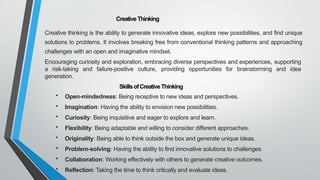
CreativeThinking
Creative thinking isthe ability to generate innovative ideas, explore new possibilities, and find unique
solutions to problems. It involves breaking free from conventional thinking patterns and approaching
challenges with an open and imaginative mindset.
Encouraging curiosity and exploration, embracing diverse perspectives and experiences, supporting
a risk-taking and failure-positive culture, providing opportunities for brainstorming and idea
generation.
SkillsofCreativeThinking
• Open-mindedness: Being receptive to new ideas and perspectives.
• Imagination: Having the ability to envision new possibilities.
• Curiosity: Being inquisitive and eager to explore and learn.
• Flexibility: Being adaptable and willing to consider different approaches.
• Originality: Being able to think outside the box and generate unique ideas.
• Problem-solving: Having the ability to find innovative solutions to challenges.
• Collaboration: Working effectively with others to generate creative outcomes.
• Reflection: Taking the time to think critically and evaluate ideas.
7.
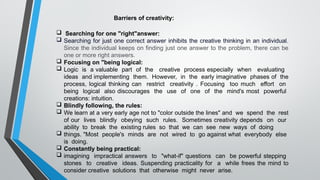
Searching forone "right"answer:
Searching for just one correct answer inhibits the creative thinking in an individual.
Since the individual keeps on finding just one answer to the problem, there can be
one or more right answers.
Focusing on "being logical:
Logic is a valuable part of the creative process especially when evaluating
ideas and implementing them. However, in the early imaginative phases of the
process, logical thinking can restrict creativity . Focusing too much effort on
being logical also discourages the use of one of the mind's most powerful
creations: intuition.
Blindly following, the rules:
We learn at a very early age not to "color outside the lines" and we spend the rest
of our lives blindly obeying such rules. Sometimes creativity depends on our
ability to break the existing rules so that we can see new ways of doing
things. "Most people's minds are not wired to go against what everybody else
is doing.
Constantly being practical:
imagining impractical answers to "what-if" questions can be powerful stepping
stones to creative ideas. Suspending practicality for a while frees the mind to
consider creative solutions that otherwise might never arise.
Barriers of creativity:
8.
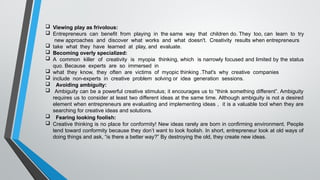
Viewing playas frivolous:
Entrepreneurs can benefit from playing in the same way that children do. They too, can learn to try
new approaches and discover what works and what doesn't. Creativity results when entrepreneurs
take what they have learned at play, and evaluate.
Becoming overly specialized:
A common killer of creativity is myopia thinking, which is narrowly focused and limited by the status
quo. Because experts are so immersed in
what they know, they often are victims of myopic thinking .That's why creative companies
include non-experts in creative problem solving or idea generation sessions.
Avoiding ambiguity:
Ambiguity can be a powerful creative stimulus; it encourages us to “think something different”. Ambiguity
requires us to consider at least two different ideas at the same time. Although ambiguity is not a desired
element when entrepreneurs are evaluating and implementing ideas , it is a valuable tool when they are
searching for creative ideas and solutions.
Fearing looking foolish:
Creative thinking is no place for conformity! New ideas rarely are born in confirming environment. People
tend toward conformity because they don’t want to look foolish. In short, entrepreneur look at old ways of
doing things and ask, “is there a better way?” By destroying the old, they create new ideas.
9.
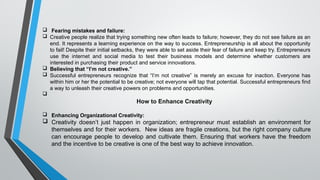
Fearing mistakesand failure:
Creative people realize that trying something new often leads to failure; however, they do not see failure as an
end. It represents a learning experience on the way to success. Entrepreneurship is all about the opportunity
to fail! Despite their initial setbacks, they were able to set aside their fear of failure and keep try. Entrepreneurs
use the internet and social media to test their business models and determine whether customers are
interested in purchasing their product and service innovations.
Believing that “I’m not creative.”
Successful entrepreneurs recognize that “I’m not creative” is merely an excuse for inaction. Everyone has
within him or her the potential to be creative; not everyone will tap that potential. Successful entrepreneurs find
a way to unleash their creative powers on problems and opportunities.
How to Enhance Creativity
Enhancing Organizational Creativity:
Creativity doesn’t just happen in organization; entrepreneur must establish an environment for
themselves and for their workers. New ideas are fragile creations, but the right company culture
can encourage people to develop and cultivate them. Ensuring that workers have the freedom
and the incentive to be creative is one of the best way to achieve innovation.
10.
Include CreativityAs A Core Company Value And Make It An Integral Part Of The Company’s
Culture:
Innovative companies do not take a passive approach to creativity; they are proactive in their search for
new ideas. One of the best ways to set a creative tone throughout an organization begins with the
company’s mission statement. Entrepreneurs should incorporate creativity and innovation into their
companies. If creativity and innovation are vital to a company’s success and they should also be a natural
part of the performance process. Every small companies that are willing to innovate can have a significant
impact on entire industries by shaking up the status quo with their creative approaches.
Hire For Creativity:
The company hired the smartest people it could find from a variety of disciplines, backgrounds and
philosophies: encouraged them to interact with them and support one another: and gave them the freedom
to dream up creative ideas, many of which failed. The ones that succeeded, however, changed the world.
Embrace Diversity
Hiring people from different backgrounds, cultural experiences, hobbies and interests provides a company
crucial raw materials needed for creativity. Focusing the talent and creativity of a diverse group of
employees on a problem or challenge is one of the best way to generate creative solutions. One manager
says, “They create a little grit to stimulate the oyster to produce a pearl.
Expect Creativity:
Employees tend to rise or fall to the level of expectations that entrepreneurs have of them. One of the best
ways to communicate the expectations of creativity is to encourage them.
11.
Design AWorkspace That Encourages Creativity:
The physical environment in which people work has an impact on their level of creativity.
Transforming the typical office space with cubicles.
Creative Director of GOOGLE, Tanya Ruegg, told Artsy. “Because if people are sitting at their
desks all day long, there will be no innovation.”
Use ambient and thoughtful design elements (funny posters, murals, photographs, artwork, add
splashes of colors, incorporating live plants enliven a workspace )to inspire thinking and enhance
organization’s creative power.
New Problems As Opportunities:
Every problem offers the opportunity for innovation. The ability to not just solve a problem but to
turn that problem into an opportunity is the mark of true entrepreneur.
Safeway and other big retailers struggled with the growing problem of plastic bag cost and
pollution, before realizing they could actually sell reusable cloth bags to customers, as a win to
all. A recurring expense was turned into recurring revenue.
Provide Creative Training:
Developing creativity requires trainings. training accomplished through books, seminars,
workshops and professional meetings.
12.
Eliminate BureaucraticObstacles And Provide The Support Necessary For Innovation:
Employees need certain needs and resources to be creative including freedom from
bureaucracy to pursue their ideas. Encourage collaboration between entrepreneurs,
researchers, and industry experts to foster innovation. This can be done through the
establishment of innovation hubs, incubators, and accelerators that provide a space for
collaboration, knowledge sharing, and access to specialized resources. By doing this ,
bureaucratic obstacles can be minimized, and the necessary support can be provided to foster
innovation in entrepreneurship, ultimately driving economic growth and job creation.
Develop A Procedure For Capturing Ideas:
As small companies have outstanding innovators, they have a process in place to solicit and
then collect new ideas. Clear entrepreneurs establish processes within their companies that are
designed to harvest the results of employee’s creativity.
Talk With Customers Or Better Yet Interact With Them:
The voice of customers can be an important source of creative ideas for innovative companies
on their products or services through internet. Companies observe their customers actually
using their products or services to glean ideas that may lead to improvement and new features
or forgoing alliances with customers to come up with creative ideas and develop new products
based on them.
A recent survey reports that customers are the most common source of ideas for new products
and services ;only 37% companies have formal process for collecting customer’s ideas.
13.
Monitoring EmergingTrends And Identify Ways Your Company Can Capitalize Of
Them:
Tracking trend is an excellent way to generate ideas for new products, services or business
models. Businesses can effectively identify and capitalize on emerging market trends to gain
a competitive advantage and achieve sustainable growth.
Taco Bell, the quick-service chain of Mexican restaurants, invests resources in monitoring
demographic and social trends that influence customers’ dining habits.
Look For Uses For Your Company’s Products Or Services In Other Markets:
Focusing on the “traditional” uses of a product or service limits creativity—and a company’s
sales. Entrepreneurs can boost sales by finding new applications, often in unexpected
places, for their products and services.
Reward Creativity:
Entrepreneurs can encourage creativity by rewarding it when it occurs. Financial rewards
can be effective motivators of creative behavior, but nonmonetary rewards, such as praise,
recognition, and celebration, usually offer more powerful incentives for creativity.
Model Creative Behavior:
Creativity is “caught” as much as it is “taught.” Companies that excel at innovation find that
the passion for creativity starts at the top. Entrepreneurs who set examples of creative
behavior, taking chances, and challenging the status quo soon find their employees doing
the same.
14.
Don’t ForgetAbout Business Model Innovation:
As Jason Fried’s experience suggests, creating new products and services is the lifeblood of a
company’s long-term success; however, business model innovations can produce significant impact
on a business as well. Apple iTune store has proved to be a valuable business model by providing a
system for billion of people to downloads apps, music ebooks and movies conveniently and easily.
Apple’s business model innovation now generates $16 billion in annual revenue for the company.
Enhancing Individual Creativity:
Just as entrepreneurs can cultivate an environment of creativity ; they can also enhance their own
creativity by using the following techniques
Allow Yourself To Be Creative:
As we have seen, one of the biggest obstacles to creativity occurs when a person believes he or
she is not creative. Giving yourself the permission to be creative is the first step toward establishing
a pattern of creative thinking. Refuse to give in to the temptation to ignore ideas simply because you
fear that someone else may consider them “stupid.” When it comes to creativity, there are no stupid
ideas!
Forget The “RULES”:
Creative individuals take a cue from Captain Jack Sparrow in the Pirates of the Caribbean series of
movies. When faced with a difficult (sometimes impossible) situation, Sparrow (played by Johnny
Depp) usually operates outside the rules and, as a result, comes up with innovative solutions.
15.
Give YourMind Fresh Input Everyday:
To be creative, your mind needs stimulation. Do something different each day listen to a new radio
station, take a walk through a park or a shopping center, or pick up a magazine you never read.
Take Up A Hobby:
Hobbies provide not only an avenue to escape your regular routine, but they also give your mind
fresh input that can be a source of creative ideas. Izhar Gafni, a bicycling enthusiast, was in a
bicycle shop talking about his hobby (“Bicycling is in my soul,” he says) when the conversation
turned to a man who had invented cardboard canoe. The concept fascinated him. “Why not make
a bicycle out of cardboard?” he wondered. Gafni went to work and invented a low-cost, eco-
friendly bicycle made entirely out of recycled cardboard and car tires.
Travel And Observe:
Visiting other countries is a creativity stimulant. Travelers see new concepts and engage in new
experiences that can spark creativity.
Observe The Products And Services Of Other Companies, Especially Those In
Completely Different Markets:
Creative entrepreneurs often borrow ideas from other companies that are in businesses totally
unrelated to their own. The project frog’s founder noted the popularity of eco-friendly modular
residential homes and applied the concepts to building prefabricated schools and government
buildings faster and cheaper then the traditional “stick-built” structures.
16.
Recognize TheCreative Power Of Mistakes And Accidents:
The innovations of creative people sometimes results as a mistake or accidents. Still they
recognize their errors may lead to new ideas, products and services.
Notice What Is Missing:
Entrepreneurs sometimes spot viable business opportunity by noticing something, very simple and
practical is missing. The first step is to determine whether a market for the missing product and
service actually exists. It is one of the objectives of building a business plan.
Looking For Ways To Turn Trash To treasure:
Entrepreneurs consider the unique characteristics of each item and brainstorm ways to transform
them into something new and useful. For example, an old wooden pallet can be transformed into a
rustic coffee table
Keep a journal handy to record your thoughts and ideas:
Creative ideas are to valuable to waste, so always keep a journal nearby to record them as soon
as you get them.
Patrick Mc Naughton invented the neon blackboards that restaurants use to advertise their
specials.in addition to neon blackboards ,he invented 30 new products.
Listen To Other People:
No rule of creativity says an idea has to be your own! Sometimes the best business ideas comes
from someone else, but entrepreneurs are the ones to act on them.
17.
Listen ToCustomers:
Entrepreneurs talk and deeply understands their customers to build products ,services and
experiences that work in today’s customer driven market.
The president of Mark Sieron says; ”Our business is built on a high degree of customer
interaction ;we listen to our customers and that’s what drives our innovation”
Get Adequate Sleep:
Sleep restores both our bodies and brain , plays an important role in creativity. It impacts both
sides of brain, enhancing imaginative thinking and the ability to solve problems.
Watch A Movie:
When you watch a movie, your brain gets a break from whatever it’s working on. You are in a
different world for few hours, which helps you escape your worries and stress. This mental
distraction is a necessary part of creativity, allowing your mind to reset.
Do Something Ordinary In Unusual Way:
Experts says that doing something out of the ordinary can stimulate creativity. Some unusual
ways to boost creativity include embrace boredom, change your environment, do something
unconventional, collaborate with someone from a different field, write by hand, engage in a
physical activity etc.
18.
Take ANote Of Your Pain Points:
Entrepreneurs often create innovations to solve problems they themselves face. Observing
“pain points” that results from missing products and services or flaws in existing products or
services can be an excellent source of business ideas.
Do Not Throw Away Seemingly “Bad” Ideas:
Some creative ideas prove to be impractical, too costly to work. Creative entrepreneurs do not
discard these seemingly bad ideas, instead they ask, “what part of this idea can I build on?” and
“what could I change about this idea to make it work?” They realize that seemingly bad ideas
can be the nucleus of a really good idea.
Collaborate With Each Others:
Working with other people to solve a problem or to generate ideas brings fresh perspective to
the creation. Two or more people usually are more creative than one.
Read Books On Stimulating Creativity:
The more you read, better you are able to concentrate and the better you will be able to imagine
ideas and new concepts. Our brains need to be kept active in order to stay healthy and reading
is a great exercise for the mind. Imagination has many benefits. It encourages creativity, which
brings about new ideas.
Take Sometime Off:
Relaxation is vital to the creative process. Getting away from a problem gives the mind to reflect
on it. It is often during this time, while the subconscious works on a problem, that the mind
generates many creative solutions.
19.
Be Persistent:
Entrepreneursknow that one secret to success is persistent and “don’t- quit” attitude. They are
passionate about and committed to their goals, which compels them to persist physically and
mentally.
THE CREATIVE PROCESS
The creative process is the act of solving a problem through innovation. It is a systematic
approach to solving problems by finding new ways of looking at old concepts. This system can be
executed by an individual or a team of people for personal, educational, or business purpose. The
process involves the following steps:
1. Preparation:
This step involves getting the mind ready for creative thinking. Preparation stage is the first stage
of creativity, and it starts with gathering information and data, such as resources and ideas. it is
the foundation on which all the other stages are built. It begins when a problem is identified, a
need is realized, or a solution is necessary. It is a working stage during which where you conduct
research and gather information. It also serves as planning stage. It must start with a marketing
strategist looking at market research before designing a new advertising.
2. Investigation:
This step requires one to develop a solid understanding of the problem, situation, or decision at
hand. To create new ideas and concepts in a particular field, an individual first must study the
problem and understand its basic components. Creative thinking comes about when people make
careful observations of the world around them and then investigate the way things work(or fail to
work).
20.
3.Transformation:
Transformation involves viewingthe similarities and differences among the information collected.
This phase requires two types of thinking: convergent and divergent. Convergent thinking is the
ability to see the similarities and the connections among various and often diverse data and
events. “So much of innovation comes from connecting things where other people don’t make
connections ,” says Mark Rice, professor of technology entrepreneur at Olin College. Divergent
thinking is the ability to see the differences among various data and events.
4.Incubation:
The subconscious needs time to reflect on the information collected . To an observer , this phase
of the creative process would be quite boring, it looks as though nothing is happening . In fact ,
during this phase, it may appear that creative person is loafing . Incubation occurs while the
individual is away from the problem , often engaging in some totally unrelated activity . Walk away
from the situation, take the time to daydream ,relax and play regularly.
5.Illumination:
This phase of the creative process occurs at, some point during the incubation stage when a
spontaneous breakthrough causes " the light bulb to go on " it may take place after five minutes
or after five years. It comes without warning. It is not something that we think is going to happen .
It feels like a gift . In the Illumination stage, all the previous stages come together to produce the
creation of innovative idea .
21.
6.Verification:
For entrepreneurs, validatingan idea as realistic and useful may include conducting
experiments, running, simulations, test marketing a product or service, establishing small
scale pilot programs, building prototypes and many other activities designed to verify that the
new idea will work and is practical to implementation.
7.Implementation:
The focus of this Step is to transform the idea into reality ,plenty of people come up with
creative idea for promising new products or services but most never take them beyond the
idea stage .
“An entrepreneur philosophy is Ready, aim, fire not ready, aim, aim, aim.”
Techniques for improving the creative process:
Brainstorming:
a method of generating ideas and sharing knowledge to solve a particular commercial or technical
problem, in which participants are encouraged to think without interruption.
Entrepreneur should follow following guidelines during the brainstorming process :
Keep the group small , just 5 to 8 members .
Use a seating pattern that enhance communication
Encourage all the ideas from the team even wild and extreme ones
22.
Mind mapping:
Agraphical technique that encourages thinking on both side of the brain , usually display the
various relationships among ideas and improves the ability to view a problem from many sides .
Force field analysis :
The Force Field Analysis is a framework used to aid business decisions, often in the context of
strategic planning, implementation or change management. The framework assumes there are
forces in favour of the decision and forces against the decision.
TRIZ:
It is a system of creative problem solving, commonly used in engineering and process
management.
It follows basic steps:
Define your specific problem.
Find the TRIZ generalized problem that matches it.
Find the generalized solution that solves the generalized problem.
Rapid prototyping:
Rapid prototyping is an excellent way to test a product's form, fit, and function. To do this, your
business takes the prototype samples that your converter sends you and places it within a test
unit. You would then put that unit through lab or chamber testing to make sure it: Fits the way
you want it to. There are three principles of rapid prototyping :
“Rough ,Rapid ,Right.”
23.
Intellectual Property
Once entrepreneurscome up with innovative ideas for a product or service that has
market potential, their immediate concern should to protect them from unauthorized use.
Entrepreneurs must understand how to protect their intellectual property using three
common tools—Patents, Trademarks and Copyrights.
Patents :
A form of protection that provides a person or legal entity with exclusive rights for making, using
or selling a concept or invention and excludes others from doing the same for the duration of the
patent. A patent is a grant of protection for an invention.
Patents Process :
o Established the invention's novelty
o Document the device
o Search existing patent
o Study search results
o Complete a patent application
o File the patent application
24.
Trademark:
A trademarkis a distinctive word, phrase, symbol, design, logo, slogan, or trade dress that a
company uses to identify the origin of a product or to distinguish it from other goods on the
market.
To receive a design patent, a product must include the following five elements:
o The item must be an "article of manufacture".
o The design must be original.
o The design must be novel.
o The design must be non-obvious.
o The design must be ornamental.
Service mark:
A service mark is the same as a trademark except that it identifies and distinguishes the
source of service rather than the product.
Trade dress :
The unique combination of elements that a company uses to create a products image and
promote it.
25.
Protect Your Company'sIntellectual Property:
1.Recognize that intellectual property, the rights that result when a person uses his or her
knowledge and creativity to produce something of value, can be a business's most valuable
asset, even for small companies.
2.Use the appropriate tool to file for protection of your intellectual property and do so promptly
3.Use qualified, experienced intellectual property attorneys to gain the proper protection.
4.Use qualified, experienced intellectual property attorneys to gain the proper protection.
5.Select your company's business affiliates, especially suppliers, carefully
6.Protect your rights vigorously. If you discover that sure one is using your intellectual property
without permission pursue your rights vigorously.
Copyright:
A copyright is an exclusive right that protects the creators of original works of authorship, such as
literary, dramatic, musical, and artistic works (e.g., art, sculptures, literature, software, music,
videos, video games, choreography, motion pictures, recordings, and others).