AERO Standards and MAP test
2013-2014
Standards Vs Curriculum
•

Standards are expectations. For instance, we expect
students to know that 2+2=4, and why. Curriculum is the
program created by school to teach students to learn that
2+2 =4, and why.


•

Standards are statements. Curriculum includes many
resources: activities, lessons, units, assessments, and can
include publisher textbooks.


•

Standards define what is to be learned by the end of a
school year. Curriculum is the detailed plan for day to day
teaching.


•

Standards are the end. Curriculum is the means.

Saint George has a Curriculum.
CIS ACCREDITED SCHOOLS
PYP

MYP

IBDP

IPC

PUNTA CANA INT. SCHOOL
St Andrew's School The International School of The
Bahamas

IMYC

CAMB.
PRIMAR
Y

CAMB.
SEC. 1

IGCSE

AERO

AP

X
X

X

X

Nido de Aguilas International School Chile

* Al parecer se rigen por el Plan de Chile- incorporan los libros, en LA los 6+1 Traits, usan el Rubicon para las
unidades de estudios..dan SAT y TOEFL

Escola Americana de Campinas en Brazil

National
Curriculu
m PS y
MS

X

Santiago College Providencia en Chile

X

X

X

Colegio Anglo-Colombiano

X

X

X

X

X

X

International School of Havana en Cuba
The British School Ecuador

British
National
Curriculu
m

X

X

X

X

X

Academia Británica Custacleca El Salvador

X

International School of Helsinki

X

X

X

Tokyo International School

X

X

X

Metropolitan School of Panamá

X

X

X

International School Singapore

X

X

X

Stamford International American School en Singapore *dan los
MAP

X

X

X

X

X

X

X

X

Benjamin Franklin International School en España
Stockholm International School

X

X

United Nation International School en NY

X

British School en Uruguay

X

Candidatos al
IB

X
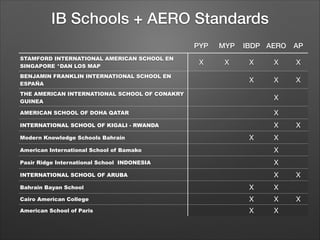
IB Schools + AERO Standards
PYP
STAMFORD INTERNATIONAL AMERICAN SCHOOL EN
SINGAPORE *DAN LOS MAP
BENJAMIN FRANKLIN INTERNATIONAL SCHOOL EN
ESPAÑA

MYP

X

X

IBDP AERO

AP

X

X

X

X

X

X

THE AMERICAN INTERNATIONAL SCHOOL OF CONAKRY
GUINEA

X

AMERICAN SCHOOL OF DOHA QATAR

X

INTERNATIONAL SCHOOL OF KIGALI - RWANDA

X

Modern Knowledge Schools Bahrain

X

X

X

American International School of Bamako

X

Pasir Ridge International School INDONESIA

X

INTERNATIONAL SCHOOL OF ARUBA

X

Bahrain Bayan School

X

X

Cairo American College

X

X

American School of Paris

X

X

X
X
AERO Vision


American-sponsored overseas schools
will know how standards-based
education can and should strengthen a
school’s curriculum, teaching,
assessment, and, most importantly,
student learning. These schools will
develop and sustain a program of
standards-based learning in their
schools.

Mission
• Provide challenging, professionally-validated,
voluntary academic standards for use as a
foundation for curriculum in Americansponsored schools overseas
• Assist overseas schools to develop their own
K-12 curricula that are grounded in standards
• Train teachers to use the AERO standards as
the basis for assessing their students’
progress and their own instruction
• Assist schools in developing standards-based
curricula and sustaining curricula by becoming
professional communities of learners.
About AERO


AERO is a project supported by the U.S. State Department’s
Office of Overseas Schools (A/OPR/OS) and the Overseas Schools
Advisory Council to assist schools in developing and implementing
standards-based curricula. Project faculty use the AERO
standards as the basis of the professional development they
provide. 

AERO provides a framework for curriculum consistency across
grades K-12 and for stability of curriculum in overseas schools,
which typically have a high rate of teacher turnover. AERO’s
resources, workshops, and professional consultation services help
overseas schools implement and sustain standards-based
curricula. This effort is in alignment with research-based trends in
the development of curriculum worldwide, and particularly with
the Common Core initiative in the U.S.
What is Project AERO?
American Education Reaches Out (AERO), began as a
project to adapt the U. S. national standards in
Mathematics, Science, Language Arts and Social Studies
to serve the needs of multi-national student bodies. Over
the years, standards have also been developed in Music,
Visual Arts and World Languages. In addition, three other
components have been added: AERO:SAW, which
provides a focus on standards-based assessment,
AERO:SBC, which is a collection of week-long summer
institutes on curriculum design, and OSAC-funded AERO
mini-workshops, which are one to two-day introductions
to the principles taught more deeply in the summer
institutes.
AERO and IB Schools


Schools with IB programs use the AERO Standards in
various ways. Some expect students to meet the
standards by the end of grade 10 and then use the IB
as the basis for the curriculum for the last two years
of high school. Another choice is to maintain the AERO
Standards through grade 12 for students not enrolled
in the full IB program.
In schools that follow the Primary Years Program and/
or Middle Years Program, AERO provides a clear,
measurable set of expectations for content knowledge
and skills that integrate with the curriculum design
criteria for PYP and MYP.
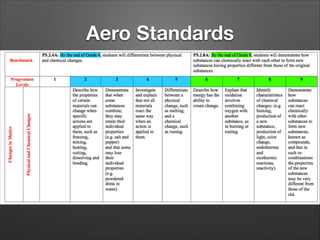
Aero Standards
PROJECT BREAKDOWN
Description

When

Principals Meeting + decision

Nov. 2013

Head Teachers Meeting

Dec. 2013

Phase 1: Awareness Phase

Jan. 2014

MAP Implementation (8-12 weeks before)

Jan. 2014

MAP test (Pilot Group)

April 2014

Phase 2: Transition Phase

Aug. 2014

MAP Test #1 Whole School

Oct. 2014

Phase 3: Implementation Phase

Jan. 2015

MAP Test #2 Whole School

April 2015
MAP: MEASURES OF
ACADEMIC PROGRESS
Created by educators for educators, MAP assessments provide detailed, actionable data
about where each child is on their unique learning path. Because student engagement is
essential to any testing experience, NWEA works with educators to create test items that
interest children and help to capture detail about what they know and what they’re ready
to learn. It’s information teachers can use in the classroom to help every child, every day.

Adapting the Test to the Student
MAP dynamically adapts to a student’s responses – as they take the test.
• Answer a question correctly and the test presents a more challenging item
• Miss a question, and MAP offers a simpler item
In this way, the test narrows in on a student’s learning level, engaging them with content
that allows them to succeed.

Available Assessments
Delivered over the web or through your local network, MAP is a complete set of
assessments aligned to national and state curricula and standards:
• MAP: Reading, mathematics and language
• MAP for Primary Grades: Reading and mathematics
• Science Assessment: General science
Phase 1: Awareness

January

Introduction : meetings, standards inside
Rubicon, MAP test implementation

March

Planning: standards match with Maps,
workshops

April

Collaborations: Pilot MAP test, meetings
analyzing results *Head Teachers

May-June

Final Reflection Phase 1
Phase 2: Transition
August

Resources: meetings, workshops how to plan using
Standards *Lesson Plans at Rubicon

August

Assessments: meetings and workshops How to Assess
using Standards * Assessments at Rubicon and
PowerSchool

September

Learning: Meetings analyzing results (teaching to the
standards) *Head Teachers

October

MAP testing whole school * meetings analyzing results
*Head Teachers

December

Final Reflection Phase 2
Phase 3: Implementation
January

Fully Aligned Curriculum revision: Rubicon
Atlas

January

Instruction and Assessment revision: visits to
the classrooms, mettings to analyze
assessments

April

MAP testing whole school * meetings
analyzing results *Head Teachers

June

Final Reflection Phase 3

SGS Aero Standards & MAPs Exams

  • 1.
    AERO Standards andMAP test 2013-2014
  • 2.
    Standards Vs Curriculum • Standardsare expectations. For instance, we expect students to know that 2+2=4, and why. Curriculum is the program created by school to teach students to learn that 2+2 =4, and why. • Standards are statements. Curriculum includes many resources: activities, lessons, units, assessments, and can include publisher textbooks. • Standards define what is to be learned by the end of a school year. Curriculum is the detailed plan for day to day teaching. • Standards are the end. Curriculum is the means. Saint George has a Curriculum.
  • 3.
    CIS ACCREDITED SCHOOLS PYP MYP IBDP IPC PUNTACANA INT. SCHOOL St Andrew's School The International School of The Bahamas IMYC CAMB. PRIMAR Y CAMB. SEC. 1 IGCSE AERO AP X X X X Nido de Aguilas International School Chile * Al parecer se rigen por el Plan de Chile- incorporan los libros, en LA los 6+1 Traits, usan el Rubicon para las unidades de estudios..dan SAT y TOEFL Escola Americana de Campinas en Brazil National Curriculu m PS y MS X Santiago College Providencia en Chile X X X Colegio Anglo-Colombiano X X X X X X International School of Havana en Cuba The British School Ecuador British National Curriculu m X X X X X Academia Británica Custacleca El Salvador X International School of Helsinki X X X Tokyo International School X X X Metropolitan School of Panamá X X X International School Singapore X X X Stamford International American School en Singapore *dan los MAP X X X X X X X X Benjamin Franklin International School en España Stockholm International School X X United Nation International School en NY X British School en Uruguay X Candidatos al IB X
  • 4.
    IB Schools +AERO Standards PYP STAMFORD INTERNATIONAL AMERICAN SCHOOL EN SINGAPORE *DAN LOS MAP BENJAMIN FRANKLIN INTERNATIONAL SCHOOL EN ESPAÑA MYP X X IBDP AERO AP X X X X X X THE AMERICAN INTERNATIONAL SCHOOL OF CONAKRY GUINEA X AMERICAN SCHOOL OF DOHA QATAR X INTERNATIONAL SCHOOL OF KIGALI - RWANDA X Modern Knowledge Schools Bahrain X X X American International School of Bamako X Pasir Ridge International School INDONESIA X INTERNATIONAL SCHOOL OF ARUBA X Bahrain Bayan School X X Cairo American College X X American School of Paris X X X X
  • 5.
    AERO Vision 
 American-sponsored overseasschools will know how standards-based education can and should strengthen a school’s curriculum, teaching, assessment, and, most importantly, student learning. These schools will develop and sustain a program of standards-based learning in their schools.

  • 6.
    Mission • Provide challenging,professionally-validated, voluntary academic standards for use as a foundation for curriculum in Americansponsored schools overseas • Assist overseas schools to develop their own K-12 curricula that are grounded in standards • Train teachers to use the AERO standards as the basis for assessing their students’ progress and their own instruction • Assist schools in developing standards-based curricula and sustaining curricula by becoming professional communities of learners.
  • 7.
    About AERO 
 AERO isa project supported by the U.S. State Department’s Office of Overseas Schools (A/OPR/OS) and the Overseas Schools Advisory Council to assist schools in developing and implementing standards-based curricula. Project faculty use the AERO standards as the basis of the professional development they provide. 
 AERO provides a framework for curriculum consistency across grades K-12 and for stability of curriculum in overseas schools, which typically have a high rate of teacher turnover. AERO’s resources, workshops, and professional consultation services help overseas schools implement and sustain standards-based curricula. This effort is in alignment with research-based trends in the development of curriculum worldwide, and particularly with the Common Core initiative in the U.S.
  • 8.
    What is ProjectAERO? American Education Reaches Out (AERO), began as a project to adapt the U. S. national standards in Mathematics, Science, Language Arts and Social Studies to serve the needs of multi-national student bodies. Over the years, standards have also been developed in Music, Visual Arts and World Languages. In addition, three other components have been added: AERO:SAW, which provides a focus on standards-based assessment, AERO:SBC, which is a collection of week-long summer institutes on curriculum design, and OSAC-funded AERO mini-workshops, which are one to two-day introductions to the principles taught more deeply in the summer institutes.
  • 9.
    AERO and IBSchools 
 Schools with IB programs use the AERO Standards in various ways. Some expect students to meet the standards by the end of grade 10 and then use the IB as the basis for the curriculum for the last two years of high school. Another choice is to maintain the AERO Standards through grade 12 for students not enrolled in the full IB program. In schools that follow the Primary Years Program and/ or Middle Years Program, AERO provides a clear, measurable set of expectations for content knowledge and skills that integrate with the curriculum design criteria for PYP and MYP.
  • 10.
  • 11.
    PROJECT BREAKDOWN Description When Principals Meeting+ decision Nov. 2013 Head Teachers Meeting Dec. 2013 Phase 1: Awareness Phase Jan. 2014 MAP Implementation (8-12 weeks before) Jan. 2014 MAP test (Pilot Group) April 2014 Phase 2: Transition Phase Aug. 2014 MAP Test #1 Whole School Oct. 2014 Phase 3: Implementation Phase Jan. 2015 MAP Test #2 Whole School April 2015
  • 12.
    MAP: MEASURES OF ACADEMICPROGRESS Created by educators for educators, MAP assessments provide detailed, actionable data about where each child is on their unique learning path. Because student engagement is essential to any testing experience, NWEA works with educators to create test items that interest children and help to capture detail about what they know and what they’re ready to learn. It’s information teachers can use in the classroom to help every child, every day. Adapting the Test to the Student MAP dynamically adapts to a student’s responses – as they take the test. • Answer a question correctly and the test presents a more challenging item • Miss a question, and MAP offers a simpler item In this way, the test narrows in on a student’s learning level, engaging them with content that allows them to succeed. Available Assessments Delivered over the web or through your local network, MAP is a complete set of assessments aligned to national and state curricula and standards: • MAP: Reading, mathematics and language • MAP for Primary Grades: Reading and mathematics • Science Assessment: General science
  • 13.
    Phase 1: Awareness January Introduction: meetings, standards inside Rubicon, MAP test implementation March Planning: standards match with Maps, workshops April Collaborations: Pilot MAP test, meetings analyzing results *Head Teachers May-June Final Reflection Phase 1
  • 14.
    Phase 2: Transition August Resources:meetings, workshops how to plan using Standards *Lesson Plans at Rubicon August Assessments: meetings and workshops How to Assess using Standards * Assessments at Rubicon and PowerSchool September Learning: Meetings analyzing results (teaching to the standards) *Head Teachers October MAP testing whole school * meetings analyzing results *Head Teachers December Final Reflection Phase 2
  • 15.
    Phase 3: Implementation January FullyAligned Curriculum revision: Rubicon Atlas January Instruction and Assessment revision: visits to the classrooms, mettings to analyze assessments April MAP testing whole school * meetings analyzing results *Head Teachers June Final Reflection Phase 3