




Becoming more creative & innovativeby Toronto Training and HR January 2011
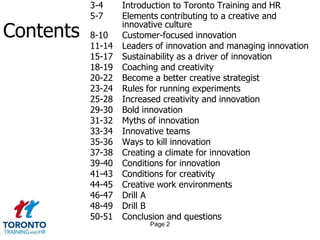
3-4 	Introduction to Toronto Training and HR5-7		Elements contributing to a creative and 	innovative culture8-10		Customer-focused innovation11-14	Leaders of innovation and managing innovation15-17	Sustainability as a driver of innovation18-19	Coaching and creativity20-22	Become a better creative strategist23-24	Rules for running experiments25-28	Increased creativity and innovation29-30	Bold innovation31-32	Myths of innovation33-34	Innovative teams35-36	Ways to kill innovation37-38	Creating a climate for innovation39-40	Conditions for innovation41-43	Conditions for creativity44-45	Creative work environments46-47	Drill A48-49	Drill B50-51	Conclusion and questionsContentsPage 2
Page 3Introduction
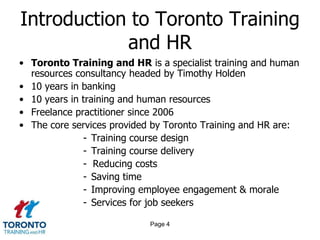
Page 4Introduction to Toronto Training and HRToronto Training and HRis a specialist training and human resources consultancy headed by Timothy Holden 10 years in banking10 years in training and human resourcesFreelance practitioner since 2006The core services provided by Toronto Training and HR are:Training course design
Training course delivery-  Reducing costsSaving time
Improving employee engagement & morale
Services for job seekersPage 5Elements contributing to a creative and innovative culture
Page 6Elements contributing to a creative and innovative culture 1 of 2INDIVIDUAL ELEMENTSA few committed individuals from diverse sectors and unusual partnershipsIndividuals who are comfortable living outside of silos and/or systemsIndividuals with an entrepreneurial and network mind-setIndividuals with passion who persevere in the face of resistance
Page 7Elements contributing to a creative and innovative culture 2 of 2SYSTEM ELEMENTSA collaborative and/or networked funding culture that frames failure as learning and an opportunity for the re-invention of an ideaAn awareness of three spaces where the system is connected or fragmentedFostering critical connectionsAn interdisciplinary environment that crosses traditional boundariesIncubators that provide opportunities to create ideas Learning and thinking globally while acting locally
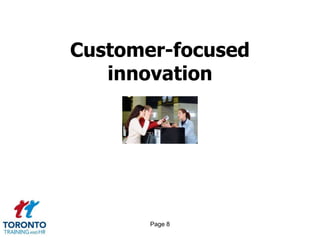
Page 8Customer-focused innovation
Page 9Customer-focused innovation 1 of 2Creating your company’s future requires being in the right marketsCreating your company’s future requires contemplating the futureCreating your company’s future requires anticipatory and proactive managementCreating your company’s future requires breakthrough strategiesCreating your company’s future requires breakthrough thinking
Page 10Customer-focused innovation 2 of 2Creating your company’s future requires numerous other capabilitiesBifocal managementBreakthrough executionSpeed and agilityBeing a learning organizationNot falling prey to the paradox of successIt all comes down to people
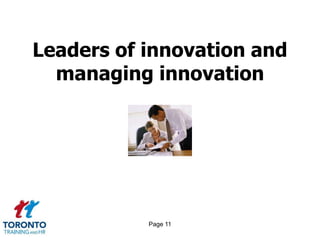
Page 11Leaders of innovation and managing innovation
Page 12Leaders of innovation and managing innovation 1 of 3LEADERS OF INNOVATIONGood knowledge of the area in which they workMission-definition perspectivesSupport for followersSkills of resource acquisition and resource distributionEvaluative feedbackAbility to induce structure where it is not well definedOrganizational outreach
Page 13Leaders of innovation and managing innovation 2 of 3MANAGING INNOVATIONOrganization models and structureOperational processesOrganizational alignmentKnowledge managementManagement style and leadershipIndividual employees
Page 14Leaders of innovation and managing innovation 3 of 3MANAGEMENT INNOVATIONTransparent financial dataOpen and honest feedbackService level agreementsOpen evaluationsMy BluePrintEmployee first councils
Page 15Sustainability as a driver for innovation
Page 16Sustainability as a driver for innovation 1 of 2Viewing compliance as opportunityMaking value chains sustainableDesigning sustainable products and servicesDeveloping new business modelsCreating next-practice platforms
Page 17Sustainability as a driver for innovation 2 of 2BECOMING MORE SUSTAINABLEDon’t start from the presentEnsure that learning precedes investmentsStay wedded to the goal while constantly adjusting tacticsBuild collaborative capacityUse a global presence to experiment
Page 18Coaching and creativity
Page 19Coaching and creativityWhat is coaching?Encouraging creativity and the introduction of new ideasHonouring and supporting work-life balanceEngagement and support of employees through effective employee assistanceCreating and maintaining a civil work environment
Page 20Become a better creative strategist
Page 21Become a better creative strategist 1 of 2Do not think that your domain experts--your operations people, accountants, or statisticians--cannot contribute innovative ideas to other areas of your business. Block out time for creative exploration throughout the day. In every meeting, no matter how tight its schedule, set aside a little time to explore creative ideas. Tell your people, "Let's think about how many different ways we could solve this problem." This expands the innovative capacity of your people and may lead to breakthrough ideas.
Page 22Become a better creative strategist 2 of 2Encourage your kids to think. Asking "Why?” is a good thing. Encourage your people to keep asking why. Don't let them be satisfied by the accepted solution.
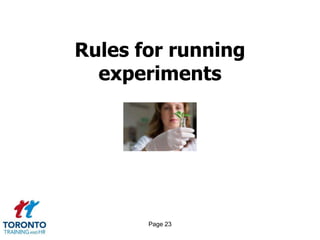
Page 23Rules for running experiments
Page 24Rules for running experimentsFocus on individuals and think short termKeep it simpleStart with a proof-of-concept testWhen the results come in, slice the dataTry out-of the-box thinkingMeasure everything that mattersLook for natural experiments
Page 25Increased creativity and innovation
Page 26Increased creativity and innovation 1 of 3Ignore everybodyThe idea doesn’t have to be big…it just has to change the worldPut the hours inIf your business plan depends on you being ‘discovered’ by some big shot, your plan will probably failYou are responsible for your own experienceEveryone is born creative; everyone is given a box of crayons in kindergartenKeep your day jobWorrying about ‘commercial’ v ‘artistic’ is a waste of time
Page 27Increased creativity and innovation 2 of 3Organizations that squelch creativity can no longer compete with organizations that champion creativityEverybody has their own private Mount Everest they were put in this earth to climbThe more talented someone is the less they need the propsDon’t try to stand out from the crowd; avoid crowds full stopIf you accept the pain, it cannot hurt youNever compare your inside with somebody else’s outsideDying young is overratedNobody cares, do it for yourselfWrite from the heart
Page 28Increased creativity and innovation 3 of 3The most important thing a creative person can learn, professionally, is to where to draw the red line that separates what you are willing to do from what you are notThe world is changingMerit can be bought, passion can’t  Avoid the Water cooler GangSing in your own voiceThe choice of media is irrelevantSelling out is harder than it looksDon’t worry about finding inspiration, it comes eventuallyYou have to find your own shtick
Page 29Bold innovation
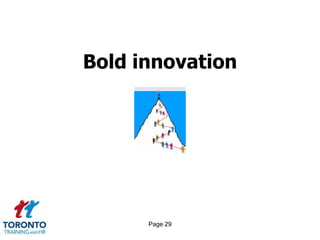
Page 30Bold innovationIn established firms, it’s impossible to start from scratch and hazardous to move too quicklyRadically-minded management innovators don’t have the benefit of a roadmapWe’re talking about people, not widgets
Page 31Myths of innovation
Page 32Myths of innovationThe ‘eureka’ momentThere is a clear path to innovationPeople dig new ideasThe lone inventor“I’m not really that creative”You’ll know innovation when you see itThe best ideas winInnovation is always good
Page 33Innovative teams
Page 34Innovative teamscreator- high-level thinker, extremely “wacky”ideascatalyst- a ‘connector’ who recognizes thoseideas and connects them to solutionschampion- paves through the nay-sayers toget the idea to market
Page 35Ways to kill innovation
Page 36Ways to kill innovation more management layers (hierarchies)paperwork, reports & reviewsover planningcompetitionfavouring the go-gettersrisk aversionskewing to high-level thinkingvaluing deadlines over doing it rightdemanding consensus
Page 37Creating a climate for innovation
Page 38Creating a climate for innovationMake innovation a priorityTake an outside-in perspectiveCreate a process for innovationDefine the big levers and pull themDrive out fearCreate trustRecognise both successful and unsuccessful innovators
Page 39Conditions for innovation
Page 40Conditions for innovationA motivation or directionCreative thinking / experimenter mentalityAbility to convert dead ends into new motivations /directionsDesire to challenge (or sometimes ignorance of) the status quoThreshold for risk & comfort w/uncertaintyTime + $$$ for work
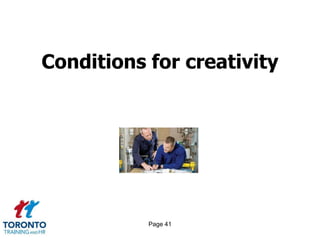
Page 41Conditions for creativity
Page 42Conditions for creativity 1 of 2a safe space (ability to say potentially ‘dumb’things)start from simple, move to difficult – game flowmoving from personal to communalintroducing different perspectivesexperimentationcelebration of risk-takingtransparency and openness
Page 43Conditions for creativity 2 of 2change of environmentfun, laughter & enjoyment of activityclear understanding of rewardsoodles of encouragement
Page 44Creative work environments
Page 45Creative work environmentsopen spacesroom for personalizationclose to parks, coffee shops etc.healthy snacks and drinksout in the open meeting spacescreation of personal connections
Page 46Drill A
Page 47Drill A
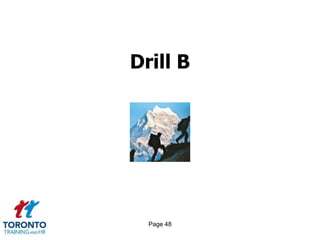
Page 48Drill B
Page 49Drill B

Becoming more creative & innovative January 2011

  • 1.
    Becoming more creative& innovativeby Toronto Training and HR January 2011
  • 2.
    3-4 Introduction toToronto Training and HR5-7 Elements contributing to a creative and innovative culture8-10 Customer-focused innovation11-14 Leaders of innovation and managing innovation15-17 Sustainability as a driver of innovation18-19 Coaching and creativity20-22 Become a better creative strategist23-24 Rules for running experiments25-28 Increased creativity and innovation29-30 Bold innovation31-32 Myths of innovation33-34 Innovative teams35-36 Ways to kill innovation37-38 Creating a climate for innovation39-40 Conditions for innovation41-43 Conditions for creativity44-45 Creative work environments46-47 Drill A48-49 Drill B50-51 Conclusion and questionsContentsPage 2
  • 3.
  • 4.
    Page 4Introduction toToronto Training and HRToronto Training and HRis a specialist training and human resources consultancy headed by Timothy Holden 10 years in banking10 years in training and human resourcesFreelance practitioner since 2006The core services provided by Toronto Training and HR are:Training course design
  • 5.
    Training course delivery- Reducing costsSaving time
  • 6.
  • 7.
    Services for jobseekersPage 5Elements contributing to a creative and innovative culture
  • 8.
    Page 6Elements contributingto a creative and innovative culture 1 of 2INDIVIDUAL ELEMENTSA few committed individuals from diverse sectors and unusual partnershipsIndividuals who are comfortable living outside of silos and/or systemsIndividuals with an entrepreneurial and network mind-setIndividuals with passion who persevere in the face of resistance
  • 9.
    Page 7Elements contributingto a creative and innovative culture 2 of 2SYSTEM ELEMENTSA collaborative and/or networked funding culture that frames failure as learning and an opportunity for the re-invention of an ideaAn awareness of three spaces where the system is connected or fragmentedFostering critical connectionsAn interdisciplinary environment that crosses traditional boundariesIncubators that provide opportunities to create ideas Learning and thinking globally while acting locally
  • 10.
  • 11.
    Page 9Customer-focused innovation1 of 2Creating your company’s future requires being in the right marketsCreating your company’s future requires contemplating the futureCreating your company’s future requires anticipatory and proactive managementCreating your company’s future requires breakthrough strategiesCreating your company’s future requires breakthrough thinking
  • 12.
    Page 10Customer-focused innovation2 of 2Creating your company’s future requires numerous other capabilitiesBifocal managementBreakthrough executionSpeed and agilityBeing a learning organizationNot falling prey to the paradox of successIt all comes down to people
  • 13.
    Page 11Leaders ofinnovation and managing innovation
  • 14.
    Page 12Leaders ofinnovation and managing innovation 1 of 3LEADERS OF INNOVATIONGood knowledge of the area in which they workMission-definition perspectivesSupport for followersSkills of resource acquisition and resource distributionEvaluative feedbackAbility to induce structure where it is not well definedOrganizational outreach
  • 15.
    Page 13Leaders ofinnovation and managing innovation 2 of 3MANAGING INNOVATIONOrganization models and structureOperational processesOrganizational alignmentKnowledge managementManagement style and leadershipIndividual employees
  • 16.
    Page 14Leaders ofinnovation and managing innovation 3 of 3MANAGEMENT INNOVATIONTransparent financial dataOpen and honest feedbackService level agreementsOpen evaluationsMy BluePrintEmployee first councils
  • 17.
    Page 15Sustainability asa driver for innovation
  • 18.
    Page 16Sustainability asa driver for innovation 1 of 2Viewing compliance as opportunityMaking value chains sustainableDesigning sustainable products and servicesDeveloping new business modelsCreating next-practice platforms
  • 19.
    Page 17Sustainability asa driver for innovation 2 of 2BECOMING MORE SUSTAINABLEDon’t start from the presentEnsure that learning precedes investmentsStay wedded to the goal while constantly adjusting tacticsBuild collaborative capacityUse a global presence to experiment
  • 20.
  • 21.
    Page 19Coaching andcreativityWhat is coaching?Encouraging creativity and the introduction of new ideasHonouring and supporting work-life balanceEngagement and support of employees through effective employee assistanceCreating and maintaining a civil work environment
  • 22.
    Page 20Become abetter creative strategist
  • 23.
    Page 21Become abetter creative strategist 1 of 2Do not think that your domain experts--your operations people, accountants, or statisticians--cannot contribute innovative ideas to other areas of your business. Block out time for creative exploration throughout the day. In every meeting, no matter how tight its schedule, set aside a little time to explore creative ideas. Tell your people, "Let's think about how many different ways we could solve this problem." This expands the innovative capacity of your people and may lead to breakthrough ideas.
  • 24.
    Page 22Become abetter creative strategist 2 of 2Encourage your kids to think. Asking "Why?” is a good thing. Encourage your people to keep asking why. Don't let them be satisfied by the accepted solution.
  • 25.
    Page 23Rules forrunning experiments
  • 26.
    Page 24Rules forrunning experimentsFocus on individuals and think short termKeep it simpleStart with a proof-of-concept testWhen the results come in, slice the dataTry out-of the-box thinkingMeasure everything that mattersLook for natural experiments
  • 27.
  • 28.
    Page 26Increased creativityand innovation 1 of 3Ignore everybodyThe idea doesn’t have to be big…it just has to change the worldPut the hours inIf your business plan depends on you being ‘discovered’ by some big shot, your plan will probably failYou are responsible for your own experienceEveryone is born creative; everyone is given a box of crayons in kindergartenKeep your day jobWorrying about ‘commercial’ v ‘artistic’ is a waste of time
  • 29.
    Page 27Increased creativityand innovation 2 of 3Organizations that squelch creativity can no longer compete with organizations that champion creativityEverybody has their own private Mount Everest they were put in this earth to climbThe more talented someone is the less they need the propsDon’t try to stand out from the crowd; avoid crowds full stopIf you accept the pain, it cannot hurt youNever compare your inside with somebody else’s outsideDying young is overratedNobody cares, do it for yourselfWrite from the heart
  • 30.
    Page 28Increased creativityand innovation 3 of 3The most important thing a creative person can learn, professionally, is to where to draw the red line that separates what you are willing to do from what you are notThe world is changingMerit can be bought, passion can’t Avoid the Water cooler GangSing in your own voiceThe choice of media is irrelevantSelling out is harder than it looksDon’t worry about finding inspiration, it comes eventuallyYou have to find your own shtick
  • 31.
  • 32.
    Page 30Bold innovationInestablished firms, it’s impossible to start from scratch and hazardous to move too quicklyRadically-minded management innovators don’t have the benefit of a roadmapWe’re talking about people, not widgets
  • 33.
    Page 31Myths ofinnovation
  • 34.
    Page 32Myths ofinnovationThe ‘eureka’ momentThere is a clear path to innovationPeople dig new ideasThe lone inventor“I’m not really that creative”You’ll know innovation when you see itThe best ideas winInnovation is always good
  • 35.
  • 36.
    Page 34Innovative teamscreator-high-level thinker, extremely “wacky”ideascatalyst- a ‘connector’ who recognizes thoseideas and connects them to solutionschampion- paves through the nay-sayers toget the idea to market
  • 37.
    Page 35Ways tokill innovation
  • 38.
    Page 36Ways tokill innovation more management layers (hierarchies)paperwork, reports & reviewsover planningcompetitionfavouring the go-gettersrisk aversionskewing to high-level thinkingvaluing deadlines over doing it rightdemanding consensus
  • 39.
    Page 37Creating aclimate for innovation
  • 40.
    Page 38Creating aclimate for innovationMake innovation a priorityTake an outside-in perspectiveCreate a process for innovationDefine the big levers and pull themDrive out fearCreate trustRecognise both successful and unsuccessful innovators
  • 41.
  • 42.
    Page 40Conditions forinnovationA motivation or directionCreative thinking / experimenter mentalityAbility to convert dead ends into new motivations /directionsDesire to challenge (or sometimes ignorance of) the status quoThreshold for risk & comfort w/uncertaintyTime + $$$ for work
  • 43.
  • 44.
    Page 42Conditions forcreativity 1 of 2a safe space (ability to say potentially ‘dumb’things)start from simple, move to difficult – game flowmoving from personal to communalintroducing different perspectivesexperimentationcelebration of risk-takingtransparency and openness
  • 45.
    Page 43Conditions forcreativity 2 of 2change of environmentfun, laughter & enjoyment of activityclear understanding of rewardsoodles of encouragement
  • 46.
  • 47.
    Page 45Creative workenvironmentsopen spacesroom for personalizationclose to parks, coffee shops etc.healthy snacks and drinksout in the open meeting spacescreation of personal connections
  • 48.
  • 49.
  • 50.
  • 51.