INTRODUCTIONNATURE AND SCOPE OF BUSINESS LAWBusiness comprises all profit seeking activities and enterprises that provide goods and services necessary to an economic system.Law refers to the principles and regulations established by a Government , applicable to people and enforced by judicial decision.
Meaning and DefinitionBusiness law is that portion of the legal system which guarantees an orderly conduct of business affairs and the settlement of legitimate disputes in a just manner. It establishes a set of rules and   prescribes  conduct to order to avoid misunderstandings and injury in our business relationships
Sources of business lawLegislations.Customs.Case Law.Natural Law.English Law.
Scope of Business lawThe Indian Contract Act,1872The Sale of Goods Act,1930The Partnership Act,1932The Negotiable Instruments Act,1881The Companies Act,1956The Patents Act,1970The Trade and Merchandise Marks Act,1958The Consumer Protection Act,1986.
Objectives of Business Law:To  enable enforcement of right
To facilitate industrial growth
To achieve social justice
To define the rulesRequirements of effective Business law:Rules must be obeyed voluntarily
Rules must be just and reasonable
Rules must be flexible
Rules must be knowableThe Indian Contract Act,1872The Indian Contract Act came into force on 1st September 1872. The Act applies to the whole of  India except the state of Jammu and Kashmir.The main objective of the Act is to ensure that  the rights and obligations are honored, the expectations created by the promises of parties to an agreement are fulfilled and legal remedies are available to an aggrieved party against the party failing to honor his part of the agreement.
The Indian Contract Act,1872An agreement is defined as every promise  and every set of promises forming consideration for each other.[Sec.2(e)]When the person to whom proposal is made signifies his assent, the proposal is said to be accepted. A proposal, when accepted, becomes a promise.[Sec2(b)].
Essentials of a valid contractAccording to Sec2(h), a contract is an agreement enforceable at law.Essentials:  1.Offer and Acceptance  2. Free consent  3. Contractual capacity  4. Lawful consideration  5. Lawful object   6. Agreement not expressly declared void  7. Possibility of performance  8. Certainty of terms  9. Intention to create legal relationship 10. Legal formalities.
Classification of ContractsAccording to validity:1.Valid contract2.Void contract3. Void agreement4.Voidable contract5.Illegal agreement6.Unenforceable contractNote:An agreement not enforceable by law is said to be void.A contract which was valid when first entered into but subsequently becomes  unenforceable is called void contact.eg: war breaks out.A voidable contract is one which can be set aside at the option of one of the parties.
Classification of ContractsAccording to formation:1.Express contract2.Implied contract3.Quasi contractAccording to Performance:1.Executed contract2.Executory contract3.Unilateral contract4.Bilateral contract
Quasi contract- refers to certain transactions which create peculiar obligations  like   a)supplier of necessaries  to minors, lunatics, married women, b)person paying money owed by another, c) finder of goods,d)person receiving money or goods belonging to another by mistake or under coercion.   Here the person receiving the benefit has an obligation to compensate the person paying the benefit although there is no explicit contract  between the giver and the receiver of benefit.
Offer and AcceptanceAccording to Sec 2(a),”when one person signifies to another his willingness to do or abstain from doing anything, with a view to obtain the assent of the other  to such act or abstinence, he is said to make a proposal.” Essentials of a valid offer:   1.Intention to create legal relationship   2. Definite terms   3. Statement of intention and invitation to offer.   4. Offer must be communicated.(LalmanShuklaVs.GauriDutt.(1913).
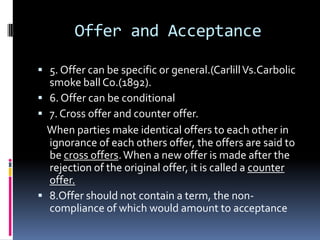
Offer and Acceptance5. Offer can be specific or general.(CarlillVs.Carbolic smoke ball Co.(1892).6. Offer can be conditional7. Cross offer and counter offer. When parties make identical offers to each other in ignorance of each others offer, the offers are said to be cross offers. When a new offer is made after the rejection of the original offer, it is called a counter offer.8.Offer should not contain a term, the non-compliance of which would amount to acceptance
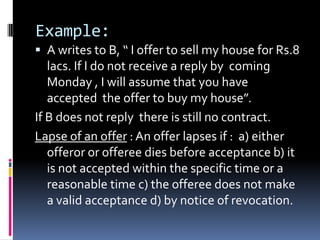
Example:A writes to B, “ I offer to sell my house for Rs.8 lacs. If I do not receive a reply by  coming Monday , I will assume that you have accepted  the offer to buy my house”. If B does not reply  there is still no contract.Lapse of an offer : An offer lapses if :  a) either offeror or offeree dies before acceptance b) it is not accepted within the specific time or a reasonable time c) the offeree does not make a valid acceptance d) by notice of revocation.
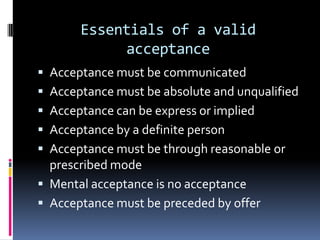
Essentials of a valid acceptanceAcceptance must be communicatedAcceptance must be absolute and unqualifiedAcceptance can be express or impliedAcceptance by a definite personAcceptance must be through reasonable or prescribed modeMental acceptance is no acceptanceAcceptance must be preceded by offer
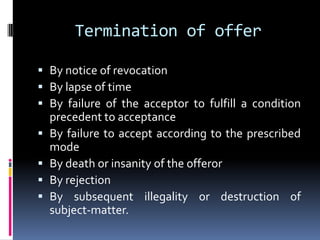
Termination of offerBy notice of revocationBy lapse of timeBy failure of the acceptor to fulfill a condition precedent to acceptanceBy failure to accept according to the prescribed modeBy death or insanity of the offerorBy rejectionBy subsequent illegality or destruction of subject-matter.
Communication of offer and acceptanceMethods:By Act: It includes conduct, words.(written or oral) It can also be through letter, telegram or telephone.By Omission: It includes an abstinence or forbearance on the part of one person.Communication of acceptance not necessary:When there is a prescribed mode and the offeree follows it, b) when the offeror has acted  in a certain conduct on the part of the offeree as equivalent to acceptance.
CONSIDERATION   Section 2(d) of Indian Contract Act defines consideration as –When at the desire of the promisorThe promisee or any other personHas done or abstained from doing ,or does or abstains from doing , or promises to do or abstain from doing somethingsuch act or abstinence or promise is called a consideration for the promise.
Essentials of  valid considerationIt must move at the desire of the promisor  (Kedarnath Vs. Gorie Mohamed)1886It must move from the promisee or any other person (ChinnayaVs.Ramaya)1882Consideration may be an act or abstinence.It may be past , present or futureIt need not be adequate-The court can hardly assume the role of setting what should be the appropriate consideration for a promise.
Essentials of  valid considerationIt must be real and not illusory- a promise by a man to make two parallel lines meet  is no good consideration.It must be lawful.The consideration of an agreement is lawful unless -    a)it is forbidden by law. b)fraudulent c) it involves or implies injury to person or property of another d) the court regards it as immoral or opposed to public policy e) it defeats the provision of any law.Discharge of a pre-existing obligation is no consideration.
Exceptions to the rule                  “no consideration no contract”Natural love and affectionCompensation  for past voluntary serviceTime barred debt- but the promise must be in writing and duly signed by the promisor or his authorized agent.Completed giftsAgency-no consideration is required to create an agencyGuaranteeRemission- no consideration is required for an agreement to receive anything less than what is due.
Contractual Capacity Of Parties“Capacity to contract” means the competence or capability of the parties to enter into a valid contract.Section 11 of the Contract Act says that “every person is competent to contract who is of the age of majority and who is of sound mind and is not disqualified from contracting by any law to which he is subject”
MINORMinor is a person who has not completed  the age of 18 years.  However, a minor for whom a guardian has been appointed by the court or when his property is managed by the court of wards, becomes a major only on completing 21 years of age.
Effect of minor’s agreementAn agreement with or by a minor is void. A minor is not competent to contract and a contract by minor is void ab  initio. (Mohoribibi vs.Dharmodas ghose)1903No ratification. A minor cannot ratify the agreement on attaining majority because a void agreement cannot be ratified.Minor can be a promisee or beneficiary.   Thus in case of goods sold by a minor he is entitled to recover the price from the  buyer. He can be a payee in a contract.   (Raghava Chariar Vs.Srinivasa)
Effect of minor’s agreementNo estoppel against a minor. A minor can always  plead minority and will not be prevented from doing so even when he has entered into a contract falsely representing himself to be a major. Contract by guardian.  A contract can be entered into by the guardian or manager of a minor only if a) the contract is within the authority of the guardian or manager b) it is for the benefit of the minor.
Effect of minor’s agreementLiability for torts.  Where the tort is directly connected with the contract the minor is not liable, (Mohoribibi Vs.Dharmodas Ghose)but where the tort is independent of the contract, the minor cannot escape his liability.(Burnard v. Haggis.1863) Doctrine of restitution. If an infant has obtained goods or property by misrepresenting his age , he can be compelled to restore it as long as it is traceable in his possession.
Effect of minor’s agreementBeneficial contracts : Agreements entered into by a minor for his/her benefit are valid and enforceable. They are –a) Contracts of marriage- such contracts can be enforced against the other enforcing party at the instance of the minor but the same cannot be enforced against the minor.b) Contracts of apprenticeship- such contract can be made by the guardian on behalf and for the benefit of the minor.(Roberts  v. Gray)
Effect of minor’s agreementMinor as an agent- Although a minor is not entitled to employ an agent, he can be an agent for someone else.Minor as a Partner- A minor cannot make a contract of partnership although he may be admitted to its benefits with the consent of all the partners.Minor as a shareholder-A minor cannot be a member of a company because membership arises out of a contract.Insolvency-minor cannot be declared insolvent as he is incapable of entering into valid contract.
Free ConsentCoercion:               According  to Section 15 “Coercion is the committing or threatening to commit, any act forbidden by the Indian Penal Code, or the unlawful detaining, or threatening to detain, any property, to the prejudice of any person whatever, with the intention of causing any person to enter into an agreement”Ranganayakamma v. AlwarSetty. (1889).
Undue InfluenceAccording to Section 16 “ A contract is said to be induced by undue influence where the relations subsisting between the parties are such that one of the parties is in a position to dominate the will of the other and uses that position to obtain an unfair advantage over the other “Manu Singh V. Umadat Pandey. (1890) Lloyds Bank V.Bundy.(1975)
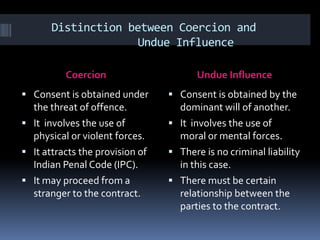
Distinction between Coercion and          		Undue Influence                    Coercion             Undue InfluenceConsent is obtained under the threat of offence.It  involves the use of  physical or violent forces.It attracts the provision of Indian Penal Code (IPC).It may proceed from a stranger to the contract.Consent is obtained by the dominant will of another.It  involves the use of  moral or mental forces.There is no criminal liability in this case.There must be certain relationship between the parties to the contract.
MisrepresentationMisrepresentation  refers to the misstatement of fact material to the contract. According to Section 18 of the Act “Misrepresentation means and includes –1.  the positive assertion, in a manner not warranted by the information of the person making it, of that which is not true, though he believes it to be true2. Any breach of duty which, without any intent to deceive, gains an advantage to the person committing it by misleading another to his prejudice
Misrepresentation3. Causing ,however innocently,  a party to an agreement, to make a mistake as to the substance of  a thing which is the subject matter of the agreement.”Types Of Misrepresentation:Unwarranted Statements-When a party to a contract positively asserts that a particular fact  relating to the subject matter of the agreement is true, when his information  does not warrant it to be so, he is guilty of misrepresentation.
MisrepresentationBreach of Duty – When a person commits a breach of duty without any intention  to deceive the other party, and thereby gains an advantage to himself to the prejudice of the other party, the person committing the breach of duty is said to be guilty of misrepresentation. Oriental Banking Corporation V. John Fleming (1879)
MisrepresentationInducing mistake about subject-matter : If a party to an agreement induces the other party, although innocently, to commit a mistake as to the nature or quality of the subject-matter  of the agreement, he becomes guilty of misrepresentation.Eg: Concealment of information relating to company in prospectus.
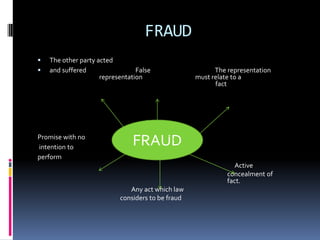
FRAUDThe other party actedand suffered                                  False                                             The representation 			representation		must relate to a 							              factPromise with no intention to performActive						concealment of 						fact.Any act which law                             considers to be fraudFRAUD
VOID AGREEMENTSAgreement made by incompetent parties.Agreement made under  a mutual mistake of fact.Agreement , the consideration or object of which is unlawful.Agreements , the consideration or object of which is unlawful in parts.Agreements made without consideration.       (subject to exceptions to the rule “No Consideration No Contract”).
VOID AGREEMENTS6.Agreements in restraint of marriage- An agreement in restraint of marriage of any person , other than a minor is void. Example:P promised to marry L  only and no one else and to pay a definite sum if he married  someone else.P married X.7. Agreements in restraint of trade- An agreement  restraining a person from exercising a lawful profession, trade or business of any kind is void. However there are two types of exceptions to this rule.
VOID AGREEMENTSStatutory Exceptions:1.Sale of goodwill2.Partnership ActB.Exceptions under the common law:1.Trade combinations. Traders and manufacturers in the same line of business normally form associations to regulate, promote and carry out business in an organized way.2.Exclusive Dealing Agreements3.Restraints on employees.
VOID AGREEMENTS8. Agreements in restraint of legal proceedings- An agreement which prohibits a person from taking judicial proceedings, in respect of any right arising from a contract, is void. 9. Agreements the meaning of which is uncertain. Exception: A horse was purchased for a certain price together with a promise to give $5 more if the horse proved lucky.10.Agreements in respect of wager (Sec 30) An agreement becomes a wager when it has the following features:
VOID AGREEMENTSa) Uncertain eventb) Mutual chances of gain or lossc) Neither party to have control over the eventd) No other interest in the event.Exceptions: a)Horse race b)Crosswords competitions c)Share market transactions d)Chit funds.11.Agreements  to do impossible acts. Example: A agrees with B to put life into a dead man,    the agreement is void.
DISCHARGE OF CONTRACTA contract may be discharged in either of the following ways:By performanceBy agreementBy impossibilityBy bar of limitationBy operation of lawBy breach of contract
Rules relating  performance1.Tender of performance- It refers to the offer made by the promisor to the promisee  to perform his obligation under the contract. The tender must be : a) unconditional, b)made at a proper time and place2. Party to perform- If the contract requires personal skill of the promisor e.g. painting, singing, then death of the promisor puts an end to the contract. Otherwise the promisor or his representative may employ a competent person to perform the promise.
Rules relating  performance3. Time and place of performance- when day is specified then the promisor must perform at ant time during the usual hours of business of such day and place at which the promise ought to be performed.When no time is specified then the promisor must perform his obligation within a reasonable time.The performance of any promise may be in any manner or at any time which the promisee prescribes or sanctions.
Rules relating  performance4.Performance of reciprocal promises- when a contract consists of an exchange of promises, they are called reciprocal promises. Sec 54 lays down that where the nature of the reciprocal promises is such that one cannot be performed unless the other party performs his promise first, then if the latter fails to perform, he cannot claim performance from the other, but make compensation to him for his loss.5.Appropriation of payments – It arises when a debtor owes several debts to a creditor and makes a payment insufficient to clear all debts.
Discharge by AgreementIt may happen in any of the following ways:1. Novation- When the parties to a contract agree to substitute the existing contract with a new one, it is called novation.2. Remission- It means acceptance of less than what was agreed for.3. Waiver- It means  deliberate abandonment  of the rights by the parties to a contract.4. Rescission- It takes place when all or some of the terms of the contract are cancelled.5.Merger- It takes place when an inferior right merges into a superior right accruing to the same party under the same or some other contract.
Discharge by ImpossibilityImpossibility of performance may be –At the time of entering into the contractSubsequent impossibility (also called the doctrine of frustration)Grounds of frustration: Destruction of subject-matterChange of lawNon-occurrence of an eventDeath or incapacity of partyOutbreak of war.

Business law

  • 1.
    INTRODUCTIONNATURE AND SCOPEOF BUSINESS LAWBusiness comprises all profit seeking activities and enterprises that provide goods and services necessary to an economic system.Law refers to the principles and regulations established by a Government , applicable to people and enforced by judicial decision.
  • 2.
    Meaning and DefinitionBusinesslaw is that portion of the legal system which guarantees an orderly conduct of business affairs and the settlement of legitimate disputes in a just manner. It establishes a set of rules and prescribes conduct to order to avoid misunderstandings and injury in our business relationships
  • 3.
    Sources of businesslawLegislations.Customs.Case Law.Natural Law.English Law.
  • 4.
    Scope of BusinesslawThe Indian Contract Act,1872The Sale of Goods Act,1930The Partnership Act,1932The Negotiable Instruments Act,1881The Companies Act,1956The Patents Act,1970The Trade and Merchandise Marks Act,1958The Consumer Protection Act,1986.
  • 5.
    Objectives of BusinessLaw:To enable enforcement of right
  • 6.
  • 7.
  • 8.
    To define therulesRequirements of effective Business law:Rules must be obeyed voluntarily
  • 9.
    Rules must bejust and reasonable
  • 10.
  • 11.
    Rules must beknowableThe Indian Contract Act,1872The Indian Contract Act came into force on 1st September 1872. The Act applies to the whole of India except the state of Jammu and Kashmir.The main objective of the Act is to ensure that the rights and obligations are honored, the expectations created by the promises of parties to an agreement are fulfilled and legal remedies are available to an aggrieved party against the party failing to honor his part of the agreement.
  • 12.
    The Indian ContractAct,1872An agreement is defined as every promise and every set of promises forming consideration for each other.[Sec.2(e)]When the person to whom proposal is made signifies his assent, the proposal is said to be accepted. A proposal, when accepted, becomes a promise.[Sec2(b)].
  • 13.
    Essentials of avalid contractAccording to Sec2(h), a contract is an agreement enforceable at law.Essentials: 1.Offer and Acceptance 2. Free consent 3. Contractual capacity 4. Lawful consideration 5. Lawful object 6. Agreement not expressly declared void 7. Possibility of performance 8. Certainty of terms 9. Intention to create legal relationship 10. Legal formalities.
  • 14.
    Classification of ContractsAccordingto validity:1.Valid contract2.Void contract3. Void agreement4.Voidable contract5.Illegal agreement6.Unenforceable contractNote:An agreement not enforceable by law is said to be void.A contract which was valid when first entered into but subsequently becomes unenforceable is called void contact.eg: war breaks out.A voidable contract is one which can be set aside at the option of one of the parties.
  • 15.
    Classification of ContractsAccordingto formation:1.Express contract2.Implied contract3.Quasi contractAccording to Performance:1.Executed contract2.Executory contract3.Unilateral contract4.Bilateral contract
  • 16.
    Quasi contract- refersto certain transactions which create peculiar obligations like a)supplier of necessaries to minors, lunatics, married women, b)person paying money owed by another, c) finder of goods,d)person receiving money or goods belonging to another by mistake or under coercion. Here the person receiving the benefit has an obligation to compensate the person paying the benefit although there is no explicit contract between the giver and the receiver of benefit.
  • 17.
    Offer and AcceptanceAccordingto Sec 2(a),”when one person signifies to another his willingness to do or abstain from doing anything, with a view to obtain the assent of the other to such act or abstinence, he is said to make a proposal.” Essentials of a valid offer: 1.Intention to create legal relationship 2. Definite terms 3. Statement of intention and invitation to offer. 4. Offer must be communicated.(LalmanShuklaVs.GauriDutt.(1913).
  • 18.
    Offer and Acceptance5.Offer can be specific or general.(CarlillVs.Carbolic smoke ball Co.(1892).6. Offer can be conditional7. Cross offer and counter offer. When parties make identical offers to each other in ignorance of each others offer, the offers are said to be cross offers. When a new offer is made after the rejection of the original offer, it is called a counter offer.8.Offer should not contain a term, the non-compliance of which would amount to acceptance
  • 19.
    Example:A writes toB, “ I offer to sell my house for Rs.8 lacs. If I do not receive a reply by coming Monday , I will assume that you have accepted the offer to buy my house”. If B does not reply there is still no contract.Lapse of an offer : An offer lapses if : a) either offeror or offeree dies before acceptance b) it is not accepted within the specific time or a reasonable time c) the offeree does not make a valid acceptance d) by notice of revocation.
  • 20.
    Essentials of avalid acceptanceAcceptance must be communicatedAcceptance must be absolute and unqualifiedAcceptance can be express or impliedAcceptance by a definite personAcceptance must be through reasonable or prescribed modeMental acceptance is no acceptanceAcceptance must be preceded by offer
  • 21.
    Termination of offerBynotice of revocationBy lapse of timeBy failure of the acceptor to fulfill a condition precedent to acceptanceBy failure to accept according to the prescribed modeBy death or insanity of the offerorBy rejectionBy subsequent illegality or destruction of subject-matter.
  • 22.
    Communication of offerand acceptanceMethods:By Act: It includes conduct, words.(written or oral) It can also be through letter, telegram or telephone.By Omission: It includes an abstinence or forbearance on the part of one person.Communication of acceptance not necessary:When there is a prescribed mode and the offeree follows it, b) when the offeror has acted in a certain conduct on the part of the offeree as equivalent to acceptance.
  • 23.
    CONSIDERATION Section 2(d) of Indian Contract Act defines consideration as –When at the desire of the promisorThe promisee or any other personHas done or abstained from doing ,or does or abstains from doing , or promises to do or abstain from doing somethingsuch act or abstinence or promise is called a consideration for the promise.
  • 24.
    Essentials of valid considerationIt must move at the desire of the promisor (Kedarnath Vs. Gorie Mohamed)1886It must move from the promisee or any other person (ChinnayaVs.Ramaya)1882Consideration may be an act or abstinence.It may be past , present or futureIt need not be adequate-The court can hardly assume the role of setting what should be the appropriate consideration for a promise.
  • 25.
    Essentials of valid considerationIt must be real and not illusory- a promise by a man to make two parallel lines meet is no good consideration.It must be lawful.The consideration of an agreement is lawful unless - a)it is forbidden by law. b)fraudulent c) it involves or implies injury to person or property of another d) the court regards it as immoral or opposed to public policy e) it defeats the provision of any law.Discharge of a pre-existing obligation is no consideration.
  • 26.
    Exceptions to therule “no consideration no contract”Natural love and affectionCompensation for past voluntary serviceTime barred debt- but the promise must be in writing and duly signed by the promisor or his authorized agent.Completed giftsAgency-no consideration is required to create an agencyGuaranteeRemission- no consideration is required for an agreement to receive anything less than what is due.
  • 27.
    Contractual Capacity OfParties“Capacity to contract” means the competence or capability of the parties to enter into a valid contract.Section 11 of the Contract Act says that “every person is competent to contract who is of the age of majority and who is of sound mind and is not disqualified from contracting by any law to which he is subject”
  • 28.
    MINORMinor is aperson who has not completed the age of 18 years. However, a minor for whom a guardian has been appointed by the court or when his property is managed by the court of wards, becomes a major only on completing 21 years of age.
  • 29.
    Effect of minor’sagreementAn agreement with or by a minor is void. A minor is not competent to contract and a contract by minor is void ab initio. (Mohoribibi vs.Dharmodas ghose)1903No ratification. A minor cannot ratify the agreement on attaining majority because a void agreement cannot be ratified.Minor can be a promisee or beneficiary. Thus in case of goods sold by a minor he is entitled to recover the price from the buyer. He can be a payee in a contract. (Raghava Chariar Vs.Srinivasa)
  • 30.
    Effect of minor’sagreementNo estoppel against a minor. A minor can always plead minority and will not be prevented from doing so even when he has entered into a contract falsely representing himself to be a major. Contract by guardian. A contract can be entered into by the guardian or manager of a minor only if a) the contract is within the authority of the guardian or manager b) it is for the benefit of the minor.
  • 31.
    Effect of minor’sagreementLiability for torts. Where the tort is directly connected with the contract the minor is not liable, (Mohoribibi Vs.Dharmodas Ghose)but where the tort is independent of the contract, the minor cannot escape his liability.(Burnard v. Haggis.1863) Doctrine of restitution. If an infant has obtained goods or property by misrepresenting his age , he can be compelled to restore it as long as it is traceable in his possession.
  • 32.
    Effect of minor’sagreementBeneficial contracts : Agreements entered into by a minor for his/her benefit are valid and enforceable. They are –a) Contracts of marriage- such contracts can be enforced against the other enforcing party at the instance of the minor but the same cannot be enforced against the minor.b) Contracts of apprenticeship- such contract can be made by the guardian on behalf and for the benefit of the minor.(Roberts v. Gray)
  • 33.
    Effect of minor’sagreementMinor as an agent- Although a minor is not entitled to employ an agent, he can be an agent for someone else.Minor as a Partner- A minor cannot make a contract of partnership although he may be admitted to its benefits with the consent of all the partners.Minor as a shareholder-A minor cannot be a member of a company because membership arises out of a contract.Insolvency-minor cannot be declared insolvent as he is incapable of entering into valid contract.
  • 34.
    Free ConsentCoercion: According to Section 15 “Coercion is the committing or threatening to commit, any act forbidden by the Indian Penal Code, or the unlawful detaining, or threatening to detain, any property, to the prejudice of any person whatever, with the intention of causing any person to enter into an agreement”Ranganayakamma v. AlwarSetty. (1889).
  • 35.
    Undue InfluenceAccording toSection 16 “ A contract is said to be induced by undue influence where the relations subsisting between the parties are such that one of the parties is in a position to dominate the will of the other and uses that position to obtain an unfair advantage over the other “Manu Singh V. Umadat Pandey. (1890) Lloyds Bank V.Bundy.(1975)
  • 36.
    Distinction between Coercionand Undue Influence Coercion Undue InfluenceConsent is obtained under the threat of offence.It involves the use of physical or violent forces.It attracts the provision of Indian Penal Code (IPC).It may proceed from a stranger to the contract.Consent is obtained by the dominant will of another.It involves the use of moral or mental forces.There is no criminal liability in this case.There must be certain relationship between the parties to the contract.
  • 37.
    MisrepresentationMisrepresentation refersto the misstatement of fact material to the contract. According to Section 18 of the Act “Misrepresentation means and includes –1. the positive assertion, in a manner not warranted by the information of the person making it, of that which is not true, though he believes it to be true2. Any breach of duty which, without any intent to deceive, gains an advantage to the person committing it by misleading another to his prejudice
  • 38.
    Misrepresentation3. Causing ,howeverinnocently, a party to an agreement, to make a mistake as to the substance of a thing which is the subject matter of the agreement.”Types Of Misrepresentation:Unwarranted Statements-When a party to a contract positively asserts that a particular fact relating to the subject matter of the agreement is true, when his information does not warrant it to be so, he is guilty of misrepresentation.
  • 39.
    MisrepresentationBreach of Duty– When a person commits a breach of duty without any intention to deceive the other party, and thereby gains an advantage to himself to the prejudice of the other party, the person committing the breach of duty is said to be guilty of misrepresentation. Oriental Banking Corporation V. John Fleming (1879)
  • 40.
    MisrepresentationInducing mistake aboutsubject-matter : If a party to an agreement induces the other party, although innocently, to commit a mistake as to the nature or quality of the subject-matter of the agreement, he becomes guilty of misrepresentation.Eg: Concealment of information relating to company in prospectus.
  • 41.
    FRAUDThe other partyactedand suffered False The representation representation must relate to a factPromise with no intention to performActive concealment of fact.Any act which law considers to be fraudFRAUD
  • 42.
    VOID AGREEMENTSAgreement madeby incompetent parties.Agreement made under a mutual mistake of fact.Agreement , the consideration or object of which is unlawful.Agreements , the consideration or object of which is unlawful in parts.Agreements made without consideration. (subject to exceptions to the rule “No Consideration No Contract”).
  • 43.
    VOID AGREEMENTS6.Agreements inrestraint of marriage- An agreement in restraint of marriage of any person , other than a minor is void. Example:P promised to marry L only and no one else and to pay a definite sum if he married someone else.P married X.7. Agreements in restraint of trade- An agreement restraining a person from exercising a lawful profession, trade or business of any kind is void. However there are two types of exceptions to this rule.
  • 44.
    VOID AGREEMENTSStatutory Exceptions:1.Saleof goodwill2.Partnership ActB.Exceptions under the common law:1.Trade combinations. Traders and manufacturers in the same line of business normally form associations to regulate, promote and carry out business in an organized way.2.Exclusive Dealing Agreements3.Restraints on employees.
  • 45.
    VOID AGREEMENTS8. Agreementsin restraint of legal proceedings- An agreement which prohibits a person from taking judicial proceedings, in respect of any right arising from a contract, is void. 9. Agreements the meaning of which is uncertain. Exception: A horse was purchased for a certain price together with a promise to give $5 more if the horse proved lucky.10.Agreements in respect of wager (Sec 30) An agreement becomes a wager when it has the following features:
  • 46.
    VOID AGREEMENTSa) Uncertaineventb) Mutual chances of gain or lossc) Neither party to have control over the eventd) No other interest in the event.Exceptions: a)Horse race b)Crosswords competitions c)Share market transactions d)Chit funds.11.Agreements to do impossible acts. Example: A agrees with B to put life into a dead man, the agreement is void.
  • 47.
    DISCHARGE OF CONTRACTAcontract may be discharged in either of the following ways:By performanceBy agreementBy impossibilityBy bar of limitationBy operation of lawBy breach of contract
  • 48.
    Rules relating performance1.Tender of performance- It refers to the offer made by the promisor to the promisee to perform his obligation under the contract. The tender must be : a) unconditional, b)made at a proper time and place2. Party to perform- If the contract requires personal skill of the promisor e.g. painting, singing, then death of the promisor puts an end to the contract. Otherwise the promisor or his representative may employ a competent person to perform the promise.
  • 49.
    Rules relating performance3. Time and place of performance- when day is specified then the promisor must perform at ant time during the usual hours of business of such day and place at which the promise ought to be performed.When no time is specified then the promisor must perform his obligation within a reasonable time.The performance of any promise may be in any manner or at any time which the promisee prescribes or sanctions.
  • 50.
    Rules relating performance4.Performance of reciprocal promises- when a contract consists of an exchange of promises, they are called reciprocal promises. Sec 54 lays down that where the nature of the reciprocal promises is such that one cannot be performed unless the other party performs his promise first, then if the latter fails to perform, he cannot claim performance from the other, but make compensation to him for his loss.5.Appropriation of payments – It arises when a debtor owes several debts to a creditor and makes a payment insufficient to clear all debts.
  • 51.
    Discharge by AgreementItmay happen in any of the following ways:1. Novation- When the parties to a contract agree to substitute the existing contract with a new one, it is called novation.2. Remission- It means acceptance of less than what was agreed for.3. Waiver- It means deliberate abandonment of the rights by the parties to a contract.4. Rescission- It takes place when all or some of the terms of the contract are cancelled.5.Merger- It takes place when an inferior right merges into a superior right accruing to the same party under the same or some other contract.
  • 52.
    Discharge by ImpossibilityImpossibilityof performance may be –At the time of entering into the contractSubsequent impossibility (also called the doctrine of frustration)Grounds of frustration: Destruction of subject-matterChange of lawNon-occurrence of an eventDeath or incapacity of partyOutbreak of war.

Editor's Notes