Fundamentals of Nursing
Level 1
Dr Abdulaazi Baalawi
T. Ammar Alqahwee
Body mechanics
LEARNING OUTCOMES
At the end of this lecture students are able to:
1.Describe the four basic elements of normal movement.
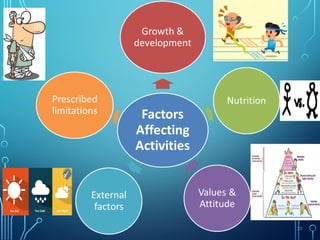
2.Identify factors affecting activity level
1.Compare the effects of exercise and immobility on
body
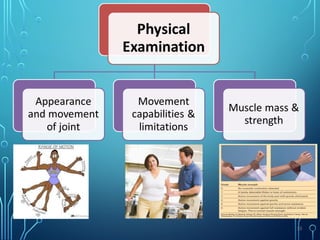
2.Assess activity-exercise pattern, movement of joints, mobility
capabilities and limitations, muscle mass and strength, activity
tolerance, and problems related to immobility.
3.Uses safe practices when positioning, moving, lifting and
ambulating clients
4.Compare and contrast active, passive, and active-assistive
range-of-motion (ROM) exercises.
2
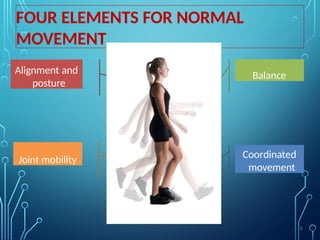
FOUR ELEMENTS FOR NORMAL
MOVEMENT
Balance
Coordinated
movement
Alignment and
posture
Joint mobility
3
1
.
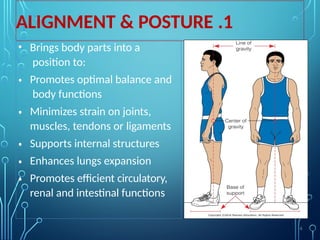
ALIGNMENT & POSTURE
•
•
•
•
•
• Brings body parts into a
position to:
Promotes optimal balance and
body functions
Minimizes strain on joints,
muscles, tendons or ligaments
Supports internal structures
Enhances lungs expansion
Promotes efficient circulatory,
renal and intestinal functions
4
2
.
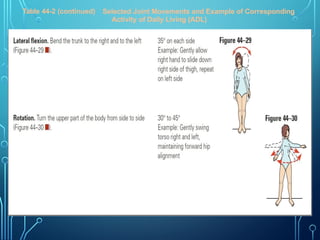
JOINT MOBILITY
• Range of motion (ROM) is the maximum and possible
movement of a joint
• ROM varies and determined by:
• Genetic makeup
• Developmental patterns
• Presence or absence of disease
• Physical activity
• Inactivity may lead to joints to flex, muscle shorten
and contracture of joint
5
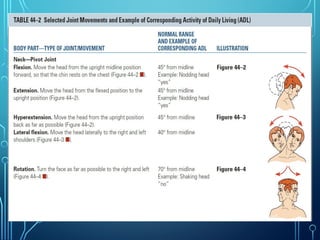
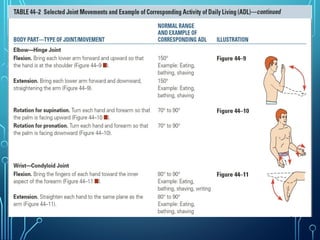
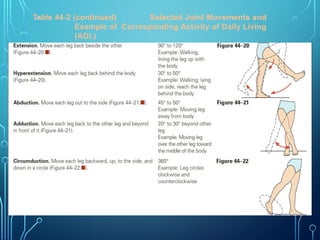
Table 44-2 Selected Joint Movements and Example of Corresponding
Activity of Daily Living (ADL)
and
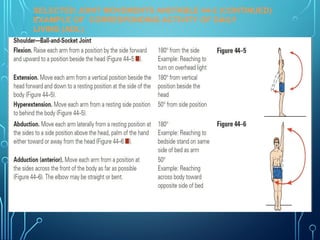
TABLE 44-2 (CONTINUED)
SELECTED JOINT MOVEMENTS AND
EXAMPLE OF CORRESPONDING ACTIVITY OF DAILY
LIVING (ADL)
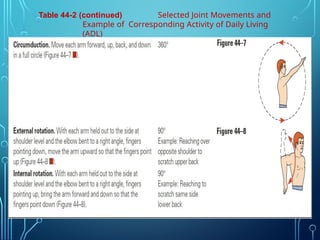
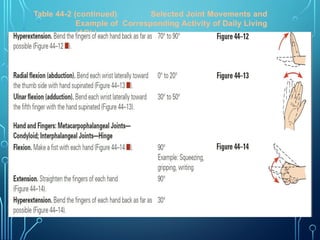
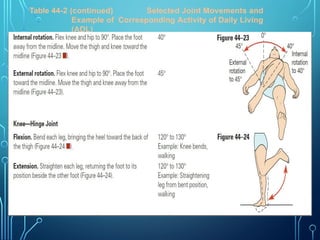
Table 44-2 (continued) Selected Joint Movements and
Example of Corresponding Activity of Daily Living
(ADL)
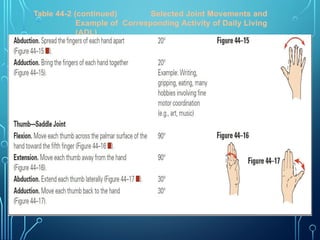
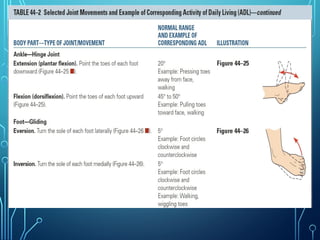
Table 44-2 (continued) Selected Joint Movements and Example of
Corresponding Activity of Daily Living (ADL)
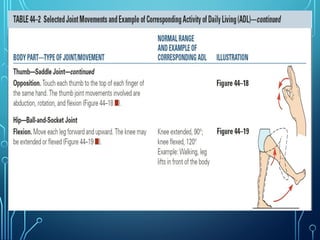
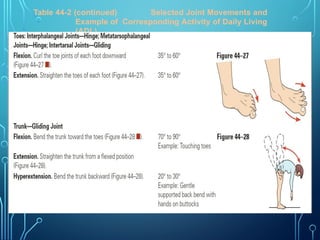
Table 44-2 (continued) Selected Joint Movements and
Example of Corresponding Activity of Daily Living
(ADL)
Table 44-2 (continued) Selected Joint Movements and
Example of Corresponding Activity of Daily Living
(ADL)
Table 44-2 (continued) Selected Joint Movements and Example of Corresponding Activity of Daily Living (ADL)
Table 44-2 (continued) Selected Joint Movements and
Example of Corresponding Activity of Daily Living
(ADL)
Table 44-2 (continued) Selected Joint Movements and
Example of Corresponding Activity of Daily Living
(ADL)
Table 44-2 (continued) Selected Joint Movements and Example of
Corresponding Activity of Daily Living (ADL)
Table 44-2 (continued) Selected Joint Movements and
Example of Corresponding Activity of Daily Living
(ADL)
Table 44-2 (continued) Selected Joint Movements and Example of Corresponding
Activity of Daily Living (ADL)
3
.
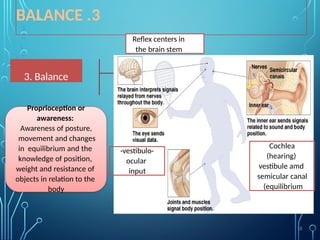
BALANCE
3. Balance
Proprioception or
awareness:
Awareness of posture,
movement and changes
in equilibrium and the
knowledge of position,
weight and resistance of
objects in relation to the
body
-vestibulo-
ocular
input
Cochlea
(hearing)
vestibule amd
semicular canal
(equilibrium
Reflex centers in
the brain stem
18
4
.
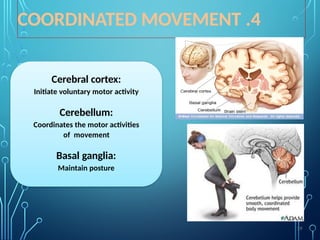
COORDINATED MOVEMENT
Cerebral cortex:
Initiate voluntary motor activity
Cerebellum:
Coordinates the motor activities
of movement
Basal ganglia:
Maintain posture
19
20
EFFECTS OF EXERCISE AND
IMMOBILITY ON
MUSCULOSKELETAL SYSTEM
21
Exercise
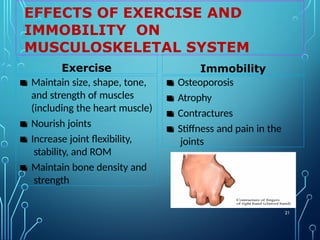
▪ Maintain size, shape, tone,
and strength of muscles
(including the heart muscle)
▪ Nourish joints
▪ Increase joint flexibility,
stability, and ROM
▪ Maintain bone density and
strength
Immobility
▪ Osteoporosis
▪ Atrophy
▪ Contractures
▪ Stiffness and pain in the
joints
EFFECTS OF EXERCISE AND
IMMOBILITY ON
CARDIOVASCULAR SYSTEM
22
Exercise
▪ Increases HR
▪ Strength of contraction, and
blood supply to the heart
and muscles
▪ Mediates harmful effects of
stress
Immobility
▪ Diminished cardiac reserve
▪ Increased use of the
Valsalva maneuver
▪ Orthostatic
hypotension
▪ Venous vasodilation and
stasis
▪ Dependent edema
▪ Thrombus formation
EFFECTS OF EXERCISE AND
IMMOBILITY ON
RESPIRATORY SYSTEM
23
Exercise
▪ Increase ventilation and
oxygen intake improving gas
exchange
▪ Prevents pooling of
secretions in the bronchi
and bronchioles
Immobility
▪ Decreased respiratory
movement
▪ Pooling of respiratory
secretions
▪ Atelectasis
▪ Hypostatic
pneumonia
EFFECTS OF EXERCISE AND
IMMOBILITY ON
METABOLIC SYSTEM
24
Exercise
▪ Elevates the metabolic rate
▪ Decreases serum
triglycerides and cholesterol
▪ Stabilizes blood sugar and
make cells more responsive
to insulin
Immobility
▪ Decreased metabolic rate
▪ Negative nitrogen balance
▪ Anorexia
▪ Negative calcium balance
EFFECTS OF EXERCISE AND
IMMOBILITY ON
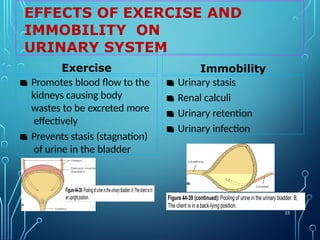
URINARY SYSTEM
25
Exercise
▪ Promotes blood flow to the
kidneys causing body
wastes to be excreted more
effectively
▪ Prevents stasis (stagnation)
of urine in the bladder
Immobility
▪ Urinary stasis
▪ Renal calculi
▪ Urinary retention
▪ Urinary infection
EFFECTS OF EXERCISE AND
IMMOBILITY ON
GASTROINTESTINE (GI)SYSTEM
26
Exercise
▪ Improves the appetite
▪ Increases GI tract tone
▪ Facilitates peristalsis
Immobility
▪ Constipation
EFFECTS OF EXERCISE AND
IMMOBILITY ON
METABOLIC/ENDOCRINE
SYSTEM
27
Exercise
▪ Elevates metabolic rate
▪ Helps reduce serum
triglycerides and
cholesterol
▪ Stabilizes blood sugar and
makes cells more
responsive to insulin
Immobility
• Increase blood glucose
EFFECTS OF EXERCISE AND
IMMOBILITY ON IMMUNE
SYSTEM
28
Exercise
▪ Pumps lymph fluid from
tissues into lymph
capillaries and vessels
▪ Increases circulation
through lymph nodes
Immobility
• Reduce immune function
EFFECTS OF EXERCISE AND
IMMOBILITY ON PSYCH-
NEUROLOGIC SYSTEM
29
Exercise
▪ Elevates mood
▪ Relieves stress and
anxiety
▪ Develops relaxation
response (RR)
▪ Improves quality of sleep
for most individuals
Immobility
•
•
•
•
Depression
Anxiety
Forgetfulness
Confusion
EFFECTS OF EXERCISE AND
IMMOBILITY ON
INTEGUMENTARY SYSTEM
30
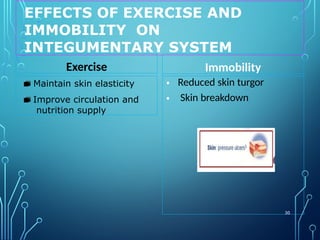
Exercise
▪ Maintain skin elasticity
▪ Improve circulation and
nutrition supply
Immobility
•
•
Reduced skin turgor
Skin breakdown
31
32
33
34
35
36
NURSING DIAGNOSES
37
• Activity and exercise problems:
▪ Activity Intolerance
▪ Risk for Activity Intolerance
▪ Impaired Physical Mobility
▪ Sedentary Lifestyle
▪ Risk for Falls
PLANNING:
GOALS
• The client will have:
– Increased tolerance for physical activity
– Restored or improved capability to ambulate
and/or participate in ADLs
– Absence of injury from falling or improper
use of body mechanics
– Enhance physical fitness
– Absence of any complications associated with
immobility
38
PLANNING:
INTERVENTION
39
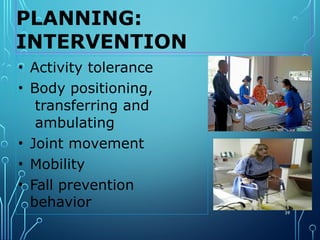
• Activity tolerance
• Body positioning,
transferring and
ambulating
• Joint movement
• Mobility
• Fall prevention
behavior
IMPLEMENTATION
40
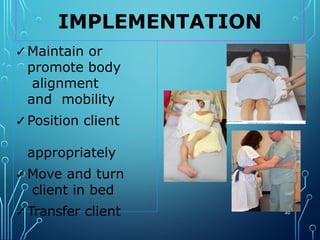
✓Maintain or
promote body
alignment
and mobility
✓Position client
appropriately
✓Move and turn
client in bed
✓Transfer client
IMPLEMENTATION
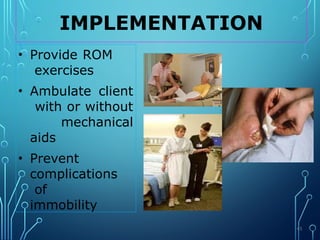
• Provide ROM
exercises
• Ambulate client
with or without
mechanical
aids
• Prevent
complications
of
immobility
41
BODY
MECHANIC
42
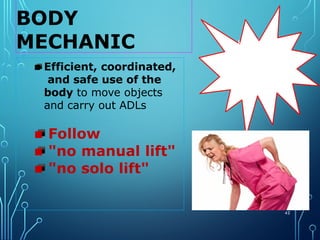
▪ Efficient, coordinated,
and safe use of the
body to move objects
and carry out ADLs
▪ Follow
▪ "no manual lift"
▪ "no solo lift"
Healthcare
workers work
hazard
“low back
pain”
BODY MECHANIC
43
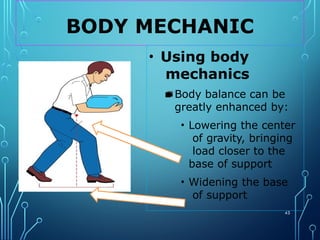
• Using body
mechanics
▪ Body balance can be
greatly enhanced by:
• Lowering the center
of gravity, bringing
load closer to the
base of support
• Widening the base
of support
44
BODY MECHANICS
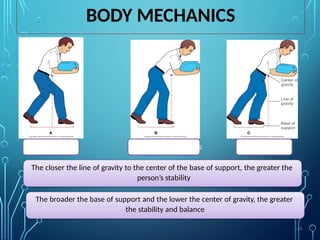
Balance Balance is precious Not Balance
The closer the line of gravity to the center of the base of support, the greater the
person’s stability
The broader the base of support and the lower the center of gravity, the greater
the stability and balance
45
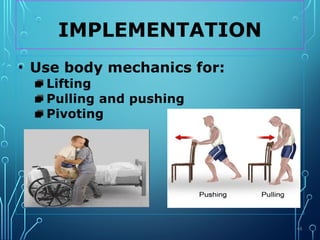
IMPLEMENTATION
• Use body mechanics for:
▪ Lifting
▪ Pulling and pushing
▪ Pivoting
46
IMPLEMENTATION
47
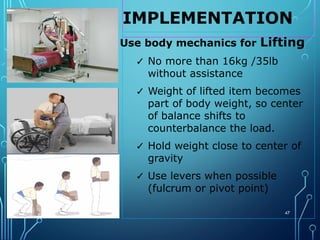
Use body mechanics for Lifting
✓ No more than 16kg /35lb
without assistance
✓ Weight of lifted item becomes
part of body weight, so center
of balance shifts to
counterbalance the load.
✓ Hold weight close to center of
gravity
✓ Use levers when possible
(fulcrum or pivot point)
IMPLEMENTATION
48
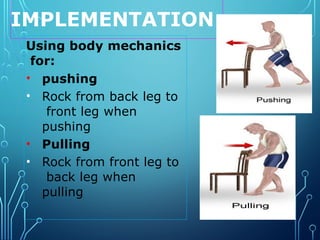
Using body mechanics
for:
•
•
•
•
pushing
Rock from back leg to
front leg when
pushing
Pulling
Rock from front leg to
back leg when
pulling
IMPLEMENTATION
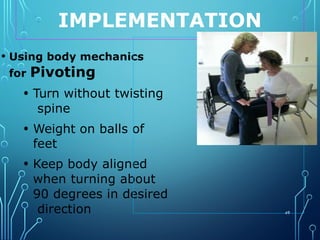
• Using body mechanics
for Pivoting
• Turn without twisting
spine

• Weight on balls of
feet
• Keep body aligned
when turning about
90 degrees in desired
direction 49
IMPLEMENTATION
50
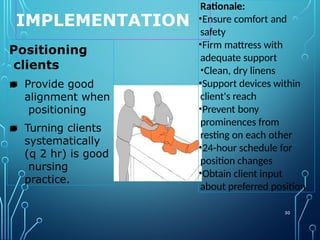
Positioning
clients
▪ Provide good
alignment when
positioning
▪ Turning clients
systematically
(q 2 hr) is good
nursing
practice.
Rationale:
•Ensure comfort and
safety
•Firm mattress with
adequate support
•Clean, dry linens
•Support devices within
client's reach
•Prevent bony
prominences from
resting on each other
•24-hour schedule for
position changes
•Obtain client input
about preferred position
IMPLEMENTATION
51
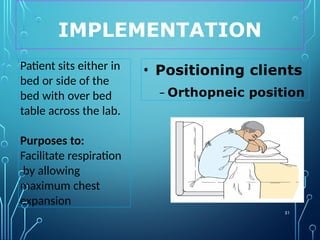
• Positioning clients
– Orthopneic position
Patient sits either in
bed or side of the
bed with over bed
table across the lab.
Purposes to:
Facilitate respiration
by allowing
maximum chest
expansion
IMPLEMENTATION
52
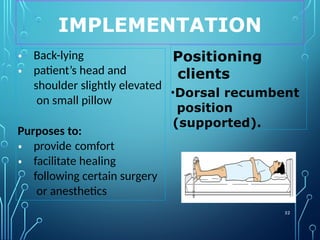
Positioning
clients
•Dorsal recumbent
position
(supported).
•
•
Back-lying
patient’s head and
shoulder slightly elevated
on small pillow
Purposes to:
•
•
provide comfort
facilitate healing
following certain surgery
or anesthetics
IMPLEMENTATION
53
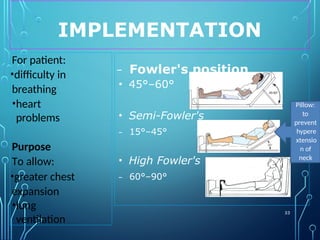
– Fowler's position
• 45°–60°
• Semi-Fowler's
– 15°–45°
• High Fowler's
– 60°–90°
For patient:
•difficulty in
breathing
•heart
problems
Purpose
To allow:
•greater chest
expansion
•lung
ventilation
Pillow:
to
prevent
hypere
xtensio
n of
neck
IMPLEMENTATION
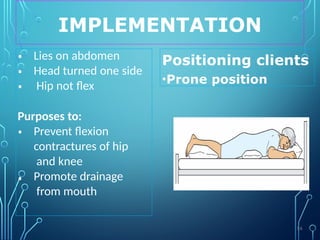
Positioning clients
•Prone position
•
•
•
Lies on abdomen
Head turned one side
Hip not flex
Purposes to:
•
•
Prevent flexion
contractures of hip
and knee
Promote drainage
from mouth
54
IMPLEMENTATION
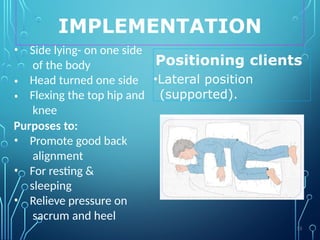
Positioning clients
•Lateral position
(supported).
•
•
• Side lying- on one side
of the body
Head turned one side
Flexing the top hip and
knee
Purposes to:
• Promote good back
alignment
• For resting &
sleeping
• Relieve pressure on
sacrum and heel
55
IMPLEMENTATION
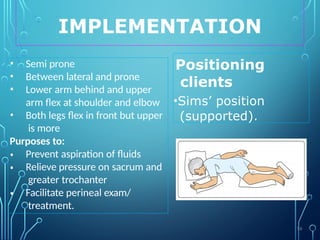
Positioning
clients
•Sims’ position
(supported).
• Semi prone
• Between lateral and prone
• Lower arm behind and upper
arm flex at shoulder and elbow
• Both legs flex in front but upper
is more
Purposes to:
•
•
•
Prevent aspiration of fluids
Relieve pressure on sacrum and
greater trochanter
Facilitate perineal exam/
treatment.
56
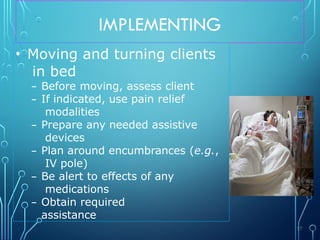
IMPLEMENTING
• Moving and turning clients
in bed
– Before moving, assess client
– If indicated, use pain relief
modalities
– Prepare any needed assistive
devices
– Plan around encumbrances (e.g.,
IV pole)
– Be alert to effects of any
medications
– Obtain required
assistance
57
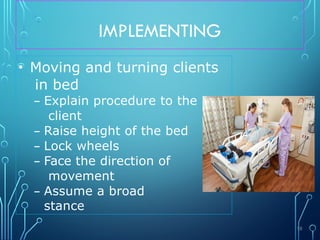
IMPLEMENTING
• Moving and turning clients
in bed
– Explain procedure to the
client
– Raise height of the bed
– Lock wheels
– Face the direction of
movement
– Assume a broad
stance
58
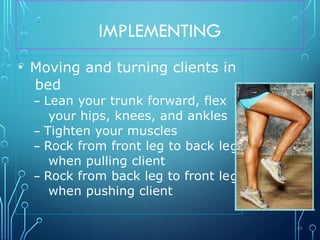
IMPLEMENTING
g
g
• Moving and turning clients in
bed
– Lean your trunk forward, flex
your hips, knees, and ankles
– Tighten your muscles
– Rock from front leg to back le
when pulling client
– Rock from back leg to front le
when pushing client
59
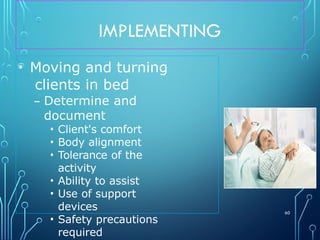
IMPLEMENTING
60
• Moving and turning
clients in bed
– Determine and
document
• Client's comfort
• Body alignment
• Tolerance of the
activity
• Ability to assist
• Use of support
devices
• Safety precautions
required
IMPLEMENTATION
61
Guidelines for transferring a client:
•Plan what to do and how to do it
•Obtain essential equipment before starting
•Remove obstacles
•Explain transfer to client and assistive personnel
•Support or hold client rather than equipment
•Explain what client should do
IMPLEMENTATION
62
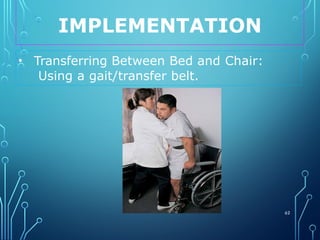
• Transferring Between Bed and Chair:
Using a gait/transfer belt.
IMPLEMENTATION
63
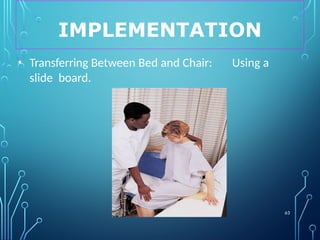
• Transferring Between Bed and Chair: Using a
slide board.
IMPLEMENTATION
64
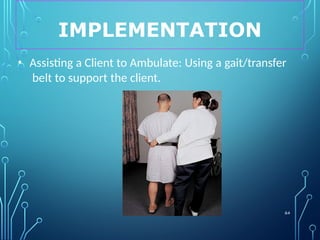
• Assisting a Client to Ambulate: Using a gait/transfer
belt to support the client.
IMPLEMENTATION
65
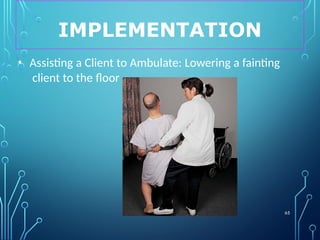
• Assisting a Client to Ambulate: Lowering a fainting
client to the floor
IMPLEMENTATION
66
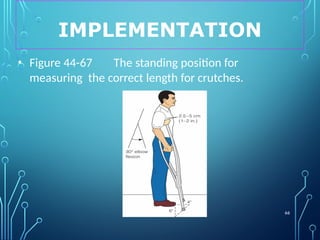
• Figure 44-67 The standing position for
measuring the correct length for crutches.
IMPLEMENTATION
67
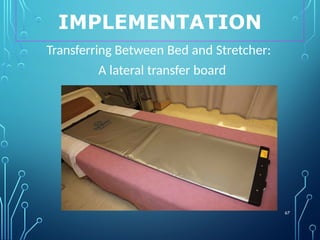
Transferring Between Bed and Stretcher:
A lateral transfer board
IMPLEMENTATION
68
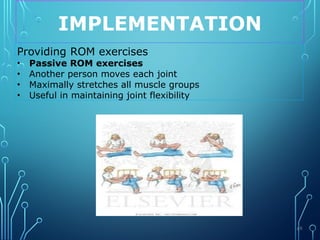
Providing ROM exercises
•Active:
▪ Moves each joint in the body
▪ Maximally stretching all muscle groups
•Passive:
▪ Another person moves each joint
▪ Maximally stretching all muscle groups
▪ Useful in maintaining joint flexibility
IMPLEMENTATION
Providing ROM exercises
• Passive ROM exercises
• Another person moves each joint
• Maximally stretches all muscle groups
• Useful in maintaining joint flexibility
69
IMPLEMENTING
70
• Guidelines to provide passive ROM
•
•
•
•
•
•
•
•
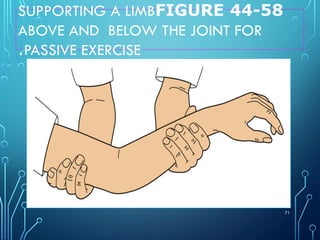
Expose only the limb being exercised
Support clients limb above and below the joint
If contractures are present, apply slow firm pressure
If rigidity occurs, press against rigidity
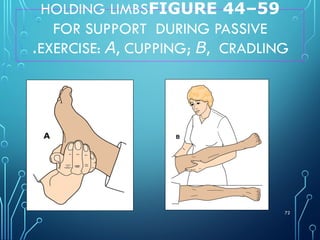
Use a firm comfortable grip
Move body parts smoothly, slowly, and rhythmically
Avoid moving or forcing body part beyond the existing
range of motion
If muscle spasticity occurs, stop
FIGURE 44-58
SUPPORTING A LIMB
ABOVE AND BELOW THE JOINT FOR
PASSIVE EXERCISE
.
71
FIGURE 44–59
HOLDING LIMBS
FOR SUPPORT DURING PASSIVE
EXERCISE: A, CUPPING; B, CRADLING
.
72
EVALUATION
73
• Evaluate established goals
• Achieved
• Not develop any compromised muscle
function
• If not achieved
• Explore the reasons.
SUMMARY
• Four elements that regulate body movement. Factors
affecting activity level
• The effects of exercise on body systems Assess
activity-exercise pattern
• Uses safe practices when positioning, moving, lifting and
ambulating clients
• Compare and contrast active, passive, and active- assistive
range-of-motion (ROM) exercises
•
•
•
•
•
•
74

14. Activity and Exercise level 1 un.pptx

  • 1.
    Fundamentals of Nursing Level1 Dr Abdulaazi Baalawi T. Ammar Alqahwee Body mechanics
  • 2.
    LEARNING OUTCOMES At theend of this lecture students are able to: 1.Describe the four basic elements of normal movement. 2.Identify factors affecting activity level 1.Compare the effects of exercise and immobility on body 2.Assess activity-exercise pattern, movement of joints, mobility capabilities and limitations, muscle mass and strength, activity tolerance, and problems related to immobility. 3.Uses safe practices when positioning, moving, lifting and ambulating clients 4.Compare and contrast active, passive, and active-assistive range-of-motion (ROM) exercises. 2
  • 3.
    FOUR ELEMENTS FORNORMAL MOVEMENT Balance Coordinated movement Alignment and posture Joint mobility 3
  • 4.
    1 . ALIGNMENT & POSTURE • • • • • •Brings body parts into a position to: Promotes optimal balance and body functions Minimizes strain on joints, muscles, tendons or ligaments Supports internal structures Enhances lungs expansion Promotes efficient circulatory, renal and intestinal functions 4
  • 5.
    2 . JOINT MOBILITY • Rangeof motion (ROM) is the maximum and possible movement of a joint • ROM varies and determined by: • Genetic makeup • Developmental patterns • Presence or absence of disease • Physical activity • Inactivity may lead to joints to flex, muscle shorten and contracture of joint 5
  • 6.
    Table 44-2 SelectedJoint Movements and Example of Corresponding Activity of Daily Living (ADL) and
  • 7.
    TABLE 44-2 (CONTINUED) SELECTEDJOINT MOVEMENTS AND EXAMPLE OF CORRESPONDING ACTIVITY OF DAILY LIVING (ADL)
  • 8.
    Table 44-2 (continued)Selected Joint Movements and Example of Corresponding Activity of Daily Living (ADL)
  • 9.
    Table 44-2 (continued)Selected Joint Movements and Example of Corresponding Activity of Daily Living (ADL)
  • 10.
    Table 44-2 (continued)Selected Joint Movements and Example of Corresponding Activity of Daily Living (ADL)
  • 11.
    Table 44-2 (continued)Selected Joint Movements and Example of Corresponding Activity of Daily Living (ADL)
  • 12.
    Table 44-2 (continued)Selected Joint Movements and Example of Corresponding Activity of Daily Living (ADL)
  • 13.
    Table 44-2 (continued)Selected Joint Movements and Example of Corresponding Activity of Daily Living (ADL)
  • 14.
    Table 44-2 (continued)Selected Joint Movements and Example of Corresponding Activity of Daily Living (ADL)
  • 15.
    Table 44-2 (continued)Selected Joint Movements and Example of Corresponding Activity of Daily Living (ADL)
  • 16.
    Table 44-2 (continued)Selected Joint Movements and Example of Corresponding Activity of Daily Living (ADL)
  • 17.
    Table 44-2 (continued)Selected Joint Movements and Example of Corresponding Activity of Daily Living (ADL)
  • 18.
    3 . BALANCE 3. Balance Proprioception or awareness: Awarenessof posture, movement and changes in equilibrium and the knowledge of position, weight and resistance of objects in relation to the body -vestibulo- ocular input Cochlea (hearing) vestibule amd semicular canal (equilibrium Reflex centers in the brain stem 18
  • 19.
    4 . COORDINATED MOVEMENT Cerebral cortex: Initiatevoluntary motor activity Cerebellum: Coordinates the motor activities of movement Basal ganglia: Maintain posture 19
  • 20.
  • 21.
    EFFECTS OF EXERCISEAND IMMOBILITY ON MUSCULOSKELETAL SYSTEM 21 Exercise ▪ Maintain size, shape, tone, and strength of muscles (including the heart muscle) ▪ Nourish joints ▪ Increase joint flexibility, stability, and ROM ▪ Maintain bone density and strength Immobility ▪ Osteoporosis ▪ Atrophy ▪ Contractures ▪ Stiffness and pain in the joints
  • 22.
    EFFECTS OF EXERCISEAND IMMOBILITY ON CARDIOVASCULAR SYSTEM 22 Exercise ▪ Increases HR ▪ Strength of contraction, and blood supply to the heart and muscles ▪ Mediates harmful effects of stress Immobility ▪ Diminished cardiac reserve ▪ Increased use of the Valsalva maneuver ▪ Orthostatic hypotension ▪ Venous vasodilation and stasis ▪ Dependent edema ▪ Thrombus formation
  • 23.
    EFFECTS OF EXERCISEAND IMMOBILITY ON RESPIRATORY SYSTEM 23 Exercise ▪ Increase ventilation and oxygen intake improving gas exchange ▪ Prevents pooling of secretions in the bronchi and bronchioles Immobility ▪ Decreased respiratory movement ▪ Pooling of respiratory secretions ▪ Atelectasis ▪ Hypostatic pneumonia
  • 24.
    EFFECTS OF EXERCISEAND IMMOBILITY ON METABOLIC SYSTEM 24 Exercise ▪ Elevates the metabolic rate ▪ Decreases serum triglycerides and cholesterol ▪ Stabilizes blood sugar and make cells more responsive to insulin Immobility ▪ Decreased metabolic rate ▪ Negative nitrogen balance ▪ Anorexia ▪ Negative calcium balance
  • 25.
    EFFECTS OF EXERCISEAND IMMOBILITY ON URINARY SYSTEM 25 Exercise ▪ Promotes blood flow to the kidneys causing body wastes to be excreted more effectively ▪ Prevents stasis (stagnation) of urine in the bladder Immobility ▪ Urinary stasis ▪ Renal calculi ▪ Urinary retention ▪ Urinary infection
  • 26.
    EFFECTS OF EXERCISEAND IMMOBILITY ON GASTROINTESTINE (GI)SYSTEM 26 Exercise ▪ Improves the appetite ▪ Increases GI tract tone ▪ Facilitates peristalsis Immobility ▪ Constipation
  • 27.
    EFFECTS OF EXERCISEAND IMMOBILITY ON METABOLIC/ENDOCRINE SYSTEM 27 Exercise ▪ Elevates metabolic rate ▪ Helps reduce serum triglycerides and cholesterol ▪ Stabilizes blood sugar and makes cells more responsive to insulin Immobility • Increase blood glucose
  • 28.
    EFFECTS OF EXERCISEAND IMMOBILITY ON IMMUNE SYSTEM 28 Exercise ▪ Pumps lymph fluid from tissues into lymph capillaries and vessels ▪ Increases circulation through lymph nodes Immobility • Reduce immune function
  • 29.
    EFFECTS OF EXERCISEAND IMMOBILITY ON PSYCH- NEUROLOGIC SYSTEM 29 Exercise ▪ Elevates mood ▪ Relieves stress and anxiety ▪ Develops relaxation response (RR) ▪ Improves quality of sleep for most individuals Immobility • • • • Depression Anxiety Forgetfulness Confusion
  • 30.
    EFFECTS OF EXERCISEAND IMMOBILITY ON INTEGUMENTARY SYSTEM 30 Exercise ▪ Maintain skin elasticity ▪ Improve circulation and nutrition supply Immobility • • Reduced skin turgor Skin breakdown
  • 31.
  • 32.
  • 33.
  • 34.
  • 35.
  • 36.
  • 37.
    NURSING DIAGNOSES 37 • Activityand exercise problems: ▪ Activity Intolerance ▪ Risk for Activity Intolerance ▪ Impaired Physical Mobility ▪ Sedentary Lifestyle ▪ Risk for Falls
  • 38.
    PLANNING: GOALS • The clientwill have: – Increased tolerance for physical activity – Restored or improved capability to ambulate and/or participate in ADLs – Absence of injury from falling or improper use of body mechanics – Enhance physical fitness – Absence of any complications associated with immobility 38
  • 39.
    PLANNING: INTERVENTION 39 • Activity tolerance •Body positioning, transferring and ambulating • Joint movement • Mobility • Fall prevention behavior
  • 40.
    IMPLEMENTATION 40 ✓Maintain or promote body alignment andmobility ✓Position client appropriately ✓Move and turn client in bed ✓Transfer client
  • 41.
    IMPLEMENTATION • Provide ROM exercises •Ambulate client with or without mechanical aids • Prevent complications of immobility 41
  • 42.
    BODY MECHANIC 42 ▪ Efficient, coordinated, andsafe use of the body to move objects and carry out ADLs ▪ Follow ▪ "no manual lift" ▪ "no solo lift" Healthcare workers work hazard “low back pain”
  • 43.
    BODY MECHANIC 43 • Usingbody mechanics ▪ Body balance can be greatly enhanced by: • Lowering the center of gravity, bringing load closer to the base of support • Widening the base of support
  • 44.
  • 45.
    BODY MECHANICS Balance Balanceis precious Not Balance The closer the line of gravity to the center of the base of support, the greater the person’s stability The broader the base of support and the lower the center of gravity, the greater the stability and balance 45
  • 46.
    IMPLEMENTATION • Use bodymechanics for: ▪ Lifting ▪ Pulling and pushing ▪ Pivoting 46
  • 47.
    IMPLEMENTATION 47 Use body mechanicsfor Lifting ✓ No more than 16kg /35lb without assistance ✓ Weight of lifted item becomes part of body weight, so center of balance shifts to counterbalance the load. ✓ Hold weight close to center of gravity ✓ Use levers when possible (fulcrum or pivot point)
  • 48.
    IMPLEMENTATION 48 Using body mechanics for: • • • • pushing Rockfrom back leg to front leg when pushing Pulling Rock from front leg to back leg when pulling
  • 49.
    IMPLEMENTATION • Using bodymechanics for Pivoting • Turn without twisting spine • Weight on balls of feet • Keep body aligned when turning about 90 degrees in desired direction 49
  • 50.
    IMPLEMENTATION 50 Positioning clients ▪ Provide good alignmentwhen positioning ▪ Turning clients systematically (q 2 hr) is good nursing practice. Rationale: •Ensure comfort and safety •Firm mattress with adequate support •Clean, dry linens •Support devices within client's reach •Prevent bony prominences from resting on each other •24-hour schedule for position changes •Obtain client input about preferred position
  • 51.
    IMPLEMENTATION 51 • Positioning clients –Orthopneic position Patient sits either in bed or side of the bed with over bed table across the lab. Purposes to: Facilitate respiration by allowing maximum chest expansion
  • 52.
    IMPLEMENTATION 52 Positioning clients •Dorsal recumbent position (supported). • • Back-lying patient’s headand shoulder slightly elevated on small pillow Purposes to: • • provide comfort facilitate healing following certain surgery or anesthetics
  • 53.
    IMPLEMENTATION 53 – Fowler's position •45°–60° • Semi-Fowler's – 15°–45° • High Fowler's – 60°–90° For patient: •difficulty in breathing •heart problems Purpose To allow: •greater chest expansion •lung ventilation Pillow: to prevent hypere xtensio n of neck
  • 54.
    IMPLEMENTATION Positioning clients •Prone position • • • Lieson abdomen Head turned one side Hip not flex Purposes to: • • Prevent flexion contractures of hip and knee Promote drainage from mouth 54
  • 55.
    IMPLEMENTATION Positioning clients •Lateral position (supported). • • •Side lying- on one side of the body Head turned one side Flexing the top hip and knee Purposes to: • Promote good back alignment • For resting & sleeping • Relieve pressure on sacrum and heel 55
  • 56.
    IMPLEMENTATION Positioning clients •Sims’ position (supported). • Semiprone • Between lateral and prone • Lower arm behind and upper arm flex at shoulder and elbow • Both legs flex in front but upper is more Purposes to: • • • Prevent aspiration of fluids Relieve pressure on sacrum and greater trochanter Facilitate perineal exam/ treatment. 56
  • 57.
    IMPLEMENTING • Moving andturning clients in bed – Before moving, assess client – If indicated, use pain relief modalities – Prepare any needed assistive devices – Plan around encumbrances (e.g., IV pole) – Be alert to effects of any medications – Obtain required assistance 57
  • 58.
    IMPLEMENTING • Moving andturning clients in bed – Explain procedure to the client – Raise height of the bed – Lock wheels – Face the direction of movement – Assume a broad stance 58
  • 59.
    IMPLEMENTING g g • Moving andturning clients in bed – Lean your trunk forward, flex your hips, knees, and ankles – Tighten your muscles – Rock from front leg to back le when pulling client – Rock from back leg to front le when pushing client 59
  • 60.
    IMPLEMENTING 60 • Moving andturning clients in bed – Determine and document • Client's comfort • Body alignment • Tolerance of the activity • Ability to assist • Use of support devices • Safety precautions required
  • 61.
    IMPLEMENTATION 61 Guidelines for transferringa client: •Plan what to do and how to do it •Obtain essential equipment before starting •Remove obstacles •Explain transfer to client and assistive personnel •Support or hold client rather than equipment •Explain what client should do
  • 62.
    IMPLEMENTATION 62 • Transferring BetweenBed and Chair: Using a gait/transfer belt.
  • 63.
    IMPLEMENTATION 63 • Transferring BetweenBed and Chair: Using a slide board.
  • 64.
    IMPLEMENTATION 64 • Assisting aClient to Ambulate: Using a gait/transfer belt to support the client.
  • 65.
    IMPLEMENTATION 65 • Assisting aClient to Ambulate: Lowering a fainting client to the floor
  • 66.
    IMPLEMENTATION 66 • Figure 44-67The standing position for measuring the correct length for crutches.
  • 67.
    IMPLEMENTATION 67 Transferring Between Bedand Stretcher: A lateral transfer board
  • 68.
    IMPLEMENTATION 68 Providing ROM exercises •Active: ▪Moves each joint in the body ▪ Maximally stretching all muscle groups •Passive: ▪ Another person moves each joint ▪ Maximally stretching all muscle groups ▪ Useful in maintaining joint flexibility
  • 69.
    IMPLEMENTATION Providing ROM exercises •Passive ROM exercises • Another person moves each joint • Maximally stretches all muscle groups • Useful in maintaining joint flexibility 69
  • 70.
    IMPLEMENTING 70 • Guidelines toprovide passive ROM • • • • • • • • Expose only the limb being exercised Support clients limb above and below the joint If contractures are present, apply slow firm pressure If rigidity occurs, press against rigidity Use a firm comfortable grip Move body parts smoothly, slowly, and rhythmically Avoid moving or forcing body part beyond the existing range of motion If muscle spasticity occurs, stop
  • 71.
    FIGURE 44-58 SUPPORTING ALIMB ABOVE AND BELOW THE JOINT FOR PASSIVE EXERCISE . 71
  • 72.
    FIGURE 44–59 HOLDING LIMBS FORSUPPORT DURING PASSIVE EXERCISE: A, CUPPING; B, CRADLING . 72
  • 73.
    EVALUATION 73 • Evaluate establishedgoals • Achieved • Not develop any compromised muscle function • If not achieved • Explore the reasons.
  • 74.
    SUMMARY • Four elementsthat regulate body movement. Factors affecting activity level • The effects of exercise on body systems Assess activity-exercise pattern • Uses safe practices when positioning, moving, lifting and ambulating clients • Compare and contrast active, passive, and active- assistive range-of-motion (ROM) exercises • • • • • • 74

Editor's Notes

  • #4 يجعل اجزاء الجسم في وضع يمكنها من تعزيز التوزان الامثل ووظائف الجسم يدعم الهياكل الداخلية يعزز تمديد الرئة
  • #18 الحس العميق الوعي بالوضعية والحركة والتغيرات في التوزان ومعرفة الموضع والوزن ومقاومة الاشياء فيما يتعلق