
Mobile (tele)radiology
Erik R. Ranschaert
e.ranschaert@jbz.nl
ECR 2015
Introduction
• What is changing?
• What are mobile devices?
• What is mobility?
• What is teleradiology?
• What is the role of social media?
• What is the impact on health care and
radiology?
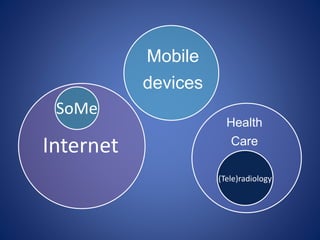
Internet
(Tele)radiology
Mobile
devices
Health
Care
SoMe
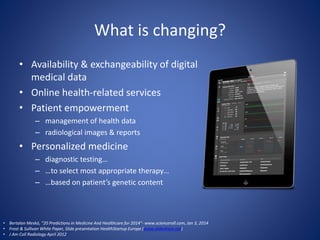
What is changing?
• Availability & exchangeability of digital
medical data
• Online health-related services
• Patient empowerment
– management of health data
– radiological images & reports
• Personalized medicine
– diagnostic testing…
– …to select most appropriate therapy…
– …based on patient’s genetic content
• Bertalan Meskó, “20 Predictions in Medicine And Healthcare for 2014”- www.scienceroll.com, Jan 3, 2014
• Frost & Sullivan White Paper, Slide presentation HealthStartup Europe (www.slideshare.net)
• J Am Coll Radiology April 2012
Almost anything
- including living things -
will be connected to the Internet
regardless of location or other
physical restrictions
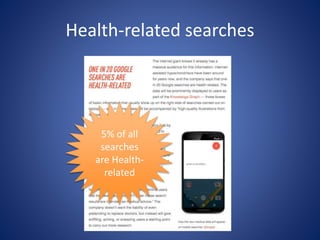
Health-related searches
5% of all
searches
are Health-
related
Mobile devices and mobility
• HC professionals are
globally rapidly adapting to
mobile technology.
• Smartphones and tablets
are regarded as “the most
popular technological
development for providers
since the invention of the
stethoscope”.
Source: “The road to telehealth 2.0 is mobile”, Calgary Scientific, 2015
Boston Consulting Group & Telenor Group (2013). The Socio-Economic Impact of Mobile Health. Page 6.
http://www.telenor.com/media/in-focus/the-socio-economic-impact-of-mhealth
What are mobile devices?
• Smartphones are mainly for
phone calls
• Tablets are mainly for all
other applications
• Mini-tablets become smaller,
smartphones become larger
• Phablet combines tablet and
phone features
• Isn’t a laptop a mobile
device?
Smartphones TabletsPhablets
Size of mobile devices
- Large phones (“phablet”) will grab 50% of the market in 2015
- Laptops are not threatened by tablets
- Larger smartphones are “pushing out” tablets
- Tablets need to evolve direction laptops: larger screen, multitasking
60%
small
55%
medium
Pcworld.com, 10 Oct. 2014, Phablet vs. mini-tablet: the big choice between two smallish devices
Tablets aren’t killing laptops, but smartphones are killing tablets, Chris HoffmanHowtogeek.com, 25 Oct. 2014
In 2015 iPad Air Pro with 12.2 inches?
2732 x 2048 and 265 pixels-per-inch (ppi)
Internet
HealthRadiology
Mobile
devices
Smartphones
Phablets
Tablets
Laptops
Mobile devices
What should radiologists use?
• “Careful product selection
and judicious use are
necessary ...”
• “It is the responsibility of
the radiologist to securely
and effectively utilize
mobile technology in the
best interests of patient
care.”
http://www.acr.org/Advocacy/Informatics/IT-Reference-Guide
1
4
3
2 5
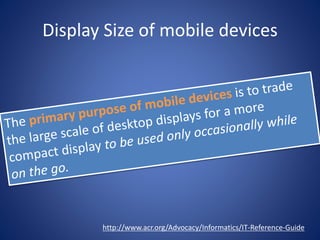
Display Size of mobile devices
http://www.acr.org/Advocacy/Informatics/IT-Reference-Guide
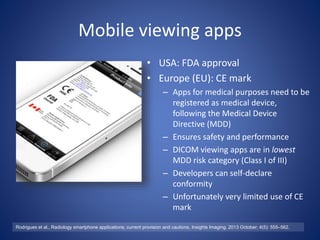
Mobile viewing apps
• USA: FDA approval
• Europe (EU): CE mark
– Apps for medical purposes need to be
registered as medical device,
following the Medical Device
Directive (MDD)
– Ensures safety and performance
– DICOM viewing apps are in lowest
MDD risk category (Class I of III)
– Developers can self-declare
conformity
– Unfortunately very limited use of CE
mark
Rodrigues et al., Radiology smartphone applications; current provision and cautions, Insights Imaging. 2013 October; 4(5): 555–562.
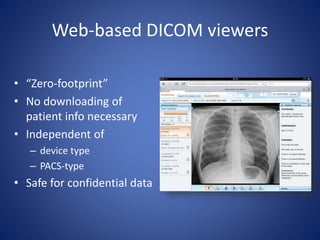
Web-based DICOM viewers
• “Zero-footprint”
• No downloading of
patient info necessary
• Independent of
– device type
– PACS-type
• Safe for confidential data
Mobility
• Radiologists are discovering new ways to create
additional efficiencies with mobile tools
• Key is to leverage mobility so that you’re able to
benefit from it
• Radiologists must embrace a purpose driven approach
• “Look for the right devices for the right scenarios at
the right places”
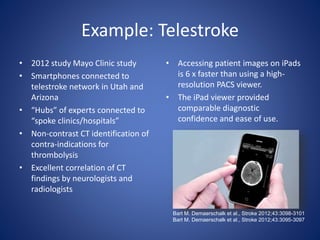
Example: Telestroke
• 2012 study Mayo Clinic study
• Smartphones connected to
telestroke network in Utah and
Arizona
• “Hubs” of experts connected to
“spoke clinics/hospitals”
• Non-contrast CT identification of
contra-indications for
thrombolysis
• Excellent correlation of CT
findings by neurologists and
radiologists
• Accessing patient images on iPads
is 6 x faster than using a high-
resolution PACS viewer.
• The iPad viewer provided
comparable diagnostic
confidence and ease of use.
Bart M. Demaerschalk et al., Stroke 2012;43:3098-3101
Bart M. Demaerschalk et al., Stroke 2012;43:3095-3097
Bart M. Demaerschalk et al. Stroke. 2012;43:3098-3101
Copyright © American Heart Association, Inc. All rights reserved.
Mobile infrastructure and algorithm
Terminology
• Currently a wide range of terms is being used:
– eHealth, mHealth
– Telemedicine, telehealth
– Teleradiology
– Virtual imaging
– Digital health
– Wireless health
– Connected health
Telemedicine and Teleradiology
Keith J. Dreyer, Amit Mehta, James H. Thrall, Springer Science & Business Media, 2002
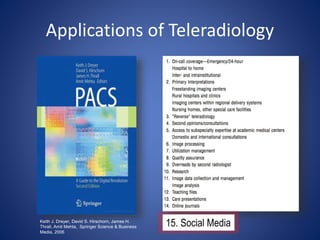
Applications of Teleradiology
Keith J. Dreyer, David S. Hirschorn, James H.
Thrall, Amit Mehta, Springer Science & Business
Media, 2006
15. Social Media
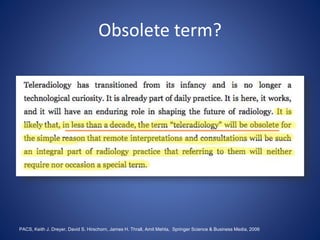
Obsolete term?
PACS, Keith J. Dreyer, David S. Hirschorn, James H. Thrall, Amit Mehta, Springer Science & Business Media, 2006
Current usage of teleradiology
• Thousands of systems have been deployed in the US
and Europe
• Many (most?) are “lower end” systems, to provide
emergency (on-call) coverage in radiology practices
• Home workstation is usually a PC, laptop or tablet…
• …for interpreting 512x512 images (CT, MRI, US)
• Expectations are rising concerning the interpretation
of medical images on mobile devices
• Mobile devices used for radiology = mobile radiology
Keith J. Dreyer, David S. Hirschorn, James H. Thrall, Amit Mehta, Springer Science & Business Media, 2006
IT Reference Guide for the Practicing Radiologist (ACR), 2013: Displays
Mobile (tele)radiology
PC screen workstation is accessible on tablet after logging in with Citrix platform, (“receiver”)
=> virtual workstation is created, accessible on all kinds of mobile devices
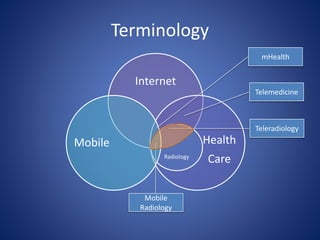
Internet
Health
CareRadiology
Mobile
Telemedicine
mHealth
Teleradiology
Mobile
Radiology
Terminology
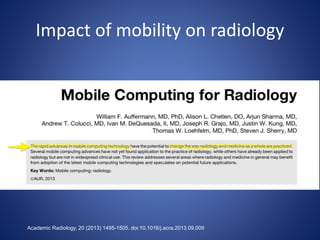
Impact of mobility on radiology
Academic Radiology, 20 (2013) 1495-1505. doi:10.1016/j.acra.2013.09.009
Changes for patients
• Clinical logistics:
– Online patient scheduling and check-in
– Information on procedures
– Satisfaction surveys
• Communication of results
– Patient portals: images and radiology reports
– Images can be shared by patients with
others
Academic Radiology, 20 (2013) 1495-1505. doi:10.1016/j.acra.2013.09.009
Changes for radiologists
• Improved radiology consultation
– Radiologists-to-radiologist consult (on-call)
– Greater social availability to clinicians
– Bed-side rounding with clinical teams
– Intra-operative guiding of operations (discussion of images)
• Critical or urgent notifications
– Providing timely, critical information complemented by a
brief message, discussion, or video chat on a mobile device
• Usage for management
– Radiation measurement (linked to sensors/devices)
Academic Radiology, 20 (2013) 1495-1505. doi:10.1016/j.acra.2013.09.009
Changes for clinicians
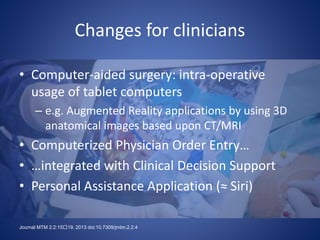
• Computer-aided surgery: intra-operative
usage of tablet computers
– e.g. Augmented Reality applications by using 3D
anatomical images based upon CT/MRI
• Computerized Physician Order Entry…
• …integrated with Clinical Decision Support
• Personal Assistance Application (≈ Siri)
Journal MTM 2:2:15􏰀19, 2013 doi:10.7309/jmtm.2.2.4
Future applications
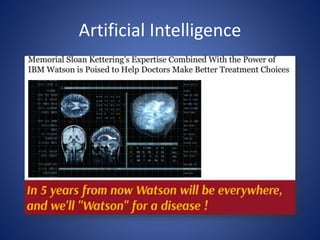
• Biotech entrepreneur Jonathan Rothberg with MIT
physicists / engineers
• “Capacitive Micro-machined Ultrasound Transducer”
• Real-time 3D images
• As cheap as stethoscope
• AI integration for automating diagnosis
Source: MIT Technology Review, Nov 2014
Artificial Intelligence
Scanner at home…?
Internet
HealthRadiology
Mobile
Telemedicine
mHealth
Teleradiology
Mobile
radiology
Smartphones
Phablets
Tablets
Laptops
Social media
What’s the role of social media?
http://www.radiologybusiness.com/topics/technology-management/googlification-radiology
Social media and medical image
• Young physicians are
embracing the digital
revolution
• They want to share
complex or interesting
cases with other HC
professionals
• They use mobile devices
and social media to
transmit medical
images to other doctors
• Patients’ privacy is not
protected on most
SoMe, no secure
platforms
• Personal data cannot be
removed (patient’s face,
tattoo, name)
• No archiving of
interesting teaching
cases possible
Instagram for Doctors
• Founded by Joshua
Landy, Canadian IC
doctor
• iOS and Android
• For sharing images of
tough medical cases
Officially approved
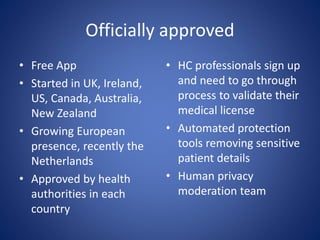
• Free App
• Started in UK, Ireland,
US, Canada, Australia,
New Zealand
• Growing European
presence, recently the
Netherlands
• Approved by health
authorities in each
country
• HC professionals sign up
and need to go through
process to validate their
medical license
• Automated protection
tools removing sensitive
patient details
• Human privacy
moderation team
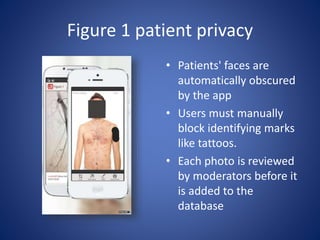
Figure 1 patient privacy
• Patients' faces are
automatically obscured
by the app
• Users must manually
block identifying marks
like tattoos.
• Each photo is reviewed
by moderators before it
is added to the
database
Video chat example
Should radiologists engage?
• Are we easy to reach? Always nearby? Never
too busy? Always easy to communicate with?
• Should we engage in SoMe as radiologists, or
can we stay away from them?
• Should residents/clinicians prefer Figure 1 to
solve cases and ask questions about radiology
among each other …
• …instead of communicating directly with
radiologists?
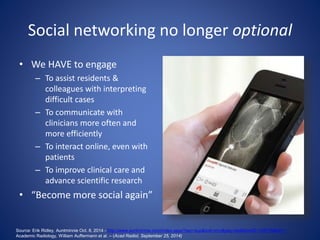
Social networking no longer optional
• We HAVE to engage
– To assist residents &
colleagues with interpreting
difficult cases
– To communicate with
clinicians more often and
more efficiently
– To interact online, even with
patients
– To improve clinical care and
advance scientific research
• “Become more social again”
Source: Erik Ridley, Auntminnie Oct. 8, 2014 - http://www.auntminnie.com/index.aspx?sec=sup&sub=imc&pag=dis&ItemID=108728&wf=1
Academic Radiology, William Auffermann et al. – (Acad Radiol, September 25, 2014)
Security risk of mobile devices
• Mobile devices = vulnerable
to loss/theft
• Patient information can be
downloaded without
encryption
• Images can be shared
through public platforms or
cloud technology, not
designed for storing
protected patient
information (PHI)
McEntee et al: 5 April 2012; Proc. of SPIE Vol. 8318 DOI: 10.1117/12.913754
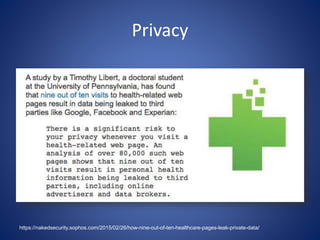
Privacy
https://nakedsecurity.sophos.com/2015/02/26/how-nine-out-of-ten-healthcare-pages-leak-private-data/
http://www.technologyreview.com/news/533631/2015-could-be-the-year-of-the-hospital-hack/
Hospital hacking
• 600% increase in attacks in 2014
• Medical records often contain both identification
information and financial information.
• Connection of smartphones, tablets, and various
medical devices to health-care facility networks
could introduce new vulnerabilities
Source: Mike Orcutt, MIT Technology Review, Dec 23, 2014
Protection
• “In the next half of
this decade, as much
attention must be
paid to deep medical
learning to pre-empt
illness as to data
security to protect
the privacy of
individuals.”
Eric J Topol et al., Digital medical tools and sensors, JAMA, 2015 vol. 313 (4) pp. 353-354.
Information of patients
• Health Care professionals should
– ensure that their patients understand what the
information that’s being collected is being used
for, how it may be disclosed, and that they agree
to these.
– understand their own
institution’s policies about collecting,
sharing, and storing information on
mobile devices.
Summary
• Radiologists need to consider a mobile strategy
– not only to view images for diagnosis on a consultative
basis,
– but also to enrich the referring clinicians’ experience and
– to improves the patient’s health care process
• It’s the responsibility of the radiologist to securely
and effectively utilize mobile technology in the best
interests of patient care.
• Guidelines are needed with the intention to facilitate
this process and to protect the patient’s privacy &
security.
Radiology-starship “Enterprise”
The Wall Street Journal, Jan 26, 2015
View from “the bridge”,
controlling all patient
information
Mobile imaging performed by
“soldiers” with the Star Trek-style
Tricorder

Mobile (tele)radiology

  • 1.
    Mobile (tele)radiology Erik R.Ranschaert e.ranschaert@jbz.nl ECR 2015
  • 2.
    Introduction • What ischanging? • What are mobile devices? • What is mobility? • What is teleradiology? • What is the role of social media? • What is the impact on health care and radiology?
  • 3.
  • 4.
    What is changing? •Availability & exchangeability of digital medical data • Online health-related services • Patient empowerment – management of health data – radiological images & reports • Personalized medicine – diagnostic testing… – …to select most appropriate therapy… – …based on patient’s genetic content • Bertalan Meskó, “20 Predictions in Medicine And Healthcare for 2014”- www.scienceroll.com, Jan 3, 2014 • Frost & Sullivan White Paper, Slide presentation HealthStartup Europe (www.slideshare.net) • J Am Coll Radiology April 2012
  • 5.
    Almost anything - includingliving things - will be connected to the Internet regardless of location or other physical restrictions
  • 6.
    Health-related searches 5% ofall searches are Health- related
  • 7.
    Mobile devices andmobility • HC professionals are globally rapidly adapting to mobile technology. • Smartphones and tablets are regarded as “the most popular technological development for providers since the invention of the stethoscope”. Source: “The road to telehealth 2.0 is mobile”, Calgary Scientific, 2015 Boston Consulting Group & Telenor Group (2013). The Socio-Economic Impact of Mobile Health. Page 6. http://www.telenor.com/media/in-focus/the-socio-economic-impact-of-mhealth
  • 8.
    What are mobiledevices? • Smartphones are mainly for phone calls • Tablets are mainly for all other applications • Mini-tablets become smaller, smartphones become larger • Phablet combines tablet and phone features • Isn’t a laptop a mobile device? Smartphones TabletsPhablets
  • 9.
    Size of mobiledevices - Large phones (“phablet”) will grab 50% of the market in 2015 - Laptops are not threatened by tablets - Larger smartphones are “pushing out” tablets - Tablets need to evolve direction laptops: larger screen, multitasking 60% small 55% medium Pcworld.com, 10 Oct. 2014, Phablet vs. mini-tablet: the big choice between two smallish devices Tablets aren’t killing laptops, but smartphones are killing tablets, Chris HoffmanHowtogeek.com, 25 Oct. 2014
  • 10.
    In 2015 iPadAir Pro with 12.2 inches? 2732 x 2048 and 265 pixels-per-inch (ppi)
  • 11.
  • 12.
    What should radiologistsuse? • “Careful product selection and judicious use are necessary ...” • “It is the responsibility of the radiologist to securely and effectively utilize mobile technology in the best interests of patient care.” http://www.acr.org/Advocacy/Informatics/IT-Reference-Guide
  • 13.
  • 14.
    Display Size ofmobile devices http://www.acr.org/Advocacy/Informatics/IT-Reference-Guide
  • 15.
    Mobile viewing apps •USA: FDA approval • Europe (EU): CE mark – Apps for medical purposes need to be registered as medical device, following the Medical Device Directive (MDD) – Ensures safety and performance – DICOM viewing apps are in lowest MDD risk category (Class I of III) – Developers can self-declare conformity – Unfortunately very limited use of CE mark Rodrigues et al., Radiology smartphone applications; current provision and cautions, Insights Imaging. 2013 October; 4(5): 555–562.
  • 16.
    Web-based DICOM viewers •“Zero-footprint” • No downloading of patient info necessary • Independent of – device type – PACS-type • Safe for confidential data
  • 17.
    Mobility • Radiologists arediscovering new ways to create additional efficiencies with mobile tools • Key is to leverage mobility so that you’re able to benefit from it • Radiologists must embrace a purpose driven approach • “Look for the right devices for the right scenarios at the right places”
  • 18.
    Example: Telestroke • 2012study Mayo Clinic study • Smartphones connected to telestroke network in Utah and Arizona • “Hubs” of experts connected to “spoke clinics/hospitals” • Non-contrast CT identification of contra-indications for thrombolysis • Excellent correlation of CT findings by neurologists and radiologists • Accessing patient images on iPads is 6 x faster than using a high- resolution PACS viewer. • The iPad viewer provided comparable diagnostic confidence and ease of use. Bart M. Demaerschalk et al., Stroke 2012;43:3098-3101 Bart M. Demaerschalk et al., Stroke 2012;43:3095-3097
  • 19.
    Bart M. Demaerschalket al. Stroke. 2012;43:3098-3101 Copyright © American Heart Association, Inc. All rights reserved. Mobile infrastructure and algorithm
  • 20.
    Terminology • Currently awide range of terms is being used: – eHealth, mHealth – Telemedicine, telehealth – Teleradiology – Virtual imaging – Digital health – Wireless health – Connected health
  • 21.
    Telemedicine and Teleradiology KeithJ. Dreyer, Amit Mehta, James H. Thrall, Springer Science & Business Media, 2002
  • 22.
    Applications of Teleradiology KeithJ. Dreyer, David S. Hirschorn, James H. Thrall, Amit Mehta, Springer Science & Business Media, 2006 15. Social Media
  • 23.
    Obsolete term? PACS, KeithJ. Dreyer, David S. Hirschorn, James H. Thrall, Amit Mehta, Springer Science & Business Media, 2006
  • 24.
    Current usage ofteleradiology • Thousands of systems have been deployed in the US and Europe • Many (most?) are “lower end” systems, to provide emergency (on-call) coverage in radiology practices • Home workstation is usually a PC, laptop or tablet… • …for interpreting 512x512 images (CT, MRI, US) • Expectations are rising concerning the interpretation of medical images on mobile devices • Mobile devices used for radiology = mobile radiology Keith J. Dreyer, David S. Hirschorn, James H. Thrall, Amit Mehta, Springer Science & Business Media, 2006 IT Reference Guide for the Practicing Radiologist (ACR), 2013: Displays
  • 25.
    Mobile (tele)radiology PC screenworkstation is accessible on tablet after logging in with Citrix platform, (“receiver”) => virtual workstation is created, accessible on all kinds of mobile devices
  • 26.
  • 27.
    Impact of mobilityon radiology Academic Radiology, 20 (2013) 1495-1505. doi:10.1016/j.acra.2013.09.009
  • 28.
    Changes for patients •Clinical logistics: – Online patient scheduling and check-in – Information on procedures – Satisfaction surveys • Communication of results – Patient portals: images and radiology reports – Images can be shared by patients with others Academic Radiology, 20 (2013) 1495-1505. doi:10.1016/j.acra.2013.09.009
  • 29.
    Changes for radiologists •Improved radiology consultation – Radiologists-to-radiologist consult (on-call) – Greater social availability to clinicians – Bed-side rounding with clinical teams – Intra-operative guiding of operations (discussion of images) • Critical or urgent notifications – Providing timely, critical information complemented by a brief message, discussion, or video chat on a mobile device • Usage for management – Radiation measurement (linked to sensors/devices) Academic Radiology, 20 (2013) 1495-1505. doi:10.1016/j.acra.2013.09.009
  • 30.
    Changes for clinicians •Computer-aided surgery: intra-operative usage of tablet computers – e.g. Augmented Reality applications by using 3D anatomical images based upon CT/MRI • Computerized Physician Order Entry… • …integrated with Clinical Decision Support • Personal Assistance Application (≈ Siri) Journal MTM 2:2:15􏰀19, 2013 doi:10.7309/jmtm.2.2.4
  • 31.
    Future applications • Biotechentrepreneur Jonathan Rothberg with MIT physicists / engineers • “Capacitive Micro-machined Ultrasound Transducer” • Real-time 3D images • As cheap as stethoscope • AI integration for automating diagnosis Source: MIT Technology Review, Nov 2014
  • 33.
  • 34.
  • 35.
  • 36.
    What’s the roleof social media? http://www.radiologybusiness.com/topics/technology-management/googlification-radiology
  • 37.
    Social media andmedical image • Young physicians are embracing the digital revolution • They want to share complex or interesting cases with other HC professionals • They use mobile devices and social media to transmit medical images to other doctors • Patients’ privacy is not protected on most SoMe, no secure platforms • Personal data cannot be removed (patient’s face, tattoo, name) • No archiving of interesting teaching cases possible
  • 38.
    Instagram for Doctors •Founded by Joshua Landy, Canadian IC doctor • iOS and Android • For sharing images of tough medical cases
  • 39.
    Officially approved • FreeApp • Started in UK, Ireland, US, Canada, Australia, New Zealand • Growing European presence, recently the Netherlands • Approved by health authorities in each country • HC professionals sign up and need to go through process to validate their medical license • Automated protection tools removing sensitive patient details • Human privacy moderation team
  • 40.
    Figure 1 patientprivacy • Patients' faces are automatically obscured by the app • Users must manually block identifying marks like tattoos. • Each photo is reviewed by moderators before it is added to the database
  • 41.
  • 42.
    Should radiologists engage? •Are we easy to reach? Always nearby? Never too busy? Always easy to communicate with? • Should we engage in SoMe as radiologists, or can we stay away from them? • Should residents/clinicians prefer Figure 1 to solve cases and ask questions about radiology among each other … • …instead of communicating directly with radiologists?
  • 43.
    Social networking nolonger optional • We HAVE to engage – To assist residents & colleagues with interpreting difficult cases – To communicate with clinicians more often and more efficiently – To interact online, even with patients – To improve clinical care and advance scientific research • “Become more social again” Source: Erik Ridley, Auntminnie Oct. 8, 2014 - http://www.auntminnie.com/index.aspx?sec=sup&sub=imc&pag=dis&ItemID=108728&wf=1 Academic Radiology, William Auffermann et al. – (Acad Radiol, September 25, 2014)
  • 44.
    Security risk ofmobile devices • Mobile devices = vulnerable to loss/theft • Patient information can be downloaded without encryption • Images can be shared through public platforms or cloud technology, not designed for storing protected patient information (PHI) McEntee et al: 5 April 2012; Proc. of SPIE Vol. 8318 DOI: 10.1117/12.913754
  • 45.
  • 46.
  • 47.
    Hospital hacking • 600%increase in attacks in 2014 • Medical records often contain both identification information and financial information. • Connection of smartphones, tablets, and various medical devices to health-care facility networks could introduce new vulnerabilities Source: Mike Orcutt, MIT Technology Review, Dec 23, 2014
  • 48.
    Protection • “In thenext half of this decade, as much attention must be paid to deep medical learning to pre-empt illness as to data security to protect the privacy of individuals.” Eric J Topol et al., Digital medical tools and sensors, JAMA, 2015 vol. 313 (4) pp. 353-354.
  • 49.
    Information of patients •Health Care professionals should – ensure that their patients understand what the information that’s being collected is being used for, how it may be disclosed, and that they agree to these. – understand their own institution’s policies about collecting, sharing, and storing information on mobile devices.
  • 50.
    Summary • Radiologists needto consider a mobile strategy – not only to view images for diagnosis on a consultative basis, – but also to enrich the referring clinicians’ experience and – to improves the patient’s health care process • It’s the responsibility of the radiologist to securely and effectively utilize mobile technology in the best interests of patient care. • Guidelines are needed with the intention to facilitate this process and to protect the patient’s privacy & security.
  • 51.
    Radiology-starship “Enterprise” The WallStreet Journal, Jan 26, 2015 View from “the bridge”, controlling all patient information Mobile imaging performed by “soldiers” with the Star Trek-style Tricorder

Editor's Notes

  • #19 Source: Branz, Karen (June 2013). “Transitioning to a Vendor-Neutral Image Archive.” Health Management Technology. Retrieved from http://www.healthmgttech.com/articles/201306/transitioning-to-a- vendor-neutral-image-archive.php
  • #20 ResolutionMD mobile infrastructure and algorithm.
  • #22 Telemedicine is not a new medical act, and it is not intended to replace traditional methods of care delivery, such as face-to face consultations. Rather, it represents an innovative way of providing health care services, which can complement and potentially increase the quality and efficiency of traditional health care delivery. All member states that do not make teleradiology a medical act should be pressured to do so.
  • #45 iPads and LCDs show similar performance in the detection of pulmonary nodules. McEntee et al 2012 Risk to the security of patient records if they are stored on the tablet computer using applications such as Mobile MIM
  • #46 What the study highlights is that we live in the era of Big Data and we're only just beginning to understand some of the very big implications of small problems that have been under our noses for years.
  • #52 Instead of the Galactic quadrant, the view from the bridge consists of individual patient’s scans and other input from across the company’s network of 400 radiologists. “We have real-time visibility into every exam at every facility and diagnostic images can be read in less than 30 minutes, far faster than many other health-care facilities where the backlog can take days to process