Introduction
Radiology
Information Technology
Application of Information Technology to Radiology
Conclusion
Information Technology in Radiology
Dr. Adegbenga Ismail
Rays & Waves Radiology Clinic
October 30, 2014
Dr. Adegbenga Ismail Information Technology in Radiology
Introduction
Radiology
Information Technology
Application of Information Technology to Radiology
Conclusion
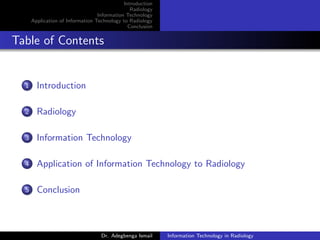
Table of Contents
1 Introduction
2 Radiology
3 Information Technology
4 Application of Information Technology to Radiology
5 Conclusion
Dr. Adegbenga Ismail Information Technology in Radiology
Introduction
Radiology
Information Technology
Application of Information Technology to Radiology
Conclusion
Radiology
Definition Medical specialty that uses imaging to diagnose
diseases [Wikipedia]
Fundamental Concerns Just two things:
1 Image acquisition
2 Interpretation of Images viz-a-viz Disease states
Dr. Adegbenga Ismail Information Technology in Radiology
Introduction
Radiology
Information Technology
Application of Information Technology to Radiology
Conclusion
Radiology
Definition Medical specialty that uses imaging to diagnose
diseases [Wikipedia]
Fundamental Concerns Just two things:
1 Image acquisition
2 Interpretation of Images viz-a-viz Disease states
Dr. Adegbenga Ismail Information Technology in Radiology
Introduction
Radiology
Information Technology
Application of Information Technology to Radiology
Conclusion
Information Technology
Definition Application of Computers and Telecommunications
equipment to store, retrieve, transmit and manipulate
data, often in the context of a business or other
enterprise [Wikipedia]
Fundamental Concern Automation
Dr. Adegbenga Ismail Information Technology in Radiology
Introduction
Radiology
Information Technology
Application of Information Technology to Radiology
Conclusion
Information Technology
Definition Application of Computers and Telecommunications
equipment to store, retrieve, transmit and manipulate
data, often in the context of a business or other
enterprise [Wikipedia]
Fundamental Concern Automation
Dr. Adegbenga Ismail Information Technology in Radiology
Introduction
Radiology
Information Technology
Application of Information Technology to Radiology
Conclusion
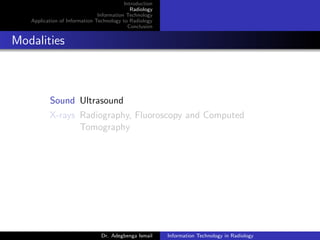
Modalities
Sound Ultrasound
X-rays Radiography, Fluoroscopy and Computed
Tomography
Dr. Adegbenga Ismail Information Technology in Radiology
Introduction
Radiology
Information Technology
Application of Information Technology to Radiology
Conclusion
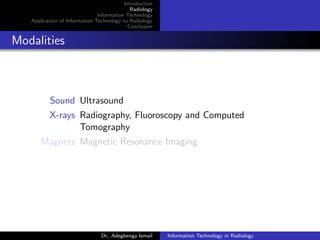
Modalities
Sound Ultrasound
X-rays Radiography, Fluoroscopy and Computed
Tomography
Magnets Magnetic Resonance Imaging
Dr. Adegbenga Ismail Information Technology in Radiology
Introduction
Radiology
Information Technology
Application of Information Technology to Radiology
Conclusion
Modalities
Sound Ultrasound
X-rays Radiography, Fluoroscopy and Computed
Tomography
Magnets Magnetic Resonance Imaging
Sub-atomic particles Nuclear Medicine, and Positron Emission
Tomography
Dr. Adegbenga Ismail Information Technology in Radiology
Introduction
Radiology
Information Technology
Application of Information Technology to Radiology
Conclusion
Modalities
Sound Ultrasound
X-rays Radiography, Fluoroscopy and Computed
Tomography
Magnets Magnetic Resonance Imaging
Sub-atomic particles Nuclear Medicine, and Positron Emission
Tomography
Dr. Adegbenga Ismail Information Technology in Radiology
Introduction
Radiology
Information Technology
Application of Information Technology to Radiology
Conclusion
Modalities
Hardware Typical Configuration: Client – Server Architecture:
Server + Dedicated Multi-modality viewing
Work-station
Server + General-purpose PC
Networks 1GB or faster ethernet hardware. Fast routers.
Implementations:
Local Area Network
Wide Area Network
Virtual Private Network
Dr. Adegbenga Ismail Information Technology in Radiology
Introduction
Radiology
Information Technology
Application of Information Technology to Radiology
Conclusion
Modalities
Hardware Typical Configuration: Client – Server Architecture:
Server + Dedicated Multi-modality viewing
Work-station
Server + General-purpose PC
Networks 1GB or faster ethernet hardware. Fast routers.
Implementations:
Local Area Network
Wide Area Network
Virtual Private Network
Dr. Adegbenga Ismail Information Technology in Radiology
Introduction
Radiology
Information Technology
Application of Information Technology to Radiology
Conclusion
Modalities
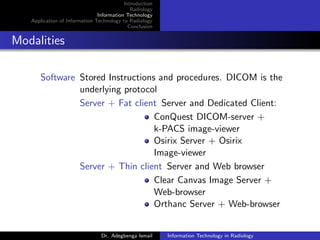
Software Stored Instructions and procedures. DICOM is the
underlying protocol
Server + Fat client Server and Dedicated Client:
ConQuest DICOM-server +
k-PACS image-viewer
Osirix Server + Osirix
Image-viewer
Server + Thin client Server and Web browser
Clear Canvas Image Server +
Web-browser
Orthanc Server + Web-browser
Dr. Adegbenga Ismail Information Technology in Radiology
Introduction
Radiology
Information Technology
Application of Information Technology to Radiology
Conclusion
Radiology already involves an intense use of Science,
Technology and Information. Can Computers,
Tele-communication and Information systems still add value?
Dr. Adegbenga Ismail Information Technology in Radiology
Introduction
Radiology
Information Technology
Application of Information Technology to Radiology
Conclusion
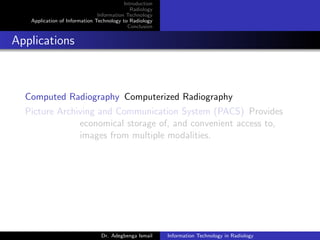
Applications
Computed Radiography Computerized Radiography
Picture Archiving and Communication System (PACS) Provides
economical storage of, and convenient access to,
images from multiple modalities.
Dr. Adegbenga Ismail Information Technology in Radiology
Introduction
Radiology
Information Technology
Application of Information Technology to Radiology
Conclusion
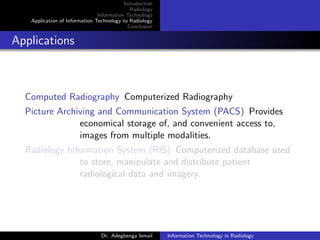
Applications
Computed Radiography Computerized Radiography
Picture Archiving and Communication System (PACS) Provides
economical storage of, and convenient access to,
images from multiple modalities.
Radiology Information System (RIS) Computerized database used
to store, manipulate and distribute patient
radiological data and imagery.
Dr. Adegbenga Ismail Information Technology in Radiology
Introduction
Radiology
Information Technology
Application of Information Technology to Radiology
Conclusion
Applications
Computed Radiography Computerized Radiography
Picture Archiving and Communication System (PACS) Provides
economical storage of, and convenient access to,
images from multiple modalities.
Radiology Information System (RIS) Computerized database used
to store, manipulate and distribute patient
radiological data and imagery.
Dr. Adegbenga Ismail Information Technology in Radiology
Introduction
Radiology
Information Technology
Application of Information Technology to Radiology
Conclusion
Applications
Teleradiology Transmission of radiological images from one
location to another for the purpose of sharing studies
with other radiologists and physicians.
Voice Recognition System Translation of spoken words into text
Dr. Adegbenga Ismail Information Technology in Radiology
Introduction
Radiology
Information Technology
Application of Information Technology to Radiology
Conclusion
Applications
Teleradiology Transmission of radiological images from one
location to another for the purpose of sharing studies
with other radiologists and physicians.
Voice Recognition System Translation of spoken words into text
Computer-aided Diagnosis Pattern-recognition softwares highlight
suspicious areas on images, and draws the attention
of the radiologist to suspicious areas
Dr. Adegbenga Ismail Information Technology in Radiology
Introduction
Radiology
Information Technology
Application of Information Technology to Radiology
Conclusion
Applications
Teleradiology Transmission of radiological images from one
location to another for the purpose of sharing studies
with other radiologists and physicians.
Voice Recognition System Translation of spoken words into text
Computer-aided Diagnosis Pattern-recognition softwares highlight
suspicious areas on images, and draws the attention
of the radiologist to suspicious areas
Decision Support Systems Particularly useful in assisting decision
for appropriate Imaging and follow-up Imaging
Dr. Adegbenga Ismail Information Technology in Radiology
Introduction
Radiology
Information Technology
Application of Information Technology to Radiology
Conclusion
Applications
Teleradiology Transmission of radiological images from one
location to another for the purpose of sharing studies
with other radiologists and physicians.
Voice Recognition System Translation of spoken words into text
Computer-aided Diagnosis Pattern-recognition softwares highlight
suspicious areas on images, and draws the attention
of the radiologist to suspicious areas
Decision Support Systems Particularly useful in assisting decision
for appropriate Imaging and follow-up Imaging
Dr. Adegbenga Ismail Information Technology in Radiology
Introduction
Radiology
Information Technology
Application of Information Technology to Radiology
Conclusion
Computed Radiography
Combines four steps involved in radiographic film development
into just one step:
Developer A base (alkali) and metal solution used in
reducing ionized silver bromide crystals on
radiographic films to black metallic silver crystals
Stopper A glacial acetic acid solution used to neutralize
any excessive development of the film
Fixer Solution used to preserve radiographic image
over time
Rinsing and Drying Dry off water to allow film to be reported
Using a laser scanner to directly acquire images from a
photostimulable phospor imaging plate
Dr. Adegbenga Ismail Information Technology in Radiology
Introduction
Radiology
Information Technology
Application of Information Technology to Radiology
Conclusion
Computed Radiography
Combines four steps involved in radiographic film development
into just one step:
Developer A base (alkali) and metal solution used in
reducing ionized silver bromide crystals on
radiographic films to black metallic silver crystals
Stopper A glacial acetic acid solution used to neutralize
any excessive development of the film
Fixer Solution used to preserve radiographic image
over time
Rinsing and Drying Dry off water to allow film to be reported
Using a laser scanner to directly acquire images from a
photostimulable phospor imaging plate
Dr. Adegbenga Ismail Information Technology in Radiology
Introduction
Radiology
Information Technology
Application of Information Technology to Radiology
Conclusion
Picture Archiving and Communication System
Uses the DICOM standard to acquire images and data from
different HL7-compliant radiological imaging modalities
Stores images on RAIDs. RAID 5 in particular
Dr. Adegbenga Ismail Information Technology in Radiology
Introduction
Radiology
Information Technology
Application of Information Technology to Radiology
Conclusion
Picture Archiving and Communication System
Uses the DICOM standard to acquire images and data from
different HL7-compliant radiological imaging modalities
Stores images on RAIDs. RAID 5 in particular
Makes images available to reporting radiologists and clinicians
over high-speed broadband networks
Dr. Adegbenga Ismail Information Technology in Radiology
Introduction
Radiology
Information Technology
Application of Information Technology to Radiology
Conclusion
Picture Archiving and Communication System
Uses the DICOM standard to acquire images and data from
different HL7-compliant radiological imaging modalities
Stores images on RAIDs. RAID 5 in particular
Makes images available to reporting radiologists and clinicians
over high-speed broadband networks
Same image is simultaneously available over a LAN, a WAN
or the internet for reporting and clinical decision making
Dr. Adegbenga Ismail Information Technology in Radiology
Introduction
Radiology
Information Technology
Application of Information Technology to Radiology
Conclusion
Picture Archiving and Communication System
Uses the DICOM standard to acquire images and data from
different HL7-compliant radiological imaging modalities
Stores images on RAIDs. RAID 5 in particular
Makes images available to reporting radiologists and clinicians
over high-speed broadband networks
Same image is simultaneously available over a LAN, a WAN
or the internet for reporting and clinical decision making
Long term storage is ensured by periodic off-site back-ups
Dr. Adegbenga Ismail Information Technology in Radiology
Introduction
Radiology
Information Technology
Application of Information Technology to Radiology
Conclusion
Picture Archiving and Communication System
Uses the DICOM standard to acquire images and data from
different HL7-compliant radiological imaging modalities
Stores images on RAIDs. RAID 5 in particular
Makes images available to reporting radiologists and clinicians
over high-speed broadband networks
Same image is simultaneously available over a LAN, a WAN
or the internet for reporting and clinical decision making
Long term storage is ensured by periodic off-site back-ups
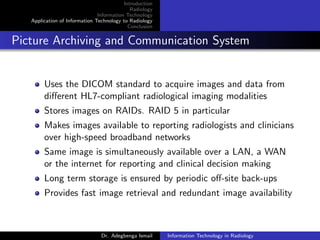
Provides fast image retrieval and redundant image availability
Dr. Adegbenga Ismail Information Technology in Radiology
Introduction
Radiology
Information Technology
Application of Information Technology to Radiology
Conclusion
Picture Archiving and Communication System
Uses the DICOM standard to acquire images and data from
different HL7-compliant radiological imaging modalities
Stores images on RAIDs. RAID 5 in particular
Makes images available to reporting radiologists and clinicians
over high-speed broadband networks
Same image is simultaneously available over a LAN, a WAN
or the internet for reporting and clinical decision making
Long term storage is ensured by periodic off-site back-ups
Provides fast image retrieval and redundant image availability
Dr. Adegbenga Ismail Information Technology in Radiology
Introduction
Radiology
Information Technology
Application of Information Technology to Radiology
Conclusion
Radiologic Information System
Specialized instance of a Health Information System
addressing the peculiar needs of a radiology department
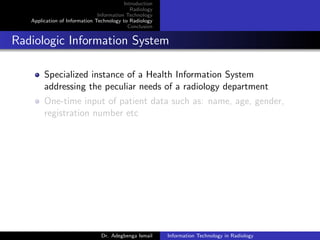
One-time input of patient data such as: name, age, gender,
registration number etc
Dr. Adegbenga Ismail Information Technology in Radiology
Introduction
Radiology
Information Technology
Application of Information Technology to Radiology
Conclusion
Radiologic Information System
Specialized instance of a Health Information System
addressing the peculiar needs of a radiology department
One-time input of patient data such as: name, age, gender,
registration number etc
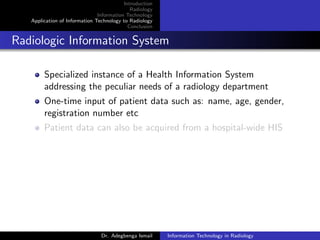
Patient data can also be acquired from a hospital-wide HIS
Dr. Adegbenga Ismail Information Technology in Radiology
Introduction
Radiology
Information Technology
Application of Information Technology to Radiology
Conclusion
Radiologic Information System
Specialized instance of a Health Information System
addressing the peculiar needs of a radiology department
One-time input of patient data such as: name, age, gender,
registration number etc
Patient data can also be acquired from a hospital-wide HIS
Can Communicate via a Dicom Modality Work-list with
imaging equipments [Grainger & Allison, 2008]
Dr. Adegbenga Ismail Information Technology in Radiology
Introduction
Radiology
Information Technology
Application of Information Technology to Radiology
Conclusion
Radiologic Information System
Specialized instance of a Health Information System
addressing the peculiar needs of a radiology department
One-time input of patient data such as: name, age, gender,
registration number etc
Patient data can also be acquired from a hospital-wide HIS
Can Communicate via a Dicom Modality Work-list with
imaging equipments [Grainger & Allison, 2008]
Same patient data can be linked with multiple images from
different imaging modalities
Dr. Adegbenga Ismail Information Technology in Radiology
Introduction
Radiology
Information Technology
Application of Information Technology to Radiology
Conclusion
Radiologic Information System
Specialized instance of a Health Information System
addressing the peculiar needs of a radiology department
One-time input of patient data such as: name, age, gender,
registration number etc
Patient data can also be acquired from a hospital-wide HIS
Can Communicate via a Dicom Modality Work-list with
imaging equipments [Grainger & Allison, 2008]
Same patient data can be linked with multiple images from
different imaging modalities
Reduces clerical errors by eliminating multiple entry of same
patient information in different imaging equipment
Dr. Adegbenga Ismail Information Technology in Radiology
Introduction
Radiology
Information Technology
Application of Information Technology to Radiology
Conclusion
Radiologic Information System
Specialized instance of a Health Information System
addressing the peculiar needs of a radiology department
One-time input of patient data such as: name, age, gender,
registration number etc
Patient data can also be acquired from a hospital-wide HIS
Can Communicate via a Dicom Modality Work-list with
imaging equipments [Grainger & Allison, 2008]
Same patient data can be linked with multiple images from
different imaging modalities
Reduces clerical errors by eliminating multiple entry of same
patient information in different imaging equipment
Dr. Adegbenga Ismail Information Technology in Radiology
Introduction
Radiology
Information Technology
Application of Information Technology to Radiology
Conclusion
Teleradiology
Images transmitted over broadband networks to off-site
reporting radiologist
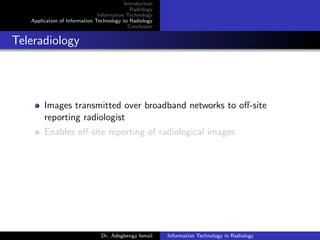
Enables off-site reporting of radiological images
Dr. Adegbenga Ismail Information Technology in Radiology
Introduction
Radiology
Information Technology
Application of Information Technology to Radiology
Conclusion
Teleradiology
Images transmitted over broadband networks to off-site
reporting radiologist
Enables off-site reporting of radiological images
Enables virtual Multi-disciplinary Team Meetings
Dr. Adegbenga Ismail Information Technology in Radiology
Introduction
Radiology
Information Technology
Application of Information Technology to Radiology
Conclusion
Teleradiology
Images transmitted over broadband networks to off-site
reporting radiologist
Enables off-site reporting of radiological images
Enables virtual Multi-disciplinary Team Meetings
Emerging area of Tele-education
Dr. Adegbenga Ismail Information Technology in Radiology
Introduction
Radiology
Information Technology
Application of Information Technology to Radiology
Conclusion
Teleradiology
Images transmitted over broadband networks to off-site
reporting radiologist
Enables off-site reporting of radiological images
Enables virtual Multi-disciplinary Team Meetings
Emerging area of Tele-education
Dr. Adegbenga Ismail Information Technology in Radiology
Introduction
Radiology
Information Technology
Application of Information Technology to Radiology
Conclusion
Voice Recognition System
Seeks to automate stenography
Typical Reporting Work-flow:
Radiologist’s Dictation ⇒ Secretary ⇒ Typed Report
Dr. Adegbenga Ismail Information Technology in Radiology
Introduction
Radiology
Information Technology
Application of Information Technology to Radiology
Conclusion
Voice Recognition System
Seeks to automate stenography
Typical Reporting Work-flow:
Radiologist’s Dictation ⇒ Secretary ⇒ Typed Report
Automated Reporting Work-flow:
Radiologist’s Dictation ⇒ Voice Recognition Software ⇒
Computerized Report [Grainger & Allison, 2008]
Dr. Adegbenga Ismail Information Technology in Radiology
Introduction
Radiology
Information Technology
Application of Information Technology to Radiology
Conclusion
Voice Recognition System
Seeks to automate stenography
Typical Reporting Work-flow:
Radiologist’s Dictation ⇒ Secretary ⇒ Typed Report
Automated Reporting Work-flow:
Radiologist’s Dictation ⇒ Voice Recognition Software ⇒
Computerized Report [Grainger & Allison, 2008]
Faster
Dr. Adegbenga Ismail Information Technology in Radiology
Introduction
Radiology
Information Technology
Application of Information Technology to Radiology
Conclusion
Voice Recognition System
Seeks to automate stenography
Typical Reporting Work-flow:
Radiologist’s Dictation ⇒ Secretary ⇒ Typed Report
Automated Reporting Work-flow:
Radiologist’s Dictation ⇒ Voice Recognition Software ⇒
Computerized Report [Grainger & Allison, 2008]
Faster
Report is instantly verified and signed by radiologist author
Dr. Adegbenga Ismail Information Technology in Radiology
Introduction
Radiology
Information Technology
Application of Information Technology to Radiology
Conclusion
Voice Recognition System
Seeks to automate stenography
Typical Reporting Work-flow:
Radiologist’s Dictation ⇒ Secretary ⇒ Typed Report
Automated Reporting Work-flow:
Radiologist’s Dictation ⇒ Voice Recognition Software ⇒
Computerized Report [Grainger & Allison, 2008]
Faster
Report is instantly verified and signed by radiologist author
Interfaces with the RIS and PACS
Dr. Adegbenga Ismail Information Technology in Radiology
Introduction
Radiology
Information Technology
Application of Information Technology to Radiology
Conclusion
Voice Recognition System
Seeks to automate stenography
Typical Reporting Work-flow:
Radiologist’s Dictation ⇒ Secretary ⇒ Typed Report
Automated Reporting Work-flow:
Radiologist’s Dictation ⇒ Voice Recognition Software ⇒
Computerized Report [Grainger & Allison, 2008]
Faster
Report is instantly verified and signed by radiologist author
Interfaces with the RIS and PACS
Dr. Adegbenga Ismail Information Technology in Radiology
Introduction
Radiology
Information Technology
Application of Information Technology to Radiology
Conclusion
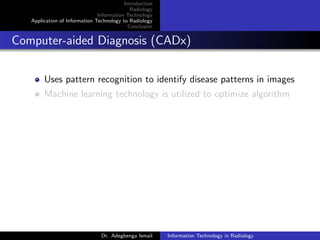
Computer-aided Diagnosis (CADx)
Uses pattern recognition to identify disease patterns in images
Machine learning technology is utilized to optimize algorithm
Dr. Adegbenga Ismail Information Technology in Radiology
Introduction
Radiology
Information Technology
Application of Information Technology to Radiology
Conclusion
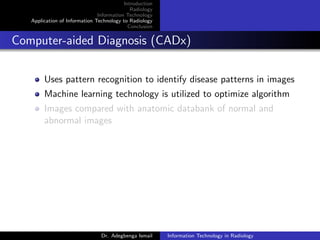
Computer-aided Diagnosis (CADx)
Uses pattern recognition to identify disease patterns in images
Machine learning technology is utilized to optimize algorithm
Images compared with anatomic databank of normal and
abnormal images
Dr. Adegbenga Ismail Information Technology in Radiology
Introduction
Radiology
Information Technology
Application of Information Technology to Radiology
Conclusion
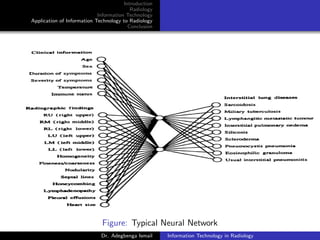
Computer-aided Diagnosis (CADx)
Uses pattern recognition to identify disease patterns in images
Machine learning technology is utilized to optimize algorithm
Images compared with anatomic databank of normal and
abnormal images
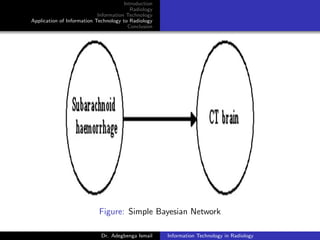
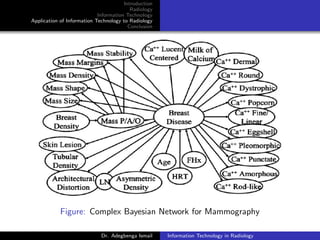
Uses Artificial Neural Network and Bayesian statistics in
analyzing images for probability of disease
[Stivaros et al, 2010]
Dr. Adegbenga Ismail Information Technology in Radiology
Introduction
Radiology
Information Technology
Application of Information Technology to Radiology
Conclusion
Computer-aided Diagnosis (CADx)
Uses pattern recognition to identify disease patterns in images
Machine learning technology is utilized to optimize algorithm
Images compared with anatomic databank of normal and
abnormal images
Uses Artificial Neural Network and Bayesian statistics in
analyzing images for probability of disease
[Stivaros et al, 2010]
Technology also used in Computer-aided Simple Triage
(CAST)
Dr. Adegbenga Ismail Information Technology in Radiology
Introduction
Radiology
Information Technology
Application of Information Technology to Radiology
Conclusion
Computer-aided Diagnosis (CADx)
Uses pattern recognition to identify disease patterns in images
Machine learning technology is utilized to optimize algorithm
Images compared with anatomic databank of normal and
abnormal images
Uses Artificial Neural Network and Bayesian statistics in
analyzing images for probability of disease
[Stivaros et al, 2010]
Technology also used in Computer-aided Simple Triage
(CAST)
Supplements and assists, not replace, human evaluation
Dr. Adegbenga Ismail Information Technology in Radiology
Introduction
Radiology
Information Technology
Application of Information Technology to Radiology
Conclusion
Computer-aided Diagnosis (CADx)
Uses pattern recognition to identify disease patterns in images
Machine learning technology is utilized to optimize algorithm
Images compared with anatomic databank of normal and
abnormal images
Uses Artificial Neural Network and Bayesian statistics in
analyzing images for probability of disease
[Stivaros et al, 2010]
Technology also used in Computer-aided Simple Triage
(CAST)
Supplements and assists, not replace, human evaluation
Dr. Adegbenga Ismail Information Technology in Radiology
Introduction
Radiology
Information Technology
Application of Information Technology to Radiology
Conclusion
Figure: Typical Neural Network
Dr. Adegbenga Ismail Information Technology in Radiology
Introduction
Radiology
Information Technology
Application of Information Technology to Radiology
Conclusion
Figure: Simple Bayesian Network
Dr. Adegbenga Ismail Information Technology in Radiology
Introduction
Radiology
Information Technology
Application of Information Technology to Radiology
Conclusion
Figure: Complex Bayesian Network for Mammography
Dr. Adegbenga Ismail Information Technology in Radiology
Introduction
Radiology
Information Technology
Application of Information Technology to Radiology
Conclusion
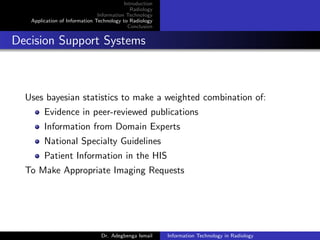
Decision Support Systems
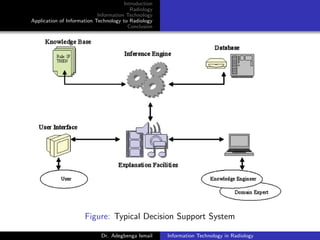
Uses bayesian statistics to make a weighted combination of:
Evidence in peer-reviewed publications
Information from Domain Experts
National Specialty Guidelines
Patient Information in the HIS
To Make Appropriate Imaging Requests
Dr. Adegbenga Ismail Information Technology in Radiology
Introduction
Radiology
Information Technology
Application of Information Technology to Radiology
Conclusion
Figure: Typical Decision Support System
Dr. Adegbenga Ismail Information Technology in Radiology
Introduction
Radiology
Information Technology
Application of Information Technology to Radiology
Conclusion
Decision Support Systems
Aimed at Automating the work of a Radiology Benefit
Manager
Assists clinicians in making appropriate Evidence-based Image
ordering
Dr. Adegbenga Ismail Information Technology in Radiology
Introduction
Radiology
Information Technology
Application of Information Technology to Radiology
Conclusion
Decision Support Systems
Aimed at Automating the work of a Radiology Benefit
Manager
Assists clinicians in making appropriate Evidence-based Image
ordering
Increasingly being used by radiologists in making informed
imaging recommendations
Dr. Adegbenga Ismail Information Technology in Radiology
Introduction
Radiology
Information Technology
Application of Information Technology to Radiology
Conclusion
Decision Support Systems
Aimed at Automating the work of a Radiology Benefit
Manager
Assists clinicians in making appropriate Evidence-based Image
ordering
Increasingly being used by radiologists in making informed
imaging recommendations
More objective and transparent replacement of the job of a
Radiology Benefit Manager [ACR-RBMA, 2011]
Dr. Adegbenga Ismail Information Technology in Radiology
Introduction
Radiology
Information Technology
Application of Information Technology to Radiology
Conclusion
Decision Support Systems
Aimed at Automating the work of a Radiology Benefit
Manager
Assists clinicians in making appropriate Evidence-based Image
ordering
Increasingly being used by radiologists in making informed
imaging recommendations
More objective and transparent replacement of the job of a
Radiology Benefit Manager [ACR-RBMA, 2011]
Dr. Adegbenga Ismail Information Technology in Radiology
Introduction
Radiology
Information Technology
Application of Information Technology to Radiology
Conclusion
To What End?
Machinery . . . will facilitate and abridge labour [Smith, 1776]
Dr. Adegbenga Ismail Information Technology in Radiology
Introduction
Radiology
Information Technology
Application of Information Technology to Radiology
Conclusion
To What End?
Increased Efficiency and Productivity
Increased Revenue
Dr. Adegbenga Ismail Information Technology in Radiology
Introduction
Radiology
Information Technology
Application of Information Technology to Radiology
Conclusion
Increased Productivity
What difference does automation make in productivity?
What is the difference in productivity between a manual
worker and an automated worker?
A mathematical metaphor:
Lazy Manual worker: ⇒ 0.2365 = 0
Efficient Manual worker: ⇒ 0.99365 = 0.026
Automated Worker: ⇒ 1.01365 = 37.78
Dr. Adegbenga Ismail Information Technology in Radiology
Introduction
Radiology
Information Technology
Application of Information Technology to Radiology
Conclusion
Increased Revenue
Directly from the Increased Productivity
From accreted Value.
Data Client Database
Data Image Repositories
Dr. Adegbenga Ismail Information Technology in Radiology
Introduction
Radiology
Information Technology
Application of Information Technology to Radiology
Conclusion
Increased Revenue
Directly from the Increased Productivity
From accreted Value.
Data Client Database
Data Image Repositories
Dr. Adegbenga Ismail Information Technology in Radiology
Introduction
Radiology
Information Technology
Application of Information Technology to Radiology
Conclusion
References
Wikipedia
http://en.wikipedia.org/wiki/Radiology
Wikipedia
http://en.wikipedia.org/wiki/Information technology
Stivaros SM, Gledson A, Nenadic G, Zeng XJ, Keane J, Jackson A.
Decision support systems for clinical radiological practice – towards the
next generation.
Br J Radiol. 2010 Nov;83(995):904-14. doi: 10.1259/bjr/33620087.
Review.
PMID:20965900 [PubMed - indexed for MEDLINE]
Adam Smith (1776)
An Inquiry into the Nature and Causes of the Wealth of Nations
http://www2.hn.psu.edu/faculty/jmanis/adam-smith/wealth-nations.pdf
12(3), 45 – 678.
Dr. Adegbenga Ismail Information Technology in Radiology
Introduction
Radiology
Information Technology
Application of Information Technology to Radiology
Conclusion
References
ACR-RBMA Best Practices Guidelines on Radiology Benefits Management
Programs (2011)
http://www.rbma.org/uploadedFiles/RBMA Web site/Advocacy/Advocacy Payer
RBMA%20Best%20Practices%20for%20Radiology%20Benefits%20Management
%20Programs.pdf
Grainger & Allison’s Diagnostic Radiology (5th
edition).
Section 1, Chapter 1
Churchill Livingstone, Elsevier
Dr. Adegbenga Ismail Information Technology in Radiology
Introduction
Radiology
Information Technology
Application of Information Technology to Radiology
Conclusion
Thank You For Listening
Dr. Adegbenga Ismail Information Technology in Radiology
Introduction
Radiology
Information Technology
Application of Information Technology to Radiology
Conclusion
Questions
Dr. Adegbenga Ismail Information Technology in Radiology

Information Technology in Radiology

  • 1.
    Introduction Radiology Information Technology Application ofInformation Technology to Radiology Conclusion Information Technology in Radiology Dr. Adegbenga Ismail Rays & Waves Radiology Clinic October 30, 2014 Dr. Adegbenga Ismail Information Technology in Radiology
  • 2.
    Introduction Radiology Information Technology Application ofInformation Technology to Radiology Conclusion Table of Contents 1 Introduction 2 Radiology 3 Information Technology 4 Application of Information Technology to Radiology 5 Conclusion Dr. Adegbenga Ismail Information Technology in Radiology
  • 3.
    Introduction Radiology Information Technology Application ofInformation Technology to Radiology Conclusion Radiology Definition Medical specialty that uses imaging to diagnose diseases [Wikipedia] Fundamental Concerns Just two things: 1 Image acquisition 2 Interpretation of Images viz-a-viz Disease states Dr. Adegbenga Ismail Information Technology in Radiology
  • 4.
    Introduction Radiology Information Technology Application ofInformation Technology to Radiology Conclusion Radiology Definition Medical specialty that uses imaging to diagnose diseases [Wikipedia] Fundamental Concerns Just two things: 1 Image acquisition 2 Interpretation of Images viz-a-viz Disease states Dr. Adegbenga Ismail Information Technology in Radiology
  • 5.
    Introduction Radiology Information Technology Application ofInformation Technology to Radiology Conclusion Information Technology Definition Application of Computers and Telecommunications equipment to store, retrieve, transmit and manipulate data, often in the context of a business or other enterprise [Wikipedia] Fundamental Concern Automation Dr. Adegbenga Ismail Information Technology in Radiology
  • 6.
    Introduction Radiology Information Technology Application ofInformation Technology to Radiology Conclusion Information Technology Definition Application of Computers and Telecommunications equipment to store, retrieve, transmit and manipulate data, often in the context of a business or other enterprise [Wikipedia] Fundamental Concern Automation Dr. Adegbenga Ismail Information Technology in Radiology
  • 7.
    Introduction Radiology Information Technology Application ofInformation Technology to Radiology Conclusion Modalities Sound Ultrasound X-rays Radiography, Fluoroscopy and Computed Tomography Dr. Adegbenga Ismail Information Technology in Radiology
  • 8.
    Introduction Radiology Information Technology Application ofInformation Technology to Radiology Conclusion Modalities Sound Ultrasound X-rays Radiography, Fluoroscopy and Computed Tomography Magnets Magnetic Resonance Imaging Dr. Adegbenga Ismail Information Technology in Radiology
  • 9.
    Introduction Radiology Information Technology Application ofInformation Technology to Radiology Conclusion Modalities Sound Ultrasound X-rays Radiography, Fluoroscopy and Computed Tomography Magnets Magnetic Resonance Imaging Sub-atomic particles Nuclear Medicine, and Positron Emission Tomography Dr. Adegbenga Ismail Information Technology in Radiology
  • 10.
    Introduction Radiology Information Technology Application ofInformation Technology to Radiology Conclusion Modalities Sound Ultrasound X-rays Radiography, Fluoroscopy and Computed Tomography Magnets Magnetic Resonance Imaging Sub-atomic particles Nuclear Medicine, and Positron Emission Tomography Dr. Adegbenga Ismail Information Technology in Radiology
  • 11.
    Introduction Radiology Information Technology Application ofInformation Technology to Radiology Conclusion Modalities Hardware Typical Configuration: Client – Server Architecture: Server + Dedicated Multi-modality viewing Work-station Server + General-purpose PC Networks 1GB or faster ethernet hardware. Fast routers. Implementations: Local Area Network Wide Area Network Virtual Private Network Dr. Adegbenga Ismail Information Technology in Radiology
  • 12.
    Introduction Radiology Information Technology Application ofInformation Technology to Radiology Conclusion Modalities Hardware Typical Configuration: Client – Server Architecture: Server + Dedicated Multi-modality viewing Work-station Server + General-purpose PC Networks 1GB or faster ethernet hardware. Fast routers. Implementations: Local Area Network Wide Area Network Virtual Private Network Dr. Adegbenga Ismail Information Technology in Radiology
  • 13.
    Introduction Radiology Information Technology Application ofInformation Technology to Radiology Conclusion Modalities Software Stored Instructions and procedures. DICOM is the underlying protocol Server + Fat client Server and Dedicated Client: ConQuest DICOM-server + k-PACS image-viewer Osirix Server + Osirix Image-viewer Server + Thin client Server and Web browser Clear Canvas Image Server + Web-browser Orthanc Server + Web-browser Dr. Adegbenga Ismail Information Technology in Radiology
  • 14.
    Introduction Radiology Information Technology Application ofInformation Technology to Radiology Conclusion Radiology already involves an intense use of Science, Technology and Information. Can Computers, Tele-communication and Information systems still add value? Dr. Adegbenga Ismail Information Technology in Radiology
  • 15.
    Introduction Radiology Information Technology Application ofInformation Technology to Radiology Conclusion Applications Computed Radiography Computerized Radiography Picture Archiving and Communication System (PACS) Provides economical storage of, and convenient access to, images from multiple modalities. Dr. Adegbenga Ismail Information Technology in Radiology
  • 16.
    Introduction Radiology Information Technology Application ofInformation Technology to Radiology Conclusion Applications Computed Radiography Computerized Radiography Picture Archiving and Communication System (PACS) Provides economical storage of, and convenient access to, images from multiple modalities. Radiology Information System (RIS) Computerized database used to store, manipulate and distribute patient radiological data and imagery. Dr. Adegbenga Ismail Information Technology in Radiology
  • 17.
    Introduction Radiology Information Technology Application ofInformation Technology to Radiology Conclusion Applications Computed Radiography Computerized Radiography Picture Archiving and Communication System (PACS) Provides economical storage of, and convenient access to, images from multiple modalities. Radiology Information System (RIS) Computerized database used to store, manipulate and distribute patient radiological data and imagery. Dr. Adegbenga Ismail Information Technology in Radiology
  • 18.
    Introduction Radiology Information Technology Application ofInformation Technology to Radiology Conclusion Applications Teleradiology Transmission of radiological images from one location to another for the purpose of sharing studies with other radiologists and physicians. Voice Recognition System Translation of spoken words into text Dr. Adegbenga Ismail Information Technology in Radiology
  • 19.
    Introduction Radiology Information Technology Application ofInformation Technology to Radiology Conclusion Applications Teleradiology Transmission of radiological images from one location to another for the purpose of sharing studies with other radiologists and physicians. Voice Recognition System Translation of spoken words into text Computer-aided Diagnosis Pattern-recognition softwares highlight suspicious areas on images, and draws the attention of the radiologist to suspicious areas Dr. Adegbenga Ismail Information Technology in Radiology
  • 20.
    Introduction Radiology Information Technology Application ofInformation Technology to Radiology Conclusion Applications Teleradiology Transmission of radiological images from one location to another for the purpose of sharing studies with other radiologists and physicians. Voice Recognition System Translation of spoken words into text Computer-aided Diagnosis Pattern-recognition softwares highlight suspicious areas on images, and draws the attention of the radiologist to suspicious areas Decision Support Systems Particularly useful in assisting decision for appropriate Imaging and follow-up Imaging Dr. Adegbenga Ismail Information Technology in Radiology
  • 21.
    Introduction Radiology Information Technology Application ofInformation Technology to Radiology Conclusion Applications Teleradiology Transmission of radiological images from one location to another for the purpose of sharing studies with other radiologists and physicians. Voice Recognition System Translation of spoken words into text Computer-aided Diagnosis Pattern-recognition softwares highlight suspicious areas on images, and draws the attention of the radiologist to suspicious areas Decision Support Systems Particularly useful in assisting decision for appropriate Imaging and follow-up Imaging Dr. Adegbenga Ismail Information Technology in Radiology
  • 22.
    Introduction Radiology Information Technology Application ofInformation Technology to Radiology Conclusion Computed Radiography Combines four steps involved in radiographic film development into just one step: Developer A base (alkali) and metal solution used in reducing ionized silver bromide crystals on radiographic films to black metallic silver crystals Stopper A glacial acetic acid solution used to neutralize any excessive development of the film Fixer Solution used to preserve radiographic image over time Rinsing and Drying Dry off water to allow film to be reported Using a laser scanner to directly acquire images from a photostimulable phospor imaging plate Dr. Adegbenga Ismail Information Technology in Radiology
  • 23.
    Introduction Radiology Information Technology Application ofInformation Technology to Radiology Conclusion Computed Radiography Combines four steps involved in radiographic film development into just one step: Developer A base (alkali) and metal solution used in reducing ionized silver bromide crystals on radiographic films to black metallic silver crystals Stopper A glacial acetic acid solution used to neutralize any excessive development of the film Fixer Solution used to preserve radiographic image over time Rinsing and Drying Dry off water to allow film to be reported Using a laser scanner to directly acquire images from a photostimulable phospor imaging plate Dr. Adegbenga Ismail Information Technology in Radiology
  • 24.
    Introduction Radiology Information Technology Application ofInformation Technology to Radiology Conclusion Picture Archiving and Communication System Uses the DICOM standard to acquire images and data from different HL7-compliant radiological imaging modalities Stores images on RAIDs. RAID 5 in particular Dr. Adegbenga Ismail Information Technology in Radiology
  • 25.
    Introduction Radiology Information Technology Application ofInformation Technology to Radiology Conclusion Picture Archiving and Communication System Uses the DICOM standard to acquire images and data from different HL7-compliant radiological imaging modalities Stores images on RAIDs. RAID 5 in particular Makes images available to reporting radiologists and clinicians over high-speed broadband networks Dr. Adegbenga Ismail Information Technology in Radiology
  • 26.
    Introduction Radiology Information Technology Application ofInformation Technology to Radiology Conclusion Picture Archiving and Communication System Uses the DICOM standard to acquire images and data from different HL7-compliant radiological imaging modalities Stores images on RAIDs. RAID 5 in particular Makes images available to reporting radiologists and clinicians over high-speed broadband networks Same image is simultaneously available over a LAN, a WAN or the internet for reporting and clinical decision making Dr. Adegbenga Ismail Information Technology in Radiology
  • 27.
    Introduction Radiology Information Technology Application ofInformation Technology to Radiology Conclusion Picture Archiving and Communication System Uses the DICOM standard to acquire images and data from different HL7-compliant radiological imaging modalities Stores images on RAIDs. RAID 5 in particular Makes images available to reporting radiologists and clinicians over high-speed broadband networks Same image is simultaneously available over a LAN, a WAN or the internet for reporting and clinical decision making Long term storage is ensured by periodic off-site back-ups Dr. Adegbenga Ismail Information Technology in Radiology
  • 28.
    Introduction Radiology Information Technology Application ofInformation Technology to Radiology Conclusion Picture Archiving and Communication System Uses the DICOM standard to acquire images and data from different HL7-compliant radiological imaging modalities Stores images on RAIDs. RAID 5 in particular Makes images available to reporting radiologists and clinicians over high-speed broadband networks Same image is simultaneously available over a LAN, a WAN or the internet for reporting and clinical decision making Long term storage is ensured by periodic off-site back-ups Provides fast image retrieval and redundant image availability Dr. Adegbenga Ismail Information Technology in Radiology
  • 29.
    Introduction Radiology Information Technology Application ofInformation Technology to Radiology Conclusion Picture Archiving and Communication System Uses the DICOM standard to acquire images and data from different HL7-compliant radiological imaging modalities Stores images on RAIDs. RAID 5 in particular Makes images available to reporting radiologists and clinicians over high-speed broadband networks Same image is simultaneously available over a LAN, a WAN or the internet for reporting and clinical decision making Long term storage is ensured by periodic off-site back-ups Provides fast image retrieval and redundant image availability Dr. Adegbenga Ismail Information Technology in Radiology
  • 30.
    Introduction Radiology Information Technology Application ofInformation Technology to Radiology Conclusion Radiologic Information System Specialized instance of a Health Information System addressing the peculiar needs of a radiology department One-time input of patient data such as: name, age, gender, registration number etc Dr. Adegbenga Ismail Information Technology in Radiology
  • 31.
    Introduction Radiology Information Technology Application ofInformation Technology to Radiology Conclusion Radiologic Information System Specialized instance of a Health Information System addressing the peculiar needs of a radiology department One-time input of patient data such as: name, age, gender, registration number etc Patient data can also be acquired from a hospital-wide HIS Dr. Adegbenga Ismail Information Technology in Radiology
  • 32.
    Introduction Radiology Information Technology Application ofInformation Technology to Radiology Conclusion Radiologic Information System Specialized instance of a Health Information System addressing the peculiar needs of a radiology department One-time input of patient data such as: name, age, gender, registration number etc Patient data can also be acquired from a hospital-wide HIS Can Communicate via a Dicom Modality Work-list with imaging equipments [Grainger & Allison, 2008] Dr. Adegbenga Ismail Information Technology in Radiology
  • 33.
    Introduction Radiology Information Technology Application ofInformation Technology to Radiology Conclusion Radiologic Information System Specialized instance of a Health Information System addressing the peculiar needs of a radiology department One-time input of patient data such as: name, age, gender, registration number etc Patient data can also be acquired from a hospital-wide HIS Can Communicate via a Dicom Modality Work-list with imaging equipments [Grainger & Allison, 2008] Same patient data can be linked with multiple images from different imaging modalities Dr. Adegbenga Ismail Information Technology in Radiology
  • 34.
    Introduction Radiology Information Technology Application ofInformation Technology to Radiology Conclusion Radiologic Information System Specialized instance of a Health Information System addressing the peculiar needs of a radiology department One-time input of patient data such as: name, age, gender, registration number etc Patient data can also be acquired from a hospital-wide HIS Can Communicate via a Dicom Modality Work-list with imaging equipments [Grainger & Allison, 2008] Same patient data can be linked with multiple images from different imaging modalities Reduces clerical errors by eliminating multiple entry of same patient information in different imaging equipment Dr. Adegbenga Ismail Information Technology in Radiology
  • 35.
    Introduction Radiology Information Technology Application ofInformation Technology to Radiology Conclusion Radiologic Information System Specialized instance of a Health Information System addressing the peculiar needs of a radiology department One-time input of patient data such as: name, age, gender, registration number etc Patient data can also be acquired from a hospital-wide HIS Can Communicate via a Dicom Modality Work-list with imaging equipments [Grainger & Allison, 2008] Same patient data can be linked with multiple images from different imaging modalities Reduces clerical errors by eliminating multiple entry of same patient information in different imaging equipment Dr. Adegbenga Ismail Information Technology in Radiology
  • 36.
    Introduction Radiology Information Technology Application ofInformation Technology to Radiology Conclusion Teleradiology Images transmitted over broadband networks to off-site reporting radiologist Enables off-site reporting of radiological images Dr. Adegbenga Ismail Information Technology in Radiology
  • 37.
    Introduction Radiology Information Technology Application ofInformation Technology to Radiology Conclusion Teleradiology Images transmitted over broadband networks to off-site reporting radiologist Enables off-site reporting of radiological images Enables virtual Multi-disciplinary Team Meetings Dr. Adegbenga Ismail Information Technology in Radiology
  • 38.
    Introduction Radiology Information Technology Application ofInformation Technology to Radiology Conclusion Teleradiology Images transmitted over broadband networks to off-site reporting radiologist Enables off-site reporting of radiological images Enables virtual Multi-disciplinary Team Meetings Emerging area of Tele-education Dr. Adegbenga Ismail Information Technology in Radiology
  • 39.
    Introduction Radiology Information Technology Application ofInformation Technology to Radiology Conclusion Teleradiology Images transmitted over broadband networks to off-site reporting radiologist Enables off-site reporting of radiological images Enables virtual Multi-disciplinary Team Meetings Emerging area of Tele-education Dr. Adegbenga Ismail Information Technology in Radiology
  • 40.
    Introduction Radiology Information Technology Application ofInformation Technology to Radiology Conclusion Voice Recognition System Seeks to automate stenography Typical Reporting Work-flow: Radiologist’s Dictation ⇒ Secretary ⇒ Typed Report Dr. Adegbenga Ismail Information Technology in Radiology
  • 41.
    Introduction Radiology Information Technology Application ofInformation Technology to Radiology Conclusion Voice Recognition System Seeks to automate stenography Typical Reporting Work-flow: Radiologist’s Dictation ⇒ Secretary ⇒ Typed Report Automated Reporting Work-flow: Radiologist’s Dictation ⇒ Voice Recognition Software ⇒ Computerized Report [Grainger & Allison, 2008] Dr. Adegbenga Ismail Information Technology in Radiology
  • 42.
    Introduction Radiology Information Technology Application ofInformation Technology to Radiology Conclusion Voice Recognition System Seeks to automate stenography Typical Reporting Work-flow: Radiologist’s Dictation ⇒ Secretary ⇒ Typed Report Automated Reporting Work-flow: Radiologist’s Dictation ⇒ Voice Recognition Software ⇒ Computerized Report [Grainger & Allison, 2008] Faster Dr. Adegbenga Ismail Information Technology in Radiology
  • 43.
    Introduction Radiology Information Technology Application ofInformation Technology to Radiology Conclusion Voice Recognition System Seeks to automate stenography Typical Reporting Work-flow: Radiologist’s Dictation ⇒ Secretary ⇒ Typed Report Automated Reporting Work-flow: Radiologist’s Dictation ⇒ Voice Recognition Software ⇒ Computerized Report [Grainger & Allison, 2008] Faster Report is instantly verified and signed by radiologist author Dr. Adegbenga Ismail Information Technology in Radiology
  • 44.
    Introduction Radiology Information Technology Application ofInformation Technology to Radiology Conclusion Voice Recognition System Seeks to automate stenography Typical Reporting Work-flow: Radiologist’s Dictation ⇒ Secretary ⇒ Typed Report Automated Reporting Work-flow: Radiologist’s Dictation ⇒ Voice Recognition Software ⇒ Computerized Report [Grainger & Allison, 2008] Faster Report is instantly verified and signed by radiologist author Interfaces with the RIS and PACS Dr. Adegbenga Ismail Information Technology in Radiology
  • 45.
    Introduction Radiology Information Technology Application ofInformation Technology to Radiology Conclusion Voice Recognition System Seeks to automate stenography Typical Reporting Work-flow: Radiologist’s Dictation ⇒ Secretary ⇒ Typed Report Automated Reporting Work-flow: Radiologist’s Dictation ⇒ Voice Recognition Software ⇒ Computerized Report [Grainger & Allison, 2008] Faster Report is instantly verified and signed by radiologist author Interfaces with the RIS and PACS Dr. Adegbenga Ismail Information Technology in Radiology
  • 46.
    Introduction Radiology Information Technology Application ofInformation Technology to Radiology Conclusion Computer-aided Diagnosis (CADx) Uses pattern recognition to identify disease patterns in images Machine learning technology is utilized to optimize algorithm Dr. Adegbenga Ismail Information Technology in Radiology
  • 47.
    Introduction Radiology Information Technology Application ofInformation Technology to Radiology Conclusion Computer-aided Diagnosis (CADx) Uses pattern recognition to identify disease patterns in images Machine learning technology is utilized to optimize algorithm Images compared with anatomic databank of normal and abnormal images Dr. Adegbenga Ismail Information Technology in Radiology
  • 48.
    Introduction Radiology Information Technology Application ofInformation Technology to Radiology Conclusion Computer-aided Diagnosis (CADx) Uses pattern recognition to identify disease patterns in images Machine learning technology is utilized to optimize algorithm Images compared with anatomic databank of normal and abnormal images Uses Artificial Neural Network and Bayesian statistics in analyzing images for probability of disease [Stivaros et al, 2010] Dr. Adegbenga Ismail Information Technology in Radiology
  • 49.
    Introduction Radiology Information Technology Application ofInformation Technology to Radiology Conclusion Computer-aided Diagnosis (CADx) Uses pattern recognition to identify disease patterns in images Machine learning technology is utilized to optimize algorithm Images compared with anatomic databank of normal and abnormal images Uses Artificial Neural Network and Bayesian statistics in analyzing images for probability of disease [Stivaros et al, 2010] Technology also used in Computer-aided Simple Triage (CAST) Dr. Adegbenga Ismail Information Technology in Radiology
  • 50.
    Introduction Radiology Information Technology Application ofInformation Technology to Radiology Conclusion Computer-aided Diagnosis (CADx) Uses pattern recognition to identify disease patterns in images Machine learning technology is utilized to optimize algorithm Images compared with anatomic databank of normal and abnormal images Uses Artificial Neural Network and Bayesian statistics in analyzing images for probability of disease [Stivaros et al, 2010] Technology also used in Computer-aided Simple Triage (CAST) Supplements and assists, not replace, human evaluation Dr. Adegbenga Ismail Information Technology in Radiology
  • 51.
    Introduction Radiology Information Technology Application ofInformation Technology to Radiology Conclusion Computer-aided Diagnosis (CADx) Uses pattern recognition to identify disease patterns in images Machine learning technology is utilized to optimize algorithm Images compared with anatomic databank of normal and abnormal images Uses Artificial Neural Network and Bayesian statistics in analyzing images for probability of disease [Stivaros et al, 2010] Technology also used in Computer-aided Simple Triage (CAST) Supplements and assists, not replace, human evaluation Dr. Adegbenga Ismail Information Technology in Radiology
  • 52.
    Introduction Radiology Information Technology Application ofInformation Technology to Radiology Conclusion Figure: Typical Neural Network Dr. Adegbenga Ismail Information Technology in Radiology
  • 53.
    Introduction Radiology Information Technology Application ofInformation Technology to Radiology Conclusion Figure: Simple Bayesian Network Dr. Adegbenga Ismail Information Technology in Radiology
  • 54.
    Introduction Radiology Information Technology Application ofInformation Technology to Radiology Conclusion Figure: Complex Bayesian Network for Mammography Dr. Adegbenga Ismail Information Technology in Radiology
  • 55.
    Introduction Radiology Information Technology Application ofInformation Technology to Radiology Conclusion Decision Support Systems Uses bayesian statistics to make a weighted combination of: Evidence in peer-reviewed publications Information from Domain Experts National Specialty Guidelines Patient Information in the HIS To Make Appropriate Imaging Requests Dr. Adegbenga Ismail Information Technology in Radiology
  • 56.
    Introduction Radiology Information Technology Application ofInformation Technology to Radiology Conclusion Figure: Typical Decision Support System Dr. Adegbenga Ismail Information Technology in Radiology
  • 57.
    Introduction Radiology Information Technology Application ofInformation Technology to Radiology Conclusion Decision Support Systems Aimed at Automating the work of a Radiology Benefit Manager Assists clinicians in making appropriate Evidence-based Image ordering Dr. Adegbenga Ismail Information Technology in Radiology
  • 58.
    Introduction Radiology Information Technology Application ofInformation Technology to Radiology Conclusion Decision Support Systems Aimed at Automating the work of a Radiology Benefit Manager Assists clinicians in making appropriate Evidence-based Image ordering Increasingly being used by radiologists in making informed imaging recommendations Dr. Adegbenga Ismail Information Technology in Radiology
  • 59.
    Introduction Radiology Information Technology Application ofInformation Technology to Radiology Conclusion Decision Support Systems Aimed at Automating the work of a Radiology Benefit Manager Assists clinicians in making appropriate Evidence-based Image ordering Increasingly being used by radiologists in making informed imaging recommendations More objective and transparent replacement of the job of a Radiology Benefit Manager [ACR-RBMA, 2011] Dr. Adegbenga Ismail Information Technology in Radiology
  • 60.
    Introduction Radiology Information Technology Application ofInformation Technology to Radiology Conclusion Decision Support Systems Aimed at Automating the work of a Radiology Benefit Manager Assists clinicians in making appropriate Evidence-based Image ordering Increasingly being used by radiologists in making informed imaging recommendations More objective and transparent replacement of the job of a Radiology Benefit Manager [ACR-RBMA, 2011] Dr. Adegbenga Ismail Information Technology in Radiology
  • 61.
    Introduction Radiology Information Technology Application ofInformation Technology to Radiology Conclusion To What End? Machinery . . . will facilitate and abridge labour [Smith, 1776] Dr. Adegbenga Ismail Information Technology in Radiology
  • 62.
    Introduction Radiology Information Technology Application ofInformation Technology to Radiology Conclusion To What End? Increased Efficiency and Productivity Increased Revenue Dr. Adegbenga Ismail Information Technology in Radiology
  • 63.
    Introduction Radiology Information Technology Application ofInformation Technology to Radiology Conclusion Increased Productivity What difference does automation make in productivity? What is the difference in productivity between a manual worker and an automated worker? A mathematical metaphor: Lazy Manual worker: ⇒ 0.2365 = 0 Efficient Manual worker: ⇒ 0.99365 = 0.026 Automated Worker: ⇒ 1.01365 = 37.78 Dr. Adegbenga Ismail Information Technology in Radiology
  • 64.
    Introduction Radiology Information Technology Application ofInformation Technology to Radiology Conclusion Increased Revenue Directly from the Increased Productivity From accreted Value. Data Client Database Data Image Repositories Dr. Adegbenga Ismail Information Technology in Radiology
  • 65.
    Introduction Radiology Information Technology Application ofInformation Technology to Radiology Conclusion Increased Revenue Directly from the Increased Productivity From accreted Value. Data Client Database Data Image Repositories Dr. Adegbenga Ismail Information Technology in Radiology
  • 66.
    Introduction Radiology Information Technology Application ofInformation Technology to Radiology Conclusion References Wikipedia http://en.wikipedia.org/wiki/Radiology Wikipedia http://en.wikipedia.org/wiki/Information technology Stivaros SM, Gledson A, Nenadic G, Zeng XJ, Keane J, Jackson A. Decision support systems for clinical radiological practice – towards the next generation. Br J Radiol. 2010 Nov;83(995):904-14. doi: 10.1259/bjr/33620087. Review. PMID:20965900 [PubMed - indexed for MEDLINE] Adam Smith (1776) An Inquiry into the Nature and Causes of the Wealth of Nations http://www2.hn.psu.edu/faculty/jmanis/adam-smith/wealth-nations.pdf 12(3), 45 – 678. Dr. Adegbenga Ismail Information Technology in Radiology
  • 67.
    Introduction Radiology Information Technology Application ofInformation Technology to Radiology Conclusion References ACR-RBMA Best Practices Guidelines on Radiology Benefits Management Programs (2011) http://www.rbma.org/uploadedFiles/RBMA Web site/Advocacy/Advocacy Payer RBMA%20Best%20Practices%20for%20Radiology%20Benefits%20Management %20Programs.pdf Grainger & Allison’s Diagnostic Radiology (5th edition). Section 1, Chapter 1 Churchill Livingstone, Elsevier Dr. Adegbenga Ismail Information Technology in Radiology
  • 68.
    Introduction Radiology Information Technology Application ofInformation Technology to Radiology Conclusion Thank You For Listening Dr. Adegbenga Ismail Information Technology in Radiology
  • 69.
    Introduction Radiology Information Technology Application ofInformation Technology to Radiology Conclusion Questions Dr. Adegbenga Ismail Information Technology in Radiology