IT changes communication
for radiologists
Erik R. Ranschaert
E. R. Ranschaert, EUSOMIIValencia, 2016
Topics
• Online communication in health care
– What is available?
– What should we use?
– How should we use it?
• Accessibility of reports through i-Portals
E. R. Ranschaert, EUSOMIIValencia, 2016
New communication tools
Society
• Unlimited interconnectivity
• Boundless ability to share
knowledge and expertise
• Viral transit of information
Healthcare
• New ways of communicating
with peers and patients,
eliminating geographical
distance and thresholds
• Greater patient engagement,
new patient demands
E. R. Ranschaert, EUSOMIIValencia, 2016
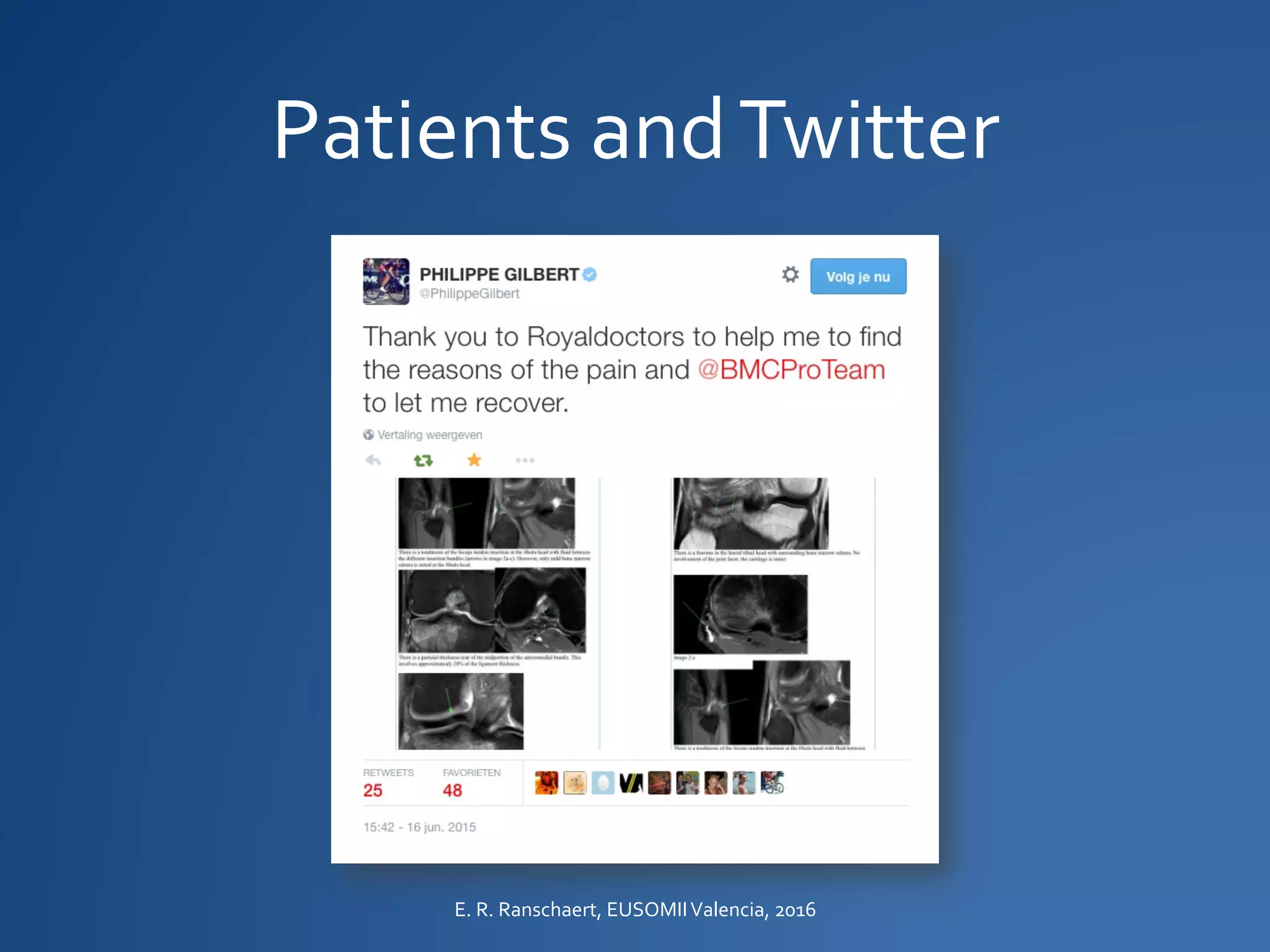
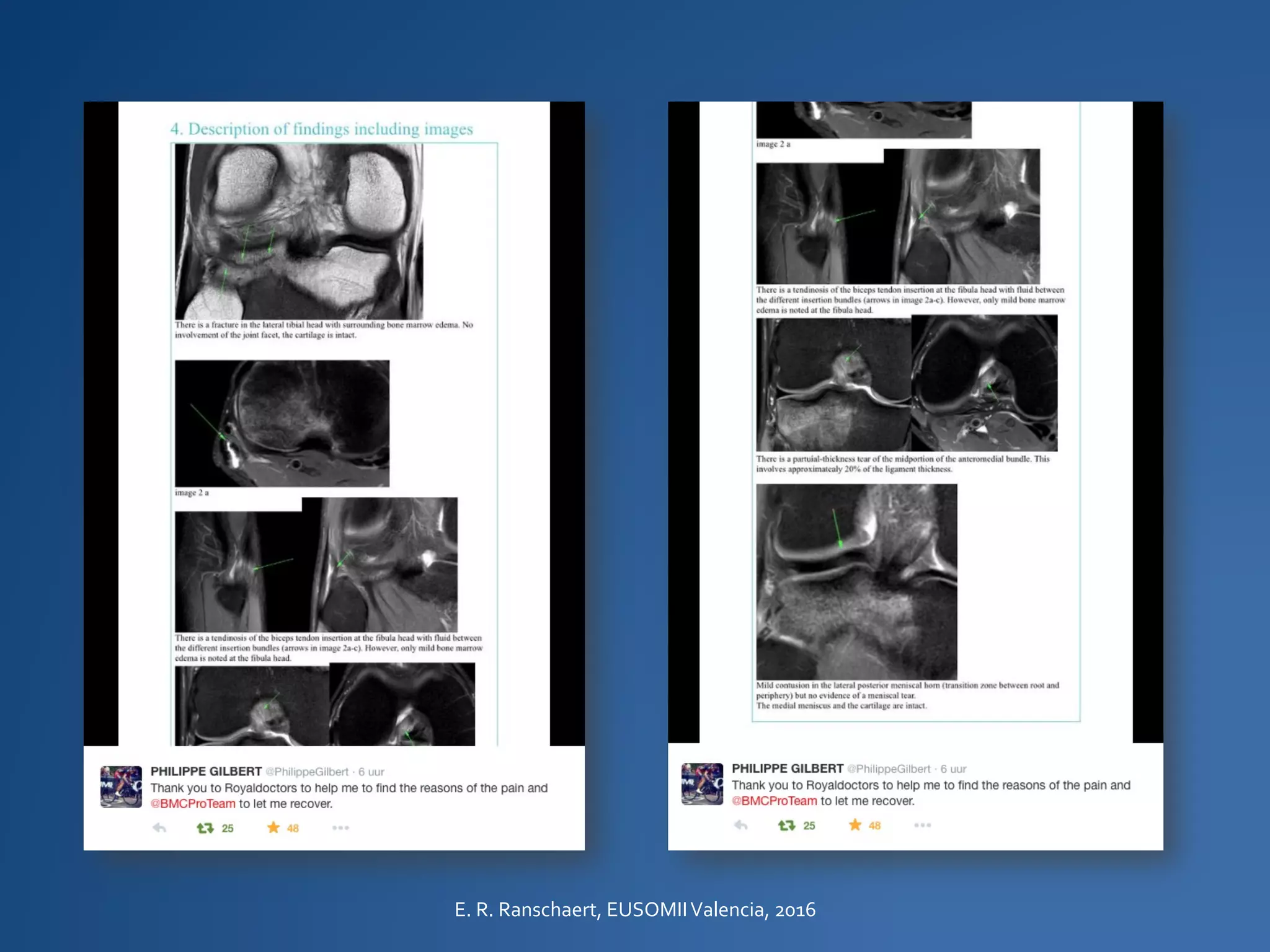
Patients andTwitter
E. R. Ranschaert, EUSOMIIValencia, 2016
Radiologists andTwitter
E. R. Ranschaert, EUSOMIIValencia, 2016
For what reason(s) are you using Social Media professionally? Total %
To stay informed about the latest news & developments in radiology 65
To communicate with colleagues about radiological topics (national & international) 49
To share and discuss interesting or difficult cases/images with colleagues 34
To increase my influence and promote my ideas/vision among radiologists 29
To make our profession more visible for patients 27
To make my expertise and knowledge available for teaching purposes 25
To market our team and services 19
To become more "social" with both patients and clinicians 18
To enable people and patients to communicate with radiologists 17
To inform patients about the examinations they will undergo 7
To get feedback from patients (both positive and negative) 6
To discuss radiological images with patients 4
To apply for a job or to be visible for recruiters 3
Reasons for using SoMe
E. R. Ranschaert, EUSOMIIValencia, 2016
RANSOM survey 2015
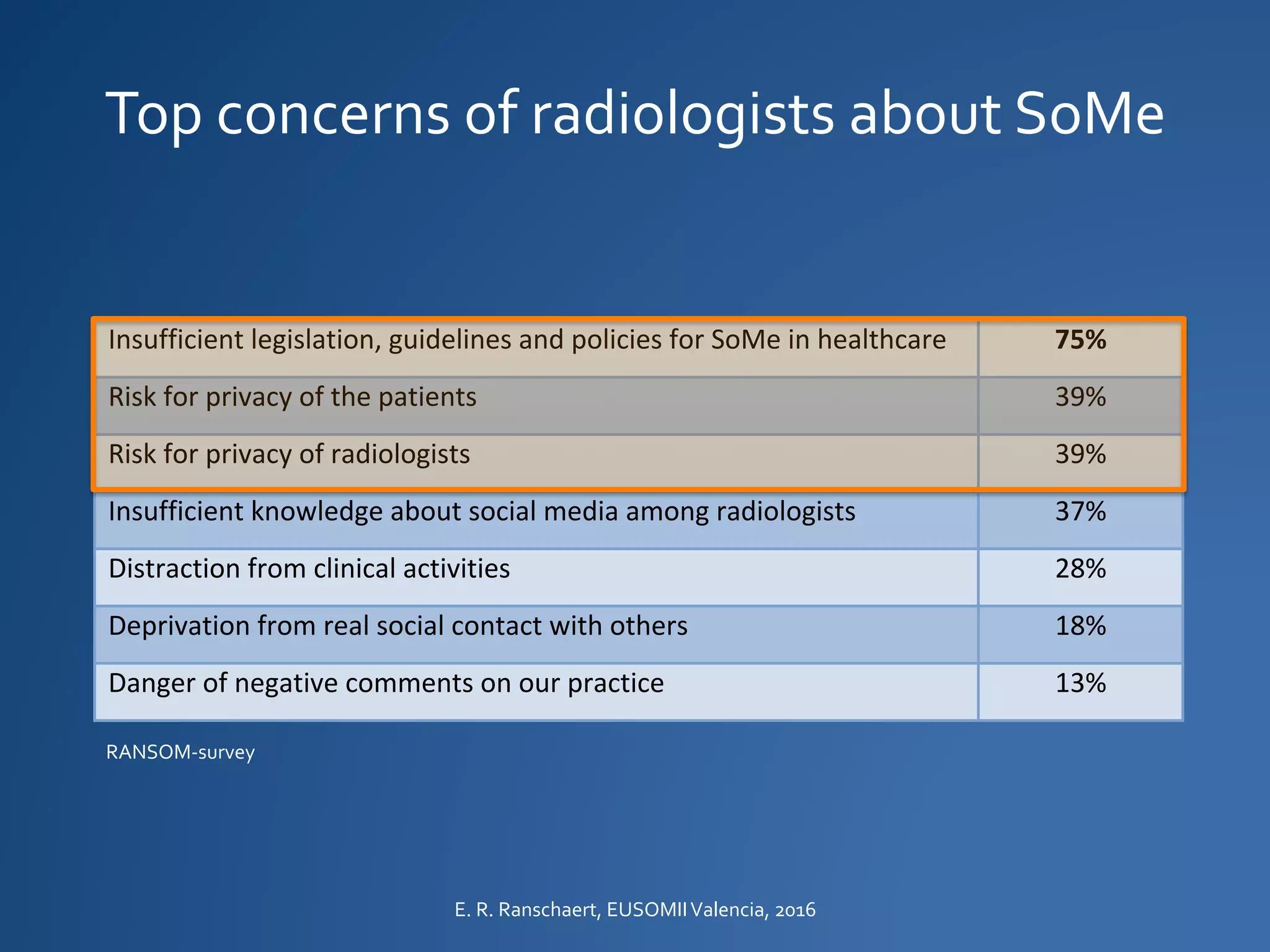
Top concerns of radiologists about SoMe
E. R. Ranschaert, EUSOMIIValencia, 2016
Insufficient legislation, guidelines and policies for SoMe in healthcare 75%
Risk for privacy of the patients 39%
Risk for privacy of radiologists 39%
Insufficient knowledge about social media among radiologists 37%
Distraction from clinical activities 28%
Deprivation from real social contact with others 18%
Danger of negative comments on our practice 13%
RANSOM-survey
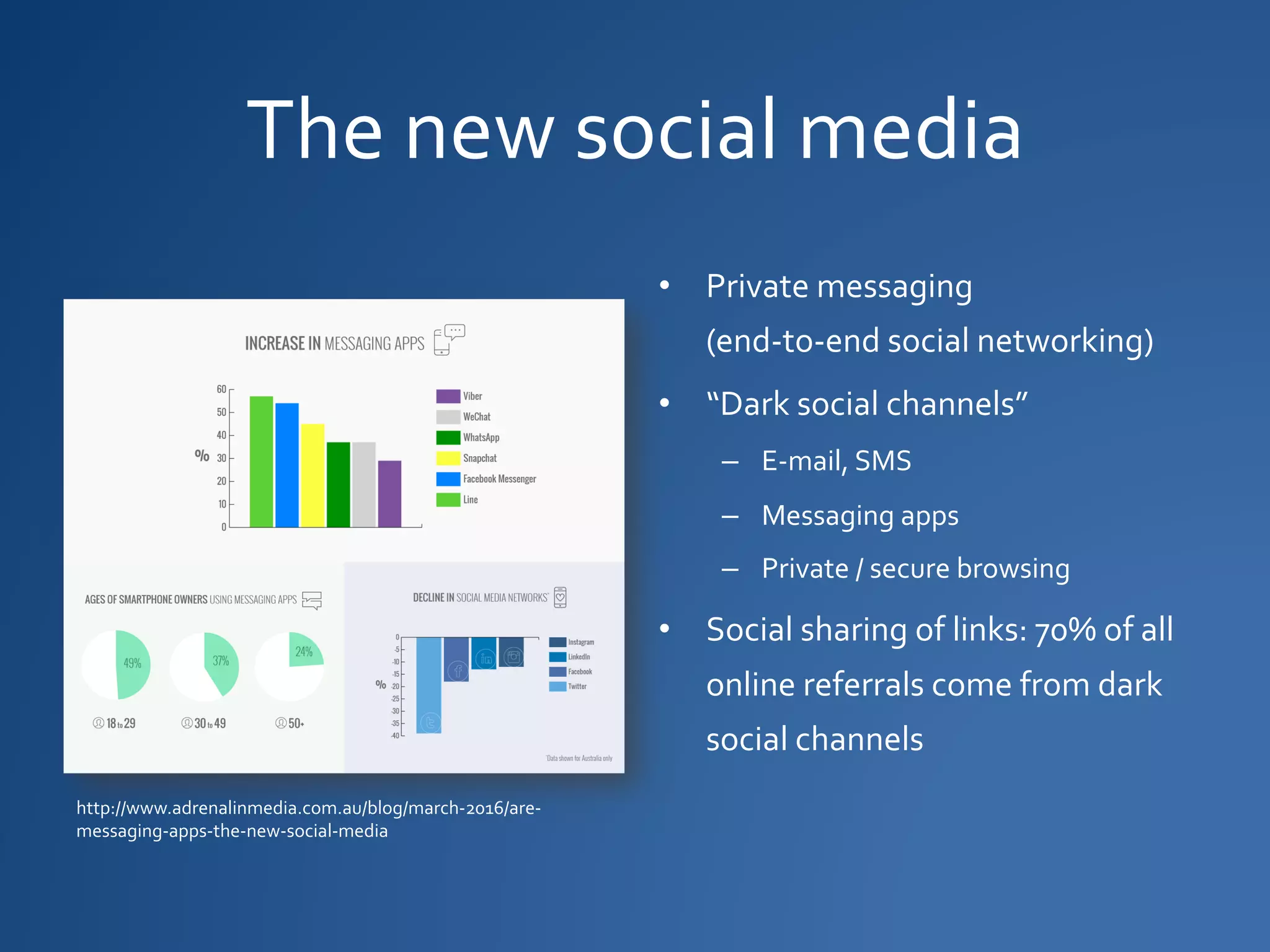
The new social media
• Private messaging
(end-to-end social networking)
• “Dark social channels”
– E-mail, SMS
– Messaging apps
– Private / secure browsing
• Social sharing of links: 70% of all
online referrals come from dark
social channels
http://www.adrenalinmedia.com.au/blog/march-2016/are-
messaging-apps-the-new-social-media
Messaging Apps
E. R. Ranschaert, EUSOMIIValencia, 2016
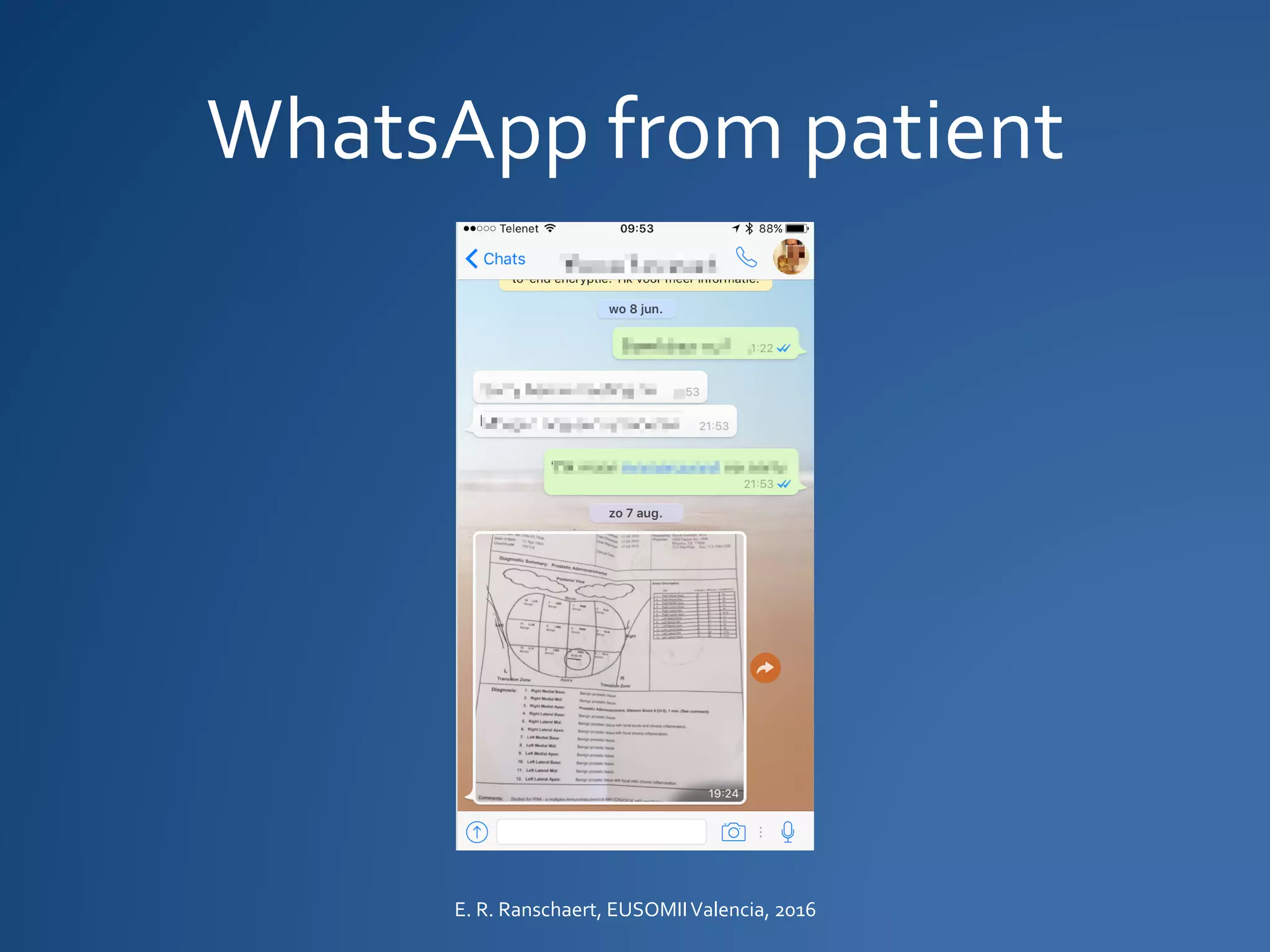
WhatsApp from patient
E. R. Ranschaert, EUSOMIIValencia, 2016
WhatsApp from radiologist
• “I got this picture of an angiogram at 11 PM
viaWhatsApp from another radiologist.The
patient was in coma, almost dead.”
• “The colleague wanted to know what this
structure on the angiogram is. I’m specialised
in cerebral stroke and could see that it was a
thrombosis of the basilar artery with a rare
anatomic variant.”
• “I could explain the colleague how to deal
with this abnormality; the patient could be
treated quickly, woke up after treatment and
could go home.”
Croonen H.Veilig whatsappen een must voor dokters.
Med Contact 2015(48):2312-5. E. R. Ranschaert, EUSOMIIValencia, 2016
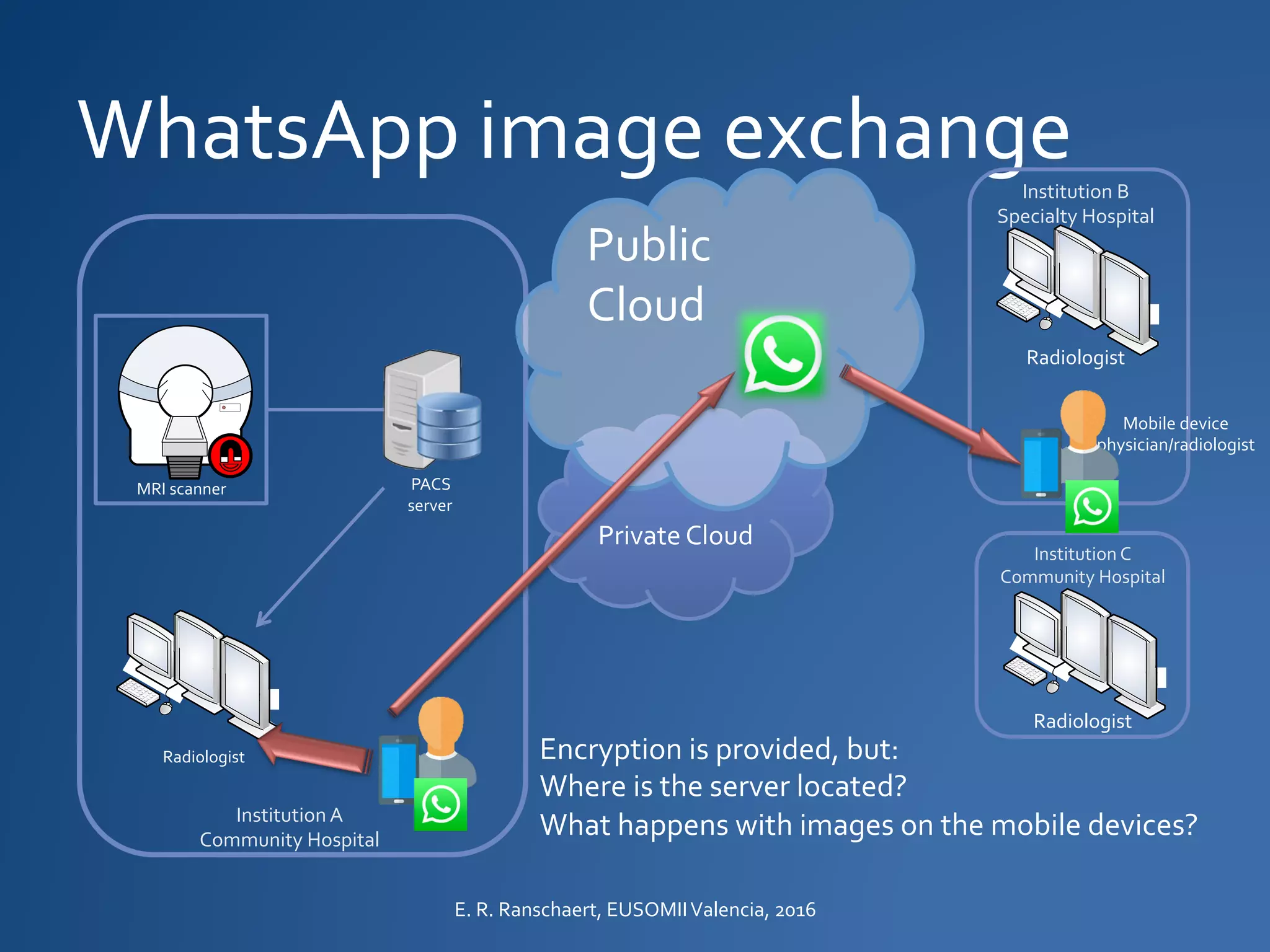
WhatsApp image exchange
Private Cloud
MRI scanner
Radiologist
PACS
server
InstitutionA
Community Hospital
Institution B
Specialty Hospital
Radiologist
Institution C
Community Hospital
Radiologist
Public
Cloud
Mobile device
physician/radiologist
E. R. Ranschaert, EUSOMIIValencia, 2016
Encryption is provided, but:
Where is the server located?
What happens with images on the mobile devices?
WhatsApp in Netherlands
• Study at Albert Schweitzer hospital:
– 40% of doctors useWhatsApp for clinical purposes
– In 33% name of patient is mentioned
– In 62% picture of patient is included
• Although SoMe are used for benefit of patient
care, most specialists are not aware of the lack of
privacy
Source: Heleen Croonen; Medisch Contact Nr. 48, 26 november 2015, p 2312-2315
E. R. Ranschaert, EUSOMIIValencia, 2016
Newspapers Feb. 24th
• Dutch DPA stands for the
fundamental right to the
protection of personal data
• “WhatsApp does not meet the
standards for sharing medical
data.”
• The individual doctor and/or
institution may receive a fine for
breaching protection of personal
data
• Medical doctors should find
alternative solutions
http://linkis.com/medischcontact.nl/oRWkJ
E. R. Ranschaert, EUSOMIIValencia, 2016
Dedicated messaging apps
E. R. Ranschaert, EUSOMIIValencia, 2016
Example
E. R. Ranschaert, EUSOMIIValencia, 2016
• End-to-end encryption
• Security of data at rest
– PIN-code access
– Remote wiping of data from
mobile device
– 30-day auto deletion of data from
mobile device
– Immediate deletion of servers
after arrival
– Anonymisation tool
– Professional profile of each user
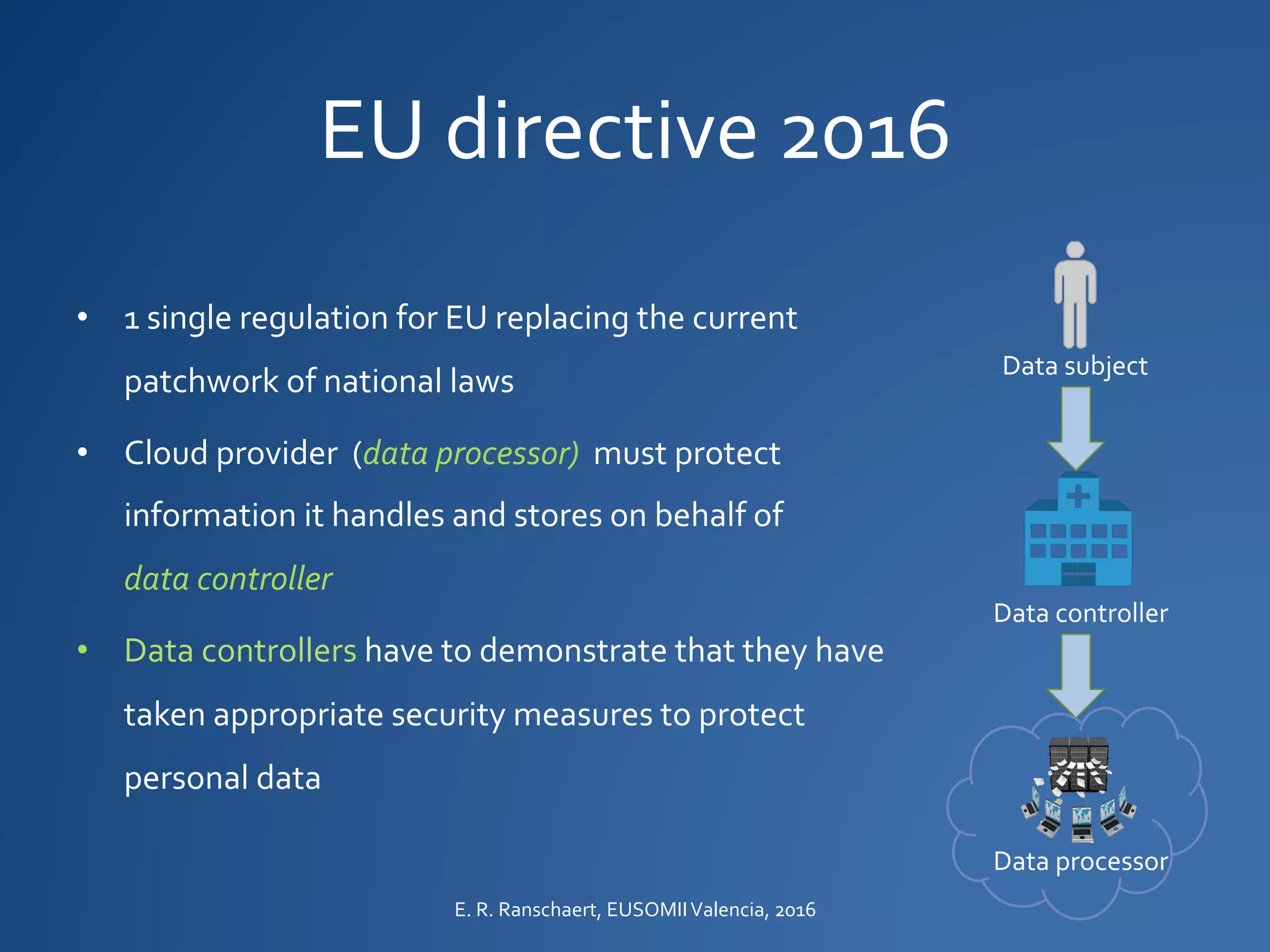
EU directive 2016
• 1 single regulation for EU replacing the current
patchwork of national laws
• Cloud provider (data processor) must protect
information it handles and stores on behalf of
data controller
• Data controllers have to demonstrate that they have
taken appropriate security measures to protect
personal data
E. R. Ranschaert, EUSOMIIValencia, 2016
Data subject
Data controller
Data processor
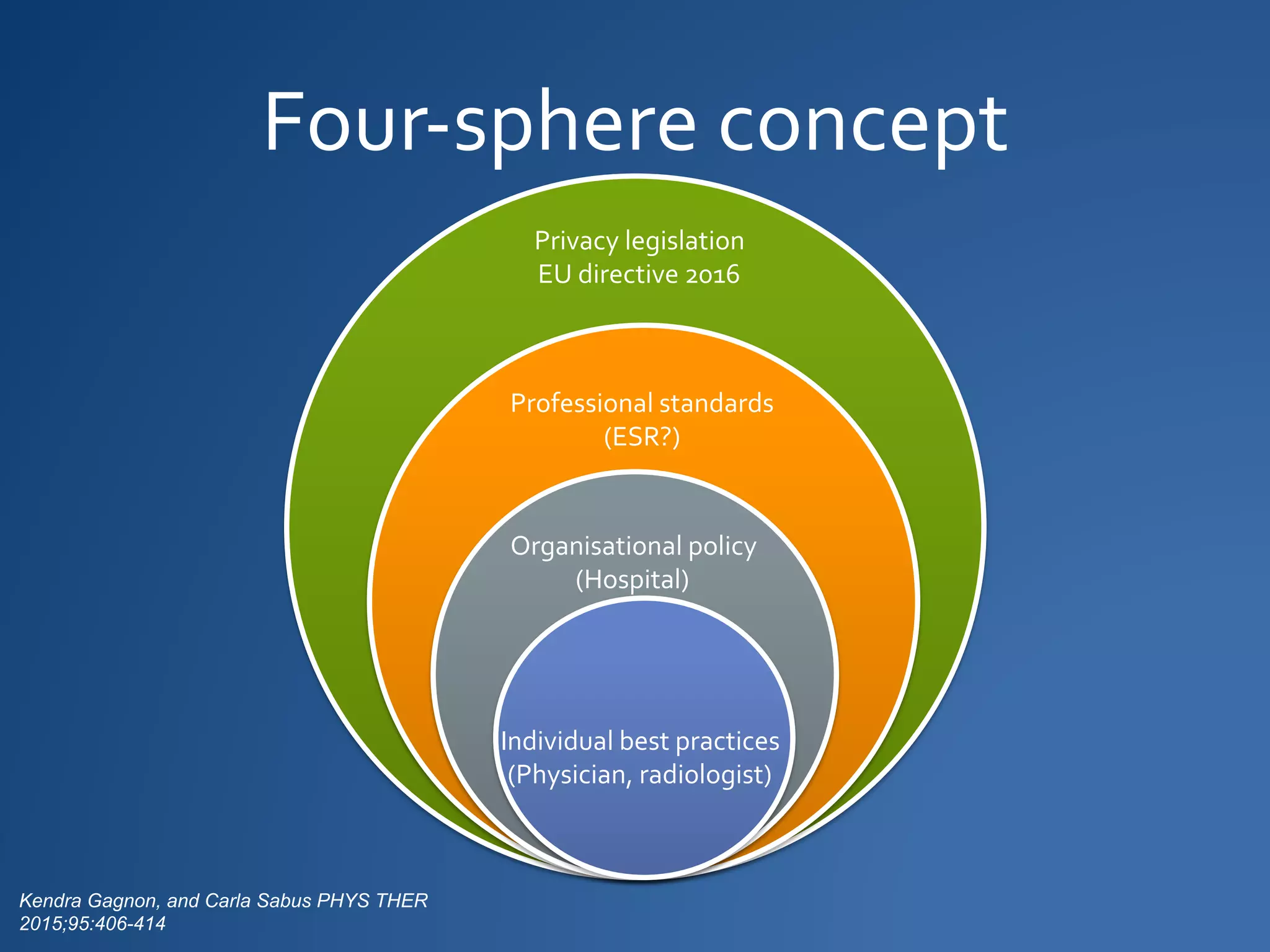
Privacy legislation
EU directive 2016
Professional standards
(ESR?)
Organisational policy
(Hospital)
Individual best practices
(Physician, radiologist)
Kendra Gagnon, and Carla Sabus PHYS THER 2015;95:406-
414
Four-sphere concept
Secure messaging
• Goal:
– to enable patients and their providers (clinicians
and their supporters) to communicate
electronically, privately and securely.
http://searchhealthit.techtarget.com/feature/SMS-doesnt-translate-to-secure-messaging-in-healthcare
Secure messaging: why?
• Possible applications for patients:
– making (and confirming) medical appointments
– asking medical questions
– discuss treatment options
– send medical device readings to a care provider
• blood pressure, X-ray result etc.
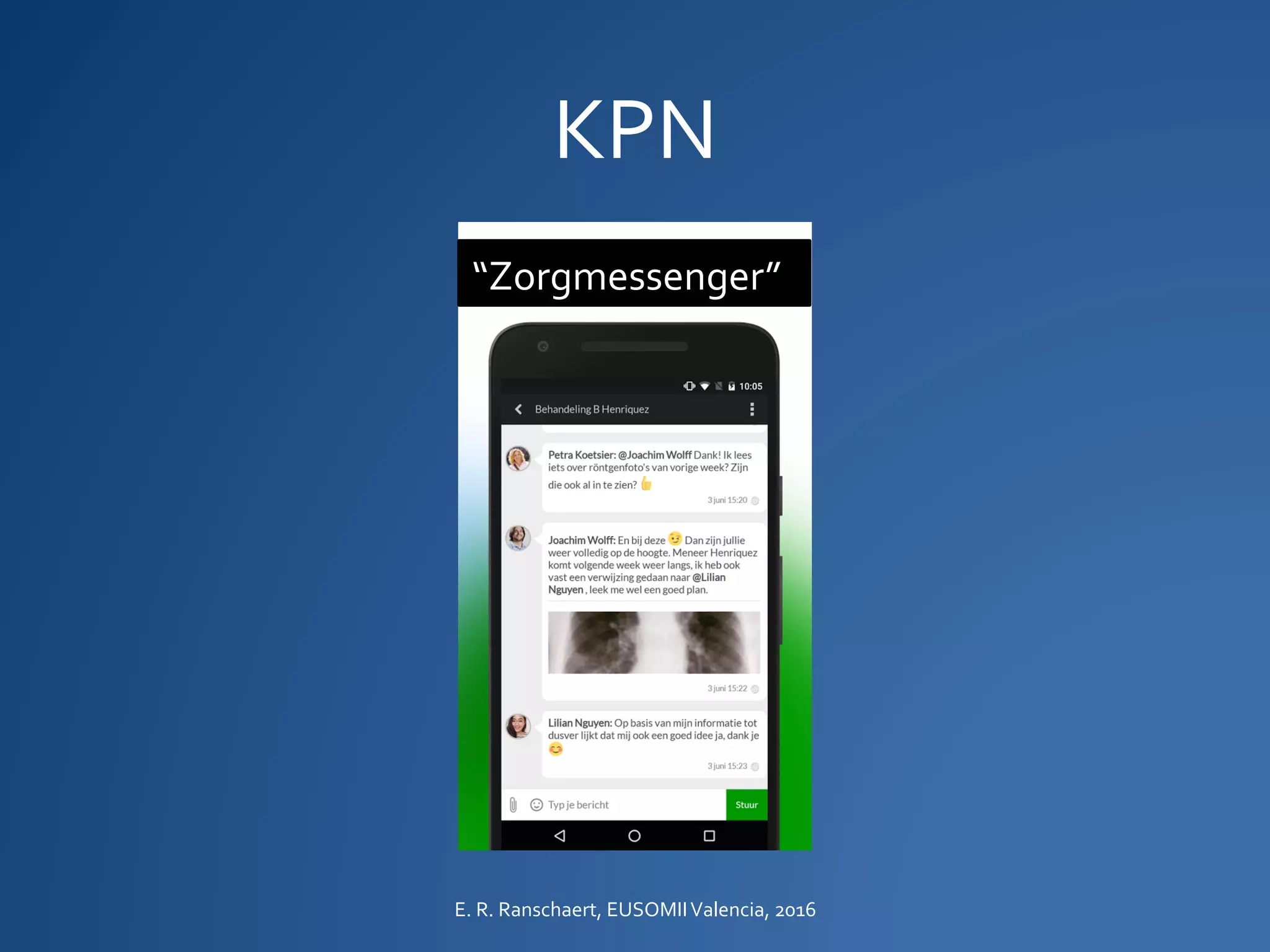
E. R. Ranschaert, EUSOMIIValencia, 2016
KPN
E. R. Ranschaert, EUSOMIIValencia, 2016
“Zorgmessenger”
i-Portals
• Web portals: online tools providing patients direct & secure access
to personal HR.
• Some are offering patients access to radiologic test results.
• Research has demonstrated patient dissatisfaction because of
– delays in receiving test results
– lack of clarity with results findings.
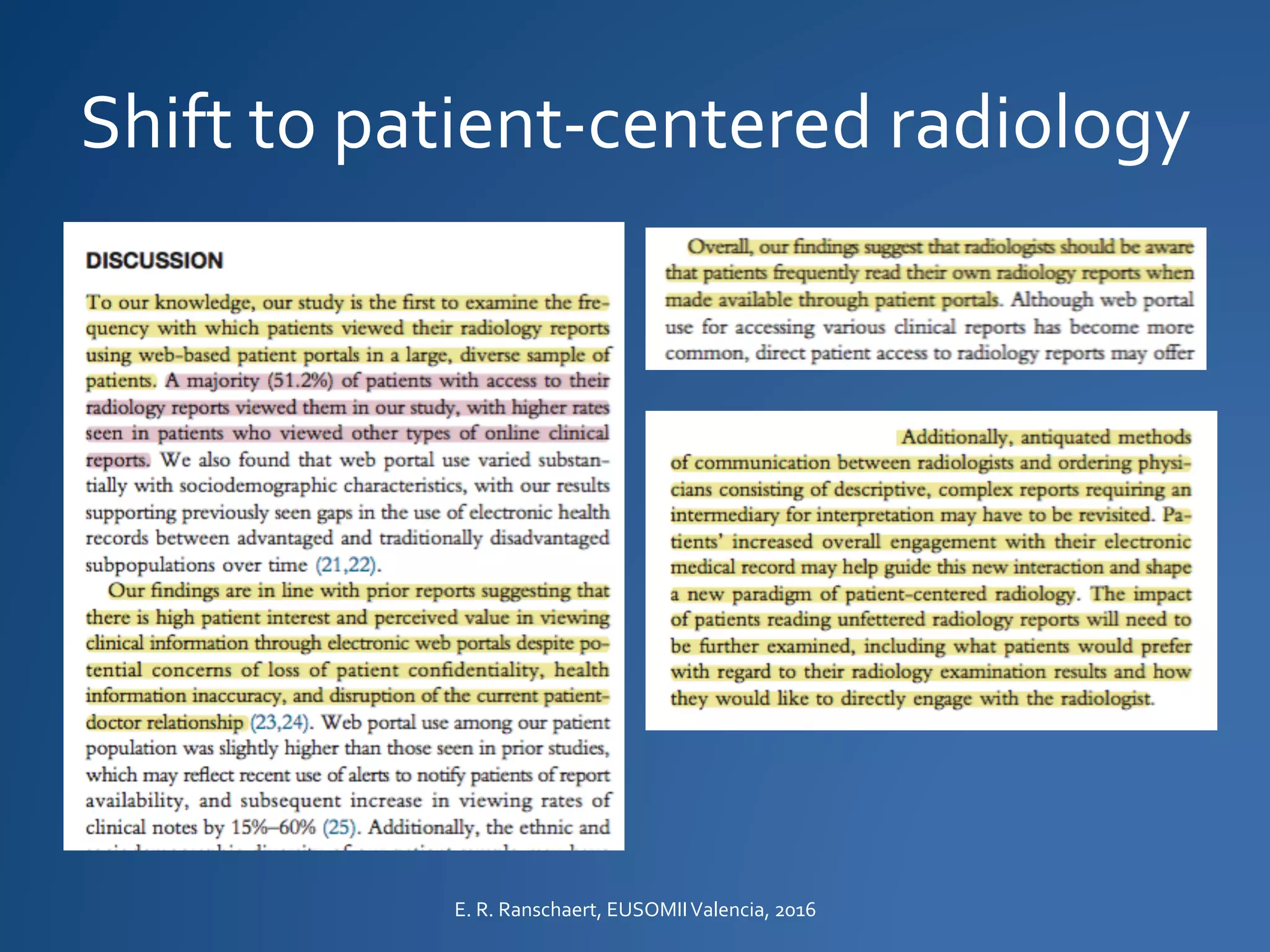
• Growing patient desire to view their full radiology reports online .
• Desire influenced by socioeconomic factors.
E. R. Ranschaert, EUSOMIIValencia, 2016
OpenNotes
• Created on the notion that information between
patients & doctors should be equal and
transparent
• 10.000.000 patients can read their medical notes
online
• Study of doctors and patients in 1-year pilot
program
Research results
Up to 92% of patients in the OpenNotes study opened their notes
More than 60% of patients reported doing better with taking medications as
prescribed because of open notes
More than 77% of patients reported that open notes helped them feel more in
control of their care
More than 86% of patients agreed that open notes would be an important factor in
choosing a future doctor or health plan
Fewer than 8% of doctors reported taking more time to address patients’ questions
outside of visits
Fewer than 20% of doctors reported taking more time writing notes
99% of patients wanted open notes to continue
Content of reports
• How much detail is in note is up to individual HC
provider
• Clinicians try to use terms that are still
understandable to patients
• “For me the most difficult thing was having to be
careful about tone and phrasing of the notes
knowing the patient would be reading them.”
Acad Radiol 2016
E. R. Ranschaert, EUSOMIIValencia, 2016
Shift to patient-centered radiology
E. R. Ranschaert, EUSOMIIValencia, 2016
OpenNotes is like a new medicine
• Its goal is to help people manage health and
illness more effectively
• It can have side effects and may hurt some
patients
• Clinicians and patients will need to learn how
to use it well
Summary
• It’s important to understand the concept of social networking
• SoMe can be used by radiologists to enhance collaboration,
networking, education/training and to keep up with information
• Health professionals need some guidance to enhance use and
avoid pitfalls in their use of SoMe and to uphold their professional
values.
• Appropriate use of new communication tools should result in
better patient care.
E. R. Ranschaert, EUSOMIIValencia, 2016

IT changes communication for radiologists

  • 1.
    IT changes communication forradiologists Erik R. Ranschaert E. R. Ranschaert, EUSOMIIValencia, 2016
  • 2.
    Topics • Online communicationin health care – What is available? – What should we use? – How should we use it? • Accessibility of reports through i-Portals E. R. Ranschaert, EUSOMIIValencia, 2016
  • 3.
    New communication tools Society •Unlimited interconnectivity • Boundless ability to share knowledge and expertise • Viral transit of information Healthcare • New ways of communicating with peers and patients, eliminating geographical distance and thresholds • Greater patient engagement, new patient demands E. R. Ranschaert, EUSOMIIValencia, 2016
  • 4.
    Patients andTwitter E. R.Ranschaert, EUSOMIIValencia, 2016
  • 5.
    E. R. Ranschaert,EUSOMIIValencia, 2016
  • 6.
    Radiologists andTwitter E. R.Ranschaert, EUSOMIIValencia, 2016
  • 7.
    For what reason(s)are you using Social Media professionally? Total % To stay informed about the latest news & developments in radiology 65 To communicate with colleagues about radiological topics (national & international) 49 To share and discuss interesting or difficult cases/images with colleagues 34 To increase my influence and promote my ideas/vision among radiologists 29 To make our profession more visible for patients 27 To make my expertise and knowledge available for teaching purposes 25 To market our team and services 19 To become more "social" with both patients and clinicians 18 To enable people and patients to communicate with radiologists 17 To inform patients about the examinations they will undergo 7 To get feedback from patients (both positive and negative) 6 To discuss radiological images with patients 4 To apply for a job or to be visible for recruiters 3 Reasons for using SoMe E. R. Ranschaert, EUSOMIIValencia, 2016 RANSOM survey 2015
  • 8.
    Top concerns ofradiologists about SoMe E. R. Ranschaert, EUSOMIIValencia, 2016 Insufficient legislation, guidelines and policies for SoMe in healthcare 75% Risk for privacy of the patients 39% Risk for privacy of radiologists 39% Insufficient knowledge about social media among radiologists 37% Distraction from clinical activities 28% Deprivation from real social contact with others 18% Danger of negative comments on our practice 13% RANSOM-survey
  • 9.
    The new socialmedia • Private messaging (end-to-end social networking) • “Dark social channels” – E-mail, SMS – Messaging apps – Private / secure browsing • Social sharing of links: 70% of all online referrals come from dark social channels http://www.adrenalinmedia.com.au/blog/march-2016/are- messaging-apps-the-new-social-media
  • 10.
    Messaging Apps E. R.Ranschaert, EUSOMIIValencia, 2016
  • 11.
    WhatsApp from patient E.R. Ranschaert, EUSOMIIValencia, 2016
  • 12.
    WhatsApp from radiologist •“I got this picture of an angiogram at 11 PM viaWhatsApp from another radiologist.The patient was in coma, almost dead.” • “The colleague wanted to know what this structure on the angiogram is. I’m specialised in cerebral stroke and could see that it was a thrombosis of the basilar artery with a rare anatomic variant.” • “I could explain the colleague how to deal with this abnormality; the patient could be treated quickly, woke up after treatment and could go home.” Croonen H.Veilig whatsappen een must voor dokters. Med Contact 2015(48):2312-5. E. R. Ranschaert, EUSOMIIValencia, 2016
  • 13.
    WhatsApp image exchange PrivateCloud MRI scanner Radiologist PACS server InstitutionA Community Hospital Institution B Specialty Hospital Radiologist Institution C Community Hospital Radiologist Public Cloud Mobile device physician/radiologist E. R. Ranschaert, EUSOMIIValencia, 2016 Encryption is provided, but: Where is the server located? What happens with images on the mobile devices?
  • 14.
    WhatsApp in Netherlands •Study at Albert Schweitzer hospital: – 40% of doctors useWhatsApp for clinical purposes – In 33% name of patient is mentioned – In 62% picture of patient is included • Although SoMe are used for benefit of patient care, most specialists are not aware of the lack of privacy Source: Heleen Croonen; Medisch Contact Nr. 48, 26 november 2015, p 2312-2315 E. R. Ranschaert, EUSOMIIValencia, 2016
  • 15.
    Newspapers Feb. 24th •Dutch DPA stands for the fundamental right to the protection of personal data • “WhatsApp does not meet the standards for sharing medical data.” • The individual doctor and/or institution may receive a fine for breaching protection of personal data • Medical doctors should find alternative solutions http://linkis.com/medischcontact.nl/oRWkJ E. R. Ranschaert, EUSOMIIValencia, 2016
  • 16.
    Dedicated messaging apps E.R. Ranschaert, EUSOMIIValencia, 2016
  • 17.
    Example E. R. Ranschaert,EUSOMIIValencia, 2016 • End-to-end encryption • Security of data at rest – PIN-code access – Remote wiping of data from mobile device – 30-day auto deletion of data from mobile device – Immediate deletion of servers after arrival – Anonymisation tool – Professional profile of each user
  • 18.
    EU directive 2016 •1 single regulation for EU replacing the current patchwork of national laws • Cloud provider (data processor) must protect information it handles and stores on behalf of data controller • Data controllers have to demonstrate that they have taken appropriate security measures to protect personal data E. R. Ranschaert, EUSOMIIValencia, 2016 Data subject Data controller Data processor
  • 19.
    Privacy legislation EU directive2016 Professional standards (ESR?) Organisational policy (Hospital) Individual best practices (Physician, radiologist) Kendra Gagnon, and Carla Sabus PHYS THER 2015;95:406- 414 Four-sphere concept
  • 20.
    Secure messaging • Goal: –to enable patients and their providers (clinicians and their supporters) to communicate electronically, privately and securely. http://searchhealthit.techtarget.com/feature/SMS-doesnt-translate-to-secure-messaging-in-healthcare
  • 21.
    Secure messaging: why? •Possible applications for patients: – making (and confirming) medical appointments – asking medical questions – discuss treatment options – send medical device readings to a care provider • blood pressure, X-ray result etc. E. R. Ranschaert, EUSOMIIValencia, 2016
  • 22.
    KPN E. R. Ranschaert,EUSOMIIValencia, 2016 “Zorgmessenger”
  • 23.
    i-Portals • Web portals:online tools providing patients direct & secure access to personal HR. • Some are offering patients access to radiologic test results. • Research has demonstrated patient dissatisfaction because of – delays in receiving test results – lack of clarity with results findings. • Growing patient desire to view their full radiology reports online . • Desire influenced by socioeconomic factors. E. R. Ranschaert, EUSOMIIValencia, 2016
  • 24.
    OpenNotes • Created onthe notion that information between patients & doctors should be equal and transparent • 10.000.000 patients can read their medical notes online • Study of doctors and patients in 1-year pilot program
  • 26.
    Research results Up to92% of patients in the OpenNotes study opened their notes More than 60% of patients reported doing better with taking medications as prescribed because of open notes More than 77% of patients reported that open notes helped them feel more in control of their care More than 86% of patients agreed that open notes would be an important factor in choosing a future doctor or health plan Fewer than 8% of doctors reported taking more time to address patients’ questions outside of visits Fewer than 20% of doctors reported taking more time writing notes 99% of patients wanted open notes to continue
  • 27.
    Content of reports •How much detail is in note is up to individual HC provider • Clinicians try to use terms that are still understandable to patients • “For me the most difficult thing was having to be careful about tone and phrasing of the notes knowing the patient would be reading them.”
  • 28.
    Acad Radiol 2016 E.R. Ranschaert, EUSOMIIValencia, 2016
  • 29.
    Shift to patient-centeredradiology E. R. Ranschaert, EUSOMIIValencia, 2016
  • 30.
    OpenNotes is likea new medicine • Its goal is to help people manage health and illness more effectively • It can have side effects and may hurt some patients • Clinicians and patients will need to learn how to use it well
  • 31.
    Summary • It’s importantto understand the concept of social networking • SoMe can be used by radiologists to enhance collaboration, networking, education/training and to keep up with information • Health professionals need some guidance to enhance use and avoid pitfalls in their use of SoMe and to uphold their professional values. • Appropriate use of new communication tools should result in better patient care. E. R. Ranschaert, EUSOMIIValencia, 2016