Developing Multiliteracies in
 Secondary Content Area
        Classrooms
              Michelle Schira Hagerman
      Doctoral Student, Michigan State University
          Research Affiliate, Albion College
            http://mschirahagerman.com

  A special presentation for EDUC 373, Albion College
                Tuesday, February 5, 2013
Today’s Big Questions

• What are the key job skills and life skills needed in
  our 21st-century world?

• To what extent should multiliteracies be used to help
  students develop those skills?

• How should they be used?
Let’s hear what you think?

• What are the key job skills and life skills needed in
  our 21st-century world?

• We’re going to talk about it…but we’re also going to
  share what we think using Lino.

• Lino Board: What are 21st Century Skills?
What do the experts say?
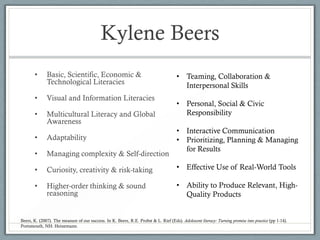
Kylene Beers
       •      Basic, Scientific, Economic &                                            • Teaming, Collaboration &
              Technological Literacies                                                   Interpersonal Skills
       •      Visual and Information Literacies
                                                                                       • Personal, Social & Civic
       •      Multicultural Literacy and Global                                          Responsibility
              Awareness
                                                                                       • Interactive Communication
       •      Adaptability                                                             • Prioritizing, Planning & Managing
                                                                                         for Results
       •      Managing complexity & Self-direction

       •      Curiosity, creativity & risk-taking                                      • Effective Use of Real-World Tools

       •      Higher-order thinking & sound                                            • Ability to Produce Relevant, High-
              reasoning                                                                  Quality Products


Beers, K. (2007). The measure of our success. In K. Beers, R.E. Probst & L. Rief (Eds). Adolescent literacy: Turning promise into practice (pp 1-14).
Portsmouth, NH: Heinemann.
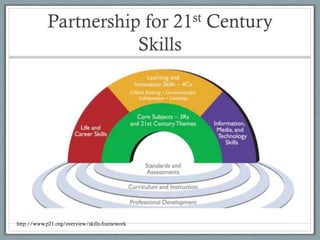
Partnership for 21st Century
                       Skills


http://www.p21.org/overview/skills-framework
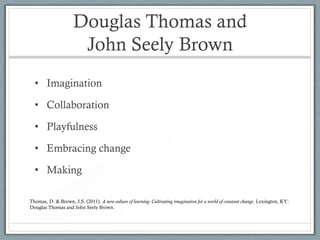
Douglas Thomas and
                      John Seely Brown
  • Imagination

  • Collaboration

  • Playfulness

  • Embracing change

  • Making

Thomas, D. & Brown, J.S. (2011). A new culture of learning: Cultivating imagination for a world of constant change. Lexington, KY:
Douglas Thomas and John Seely Brown.
Jason Ohler

     • Discipline specific literacies

     • Digital literacies

     • Integrating new media into a cohesive narrative, or
       collage – words, images, video coalesce to create
       new meaning together

     • Participatory digital citizenship

     • Creation/Making
Ohler, J. (2009). Orchestrating the media collage. ASCD, 66(6), 8-13.
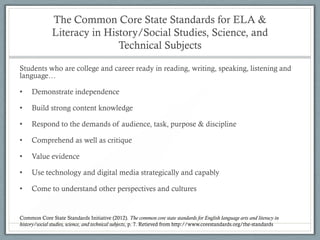
The Common Core State Standards for ELA &
              Literacy in History/Social Studies, Science, and
                             Technical Subjects

Students who are college and career ready in reading, writing, speaking, listening and
language…

•    Demonstrate independence

•    Build strong content knowledge

•    Respond to the demands of audience, task, purpose & discipline

•    Comprehend as well as critique

•    Value evidence

•    Use technology and digital media strategically and capably

•    Come to understand other perspectives and cultures


Common Core State Standards Initiative (2012). The common core state standards for English language arts and literacy in
history/social studies, science, and technical subjects, p. 7. Retieved from http://www.corestandards.org/the-standards
What are multiliteracies?

• This time, let’s try Hootcourse to see what we
  understand.

• http://hootcourse.com/course/2941/w3uk66pjqjxd
  8ms/
What do the experts say?
The New London Group

     • Multiliteracies – two big ideas…

           • Multiple modes of making meaning, e.g., linguistic
             meaning, visual meaning, audio meaning, gestural
             meaning, spatial meaning & multimodal patterns of meaning
             based on the integration of the others

           • Cultural and social ways of understanding/making meaning


     • “Literacy educators and students must see themselves as
       active participants in social change, as learners who can
       be active designers – makers of social futures.”
New London Group (1996). A pedagogy of multiliteracies: Designing social futures. Harvard Educational Review,66:1, 60-92.
New Literacies of
 Online Reading Comprehension
   • Questioning

   • Locating

   • Evaluating

   • Synthesizing

   • Communicating

Leu, D. J., Kinzer, C. K., Coiro, J. L., & Cammack, D. W. (2004). Toward a theory of new literacies emerging from the
Internet and other information and communication technologies. In R. Ruddell & N. Unrau (Eds.) Theoretical models
and processes of reading (5th ed, pp. 1568-1611) Newark, DE: International Reading Association.
How should we teach them?

• Ideas? (Hint: Ideas from your readings most
  welcomed in addition to your own!)

• Tweet them in Hootcourse!
TPACK it…
• Imagine an activity for students in your content area that…

    1.     Includes collaborative construction of understanding
    2.     Involves reading, writing, listening and/or speaking
    3.     Integrates technologies in ways that support 1 & 2…but also the
           development of digital literacies
    4.     Requires the creation of something that can be shared with an
           authentic audience online

•        Work with a partner
•        20 minutes for planning & sketching, then we share our ideas
•        For tech tool ideas: Cool Tools for Schools
Where will you archive this idea?
       With whom will you share it?

• Will you blog about it?
• Will you keep it in an Evernote library?
• Will you post it to a social network?
• Will you write it up on a publicly searchable Google
  Doc?
• Will you share it with a professional community of other
  teachers?
• Or…will it stay on your hard drive…never to be seen
  again?
Voicethread

• Let’s try something crazy…

• Let’s record our ideas on a Voicethread.

• https://voicethread.com/share/4089383/
More from the experts…

• “School is all about little minds, not big Minds.”
  (Gee, 2013, p. 165)
• “[…] the kind of learning that will define the twenty-first
  century is not taking place in a classroom – at least not in
  today’s classroom.” (Thomas & Brown, 2011, p. 17)
• “Schools have kept digital technologies on the periphery
  of their core academic practices. Schools often provide
  computer labs, tech prep courses, and computer literacy
  and programming courses to help students learn about
  technology, but do not try to rethink basic practices of
  teaching and learning.” (Collins & Halverson, 2009, p. 6)
Michelle’s Top 5 Recommendations for
 Supporting Digital/New/Multi Literacies in
          the Secondary Classroom

1. Think first and think deeply about the skills, strategies
   and mindsets you need to help your students acquire.
   This is your purpose. It must drive your choices.
2. Think second about the best pedagogical methods you
   know for supporting the development of those
   skills, strategies and mindsets. If you don’t know – ask
   someone AND use technology to find out.
3. Ask yourself at every turn: Is there a way for me to
   integrate a technology that would make this learning
   activity more collaborative, more playful, more
   authentic, more complex?
Michelle’s Top 5

4. Play. Make things. Share. Contribute. Repeat.

5. Remember that literacies give access – and that 21st
   century literacies are diverse, complex and like all
   other literacies, develop when scaffolded. Don’t
   assume kids will just “learn them”in the absence of
   thoughtful engagement.
Pink, D. (2013, January 7) Does the “school cliff ” matter more than the “fiscal cliff ”? Retrieved from
http://www.danpink.com/2013/01/does-the-school-cliff-matter-more-than-the-fiscal-cliff
What are the key job skills and life skills
                  needed in our 21st-century world?

       Mind Visions: What do YOU think WE should do? If you cannot
       help answer this question and motivate people to action for a
       vision, or if you trust “experts” or politicians to answer it
       alone, you have not been educated. […] How can school
       encourage Mind Visions? This is what the Liberal Arts at their best
       were always about: multiple visions, from art and science, of a
       better, fairer, sustainable world. What we have to add to this is the
       demand that each student become a maker of visions, a
       visionary, and not just a spectator of visions. Today’s digital
       media, used well, can facilitate students to be visionaries. […]
       Digital media can make learning in and out of school engaging
       […], social, and life enhancing. Digital tools can make better
       minds and a better society, but they cannot do this by themselves.
       ” (Gee, 2013, pp. 214-215)
Gee, J.P. (2013). The anti-education era: Creating smarter students through digital learning. New York: Palgrave MacMillan.
Let’s end with a poll…


http://www.polleverywhere.com/survey/CGtlzC_IF
Resources in One Place

• Lino
• Hootcourse
• VoiceThread
• Evernote
• Google Drive
• Poll Everywhere
• Cool Tools for School Wiki
References
Beers, K. (2007). The measure of our success. In K. Beers, R.E. Probst & L. Rief (Eds). Adolescent literacy: Turning promise into practice (pp 1-14).
Portsmouth, NH: Heinemann.

Collins, A. & Halverson, R. (2009). Rethinking education in the age of technology: The digital revolution and schooling in America. New York:
Teachers College Press.

Common Core State Standards Initiative (2012). The common core state standards for English language arts and literacy in history/social studies, science, and
technical subjects, p. 7. Retieved from http://www.corestandards.org/the-standards

Gee, J.P. (2013). The anti-education era: Creating smarter students through digital learning. New York: Palgrave MacMillan

Leu, D. J., Kinzer, C. K., Coiro, J. L., & Cammack, D. W. (2004). Toward a theory of new literacies emerging from the Internet and other
information and communication technologies. In R. Ruddell & N. Unrau (Eds.) Theoretical models and processes of reading (5th ed, pp. 1568-1611)
Newark, DE: International Reading Association.

New London Group (1996). A pedagogy of multiliteracies: Designing social futures. Harvard Educational Review,66:1, 60-92.

Ohler, J. (2009). Orchestrating the media collage. ASCD, 66(6), 8-13.

Partnership for 21st Century Skills Initiative (2013). The framework. Retrieved from http://www.p21.org/overview/skills-framework

Pink, D. (2013, January 7) Does the “school cliff” matter more than the “fiscal cliff”? Retrieved from http://www.danpink.com/2013/01/does-the-
school-cliff-matter-more-than-the-fiscal-cliff

Thomas, D. & Brown, J.S. (2011). A new culture of learning: Cultivating imagination for a world of constant change. Lexington, KY: Douglas Thomas and
John Seely Brown.

Educ373 albion college_02-04-2013

  • 1.
    Developing Multiliteracies in Secondary Content Area Classrooms Michelle Schira Hagerman Doctoral Student, Michigan State University Research Affiliate, Albion College http://mschirahagerman.com A special presentation for EDUC 373, Albion College Tuesday, February 5, 2013
  • 2.
    Today’s Big Questions •What are the key job skills and life skills needed in our 21st-century world? • To what extent should multiliteracies be used to help students develop those skills? • How should they be used?
  • 3.
    Let’s hear whatyou think? • What are the key job skills and life skills needed in our 21st-century world? • We’re going to talk about it…but we’re also going to share what we think using Lino. • Lino Board: What are 21st Century Skills?
  • 4.
    What do theexperts say?
  • 5.
    Kylene Beers • Basic, Scientific, Economic & • Teaming, Collaboration & Technological Literacies Interpersonal Skills • Visual and Information Literacies • Personal, Social & Civic • Multicultural Literacy and Global Responsibility Awareness • Interactive Communication • Adaptability • Prioritizing, Planning & Managing for Results • Managing complexity & Self-direction • Curiosity, creativity & risk-taking • Effective Use of Real-World Tools • Higher-order thinking & sound • Ability to Produce Relevant, High- reasoning Quality Products Beers, K. (2007). The measure of our success. In K. Beers, R.E. Probst & L. Rief (Eds). Adolescent literacy: Turning promise into practice (pp 1-14). Portsmouth, NH: Heinemann.
  • 6.
    Partnership for 21stCentury Skills http://www.p21.org/overview/skills-framework
  • 7.
    Douglas Thomas and John Seely Brown • Imagination • Collaboration • Playfulness • Embracing change • Making Thomas, D. & Brown, J.S. (2011). A new culture of learning: Cultivating imagination for a world of constant change. Lexington, KY: Douglas Thomas and John Seely Brown.
  • 8.
    Jason Ohler • Discipline specific literacies • Digital literacies • Integrating new media into a cohesive narrative, or collage – words, images, video coalesce to create new meaning together • Participatory digital citizenship • Creation/Making Ohler, J. (2009). Orchestrating the media collage. ASCD, 66(6), 8-13.
  • 9.
    The Common CoreState Standards for ELA & Literacy in History/Social Studies, Science, and Technical Subjects Students who are college and career ready in reading, writing, speaking, listening and language… • Demonstrate independence • Build strong content knowledge • Respond to the demands of audience, task, purpose & discipline • Comprehend as well as critique • Value evidence • Use technology and digital media strategically and capably • Come to understand other perspectives and cultures Common Core State Standards Initiative (2012). The common core state standards for English language arts and literacy in history/social studies, science, and technical subjects, p. 7. Retieved from http://www.corestandards.org/the-standards
  • 10.
    What are multiliteracies? •This time, let’s try Hootcourse to see what we understand. • http://hootcourse.com/course/2941/w3uk66pjqjxd 8ms/
  • 11.
    What do theexperts say?
  • 12.
    The New LondonGroup • Multiliteracies – two big ideas… • Multiple modes of making meaning, e.g., linguistic meaning, visual meaning, audio meaning, gestural meaning, spatial meaning & multimodal patterns of meaning based on the integration of the others • Cultural and social ways of understanding/making meaning • “Literacy educators and students must see themselves as active participants in social change, as learners who can be active designers – makers of social futures.” New London Group (1996). A pedagogy of multiliteracies: Designing social futures. Harvard Educational Review,66:1, 60-92.
  • 13.
    New Literacies of Online Reading Comprehension • Questioning • Locating • Evaluating • Synthesizing • Communicating Leu, D. J., Kinzer, C. K., Coiro, J. L., & Cammack, D. W. (2004). Toward a theory of new literacies emerging from the Internet and other information and communication technologies. In R. Ruddell & N. Unrau (Eds.) Theoretical models and processes of reading (5th ed, pp. 1568-1611) Newark, DE: International Reading Association.
  • 14.
    How should weteach them? • Ideas? (Hint: Ideas from your readings most welcomed in addition to your own!) • Tweet them in Hootcourse!
  • 15.
    TPACK it… • Imaginean activity for students in your content area that… 1. Includes collaborative construction of understanding 2. Involves reading, writing, listening and/or speaking 3. Integrates technologies in ways that support 1 & 2…but also the development of digital literacies 4. Requires the creation of something that can be shared with an authentic audience online • Work with a partner • 20 minutes for planning & sketching, then we share our ideas • For tech tool ideas: Cool Tools for Schools
  • 16.
    Where will youarchive this idea? With whom will you share it? • Will you blog about it? • Will you keep it in an Evernote library? • Will you post it to a social network? • Will you write it up on a publicly searchable Google Doc? • Will you share it with a professional community of other teachers? • Or…will it stay on your hard drive…never to be seen again?
  • 17.
    Voicethread • Let’s trysomething crazy… • Let’s record our ideas on a Voicethread. • https://voicethread.com/share/4089383/
  • 18.
    More from theexperts… • “School is all about little minds, not big Minds.” (Gee, 2013, p. 165) • “[…] the kind of learning that will define the twenty-first century is not taking place in a classroom – at least not in today’s classroom.” (Thomas & Brown, 2011, p. 17) • “Schools have kept digital technologies on the periphery of their core academic practices. Schools often provide computer labs, tech prep courses, and computer literacy and programming courses to help students learn about technology, but do not try to rethink basic practices of teaching and learning.” (Collins & Halverson, 2009, p. 6)
  • 19.
    Michelle’s Top 5Recommendations for Supporting Digital/New/Multi Literacies in the Secondary Classroom 1. Think first and think deeply about the skills, strategies and mindsets you need to help your students acquire. This is your purpose. It must drive your choices. 2. Think second about the best pedagogical methods you know for supporting the development of those skills, strategies and mindsets. If you don’t know – ask someone AND use technology to find out. 3. Ask yourself at every turn: Is there a way for me to integrate a technology that would make this learning activity more collaborative, more playful, more authentic, more complex?
  • 20.
    Michelle’s Top 5 4.Play. Make things. Share. Contribute. Repeat. 5. Remember that literacies give access – and that 21st century literacies are diverse, complex and like all other literacies, develop when scaffolded. Don’t assume kids will just “learn them”in the absence of thoughtful engagement.
  • 21.
    Pink, D. (2013,January 7) Does the “school cliff ” matter more than the “fiscal cliff ”? Retrieved from http://www.danpink.com/2013/01/does-the-school-cliff-matter-more-than-the-fiscal-cliff
  • 22.
    What are thekey job skills and life skills needed in our 21st-century world? Mind Visions: What do YOU think WE should do? If you cannot help answer this question and motivate people to action for a vision, or if you trust “experts” or politicians to answer it alone, you have not been educated. […] How can school encourage Mind Visions? This is what the Liberal Arts at their best were always about: multiple visions, from art and science, of a better, fairer, sustainable world. What we have to add to this is the demand that each student become a maker of visions, a visionary, and not just a spectator of visions. Today’s digital media, used well, can facilitate students to be visionaries. […] Digital media can make learning in and out of school engaging […], social, and life enhancing. Digital tools can make better minds and a better society, but they cannot do this by themselves. ” (Gee, 2013, pp. 214-215) Gee, J.P. (2013). The anti-education era: Creating smarter students through digital learning. New York: Palgrave MacMillan.
  • 23.
    Let’s end witha poll… http://www.polleverywhere.com/survey/CGtlzC_IF
  • 24.
    Resources in OnePlace • Lino • Hootcourse • VoiceThread • Evernote • Google Drive • Poll Everywhere • Cool Tools for School Wiki
  • 25.
    References Beers, K. (2007).The measure of our success. In K. Beers, R.E. Probst & L. Rief (Eds). Adolescent literacy: Turning promise into practice (pp 1-14). Portsmouth, NH: Heinemann. Collins, A. & Halverson, R. (2009). Rethinking education in the age of technology: The digital revolution and schooling in America. New York: Teachers College Press. Common Core State Standards Initiative (2012). The common core state standards for English language arts and literacy in history/social studies, science, and technical subjects, p. 7. Retieved from http://www.corestandards.org/the-standards Gee, J.P. (2013). The anti-education era: Creating smarter students through digital learning. New York: Palgrave MacMillan Leu, D. J., Kinzer, C. K., Coiro, J. L., & Cammack, D. W. (2004). Toward a theory of new literacies emerging from the Internet and other information and communication technologies. In R. Ruddell & N. Unrau (Eds.) Theoretical models and processes of reading (5th ed, pp. 1568-1611) Newark, DE: International Reading Association. New London Group (1996). A pedagogy of multiliteracies: Designing social futures. Harvard Educational Review,66:1, 60-92. Ohler, J. (2009). Orchestrating the media collage. ASCD, 66(6), 8-13. Partnership for 21st Century Skills Initiative (2013). The framework. Retrieved from http://www.p21.org/overview/skills-framework Pink, D. (2013, January 7) Does the “school cliff” matter more than the “fiscal cliff”? Retrieved from http://www.danpink.com/2013/01/does-the- school-cliff-matter-more-than-the-fiscal-cliff Thomas, D. & Brown, J.S. (2011). A new culture of learning: Cultivating imagination for a world of constant change. Lexington, KY: Douglas Thomas and John Seely Brown.