E-Learning Culture on the Move
Enhancing MOOCs through Trialogical Learning and Cultural Sensitive Education
Tanja Jadin
Page 2
MOOC:
…“connecting, interacting, and sharing across diverse
cultures, attitudes and skill set…“ (McAuley et al, 2010)
Cross Cultural Business Conference, Steyr Page 2
Page 3
Traditional Learning Approaches
Behaviorism
Drill & Practice, Skinner: programmed instruction
Learning through reinforcement
Cognitivism
Learning depends on individual differences e.g. motivation, previous knowledge
Tutorials, Learning means more exploration
Considering more tools for collaborating, communication and learning
Constructivism
Inquiry and problem-based learning
Situated learning
Learning in groups, collaborative learning
Cross Cultural Business Conference, Steyr Page 3
Page 4
Trialogical Learning
(Paavola, Lipponen and Hakkarainen (2004)
Based on Cultural-Historical Activity Theory (CHAT) including the work
of Engeström (expansive learning), Nonaka and Takeuchis's model of
knowledge creation and the theoretical considerations of Scardamelia
and Bereiter (knowledge building)
Three metaphors of learning:
“monological” view; the acquisition metaphor: individual learning, learning
facts
“dialogical” view; the participation metaphor: interaction with others
“trialogicial” view; the knowledge-creation metaphor: interaction through
shared objects
In the sense of cultural psychology and the approach of trialogical
learning, MOOCs can be enhanced through the deliberately use of
shared artifacts and knowledge creation.
Cross Cultural Business Conference, Steyr Page 4
Page 5
Short Overview
Learning Culture & MOOCs
Behaviorism and xMOOCs
Short video lectures followed by quizzes and immediate feedback
Connectivism and cMOOCs
To know where the information can be found
Impact of networks
Considering more tools for collaborating, communication and learning like Blogs and
Microblogs, using Social Media for communication
Cross Cultural Business Conference, Steyr Page 4
Page 6
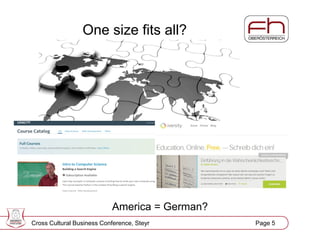
One size fits all?
America = German?
Cross Cultural Business Conference, Steyr Page 5
Page 7
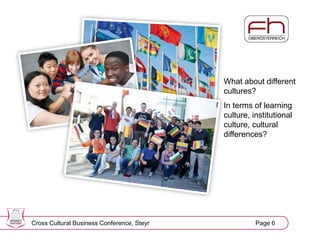
What about different
cultures?
In terms of learning
culture, institutional
culture, cultural
differences?
Cross Cultural Business Conference, Steyr Page 6
Page 8
Introduction of Enhanced MOOC
(Jadin & Gaisch, 2014)
Enhanced means…
considering knowledge creation through collaborative development of
shared artifacts
transforming social practices during learning by incorporating culture-
sensitive material
diversified and customized learning material
culture-sensitive distribution of content
Cross Cultural Business Conference, Steyr Page 7
Page 9
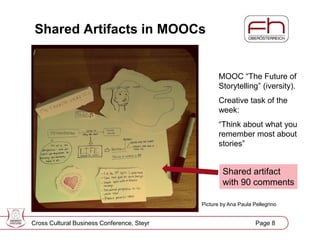
Shared Artifacts in MOOCs
Cross Cultural Business Conference, Steyr Page 8
Picture by Ana Paula Pellegrino
MOOC “The Future of
Storytelling” (iversity).
Creative task of the
week:
“Think about what you
remember most about
stories”
Shared artifact
with 90 comments
Page 10
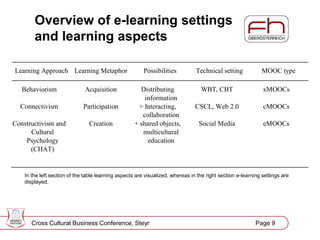
Learning Approach Learning Metaphor Possibilities Technical setting MOOC type
Behaviorism Acquisition Distributing
information
WBT, CBT xMOOCs
Connectivism Participation + Interacting,
collaboration
CSCL, Web 2.0 cMOOCs
Constructivism and
Cultural
Psychology
(CHAT)
Creation + shared objects,
multicultural
education
Social Media eMOOCs
In the left section of the table learning aspects are visualized, whereas in the right section e-learning settings are
displayed.
Overview of e-learning settings
and learning aspects
Cross Cultural Business Conference, Steyr Page 9
Page 11
Design Principles for Trialogical
Learning
(Lakkala et al, 2007)
organizing activities around shared objects,
supporting interaction between personal and social levels,
eliciting individual and collective agency,
fostering long-term processes of knowledge advancement,
reflecting on various forms of knowledge and practices,
cross-fertilising knowledge practices
providing flexible tool mediation
Cross Cultural Business Conference, Steyr Page 10
Page 12
Reflection and Discussion
Further research required to test our assumptions
Role of shared artifacts and mediating tools in learning with
MOOCs
Considering different cultures and their acceptance and usage
of MOOCs
How to design culture-sensitive learning material for MOOCs?
Are the design principles helpful to facilitate knowledge
creation in a trialogical manner?
Cross Cultural Business Conference, Steyr Page 11
Page 13
If we teach today as we taught
yesterday, we rob our children of
tomorrow. (John Dewey)
Prof.(FH) Mag. Dr. Tanja Jadin
University of Applied Sciences Upper Austria
tanja.jadin@fh-hagenberg.at
Cross Cultural Business Conference, Steyr Page 12
Page 14
References
Jadin, T. & Gaisch, M. (2014). Extending the MOOCversity. A Multi-Layered and
Diversified Lens for MOOC In U. Cress & C. Delgado Kloos, (Eds.), Proceedings of the
European MOOC Stakeholder Summit 2014 (pp.73-79).
Lakkala, M., Muukkonen, H., Paavola, S., & Rämö, E. (2007) Pedagogical Design for
Trialogical Approach on Learning. A paper presented at the 12th Biennial Conference for
Research on Learning and Instruction (EARLI), Aug 28 – Sept 1, Budapest, Hungary.
McAuley, A., Stewart, B., Siemens, G. & Courmier, D. (2010). The MOOC Model for
Digital Practice. Retrieved from http://davecormier.com/edblog/wp-
content/uploads/MOOC_Final.pdf
Paavola, S., Lipponen, L. & Hakkarainen, K. (2004). Models of Innovative Knowledge
Communities and Three Metaphors of Learning. Review of Educational Research, 74(4),
pp. 557-576.
Cross Cultural Business Conference, Steyr Page 14

E-Learning Culture on the Move.

  • 1.
    E-Learning Culture onthe Move Enhancing MOOCs through Trialogical Learning and Cultural Sensitive Education Tanja Jadin
  • 2.
    Page 2 MOOC: …“connecting, interacting,and sharing across diverse cultures, attitudes and skill set…“ (McAuley et al, 2010) Cross Cultural Business Conference, Steyr Page 2
  • 3.
    Page 3 Traditional LearningApproaches Behaviorism Drill & Practice, Skinner: programmed instruction Learning through reinforcement Cognitivism Learning depends on individual differences e.g. motivation, previous knowledge Tutorials, Learning means more exploration Considering more tools for collaborating, communication and learning Constructivism Inquiry and problem-based learning Situated learning Learning in groups, collaborative learning Cross Cultural Business Conference, Steyr Page 3
  • 4.
    Page 4 Trialogical Learning (Paavola,Lipponen and Hakkarainen (2004) Based on Cultural-Historical Activity Theory (CHAT) including the work of Engeström (expansive learning), Nonaka and Takeuchis's model of knowledge creation and the theoretical considerations of Scardamelia and Bereiter (knowledge building) Three metaphors of learning: “monological” view; the acquisition metaphor: individual learning, learning facts “dialogical” view; the participation metaphor: interaction with others “trialogicial” view; the knowledge-creation metaphor: interaction through shared objects In the sense of cultural psychology and the approach of trialogical learning, MOOCs can be enhanced through the deliberately use of shared artifacts and knowledge creation. Cross Cultural Business Conference, Steyr Page 4
  • 5.
    Page 5 Short Overview LearningCulture & MOOCs Behaviorism and xMOOCs Short video lectures followed by quizzes and immediate feedback Connectivism and cMOOCs To know where the information can be found Impact of networks Considering more tools for collaborating, communication and learning like Blogs and Microblogs, using Social Media for communication Cross Cultural Business Conference, Steyr Page 4
  • 6.
    Page 6 One sizefits all? America = German? Cross Cultural Business Conference, Steyr Page 5
  • 7.
    Page 7 What aboutdifferent cultures? In terms of learning culture, institutional culture, cultural differences? Cross Cultural Business Conference, Steyr Page 6
  • 8.
    Page 8 Introduction ofEnhanced MOOC (Jadin & Gaisch, 2014) Enhanced means… considering knowledge creation through collaborative development of shared artifacts transforming social practices during learning by incorporating culture- sensitive material diversified and customized learning material culture-sensitive distribution of content Cross Cultural Business Conference, Steyr Page 7
  • 9.
    Page 9 Shared Artifactsin MOOCs Cross Cultural Business Conference, Steyr Page 8 Picture by Ana Paula Pellegrino MOOC “The Future of Storytelling” (iversity). Creative task of the week: “Think about what you remember most about stories” Shared artifact with 90 comments
  • 10.
    Page 10 Learning ApproachLearning Metaphor Possibilities Technical setting MOOC type Behaviorism Acquisition Distributing information WBT, CBT xMOOCs Connectivism Participation + Interacting, collaboration CSCL, Web 2.0 cMOOCs Constructivism and Cultural Psychology (CHAT) Creation + shared objects, multicultural education Social Media eMOOCs In the left section of the table learning aspects are visualized, whereas in the right section e-learning settings are displayed. Overview of e-learning settings and learning aspects Cross Cultural Business Conference, Steyr Page 9
  • 11.
    Page 11 Design Principlesfor Trialogical Learning (Lakkala et al, 2007) organizing activities around shared objects, supporting interaction between personal and social levels, eliciting individual and collective agency, fostering long-term processes of knowledge advancement, reflecting on various forms of knowledge and practices, cross-fertilising knowledge practices providing flexible tool mediation Cross Cultural Business Conference, Steyr Page 10
  • 12.
    Page 12 Reflection andDiscussion Further research required to test our assumptions Role of shared artifacts and mediating tools in learning with MOOCs Considering different cultures and their acceptance and usage of MOOCs How to design culture-sensitive learning material for MOOCs? Are the design principles helpful to facilitate knowledge creation in a trialogical manner? Cross Cultural Business Conference, Steyr Page 11
  • 13.
    Page 13 If weteach today as we taught yesterday, we rob our children of tomorrow. (John Dewey) Prof.(FH) Mag. Dr. Tanja Jadin University of Applied Sciences Upper Austria tanja.jadin@fh-hagenberg.at Cross Cultural Business Conference, Steyr Page 12
  • 14.
    Page 14 References Jadin, T.& Gaisch, M. (2014). Extending the MOOCversity. A Multi-Layered and Diversified Lens for MOOC In U. Cress & C. Delgado Kloos, (Eds.), Proceedings of the European MOOC Stakeholder Summit 2014 (pp.73-79). Lakkala, M., Muukkonen, H., Paavola, S., & Rämö, E. (2007) Pedagogical Design for Trialogical Approach on Learning. A paper presented at the 12th Biennial Conference for Research on Learning and Instruction (EARLI), Aug 28 – Sept 1, Budapest, Hungary. McAuley, A., Stewart, B., Siemens, G. & Courmier, D. (2010). The MOOC Model for Digital Practice. Retrieved from http://davecormier.com/edblog/wp- content/uploads/MOOC_Final.pdf Paavola, S., Lipponen, L. & Hakkarainen, K. (2004). Models of Innovative Knowledge Communities and Three Metaphors of Learning. Review of Educational Research, 74(4), pp. 557-576. Cross Cultural Business Conference, Steyr Page 14