





TECHNOLOGY
AND LANGUAGE
LEARNING
NAME:
KRUSHKAT RAJENDRAN
NITHYAVELLIKANNA
KHADIJA HAMIDANI
Introduction
•There are two main ways to think about
technology for language learning/ teaching :
• As providing teaching resources
•For years technology may have only been
chalk and blackboard. Later audio and video
recording and playback equipment were
added.
• Now, we have www ( world wide web), a
way of accessing information over
internet.
•This means computer are online dictionaries
, grammar and style checkers for us.
WHAT CANYOU
DOWITH
TECHNOLOGY
INTHE
LANGUAGE
CLASSROOM
ROLE OFTECHNOLOGY IN LANGUAGE
Can be used as :
• An instructional tool in the classroom
• a delivery system for learner instruction
• An instructional content itself
WHAT CANYOU
DOWITH
TECHNOLOGY
INTHE
LANGUAGE
CLASSROOM
IN ATECHNOLOGY AIDED CLASSROOM
• The role of teacher
• Is to plan activities that students accomplish via
technological means.
• The teacher monitors their work and guides the
students as they learn the language.
• The role of students
• Is to be actively involved in using the language
• Taking risk with the language by connecting with
others.
• Students help each others.
Providing enhanced
learning experiences
• Technology provides more resources which teachers can
use.
• It also provides learners with greater access to the target
language
• As a result , it has potential to change where and when
learning take place.
• It can even shape how we view nature of what is being
taught.
• Technology makes possible greater individualization,
social interaction and reflection on language.
Providing enhanced
learning experiences
• At the same time as technology enhances
language learning experiences,
• It also contributes to reshaping our understanding of the
nature of language.
• Language is not a fixed system.
• It is always changing and being changed by
those who used.
• Technology should be integrated into the curriculum and
not just added in because it is new.
Why use Multimedia?
multimedia activities encourage students
● to work in groups
● Express their knowledge in multiple ways
● Solve problem
● Revise their own work
● Construct knowledge
Advantage include:
-Real-world skills related to technology
-The value of teamwork
-Effective collaboration techniques
CALL ( COMPUTER- ASSISTED LANGUAGE
LEARNING)
● There is wide variety of CALL software and websites available for language
learners.
● Some of the CALL programs are open source , which means that they are
free and easily accessible, downloadable into computers.
WHAT CAN WE DO WITH” CALL” ?
● Collaboration projects
● Peer editing of composition
● Email
● Reinforcement of classroom material
● games and stimulations
● WebQuests
● Authentic language learning opportunities
Benefit of Using Computers in the Language
Classroom
 Multimodal practice with feedback
 Individualization in a large class
 Pair & small group work on projects
 Fun factor
 Variety in resources available & learning styles
used.
 Real –life-skill-building in computer use.
How effective is the
impact of technology
in language learning ?
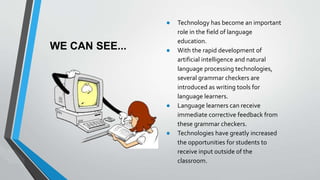
● Technology has become an important
role in the field of language
education.
● With the rapid development of
artificial intelligence and natural
language processing technologies,
several grammar checkers are
introduced as writing tools for
language learners.
● Language learners can receive
immediate corrective feedback from
these grammar checkers.
● Technologies have greatly increased
the opportunities for students to
receive input outside of the
classroom.
WE CAN SEE...
What are the
advantages of
using
technology in
language
learning
1. The best complementary tool for teachers
in the classroom
2. Books are taking a back seat and new
technology means that classes can be
much richer in content and more
participative than before.
3. Technology in language learning is
motivating and stimulating for students
4. It makes the students feel much more
motivated, using devices with which they
can practice a language through features
such as voice recognition and interactive
multimedia exercises etc.
What are the
advantages of
using
technology in
language
learning
5. Ease in managing and monitoring
student progress
6. managing courses, evaluating students with
tests and exams, and they can perform
important tasks such as monitoring the
progress of students
through specialized software.
7. Create a unique experience as much for the
teacher as the students
8. Learning is better with virtual whiteboards,
the students are a lot more involved, and
online exercises and interactive multimedia
content are motivating for them.
What are the disadvantages of using technology in
language learning
1. It can be distracting to students.
2. Students may find themselves trying to access other
components of the online experience instead of the
learning experience.
3. It can disconnect students from face-to-face relationships.
4. Interacting with people online is a very different experience
than interacting with them face-to-face.When people feel
like they can be anonymous, they begin to lose the filter
that they have over their words and conduct.
What are the disadvantages of using technology in
language learning
● It can make it easier to cheat.
● All it takes is a single group email broadcast to
share the answers to a quiz or test, especially if the
teacher is not monitoring student interactions on
the computer.
● It can create a dependence.
● Students using technology every day might feel
offended by the idea of picking up a real book to
read.They might even resist going outside for
recess or to participate in family activities.
EXAMPLES OF
TECHNOLOGY IN
LANGUAGE
EDUCATION
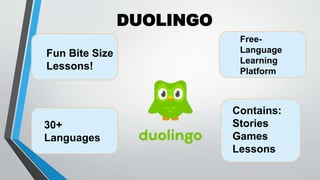
DUOLINGO
Fun Bite Size
Lessons!
30+
Languages
Free-
Language
Learning
Platform
Contains:
Stories
Games
Lessons
FluentU
• FluentU is an online immersion
platform that takes real-world
videos—like music videos,
movie trailers, news and
inspiring talks—and turns them
into personalized language
learning lessons. FluentU takes
a step back from the traditional
textbook approach and
encourages you to learn
languages in a more natural
way.
BrainPOP ELL integrates engaging lessons with language practice to create an
excellent resource for ELLs.
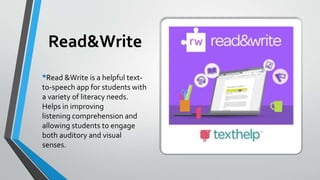
Read&Write
•Read &Write is a helpful text-
to-speech app for students with
a variety of literacy needs.
Helps in improving
listening comprehension and
allowing students to engage
both auditory and visual
senses.
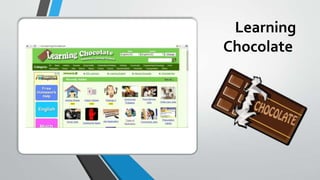
Learning
Chocolate
Discussion Questions
• Q1-What aspects/skills of language learning can be best
learned from use of technology?
• Q2 - How doesTechnology Affect language learning
process at an Early Age
THANKYOU!

Technology and language learning

  • 1.
  • 2.
    Introduction •There are twomain ways to think about technology for language learning/ teaching : • As providing teaching resources •For years technology may have only been chalk and blackboard. Later audio and video recording and playback equipment were added. • Now, we have www ( world wide web), a way of accessing information over internet. •This means computer are online dictionaries , grammar and style checkers for us.
  • 3.
    WHAT CANYOU DOWITH TECHNOLOGY INTHE LANGUAGE CLASSROOM ROLE OFTECHNOLOGYIN LANGUAGE Can be used as : • An instructional tool in the classroom • a delivery system for learner instruction • An instructional content itself
  • 4.
    WHAT CANYOU DOWITH TECHNOLOGY INTHE LANGUAGE CLASSROOM IN ATECHNOLOGYAIDED CLASSROOM • The role of teacher • Is to plan activities that students accomplish via technological means. • The teacher monitors their work and guides the students as they learn the language. • The role of students • Is to be actively involved in using the language • Taking risk with the language by connecting with others. • Students help each others.
  • 5.
    Providing enhanced learning experiences •Technology provides more resources which teachers can use. • It also provides learners with greater access to the target language • As a result , it has potential to change where and when learning take place. • It can even shape how we view nature of what is being taught. • Technology makes possible greater individualization, social interaction and reflection on language.
  • 6.
    Providing enhanced learning experiences •At the same time as technology enhances language learning experiences, • It also contributes to reshaping our understanding of the nature of language. • Language is not a fixed system. • It is always changing and being changed by those who used. • Technology should be integrated into the curriculum and not just added in because it is new.
  • 7.
    Why use Multimedia? multimediaactivities encourage students ● to work in groups ● Express their knowledge in multiple ways ● Solve problem ● Revise their own work ● Construct knowledge Advantage include: -Real-world skills related to technology -The value of teamwork -Effective collaboration techniques
  • 8.
    CALL ( COMPUTER-ASSISTED LANGUAGE LEARNING) ● There is wide variety of CALL software and websites available for language learners. ● Some of the CALL programs are open source , which means that they are free and easily accessible, downloadable into computers. WHAT CAN WE DO WITH” CALL” ? ● Collaboration projects ● Peer editing of composition ● Email ● Reinforcement of classroom material ● games and stimulations ● WebQuests ● Authentic language learning opportunities
  • 9.
    Benefit of UsingComputers in the Language Classroom  Multimodal practice with feedback  Individualization in a large class  Pair & small group work on projects  Fun factor  Variety in resources available & learning styles used.  Real –life-skill-building in computer use.
  • 10.
    How effective isthe impact of technology in language learning ?
  • 11.
    ● Technology hasbecome an important role in the field of language education. ● With the rapid development of artificial intelligence and natural language processing technologies, several grammar checkers are introduced as writing tools for language learners. ● Language learners can receive immediate corrective feedback from these grammar checkers. ● Technologies have greatly increased the opportunities for students to receive input outside of the classroom. WE CAN SEE...
  • 12.
    What are the advantagesof using technology in language learning 1. The best complementary tool for teachers in the classroom 2. Books are taking a back seat and new technology means that classes can be much richer in content and more participative than before. 3. Technology in language learning is motivating and stimulating for students 4. It makes the students feel much more motivated, using devices with which they can practice a language through features such as voice recognition and interactive multimedia exercises etc.
  • 13.
    What are the advantagesof using technology in language learning 5. Ease in managing and monitoring student progress 6. managing courses, evaluating students with tests and exams, and they can perform important tasks such as monitoring the progress of students through specialized software. 7. Create a unique experience as much for the teacher as the students 8. Learning is better with virtual whiteboards, the students are a lot more involved, and online exercises and interactive multimedia content are motivating for them.
  • 14.
    What are thedisadvantages of using technology in language learning 1. It can be distracting to students. 2. Students may find themselves trying to access other components of the online experience instead of the learning experience. 3. It can disconnect students from face-to-face relationships. 4. Interacting with people online is a very different experience than interacting with them face-to-face.When people feel like they can be anonymous, they begin to lose the filter that they have over their words and conduct.
  • 15.
    What are thedisadvantages of using technology in language learning ● It can make it easier to cheat. ● All it takes is a single group email broadcast to share the answers to a quiz or test, especially if the teacher is not monitoring student interactions on the computer. ● It can create a dependence. ● Students using technology every day might feel offended by the idea of picking up a real book to read.They might even resist going outside for recess or to participate in family activities.
  • 16.
  • 17.
  • 18.
    FluentU • FluentU isan online immersion platform that takes real-world videos—like music videos, movie trailers, news and inspiring talks—and turns them into personalized language learning lessons. FluentU takes a step back from the traditional textbook approach and encourages you to learn languages in a more natural way.
  • 19.
    BrainPOP ELL integratesengaging lessons with language practice to create an excellent resource for ELLs.
  • 20.
    Read&Write •Read &Write isa helpful text- to-speech app for students with a variety of literacy needs. Helps in improving listening comprehension and allowing students to engage both auditory and visual senses.
  • 21.
  • 22.
    Discussion Questions • Q1-Whataspects/skills of language learning can be best learned from use of technology? • Q2 - How doesTechnology Affect language learning process at an Early Age
  • 23.