MANAGEMENT AND
ORGANIZATIONAL BEHAVIOUR
MOTIVATION AND LEADERSHIP
Learnito Study Series for Business Students
Notes, Presentations, MCQs and more available at
www.learnito.com/catalog
www.learnito.com M&OB 1
Definition of Motivation
Motivation - the process of arousing and
sustaining goal-directed behavior
www.learnito.com M&OB 2
Maslow’s Hierarchy of Needs
Physiological
Safety & Security
Love (Social)
Esteem
SA
www.learnito.com M&OB 3
Motivational Theories X & Y
Physiological
Safety & Security
Love (Social)
Esteem
SA Theory Y - a set of
assumptions of how to
manage individuals
motivated by higher order
needs
Theory X - a set of
assumptions of how to
manage individuals
motivated by lower order
needs
www.learnito.com M&OB 4
McGregor’s Assumptions
about People based on Theory X
• Naturally indolent
• Lack ambition, dislike responsibility, and
prefer to be led
• Inherently self-centered and indifferent to
organizational needs
• Naturally resistant to change
• Gullible, not bright, ready dupes
www.learnito.com M&OB 5
McGregor’s Assumptions
about People based on Theory Y
• Experiences in organizations result in passive and
resistant behaviors; they are not inherent
• Motivation, development potential, capacity for
assuming responsibility, readiness to direct
behavior toward organizational goals are present
in people
• Management’s task—arrange conditions and
operational methods so people can achieve their
own goals by directing efforts to organizational
goals
www.learnito.com M&OB 6
Alderfer ERG Theory
• Existence – needs satisfied by factors such as
food, air, water, pay, and working conditions
• Relatedness- needs satisfied by meaningful
social and interpersonal relationships
• Growth – needs satisfied by creative
contributions
• In addition to satisfaction-progression
hierarchy, there is frustration-regression.
www.learnito.com M&OB 7
Alderfer’s ERG Theory
Physiological
Safety & Security
Love (Social)
Esteem
SA
Existence
Relatedness
Growth
www.learnito.com M&OB 8
Self-actualization
3 Motivational Need Theories
Maslow Alderfer McClelland
Higher
Order
Needs
Lower
Order
Needs
Esteem
self
interpersonal
Safety & Security
interpersonal
physical
Need for
Achievement
Need for
Power
Relatedness Need for
Affiliation
Existence
Growth
Belongingness
(social & love)
Physiological
www.learnito.com M&OB 9
Herzberg’s Two-Factor Theory
Hygiene Factor - work condition related to
dissatisfaction caused by discomfort or pain
– maintenance factor
– contributes to employee’s feeling not dissatisfied
– contributes to absence of complaints
Motivation Factor - work condition related to
the satisfaction of the need for psychological
growth
– job enrichment
– leads to superior performance & effort
www.learnito.com M&OB 10
Herzberg’s Motivator-Hygiene Model
Motivators
No Satisfaction Satisfaction
Jobs that do not Jobs offering
offer achievement achievement,
recognition, recognition,
stimulating work, stimulating work,
responsibility, responsibility,
and advancement. and advancement.
www.learnito.com M&OB 11
Herzberg’s Motivator-Hygiene
Model (continued)
Hygiene Factors
Dissatisfaction No Dissatisfaction
Jobs with poor Jobs with good
company policies, company policies,
and administration, and administration,
technical supervision technical supervision,
salary, interpersonal salary, interpersonal
relationships with relationships with
supervisors, and supervisors, and
working conditions. working conditions.
www.learnito.com M&OB 12
Expectancy Theory of
Motivation: Key Constructs
• Valence - value or importance placed on a
particular reward
• Expectancy - belief that effort leads to performance
• Instrumentality - belief that performance is related
to rewards
www.learnito.com M&OB 13
McClelland’s Need Theory
Achievement-motivated people prefer
 tasks of moderate ability that they can achieve
 situations in which their performance is due to their own
efforts
 more feedback on their success and failures than do low
achievers
Need For Affiliation: Desire to spend time in social relationships
and activities.
Need For Power: Desire to influence, coach, teach, or encourage
others to achieve.
Need For Achievement: Desire to excel and accomplish something difficult.
www.learnito.com M&OB 14
What is Leadership?
• The ability to influence, motivate, and enable
others to contribute to the effectiveness and
success of the organizations of which they are
members.
» Robert House (2004)
• The ability to influence a group toward the
achievement of a vision or set of goals.
» Robbins & Judge (2008)
www.learnito.com M&OB 15
History of Leadership Thought
• Trait Theories ( -1940s)
• Behavioral Theories (1940s-1960s)
• Contingency/Situational Approaches (1960s- )
• Contemporary
– Transformational Leadership
www.learnito.com M&OB 16
Trait Theories of Leadership
• "GREAT MAN" Theories
• Little agreement on leadership traits
• Traits can be developed/improved
• In isolation, narrow traits have little utility
www.learnito.com M&OB 17
Behavioral Approaches: Ohio State Studies
• LEADERSHIP BEHAVIORS:
– 1. Initiating structure:
• The extent to which a leader is likely to define and structure his or
her role and those of subordinates.
– 2. Consideration:
• The extent to which a leader is likely to build job relationships
characterized by mutual trust, respect for subordinates' ideas, and
regard for their feelings.
• Effective leaders achieve both.
www.learnito.com M&OB 18
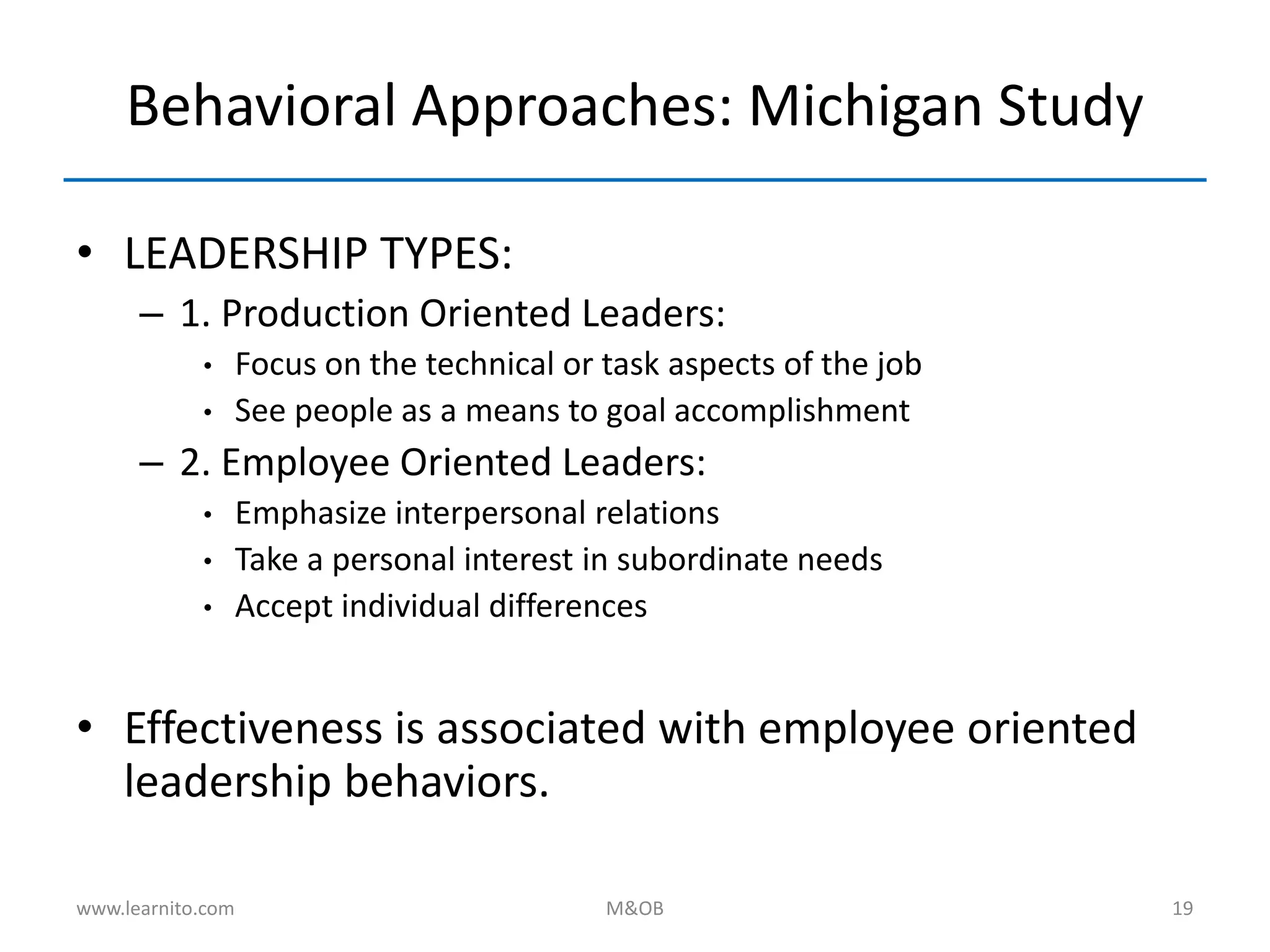
Behavioral Approaches: Michigan Study
• LEADERSHIP TYPES:
– 1. Production Oriented Leaders:
• Focus on the technical or task aspects of the job
• See people as a means to goal accomplishment
– 2. Employee Oriented Leaders:
• Emphasize interpersonal relations
• Take a personal interest in subordinate needs
• Accept individual differences
• Effectiveness is associated with employee oriented
leadership behaviors.
www.learnito.com M&OB 19
Contemporary Theories
• Leaders are individuals who inspire followers
through their words, ideas, and behaviors.
• Charismatic Leadership
• Transformational Leadership
www.learnito.com M&OB 20
• Transformational Leaders: Motivate followers
to go beyond normal expectations by pushing
their comfort zone.
• Transactional Leaders: Guide followers to
accomplish established goals by clarifying
requirements and emphasizing extrinsic
rewards.
Transformational Leadership
www.learnito.com M&OB 21
Transformational Behaviors
• Modeling the way
• Challenging the process
• Enabling/empowering
• Inspiring a shared vision
• Encouraging the heart.
www.learnito.com M&OB 22
Learnito Study Series for Business Students
Notes, Presentations, MCQs and more available at
www.learnito.com/catalog
www.learnito.com M&OB 23

M&OB - Motivation and Leadership

  • 1.
    MANAGEMENT AND ORGANIZATIONAL BEHAVIOUR MOTIVATIONAND LEADERSHIP Learnito Study Series for Business Students Notes, Presentations, MCQs and more available at www.learnito.com/catalog www.learnito.com M&OB 1
  • 2.
    Definition of Motivation Motivation- the process of arousing and sustaining goal-directed behavior www.learnito.com M&OB 2
  • 3.
    Maslow’s Hierarchy ofNeeds Physiological Safety & Security Love (Social) Esteem SA www.learnito.com M&OB 3
  • 4.
    Motivational Theories X& Y Physiological Safety & Security Love (Social) Esteem SA Theory Y - a set of assumptions of how to manage individuals motivated by higher order needs Theory X - a set of assumptions of how to manage individuals motivated by lower order needs www.learnito.com M&OB 4
  • 5.
    McGregor’s Assumptions about Peoplebased on Theory X • Naturally indolent • Lack ambition, dislike responsibility, and prefer to be led • Inherently self-centered and indifferent to organizational needs • Naturally resistant to change • Gullible, not bright, ready dupes www.learnito.com M&OB 5
  • 6.
    McGregor’s Assumptions about Peoplebased on Theory Y • Experiences in organizations result in passive and resistant behaviors; they are not inherent • Motivation, development potential, capacity for assuming responsibility, readiness to direct behavior toward organizational goals are present in people • Management’s task—arrange conditions and operational methods so people can achieve their own goals by directing efforts to organizational goals www.learnito.com M&OB 6
  • 7.
    Alderfer ERG Theory •Existence – needs satisfied by factors such as food, air, water, pay, and working conditions • Relatedness- needs satisfied by meaningful social and interpersonal relationships • Growth – needs satisfied by creative contributions • In addition to satisfaction-progression hierarchy, there is frustration-regression. www.learnito.com M&OB 7
  • 8.
    Alderfer’s ERG Theory Physiological Safety& Security Love (Social) Esteem SA Existence Relatedness Growth www.learnito.com M&OB 8
  • 9.
    Self-actualization 3 Motivational NeedTheories Maslow Alderfer McClelland Higher Order Needs Lower Order Needs Esteem self interpersonal Safety & Security interpersonal physical Need for Achievement Need for Power Relatedness Need for Affiliation Existence Growth Belongingness (social & love) Physiological www.learnito.com M&OB 9
  • 10.
    Herzberg’s Two-Factor Theory HygieneFactor - work condition related to dissatisfaction caused by discomfort or pain – maintenance factor – contributes to employee’s feeling not dissatisfied – contributes to absence of complaints Motivation Factor - work condition related to the satisfaction of the need for psychological growth – job enrichment – leads to superior performance & effort www.learnito.com M&OB 10
  • 11.
    Herzberg’s Motivator-Hygiene Model Motivators NoSatisfaction Satisfaction Jobs that do not Jobs offering offer achievement achievement, recognition, recognition, stimulating work, stimulating work, responsibility, responsibility, and advancement. and advancement. www.learnito.com M&OB 11
  • 12.
    Herzberg’s Motivator-Hygiene Model (continued) HygieneFactors Dissatisfaction No Dissatisfaction Jobs with poor Jobs with good company policies, company policies, and administration, and administration, technical supervision technical supervision, salary, interpersonal salary, interpersonal relationships with relationships with supervisors, and supervisors, and working conditions. working conditions. www.learnito.com M&OB 12
  • 13.
    Expectancy Theory of Motivation:Key Constructs • Valence - value or importance placed on a particular reward • Expectancy - belief that effort leads to performance • Instrumentality - belief that performance is related to rewards www.learnito.com M&OB 13
  • 14.
    McClelland’s Need Theory Achievement-motivatedpeople prefer  tasks of moderate ability that they can achieve  situations in which their performance is due to their own efforts  more feedback on their success and failures than do low achievers Need For Affiliation: Desire to spend time in social relationships and activities. Need For Power: Desire to influence, coach, teach, or encourage others to achieve. Need For Achievement: Desire to excel and accomplish something difficult. www.learnito.com M&OB 14
  • 15.
    What is Leadership? •The ability to influence, motivate, and enable others to contribute to the effectiveness and success of the organizations of which they are members. » Robert House (2004) • The ability to influence a group toward the achievement of a vision or set of goals. » Robbins & Judge (2008) www.learnito.com M&OB 15
  • 16.
    History of LeadershipThought • Trait Theories ( -1940s) • Behavioral Theories (1940s-1960s) • Contingency/Situational Approaches (1960s- ) • Contemporary – Transformational Leadership www.learnito.com M&OB 16
  • 17.
    Trait Theories ofLeadership • "GREAT MAN" Theories • Little agreement on leadership traits • Traits can be developed/improved • In isolation, narrow traits have little utility www.learnito.com M&OB 17
  • 18.
    Behavioral Approaches: OhioState Studies • LEADERSHIP BEHAVIORS: – 1. Initiating structure: • The extent to which a leader is likely to define and structure his or her role and those of subordinates. – 2. Consideration: • The extent to which a leader is likely to build job relationships characterized by mutual trust, respect for subordinates' ideas, and regard for their feelings. • Effective leaders achieve both. www.learnito.com M&OB 18
  • 19.
    Behavioral Approaches: MichiganStudy • LEADERSHIP TYPES: – 1. Production Oriented Leaders: • Focus on the technical or task aspects of the job • See people as a means to goal accomplishment – 2. Employee Oriented Leaders: • Emphasize interpersonal relations • Take a personal interest in subordinate needs • Accept individual differences • Effectiveness is associated with employee oriented leadership behaviors. www.learnito.com M&OB 19
  • 20.
    Contemporary Theories • Leadersare individuals who inspire followers through their words, ideas, and behaviors. • Charismatic Leadership • Transformational Leadership www.learnito.com M&OB 20
  • 21.
    • Transformational Leaders:Motivate followers to go beyond normal expectations by pushing their comfort zone. • Transactional Leaders: Guide followers to accomplish established goals by clarifying requirements and emphasizing extrinsic rewards. Transformational Leadership www.learnito.com M&OB 21
  • 22.
    Transformational Behaviors • Modelingthe way • Challenging the process • Enabling/empowering • Inspiring a shared vision • Encouraging the heart. www.learnito.com M&OB 22
  • 23.
    Learnito Study Seriesfor Business Students Notes, Presentations, MCQs and more available at www.learnito.com/catalog www.learnito.com M&OB 23