NEW PRODUCT
DEVELOPMENT
Course: MBA
Subject: MM II
Unit: 2
Contents:
• What is new product development??
• Challenges in NPD
• Overcoming these challenges
• NPD Strategies
• New product failures
• Stages in NPD
• Conclusion
What is New Product
Development??
 New product development (NPD) is the term
used to describe the complete process of bringing
a new product to market.
 A product is a set of benefits offered for
exchange and can be tangible (that is,
something physical you can touch) or
intangible (like a service, experience, or
belief).
Challenges in New Product
Development
New Product development challenges fall into three
major categories:-
• Definition of product specifications
• Time and resources issues
• Interactions of the Product Development group
with the rest of the company
How to overcome these
Challenges??
• Assess the projects financial value before the
development starts.
• Prioritize projects according to clear criteria.
• Let Marketing professionals define the target market
and specify the product upfront.
• Involve all the functions of the companies at the
product selection stage.
• Align project targets and resources.
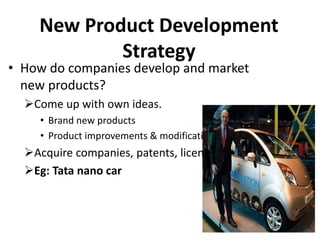
New Product Development
Strategy
• How do companies develop and market
new products?
Come up with own ideas.
• Brand new products
• Product improvements & modifications
Acquire companies, patents, licenses.
Eg: Tata nano car
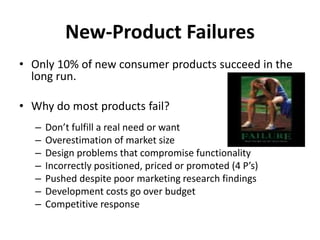
New-Product Failures
• Only 10% of new consumer products succeed in the
long run.
• Why do most products fail?
– Don’t fulfill a real need or want
– Overestimation of market size
– Design problems that compromise functionality
– Incorrectly positioned, priced or promoted (4 P’s)
– Pushed despite poor marketing research findings
– Development costs go over budget
– Competitive response
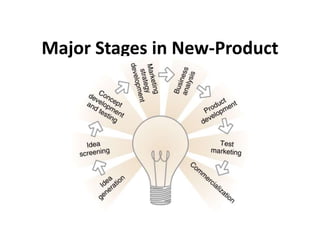
Major Stages in New-Product
Development Process
Idea Generation
Where do ideas come from?
• Internal sources:-
– Company employees at all levels:
“Intrapraneuring”
• External sources :-
Customers
Competitors
Distributors
Suppliers
Outsourcing partners
Idea Screening
• Keep the good ideas and drop the poor ones.
• Criteria :-
 Market Size
 Product Price
 Development Time & Costs
 Manufacturing Costs
 Rate of Return
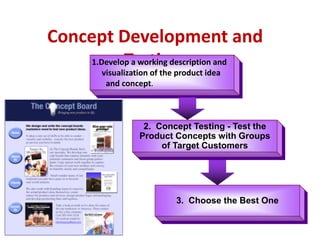
Concept Development and
Testing:1.Develop a working description and
visualization of the product idea
and concept.
2. Concept Testing - Test the
Product Concepts with Groups
of Target Customers
3. Choose the Best One
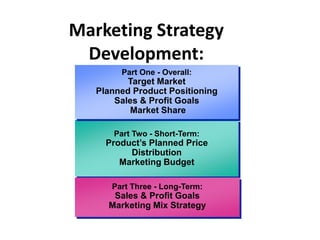
Marketing Strategy
Development:
Part Two - Short-Term:
Product’s Planned Price
Distribution
Marketing Budget
Part Three - Long-Term:
Sales & Profit Goals
Marketing Mix Strategy
Part One - Overall:
Target Market
Planned Product Positioning
Sales & Profit Goals
Market Share
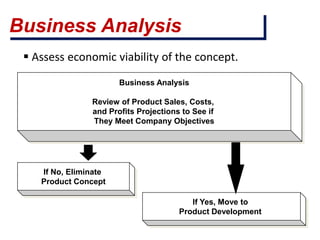
Business Analysis
Business Analysis
Review of Product Sales, Costs,
and Profits Projections to See if
They Meet Company Objectives
If Yes, Move to
Product Development
If No, Eliminate
Product Concept
 Assess economic viability of the concept.
Product Development
• Develop concept into physical product
prototype.
• Large jump in investment – “point of no
return”.
• Test and refine prototype until product passes
consumer and legal scrutiny.
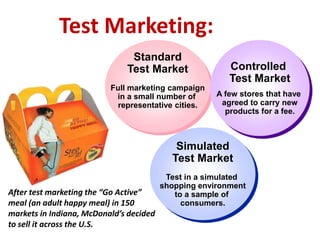
Test Marketing:
Standard
Test Market
Full marketing campaign
in a small number of
representative cities.
Simulated
Test Market
Test in a simulated
shopping environment
to a sample of
consumers.
Controlled
Test Market
A few stores that have
agreed to carry new
products for a fee.
After test marketing the “Go Active”
meal (an adult happy meal) in 150
markets in Indiana, McDonald’s decided
to sell it across the U.S.
Commercialization:
• Broad launch of product if market test results
are positive.
• Timing of launch is important.
• Potential Rollout plans
– Local
– Regional
– National
– International
– “Wider Test Market”
Conclusion
 Implementation of a NPD process with stages has
helped businesses focus their New Product
investment on the most potentially rewarding
projects.
 It has shortened the time between idea and
revenue by orchestrating the complex set of
activities required for the commercial success of new
products.
http://www.slideshare.net/onlyram/new-product-devlopment-
ppt
http://www.slideshare.net/zead28/new-product-development-
12525884?related=1
Sources:

Mm unit 2point2

  • 1.
  • 2.
    Contents: • What isnew product development?? • Challenges in NPD • Overcoming these challenges • NPD Strategies • New product failures • Stages in NPD • Conclusion
  • 3.
    What is NewProduct Development??  New product development (NPD) is the term used to describe the complete process of bringing a new product to market.  A product is a set of benefits offered for exchange and can be tangible (that is, something physical you can touch) or intangible (like a service, experience, or belief).
  • 4.
    Challenges in NewProduct Development New Product development challenges fall into three major categories:- • Definition of product specifications • Time and resources issues • Interactions of the Product Development group with the rest of the company
  • 5.
    How to overcomethese Challenges?? • Assess the projects financial value before the development starts. • Prioritize projects according to clear criteria. • Let Marketing professionals define the target market and specify the product upfront. • Involve all the functions of the companies at the product selection stage. • Align project targets and resources.
  • 6.
    New Product Development Strategy •How do companies develop and market new products? Come up with own ideas. • Brand new products • Product improvements & modifications Acquire companies, patents, licenses. Eg: Tata nano car
  • 7.
    New-Product Failures • Only10% of new consumer products succeed in the long run. • Why do most products fail? – Don’t fulfill a real need or want – Overestimation of market size – Design problems that compromise functionality – Incorrectly positioned, priced or promoted (4 P’s) – Pushed despite poor marketing research findings – Development costs go over budget – Competitive response
  • 8.
    Major Stages inNew-Product Development Process
  • 9.
    Idea Generation Where doideas come from? • Internal sources:- – Company employees at all levels: “Intrapraneuring” • External sources :- Customers Competitors Distributors Suppliers Outsourcing partners
  • 10.
    Idea Screening • Keepthe good ideas and drop the poor ones. • Criteria :-  Market Size  Product Price  Development Time & Costs  Manufacturing Costs  Rate of Return
  • 11.
    Concept Development and Testing:1.Developa working description and visualization of the product idea and concept. 2. Concept Testing - Test the Product Concepts with Groups of Target Customers 3. Choose the Best One
  • 12.
    Marketing Strategy Development: Part Two- Short-Term: Product’s Planned Price Distribution Marketing Budget Part Three - Long-Term: Sales & Profit Goals Marketing Mix Strategy Part One - Overall: Target Market Planned Product Positioning Sales & Profit Goals Market Share
  • 13.
    Business Analysis Business Analysis Reviewof Product Sales, Costs, and Profits Projections to See if They Meet Company Objectives If Yes, Move to Product Development If No, Eliminate Product Concept  Assess economic viability of the concept.
  • 14.
    Product Development • Developconcept into physical product prototype. • Large jump in investment – “point of no return”. • Test and refine prototype until product passes consumer and legal scrutiny.
  • 15.
    Test Marketing: Standard Test Market Fullmarketing campaign in a small number of representative cities. Simulated Test Market Test in a simulated shopping environment to a sample of consumers. Controlled Test Market A few stores that have agreed to carry new products for a fee. After test marketing the “Go Active” meal (an adult happy meal) in 150 markets in Indiana, McDonald’s decided to sell it across the U.S.
  • 16.
    Commercialization: • Broad launchof product if market test results are positive. • Timing of launch is important. • Potential Rollout plans – Local – Regional – National – International – “Wider Test Market”
  • 17.
    Conclusion  Implementation ofa NPD process with stages has helped businesses focus their New Product investment on the most potentially rewarding projects.  It has shortened the time between idea and revenue by orchestrating the complex set of activities required for the commercial success of new products.
  • 18.

Editor's Notes

  • #16 Test Marketing This CTR relates to the discussion on pp. 282-284.