New Product Development.NPD
Overview
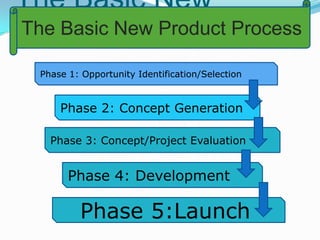
The Basic New Product ProcessThe Basic New Product ProcessPhase 1: Opportunity Identification/SelectionPhase 1: Opportunity Identification/SelectionPhase 2: Concept GenerationPhase 2: Concept GenerationPhase 3: Concept/Project EvaluationPhase 3: Concept/Project EvaluationPhase 4: DevelopmentPhase 4: Development   Phase 5:LaunchPhase 5: Launch
NPI Process Stages…The simultaneous engineering and concurrence of activities in the development of a new product:In the development of a product, several activities happen simultaneously in numerous functions, departments and locations across the organization.These activities usually have some kind of a relationship or dependency with another activity happening elsewhere. This means that the outcome of activity in one function could have a bearing on one or more activities happening concurrently at another location or function or on an activity at a different point of time.The simultaneous engineering and concurrence of activities in the development of a new product:
Making sure every new product contributes towards the overall business goals of the company:Making sure every new product contributes towards the overall business goals of the company:
Handling multiple projects at any given point in time:
The Stage Or (Phase-Gate Process):
Stage-Gate SystemStage-Gate SystemDetailedInvestigation(BusinessCase)PreparationFullProduction& MarketLaunchPreliminaryAssessmentTesting &ValidationDevelopmentGateGateGateGateGateStageStageStageStageStageInitialScreenSecondScreenDecisiononBusinessCasePost-Develop-mentReviewPre-Comm-cializationBusinessAnalysis
Product Life CyclesDeclineMaturity
Product Life CyclesProduct Life CyclesPRODUCT  DEVELOPMENT:Product Development: StagesNew ideas/possible inventionsMarket analysis – is it wanted? Can it be produced at a profit? Who is it likely to be aimed at?Product Development and refinementTest Marketing – possibly local/regionalAnalysis of test marketing results and amendment of product/production processPreparations for launch – publicity, marketing campaign
Product Life CyclesProduct Life CyclesINTRODUCTION/LAUNCH:Introduction/Launch:Advertising and promotion campaignsTarget campaign at specific audience?Monitor initial salesMaximise publicityHigh cost/low salesLength of time – type of product
Product Life CyclesProduct Life CyclesGrowth:Increased consumer awarenessSales riseRevenues increaseCosts - fixed costs/variable costs, profits may be madeMonitor market – competitors reaction?GROWTH:
Product Life CyclesProduct Life CyclesMATURITY:Maturity:Sales reach peakCost of supporting the product declinesRatio of revenue to cost highSales growth likely to be lowMarket share may be highCompetition likely to be greaterPrice elasticity of demand?Monitor market – changes/amendments/new strategies?
Product Life CyclesProduct Life CyclesSaturation:New entrants likely to mean market is ‘flooded’Necessity to develop new strategies becomes more pressing:Searching out new markets:Linking to changing fashionsSeeking new or exploiting market segmentsLinking to joint ventures – media/music, etc.Developing new usesFocus on adapting the productRe-packaging or formatImproving the standard or qualityDeveloping the product rangeSATURATION:
Product Life CyclesProduct Life CyclesDECLINE  AND WITHDRAWL:Decline and Withdrawal:Product outlives/outgrows its usefulness/valueFashions changeTechnology changesSales declineCost of supporting starts to rise too farDecision to withdraw may be dependent on availability of new products and whether fashions/trends will come around again?
Product Life Cycles:Product Life CyclesDevelopmentGrowthMaturityDeclineIntroductionSaturationSalesTime
What Is a New Product?What Is a New Product?New-to-the-World ProductsPolaroid camera, in-line skates, Kevlar, word-processing softwareNew Category EntriesHewlett-Packard PCs, Hallmark gift items, Discover CardAdditions to Product Linesline extensionsProduct Improvementsfrozen yogurt, Miller Lite, Windows 98, plain-paper faxRe-positioningsArm & Hammer baking soda
Types of NPD Projects:Types of NPD Projects:20%New productlines (e.g. AT&T Universal Card)10%HighNew-to-the-world(e.g. laser printer)26%26%Additions to existingproduct line (e.g. Bud light)Newness to the companyRevisions/improvement toexisting products (e.g. MS Excel ‘00)11%7%Cost reductions (e.g. Low-end PC)Repositionings (e.g. A&H Deodorizer) LowNewness to the marketLowHighSource: New Products Management for the 1980’s (New York: Booz, Allen &Hamilton, 1982
What Is a Successful New Product?Although you may hear much higher percentages, careful studies supported by research evidence suggest that about40% of new products fail -- somewhat higher for consumerproducts, somewhat lower for business-to-business products.
Classic Brand Names>>BudweiserIvoryCoca-ColaMaxwell HouseKodakGeneral ElectricSteinwayWrigleyKleenexWaterfordL.L. BeanFordJohn DeereMaytagJCPenneySearsColgateHersheyGilletteTiconderoga
QualityValueTimeCostThe Conflicting Masters of New Products Management:Three inputs to the new products process: the right quality product, at the right time, and at the right cost.These conflict with each other but may have synergies too.Issue: how to optimize these relationships in a new product situation.
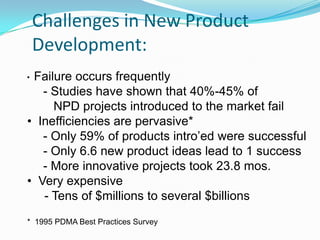
Challenges in New Product Development:Failure occurs frequently- Studies have shown that 40%-45% of     NPD projects introduced to the market fail  Inefficiencies are pervasive*- Only 59% of products intro’ed were successful- Only 6.6 new product ideas lead to 1 success	- More innovative projects took 23.8 mos.  Very expensive        - Tens of $millions to several $billions*  1995 PDMA Best Practices Survey
Market Uncertainty:Market Uncertainty:Consumer fear, uncertainty, and doubt (FUD)
  Customer needs change rapidly and    unpredictably  Customer anxiety over the lack of standards   and dominant design  Uncertainty over the pace of adoption
  Uncertainty over/inability to forecast market sizeTechnology  Uncertainty:Technology  Uncertainty:  Uncertainty over whether the new innovation    will function as promised  Uncertainty over timetable for NPD
  Ambiguity over whether the supplier will be able    to fix customer problems with the technology  Concerns over unanticipated/unintended    consequences  Concerns over obsolescenceCompetitive Uncertainty:Competitive UncertaintyUncertainty over who will be future competitors
  Uncertainty over competitor’s strategies
  Uncertainty over product form competition    (competition between product classes vs.     between different brands of the same product)
NPD MythsFirst to market wins!Company reputation, a strong brand name and a good selling effort will make almost any new product a success.Having a low price is critical to winning.

New Product Development

  • 1.
  • 2.
  • 3.
    The Basic NewProduct ProcessThe Basic New Product ProcessPhase 1: Opportunity Identification/SelectionPhase 1: Opportunity Identification/SelectionPhase 2: Concept GenerationPhase 2: Concept GenerationPhase 3: Concept/Project EvaluationPhase 3: Concept/Project EvaluationPhase 4: DevelopmentPhase 4: Development Phase 5:LaunchPhase 5: Launch
  • 5.
    NPI Process Stages…Thesimultaneous engineering and concurrence of activities in the development of a new product:In the development of a product, several activities happen simultaneously in numerous functions, departments and locations across the organization.These activities usually have some kind of a relationship or dependency with another activity happening elsewhere. This means that the outcome of activity in one function could have a bearing on one or more activities happening concurrently at another location or function or on an activity at a different point of time.The simultaneous engineering and concurrence of activities in the development of a new product:
  • 7.
    Making sure everynew product contributes towards the overall business goals of the company:Making sure every new product contributes towards the overall business goals of the company:
  • 8.
    Handling multiple projectsat any given point in time:
  • 9.
    The Stage Or(Phase-Gate Process):
  • 10.
    Stage-Gate SystemStage-Gate SystemDetailedInvestigation(BusinessCase)PreparationFullProduction&MarketLaunchPreliminaryAssessmentTesting &ValidationDevelopmentGateGateGateGateGateStageStageStageStageStageInitialScreenSecondScreenDecisiononBusinessCasePost-Develop-mentReviewPre-Comm-cializationBusinessAnalysis
  • 11.
  • 12.
    Product Life CyclesProductLife CyclesPRODUCT DEVELOPMENT:Product Development: StagesNew ideas/possible inventionsMarket analysis – is it wanted? Can it be produced at a profit? Who is it likely to be aimed at?Product Development and refinementTest Marketing – possibly local/regionalAnalysis of test marketing results and amendment of product/production processPreparations for launch – publicity, marketing campaign
  • 13.
    Product Life CyclesProductLife CyclesINTRODUCTION/LAUNCH:Introduction/Launch:Advertising and promotion campaignsTarget campaign at specific audience?Monitor initial salesMaximise publicityHigh cost/low salesLength of time – type of product
  • 14.
    Product Life CyclesProductLife CyclesGrowth:Increased consumer awarenessSales riseRevenues increaseCosts - fixed costs/variable costs, profits may be madeMonitor market – competitors reaction?GROWTH:
  • 15.
    Product Life CyclesProductLife CyclesMATURITY:Maturity:Sales reach peakCost of supporting the product declinesRatio of revenue to cost highSales growth likely to be lowMarket share may be highCompetition likely to be greaterPrice elasticity of demand?Monitor market – changes/amendments/new strategies?
  • 16.
    Product Life CyclesProductLife CyclesSaturation:New entrants likely to mean market is ‘flooded’Necessity to develop new strategies becomes more pressing:Searching out new markets:Linking to changing fashionsSeeking new or exploiting market segmentsLinking to joint ventures – media/music, etc.Developing new usesFocus on adapting the productRe-packaging or formatImproving the standard or qualityDeveloping the product rangeSATURATION:
  • 17.
    Product Life CyclesProductLife CyclesDECLINE AND WITHDRAWL:Decline and Withdrawal:Product outlives/outgrows its usefulness/valueFashions changeTechnology changesSales declineCost of supporting starts to rise too farDecision to withdraw may be dependent on availability of new products and whether fashions/trends will come around again?
  • 18.
    Product Life Cycles:ProductLife CyclesDevelopmentGrowthMaturityDeclineIntroductionSaturationSalesTime
  • 19.
    What Is aNew Product?What Is a New Product?New-to-the-World ProductsPolaroid camera, in-line skates, Kevlar, word-processing softwareNew Category EntriesHewlett-Packard PCs, Hallmark gift items, Discover CardAdditions to Product Linesline extensionsProduct Improvementsfrozen yogurt, Miller Lite, Windows 98, plain-paper faxRe-positioningsArm & Hammer baking soda
  • 20.
    Types of NPDProjects:Types of NPD Projects:20%New productlines (e.g. AT&T Universal Card)10%HighNew-to-the-world(e.g. laser printer)26%26%Additions to existingproduct line (e.g. Bud light)Newness to the companyRevisions/improvement toexisting products (e.g. MS Excel ‘00)11%7%Cost reductions (e.g. Low-end PC)Repositionings (e.g. A&H Deodorizer) LowNewness to the marketLowHighSource: New Products Management for the 1980’s (New York: Booz, Allen &Hamilton, 1982
  • 21.
    What Is aSuccessful New Product?Although you may hear much higher percentages, careful studies supported by research evidence suggest that about40% of new products fail -- somewhat higher for consumerproducts, somewhat lower for business-to-business products.
  • 22.
    Classic Brand Names>>BudweiserIvoryCoca-ColaMaxwellHouseKodakGeneral ElectricSteinwayWrigleyKleenexWaterfordL.L. BeanFordJohn DeereMaytagJCPenneySearsColgateHersheyGilletteTiconderoga
  • 23.
    QualityValueTimeCostThe Conflicting Mastersof New Products Management:Three inputs to the new products process: the right quality product, at the right time, and at the right cost.These conflict with each other but may have synergies too.Issue: how to optimize these relationships in a new product situation.
  • 24.
    Challenges in NewProduct Development:Failure occurs frequently- Studies have shown that 40%-45% of NPD projects introduced to the market fail Inefficiencies are pervasive*- Only 59% of products intro’ed were successful- Only 6.6 new product ideas lead to 1 success - More innovative projects took 23.8 mos. Very expensive - Tens of $millions to several $billions* 1995 PDMA Best Practices Survey
  • 25.
    Market Uncertainty:Market Uncertainty:Consumerfear, uncertainty, and doubt (FUD)
  • 26.
    Customerneeds change rapidly and unpredictably Customer anxiety over the lack of standards and dominant design Uncertainty over the pace of adoption
  • 27.
    Uncertaintyover/inability to forecast market sizeTechnology Uncertainty:Technology Uncertainty: Uncertainty over whether the new innovation will function as promised Uncertainty over timetable for NPD
  • 28.
    Ambiguityover whether the supplier will be able to fix customer problems with the technology Concerns over unanticipated/unintended consequences Concerns over obsolescenceCompetitive Uncertainty:Competitive UncertaintyUncertainty over who will be future competitors
  • 29.
    Uncertaintyover competitor’s strategies
  • 30.
    Uncertaintyover product form competition (competition between product classes vs. between different brands of the same product)
  • 31.
    NPD MythsFirst tomarket wins!Company reputation, a strong brand name and a good selling effort will make almost any new product a success.Having a low price is critical to winning.