STRATEGY AS
DISCIPLINE
Michael C. Suldan
Faculty, College of Business Education and
Management
PRINCIPLE
No discipline may be neglected: threshold
levels on the two disciplines that are not
selected must be maintained.
Value Discipline
• 1. Operational Excellence
• 2. Product Leadership
• 3. Customer Intimacy
Operational Excellence
• Key characteristics of the strategy are superb operations
and execution, often by providing a reasonable quality at
a very low price, and task-oriented vision toward
personnel. The focus is on efficiency, streamlined
operations, supply chain management, no frills, and high
volume. Most large international corporations strive to
operate according to this discipline but circumstances
• impact their degree of success. Measuring systems are
important, as is extremely limited variation in product
assortment.
Product Leadership
• Firms executing this strategy well are very strong in
innovation and brand marketing. Organization leaders
demonstrate a recognition that the company’s current
success and future prospects lie in its talented product
design people and those who support them. The company
operates in dynamic markets. The focus is on
development, innovation, design, time to market, and high
margins in a short time frame. Company cultures are
flexible to encourage innovation. Structure also
encourages innovation through small ad hoc working
groups, an experimentation-is-good mindset, and
compensation systems that reward success.
CUSTOMER INTIMACY
• Companies pursuing this strategy excel in customer attention
and customer service. They tailor their products and services to
individual or almost individual customers. There is large variation
in product assortment. The focus is on: customer relationship
management (CRM), delivery of products and services on time
and above customer expectations, lifetime value concepts,
reliability, and being close to the customer. Decision authority is
given to employees who are close to the customer. The
operating principles of this value discipline include having a full
range of services available to serve customers upon demand—
this may involve running what the authors call a “hollow
company,” where a variety of goods or services are available
quickly through contract arrangements, rather than the supplier
business having everything in stock all the time.
ONLY ONE DISCIPLINE PRINCIPLE
In the end, business owners use only one of the three
major discipline.
The owners choose whether the market is broad or narrow.
GENERATING ADVANTAGE
• A company’s competitive strategy deals exclusively with the
specifics of management’s game plan for competing
successfully—its specific efforts to please customers, its
offensive and defensive moves to counter the maneuvers of
rivals, its responses to whatever market conditions prevail
at the moment, and its approach to securing a competitive
advantage relative to rivals. There are countless variations
in the competitive strategies that companies employ, mainly
because each company’s strategic approach entails
custom-designed actions to fit its own circumstances and
industry environment. The custom-tailored nature of each
company’s strategy is also the result of management’s
efforts to uniquely position the company in its market.
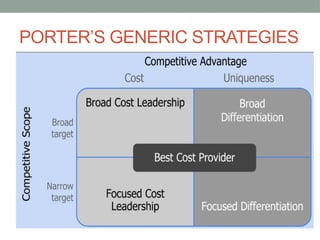
Five Competitive Strategy Options
• 1.A low-cost provider strategy — striving to achieve lower
overall costs than rivals and appealing to a broad
spectrum of customers, usually by under-pricing rivals.
• 2. A broad differentiation strategy — seeking to
differentiate the company’s product or service from rivals’
in ways that will appeal to a broad spectrum of buyers.
• 3. A focused low-cost strategy — concentrating on a
narrow buyer segment (or market niche) and
outcompeting rivals by having lower costs than rivals and
thus being able to serve niche
• members at a lower price.
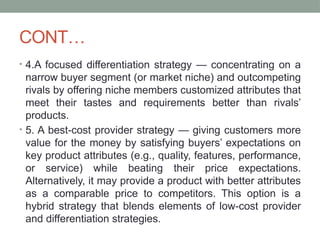
CONT…
• 4.A focused differentiation strategy — concentrating on a
narrow buyer segment (or market niche) and outcompeting
rivals by offering niche members customized attributes that
meet their tastes and requirements better than rivals’
products.
• 5. A best-cost provider strategy — giving customers more
value for the money by satisfying buyers’ expectations on
key product attributes (e.g., quality, features, performance,
or service) while beating their price expectations.
Alternatively, it may provide a product with better attributes
as a comparable price to competitors. This option is a
hybrid strategy that blends elements of low-cost provider
and differentiation strategies.
PORTER’S GENERIC STRATEGIES
REFERENCES
www.uplblib/r002opu.com
www.spup/stratmgt.com.ph

STRATEGY-AS-DISCIPLINE-strategic management

  • 1.
    STRATEGY AS DISCIPLINE Michael C.Suldan Faculty, College of Business Education and Management
  • 2.
    PRINCIPLE No discipline maybe neglected: threshold levels on the two disciplines that are not selected must be maintained.
  • 3.
    Value Discipline • 1.Operational Excellence • 2. Product Leadership • 3. Customer Intimacy
  • 4.
    Operational Excellence • Keycharacteristics of the strategy are superb operations and execution, often by providing a reasonable quality at a very low price, and task-oriented vision toward personnel. The focus is on efficiency, streamlined operations, supply chain management, no frills, and high volume. Most large international corporations strive to operate according to this discipline but circumstances • impact their degree of success. Measuring systems are important, as is extremely limited variation in product assortment.
  • 5.
    Product Leadership • Firmsexecuting this strategy well are very strong in innovation and brand marketing. Organization leaders demonstrate a recognition that the company’s current success and future prospects lie in its talented product design people and those who support them. The company operates in dynamic markets. The focus is on development, innovation, design, time to market, and high margins in a short time frame. Company cultures are flexible to encourage innovation. Structure also encourages innovation through small ad hoc working groups, an experimentation-is-good mindset, and compensation systems that reward success.
  • 6.
    CUSTOMER INTIMACY • Companiespursuing this strategy excel in customer attention and customer service. They tailor their products and services to individual or almost individual customers. There is large variation in product assortment. The focus is on: customer relationship management (CRM), delivery of products and services on time and above customer expectations, lifetime value concepts, reliability, and being close to the customer. Decision authority is given to employees who are close to the customer. The operating principles of this value discipline include having a full range of services available to serve customers upon demand— this may involve running what the authors call a “hollow company,” where a variety of goods or services are available quickly through contract arrangements, rather than the supplier business having everything in stock all the time.
  • 7.
    ONLY ONE DISCIPLINEPRINCIPLE In the end, business owners use only one of the three major discipline. The owners choose whether the market is broad or narrow.
  • 8.
    GENERATING ADVANTAGE • Acompany’s competitive strategy deals exclusively with the specifics of management’s game plan for competing successfully—its specific efforts to please customers, its offensive and defensive moves to counter the maneuvers of rivals, its responses to whatever market conditions prevail at the moment, and its approach to securing a competitive advantage relative to rivals. There are countless variations in the competitive strategies that companies employ, mainly because each company’s strategic approach entails custom-designed actions to fit its own circumstances and industry environment. The custom-tailored nature of each company’s strategy is also the result of management’s efforts to uniquely position the company in its market.
  • 9.
    Five Competitive StrategyOptions • 1.A low-cost provider strategy — striving to achieve lower overall costs than rivals and appealing to a broad spectrum of customers, usually by under-pricing rivals. • 2. A broad differentiation strategy — seeking to differentiate the company’s product or service from rivals’ in ways that will appeal to a broad spectrum of buyers. • 3. A focused low-cost strategy — concentrating on a narrow buyer segment (or market niche) and outcompeting rivals by having lower costs than rivals and thus being able to serve niche • members at a lower price.
  • 10.
    CONT… • 4.A focuseddifferentiation strategy — concentrating on a narrow buyer segment (or market niche) and outcompeting rivals by offering niche members customized attributes that meet their tastes and requirements better than rivals’ products. • 5. A best-cost provider strategy — giving customers more value for the money by satisfying buyers’ expectations on key product attributes (e.g., quality, features, performance, or service) while beating their price expectations. Alternatively, it may provide a product with better attributes as a comparable price to competitors. This option is a hybrid strategy that blends elements of low-cost provider and differentiation strategies.
  • 11.
  • 12.