1
For Business Use Only, Stephen McGrath PhD. 21st November 2013
Stephen McGrath, Ph.D.
Site Microbiologist
Teva Pharmaceuticals Ireland
Sterile, Respiratory
and Specialty
Quality Operations
November 21st
2013
2
For Business Use Only, Stephen McGrath PhD. 21st November 2013
3
For Business Use Only, Stephen McGrath PhD. 21st November 2013
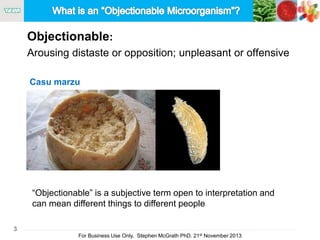
Objectionable:
Arousing distaste or opposition; unpleasant or offensive
Casu marzu
“Objectionable” is a subjective term open to interpretation and
can mean different things to different people
4
For Business Use Only, Stephen McGrath PhD. 21st November 2013
However you define what an
objectionable microorganism is, the
quality and safety of the pharmaceutical
product provided to customers remains
the responsibility of the manufacturer.
For non-sterile pharmaceutical products it
is up to the manufacturer to demonstrate
that microorganisms present in products
are safe to release to market.
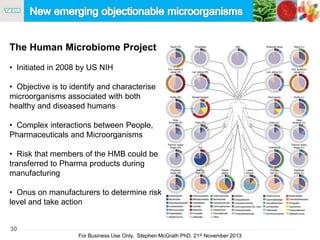
Any and all microorganisms present in
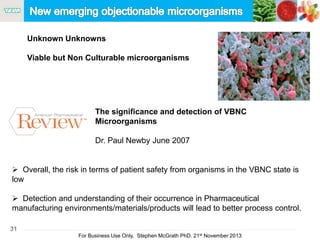
non-sterile dosage forms may be
considered objectionable unless
demonstrated otherwise.
5
For Business Use Only, Stephen McGrath PhD. 21st November 2013
The concept of Objectionable Microorganisms in Non-sterile
Pharmaceutical products is not a recent development.
1982: The USP Microbiology Committee stated
that the demonstration of “absence of
objectionable microorganisms” was not
the intent of the tests described in the
Microbial Limit Tests <61>.
1993: FDA guide to inspections of
Microbiological Pharmaceutical QC
Labs: The USP Microbial Limits
Chapter <61> provides methodology for
selected indicator organisms, but not all
objectionable organisms.
6
For Business Use Only, Stephen McGrath PhD. 21st November 2013
What is an “Objectionable Organism”
Scott Sutton October 2012
A pure interpretation in regards to patient health would lead to
the following requirements:
 Objectionable in view of the product’s intended use or to its shelf-
life stability, and;
 For products not required to be sterile
7
For Business Use Only, Stephen McGrath PhD. 21st November 2013
A microorganism can be considered objectionable if
it represents a potential health hazard to the user
who is using the product as directed, or if it is
capable of growing in the product. Objectionable
microorganisms are defined as contaminants, that
depending on the microbial species, number of
organisms, dosage form, intended use and patient
population, would adversely affect product safety.
Additionally, microorganisms may be deemed
objectionable if they adversely affect product
stability or if they damage the integrity of the
container closure system.
USP <2022> Microbiological Procedures for
absence of specified Microorganisms-Nutritional
and dietary supplements.
8
For Business Use Only, Stephen McGrath PhD. 21st November 2013
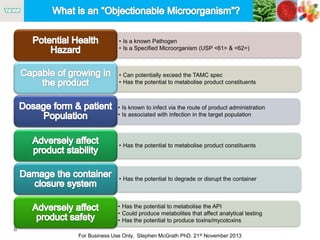
• Is a known Pathogen
• Is a Specified Microorganism (USP <61> & <62>)
• Can potentially exceed the TAMC spec
• Has the potential to metabolise product constituents
• Has the potential to metabolise the API
• Could produce metabolites that affect analytical testing
• Has the potential to produce toxins/mycotoxins
• Has the potential to metabolise product constituents
• Has the potential to degrade or disrupt the container
• Is known to infect via the route of product administration
• Is associated with infection in the target population
9
For Business Use Only, Stephen McGrath PhD. 21st November 2013
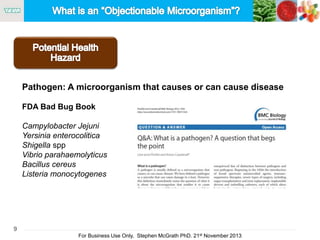
Pathogen: A microorganism that causes or can cause disease
FDA Bad Bug Book
Campylobacter Jejuni
Yersinia enterocolitica
Shigella spp
Vibrio parahaemolyticus
Bacillus cereus
Listeria monocytogenes
10
For Business Use Only, Stephen McGrath PhD. 21st November 2013
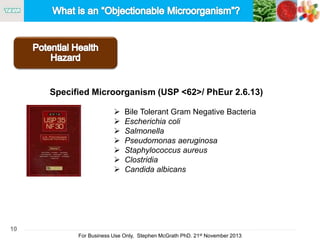
Specified Microorganism (USP <62>/ PhEur 2.6.13)
 Bile Tolerant Gram Negative Bacteria
 Escherichia coli
 Salmonella
 Pseudomonas aeruginosa
 Staphylococcus aureus
 Clostridia
 Candida albicans
11
For Business Use Only, Stephen McGrath PhD. 21st November 2013
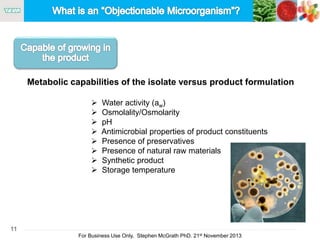
Metabolic capabilities of the isolate versus product formulation
 Water activity (aw)
 Osmolality/Osmolarity
 pH
 Antimicrobial properties of product constituents
 Presence of preservatives
 Presence of natural raw materials
 Synthetic product
 Storage temperature
12
For Business Use Only, Stephen McGrath PhD. 21st November 2013
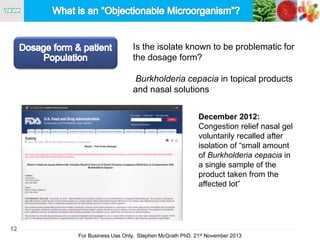
Is the isolate known to be problematic for
the dosage form?
Burkholderia cepacia in topical products
and nasal solutions
December 2012:
Congestion relief nasal gel
voluntarily recalled after
isolation of “small amount
of Burkholderia cepacia in
a single sample of the
product taken from the
affected lot”
13
For Business Use Only, Stephen McGrath PhD. 21st November 2013
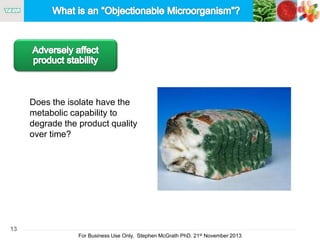
Does the isolate have the
metabolic capability to
degrade the product quality
over time?
14
For Business Use Only, Stephen McGrath PhD. 21st November 2013
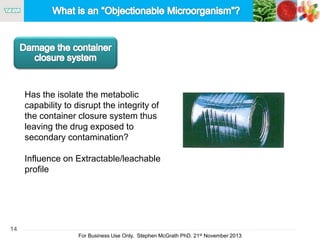
Has the isolate the metabolic
capability to disrupt the integrity of
the container closure system thus
leaving the drug exposed to
secondary contamination?
Influence on Extractable/leachable
profile
15
For Business Use Only, Stephen McGrath PhD. 21st November 2013
All of the previous information
plus: Has the isolate the capability
to produce toxins, metabolise the
API or produce metabolites that
may interfere with analytical QC
testing?
16
For Business Use Only, Stephen McGrath PhD. 21st November 2013
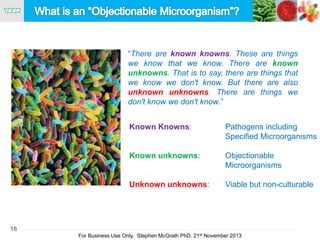
“There are known knowns. These are things
we know that we know. There are known
unknowns. That is to say, there are things that
we know we don't know. But there are also
unknown unknowns. There are things we
don't know we don't know.”
Known Knowns: Pathogens including
Specified Microorganisms
Known unknowns: Objectionable
Microorganisms
Unknown unknowns: Viable but non-culturable
17
For Business Use Only, Stephen McGrath PhD. 21st November 2013
18
For Business Use Only, Stephen McGrath PhD. 21st November 2013
FDA Code of Federal Regulations
 21 CFR 211.84 (d)(6) “Each lot of a component, drug product container,
or closure with potential for microbiological contamination that is
objectionable in view of its intended use shall be subjected to
microbiological tests before use.
 21 CFR 211.113 (a) “Appropriate written procedures, designed to
prevent objectionable microorganisms in drug products not required to
be sterile, shall be established and followed.
 21 CFR 211.165 (b) “There shall be appropriate laboratory testing, as
necessary of each batch of drug product required to be free of
objectionable microorganisms.”
19
For Business Use Only, Stephen McGrath PhD. 21st November 2013
USP <1111>
Microbiological Examination of nonsterile products: Acceptance criteria for
pharmaceutical preparations and substances for pharmaceutical use.
 ....for a given preparation it may be necessary to test for other microorganisms
depending on the nature of the starting materials and the manufacturing
process.
 In addition to the microorganisms listed, the significance of other
microorganisms recovered should be evaluated in terms of the following:
– The use of the product
– The nature of the product
– The method of application
– The intended recipient
– Use of immunosuppressive agents
– The presence of disease, wounds, organ damage
 Risk based assessment
20
For Business Use Only, Stephen McGrath PhD. 21st November 2013
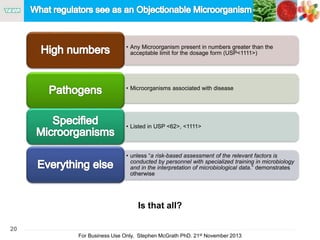
• Any Microorganism present in numbers greater than the
acceptable limit for the dosage form (USP<1111>)
• Microorganisms associated with disease
• Listed in USP <62>, <1111>
• unless “a risk-based assessment of the relevant factors is
conducted by personnel with specialized training in microbiology
and in the interpretation of microbiological data.” demonstrates
otherwise
Is that all?
21
For Business Use Only, Stephen McGrath PhD. 21st November 2013
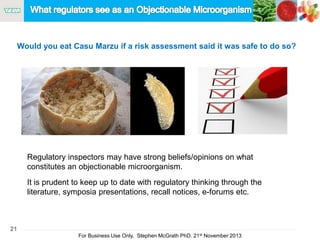
Would you eat Casu Marzu if a risk assessment said it was safe to do so?
Regulatory inspectors may have strong beliefs/opinions on what
constitutes an objectionable microorganism.
It is prudent to keep up to date with regulatory thinking through the
literature, symposia presentations, recall notices, e-forums etc.
22
For Business Use Only, Stephen McGrath PhD. 21st November 2013
23
For Business Use Only, Stephen McGrath PhD. 21st November 2013
 USP <62> ...Will allow determination of the absence of, or limited
occurrence of Specified microorganisms that may be detected under
the conditions described. The tests are designed primarily to determine
whether a substance or preparation complies with an established
specification for microbiological quality.
Absence of : Bile tolerant Gram negative bacteria
Escherichia coli
Salmonella
Pseudomonas aeruginosa
Staphylococcus aureus
Clostridia
Candida albicans
24
For Business Use Only, Stephen McGrath PhD. 21st November 2013
 USP<62> is a set of instructions for performing tests to demonstrate the
absence of particular (specified) microorganisms
 It does not mention “Objectionable microorganisms”
 It does not indicate the significance of the organisms with respect to
particular product formulations, dosage forms, intended recipients
 USP<1111>/PhEur 5.1.4 provides guidance for acceptance criteria for
microbiological quality of nonsterile dosage forms
 However... “In addition to the microorganisms listed in Table 1 the
significance of other microorganisms recovered should be evaluated in
terms of the following:.....”
25
For Business Use Only, Stephen McGrath PhD. 21st November 2013
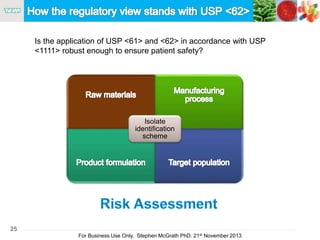
Is the application of USP <61> and <62> in accordance with USP
<1111> robust enough to ensure patient safety?
Isolate
identification
scheme
26
For Business Use Only, Stephen McGrath PhD. 21st November 2013
27
For Business Use Only, Stephen McGrath PhD. 21st November 2013
A review of reported recalls involving Microbiological control
2004-2011 with emphasis on FDA considerations of Objectionable
Organisms.
Scott Sutton and Luis Jimenez Jan/Feb 2012
 642 microbiologically-related recalls over the years 2004-2011
 142 relating to non-sterile products
 70% cited the presence of “objectionable microorganisms”
 34% of these referred to the presence of Burkholderia cepacia
28
For Business Use Only, Stephen McGrath PhD. 21st November 2013
Burkholderia cepacia: This Decision is Overdue
Torbeck, Raccasi, Guilfoyle, Friedman & Hussong. 2011
“Bcc organisms pose a clear and present danger to
patient health and safety. The challenge is
undeniable; now is the time to remove Bcc from our
pharmaceutical manufacturing areas and products”
29
For Business Use Only, Stephen McGrath PhD. 21st November 2013
Bacillus cereus: associated with foodborne illness from enterotoxin production
50 product recalls from 2004-2012. All associated with alcohol wipes
“Increasing recognition of Bacillus cereus pathogenicity and routes of
infection”
What is an “Objectionable Organism”
Scott Sutton October 2012
30
For Business Use Only, Stephen McGrath PhD. 21st November 2013
The Human Microbiome Project
• Initiated in 2008 by US NIH
• Objective is to identify and characterise
microorganisms associated with both
healthy and diseased humans
• Complex interactions between People,
Pharmaceuticals and Microorganisms
• Risk that members of the HMB could be
transferred to Pharma products during
manufacturing
• Onus on manufacturers to determine risk
level and take action
31
For Business Use Only, Stephen McGrath PhD. 21st November 2013
Unknown Unknowns
Viable but Non Culturable microorganisms
The significance and detection of VBNC
Microorganisms
Dr. Paul Newby June 2007
 Overall, the risk in terms of patient safety from organisms in the VBNC state is
low
 Detection and understanding of their occurrence in Pharmaceutical
manufacturing environments/materials/products will lead to better process control.
32
For Business Use Only, Stephen McGrath PhD. 21st November 2013
33
For Business Use Only, Stephen McGrath PhD. 21st November 2013
GMP
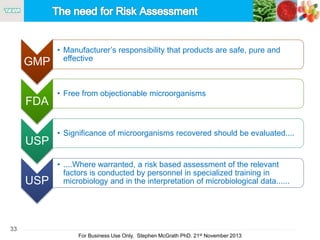
• Manufacturer’s responsibility that products are safe, pure and
effective
FDA
• Free from objectionable microorganisms
USP
• Significance of microorganisms recovered should be evaluated....
USP
• ....Where warranted, a risk based assessment of the relevant
factors is conducted by personnel in specialized training in
microbiology and in the interpretation of microbiological data......
34
For Business Use Only, Stephen McGrath PhD. 21st November 2013
Regulated
Microbial Risk in Pharmaceutical Manufacturing and ICH Q9
Guilfoyle, Friedman, Hughes, Hussong, Rosenberg and Brorson. 2013
“A risk-based assessment incorporating the five recommendations
above should be conducted by appropriate technical staff, including
microbiology personnel with specialized training in the interpretation
of microbiological data”
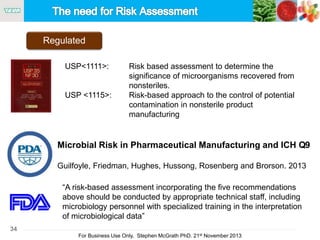
USP<1111>: Risk based assessment to determine the
significance of microorganisms recovered from
nonsteriles.
USP <1115>: Risk-based approach to the control of potential
contamination in nonsterile product
manufacturing
35
For Business Use Only, Stephen McGrath PhD. 21st November 2013
Self Control
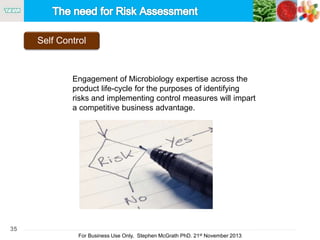
Engagement of Microbiology expertise across the
product life-cycle for the purposes of identifying
risks and implementing control measures will impart
a competitive business advantage.
36
For Business Use Only, Stephen McGrath PhD. 21st November 2013
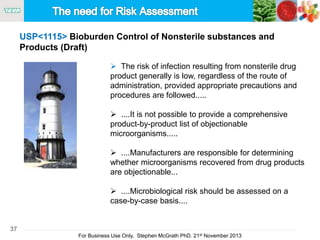
USP<1115> Bioburden Control of Nonsterile substances and
Products (Draft)
 A pragmatic scientific approach to management
of microbial bioburden in nonsterile products
requires consideration of patient risk and
contamination control objectives to achieve a
practical and appropriate level of risk management.
 Outlines a risk-based approach to the control of
potential contamination in nonsterile product
manufacturing
37
For Business Use Only, Stephen McGrath PhD. 21st November 2013
 The risk of infection resulting from nonsterile drug
product generally is low, regardless of the route of
administration, provided appropriate precautions and
procedures are followed.....
 ....It is not possible to provide a comprehensive
product-by-product list of objectionable
microorganisms.....
 ....Manufacturers are responsible for determining
whether microorganisms recovered from drug products
are objectionable...
 ....Microbiological risk should be assessed on a
case-by-case basis....
USP<1115> Bioburden Control of Nonsterile substances and
Products (Draft)
38
For Business Use Only, Stephen McGrath PhD. 21st November 2013
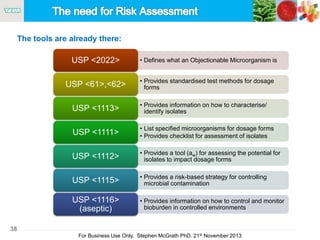
• Defines what an Objectionable Microorganism isUSP <2022>
• Provides standardised test methods for dosage
formsUSP <61>,<62>
• Provides information on how to characterise/
identify isolatesUSP <1113>
• List specified microorganisms for dosage forms
• Provides checklist for assessment of isolatesUSP <1111>
• Provides a tool (aw) for assessing the potential for
isolates to impact dosage formsUSP <1112>
• Provides a risk-based strategy for controlling
microbial contaminationUSP <1115>
• Provides information on how to control and monitor
bioburden in controlled environments
USP <1116>
(aseptic)
The tools are already there:
39
For Business Use Only, Stephen McGrath PhD. 21st November 2013
40
For Business Use Only, Stephen McGrath PhD. 21st November 2013
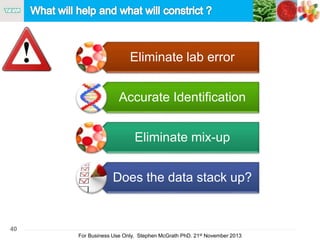
Eliminate lab error
Accurate Identification
Eliminate mix-up
Does the data stack up?
41
For Business Use Only, Stephen McGrath PhD. 21st November 2013
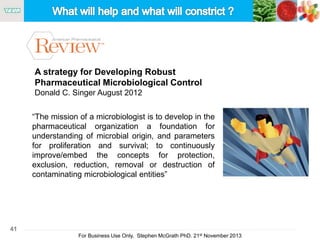
A strategy for Developing Robust
Pharmaceutical Microbiological Control
Donald C. Singer August 2012
“The mission of a microbiologist is to develop in the
pharmaceutical organization a foundation for
understanding of microbial origin, and parameters
for proliferation and survival; to continuously
improve/embed the concepts for protection,
exclusion, reduction, removal or destruction of
contaminating microbiological entities”
42
For Business Use Only, Stephen McGrath PhD. 21st November 2013
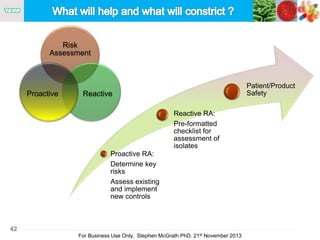
Risk
Assessment
ReactiveProactive
Proactive RA:
Determine key
risks
Assess existing
and implement
new controls
Reactive RA:
Pre-formatted
checklist for
assessment of
isolates
Patient/Product
Safety
43
For Business Use Only, Stephen McGrath PhD. 21st November 2013
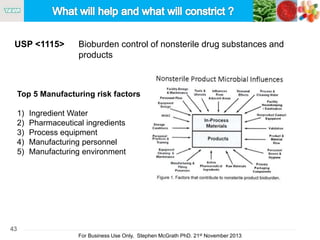
USP <1115> Bioburden control of nonsterile drug substances and
products
Top 5 Manufacturing risk factors
1) Ingredient Water
2) Pharmaceutical ingredients
3) Process equipment
4) Manufacturing personnel
5) Manufacturing environment
44
For Business Use Only, Stephen McGrath PhD. 21st November 2013
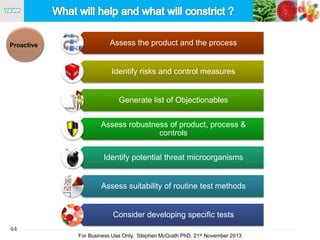
Assess the product and the process
Identify risks and control measures
Generate list of Objectionables
Assess robustness of product, process &
controls
Identify potential threat microorganisms
Assess suitability of routine test methods
Consider developing specific tests
Proactive
45
For Business Use Only, Stephen McGrath PhD. 21st November 2013
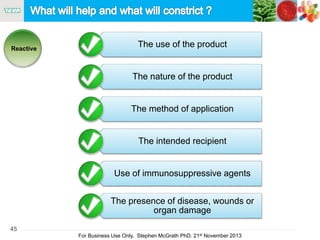
Reactive
The use of the product
The nature of the product
The method of application
The intended recipient
Use of immunosuppressive agents
The presence of disease, wounds or
organ damage
46
For Business Use Only, Stephen McGrath PhD. 21st November 2013
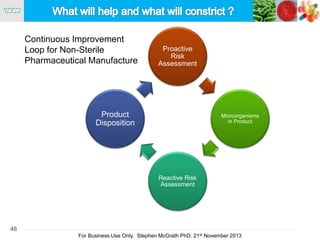
Proactive
Risk
Assessment
Microorganisms
in Product
Reactive Risk
Assessment
Product
Disposition
Continuous Improvement
Loop for Non-Sterile
Pharmaceutical Manufacture
47
For Business Use Only, Stephen McGrath PhD. 21st November 2013
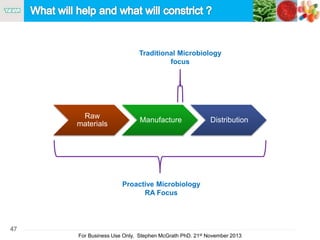
Raw
materials
Manufacture Distribution
Traditional Microbiology
focus
Proactive Microbiology
RA Focus
48
For Business Use Only, Stephen McGrath PhD. 21st November 2013
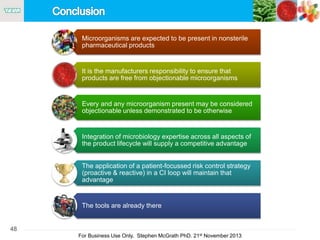
Microorganisms are expected to be present in nonsterile
pharmaceutical products
It is the manufacturers responsibility to ensure that
products are free from objectionable microorganisms
Every and any microorganism present may be considered
objectionable unless demonstrated to be otherwise
Integration of microbiology expertise across all aspects of
the product lifecycle will supply a competitive advantage
The application of a patient-focussed risk control strategy
(proactive & reactive) in a CI loop will maintain that
advantage
The tools are already there
49
For Business Use Only, Stephen McGrath PhD. 21st November 2013
1. Burkholderia cepacia: This decision is overdue. Torbeck, L. et al, 2011 PDA Journal of Pharm Sci & Tech.
2. Letter to the editor. Sutton,S. 2012 PDA Journal of Pharm Sci & Tech.
3. A review of reported recalls involving microbiological control 2004-2011 with emphasis on FDA considerations
of objectionable organisms. Sutton, S. & Jimenez, L. 2012 American Pharm Review.
4. What is an “objectionable organism”?. Sutton, S. 2012. American Pharm Review.
5. Implications of the human microbiome on pharmaceutical microbiology. Wilder, N., Sandle, T., & Sutton, S.
2013 American Pharm Review.
6. Microbial risk in pharmaceutical manufacturing and ICH Q9. Guilfoyle, D.E., et al. 2013 PDA Journal of Pharm
Sci & Tech.
7. Microbial diversity in pharmaceutical product recalls and environments. Jimenez, L., 2007 PDA Journal of
Pharm Sci & Tech.
8. A review of cleanroom microflora: types, trends, and patterns. 2011 Sandle, T. PDA Journal of Pharm Sci &
Tech.
9. A strategy for developing robust pharmaceutical microbiological control. 2012 Singer, D.C. American Pharm
Review.
10. Microbial limit tests: the difference between “absence of objectionable microorganisms and absence of
specified microorganisms. 2006 Sutton, S. PMF Newsletter June.
11. The significance and detection of VBNC Microorganisms. Newby, P. 2007. American Pharm Review.

Objectionable microorganisms within and beyond regulations

  • 1.
    1 For Business UseOnly, Stephen McGrath PhD. 21st November 2013 Stephen McGrath, Ph.D. Site Microbiologist Teva Pharmaceuticals Ireland Sterile, Respiratory and Specialty Quality Operations November 21st 2013
  • 2.
    2 For Business UseOnly, Stephen McGrath PhD. 21st November 2013
  • 3.
    3 For Business UseOnly, Stephen McGrath PhD. 21st November 2013 Objectionable: Arousing distaste or opposition; unpleasant or offensive Casu marzu “Objectionable” is a subjective term open to interpretation and can mean different things to different people
  • 4.
    4 For Business UseOnly, Stephen McGrath PhD. 21st November 2013 However you define what an objectionable microorganism is, the quality and safety of the pharmaceutical product provided to customers remains the responsibility of the manufacturer. For non-sterile pharmaceutical products it is up to the manufacturer to demonstrate that microorganisms present in products are safe to release to market. Any and all microorganisms present in non-sterile dosage forms may be considered objectionable unless demonstrated otherwise.
  • 5.
    5 For Business UseOnly, Stephen McGrath PhD. 21st November 2013 The concept of Objectionable Microorganisms in Non-sterile Pharmaceutical products is not a recent development. 1982: The USP Microbiology Committee stated that the demonstration of “absence of objectionable microorganisms” was not the intent of the tests described in the Microbial Limit Tests <61>. 1993: FDA guide to inspections of Microbiological Pharmaceutical QC Labs: The USP Microbial Limits Chapter <61> provides methodology for selected indicator organisms, but not all objectionable organisms.
  • 6.
    6 For Business UseOnly, Stephen McGrath PhD. 21st November 2013 What is an “Objectionable Organism” Scott Sutton October 2012 A pure interpretation in regards to patient health would lead to the following requirements:  Objectionable in view of the product’s intended use or to its shelf- life stability, and;  For products not required to be sterile
  • 7.
    7 For Business UseOnly, Stephen McGrath PhD. 21st November 2013 A microorganism can be considered objectionable if it represents a potential health hazard to the user who is using the product as directed, or if it is capable of growing in the product. Objectionable microorganisms are defined as contaminants, that depending on the microbial species, number of organisms, dosage form, intended use and patient population, would adversely affect product safety. Additionally, microorganisms may be deemed objectionable if they adversely affect product stability or if they damage the integrity of the container closure system. USP <2022> Microbiological Procedures for absence of specified Microorganisms-Nutritional and dietary supplements.
  • 8.
    8 For Business UseOnly, Stephen McGrath PhD. 21st November 2013 • Is a known Pathogen • Is a Specified Microorganism (USP <61> & <62>) • Can potentially exceed the TAMC spec • Has the potential to metabolise product constituents • Has the potential to metabolise the API • Could produce metabolites that affect analytical testing • Has the potential to produce toxins/mycotoxins • Has the potential to metabolise product constituents • Has the potential to degrade or disrupt the container • Is known to infect via the route of product administration • Is associated with infection in the target population
  • 9.
    9 For Business UseOnly, Stephen McGrath PhD. 21st November 2013 Pathogen: A microorganism that causes or can cause disease FDA Bad Bug Book Campylobacter Jejuni Yersinia enterocolitica Shigella spp Vibrio parahaemolyticus Bacillus cereus Listeria monocytogenes
  • 10.
    10 For Business UseOnly, Stephen McGrath PhD. 21st November 2013 Specified Microorganism (USP <62>/ PhEur 2.6.13)  Bile Tolerant Gram Negative Bacteria  Escherichia coli  Salmonella  Pseudomonas aeruginosa  Staphylococcus aureus  Clostridia  Candida albicans
  • 11.
    11 For Business UseOnly, Stephen McGrath PhD. 21st November 2013 Metabolic capabilities of the isolate versus product formulation  Water activity (aw)  Osmolality/Osmolarity  pH  Antimicrobial properties of product constituents  Presence of preservatives  Presence of natural raw materials  Synthetic product  Storage temperature
  • 12.
    12 For Business UseOnly, Stephen McGrath PhD. 21st November 2013 Is the isolate known to be problematic for the dosage form? Burkholderia cepacia in topical products and nasal solutions December 2012: Congestion relief nasal gel voluntarily recalled after isolation of “small amount of Burkholderia cepacia in a single sample of the product taken from the affected lot”
  • 13.
    13 For Business UseOnly, Stephen McGrath PhD. 21st November 2013 Does the isolate have the metabolic capability to degrade the product quality over time?
  • 14.
    14 For Business UseOnly, Stephen McGrath PhD. 21st November 2013 Has the isolate the metabolic capability to disrupt the integrity of the container closure system thus leaving the drug exposed to secondary contamination? Influence on Extractable/leachable profile
  • 15.
    15 For Business UseOnly, Stephen McGrath PhD. 21st November 2013 All of the previous information plus: Has the isolate the capability to produce toxins, metabolise the API or produce metabolites that may interfere with analytical QC testing?
  • 16.
    16 For Business UseOnly, Stephen McGrath PhD. 21st November 2013 “There are known knowns. These are things we know that we know. There are known unknowns. That is to say, there are things that we know we don't know. But there are also unknown unknowns. There are things we don't know we don't know.” Known Knowns: Pathogens including Specified Microorganisms Known unknowns: Objectionable Microorganisms Unknown unknowns: Viable but non-culturable
  • 17.
    17 For Business UseOnly, Stephen McGrath PhD. 21st November 2013
  • 18.
    18 For Business UseOnly, Stephen McGrath PhD. 21st November 2013 FDA Code of Federal Regulations  21 CFR 211.84 (d)(6) “Each lot of a component, drug product container, or closure with potential for microbiological contamination that is objectionable in view of its intended use shall be subjected to microbiological tests before use.  21 CFR 211.113 (a) “Appropriate written procedures, designed to prevent objectionable microorganisms in drug products not required to be sterile, shall be established and followed.  21 CFR 211.165 (b) “There shall be appropriate laboratory testing, as necessary of each batch of drug product required to be free of objectionable microorganisms.”
  • 19.
    19 For Business UseOnly, Stephen McGrath PhD. 21st November 2013 USP <1111> Microbiological Examination of nonsterile products: Acceptance criteria for pharmaceutical preparations and substances for pharmaceutical use.  ....for a given preparation it may be necessary to test for other microorganisms depending on the nature of the starting materials and the manufacturing process.  In addition to the microorganisms listed, the significance of other microorganisms recovered should be evaluated in terms of the following: – The use of the product – The nature of the product – The method of application – The intended recipient – Use of immunosuppressive agents – The presence of disease, wounds, organ damage  Risk based assessment
  • 20.
    20 For Business UseOnly, Stephen McGrath PhD. 21st November 2013 • Any Microorganism present in numbers greater than the acceptable limit for the dosage form (USP<1111>) • Microorganisms associated with disease • Listed in USP <62>, <1111> • unless “a risk-based assessment of the relevant factors is conducted by personnel with specialized training in microbiology and in the interpretation of microbiological data.” demonstrates otherwise Is that all?
  • 21.
    21 For Business UseOnly, Stephen McGrath PhD. 21st November 2013 Would you eat Casu Marzu if a risk assessment said it was safe to do so? Regulatory inspectors may have strong beliefs/opinions on what constitutes an objectionable microorganism. It is prudent to keep up to date with regulatory thinking through the literature, symposia presentations, recall notices, e-forums etc.
  • 22.
    22 For Business UseOnly, Stephen McGrath PhD. 21st November 2013
  • 23.
    23 For Business UseOnly, Stephen McGrath PhD. 21st November 2013  USP <62> ...Will allow determination of the absence of, or limited occurrence of Specified microorganisms that may be detected under the conditions described. The tests are designed primarily to determine whether a substance or preparation complies with an established specification for microbiological quality. Absence of : Bile tolerant Gram negative bacteria Escherichia coli Salmonella Pseudomonas aeruginosa Staphylococcus aureus Clostridia Candida albicans
  • 24.
    24 For Business UseOnly, Stephen McGrath PhD. 21st November 2013  USP<62> is a set of instructions for performing tests to demonstrate the absence of particular (specified) microorganisms  It does not mention “Objectionable microorganisms”  It does not indicate the significance of the organisms with respect to particular product formulations, dosage forms, intended recipients  USP<1111>/PhEur 5.1.4 provides guidance for acceptance criteria for microbiological quality of nonsterile dosage forms  However... “In addition to the microorganisms listed in Table 1 the significance of other microorganisms recovered should be evaluated in terms of the following:.....”
  • 25.
    25 For Business UseOnly, Stephen McGrath PhD. 21st November 2013 Is the application of USP <61> and <62> in accordance with USP <1111> robust enough to ensure patient safety? Isolate identification scheme
  • 26.
    26 For Business UseOnly, Stephen McGrath PhD. 21st November 2013
  • 27.
    27 For Business UseOnly, Stephen McGrath PhD. 21st November 2013 A review of reported recalls involving Microbiological control 2004-2011 with emphasis on FDA considerations of Objectionable Organisms. Scott Sutton and Luis Jimenez Jan/Feb 2012  642 microbiologically-related recalls over the years 2004-2011  142 relating to non-sterile products  70% cited the presence of “objectionable microorganisms”  34% of these referred to the presence of Burkholderia cepacia
  • 28.
    28 For Business UseOnly, Stephen McGrath PhD. 21st November 2013 Burkholderia cepacia: This Decision is Overdue Torbeck, Raccasi, Guilfoyle, Friedman & Hussong. 2011 “Bcc organisms pose a clear and present danger to patient health and safety. The challenge is undeniable; now is the time to remove Bcc from our pharmaceutical manufacturing areas and products”
  • 29.
    29 For Business UseOnly, Stephen McGrath PhD. 21st November 2013 Bacillus cereus: associated with foodborne illness from enterotoxin production 50 product recalls from 2004-2012. All associated with alcohol wipes “Increasing recognition of Bacillus cereus pathogenicity and routes of infection” What is an “Objectionable Organism” Scott Sutton October 2012
  • 30.
    30 For Business UseOnly, Stephen McGrath PhD. 21st November 2013 The Human Microbiome Project • Initiated in 2008 by US NIH • Objective is to identify and characterise microorganisms associated with both healthy and diseased humans • Complex interactions between People, Pharmaceuticals and Microorganisms • Risk that members of the HMB could be transferred to Pharma products during manufacturing • Onus on manufacturers to determine risk level and take action
  • 31.
    31 For Business UseOnly, Stephen McGrath PhD. 21st November 2013 Unknown Unknowns Viable but Non Culturable microorganisms The significance and detection of VBNC Microorganisms Dr. Paul Newby June 2007  Overall, the risk in terms of patient safety from organisms in the VBNC state is low  Detection and understanding of their occurrence in Pharmaceutical manufacturing environments/materials/products will lead to better process control.
  • 32.
    32 For Business UseOnly, Stephen McGrath PhD. 21st November 2013
  • 33.
    33 For Business UseOnly, Stephen McGrath PhD. 21st November 2013 GMP • Manufacturer’s responsibility that products are safe, pure and effective FDA • Free from objectionable microorganisms USP • Significance of microorganisms recovered should be evaluated.... USP • ....Where warranted, a risk based assessment of the relevant factors is conducted by personnel in specialized training in microbiology and in the interpretation of microbiological data......
  • 34.
    34 For Business UseOnly, Stephen McGrath PhD. 21st November 2013 Regulated Microbial Risk in Pharmaceutical Manufacturing and ICH Q9 Guilfoyle, Friedman, Hughes, Hussong, Rosenberg and Brorson. 2013 “A risk-based assessment incorporating the five recommendations above should be conducted by appropriate technical staff, including microbiology personnel with specialized training in the interpretation of microbiological data” USP<1111>: Risk based assessment to determine the significance of microorganisms recovered from nonsteriles. USP <1115>: Risk-based approach to the control of potential contamination in nonsterile product manufacturing
  • 35.
    35 For Business UseOnly, Stephen McGrath PhD. 21st November 2013 Self Control Engagement of Microbiology expertise across the product life-cycle for the purposes of identifying risks and implementing control measures will impart a competitive business advantage.
  • 36.
    36 For Business UseOnly, Stephen McGrath PhD. 21st November 2013 USP<1115> Bioburden Control of Nonsterile substances and Products (Draft)  A pragmatic scientific approach to management of microbial bioburden in nonsterile products requires consideration of patient risk and contamination control objectives to achieve a practical and appropriate level of risk management.  Outlines a risk-based approach to the control of potential contamination in nonsterile product manufacturing
  • 37.
    37 For Business UseOnly, Stephen McGrath PhD. 21st November 2013  The risk of infection resulting from nonsterile drug product generally is low, regardless of the route of administration, provided appropriate precautions and procedures are followed.....  ....It is not possible to provide a comprehensive product-by-product list of objectionable microorganisms.....  ....Manufacturers are responsible for determining whether microorganisms recovered from drug products are objectionable...  ....Microbiological risk should be assessed on a case-by-case basis.... USP<1115> Bioburden Control of Nonsterile substances and Products (Draft)
  • 38.
    38 For Business UseOnly, Stephen McGrath PhD. 21st November 2013 • Defines what an Objectionable Microorganism isUSP <2022> • Provides standardised test methods for dosage formsUSP <61>,<62> • Provides information on how to characterise/ identify isolatesUSP <1113> • List specified microorganisms for dosage forms • Provides checklist for assessment of isolatesUSP <1111> • Provides a tool (aw) for assessing the potential for isolates to impact dosage formsUSP <1112> • Provides a risk-based strategy for controlling microbial contaminationUSP <1115> • Provides information on how to control and monitor bioburden in controlled environments USP <1116> (aseptic) The tools are already there:
  • 39.
    39 For Business UseOnly, Stephen McGrath PhD. 21st November 2013
  • 40.
    40 For Business UseOnly, Stephen McGrath PhD. 21st November 2013 Eliminate lab error Accurate Identification Eliminate mix-up Does the data stack up?
  • 41.
    41 For Business UseOnly, Stephen McGrath PhD. 21st November 2013 A strategy for Developing Robust Pharmaceutical Microbiological Control Donald C. Singer August 2012 “The mission of a microbiologist is to develop in the pharmaceutical organization a foundation for understanding of microbial origin, and parameters for proliferation and survival; to continuously improve/embed the concepts for protection, exclusion, reduction, removal or destruction of contaminating microbiological entities”
  • 42.
    42 For Business UseOnly, Stephen McGrath PhD. 21st November 2013 Risk Assessment ReactiveProactive Proactive RA: Determine key risks Assess existing and implement new controls Reactive RA: Pre-formatted checklist for assessment of isolates Patient/Product Safety
  • 43.
    43 For Business UseOnly, Stephen McGrath PhD. 21st November 2013 USP <1115> Bioburden control of nonsterile drug substances and products Top 5 Manufacturing risk factors 1) Ingredient Water 2) Pharmaceutical ingredients 3) Process equipment 4) Manufacturing personnel 5) Manufacturing environment
  • 44.
    44 For Business UseOnly, Stephen McGrath PhD. 21st November 2013 Assess the product and the process Identify risks and control measures Generate list of Objectionables Assess robustness of product, process & controls Identify potential threat microorganisms Assess suitability of routine test methods Consider developing specific tests Proactive
  • 45.
    45 For Business UseOnly, Stephen McGrath PhD. 21st November 2013 Reactive The use of the product The nature of the product The method of application The intended recipient Use of immunosuppressive agents The presence of disease, wounds or organ damage
  • 46.
    46 For Business UseOnly, Stephen McGrath PhD. 21st November 2013 Proactive Risk Assessment Microorganisms in Product Reactive Risk Assessment Product Disposition Continuous Improvement Loop for Non-Sterile Pharmaceutical Manufacture
  • 47.
    47 For Business UseOnly, Stephen McGrath PhD. 21st November 2013 Raw materials Manufacture Distribution Traditional Microbiology focus Proactive Microbiology RA Focus
  • 48.
    48 For Business UseOnly, Stephen McGrath PhD. 21st November 2013 Microorganisms are expected to be present in nonsterile pharmaceutical products It is the manufacturers responsibility to ensure that products are free from objectionable microorganisms Every and any microorganism present may be considered objectionable unless demonstrated to be otherwise Integration of microbiology expertise across all aspects of the product lifecycle will supply a competitive advantage The application of a patient-focussed risk control strategy (proactive & reactive) in a CI loop will maintain that advantage The tools are already there
  • 49.
    49 For Business UseOnly, Stephen McGrath PhD. 21st November 2013 1. Burkholderia cepacia: This decision is overdue. Torbeck, L. et al, 2011 PDA Journal of Pharm Sci & Tech. 2. Letter to the editor. Sutton,S. 2012 PDA Journal of Pharm Sci & Tech. 3. A review of reported recalls involving microbiological control 2004-2011 with emphasis on FDA considerations of objectionable organisms. Sutton, S. & Jimenez, L. 2012 American Pharm Review. 4. What is an “objectionable organism”?. Sutton, S. 2012. American Pharm Review. 5. Implications of the human microbiome on pharmaceutical microbiology. Wilder, N., Sandle, T., & Sutton, S. 2013 American Pharm Review. 6. Microbial risk in pharmaceutical manufacturing and ICH Q9. Guilfoyle, D.E., et al. 2013 PDA Journal of Pharm Sci & Tech. 7. Microbial diversity in pharmaceutical product recalls and environments. Jimenez, L., 2007 PDA Journal of Pharm Sci & Tech. 8. A review of cleanroom microflora: types, trends, and patterns. 2011 Sandle, T. PDA Journal of Pharm Sci & Tech. 9. A strategy for developing robust pharmaceutical microbiological control. 2012 Singer, D.C. American Pharm Review. 10. Microbial limit tests: the difference between “absence of objectionable microorganisms and absence of specified microorganisms. 2006 Sutton, S. PMF Newsletter June. 11. The significance and detection of VBNC Microorganisms. Newby, P. 2007. American Pharm Review.