



MPN AND INDIRECT
METHODS OF
MEASUREMENT OF
MICROBIAL GROWTH
BY:-
Vivek kumar
M.Sc MICROBIOLOGY
Bangalore University
OBJECTIVES :
• To enumerate the number of bacteria present in the
drinking water by MPN method.
• To identify the bacteria present in the drinking water
sample.
INTRODUCTION
• Most probable number (MPN) analysis is a statistical method based
on the random dispersion of microorganisms per volume in a given
sample.
• In this method, measured volumes of water is added to a series of
tube containing a liquid indicator growth medium.
• The media receiving one or more indicator bacteria show growth and
a characteristic color change.
• Color change is absent in those receiving an inoculums of water
without indicator bacteria.
• From the number and distribution of positive and negative reactions,
the MPN of indicator organisms in the sample may be estimated by
reference to statistical tables.
• MPN test is completed in three steps :
• Presumptive test
• Confirmed test
• Completed test
PRESUMPTIVE TEST
• It is used for detection and estimation of coliform in water sample.
• For estimation of coliforms, lactose containing broth medium is used.
• Commonly used medium is MacConkey broth that contains the
indicator bromocresol purple. An inverted Durham’s tube is placed.
• The color of media changes into yellow and on collection of gas in
Durham's tube, bacteria are assumed to be coliform.
• Number of positive tubes are counted and referred to the standard
chart to find MPN of total 100 ml water sample.
CONFIRMED TEST :
• Some spore forming bacteria give false positive test in presumptive
test.
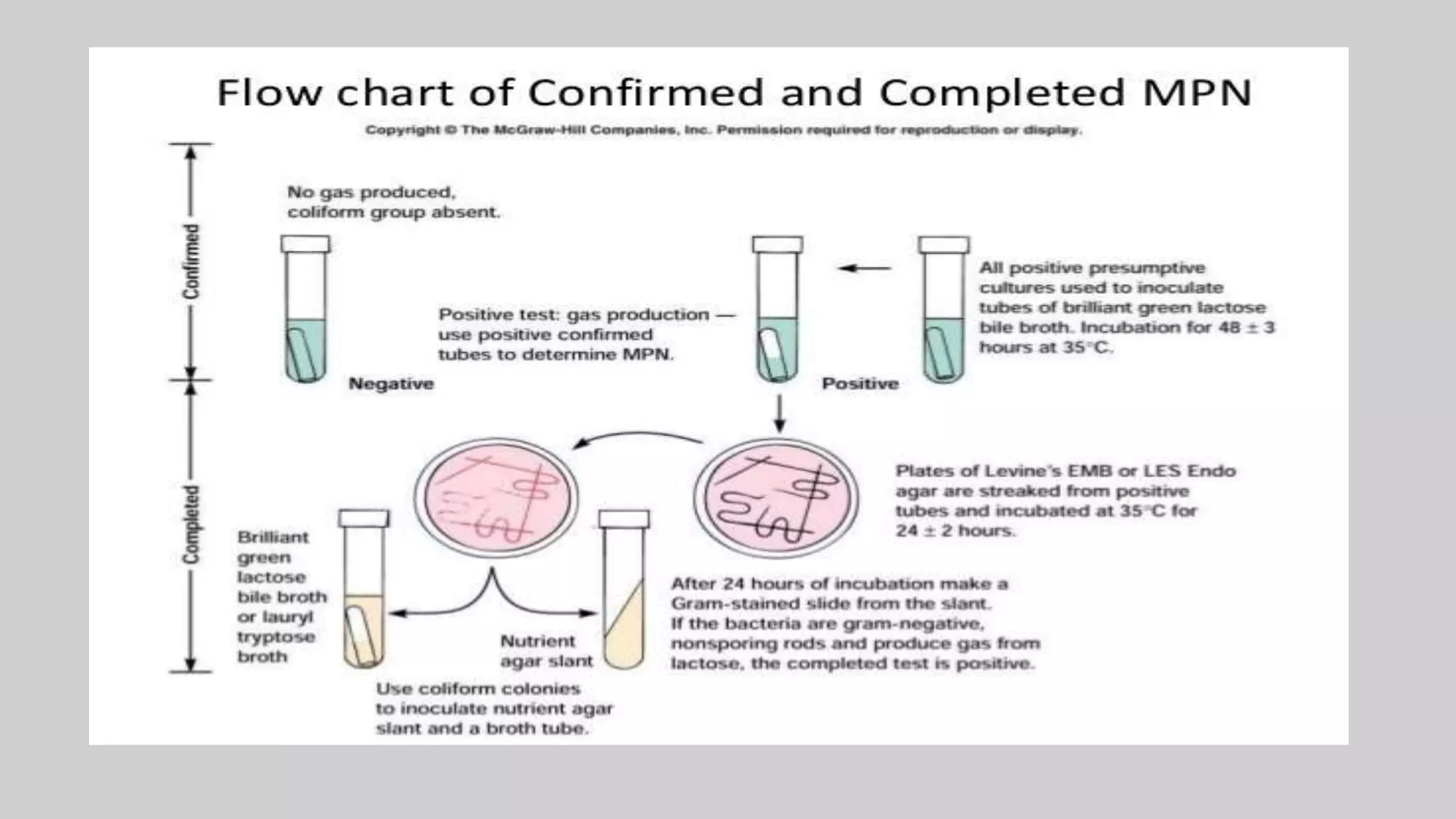
• Confirmed test is done to determine that the coliforms are of fecal
origin or not. And they are E. coli or not.
• For this positive presumptive test are inoculated in selective media
like Eosine Methylene Blue (EMB) agar and incubated at 44.5°Cand
37°C.
• Presence of typical colonies at 37°C confirms positive coliform test
and those at 44.5°C confirms the presence of E. coli.
COMPLETED TEST:
• Subculture typical colonies in lactose containing medium
and incubated at 37° C and 44.5 °C.
• Presence of E. coli is confirmed by the production of gas at
44.5 °C.
REQUIREMENTS
• Petridishes
• Test tubes
• Sampling bottle ( sterile)
• MacConkey or Lactose broth
• EMB agar, Nurtient agar
• Durham’s tube
• Test tube stand
• Water sample
PROCEDURES
• FOR PRESUMPTIVE TEST :
• Prepare MacConkey purple media of single and double strength in
test tubes with Durham’s tube and autoclave it.
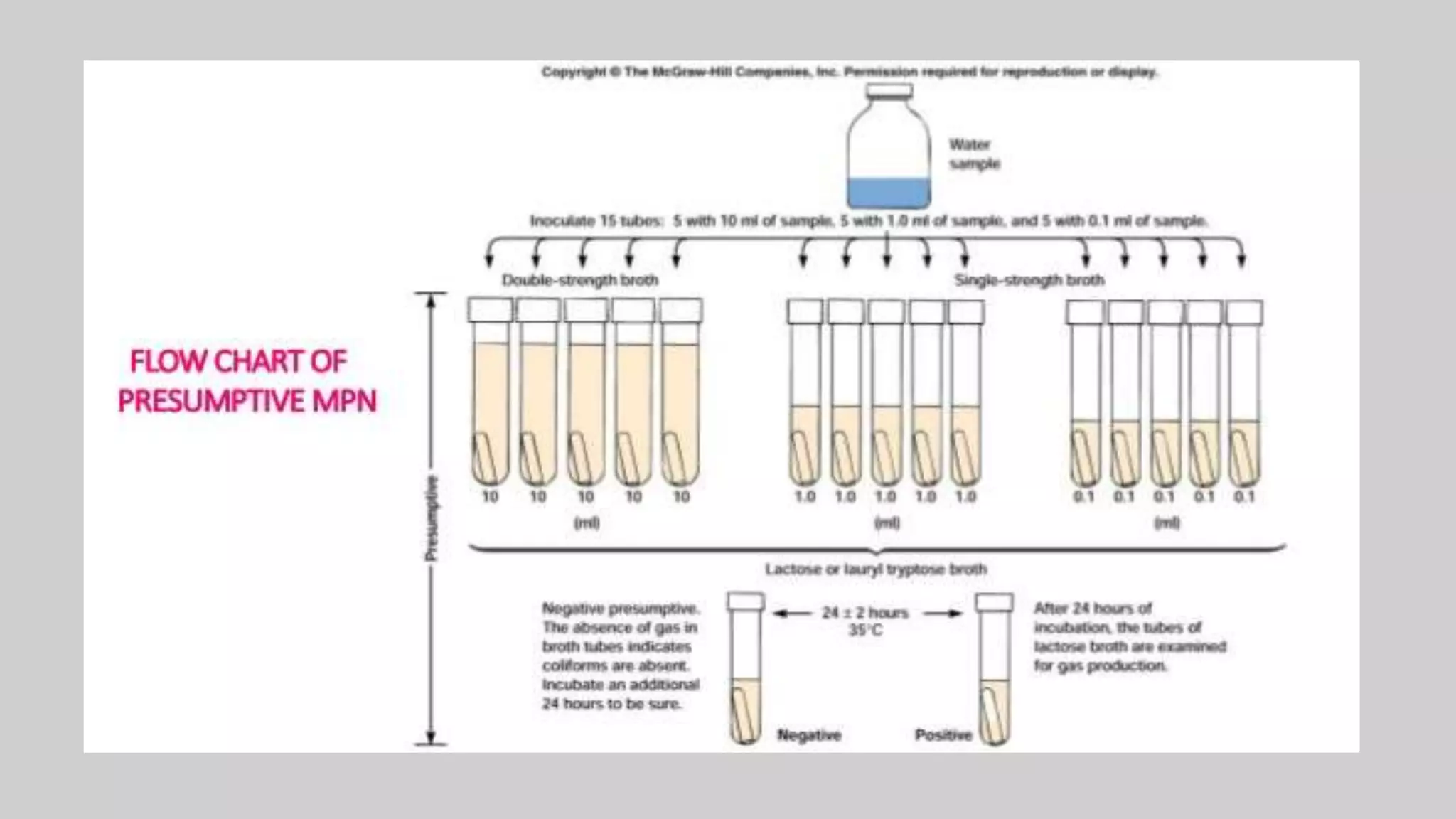
• Take three sets of test tubes containing five tubes in each set ;one set
with 10 ml of double strength (DS) other two containing 10 ml of
single strength (SS) .
• Using sterile pipettes , transfer 10 ml of water to each of DS broth
tubes .
• Transfer 1 ml of water sample to each of 5 tubes of one set of SS
broth and transfer 0.1 ml water to five tubes of remaining last set of
SS broth tubes.
• Incubate the tubes at 37°C for 24 hours.
• After incubation , observe the gas production in Durham’s tube and
color change of the media.
• Record the number of positive results from each set and compare
with standard chart to give presumptive coliform count per 100 ml
water sample.
• FOR CONFIRMED TEST :
• Take the positive tube from the presumptive test and using EMB in
duplicate.
• Incubate one plate at 37°C for 24 hours and another at 44.5°C for 24
hours.
• Look for typical colonies in the media ; blue black with green metallic
sheen colonies are of E. coli in EMB agar.
• COMPLETED TEST :
• Inoculate the colony in a tube of Lactose broth with Durham’s tube .
• Subculture the colony on Nutrient agar plate. This subculture is
considered optional.
• Incubate the broth cultures at 37°C and 44.5°C and Nutrient agar at
37°C.
• Examine for acid and gas production in Lactose broth . The nutrient
agar is used for Gram staining and for IMViC test.
INDIRECT METHODS OF MEASUREMENT
OF MICROBIAL GROWTH BY TURBIDITY
INTRODUCTION
• Turbidimetry is a simple, rapid method for following growth.
• A spectrophotometer or calorimeter can be used for turbidimetric
measurements of cell mass.
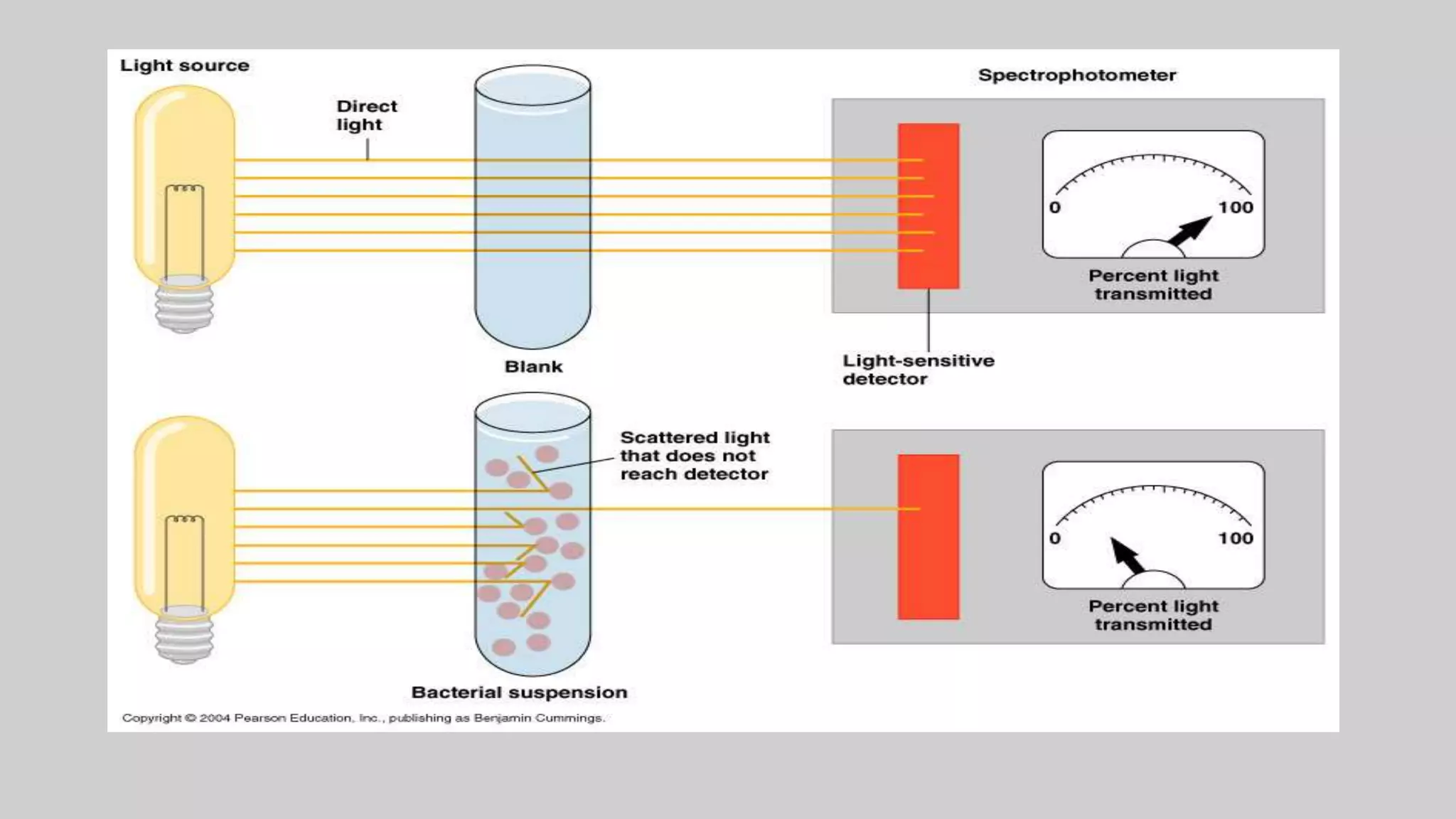
• A spectrophotometer is used to determine turbidity ("cloudiness") by
measuring the amount of light that passed through a suspension of
cells.
• More cells = more turbidity; more turbidity = less light passing
through the suspension
• However, the culture to be measured must be dense enough to
register some turbidity on the instrument.
• Moreover, it may not be possible to measure cultures grown in
deeply coloured media or cultures that contain suspended material
other than bacteria.
• It must also be recognised that dead as well as living cells contribute
to turbidity.
• (%T) percent transmission - fewer cells present (less turbidity) and
thus will allow more light to pass through.
• Therefore the %T is higher when the cell number is lower.
Absorbance is the opposite of %T.
• More light is absorbed when more cells are present and thus
absorbance goes up as turbidity (or cell number) goes up.
THANK YOU

MPN AND INDIRECT METHODS OF MEASUREMENT OF MICROBIAL GROWTH

  • 1.
    MPN AND INDIRECT METHODSOF MEASUREMENT OF MICROBIAL GROWTH BY:- Vivek kumar M.Sc MICROBIOLOGY Bangalore University
  • 2.
    OBJECTIVES : • Toenumerate the number of bacteria present in the drinking water by MPN method. • To identify the bacteria present in the drinking water sample.
  • 3.
    INTRODUCTION • Most probablenumber (MPN) analysis is a statistical method based on the random dispersion of microorganisms per volume in a given sample. • In this method, measured volumes of water is added to a series of tube containing a liquid indicator growth medium. • The media receiving one or more indicator bacteria show growth and a characteristic color change. • Color change is absent in those receiving an inoculums of water without indicator bacteria.
  • 4.
    • From thenumber and distribution of positive and negative reactions, the MPN of indicator organisms in the sample may be estimated by reference to statistical tables. • MPN test is completed in three steps : • Presumptive test • Confirmed test • Completed test
  • 5.
    PRESUMPTIVE TEST • Itis used for detection and estimation of coliform in water sample. • For estimation of coliforms, lactose containing broth medium is used. • Commonly used medium is MacConkey broth that contains the indicator bromocresol purple. An inverted Durham’s tube is placed. • The color of media changes into yellow and on collection of gas in Durham's tube, bacteria are assumed to be coliform. • Number of positive tubes are counted and referred to the standard chart to find MPN of total 100 ml water sample.
  • 7.
    CONFIRMED TEST : •Some spore forming bacteria give false positive test in presumptive test. • Confirmed test is done to determine that the coliforms are of fecal origin or not. And they are E. coli or not. • For this positive presumptive test are inoculated in selective media like Eosine Methylene Blue (EMB) agar and incubated at 44.5°Cand 37°C. • Presence of typical colonies at 37°C confirms positive coliform test and those at 44.5°C confirms the presence of E. coli.
  • 8.
    COMPLETED TEST: • Subculturetypical colonies in lactose containing medium and incubated at 37° C and 44.5 °C. • Presence of E. coli is confirmed by the production of gas at 44.5 °C.
  • 10.
    REQUIREMENTS • Petridishes • Testtubes • Sampling bottle ( sterile) • MacConkey or Lactose broth • EMB agar, Nurtient agar • Durham’s tube • Test tube stand • Water sample
  • 11.
    PROCEDURES • FOR PRESUMPTIVETEST : • Prepare MacConkey purple media of single and double strength in test tubes with Durham’s tube and autoclave it. • Take three sets of test tubes containing five tubes in each set ;one set with 10 ml of double strength (DS) other two containing 10 ml of single strength (SS) . • Using sterile pipettes , transfer 10 ml of water to each of DS broth tubes . • Transfer 1 ml of water sample to each of 5 tubes of one set of SS broth and transfer 0.1 ml water to five tubes of remaining last set of SS broth tubes.
  • 12.
    • Incubate thetubes at 37°C for 24 hours. • After incubation , observe the gas production in Durham’s tube and color change of the media. • Record the number of positive results from each set and compare with standard chart to give presumptive coliform count per 100 ml water sample. • FOR CONFIRMED TEST : • Take the positive tube from the presumptive test and using EMB in duplicate. • Incubate one plate at 37°C for 24 hours and another at 44.5°C for 24 hours. • Look for typical colonies in the media ; blue black with green metallic sheen colonies are of E. coli in EMB agar.
  • 13.
    • COMPLETED TEST: • Inoculate the colony in a tube of Lactose broth with Durham’s tube . • Subculture the colony on Nutrient agar plate. This subculture is considered optional. • Incubate the broth cultures at 37°C and 44.5°C and Nutrient agar at 37°C. • Examine for acid and gas production in Lactose broth . The nutrient agar is used for Gram staining and for IMViC test.
  • 14.
    INDIRECT METHODS OFMEASUREMENT OF MICROBIAL GROWTH BY TURBIDITY
  • 15.
    INTRODUCTION • Turbidimetry isa simple, rapid method for following growth. • A spectrophotometer or calorimeter can be used for turbidimetric measurements of cell mass. • A spectrophotometer is used to determine turbidity ("cloudiness") by measuring the amount of light that passed through a suspension of cells. • More cells = more turbidity; more turbidity = less light passing through the suspension • However, the culture to be measured must be dense enough to register some turbidity on the instrument.
  • 16.
    • Moreover, itmay not be possible to measure cultures grown in deeply coloured media or cultures that contain suspended material other than bacteria. • It must also be recognised that dead as well as living cells contribute to turbidity. • (%T) percent transmission - fewer cells present (less turbidity) and thus will allow more light to pass through. • Therefore the %T is higher when the cell number is lower. Absorbance is the opposite of %T. • More light is absorbed when more cells are present and thus absorbance goes up as turbidity (or cell number) goes up.
  • 18.