AYUSHMAAN BHARAT
BY
Dr. KRITI SINGH
JR-1(Community Medicine)
G.S.V.M.Medical College,Kanpur
1
CONTENTS
• Total no. of slides:40
• Introduction
• About PM-JAY
• Rationale
• Aim
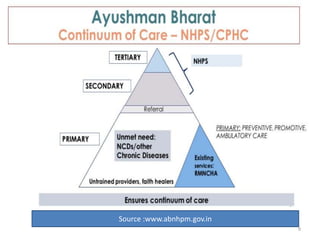
• Continuum of Care
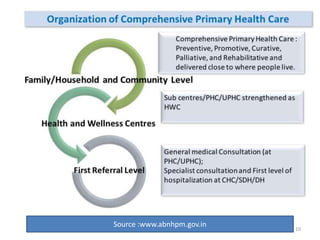
• Organization of CPHC
• Initiatives
• Health and Wellness Centre
• National Protection Scheme
• Comprehensive Primary Health Care Team
• Beneficiary Level
• Health System
• Key Features
2
INTRODUCTION
• Ayushman Bharat Yojana or Ayushman Bharat –
Pradhan Mantri Jan Aarogya Yojana (AB-PMJAY).
• Ayushman Bharat is a fundamental restructuring of the
manner in which beneficiaries access healthcare
services at the primary, secondary and tertiary care
levels.
• It represents a transition from segmented, sectoral and
fragmented program implementation models towards a
comprehensive, holistic, need-based healthcare system.
3
• It encapsulates a progression towards
promotive, preventive, curative, palliative
and rehabilitative aspects through access of
Health and Wellness Centers (HWCs) at the
primary level.
• It provides provision of financial protection for
access of curative care at the secondary and
tertiary levels through engagement with both
public and private sector.
4
5
6
Rationale
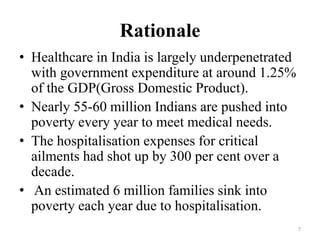
• Healthcare in India is largely underpenetrated
with government expenditure at around 1.25%
of the GDP(Gross Domestic Product).
• Nearly 55-60 million Indians are pushed into
poverty every year to meet medical needs.
• The hospitalisation expenses for critical
ailments had shot up by 300 per cent over a
decade.
• An estimated 6 million families sink into
poverty each year due to hospitalisation.
7
Aim
• Ayushman Bharat aims to undertake path
breaking interventions to holistically
address health( covering prevention,
promotion and ambulatory care), at
primary, secondary and tertiary.
8
Source :www.abnhpm.gov.in
9
Source :www.abnhpm.gov.in 10
The Initiatives
• Health and Wellness Centre:
• National Health Protection Scheme:
11
Health and Wellness Centre
• The first component, pertains to creation of
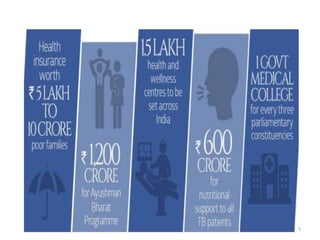
1,50,000 Health and Wellness Centres.
• Comprehensive Primary Health Care (CPHC),
covering both maternal and child health
services and non-communicable diseases,
including free essential drugs and diagnostic
services.
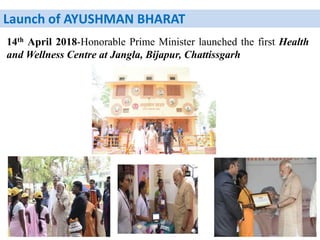
• The first Health and Wellness Centre was
launched by the Hon’ble Prime Minister at
Jangla, Bijapur, Chhatisgarh on 14 April 2018.12
Launch of AYUSHMAN BHARAT
14th April 2018-Honorable Prime Minister launched the first Health
and Wellness Centre at Jangla, Bijapur, Chattissgarh
National Health Protection Scheme
• The second component is the Pradhan Mantri
Jan Arogya Yojana (PM-JAY).
• It provides health protection cover to poor and
vulnerable families.
• About 62.58% of our population has to pay for
their own health and hospitalization expenses
and are not covered through any form of health
protection.
• Source:www.abnhpm.gov.in
14
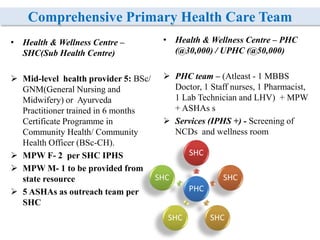
Comprehensive Primary Health Care Team
• Health & Wellness Centre –
SHC(Sub Health Centre)
 Mid-level health provider 5: BSc/
GNM(General Nursing and
Midwifery) or Ayurveda
Practitioner trained in 6 months
Certificate Programme in
Community Health/ Community
Health Officer (BSc-CH).
 MPW F- 2 per SHC IPHS
 MPW M- 1 to be provided from
state resource
 5 ASHAs as outreach team per
SHC
• Health & Wellness Centre – PHC
(@30,000) / UPHC (@50,000)
 PHC team – (Atleast - 1 MBBS
Doctor, 1 Staff nurses, 1 Pharmacist,
1 Lab Technician and LHV) + MPW
+ ASHAs s
 Services (IPHS +) - Screening of
NCDs and wellness room
PHC
SHC
SHC
SHC
SHC
SHC
16
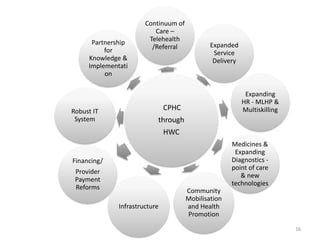
CPHC
through
HWC
Continuum of
Care –
Telehealth
/Referral Expanded
Service
Delivery
Expanding
HR - MLHP &
Multiskilling
Medicines &
Expanding
Diagnostics -
point of care
& new
technologies
Community
Mobilisation
and Health
Promotion
Infrastructure
Financing/
Provider
Payment
Reforms
Robust IT
System
Partnership
for
Knowledge &
Implementati
on
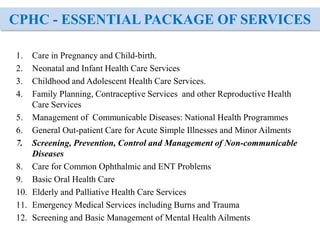
CPHC - ESSENTIAL PACKAGE OF SERVICES
1. Care in Pregnancy and Child-birth.
2. Neonatal and Infant Health Care Services
3. Childhood and Adolescent Health Care Services.
4. Family Planning, Contraceptive Services and other Reproductive Health
Care Services
5. Management of Communicable Diseases: National Health Programmes
6. General Out-patient Care for Acute Simple Illnesses and Minor Ailments
7. Screening, Prevention, Control and Management of Non-communicable
Diseases
8. Care for Common Ophthalmic and ENT Problems
9. Basic Oral Health Care
10. Elderly and Palliative Health Care Services
11. Emergency Medical Services including Burns and Trauma
12. Screening and Basic Management of Mental Health Ailments
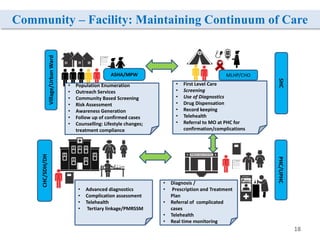
Village/Urban
Ward
ASHA/MPW
• Population Enumeration
• Outreach Services
• Community Based Screening
• Risk Assessment
• Awareness Generation
• Follow up of confirmed cases
• Counselling: Lifestyle changes;
treatment compliance
MLHP/CHO
SHC
PHC/UPHC
• First Level Care
• Screening
• Use of Diagnostics
• Drug Dispensation
• Record keeping
• Telehealth
• Referral to MO at PHC for
confirmation/complications
• Diagnosis /
• Prescription and Treatment
Plan
• Referral of complicated
cases
• Telehealth
• Real time monitoring
CHC/SDH/DH
• Advanced diagnostics
• Complication assessment
• Telehealth
• Tertiary linkage/PMRSSM
Community – Facility: Maintaining Continuum of Care
18
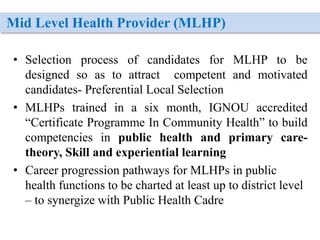
Mid Level Health Provider (MLHP)
• Selection process of candidates for MLHP to be
designed so as to attract competent and motivated
candidates- Preferential Local Selection
• MLHPs trained in a six month, IGNOU accredited
“Certificate Programme In Community Health” to build
competencies in public health and primary care-
theory, Skill and experiential learning
• Career progression pathways for MLHPs in public
health functions to be charted at least up to district level
– to synergize with Public Health Cadre
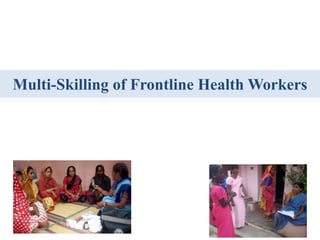
Multi-Skilling of Frontline Health Workers
Training of PHC Team- Staff Nurses, Medical Officers
 Training for Five days for screening and Management of
NCDs.
 21 days for screening for Cancer-VIA for CA Cervix and
further management
 Online Training through Massive Open Online Courses
(MOOC) and Extension for Community Health Outcomes
(ECHO)
 Other Distance mode certificate programmes in areas such as-
NCD management/MCH Care/Elderly Care/Mental Health etc.
to be planned in long term.
 Additional Incentives/ rewards can be introduced
 Partnerships with AIIMS/Regional Cancer Centres/Knowledge
networks to act as training resource centres.
Medicines and diagnostics require early attention
 Essential List of Medicines to be expanded and in place across all states
 MLHP to be able to dispense medicines for chronic diseases on the
prescription of the Medical Officer
 Uninterrupted Availability of medicines to ensure continuation of care (Eg:
HT/DM/ Epilepsy/COPD)
 DVDMS (Drugs and Vaccine Distribution Management System)implemented
in 28 states and implementation in remaining states to be completed over a
period of six months - Expansion to the level of HWC- PHCs/UPHC and
HWC-SHC
 Robust Implementation of Free drugs and Diagnostics schemes in all states to
eliminate OOPE(Out of Programme Clinical Experience.)
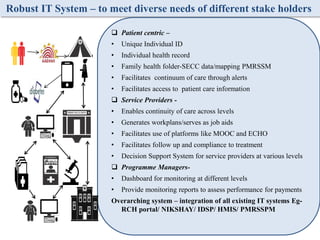
Robust IT System – to meet diverse needs of different stake holders
 Patient centric –
• Unique Individual ID
• Individual health record
• Family health folder-SECC data/mapping PMRSSM
• Facilitates continuum of care through alerts
• Facilitates access to patient care information
 Service Providers -
• Enables continuity of care across levels
• Generates workplans/serves as job aids
• Facilitates use of platforms like MOOC and ECHO
• Facilitates follow up and compliance to treatment
• Decision Support System for service providers at various levels
 Programme Managers-
• Dashboard for monitoring at different levels
• Provide monitoring reports to assess performance for payments
Overarching system – integration of all existing IT systems Eg-
RCH portal/ NIKSHAY/ IDSP/ HMIS/ PMRSSPM
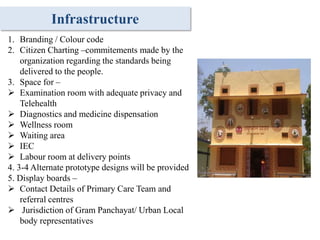
Infrastructure
1. Branding / Colour code
2. Citizen Charting –commitements made by the
organization regarding the standards being
delivered to the people.
3. Space for –
 Examination room with adequate privacy and
Telehealth
 Diagnostics and medicine dispensation
 Wellness room
 Waiting area
 IEC
 Labour room at delivery points
4. 3-4 Alternate prototype designs will be provided
5. Display boards –
 Contact Details of Primary Care Team and
referral centres
 Jurisdiction of Gram Panchayat/ Urban Local
body representatives
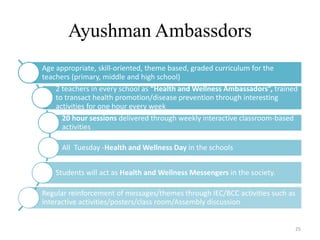
Ayushman Ambassdors
25
Age appropriate, skill-oriented, theme based, graded curriculum for the
teachers (primary, middle and high school)
2 teachers in every school as “Health and Wellness Ambassadors”, trained
to transact health promotion/disease prevention through interesting
activities for one hour every week
20 hour sessions delivered through weekly interactive classroom-based
activities
All Tuesday -Health and Wellness Day in the schools
Students will act as Health and Wellness Messengers in the society.
Regular reinforcement of messages/themes through IEC/BCC activities such as
interactive activities/posters/class room/Assembly discussion
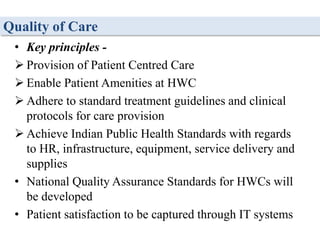
Quality of Care
• Key principles -
 Provision of Patient Centred Care
 Enable Patient Amenities at HWC
 Adhere to standard treatment guidelines and clinical
protocols for care provision
 Achieve Indian Public Health Standards with regards
to HR, infrastructure, equipment, service delivery and
supplies
• National Quality Assurance Standards for HWCs will
be developed
• Patient satisfaction to be captured through IT systems
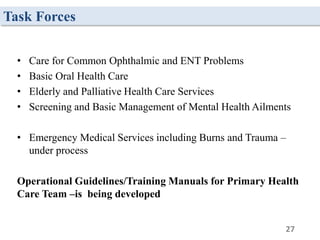
Task Forces
• Care for Common Ophthalmic and ENT Problems
• Basic Oral Health Care
• Elderly and Palliative Health Care Services
• Screening and Basic Management of Mental Health Ailments
• Emergency Medical Services including Burns and Trauma –
under process
Operational Guidelines/Training Manuals for Primary Health
Care Team –is being developed
27
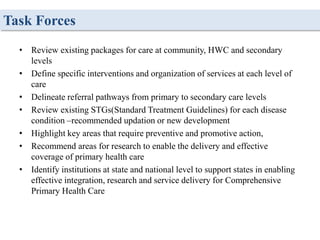
Task Forces
• Review existing packages for care at community, HWC and secondary
levels
• Define specific interventions and organization of services at each level of
care
• Delineate referral pathways from primary to secondary care levels
• Review existing STGs(Standard Treatment Guidelines) for each disease
condition –recommended updation or new development
• Highlight key areas that require preventive and promotive action,
• Recommend areas for research to enable the delivery and effective
coverage of primary health care
• Identify institutions at state and national level to support states in enabling
effective integration, research and service delivery for Comprehensive
Primary Health Care
HWCs in Urban Areas
• One UPHC for every 50,000-60,000
• All existing Urban Primary Health Centers (roughly 4000) to be
strengthened as HWCs by March 2020
• Where dispensaries exist, they could be upgraded to serve as H&WC, based
on the HR available and geographical context
• Frontline workers- 4-5 ASHAs and 1 MPW(F) for 10,000 population -
trained to deliver preventive and promotive services through outreach,
including monitoring drug compliance for chronic diseases.
• MLHP would not be required, as MO MBBS is already approved for
UPHCs
Immediate Next Steps
 Strengthen Programme Management (2 consultants in small states and 3-5
in big states as per requirement)
 Establish technical support from Training institutions/ Research
Organizations / SHSRC(State Health System Resource Centre)/ Medical
College
 Based on annual Targets of HWCs- commensurate selection/ enrolment in
IGNOU Certificate Programme in Community Health
 Completion of training of ASHAs, MPWs, PHC Staff-Medical Officers and
Staff Nurses in NCD
 Undertake gap analysis against the requirement of equipment/medicines/
consumable.
 Roll out of IT Systems and Training of Providers in NCD App/MO Portal
Key Areas for Priority Action
 Appoint Senior State Nodal Officer : Director/Additional Director/Joint
Director level officer
 Periodic reviews by Principal Secretary at all levels
 Road Map for converting all SHCs to HWCs by Dec,2022
 Annual Plans for financial year 19-20, 20-21, 21-22 and 2022-23 (up to
December,2022)
 Prioritizing Aspirational Districts/ NPCDCS( National Programme for
Prevention and Control of Cancer, Diabetes, Cardiovascular Diseases and
Stroke) Districts
 Resources Mobilization from non –Health sources
Sources-Urban Local Bodies/ State Development Programmes/District Mineral
Funds/District Innovation Funds
Beneficiary Level
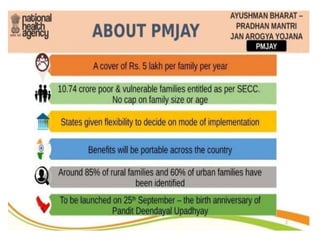
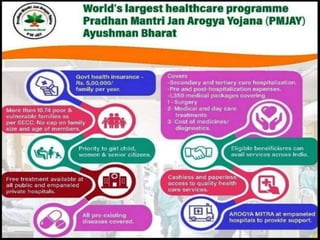
• Government provides health insurance cover of up
to Rs. 5,00,000 per family per year.
• More than 10.74 crore poor and vulnerable families
(approximately 50 crore beneficiaries) covered across
the country.
• All families listed in the SECC(Socioeconomic Caste
Census) database. No cap on family size and age of
members.
• Priority to girl child, women and senior citizens.
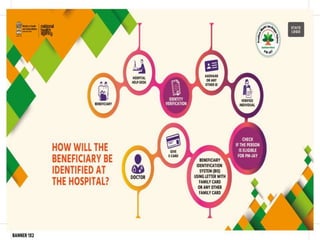
• Free treatment available at all public and empanelled
private hospitals in times of need.
32
33
34
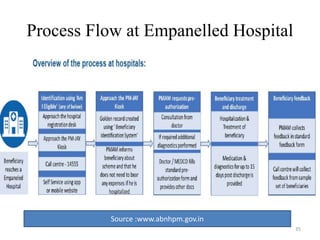
Process Flow at Empanelled Hospital
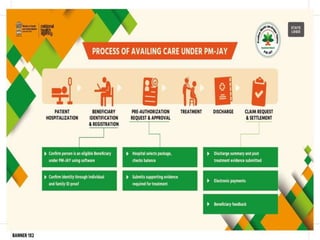
35
Source :www.abnhpm.gov.in
• Covers secondary and tertiary care hospitalization.
• 1,350 medical packages covering surgery, medical
and day care treatments, cost of medicines and
diagnostics.
• All pre-existing diseases covered. Hospitals cannot
deny treatment.
• Cashless and paperless access to quality health care
services.
• Hospitals will not be allowed to charge any additional
money from beneficiaries for the treatment.
• Eligible beneficiaries can avail services across India,
offering benefit of national portability.
36
Health System
• Ensure improved access and affordability, of
quality secondary and tertiary care services
through a combination of public hospitals
• Significantly reduce out of pocket expenditure
for hospitalization.
• Mitigate financial risk arising out of
catastrophic health episodes and consequent
impoverishment for poor and vulnerable
families.
37
• Enhanced used of evidence based health care and
cost control for improved health outcomes.
• Strengthen public health care systems through
infusion of insurance revenues.
• Enable creation of new health infrastructure in
rural, remote and under-served areas.
• Increase health expenditure by Government as a
percentage of GDP.
• Enhanced patient satisfaction.
• Improved health outcomes.
• Improvement in population-level productivity and
efficiency
• Improved quality of life for the population 38
39
40

ayushmaanbharat-181102052021.pdf

  • 1.
    AYUSHMAAN BHARAT BY Dr. KRITISINGH JR-1(Community Medicine) G.S.V.M.Medical College,Kanpur 1
  • 2.
    CONTENTS • Total no.of slides:40 • Introduction • About PM-JAY • Rationale • Aim • Continuum of Care • Organization of CPHC • Initiatives • Health and Wellness Centre • National Protection Scheme • Comprehensive Primary Health Care Team • Beneficiary Level • Health System • Key Features 2
  • 3.
    INTRODUCTION • Ayushman BharatYojana or Ayushman Bharat – Pradhan Mantri Jan Aarogya Yojana (AB-PMJAY). • Ayushman Bharat is a fundamental restructuring of the manner in which beneficiaries access healthcare services at the primary, secondary and tertiary care levels. • It represents a transition from segmented, sectoral and fragmented program implementation models towards a comprehensive, holistic, need-based healthcare system. 3
  • 4.
    • It encapsulatesa progression towards promotive, preventive, curative, palliative and rehabilitative aspects through access of Health and Wellness Centers (HWCs) at the primary level. • It provides provision of financial protection for access of curative care at the secondary and tertiary levels through engagement with both public and private sector. 4
  • 5.
  • 6.
  • 7.
    Rationale • Healthcare inIndia is largely underpenetrated with government expenditure at around 1.25% of the GDP(Gross Domestic Product). • Nearly 55-60 million Indians are pushed into poverty every year to meet medical needs. • The hospitalisation expenses for critical ailments had shot up by 300 per cent over a decade. • An estimated 6 million families sink into poverty each year due to hospitalisation. 7
  • 8.
    Aim • Ayushman Bharataims to undertake path breaking interventions to holistically address health( covering prevention, promotion and ambulatory care), at primary, secondary and tertiary. 8
  • 9.
  • 10.
  • 11.
    The Initiatives • Healthand Wellness Centre: • National Health Protection Scheme: 11
  • 12.
    Health and WellnessCentre • The first component, pertains to creation of 1,50,000 Health and Wellness Centres. • Comprehensive Primary Health Care (CPHC), covering both maternal and child health services and non-communicable diseases, including free essential drugs and diagnostic services. • The first Health and Wellness Centre was launched by the Hon’ble Prime Minister at Jangla, Bijapur, Chhatisgarh on 14 April 2018.12
  • 13.
    Launch of AYUSHMANBHARAT 14th April 2018-Honorable Prime Minister launched the first Health and Wellness Centre at Jangla, Bijapur, Chattissgarh
  • 14.
    National Health ProtectionScheme • The second component is the Pradhan Mantri Jan Arogya Yojana (PM-JAY). • It provides health protection cover to poor and vulnerable families. • About 62.58% of our population has to pay for their own health and hospitalization expenses and are not covered through any form of health protection. • Source:www.abnhpm.gov.in 14
  • 15.
    Comprehensive Primary HealthCare Team • Health & Wellness Centre – SHC(Sub Health Centre)  Mid-level health provider 5: BSc/ GNM(General Nursing and Midwifery) or Ayurveda Practitioner trained in 6 months Certificate Programme in Community Health/ Community Health Officer (BSc-CH).  MPW F- 2 per SHC IPHS  MPW M- 1 to be provided from state resource  5 ASHAs as outreach team per SHC • Health & Wellness Centre – PHC (@30,000) / UPHC (@50,000)  PHC team – (Atleast - 1 MBBS Doctor, 1 Staff nurses, 1 Pharmacist, 1 Lab Technician and LHV) + MPW + ASHAs s  Services (IPHS +) - Screening of NCDs and wellness room PHC SHC SHC SHC SHC SHC
  • 16.
    16 CPHC through HWC Continuum of Care – Telehealth /ReferralExpanded Service Delivery Expanding HR - MLHP & Multiskilling Medicines & Expanding Diagnostics - point of care & new technologies Community Mobilisation and Health Promotion Infrastructure Financing/ Provider Payment Reforms Robust IT System Partnership for Knowledge & Implementati on
  • 17.
    CPHC - ESSENTIALPACKAGE OF SERVICES 1. Care in Pregnancy and Child-birth. 2. Neonatal and Infant Health Care Services 3. Childhood and Adolescent Health Care Services. 4. Family Planning, Contraceptive Services and other Reproductive Health Care Services 5. Management of Communicable Diseases: National Health Programmes 6. General Out-patient Care for Acute Simple Illnesses and Minor Ailments 7. Screening, Prevention, Control and Management of Non-communicable Diseases 8. Care for Common Ophthalmic and ENT Problems 9. Basic Oral Health Care 10. Elderly and Palliative Health Care Services 11. Emergency Medical Services including Burns and Trauma 12. Screening and Basic Management of Mental Health Ailments
  • 18.
    Village/Urban Ward ASHA/MPW • Population Enumeration •Outreach Services • Community Based Screening • Risk Assessment • Awareness Generation • Follow up of confirmed cases • Counselling: Lifestyle changes; treatment compliance MLHP/CHO SHC PHC/UPHC • First Level Care • Screening • Use of Diagnostics • Drug Dispensation • Record keeping • Telehealth • Referral to MO at PHC for confirmation/complications • Diagnosis / • Prescription and Treatment Plan • Referral of complicated cases • Telehealth • Real time monitoring CHC/SDH/DH • Advanced diagnostics • Complication assessment • Telehealth • Tertiary linkage/PMRSSM Community – Facility: Maintaining Continuum of Care 18
  • 19.
    Mid Level HealthProvider (MLHP) • Selection process of candidates for MLHP to be designed so as to attract competent and motivated candidates- Preferential Local Selection • MLHPs trained in a six month, IGNOU accredited “Certificate Programme In Community Health” to build competencies in public health and primary care- theory, Skill and experiential learning • Career progression pathways for MLHPs in public health functions to be charted at least up to district level – to synergize with Public Health Cadre
  • 20.
  • 21.
    Training of PHCTeam- Staff Nurses, Medical Officers  Training for Five days for screening and Management of NCDs.  21 days for screening for Cancer-VIA for CA Cervix and further management  Online Training through Massive Open Online Courses (MOOC) and Extension for Community Health Outcomes (ECHO)  Other Distance mode certificate programmes in areas such as- NCD management/MCH Care/Elderly Care/Mental Health etc. to be planned in long term.  Additional Incentives/ rewards can be introduced  Partnerships with AIIMS/Regional Cancer Centres/Knowledge networks to act as training resource centres.
  • 22.
    Medicines and diagnosticsrequire early attention  Essential List of Medicines to be expanded and in place across all states  MLHP to be able to dispense medicines for chronic diseases on the prescription of the Medical Officer  Uninterrupted Availability of medicines to ensure continuation of care (Eg: HT/DM/ Epilepsy/COPD)  DVDMS (Drugs and Vaccine Distribution Management System)implemented in 28 states and implementation in remaining states to be completed over a period of six months - Expansion to the level of HWC- PHCs/UPHC and HWC-SHC  Robust Implementation of Free drugs and Diagnostics schemes in all states to eliminate OOPE(Out of Programme Clinical Experience.)
  • 23.
    Robust IT System– to meet diverse needs of different stake holders  Patient centric – • Unique Individual ID • Individual health record • Family health folder-SECC data/mapping PMRSSM • Facilitates continuum of care through alerts • Facilitates access to patient care information  Service Providers - • Enables continuity of care across levels • Generates workplans/serves as job aids • Facilitates use of platforms like MOOC and ECHO • Facilitates follow up and compliance to treatment • Decision Support System for service providers at various levels  Programme Managers- • Dashboard for monitoring at different levels • Provide monitoring reports to assess performance for payments Overarching system – integration of all existing IT systems Eg- RCH portal/ NIKSHAY/ IDSP/ HMIS/ PMRSSPM
  • 24.
    Infrastructure 1. Branding /Colour code 2. Citizen Charting –commitements made by the organization regarding the standards being delivered to the people. 3. Space for –  Examination room with adequate privacy and Telehealth  Diagnostics and medicine dispensation  Wellness room  Waiting area  IEC  Labour room at delivery points 4. 3-4 Alternate prototype designs will be provided 5. Display boards –  Contact Details of Primary Care Team and referral centres  Jurisdiction of Gram Panchayat/ Urban Local body representatives
  • 25.
    Ayushman Ambassdors 25 Age appropriate,skill-oriented, theme based, graded curriculum for the teachers (primary, middle and high school) 2 teachers in every school as “Health and Wellness Ambassadors”, trained to transact health promotion/disease prevention through interesting activities for one hour every week 20 hour sessions delivered through weekly interactive classroom-based activities All Tuesday -Health and Wellness Day in the schools Students will act as Health and Wellness Messengers in the society. Regular reinforcement of messages/themes through IEC/BCC activities such as interactive activities/posters/class room/Assembly discussion
  • 26.
    Quality of Care •Key principles -  Provision of Patient Centred Care  Enable Patient Amenities at HWC  Adhere to standard treatment guidelines and clinical protocols for care provision  Achieve Indian Public Health Standards with regards to HR, infrastructure, equipment, service delivery and supplies • National Quality Assurance Standards for HWCs will be developed • Patient satisfaction to be captured through IT systems
  • 27.
    Task Forces • Carefor Common Ophthalmic and ENT Problems • Basic Oral Health Care • Elderly and Palliative Health Care Services • Screening and Basic Management of Mental Health Ailments • Emergency Medical Services including Burns and Trauma – under process Operational Guidelines/Training Manuals for Primary Health Care Team –is being developed 27
  • 28.
    Task Forces • Reviewexisting packages for care at community, HWC and secondary levels • Define specific interventions and organization of services at each level of care • Delineate referral pathways from primary to secondary care levels • Review existing STGs(Standard Treatment Guidelines) for each disease condition –recommended updation or new development • Highlight key areas that require preventive and promotive action, • Recommend areas for research to enable the delivery and effective coverage of primary health care • Identify institutions at state and national level to support states in enabling effective integration, research and service delivery for Comprehensive Primary Health Care
  • 29.
    HWCs in UrbanAreas • One UPHC for every 50,000-60,000 • All existing Urban Primary Health Centers (roughly 4000) to be strengthened as HWCs by March 2020 • Where dispensaries exist, they could be upgraded to serve as H&WC, based on the HR available and geographical context • Frontline workers- 4-5 ASHAs and 1 MPW(F) for 10,000 population - trained to deliver preventive and promotive services through outreach, including monitoring drug compliance for chronic diseases. • MLHP would not be required, as MO MBBS is already approved for UPHCs
  • 30.
    Immediate Next Steps Strengthen Programme Management (2 consultants in small states and 3-5 in big states as per requirement)  Establish technical support from Training institutions/ Research Organizations / SHSRC(State Health System Resource Centre)/ Medical College  Based on annual Targets of HWCs- commensurate selection/ enrolment in IGNOU Certificate Programme in Community Health  Completion of training of ASHAs, MPWs, PHC Staff-Medical Officers and Staff Nurses in NCD  Undertake gap analysis against the requirement of equipment/medicines/ consumable.  Roll out of IT Systems and Training of Providers in NCD App/MO Portal
  • 31.
    Key Areas forPriority Action  Appoint Senior State Nodal Officer : Director/Additional Director/Joint Director level officer  Periodic reviews by Principal Secretary at all levels  Road Map for converting all SHCs to HWCs by Dec,2022  Annual Plans for financial year 19-20, 20-21, 21-22 and 2022-23 (up to December,2022)  Prioritizing Aspirational Districts/ NPCDCS( National Programme for Prevention and Control of Cancer, Diabetes, Cardiovascular Diseases and Stroke) Districts  Resources Mobilization from non –Health sources Sources-Urban Local Bodies/ State Development Programmes/District Mineral Funds/District Innovation Funds
  • 32.
    Beneficiary Level • Governmentprovides health insurance cover of up to Rs. 5,00,000 per family per year. • More than 10.74 crore poor and vulnerable families (approximately 50 crore beneficiaries) covered across the country. • All families listed in the SECC(Socioeconomic Caste Census) database. No cap on family size and age of members. • Priority to girl child, women and senior citizens. • Free treatment available at all public and empanelled private hospitals in times of need. 32
  • 33.
  • 34.
  • 35.
    Process Flow atEmpanelled Hospital 35 Source :www.abnhpm.gov.in
  • 36.
    • Covers secondaryand tertiary care hospitalization. • 1,350 medical packages covering surgery, medical and day care treatments, cost of medicines and diagnostics. • All pre-existing diseases covered. Hospitals cannot deny treatment. • Cashless and paperless access to quality health care services. • Hospitals will not be allowed to charge any additional money from beneficiaries for the treatment. • Eligible beneficiaries can avail services across India, offering benefit of national portability. 36
  • 37.
    Health System • Ensureimproved access and affordability, of quality secondary and tertiary care services through a combination of public hospitals • Significantly reduce out of pocket expenditure for hospitalization. • Mitigate financial risk arising out of catastrophic health episodes and consequent impoverishment for poor and vulnerable families. 37
  • 38.
    • Enhanced usedof evidence based health care and cost control for improved health outcomes. • Strengthen public health care systems through infusion of insurance revenues. • Enable creation of new health infrastructure in rural, remote and under-served areas. • Increase health expenditure by Government as a percentage of GDP. • Enhanced patient satisfaction. • Improved health outcomes. • Improvement in population-level productivity and efficiency • Improved quality of life for the population 38
  • 39.
  • 40.