

UTILIZE COMMUNITY
RESOURCES FOR SELF
AND FAMILY
PRESENTED BY:
Mrs. DEVA PON PUSHPAM.I,
ASSISTANT PROFESSOR
INTRODUCTION
 Community and family resources are
dedicated to proactively assisting
individuals, families and communities
achieve healthy behaviour and lifestyle
through advocacy, prevention and
treatment of substance abuse, gambling,
old age problems, destitute children,
trauma and mental illness.
 Using community resources can make the
difference between reward and burden, yet
self nurturing usually comes last if at all.
COMMUNITY SERVICES
 Trauma services
 Old age homes
 Orphanage
 Home for physically and mentally
challenged
 Home for destitute
 others
TRAUMA SERVICES
Trauma services refers to the services
provided to people who are the victims of
road traffic accidents.
Magnitude of the problem:
 India accounts for nearly 6% of the road
accidents globally.
 The accident rate of 35 per thousand
vehicles in India is the highest in the world.
 In India 1 lakh deaths every year takes
place affecting the age group of 20-40
years.
Main strategies in India:
 Ensure definitive treatment for the victim
within the golden hour.
 No trauma victim has to be transported for
more than 50 km and trauma care facilities
should be available at every 100km
upgrading the existing government health
care facilities.
 Basic life support ambulances should be
available at every 50km along the highways.
 Launch national injury surveillance system
and trauma registry.
 To spread awareness regarding injury
prevention and road safety.
Categories / Levels of trauma care:
1. First responder care
2. Basic pre hospital care
3. Advanced pre hospital emergency care
4. Airway management
First responder care:
 Interested community persons trained to
provide initial first aid can only offer fastest
possible care.
 Best trauma care is possible with actions
from the bystanders such as stop to help,
call for help, assess the victim, start the
breathing and stop the bleeding.
Basic pre hospital care:
 This care is provided by the community
members exposed to formal training in pre
hospital basic life support, scene
management, rescue, stabilization and
transportation of injured persons.
Advanced pre hospital emergency care:
 Advanced life support at pre hospital level is
resource intensive and is expected to be provided
by highly skilled medical professional and
paramedical staff.
 It includes intravenous fluid therapy, endotracheal
intubation and highly invasive interventions such
as needle decompression etc.,
Airway management:
 It has been advocated in patients with traumatic
brain injury, cervical spine or thoracic trauma
before evacuation unless the same can be
performed easily enroute.
 Laryngeal mask airway should be considered as an
alternative to intubation in field situations.
Trauma services at various levels:
Level IV trauma care:
 Appropriately equipped and manned mobile
hospital / ambulances are recognized to
provide level IV trauma care.
Level III trauma care:
 This provides initial evaluation and
stabilization to the trauma patient.
 The district hospitals with a bed capacity of
100 – 200 beds serve in level III.
Contd.,
Level II trauma care:
 This provides definitive care for severe
trauma patients.
 Emergency health care professionals are
available to the trauma patients
immediately on arrival.
 The existing medical college hospitals or
hospitals with bed strength 300 – 500
should be identified as Level II Trauma
Centre.
Contd.,
Level I trauma care:
 This provides the highest level of definitive and
comprehensive care for patient with complex
injuries.
 Mostly medical college hospitals are selected to
provide this level of care since it needs specialist
skill.
 Ministry of Health and Family Welfare,
Government of India is established a National
Trauma Registry and Injury Surveillance System.
 All trauma care facilities have to provide all
relevant information to the said Registry in the
prescribed format from time to time.
Status of trauma services in India:
 Centralized Accident and Trauma Services
(CATS), an autonomous body formed in 1991
by the Delhi Government was probably the first
comprehensive initiative to improve pre
hospital trauma service.
 Emergency Management and Research
Institute (EMRI), Hyderabad, Ambulance
Access for All (AAA) Foundation and Emergency
and Accident Relief Centre (EARC) are other
service providers in Andhra Pradesh,
Maharashtra and Tamil Nadu respectively.
Contd.,
 For faster response Ambulance Motorbike
and Rescue Service (AMARS) was initiated
in March 2003 by Christian Medical College,
Ludhiana to offer support in Punjab,
Himachal Pradesh, Jammu and Delhi.
 Trained paramedical staffs had been
involved by all the above agencies for
offering pre hospital emergency care.
Five year plans and trauma services:
Ninth plan:
A conceptual model of such a system for Delhi has
been prepared which optimizes utilization of
available facilities and prevents wastage of scarce
resources due to duplication of efforts.
The model includes arrangements for:
1. For on-site resuscitation of trauma victims.
2. First aid and transport to the nearest tertiary care
hospital by ambulances with essential equipments
and trained paramedical staff; networking among
and within institutions for manpower, materials,
communication, training and research.
3. Other allied trauma care activities.
Contd.,
Tenth plan:
Efforts will be made to strengthen primary,
secondary and tertiary care institutions
for trauma care through:
1. Adequate training to medical and
paramedical personnel.
2. Provision of facilities for transport of
patients.
3. Suitable strengthening of existing
emergency and casualty services.
4. Improving referral linkages.
OLD AGE HOMES
 Aging is universal and inevitable.
 The senior citizens who do not have family
support, not accommodated by relatives,
not wanting to stay with the family due to
various reasons, look for old age homes.
 Old age homes are safe heavens where old
people can live their lives with dignity and
interact with their peers.
 The report by the United Nations Population
Fund, found the number of over 60s will
increase from around 100 million in 2012 to
more than 300 million by 2050.
Definition of elderly:
 Elderly or old age consists of ages nearing or
surpassing the average life span of human
beings.
 Government of India adopted ‘National Policy
on Older Persons’ in January, 1999, which
defines ‘senior citizen’ or ‘elderly’ as a person
who is of age 60 years or above.
Types of old age homes:
1. Free old age home
2. Paid old age home
Free old age home:
 It cares for the destitute old people who
have no one else to care for them.
 It gives them care, shelter, food, clothing
and medical care.
Paid old age home:
 Here, care is provided for a fee.
 Now a days such ‘retirement’ homes have
become very popular in India and they
are well worth considering.
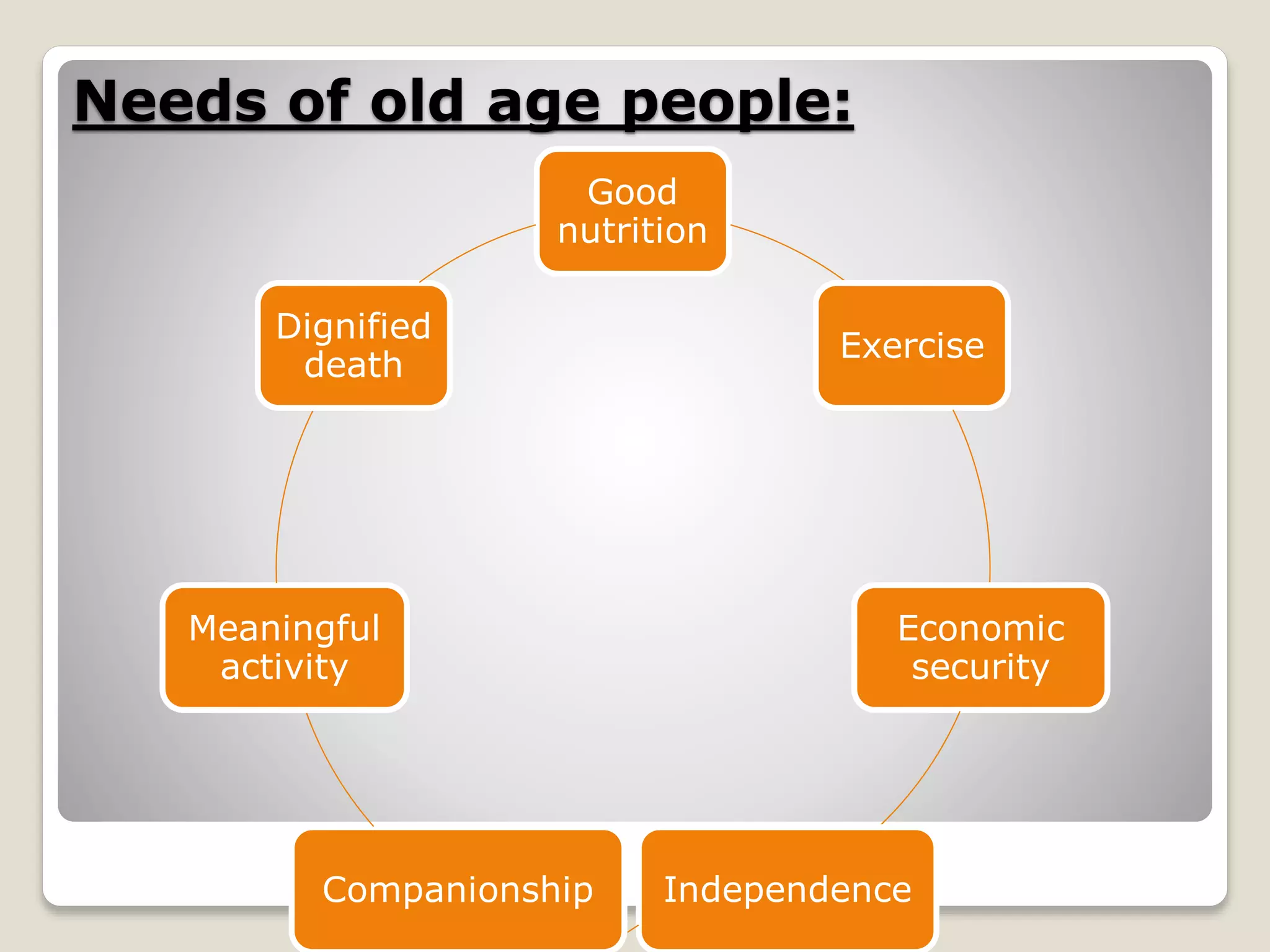
Needs of old age people:
Good
nutrition
Exercise
Economic
security
IndependenceCompanionship
Meaningful
activity
Dignified
death
Guidelines for establishing old age
homes:
Location:
 Calm, pollution free environment and all other
basic necessities just as any comfortable
housing.
 Located in rural or urban setting.
Design:
 Dormitory type, independent rooms or cottages
depending on the social and economic status of
those who are going to live.
 Well ventilated possibly at the ground floor or
else with sloping ramp for easy passage of
wheel chairs.
Contd.,
 The toilets and bathrooms should have rough
flooring.
 Separate room for sick people who need short term
care.
 Recreation rooms and rooms for medical care should
be built.
Manpower:
 Administrator for running the home and supporting
staff such as clerks, cashier cum accountant, nursing
staff, attenders, maids and a cook are the basic
required staff for the efficient running of a old age
home.
 A part time medical officer, nutritionist and a social
worker are essential members.
 Nursing staff and health care workers trained in
geriatric care should be appointed.
Contd.,
Medical care:
 All medicines and medical accessories that
may be needed for treatment of the
residents should be stored as per advice of a
senior physician.
 Drugs should be replaced periodically.
 Transport facilities should be available.
Participation:
 The residents should be encouraged to
participate in the day to day activities of the
home like cooking, maintaining cleanliness,
and periodical celebrations of various
festivals and social events.
Other facilities:
 Recreational and reading facilities such as
televisions, video players, newspapers and
books should be available.
 Other facilities such as active sports like
tennis, table tennis, etc., can be provided.
 Telephones, computers and internet services
can also be made available depending on
the residents usage.
Advantages of old age homes:
 Communication and entertainment facilities
will be provided for the residents.
 Apart from food, shelter and medical
amenities, old age homes also provide yoga
classes to senior citizens.
 Good services and good behaviour of the
staff, food being palatable and wholesome
are the main advantages of old age homes.
 Special medical facilities for senior citizens
such as mobile health care systems,
ambulances, nurses and provision of well
balanced meals.
Disadvantages of old age homes:
 The management is profit driven, patient
care is low on their priorities, employees
are poorly trained and badly paid and not
usually treated well.
 Lack of facilities as well as lack of care
takers in some old age homes.
 Some have to share rooms with others and
sometimes they don’t get along.
 Some elders are not taken care of properly.
ORPHANAGE
 An orphan is a child that has lost one or
both parents.
Definition:
A child who is below 18 years of age and who
has lost one or both parents may be defined
as an orphan.
- George, 2011
Maternal orphan is referred to a child who has
lost their mother.
Paternal orphan is referred to a child who has
lost their father.
Magnitude of orphans:
 Global estimation reveals that there are 153
million children who have lost mother or
father.
 17.8 millions of them have lost both
parents.
 The number of orphans in India stands at
approximately 55 million children of age
between 0 – 12 years, which is about 47%
of the global orphans.
Functions of orphanage:
 Taking care of orphan and abandoned
children of the society, providing them with
food, clothing, shelter and education.
 Orphanage is to bring these less fortunate
children in a divine environment, inculcate
good discipline and shape them into good
citizens.
 Sending children to government school,
private, English medium school and
providing hostel.
 Outgoing picnic.
Contd.,
 Evening activities such as outdoor games,
indoor games, self study, home works and
sports.
 Practice in singing, story telling, drama and
dancing.
 Celebrating children’s day and national
festivals.
 Children with trauma healed physically and
emotionally.
 Malnourished children will get special care
and medical attention.
HOME FOR PHYSICALLY AND
MENTALLY CHALLENGED INDIVIDUALS
 There are many homes established for
physically and mentally challenged
individuals in India.
 There are paid homes and unpaid homes
providing 24*7 care and training activities.
 There are also day care centres where
parents or care taker accompany them and
bring them back in the evening.
Activities of the homes:
 Screening of newborn babies.
 Services to parents of disabled children.
 Job oriented training programs.
 Promotion of self-help groups.
 Parents support groups.
 Physiotherapy
 Speech therapy
 Occupational therapy
 Hydrotherapy
 Medical care, etc.
Services provided by the institutions:
 Formal education
 Social and individual education
 Vocational training
 Treatment
 Food
 Transportation
 Uniforms and books
 Tour and educational exchange program
 Music therapy
 Sports
 Case work / family counseling
National Institute for Empowerment
of Persons with Multiple Disabilities
(NIEPMD):
 Established in the year 2005 in Tamil
Nadu.
 Services provided here include
rehabilitation medicine, physical therapy,
occupational therapy, sensory integration,
early intervention services, prosthetics
and orthotics, special education,
psychological assessments and
interventions, etc.
HOME FOR DESTITUTE
 These are homes for people who do not have
anybody to care.
 These homes mostly provide shelter and
food.
 This may include men, women, aged and
children who do have family or relatives to
take care of them.
Magnitude of the problem:
 Worldwide 100 million children and in India
11 million children are living in the street.
 Majority (89.8%) of children live in the street
with their parents / family.
Categories of street children:
 First category:
Street living children who have run away
from their families and live alone on the
streets. Also called children ‘off’ the street.
 Second category
Street working children, who spend most
of their time on the streets feeding for
themselves, but return home on a regular
basis. Also called children ‘on’ the street.
 Third category
Children from street families who live on
the street with their family.
Reason for being street
children:
Problems of street
children:
 Economic reason
 Physical violence by
their parents
 Loose family ties
 School failure
 Bribed by an adult
 Orphaned by an adult
 Drought, war, ethnic
conflict
 Mental illness
 Acute / chronic
alcoholism
 Respiratory tract
infection
 Drug abuse
 Trauma (assault,
accidents, burns)
 STIs
 Diarrheal disease
 Leg and ear problems
 Mental illness
Strategies to alleviate the problem:
 Making health care facilities available.
 Street based health education which focus on
Family planning, personal hygiene, STIs, HIV,
etc.,
 Looking for possibilities to reunite with their
families.
 Integrated Programme for Street Children
was started as initiatives to help street
children to fulfil their rights. The programme
provides food, shelter, nutrition, health care,
education, recreation facilities and protect
them against abuse and exploitation.
Functions of destitute homes:
 Provide and promote education on
alternative resources.
 Promote awareness through training,
speech, seminars, camps and street plays.
 Mass media on alternative resources.
 Provide industrial education, management
education and training up to top level in the
growing world.
 Train the youth towards national integration,
skill, leadership, rural development, etc.
 Give awareness to women to compete in the
modern world.
Contd.,
 Care for old ages and orphans.
 Training and exercises for physically and
mentally challenged people.
 Minimize alcoholism and rehabilitation
facilities for de addiction.
 Impart skill training to adolescent girls and
boys and to create awareness on HIV, AIDS,
etc.
 Promote and carry on research activities.
 Make aware the humanity through seminar,
talks, training camps, etc.
 Providing shelter, food and clothes.
 Attention to their health and well being.
 Support and care to perform activities of
daily living.
 Provide social, economic and physical
security.
 Improve quality of life and self fulfilment.
 Restore self esteem and dignity.
Contd.,
THANK
YOU

Utilize community resources for self and family

  • 1.
    UTILIZE COMMUNITY RESOURCES FORSELF AND FAMILY PRESENTED BY: Mrs. DEVA PON PUSHPAM.I, ASSISTANT PROFESSOR
  • 2.
    INTRODUCTION  Community andfamily resources are dedicated to proactively assisting individuals, families and communities achieve healthy behaviour and lifestyle through advocacy, prevention and treatment of substance abuse, gambling, old age problems, destitute children, trauma and mental illness.  Using community resources can make the difference between reward and burden, yet self nurturing usually comes last if at all.
  • 3.
    COMMUNITY SERVICES  Traumaservices  Old age homes  Orphanage  Home for physically and mentally challenged  Home for destitute  others
  • 4.
    TRAUMA SERVICES Trauma servicesrefers to the services provided to people who are the victims of road traffic accidents. Magnitude of the problem:  India accounts for nearly 6% of the road accidents globally.  The accident rate of 35 per thousand vehicles in India is the highest in the world.  In India 1 lakh deaths every year takes place affecting the age group of 20-40 years.
  • 5.
    Main strategies inIndia:  Ensure definitive treatment for the victim within the golden hour.  No trauma victim has to be transported for more than 50 km and trauma care facilities should be available at every 100km upgrading the existing government health care facilities.  Basic life support ambulances should be available at every 50km along the highways.  Launch national injury surveillance system and trauma registry.  To spread awareness regarding injury prevention and road safety.
  • 6.
    Categories / Levelsof trauma care: 1. First responder care 2. Basic pre hospital care 3. Advanced pre hospital emergency care 4. Airway management
  • 7.
    First responder care: Interested community persons trained to provide initial first aid can only offer fastest possible care.  Best trauma care is possible with actions from the bystanders such as stop to help, call for help, assess the victim, start the breathing and stop the bleeding. Basic pre hospital care:  This care is provided by the community members exposed to formal training in pre hospital basic life support, scene management, rescue, stabilization and transportation of injured persons.
  • 8.
    Advanced pre hospitalemergency care:  Advanced life support at pre hospital level is resource intensive and is expected to be provided by highly skilled medical professional and paramedical staff.  It includes intravenous fluid therapy, endotracheal intubation and highly invasive interventions such as needle decompression etc., Airway management:  It has been advocated in patients with traumatic brain injury, cervical spine or thoracic trauma before evacuation unless the same can be performed easily enroute.  Laryngeal mask airway should be considered as an alternative to intubation in field situations.
  • 9.
    Trauma services atvarious levels: Level IV trauma care:  Appropriately equipped and manned mobile hospital / ambulances are recognized to provide level IV trauma care. Level III trauma care:  This provides initial evaluation and stabilization to the trauma patient.  The district hospitals with a bed capacity of 100 – 200 beds serve in level III.
  • 10.
    Contd., Level II traumacare:  This provides definitive care for severe trauma patients.  Emergency health care professionals are available to the trauma patients immediately on arrival.  The existing medical college hospitals or hospitals with bed strength 300 – 500 should be identified as Level II Trauma Centre.
  • 11.
    Contd., Level I traumacare:  This provides the highest level of definitive and comprehensive care for patient with complex injuries.  Mostly medical college hospitals are selected to provide this level of care since it needs specialist skill.  Ministry of Health and Family Welfare, Government of India is established a National Trauma Registry and Injury Surveillance System.  All trauma care facilities have to provide all relevant information to the said Registry in the prescribed format from time to time.
  • 12.
    Status of traumaservices in India:  Centralized Accident and Trauma Services (CATS), an autonomous body formed in 1991 by the Delhi Government was probably the first comprehensive initiative to improve pre hospital trauma service.  Emergency Management and Research Institute (EMRI), Hyderabad, Ambulance Access for All (AAA) Foundation and Emergency and Accident Relief Centre (EARC) are other service providers in Andhra Pradesh, Maharashtra and Tamil Nadu respectively.
  • 13.
    Contd.,  For fasterresponse Ambulance Motorbike and Rescue Service (AMARS) was initiated in March 2003 by Christian Medical College, Ludhiana to offer support in Punjab, Himachal Pradesh, Jammu and Delhi.  Trained paramedical staffs had been involved by all the above agencies for offering pre hospital emergency care.
  • 14.
    Five year plansand trauma services: Ninth plan: A conceptual model of such a system for Delhi has been prepared which optimizes utilization of available facilities and prevents wastage of scarce resources due to duplication of efforts. The model includes arrangements for: 1. For on-site resuscitation of trauma victims. 2. First aid and transport to the nearest tertiary care hospital by ambulances with essential equipments and trained paramedical staff; networking among and within institutions for manpower, materials, communication, training and research. 3. Other allied trauma care activities.
  • 15.
    Contd., Tenth plan: Efforts willbe made to strengthen primary, secondary and tertiary care institutions for trauma care through: 1. Adequate training to medical and paramedical personnel. 2. Provision of facilities for transport of patients. 3. Suitable strengthening of existing emergency and casualty services. 4. Improving referral linkages.
  • 16.
    OLD AGE HOMES Aging is universal and inevitable.  The senior citizens who do not have family support, not accommodated by relatives, not wanting to stay with the family due to various reasons, look for old age homes.  Old age homes are safe heavens where old people can live their lives with dignity and interact with their peers.  The report by the United Nations Population Fund, found the number of over 60s will increase from around 100 million in 2012 to more than 300 million by 2050.
  • 17.
    Definition of elderly: Elderly or old age consists of ages nearing or surpassing the average life span of human beings.  Government of India adopted ‘National Policy on Older Persons’ in January, 1999, which defines ‘senior citizen’ or ‘elderly’ as a person who is of age 60 years or above. Types of old age homes: 1. Free old age home 2. Paid old age home
  • 18.
    Free old agehome:  It cares for the destitute old people who have no one else to care for them.  It gives them care, shelter, food, clothing and medical care. Paid old age home:  Here, care is provided for a fee.  Now a days such ‘retirement’ homes have become very popular in India and they are well worth considering.
  • 19.
    Needs of oldage people: Good nutrition Exercise Economic security IndependenceCompanionship Meaningful activity Dignified death
  • 20.
    Guidelines for establishingold age homes: Location:  Calm, pollution free environment and all other basic necessities just as any comfortable housing.  Located in rural or urban setting. Design:  Dormitory type, independent rooms or cottages depending on the social and economic status of those who are going to live.  Well ventilated possibly at the ground floor or else with sloping ramp for easy passage of wheel chairs.
  • 21.
    Contd.,  The toiletsand bathrooms should have rough flooring.  Separate room for sick people who need short term care.  Recreation rooms and rooms for medical care should be built. Manpower:  Administrator for running the home and supporting staff such as clerks, cashier cum accountant, nursing staff, attenders, maids and a cook are the basic required staff for the efficient running of a old age home.  A part time medical officer, nutritionist and a social worker are essential members.  Nursing staff and health care workers trained in geriatric care should be appointed.
  • 22.
    Contd., Medical care:  Allmedicines and medical accessories that may be needed for treatment of the residents should be stored as per advice of a senior physician.  Drugs should be replaced periodically.  Transport facilities should be available. Participation:  The residents should be encouraged to participate in the day to day activities of the home like cooking, maintaining cleanliness, and periodical celebrations of various festivals and social events.
  • 23.
    Other facilities:  Recreationaland reading facilities such as televisions, video players, newspapers and books should be available.  Other facilities such as active sports like tennis, table tennis, etc., can be provided.  Telephones, computers and internet services can also be made available depending on the residents usage.
  • 24.
    Advantages of oldage homes:  Communication and entertainment facilities will be provided for the residents.  Apart from food, shelter and medical amenities, old age homes also provide yoga classes to senior citizens.  Good services and good behaviour of the staff, food being palatable and wholesome are the main advantages of old age homes.  Special medical facilities for senior citizens such as mobile health care systems, ambulances, nurses and provision of well balanced meals.
  • 25.
    Disadvantages of oldage homes:  The management is profit driven, patient care is low on their priorities, employees are poorly trained and badly paid and not usually treated well.  Lack of facilities as well as lack of care takers in some old age homes.  Some have to share rooms with others and sometimes they don’t get along.  Some elders are not taken care of properly.
  • 26.
    ORPHANAGE  An orphanis a child that has lost one or both parents. Definition: A child who is below 18 years of age and who has lost one or both parents may be defined as an orphan. - George, 2011 Maternal orphan is referred to a child who has lost their mother. Paternal orphan is referred to a child who has lost their father.
  • 27.
    Magnitude of orphans: Global estimation reveals that there are 153 million children who have lost mother or father.  17.8 millions of them have lost both parents.  The number of orphans in India stands at approximately 55 million children of age between 0 – 12 years, which is about 47% of the global orphans.
  • 28.
    Functions of orphanage: Taking care of orphan and abandoned children of the society, providing them with food, clothing, shelter and education.  Orphanage is to bring these less fortunate children in a divine environment, inculcate good discipline and shape them into good citizens.  Sending children to government school, private, English medium school and providing hostel.  Outgoing picnic.
  • 29.
    Contd.,  Evening activitiessuch as outdoor games, indoor games, self study, home works and sports.  Practice in singing, story telling, drama and dancing.  Celebrating children’s day and national festivals.  Children with trauma healed physically and emotionally.  Malnourished children will get special care and medical attention.
  • 30.
    HOME FOR PHYSICALLYAND MENTALLY CHALLENGED INDIVIDUALS  There are many homes established for physically and mentally challenged individuals in India.  There are paid homes and unpaid homes providing 24*7 care and training activities.  There are also day care centres where parents or care taker accompany them and bring them back in the evening.
  • 31.
    Activities of thehomes:  Screening of newborn babies.  Services to parents of disabled children.  Job oriented training programs.  Promotion of self-help groups.  Parents support groups.  Physiotherapy  Speech therapy  Occupational therapy  Hydrotherapy  Medical care, etc.
  • 32.
    Services provided bythe institutions:  Formal education  Social and individual education  Vocational training  Treatment  Food  Transportation  Uniforms and books  Tour and educational exchange program  Music therapy  Sports  Case work / family counseling
  • 33.
    National Institute forEmpowerment of Persons with Multiple Disabilities (NIEPMD):  Established in the year 2005 in Tamil Nadu.  Services provided here include rehabilitation medicine, physical therapy, occupational therapy, sensory integration, early intervention services, prosthetics and orthotics, special education, psychological assessments and interventions, etc.
  • 34.
    HOME FOR DESTITUTE These are homes for people who do not have anybody to care.  These homes mostly provide shelter and food.  This may include men, women, aged and children who do have family or relatives to take care of them. Magnitude of the problem:  Worldwide 100 million children and in India 11 million children are living in the street.  Majority (89.8%) of children live in the street with their parents / family.
  • 35.
    Categories of streetchildren:  First category: Street living children who have run away from their families and live alone on the streets. Also called children ‘off’ the street.  Second category Street working children, who spend most of their time on the streets feeding for themselves, but return home on a regular basis. Also called children ‘on’ the street.  Third category Children from street families who live on the street with their family.
  • 37.
    Reason for beingstreet children: Problems of street children:  Economic reason  Physical violence by their parents  Loose family ties  School failure  Bribed by an adult  Orphaned by an adult  Drought, war, ethnic conflict  Mental illness  Acute / chronic alcoholism  Respiratory tract infection  Drug abuse  Trauma (assault, accidents, burns)  STIs  Diarrheal disease  Leg and ear problems  Mental illness
  • 38.
    Strategies to alleviatethe problem:  Making health care facilities available.  Street based health education which focus on Family planning, personal hygiene, STIs, HIV, etc.,  Looking for possibilities to reunite with their families.  Integrated Programme for Street Children was started as initiatives to help street children to fulfil their rights. The programme provides food, shelter, nutrition, health care, education, recreation facilities and protect them against abuse and exploitation.
  • 39.
    Functions of destitutehomes:  Provide and promote education on alternative resources.  Promote awareness through training, speech, seminars, camps and street plays.  Mass media on alternative resources.  Provide industrial education, management education and training up to top level in the growing world.  Train the youth towards national integration, skill, leadership, rural development, etc.  Give awareness to women to compete in the modern world.
  • 40.
    Contd.,  Care forold ages and orphans.  Training and exercises for physically and mentally challenged people.  Minimize alcoholism and rehabilitation facilities for de addiction.  Impart skill training to adolescent girls and boys and to create awareness on HIV, AIDS, etc.  Promote and carry on research activities.  Make aware the humanity through seminar, talks, training camps, etc.
  • 41.
     Providing shelter,food and clothes.  Attention to their health and well being.  Support and care to perform activities of daily living.  Provide social, economic and physical security.  Improve quality of life and self fulfilment.  Restore self esteem and dignity. Contd.,
  • 42.