Documentation
in MLA Format
Using M. L. A. 7th
Edition
Overview of MLA Formatting
 Used in humanities fields (English, writing,
philosophy, and modern languages);
 Works using in-text documentation;
 Includes a Works Cited page;
Definitive Source: MLA Handbook for Writers of
Research Papers, 7th Edition, 2009.
Why Document Sources in MLA Format?
 To give credit where credit is due: avoid
plagiarism;
 To establish your credibility as a careful
student;
 To ensure consistency: readers know what to
expect;
 To give readers access to the sources you
cite;
Works Cited Page
 An alphabetized list of works cited, which appears at the
end of your research paper, gives publication
information for each of the sources you have cited in the
paper;
 Provides bibliographic information so readers can find
sources themselves;
 Each entry includes this basic information:
 Author’s name
 Title of work
 Publication information: Source of work, date
published, volume and issue numbers, and page
numbers;
Rule: All sources cited in the paper must be listed on the
Works Cited page. All sources listed on the Works Cited
page must have been cited in the paper itself.
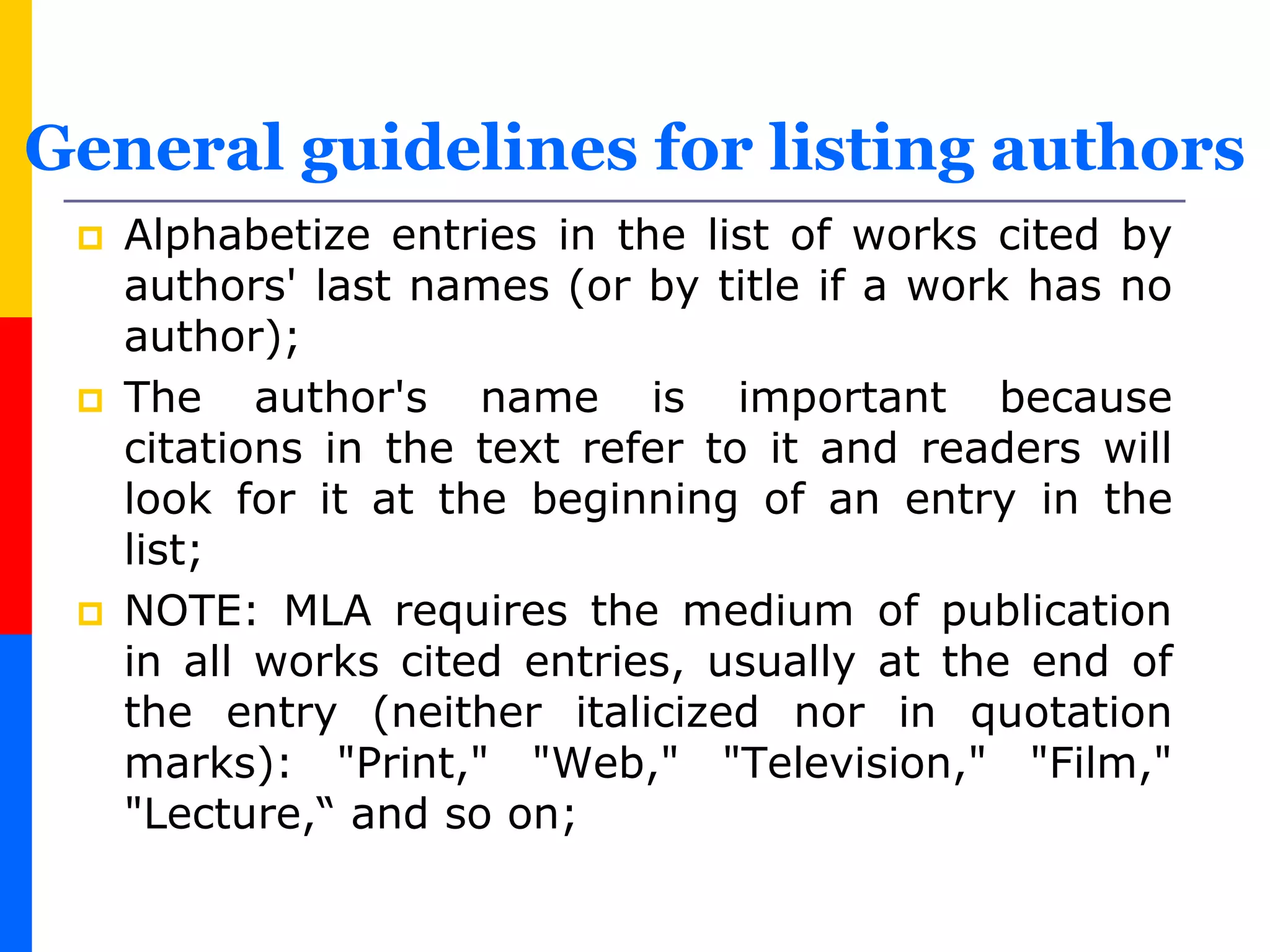
 Alphabetize entries in the list of works cited by
authors' last names (or by title if a work has no
author);
 The author's name is important because
citations in the text refer to it and readers will
look for it at the beginning of an entry in the
list;
 NOTE: MLA requires the medium of publication
in all works cited entries, usually at the end of
the entry (neither italicized nor in quotation
marks): "Print," "Web," "Television," "Film,"
"Lecture,“ and so on;
General guidelines for listing authors
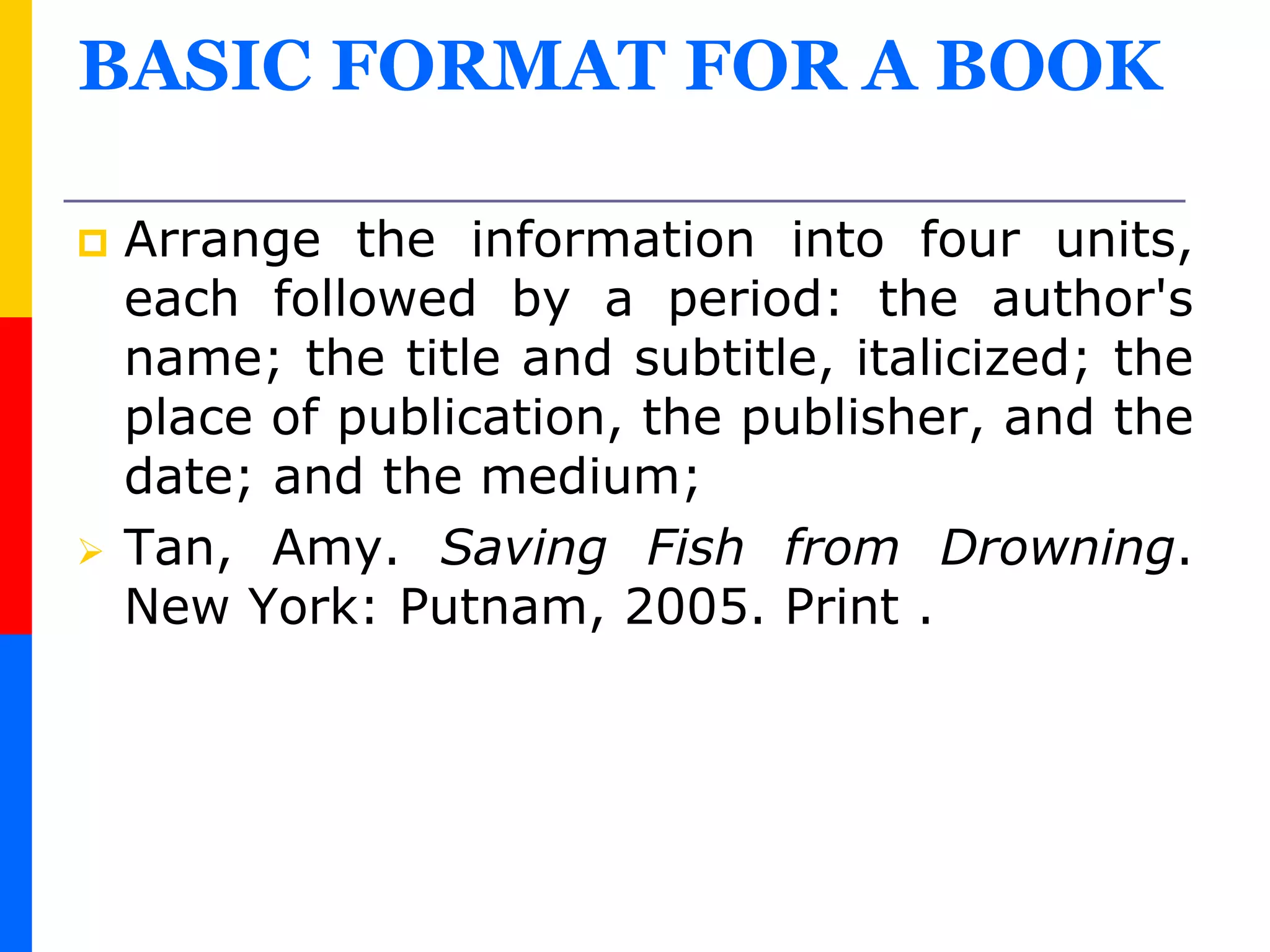
BASIC FORMAT FOR A BOOK
 Arrange the information into four units,
each followed by a period: the author's
name; the title and subtitle, italicized; the
place of publication, the publisher, and the
date; and the medium;
 Tan, Amy. Saving Fish from Drowning.
New York: Putnam, 2005. Print .
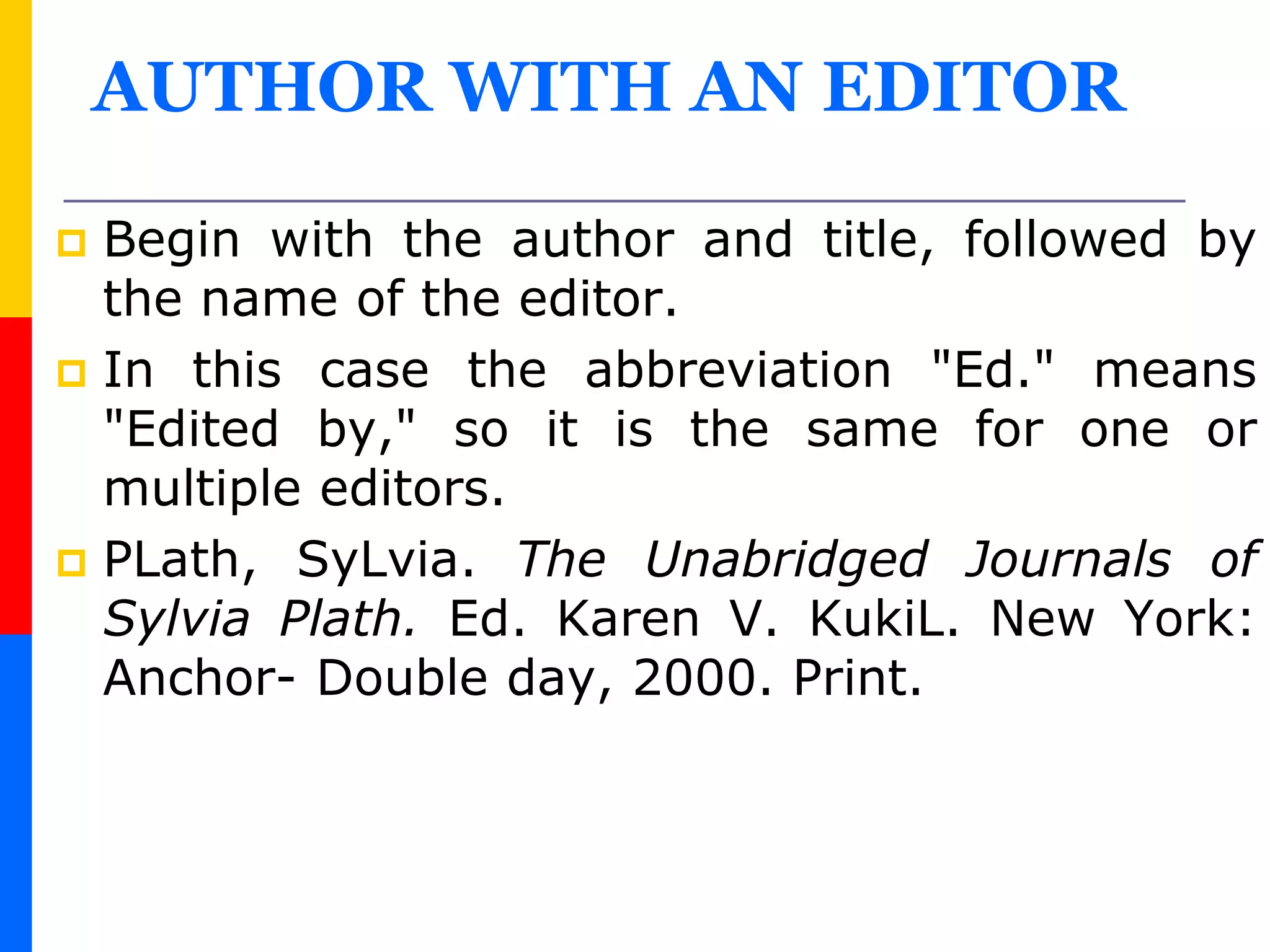
AUTHOR WITH AN EDITOR
 Begin with the author and title, followed by
the name of the editor.
 In this case the abbreviation "Ed." means
"Edited by," so it is the same for one or
multiple editors.
 PLath, SyLvia. The Unabridged Journals of
Sylvia Plath. Ed. Karen V. KukiL. New York:
Anchor- Double day, 2000. Print.
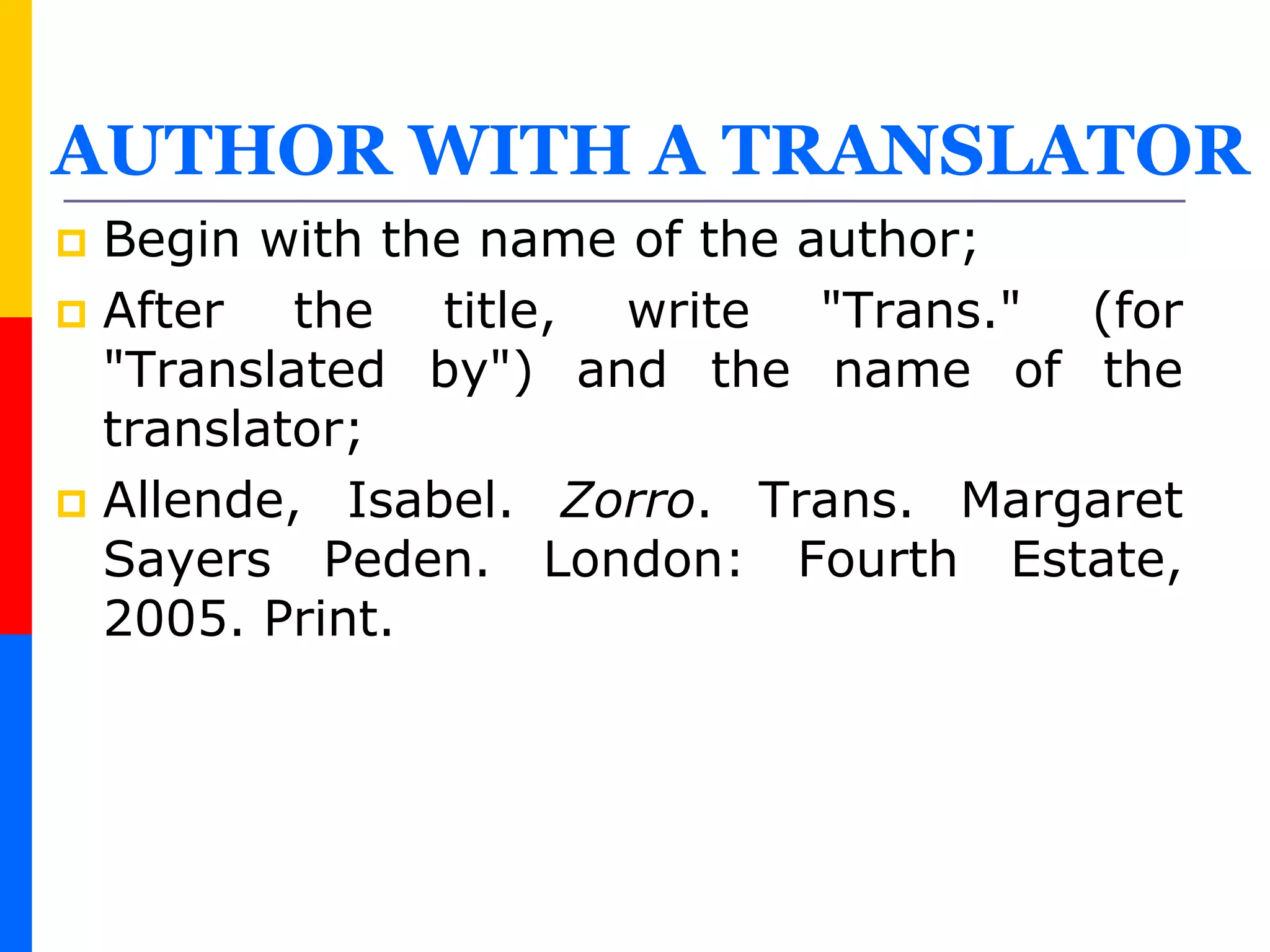
AUTHOR WITH A TRANSLATOR
 Begin with the name of the author;
 After the title, write "Trans." (for
"Translated by") and the name of the
translator;
 Allende, Isabel. Zorro. Trans. Margaret
Sayers Peden. London: Fourth Estate,
2005. Print.
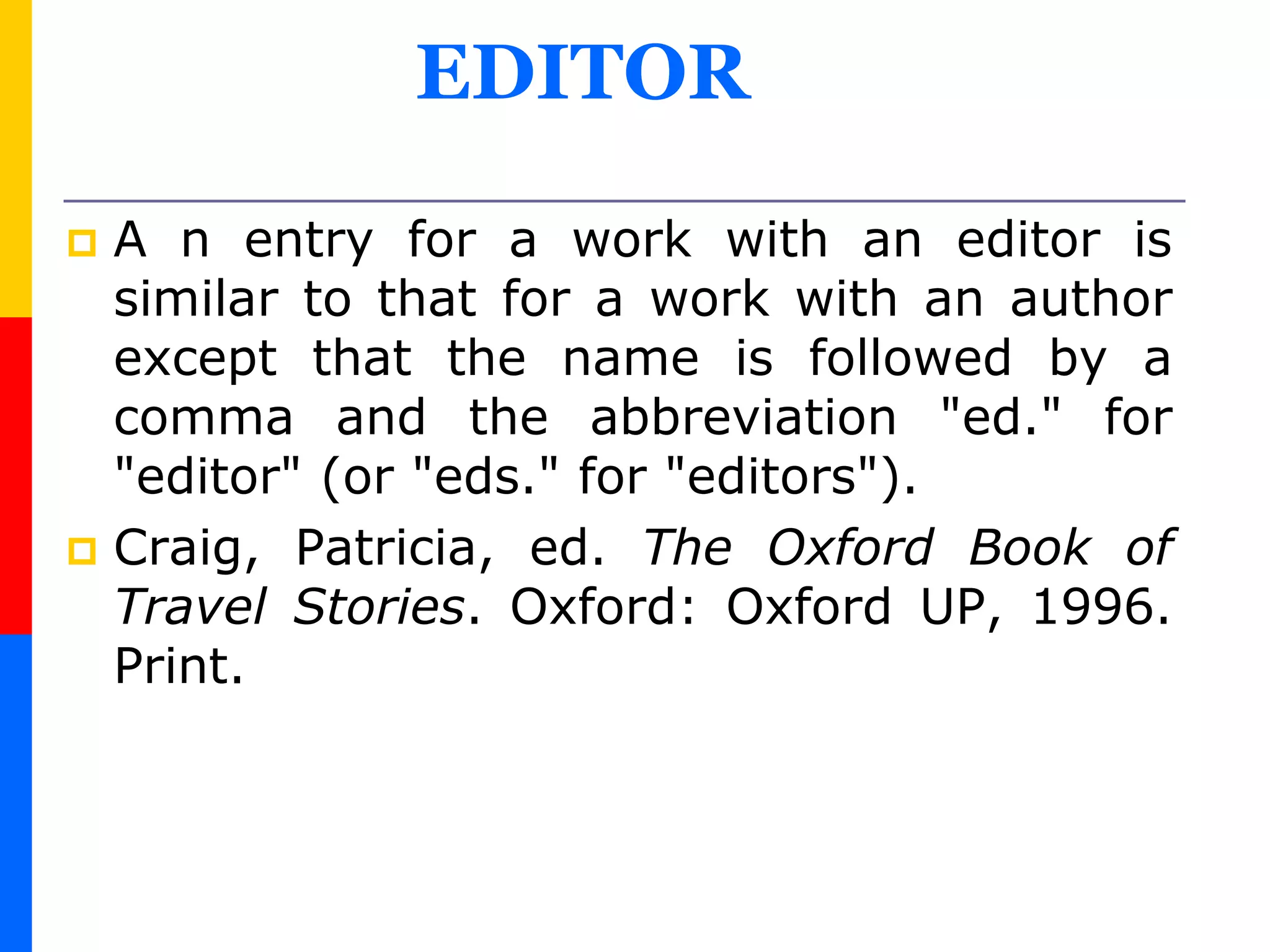
EDITOR
 A n entry for a work with an editor is
similar to that for a work with an author
except that the name is followed by a
comma and the abbreviation "ed." for
"editor" (or "eds." for "editors").
 Craig, Patricia, ed. The Oxford Book of
Travel Stories. Oxford: Oxford UP, 1996.
Print.
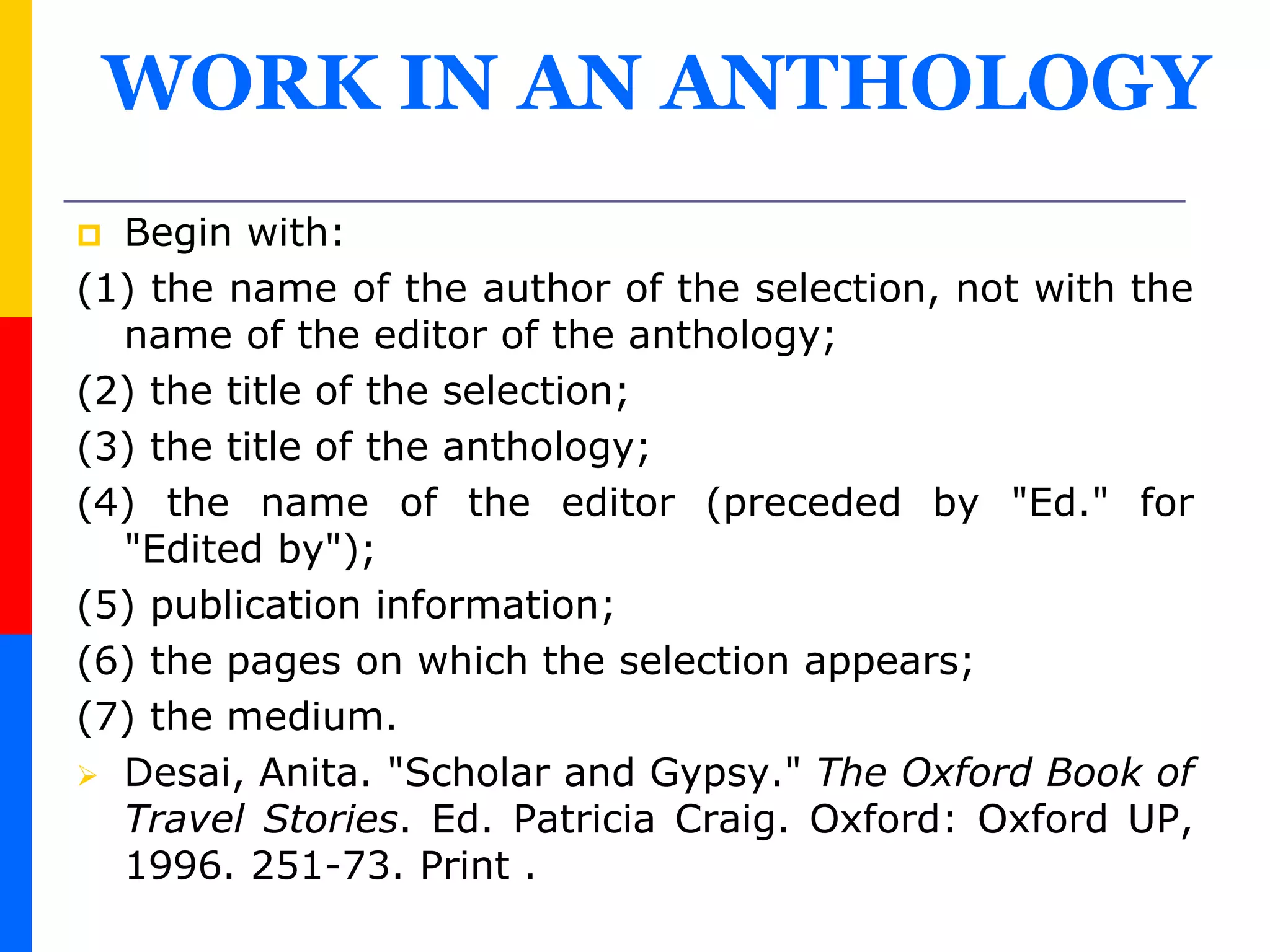
WORK IN AN ANTHOLOGY
 Begin with:
(1) the name of the author of the selection, not with the
name of the editor of the anthology;
(2) the title of the selection;
(3) the title of the anthology;
(4) the name of the editor (preceded by "Ed." for
"Edited by");
(5) publication information;
(6) the pages on which the selection appears;
(7) the medium.
 Desai, Anita. "Scholar and Gypsy." The Oxford Book of
Travel Stories. Ed. Patricia Craig. Oxford: Oxford UP,
1996. 251-73. Print .
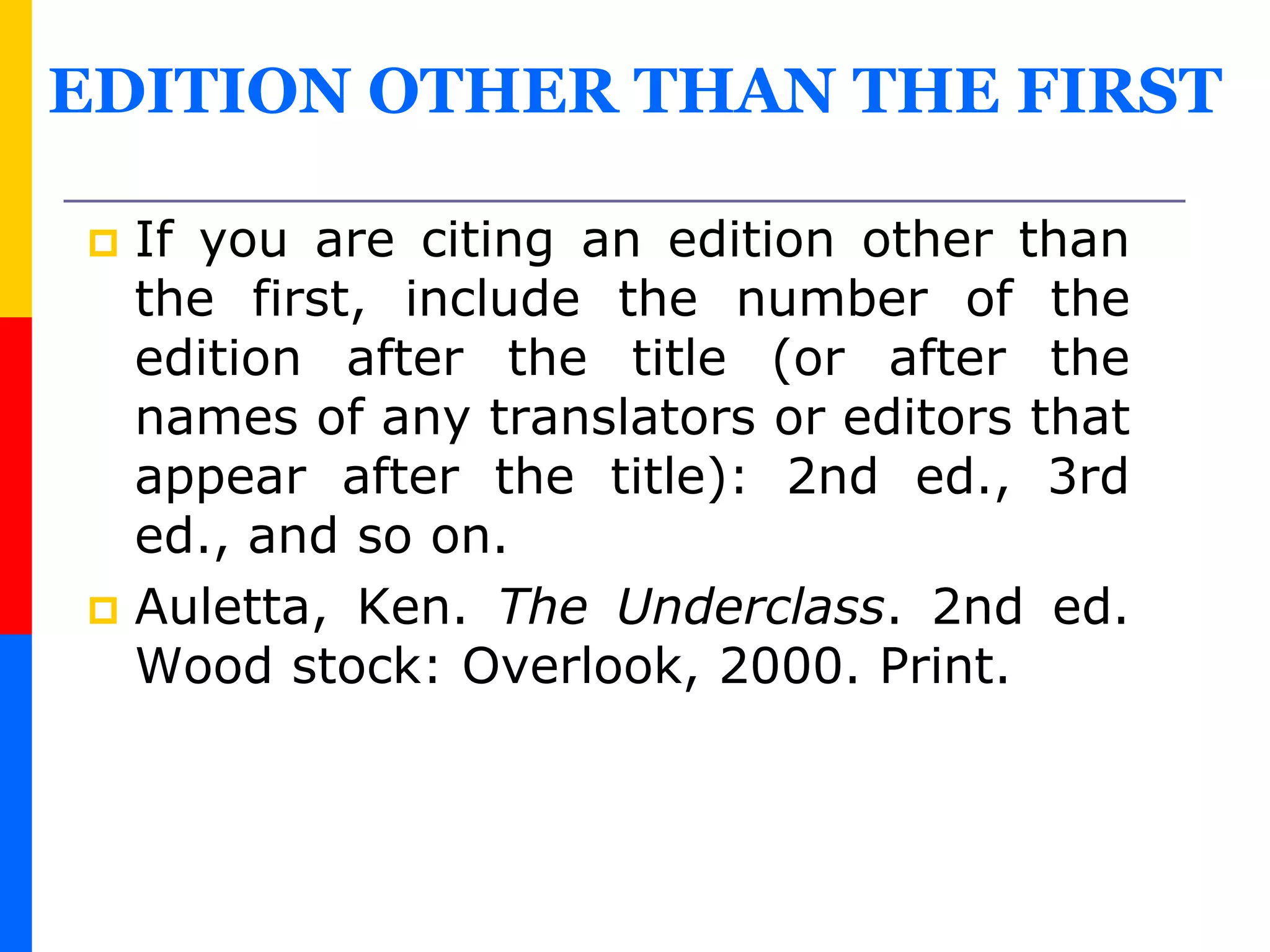
EDITION OTHER THAN THE FIRST
 If you are citing an edition other than
the first, include the number of the
edition after the title (or after the
names of any translators or editors that
appear after the title): 2nd ed., 3rd
ed., and so on.
 Auletta, Ken. The Underclass. 2nd ed.
Wood stock: Overlook, 2000. Print.
MULTIVOLUME WORK
 Include the total number of volumes before the city and
publisher, using the abbreviation "vols.“;
 If the volumes were published over several years, give the
inclusive dates of publication;
 The abbreviation "Ed.” means "Edited by," so it is the same
for one or more editors;
 Stark, Freya. Letters. Ed. Lucy Moorehead. 8vols. Salisbury:
Compton, 1974- 82. Print.
 If your paper cites only one of the volumes, give the volume
number before the city and publisher and give the date of
publication for that volume. After the date, give the total
number of volumes.
 Stark, Freya. Letters. Ed. Lucy Moorehead. Vol. 5.
Salisbury: Compton, 1978. Print. 8 vols .
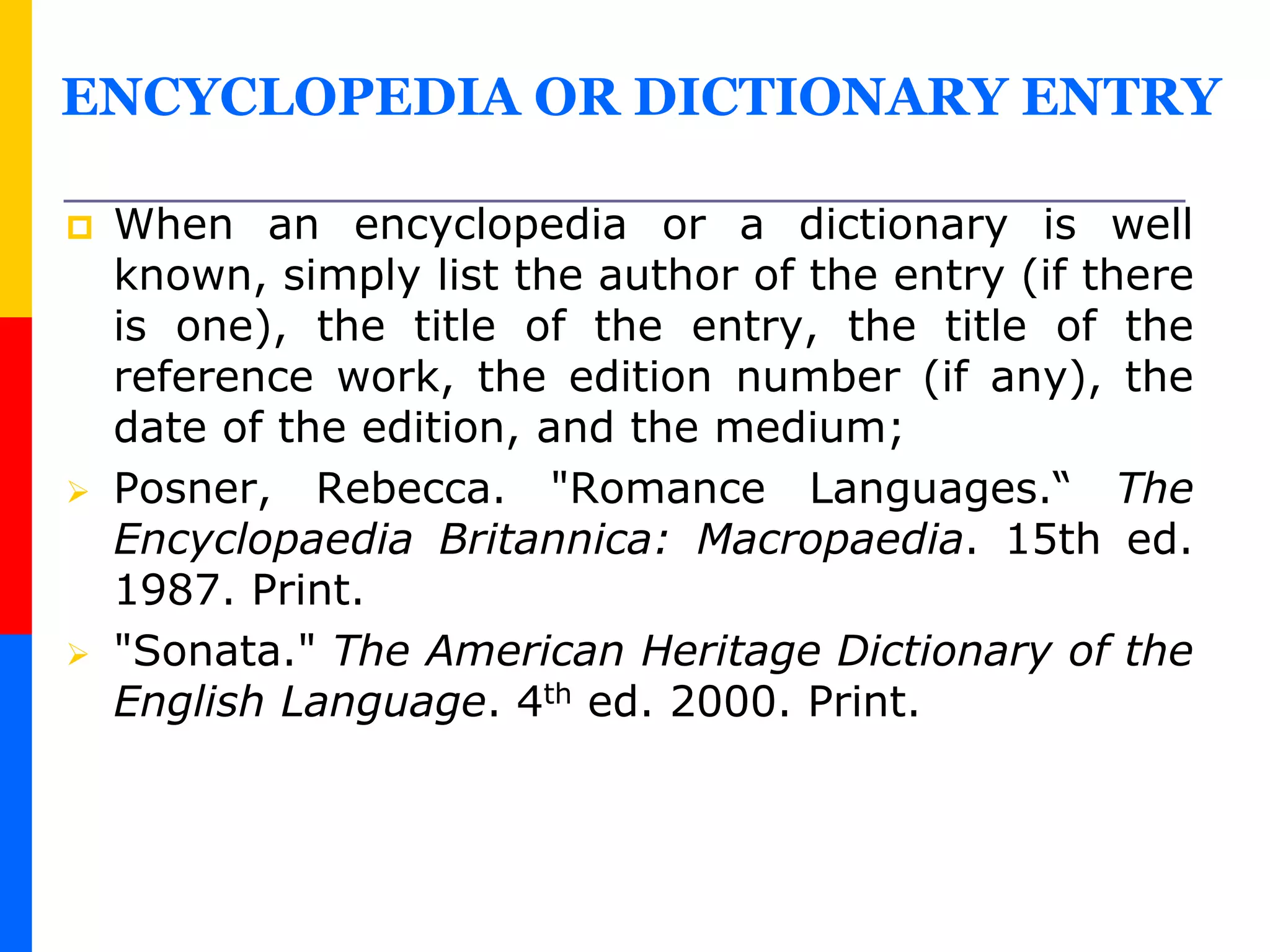
ENCYCLOPEDIA OR DICTIONARY ENTRY
 When an encyclopedia or a dictionary is well
known, simply list the author of the entry (if there
is one), the title of the entry, the title of the
reference work, the edition number (if any), the
date of the edition, and the medium;
 Posner, Rebecca. "Romance Languages.“ The
Encyclopaedia Britannica: Macropaedia. 15th ed.
1987. Print.
 "Sonata." The American Heritage Dictionary of the
English Language. 4th ed. 2000. Print.
SACRED TEXT
 Give the title of the edition of the sacred text,
italicized; the editor's or translator's name (if
any); publication information; and the
medium;
 The Our'an: Translation. Trans. Abdullah
Yusuf Ali. Elmhurst: Tahrike, 2000. Print .
FOREWORD, INTRODUCTION, PREFACE, OR
AFTERWORD
 Give the author of the book part; the name of the
part; the book title; the author of the book,
preceded by the word " By"; the editor of the
book, if any; publication information; page
numbers for the book part; and the medium.
 Morris, Jan. Introduction. Letters from the Field,
1925-1975. By Margaret Mead. New York:
Perennial- Harper, 2001. xix- xxiii. Print.
REPUBLISHED BOOK
 After the title of the book, cite the original
publication date, followed by the current
publication information;
 If the republished book contains new material, such
as an introduction or afterword, include information
about the new material after the original date;
 Hughes, Langston. Black Misery. 1969. Afterword
Robert O'Meally. New York: Oxford UP,
2000. Print.
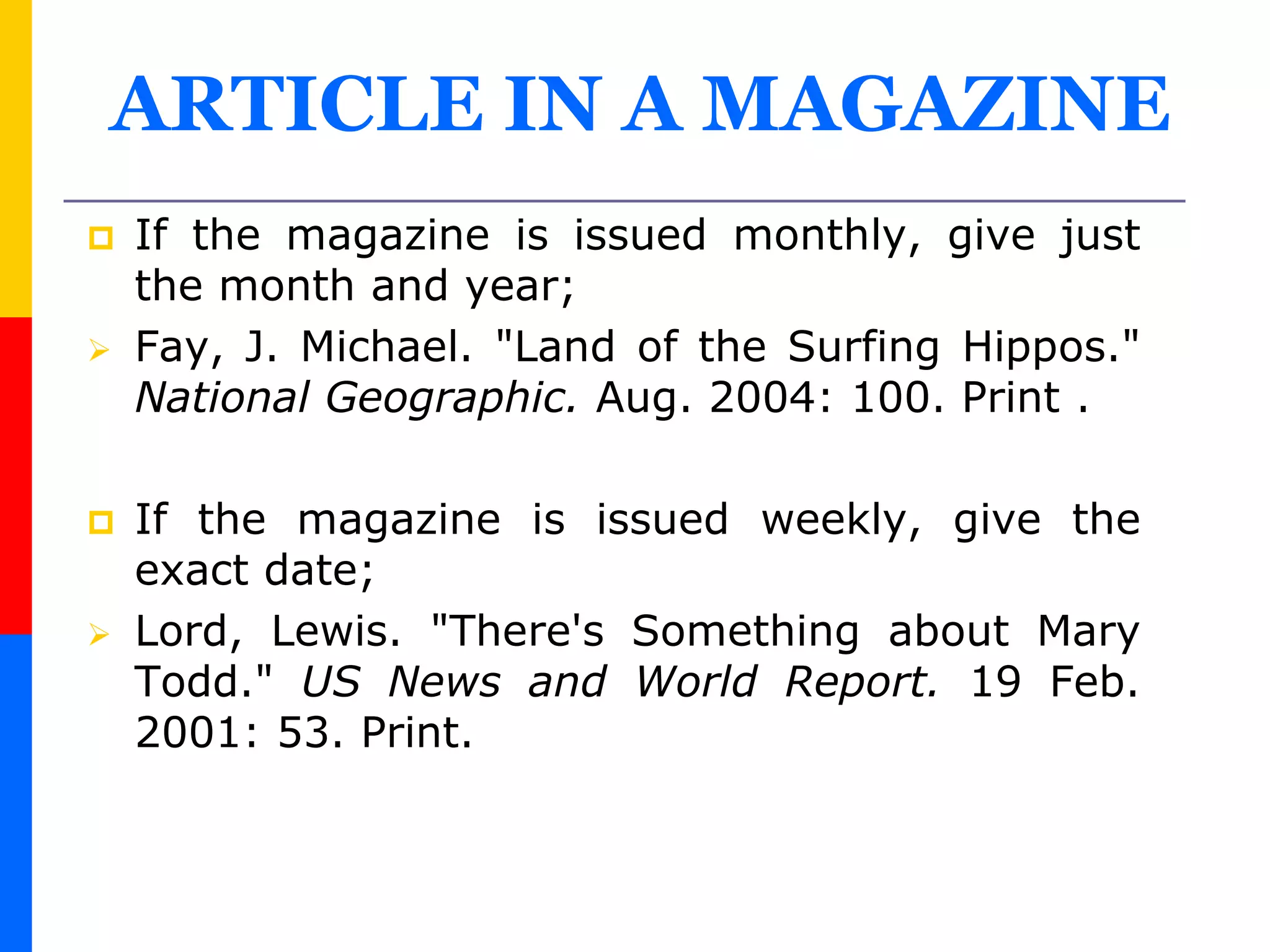
ARTICLE IN A MAGAZINE
 If the magazine is issued monthly, give just
the month and year;
 Fay, J. Michael. "Land of the Surfing Hippos."
National Geographic. Aug. 2004: 100. Print .
 If the magazine is issued weekly, give the
exact date;
 Lord, Lewis. "There's Something about Mary
Todd." US News and World Report. 19 Feb.
2001: 53. Print.
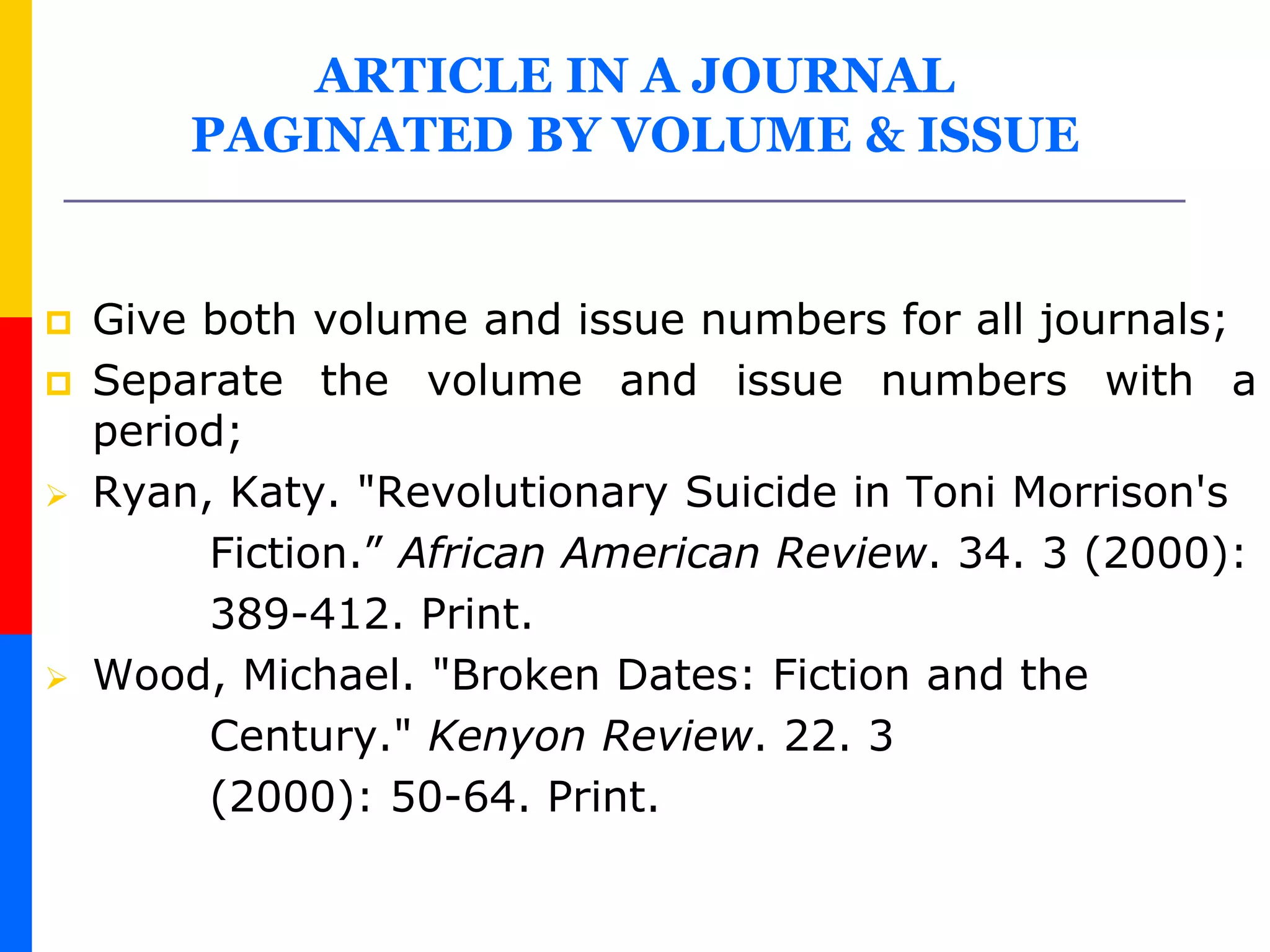
ARTICLE IN A JOURNAL
PAGINATED BY VOLUME & ISSUE
 Give both volume and issue numbers for all journals;
 Separate the volume and issue numbers with a
period;
 Ryan, Katy. "Revolutionary Suicide in Toni Morrison's
Fiction.” African American Review. 34. 3 (2000):
389-412. Print.
 Wood, Michael. "Broken Dates: Fiction and the
Century." Kenyon Review. 22. 3
(2000): 50-64. Print.
ARTICLE IN A DAILY NEWSPAPER
 Include the section letter if it is part of
the page number in the newspaper;
 Brummitt, Chris. "Indonesia's Food Needs
Expected to Soar." Boston Globe.
1 Feb. 2005: 7. Print.
ENTIRE WEB SITE
 Begin with the name of the author, editor, or corporate author
and the title of the site, italicized;
 Then give the sponsor and the date of publication or last update;
 End with the medium and your date of access;
 With author or editor:
 Peterson, Susan Lynn, The Life of Martin Luther, Susan Lynn
Peterson, 2005, Web. 24 Jan. 2009.
 Halsall, Paul. ed. Internet Modern History Sourcebook. Fordham
U, 22 Sept. 2001. Web. 19 Jan. 2009.
 With corporate (group) author:
 United States. Environmental Protection Agency. Drinking Water
Standards. EPA, 28 Nov. 2006. Web. 24 Jan. 2007.
 If your instructor requires a URL for Web sources, include the
URL, enclosed in angle brackets, at the end of the entry.
 Peterson, Susan Lynn. The Life of Martin Luther. Susan Lynn
Peterson, 2005. Web. 24 Jan. 2009. <http://www. susan lynn
peterson. com/index_files/ luther. html>.
Author unknown
 Margaret Sanger Papers Project. History Dept.,
New York U, 18 Oct. 2000. Web. 6 J an. 2009.
 If a site has no title, substitute a description, such
as "Home page," for the title. Do not italicize the
words or put them in quotation marks.
 Yoon, Mina. Home page. Oak Ridge Natl.
Laboratory, 28 Dec. 2006. Web. 12 Jan. 2009.
SHORT WORK FROM A WEB SITE
 Short works include articles, poems, and other documents
that are not book length or that appear as internal pages
on a Web site;
 Include the following elements:
 author's name; title of the short work in quotes; title of the
site italicized; sponsor of the site; date of publication or
last update; medium; and your access date;
 Shiva, Vandana. "Bioethics: A Third World Issue."
NativeWeb. Native Web, n. d. Web. 22 Jan. 2009.
 " Living Old." Frontline. PBS Online, 21 Nov. 2006.
Web. 19 Jan. 2009.
ONLINE BOOK
 Cite a book or a book-length work, such as a play or a long
poem, as you would a short work from a Web site, but
italicize the title of the work;
 Milton, John. Paradise Lost: Book I. Poetry foundation. org.
Poetry Foundation, 2008. Web. 14 Dec. 2008.
 Give the print publication information for the work, if
available, followed by the title of the Web site, the
medium, and your date of access;
 Jacobs, Harriet A. Incidents in the Life of a Slave Girl:
Written by Herself. Ed. L. Maria Child. Boston, 1861.
Documenting the American South. Web. 3 Feb. 2009.
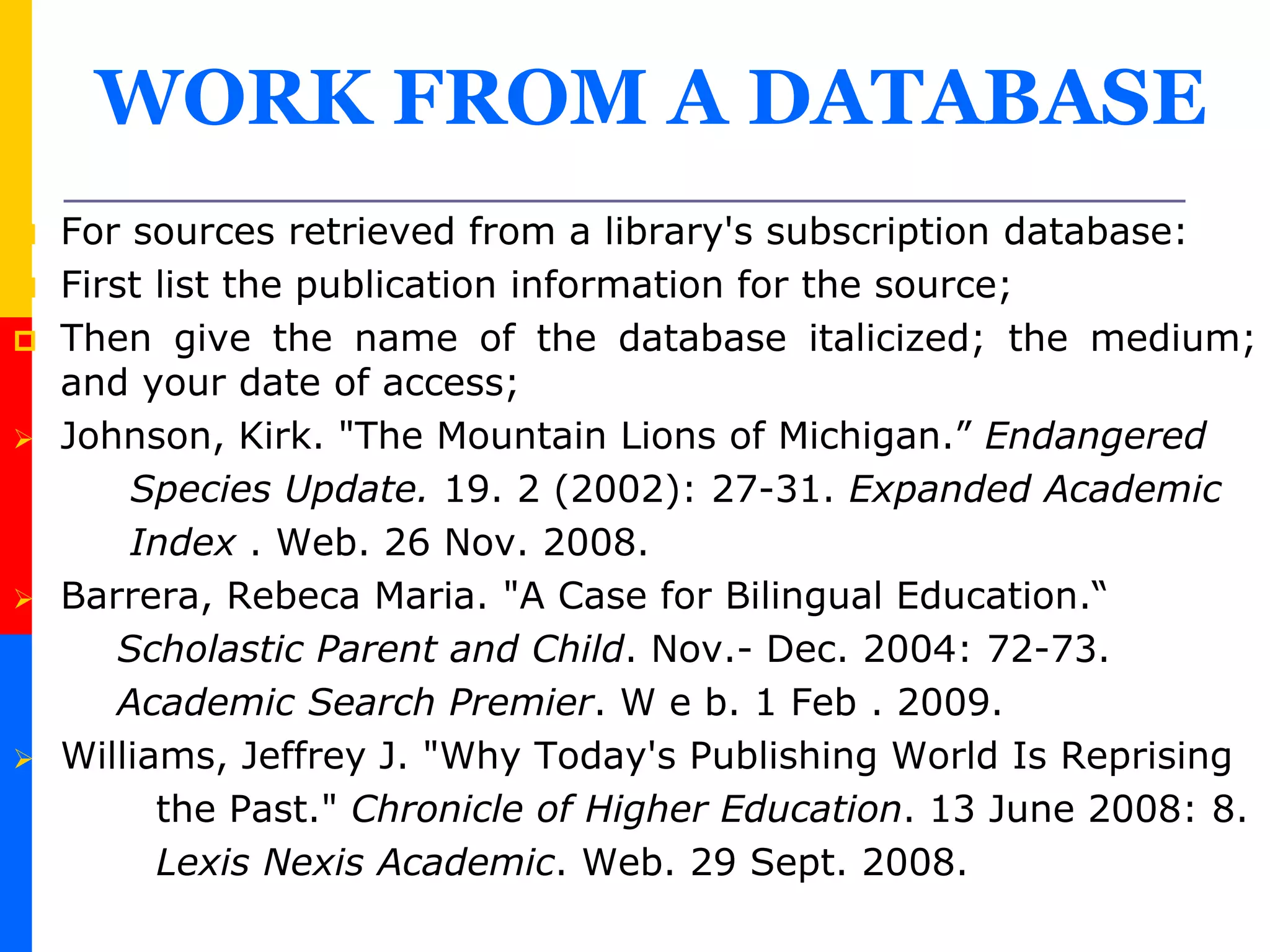
WORK FROM A DATABASE
 For sources retrieved from a library's subscription database:
 First list the publication information for the source;
 Then give the name of the database italicized; the medium;
and your date of access;
 Johnson, Kirk. "The Mountain Lions of Michigan.” Endangered
Species Update. 19. 2 (2002): 27-31. Expanded Academic
Index . Web. 26 Nov. 2008.
 Barrera, Rebeca Maria. "A Case for Bilingual Education.“
Scholastic Parent and Child. Nov.- Dec. 2004: 72-73.
Academic Search Premier. W e b. 1 Feb . 2009.
 Williams, Jeffrey J. "Why Today's Publishing World Is Reprising
the Past." Chronicle of Higher Education. 13 June 2008: 8.
Lexis Nexis Academic. Web. 29 Sept. 2008.
ARTICLE IN ONLINE JOURNALS,
MAGAZINES, OR NEWSPAPERS
 When citing an article in an online journal, give publication
information as for a printjournal, using "n. pag." if the source
does not have page numbers. Then give the medium and your
date of access.
 Belau, Linda. “Trauma and the MateriaL Signifier." Postmodern
Culture 11. 2 (2001): n. pag. Web. 20 Feb. 2009.
 Give the author; the title of the article (in quotation marks); the
title of the magazine or newspaper (italicized); the sponsor or
publisher of the site (use "N. p." if there is none); the date of
publication; the medium; and your date of access.
 Paulson, Steve. "Buddha on the Brain." Salon. com. Salon Media
Group, 27 Nov. 2006. Web. 18 Jan. 2009.
 Rubin, Joel. "Report Faults Charter School." Los Angeles Times.
Los Angeles Times, 22 Jan. 2005. Web. 24 Jan. 2009.
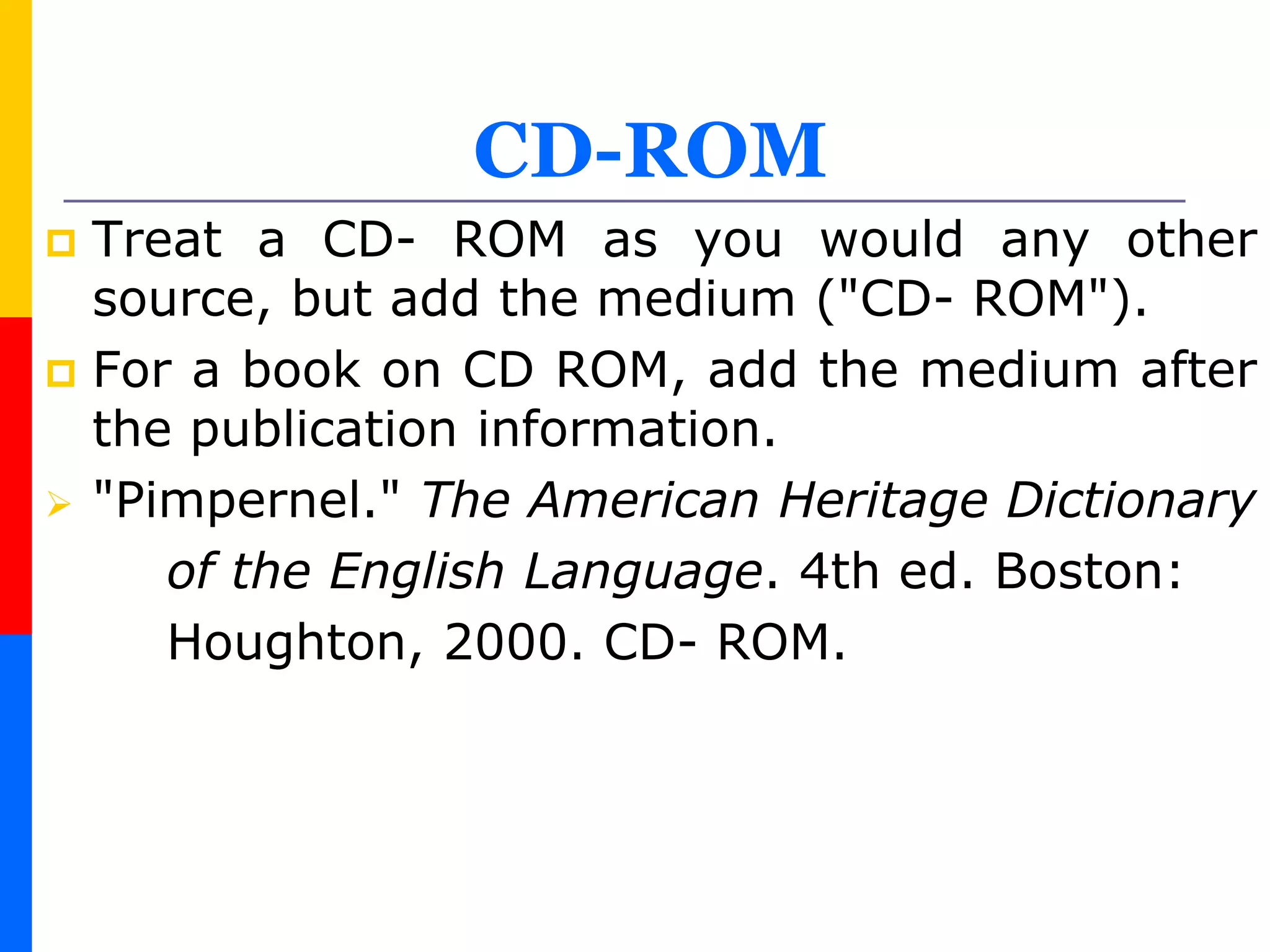
CD-ROM
 Treat a CD- ROM as you would any other
source, but add the medium ("CD- ROM").
 For a book on CD ROM, add the medium after
the publication information.
 "Pimpernel." The American Heritage Dictionary
of the English Language. 4th ed. Boston:
Houghton, 2000. CD- ROM.
E-MAIL
 To cite an e-mail, begin with the writer's
name and the subject line. Then write "
Message to" followed by the name of the
recipient. End with the date of the message
and the medium.
 Lowe, Walter. "Review questions." Message to
the author. 15 Mar. 2009. E- mail.
WORK OF ART
 Cite the artist's name; the title of the artwork, italicized; the
date of composition; the medium of composition (for instance,
"Lithograph on paper," "Photograph,“ "Charcoal on paper"); and
the institution and the city in which the artwork is located. For
artworks found online, omit the medium of composition and
include the title of the Web site, the medium, and your date of
access.
 Constable , John. Dedham Vale. 1802. Oil on canvas. Victoria
and Albert Museum, London.
 Van Gogh, Vincent. The Starry Night. 1889. Museum of Mod. Art,
New York. MoMA: The Museum of Modern Art. Web. 14 Jan.
2009.
MAP OR CHART
 Cite a map or a chart a s you would a book or a short
work within a longer work;
 Use the word "Map“ or "Chart" following the title. Add
the medium;
 For an on line source, the sponsor or publisher and the
date of access;
 Joseph, Lori, and Boblaird. "Driving While Phoning Is
Dangerous.“ Chart." USA Today. 16 Feb. 2001: 10.
Print.
 Serbia. "Map." Syrena Maps. Syrena, 2 Feb. 2001.
Web. 17 Mar. 2009.
Rambo III. Dir. George P. Cosmatos. Cast. Sylvester Stallone,
Richard Crenna, Mark de Jong, Kurtwood Smith, Spiros Focas,
Sasson Gabi, Doudi Shuoa, Marcus Gilbert. Edit. James Symon
& Andrew London. Prod. Mario Kassar & Andrew Vajna.
Written by Sylvester Stallone & Sheldon Lettich. Characters
created by David Morrell. Carolco Production, INC. 1988.
 Required: title (italicized), director, studio, and year released;
 Optional: actors, producers, screenwriters, editors,
cinematographers, and other information;
FILM OR VIDEO
Godfather II. Dir. Francis Ford Coppola. Perf. Al Pacino,
Robert De Niro, Robert Duvall, Diane Keaton. Screenplay
Francis Ford Coppola and Mario Puzo. Based on the novel
by Mario Puzo. Paramount Pictures, 1974. DVD.
Paramount Home Video, Godfather DVD Collection, 2003.
RADIO OR TELEVISION
PROGRAM
 Begin with the title of the radio segment or television episode
in quotation marks, followed by the title of the program,
italicized;
 Next give relevant information about the program's writer
("By"), director ("Dir."), performers ("Perf.");
 Then name the network, the local station and location, the date
of broadcast, and the medium ("Television," "Radio").
 For a program you accessed online, after the information about
the program give the network, the title of the Web site, the
medium ("Web"), and your date of access.
 "New Orleans." American Experience. Narr. Jeffrey Wright. PBS.
WGBH, Boston, 12 Feb. 2007. Television.
 "ElifShafak: Writin gunder a Watchful Eye." Fresh Air. Host Terry
Gross. Natl. Public Radio, 6 Feb. 2007. NPR. org. Web.
22 Feb. 2009.
RADIO OR TELEVISION
INTERVIEW
 Begin with the name of the person who was
interviewed, followed by the word "Interview"
and the interviewer's name.
 McGovern, George. Interview by Charlie Rose. Charlie
Rose. PBS. WNET, New York, 1 Feb. 2001. Television.
 Akufo, Dautey. Personal interview. 11 Aug. 2007.
LECTURE
 Cite the speaker's name, followed by the title of
the lecture in quotation marks; the
organization sponsoring the lecture; the
location; the date; and a label such as
"Lecture“
 Wellbery, David E. "On a Sentence of Franz Kafka.“
Franke Inst. for the Humanities. Gleacher Center,
Chicago. 1 Feb. 2006. Lecture.
GOVERNMENT PUBLICATION
 Treat the government agency as the author, giving the
name of the government followed by the name of the
department and the agency;
 For print sources, add the medium at the end of the entry.
 United States. Dept. of Labor. America's Dynamic
Workforce. Washington: US Dept. of Labor, 2004. Print.
 United States. Dept. of Transportation. Natl. Highway Traffic
Safety Administration. An Investigation of the Safety
Implications of Wireless Communications in Vehicles. Natl.
Highway Traffic Safety Administration, Nov. 1999. Web.
20 May 2006.
Questions?
‫هد‬‫ش‬‫فا‬ ‫هم‬‫لل‬‫ا‬
‫بلغت‬ ‫قد‬ ‫فاين‬
MLA works cited list  7th edition

MLA works cited list 7th edition

  • 1.
  • 2.
    Overview of MLAFormatting  Used in humanities fields (English, writing, philosophy, and modern languages);  Works using in-text documentation;  Includes a Works Cited page; Definitive Source: MLA Handbook for Writers of Research Papers, 7th Edition, 2009.
  • 3.
    Why Document Sourcesin MLA Format?  To give credit where credit is due: avoid plagiarism;  To establish your credibility as a careful student;  To ensure consistency: readers know what to expect;  To give readers access to the sources you cite;
  • 4.
    Works Cited Page An alphabetized list of works cited, which appears at the end of your research paper, gives publication information for each of the sources you have cited in the paper;  Provides bibliographic information so readers can find sources themselves;  Each entry includes this basic information:  Author’s name  Title of work  Publication information: Source of work, date published, volume and issue numbers, and page numbers; Rule: All sources cited in the paper must be listed on the Works Cited page. All sources listed on the Works Cited page must have been cited in the paper itself.
  • 5.
     Alphabetize entriesin the list of works cited by authors' last names (or by title if a work has no author);  The author's name is important because citations in the text refer to it and readers will look for it at the beginning of an entry in the list;  NOTE: MLA requires the medium of publication in all works cited entries, usually at the end of the entry (neither italicized nor in quotation marks): "Print," "Web," "Television," "Film," "Lecture,“ and so on; General guidelines for listing authors
  • 6.
    BASIC FORMAT FORA BOOK  Arrange the information into four units, each followed by a period: the author's name; the title and subtitle, italicized; the place of publication, the publisher, and the date; and the medium;  Tan, Amy. Saving Fish from Drowning. New York: Putnam, 2005. Print .
  • 7.
    AUTHOR WITH ANEDITOR  Begin with the author and title, followed by the name of the editor.  In this case the abbreviation "Ed." means "Edited by," so it is the same for one or multiple editors.  PLath, SyLvia. The Unabridged Journals of Sylvia Plath. Ed. Karen V. KukiL. New York: Anchor- Double day, 2000. Print.
  • 8.
    AUTHOR WITH ATRANSLATOR  Begin with the name of the author;  After the title, write "Trans." (for "Translated by") and the name of the translator;  Allende, Isabel. Zorro. Trans. Margaret Sayers Peden. London: Fourth Estate, 2005. Print.
  • 9.
    EDITOR  A nentry for a work with an editor is similar to that for a work with an author except that the name is followed by a comma and the abbreviation "ed." for "editor" (or "eds." for "editors").  Craig, Patricia, ed. The Oxford Book of Travel Stories. Oxford: Oxford UP, 1996. Print.
  • 10.
    WORK IN ANANTHOLOGY  Begin with: (1) the name of the author of the selection, not with the name of the editor of the anthology; (2) the title of the selection; (3) the title of the anthology; (4) the name of the editor (preceded by "Ed." for "Edited by"); (5) publication information; (6) the pages on which the selection appears; (7) the medium.  Desai, Anita. "Scholar and Gypsy." The Oxford Book of Travel Stories. Ed. Patricia Craig. Oxford: Oxford UP, 1996. 251-73. Print .
  • 11.
    EDITION OTHER THANTHE FIRST  If you are citing an edition other than the first, include the number of the edition after the title (or after the names of any translators or editors that appear after the title): 2nd ed., 3rd ed., and so on.  Auletta, Ken. The Underclass. 2nd ed. Wood stock: Overlook, 2000. Print.
  • 12.
    MULTIVOLUME WORK  Includethe total number of volumes before the city and publisher, using the abbreviation "vols.“;  If the volumes were published over several years, give the inclusive dates of publication;  The abbreviation "Ed.” means "Edited by," so it is the same for one or more editors;  Stark, Freya. Letters. Ed. Lucy Moorehead. 8vols. Salisbury: Compton, 1974- 82. Print.  If your paper cites only one of the volumes, give the volume number before the city and publisher and give the date of publication for that volume. After the date, give the total number of volumes.  Stark, Freya. Letters. Ed. Lucy Moorehead. Vol. 5. Salisbury: Compton, 1978. Print. 8 vols .
  • 13.
    ENCYCLOPEDIA OR DICTIONARYENTRY  When an encyclopedia or a dictionary is well known, simply list the author of the entry (if there is one), the title of the entry, the title of the reference work, the edition number (if any), the date of the edition, and the medium;  Posner, Rebecca. "Romance Languages.“ The Encyclopaedia Britannica: Macropaedia. 15th ed. 1987. Print.  "Sonata." The American Heritage Dictionary of the English Language. 4th ed. 2000. Print.

  • 14.
    SACRED TEXT  Givethe title of the edition of the sacred text, italicized; the editor's or translator's name (if any); publication information; and the medium;  The Our'an: Translation. Trans. Abdullah Yusuf Ali. Elmhurst: Tahrike, 2000. Print .
  • 15.
    FOREWORD, INTRODUCTION, PREFACE,OR AFTERWORD  Give the author of the book part; the name of the part; the book title; the author of the book, preceded by the word " By"; the editor of the book, if any; publication information; page numbers for the book part; and the medium.  Morris, Jan. Introduction. Letters from the Field, 1925-1975. By Margaret Mead. New York: Perennial- Harper, 2001. xix- xxiii. Print.
  • 16.
    REPUBLISHED BOOK  Afterthe title of the book, cite the original publication date, followed by the current publication information;  If the republished book contains new material, such as an introduction or afterword, include information about the new material after the original date;  Hughes, Langston. Black Misery. 1969. Afterword Robert O'Meally. New York: Oxford UP, 2000. Print.
  • 17.
    ARTICLE IN AMAGAZINE  If the magazine is issued monthly, give just the month and year;  Fay, J. Michael. "Land of the Surfing Hippos." National Geographic. Aug. 2004: 100. Print .  If the magazine is issued weekly, give the exact date;  Lord, Lewis. "There's Something about Mary Todd." US News and World Report. 19 Feb. 2001: 53. Print.
  • 18.
    ARTICLE IN AJOURNAL PAGINATED BY VOLUME & ISSUE  Give both volume and issue numbers for all journals;  Separate the volume and issue numbers with a period;  Ryan, Katy. "Revolutionary Suicide in Toni Morrison's Fiction.” African American Review. 34. 3 (2000): 389-412. Print.  Wood, Michael. "Broken Dates: Fiction and the Century." Kenyon Review. 22. 3 (2000): 50-64. Print.
  • 19.
    ARTICLE IN ADAILY NEWSPAPER  Include the section letter if it is part of the page number in the newspaper;  Brummitt, Chris. "Indonesia's Food Needs Expected to Soar." Boston Globe. 1 Feb. 2005: 7. Print.
  • 20.
    ENTIRE WEB SITE Begin with the name of the author, editor, or corporate author and the title of the site, italicized;  Then give the sponsor and the date of publication or last update;  End with the medium and your date of access;  With author or editor:  Peterson, Susan Lynn, The Life of Martin Luther, Susan Lynn Peterson, 2005, Web. 24 Jan. 2009.  Halsall, Paul. ed. Internet Modern History Sourcebook. Fordham U, 22 Sept. 2001. Web. 19 Jan. 2009.  With corporate (group) author:  United States. Environmental Protection Agency. Drinking Water Standards. EPA, 28 Nov. 2006. Web. 24 Jan. 2007.  If your instructor requires a URL for Web sources, include the URL, enclosed in angle brackets, at the end of the entry.  Peterson, Susan Lynn. The Life of Martin Luther. Susan Lynn Peterson, 2005. Web. 24 Jan. 2009. <http://www. susan lynn peterson. com/index_files/ luther. html>.
  • 21.
    Author unknown  MargaretSanger Papers Project. History Dept., New York U, 18 Oct. 2000. Web. 6 J an. 2009.  If a site has no title, substitute a description, such as "Home page," for the title. Do not italicize the words or put them in quotation marks.  Yoon, Mina. Home page. Oak Ridge Natl. Laboratory, 28 Dec. 2006. Web. 12 Jan. 2009.
  • 22.
    SHORT WORK FROMA WEB SITE  Short works include articles, poems, and other documents that are not book length or that appear as internal pages on a Web site;  Include the following elements:  author's name; title of the short work in quotes; title of the site italicized; sponsor of the site; date of publication or last update; medium; and your access date;  Shiva, Vandana. "Bioethics: A Third World Issue." NativeWeb. Native Web, n. d. Web. 22 Jan. 2009.  " Living Old." Frontline. PBS Online, 21 Nov. 2006. Web. 19 Jan. 2009.
  • 23.
    ONLINE BOOK  Citea book or a book-length work, such as a play or a long poem, as you would a short work from a Web site, but italicize the title of the work;  Milton, John. Paradise Lost: Book I. Poetry foundation. org. Poetry Foundation, 2008. Web. 14 Dec. 2008.  Give the print publication information for the work, if available, followed by the title of the Web site, the medium, and your date of access;  Jacobs, Harriet A. Incidents in the Life of a Slave Girl: Written by Herself. Ed. L. Maria Child. Boston, 1861. Documenting the American South. Web. 3 Feb. 2009.
  • 24.
    WORK FROM ADATABASE  For sources retrieved from a library's subscription database:  First list the publication information for the source;  Then give the name of the database italicized; the medium; and your date of access;  Johnson, Kirk. "The Mountain Lions of Michigan.” Endangered Species Update. 19. 2 (2002): 27-31. Expanded Academic Index . Web. 26 Nov. 2008.  Barrera, Rebeca Maria. "A Case for Bilingual Education.“ Scholastic Parent and Child. Nov.- Dec. 2004: 72-73. Academic Search Premier. W e b. 1 Feb . 2009.  Williams, Jeffrey J. "Why Today's Publishing World Is Reprising the Past." Chronicle of Higher Education. 13 June 2008: 8. Lexis Nexis Academic. Web. 29 Sept. 2008.
  • 25.
    ARTICLE IN ONLINEJOURNALS, MAGAZINES, OR NEWSPAPERS  When citing an article in an online journal, give publication information as for a printjournal, using "n. pag." if the source does not have page numbers. Then give the medium and your date of access.  Belau, Linda. “Trauma and the MateriaL Signifier." Postmodern Culture 11. 2 (2001): n. pag. Web. 20 Feb. 2009.  Give the author; the title of the article (in quotation marks); the title of the magazine or newspaper (italicized); the sponsor or publisher of the site (use "N. p." if there is none); the date of publication; the medium; and your date of access.  Paulson, Steve. "Buddha on the Brain." Salon. com. Salon Media Group, 27 Nov. 2006. Web. 18 Jan. 2009.  Rubin, Joel. "Report Faults Charter School." Los Angeles Times. Los Angeles Times, 22 Jan. 2005. Web. 24 Jan. 2009.

  • 26.
    CD-ROM  Treat aCD- ROM as you would any other source, but add the medium ("CD- ROM").  For a book on CD ROM, add the medium after the publication information.  "Pimpernel." The American Heritage Dictionary of the English Language. 4th ed. Boston: Houghton, 2000. CD- ROM.
  • 27.
    E-MAIL  To citean e-mail, begin with the writer's name and the subject line. Then write " Message to" followed by the name of the recipient. End with the date of the message and the medium.  Lowe, Walter. "Review questions." Message to the author. 15 Mar. 2009. E- mail.
  • 28.
    WORK OF ART Cite the artist's name; the title of the artwork, italicized; the date of composition; the medium of composition (for instance, "Lithograph on paper," "Photograph,“ "Charcoal on paper"); and the institution and the city in which the artwork is located. For artworks found online, omit the medium of composition and include the title of the Web site, the medium, and your date of access.  Constable , John. Dedham Vale. 1802. Oil on canvas. Victoria and Albert Museum, London.  Van Gogh, Vincent. The Starry Night. 1889. Museum of Mod. Art, New York. MoMA: The Museum of Modern Art. Web. 14 Jan. 2009.
  • 29.
    MAP OR CHART Cite a map or a chart a s you would a book or a short work within a longer work;  Use the word "Map“ or "Chart" following the title. Add the medium;  For an on line source, the sponsor or publisher and the date of access;  Joseph, Lori, and Boblaird. "Driving While Phoning Is Dangerous.“ Chart." USA Today. 16 Feb. 2001: 10. Print.  Serbia. "Map." Syrena Maps. Syrena, 2 Feb. 2001. Web. 17 Mar. 2009.
  • 30.
    Rambo III. Dir.George P. Cosmatos. Cast. Sylvester Stallone, Richard Crenna, Mark de Jong, Kurtwood Smith, Spiros Focas, Sasson Gabi, Doudi Shuoa, Marcus Gilbert. Edit. James Symon & Andrew London. Prod. Mario Kassar & Andrew Vajna. Written by Sylvester Stallone & Sheldon Lettich. Characters created by David Morrell. Carolco Production, INC. 1988.  Required: title (italicized), director, studio, and year released;  Optional: actors, producers, screenwriters, editors, cinematographers, and other information; FILM OR VIDEO
  • 31.
    Godfather II. Dir.Francis Ford Coppola. Perf. Al Pacino, Robert De Niro, Robert Duvall, Diane Keaton. Screenplay Francis Ford Coppola and Mario Puzo. Based on the novel by Mario Puzo. Paramount Pictures, 1974. DVD. Paramount Home Video, Godfather DVD Collection, 2003.
  • 32.
    RADIO OR TELEVISION PROGRAM Begin with the title of the radio segment or television episode in quotation marks, followed by the title of the program, italicized;  Next give relevant information about the program's writer ("By"), director ("Dir."), performers ("Perf.");  Then name the network, the local station and location, the date of broadcast, and the medium ("Television," "Radio").  For a program you accessed online, after the information about the program give the network, the title of the Web site, the medium ("Web"), and your date of access.  "New Orleans." American Experience. Narr. Jeffrey Wright. PBS. WGBH, Boston, 12 Feb. 2007. Television.  "ElifShafak: Writin gunder a Watchful Eye." Fresh Air. Host Terry Gross. Natl. Public Radio, 6 Feb. 2007. NPR. org. Web. 22 Feb. 2009.
  • 33.
    RADIO OR TELEVISION INTERVIEW Begin with the name of the person who was interviewed, followed by the word "Interview" and the interviewer's name.  McGovern, George. Interview by Charlie Rose. Charlie Rose. PBS. WNET, New York, 1 Feb. 2001. Television.  Akufo, Dautey. Personal interview. 11 Aug. 2007.
  • 34.
    LECTURE  Cite thespeaker's name, followed by the title of the lecture in quotation marks; the organization sponsoring the lecture; the location; the date; and a label such as "Lecture“  Wellbery, David E. "On a Sentence of Franz Kafka.“ Franke Inst. for the Humanities. Gleacher Center, Chicago. 1 Feb. 2006. Lecture.
  • 35.
    GOVERNMENT PUBLICATION  Treatthe government agency as the author, giving the name of the government followed by the name of the department and the agency;  For print sources, add the medium at the end of the entry.  United States. Dept. of Labor. America's Dynamic Workforce. Washington: US Dept. of Labor, 2004. Print.  United States. Dept. of Transportation. Natl. Highway Traffic Safety Administration. An Investigation of the Safety Implications of Wireless Communications in Vehicles. Natl. Highway Traffic Safety Administration, Nov. 1999. Web. 20 May 2006.
  • 36.
  • 38.