Adapted from
the Purdue
Online Writing
Lab
for
Santa Ana
College
MLA 8th Edition
Formatting
and
Style Guide:
Works Cited: The Basics
 Understand the basic elements required to create an MLA
formatted Works Cited page for a research assignment
 Understand the relationship to and the importance of a Works
Cited page to a research assignment
 Know the different sources that must be listed on a Works Cited
page
 Know how and why sources should be listed on a Works Cited
page
 Search for information regarding an MLA formatted Works Cited
page by using the OWL at Purdue
 Use Microsoft Word to create my own properly formatted MLA
Works Cited page for a research assignment
AFTER THIS WORKSHOP I WILL…
 A Works Cited page provides the necessary information to identify
and locate the sources that were summarized, paraphrased, or
quoted in a research paper.
 In-text citations are limited to the author or title of work, which is
often not enough for another researcher to locate the same source.
 Therefore, MLA requires that research papers include an
additional, separate final page entitled “Works Cited” to provide
the full bibliographic information for each source used in an essay.
 Incomplete or missing Works Cited pages can result in intentional
or unintentional plagiarism resulting in a non-passing paper.
WHAT IS A WORKS CITED PAGE?
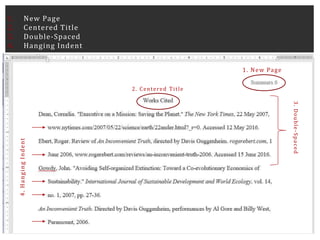
1. Start a new page for your Works Cited list (e.g., if
your paper is 4 pages long, start your Works Cited list
on page 5).
2. Center the title, Works Cited, at the top of the page
and do not bold or underline it. Look for the
alignment option in Word.
3. Double-space the list.
4. Start the first line of each citation at the left margin;
each subsequent line should be indented (also known
as a "hanging indent").
HOW DO I FORMAT A WORKS CITED PAGE?
1. New Page
2. Centered Title
3. Double-Spaced
4. Hanging Indent
1. New Page
2. Centered Title
3
.
D
o
u
b
l
e
-
S
p
a
c
e
d
4
.
H
a
n
g
i
n
g
I
n
d
e
n
t
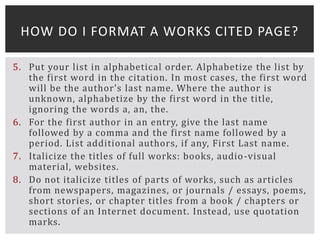
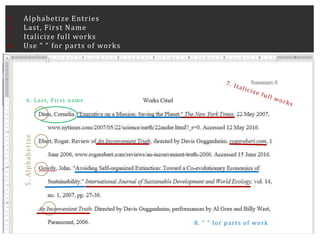
5. Put your list in alphabetical order. Alphabetize the list by
the first word in the citation. In most cases, the first word
will be the author’s last name. Where the author is
unknown, alphabetize by the first word in the title,
ignoring the words a, an, the.
6. For the first author in an entry, give the last name
followed by a comma and the first name followed by a
period. List additional authors, if any, First Last name.
7. Italicize the titles of full works: books, audio-visual
material, websites.
8. Do not italicize titles of parts of works, such as articles
from newspapers, magazines, or journals / essays, poems,
short stories, or chapter titles from a book / chapters or
sections of an Internet document. Instead, use quotation
marks.
HOW DO I FORMAT A WORKS CITED PAGE?
5. Alphabetize Entries
6. Last, First Name
7. Italicize full works
8. Use “ ” for parts of works
6. Last, First name
5.
Alphabetize
8. “ ” for parts of work
Works Cited: Creating Entries for Sources
Now that you know the basic steps to
setting up an MLA Works Cited page, we’ll
look at a few examples of types of entries.
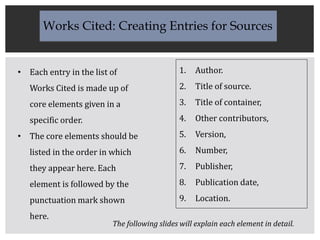
• Each entry in the list of
Works Cited is made up of
core elements given in a
specific order.
• The core elements should be
listed in the order in which
they appear here. Each
element is followed by the
punctuation mark shown
here.
1. Author.
2. Title of source.
3. Title of container,
4. Other contributors,
5. Version,
6. Number,
7. Publisher,
8. Publication date,
9. Location.
Works Cited: Creating Entries for Sources
The following slides will explain each element in detail.
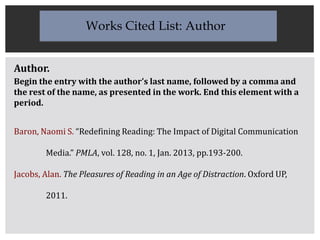
Author.
Begin the entry with the author’s last name, followed by a comma and
the rest of the name, as presented in the work. End this element with a
period.
Baron, Naomi S. “Redefining Reading: The Impact of Digital Communication
Media.” PMLA, vol. 128, no. 1, Jan. 2013, pp.193-200.
Jacobs, Alan. The Pleasures of Reading in an Age of Distraction. Oxford UP,
2011.
Works Cited List: Author
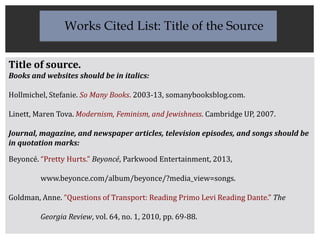
Title of source.
Books and websites should be in italics:
Hollmichel, Stefanie. So Many Books. 2003-13, somanybooksblog.com.
Linett, Maren Tova. Modernism, Feminism, and Jewishness. Cambridge UP, 2007.
Journal, magazine, and newspaper articles, television episodes, and songs should be
in quotation marks:
Beyoncé. “Pretty Hurts.” Beyoncé, Parkwood Entertainment, 2013,
www.beyonce.com/album/beyonce/?media_view=songs.
Goldman, Anne. “Questions of Transport: Reading Primo Levi Reading Dante.” The
Georgia Review, vol. 64, no. 1, 2010, pp. 69-88.
Works Cited List: Title of the Source
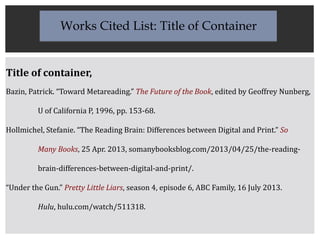
Title of container,
Bazin, Patrick. “Toward Metareading.” The Future of the Book, edited by Geoffrey Nunberg,
U of California P, 1996, pp. 153-68.
Hollmichel, Stefanie. “The Reading Brain: Differences between Digital and Print.” So
Many Books, 25 Apr. 2013, somanybooksblog.com/2013/04/25/the-reading-
brain-differences-between-digital-and-print/.
“Under the Gun.” Pretty Little Liars, season 4, episode 6, ABC Family, 16 July 2013.
Hulu, hulu.com/watch/511318.
Works Cited List: Title of Container
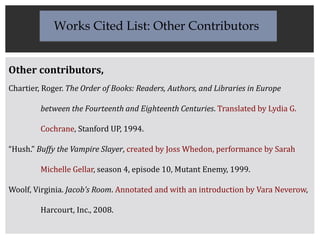
Other contributors,
Chartier, Roger. The Order of Books: Readers, Authors, and Libraries in Europe
between the Fourteenth and Eighteenth Centuries. Translated by Lydia G.
Cochrane, Stanford UP, 1994.
“Hush.” Buffy the Vampire Slayer, created by Joss Whedon, performance by Sarah
Michelle Gellar, season 4, episode 10, Mutant Enemy, 1999.
Woolf, Virginia. Jacob’s Room. Annotated and with an introduction by Vara Neverow,
Harcourt, Inc., 2008.
Works Cited List: Other Contributors
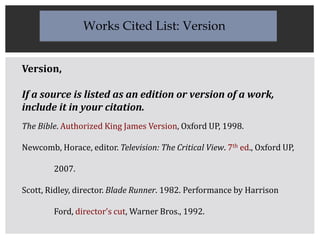
Version,
If a source is listed as an edition or version of a work,
include it in your citation.
The Bible. Authorized King James Version, Oxford UP, 1998.
Newcomb, Horace, editor. Television: The Critical View. 7th ed., Oxford UP,
2007.
Scott, Ridley, director. Blade Runner. 1982. Performance by Harrison
Ford, director’s cut, Warner Bros., 1992.
Works Cited List: Version
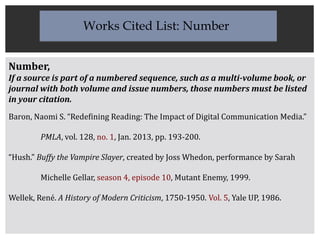
Number,
If a source is part of a numbered sequence, such as a multi-volume book, or
journal with both volume and issue numbers, those numbers must be listed
in your citation.
Baron, Naomi S. “Redefining Reading: The Impact of Digital Communication Media.”
PMLA, vol. 128, no. 1, Jan. 2013, pp. 193-200.
“Hush.” Buffy the Vampire Slayer, created by Joss Whedon, performance by Sarah
Michelle Gellar, season 4, episode 10, Mutant Enemy, 1999.
Wellek, René. A History of Modern Criticism, 1750-1950. Vol. 5, Yale UP, 1986.
Works Cited List: Number
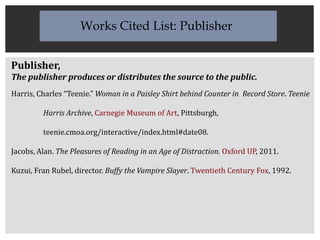
Publisher,
The publisher produces or distributes the source to the public.
Harris, Charles “Teenie.” Woman in a Paisley Shirt behind Counter in Record Store. Teenie
Harris Archive, Carnegie Museum of Art, Pittsburgh,
teenie.cmoa.org/interactive/index.html#date08.
Jacobs, Alan. The Pleasures of Reading in an Age of Distraction. Oxford UP, 2011.
Kuzui, Fran Rubel, director. Buffy the Vampire Slayer. Twentieth Century Fox, 1992.
Works Cited List: Publisher
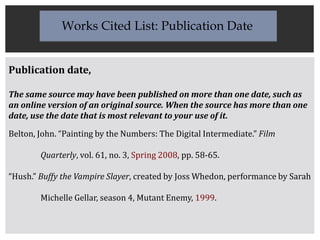
Publication date,
The same source may have been published on more than one date, such as
an online version of an original source. When the source has more than one
date, use the date that is most relevant to your use of it.
Belton, John. “Painting by the Numbers: The Digital Intermediate.” Film
Quarterly, vol. 61, no. 3, Spring 2008, pp. 58-65.
“Hush.” Buffy the Vampire Slayer, created by Joss Whedon, performance by Sarah
Michelle Gellar, season 4, Mutant Enemy, 1999.
Works Cited List: Publication Date
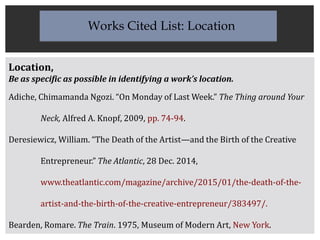
Location,
Be as specific as possible in identifying a work’s location.
Adiche, Chimamanda Ngozi. “On Monday of Last Week.” The Thing around Your
Neck, Alfred A. Knopf, 2009, pp. 74-94.
Deresiewicz, William. “The Death of the Artist—and the Birth of the Creative
Entrepreneur.” The Atlantic, 28 Dec. 2014,
www.theatlantic.com/magazine/archive/2015/01/the-death-of-the-
artist-and-the-birth-of-the-creative-entrepreneur/383497/.
Bearden, Romare. The Train. 1975, Museum of Modern Art, New York.
Works Cited List: Location
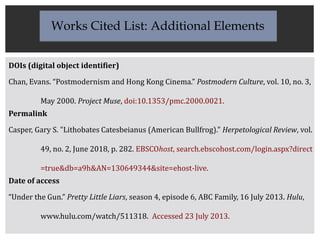
DOIs (digital object identifier)
Chan, Evans. “Postmodernism and Hong Kong Cinema.” Postmodern Culture, vol. 10, no. 3,
May 2000. Project Muse, doi:10.1353/pmc.2000.0021.
Permalink
Casper, Gary S. "Lithobates Catesbeianus (American Bullfrog)." Herpetological Review, vol.
49, no. 2, June 2018, p. 282. EBSCOhost, search.ebscohost.com/login.aspx?direct
=true&db=a9h&AN=130649344&site=ehost-live.
Date of access
“Under the Gun.” Pretty Little Liars, season 4, episode 6, ABC Family, 16 July 2013. Hulu,
www.hulu.com/watch/511318. Accessed 23 July 2013.
Works Cited List: Additional Elements
The best open (free) source with information
about MLA in-text citations is the Online
Writing Lab from Purdue University, more
commonly known as OWL.
Their website can be accessed through the url:
https://owl.purdue.edu/owl/purdue_owl.html
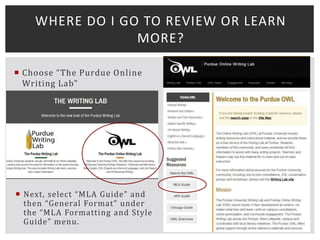
WHERE DO I GO TO REVIEW OR LEARN
MORE?
 Choose “The Purdue Online
Writing Lab”
 Next, select “MLA Guide” and
then “General Format” under
the “MLA Formatting and Style
Guide” menu.
WHERE DO I GO TO REVIEW OR LEARN
MORE?
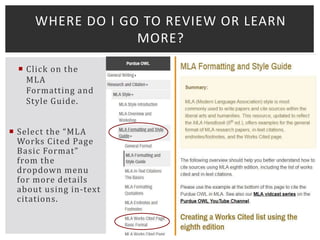
 Click on the
MLA
Formatting and
Style Guide.
 Select the “MLA
Works Cited Page
Basic Format”
from the
dropdown menu
for more details
about using in-text
citations.
WHERE DO I GO TO REVIEW OR LEARN
MORE?
 Understand the basic elements required to create an MLA
formatted Works Cited page for a research assignment
 Understand the relationship to and the importance of a Works
Cited page to a research assignment
 Know the different sources that must be listed on a Works Cited
page
 Know how and why sources should be listed on a Works Cited
page
 Can search for information regarding an MLA formatted Works
Cited page by using the OWL at Purdue
 Can use Microsoft Word to create your own properly formatted
MLA Works Cited page for a research assignment
NOW YOU…
The Purdue OWL Family of Sites. The Writing Lab and OWL at
Purdue and Purdue U, 2008, owl.english.purdue.edu/owl.
Accessed 17 Aug. 2018.
“MLA Citation Guide (8th Edition): Works Cited List & Sample
Paper.” Columbia College, Vancouver Canada, 11 Aug.
2018, https://columbiacollege-ca.libguides.com/mla.
Accessed 17 Aug. 2018.
WORKS CITED

MLA Workshop 061X- Works Cited.pptx

  • 1.
    Adapted from the Purdue OnlineWriting Lab for Santa Ana College MLA 8th Edition Formatting and Style Guide: Works Cited: The Basics
  • 2.
     Understand thebasic elements required to create an MLA formatted Works Cited page for a research assignment  Understand the relationship to and the importance of a Works Cited page to a research assignment  Know the different sources that must be listed on a Works Cited page  Know how and why sources should be listed on a Works Cited page  Search for information regarding an MLA formatted Works Cited page by using the OWL at Purdue  Use Microsoft Word to create my own properly formatted MLA Works Cited page for a research assignment AFTER THIS WORKSHOP I WILL…
  • 3.
     A WorksCited page provides the necessary information to identify and locate the sources that were summarized, paraphrased, or quoted in a research paper.  In-text citations are limited to the author or title of work, which is often not enough for another researcher to locate the same source.  Therefore, MLA requires that research papers include an additional, separate final page entitled “Works Cited” to provide the full bibliographic information for each source used in an essay.  Incomplete or missing Works Cited pages can result in intentional or unintentional plagiarism resulting in a non-passing paper. WHAT IS A WORKS CITED PAGE?
  • 4.
    1. Start anew page for your Works Cited list (e.g., if your paper is 4 pages long, start your Works Cited list on page 5). 2. Center the title, Works Cited, at the top of the page and do not bold or underline it. Look for the alignment option in Word. 3. Double-space the list. 4. Start the first line of each citation at the left margin; each subsequent line should be indented (also known as a "hanging indent"). HOW DO I FORMAT A WORKS CITED PAGE?
  • 5.
    1. New Page 2.Centered Title 3. Double-Spaced 4. Hanging Indent 1. New Page 2. Centered Title 3 . D o u b l e - S p a c e d 4 . H a n g i n g I n d e n t
  • 6.
    5. Put yourlist in alphabetical order. Alphabetize the list by the first word in the citation. In most cases, the first word will be the author’s last name. Where the author is unknown, alphabetize by the first word in the title, ignoring the words a, an, the. 6. For the first author in an entry, give the last name followed by a comma and the first name followed by a period. List additional authors, if any, First Last name. 7. Italicize the titles of full works: books, audio-visual material, websites. 8. Do not italicize titles of parts of works, such as articles from newspapers, magazines, or journals / essays, poems, short stories, or chapter titles from a book / chapters or sections of an Internet document. Instead, use quotation marks. HOW DO I FORMAT A WORKS CITED PAGE?
  • 7.
    5. Alphabetize Entries 6.Last, First Name 7. Italicize full works 8. Use “ ” for parts of works 6. Last, First name 5. Alphabetize 8. “ ” for parts of work
  • 8.
    Works Cited: CreatingEntries for Sources Now that you know the basic steps to setting up an MLA Works Cited page, we’ll look at a few examples of types of entries.
  • 9.
    • Each entryin the list of Works Cited is made up of core elements given in a specific order. • The core elements should be listed in the order in which they appear here. Each element is followed by the punctuation mark shown here. 1. Author. 2. Title of source. 3. Title of container, 4. Other contributors, 5. Version, 6. Number, 7. Publisher, 8. Publication date, 9. Location. Works Cited: Creating Entries for Sources The following slides will explain each element in detail.
  • 10.
    Author. Begin the entrywith the author’s last name, followed by a comma and the rest of the name, as presented in the work. End this element with a period. Baron, Naomi S. “Redefining Reading: The Impact of Digital Communication Media.” PMLA, vol. 128, no. 1, Jan. 2013, pp.193-200. Jacobs, Alan. The Pleasures of Reading in an Age of Distraction. Oxford UP, 2011. Works Cited List: Author
  • 11.
    Title of source. Booksand websites should be in italics: Hollmichel, Stefanie. So Many Books. 2003-13, somanybooksblog.com. Linett, Maren Tova. Modernism, Feminism, and Jewishness. Cambridge UP, 2007. Journal, magazine, and newspaper articles, television episodes, and songs should be in quotation marks: Beyoncé. “Pretty Hurts.” Beyoncé, Parkwood Entertainment, 2013, www.beyonce.com/album/beyonce/?media_view=songs. Goldman, Anne. “Questions of Transport: Reading Primo Levi Reading Dante.” The Georgia Review, vol. 64, no. 1, 2010, pp. 69-88. Works Cited List: Title of the Source
  • 12.
    Title of container, Bazin,Patrick. “Toward Metareading.” The Future of the Book, edited by Geoffrey Nunberg, U of California P, 1996, pp. 153-68. Hollmichel, Stefanie. “The Reading Brain: Differences between Digital and Print.” So Many Books, 25 Apr. 2013, somanybooksblog.com/2013/04/25/the-reading- brain-differences-between-digital-and-print/. “Under the Gun.” Pretty Little Liars, season 4, episode 6, ABC Family, 16 July 2013. Hulu, hulu.com/watch/511318. Works Cited List: Title of Container
  • 13.
    Other contributors, Chartier, Roger.The Order of Books: Readers, Authors, and Libraries in Europe between the Fourteenth and Eighteenth Centuries. Translated by Lydia G. Cochrane, Stanford UP, 1994. “Hush.” Buffy the Vampire Slayer, created by Joss Whedon, performance by Sarah Michelle Gellar, season 4, episode 10, Mutant Enemy, 1999. Woolf, Virginia. Jacob’s Room. Annotated and with an introduction by Vara Neverow, Harcourt, Inc., 2008. Works Cited List: Other Contributors
  • 14.
    Version, If a sourceis listed as an edition or version of a work, include it in your citation. The Bible. Authorized King James Version, Oxford UP, 1998. Newcomb, Horace, editor. Television: The Critical View. 7th ed., Oxford UP, 2007. Scott, Ridley, director. Blade Runner. 1982. Performance by Harrison Ford, director’s cut, Warner Bros., 1992. Works Cited List: Version
  • 15.
    Number, If a sourceis part of a numbered sequence, such as a multi-volume book, or journal with both volume and issue numbers, those numbers must be listed in your citation. Baron, Naomi S. “Redefining Reading: The Impact of Digital Communication Media.” PMLA, vol. 128, no. 1, Jan. 2013, pp. 193-200. “Hush.” Buffy the Vampire Slayer, created by Joss Whedon, performance by Sarah Michelle Gellar, season 4, episode 10, Mutant Enemy, 1999. Wellek, René. A History of Modern Criticism, 1750-1950. Vol. 5, Yale UP, 1986. Works Cited List: Number
  • 16.
    Publisher, The publisher producesor distributes the source to the public. Harris, Charles “Teenie.” Woman in a Paisley Shirt behind Counter in Record Store. Teenie Harris Archive, Carnegie Museum of Art, Pittsburgh, teenie.cmoa.org/interactive/index.html#date08. Jacobs, Alan. The Pleasures of Reading in an Age of Distraction. Oxford UP, 2011. Kuzui, Fran Rubel, director. Buffy the Vampire Slayer. Twentieth Century Fox, 1992. Works Cited List: Publisher
  • 17.
    Publication date, The samesource may have been published on more than one date, such as an online version of an original source. When the source has more than one date, use the date that is most relevant to your use of it. Belton, John. “Painting by the Numbers: The Digital Intermediate.” Film Quarterly, vol. 61, no. 3, Spring 2008, pp. 58-65. “Hush.” Buffy the Vampire Slayer, created by Joss Whedon, performance by Sarah Michelle Gellar, season 4, Mutant Enemy, 1999. Works Cited List: Publication Date
  • 18.
    Location, Be as specificas possible in identifying a work’s location. Adiche, Chimamanda Ngozi. “On Monday of Last Week.” The Thing around Your Neck, Alfred A. Knopf, 2009, pp. 74-94. Deresiewicz, William. “The Death of the Artist—and the Birth of the Creative Entrepreneur.” The Atlantic, 28 Dec. 2014, www.theatlantic.com/magazine/archive/2015/01/the-death-of-the- artist-and-the-birth-of-the-creative-entrepreneur/383497/. Bearden, Romare. The Train. 1975, Museum of Modern Art, New York. Works Cited List: Location
  • 19.
    DOIs (digital objectidentifier) Chan, Evans. “Postmodernism and Hong Kong Cinema.” Postmodern Culture, vol. 10, no. 3, May 2000. Project Muse, doi:10.1353/pmc.2000.0021. Permalink Casper, Gary S. "Lithobates Catesbeianus (American Bullfrog)." Herpetological Review, vol. 49, no. 2, June 2018, p. 282. EBSCOhost, search.ebscohost.com/login.aspx?direct =true&db=a9h&AN=130649344&site=ehost-live. Date of access “Under the Gun.” Pretty Little Liars, season 4, episode 6, ABC Family, 16 July 2013. Hulu, www.hulu.com/watch/511318. Accessed 23 July 2013. Works Cited List: Additional Elements
  • 20.
    The best open(free) source with information about MLA in-text citations is the Online Writing Lab from Purdue University, more commonly known as OWL. Their website can be accessed through the url: https://owl.purdue.edu/owl/purdue_owl.html WHERE DO I GO TO REVIEW OR LEARN MORE?
  • 21.
     Choose “ThePurdue Online Writing Lab”  Next, select “MLA Guide” and then “General Format” under the “MLA Formatting and Style Guide” menu. WHERE DO I GO TO REVIEW OR LEARN MORE?
  • 22.
     Click onthe MLA Formatting and Style Guide.  Select the “MLA Works Cited Page Basic Format” from the dropdown menu for more details about using in-text citations. WHERE DO I GO TO REVIEW OR LEARN MORE?
  • 23.
     Understand thebasic elements required to create an MLA formatted Works Cited page for a research assignment  Understand the relationship to and the importance of a Works Cited page to a research assignment  Know the different sources that must be listed on a Works Cited page  Know how and why sources should be listed on a Works Cited page  Can search for information regarding an MLA formatted Works Cited page by using the OWL at Purdue  Can use Microsoft Word to create your own properly formatted MLA Works Cited page for a research assignment NOW YOU…
  • 24.
    The Purdue OWLFamily of Sites. The Writing Lab and OWL at Purdue and Purdue U, 2008, owl.english.purdue.edu/owl. Accessed 17 Aug. 2018. “MLA Citation Guide (8th Edition): Works Cited List & Sample Paper.” Columbia College, Vancouver Canada, 11 Aug. 2018, https://columbiacollege-ca.libguides.com/mla. Accessed 17 Aug. 2018. WORKS CITED

Editor's Notes

  • #5 Remind students that a Works Cited page does not count towards a final page count. For example, if asked to write a 10 page research paper, your final draft would be 11 pages including the Works Cited page.
  • #10 While earlier editions of the MLA Handbook showed writers how to create a works-cited entry based on the source’s publication format (book, periodical, film, etc.), the updated 8th edition demonstrates that documentation should be created by consulting the list of core elements. Rather than asking: “how do I cite a book, DVD, or webpage,” the writer now creates an entry by looking at the list of core elements– which are facts common to most works– and assembling them in a specific order. These changes have been made to reflect the differences in how we consult works. In the updated model, the writer should ask: “who is the author?” and “what is the title?”, regardless of the nature of the source. The following slides will explain each of the core elements, and how they might differ from one medium to another.
  • #11 While these examples are in different mediums (the first one is a periodical, the second is a printed book), they are both formatted according to the list of key elements. Note: there are other types of author situations, such as multiple authors, translators, editors, corporate authors, performers, and pseudonyms (such as online user names). Refer to the 8th edition handbook or the MLA online Style Center https://style.mla.org/ for more information.
  • #12 The title of the source should follow the author’s name. Depending upon the type of source, it should be listed in italics or quotation marks.
  • #13 Containers are the larger wholes in which the source is located. For example, if you want to cite a poem that is listed in a collection of poems, the individual poem is the source, while the larger collection is the container. The title of the container is usually italicized and followed by a comma, since the information that follows next describes the container. In the first example, “Toward Metareading” is the title of an essay, and The Future of the Book is the title of the edited collection in which the essay appears. The container may also be a website, which contains articles, postings, and other works. The container may also be a television series, which is made up of episodes.
  • #14 In addition to the author, there may be other contributors to the source who should be credited, such as editors, illustrators, performers, translators, etc. If their contributions are relevant to your research, or necessary to identify the source, include their names in your documentation.   Note: In the eighth edition, terms like editor, illustrator, translator, etc., are no longer abbreviated.
  • #15 Books are commonly issued in versions called editions. A revised edition of a book may be labeled revised edition, or be numbered (second edition, etc.). A a film may be released in different versions, such as expanded or director’s cut.
  • #16 If your source uses another numbering system, include the number in your entry, preceded by a term that identifies the kind of division the number refers to.
  • #17 Note: the publisher’s name need not be included in the following sources: periodicals, works published by their author or editor, a Web cite whose title is the same name as its publisher, a Web cite that makes works available but does not actually publish them (such as YouTube, WordPress, or JSTOR).
  • #18 If you’re unsure about which date to use, go with the date of the source’s original publication. In the first example, the periodical’s publication schedule goes by season. So document the volume (61), the issue number (3), and the issue (Spring 2008).  In the second example, Mutant Enemy is the primary production company, and “Hush” was released in 1999. This is the way to create a general citation for a television episode.
  • #19 First example: an essay in a book, or an article in journal should include page numbers. Second example: The location of an online work should include a URL. Third example: A physical object that you experienced firsthand should identify the place of location.
  • #20 DOIs: a series of digits and letters that leads to the location of an online source. Articles in journals are often assigned DOIs to ensure that the source is locatable, even if the URL changes. If your source is listed with a DOI, use that instead of a URL. Permalinks: Used when there is no DOI available for a source within a database; find “permalink” under the tools menu within the database. Date of access: When you cite an online source, always include the date on which you accessed the material, since an online work may change or move at any time.