99
The MLA System of
Documentation
Parenthetical documentation:
Author – work (MLA)
• Modern language Association - sponsor of MLA
style
• An association of over 30,000 American and
international scholars and writers in a hundred
countries
• MLA was founded in 1883 as a group advocating
the study of literature and modern languages
• Style is widely used by literature and language
scholars worldwide
Parenthetical documentation:
Author – work (MLA)
• MLA style requires every source you use be
documented twice:
• First: in an in-text citation in the body of the work
• Specifies the source
• Second: in an entry in the bibliography at the end
of the paper
• Lists complete publication details
• Formula Name of author inverted (period) + title of book or work
underlined (period) + city of publication (colon) + publisher + year
of publication (period)
• Read text example, pg. 143
Parenthetical documentation:
Author – work (MLA)
• What to document
• General knowledge, common sayings and self-evident
opinions do not need to be documented
• Specific eye-witness accounts do need to be
documented
• Err on the side of caution
• Read/review text example pg.144
Parenthetical documentation:
Author – work (MLA)
• Guidelines for in-text citations (Read text pg. 145)
1. Keep in Brief
• parenthetical references should be brief as possible, only
information to clearly identify source
• Don’t need parenthetical citation if your “Works Cited”
includes only one work by that particular author
1. Introduce the authority
• Introduce paraphrases or quotations by giving the
authority’s name – first name and surname the first time
the authority is cited
• Subsequent citations simply use authority’s surname
Parenthetical documentation:
Author – work (MLA)
• Guidelines for in-text citations (Read text pg. 145)
3. Identify the source
• Identify what makes the source important
3. Mention both author and work
• If you can do it smoothly, mention both the author and the
work in your introduction
Read text pg. 145
Parenthetical documentation:
Author – work (MLA)
• Guidelines for in-text citations (Read text pg. 145)
5. Document parenthetically
• If you do not mention the authority behind a paraphrase, or
quotation in your text, place the information in parenthesis
5. Material by two or three authors
• Mention the names of all the authors
Read text pg. 145-146
Parenthetical documentation:
Author – work (MLA)
• Guidelines for in-text citations
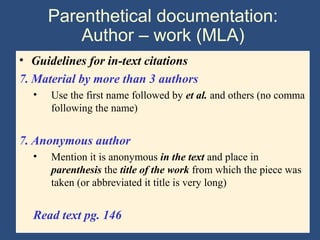
7. Material by more than 3 authors
• Use the first name followed by et al. and others (no comma
following the name)
7. Anonymous author
• Mention it is anonymous in the text and place in
parenthesis the title of the work from which the piece was
taken (or abbreviated it title is very long)
Read text pg. 146
Parenthetical documentation:
Author – work (MLA)
• Guidelines for in-text citations
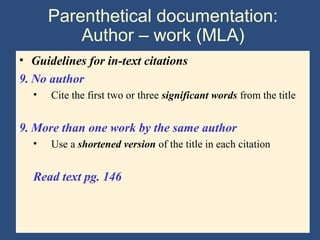
9. No author
• Cite the first two or three significant words from the title
9. More than one work by the same author
• Use a shortened version of the title in each citation
Read text pg. 146
Parenthetical documentation:
Author – work (MLA)
• Guidelines for in-text citations
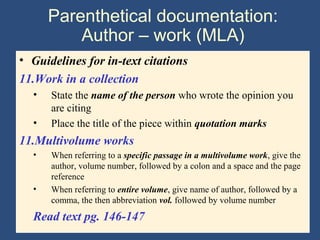
11.Work in a collection
• State the name of the person who wrote the opinion you
are citing
• Place the title of the piece within quotation marks
11.Multivolume works
• When referring to a specific passage in a multivolume work, give the
author, volume number, followed by a colon and a space and the page
reference
• When referring to entire volume, give name of author, followed by a
comma, the then abbreviation vol. followed by volume number
Read text pg. 146-147
Parenthetical documentation:
Author – work (MLA)
• Guidelines for in-text citations
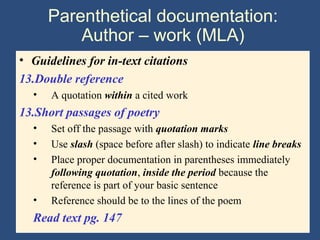
13.Double reference
• A quotation within a cited work
13.Short passages of poetry
• Set off the passage with quotation marks
• Use slash (space before after slash) to indicate line breaks
• Place proper documentation in parentheses immediately
following quotation, inside the period because the
reference is part of your basic sentence
• Reference should be to the lines of the poem
Read text pg. 147
Parenthetical documentation:
Author – work (MLA)
• Guidelines for in-text citations
15.Use Arabic numerals
• Use Arabic numerals for books, parts, volumes, an
chapters of works; for acts, scenes, and lines of plays; and
for cantos, stanzas and lines of poetry
15.Vary your introductions
• You will find a number of ways to introduce authors and
their works
• Some places will be easier to mention source in your text,
• In others, mentioning author’s name will be more natural
Read text pg. 147-148
Format for “Works Cited” (MLA)
• MLA calls the bibliography “Works Cited”
• Will list every source you actually used in your
paper, in alphabetical order by surname of the
first author
Format for “Works Cited” (MLA)
• Rules for preparing the “Works Cited” page
1. Use a new page for your “Works Cited” page
2. Alphabetize the surnames of cited author
3. Alphabetize according to the prefix/ preposition
4. Put single-author entries before multiple-author
entries
Read text pg. 148
Format for “Works Cited” (MLA)
• Rules for preparing the “Works Cited” page
5. Entries by same author(s) in same order are arranged
alphabetically by title, excluding A, An, or The
• Use a row of three hyphens followed by a period to
replace the name of the repeated author(s)
5. Alphabetize works by authors with the same surname
by the first letter of the first name
Read text pg. 149
Format for “Works Cited” (MLA)
• Rules for preparing the “Works Cited” page
7. Alphabetize corporate authors - associations,
government agencies, intuitions – by the first
significant word of the name. Use the full name, not an
abbreviation
8. Place a parent body before a subdivision
Read text pg. 149
Format for “Works Cited” (MLA)
• Rules for preparing the “Works Cited” page
9. If work is anonymous, move title into the author’s
place, and alphabetize it by the first significant word in
the title
10.Alphabetize legal references by the first significant
word
Read text pg. 149
Format for “Works Cited” (MLA)
• General order in references to books
• Basic template for an MLA citation (presented earlier)
– Text Pg. 149
• Center the “Works Cited” on a new page, with a one-inch
top margin and double spacing throughout
• Put page number in the upper right-hand corner, one half
inch from the top
• Begin first entry flush with left margin, and subsequent lines
one-half inch or five spaces (known as hanging indent)
See Text, pg. 150 – Figure 9-1
Format for “Works Cited” (MLA)
• General order in references to books
• Author
• The name of the author comes first, alphabetized by
surname, and followed by a period
• If a book has more than one author, invert the name of only
the first and follow with a comma
• For more than three authors, use the name of the fist
followed by et al.:
• Or, you may list all names as they occur in full
• In some cases, name of the editor, translator, or compiler is
cited before the name of the author
See Text, pg. 150
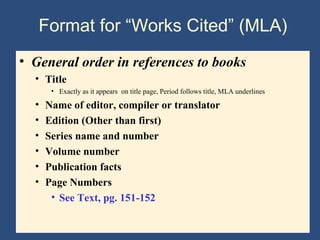
Format for “Works Cited” (MLA)
• General order in references to books
• Title
• Exactly as it appears on title page, Period follows title, MLA underlines
• Name of editor, compiler or translator
• Edition (Other than first)
• Series name and number
• Volume number
• Publication facts
• Page Numbers
• See Text, pg. 151-152
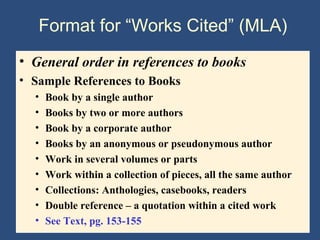
Format for “Works Cited” (MLA)
• General order in references to books
• Sample References to Books
• Book by a single author
• Books by two or more authors
• Book by a corporate author
• Books by an anonymous or pseudonymous author
• Work in several volumes or parts
• Work within a collection of pieces, all the same author
• Collections: Anthologies, casebooks, readers
• Double reference – a quotation within a cited work
• See Text, pg. 153-155
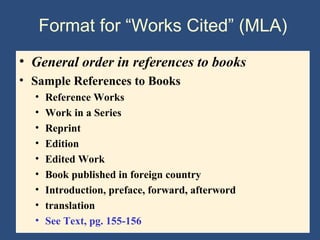
Format for “Works Cited” (MLA)
• General order in references to books
• Sample References to Books
• Reference Works
• Work in a Series
• Reprint
• Edition
• Edited Work
• Book published in foreign country
• Introduction, preface, forward, afterword
• translation
• See Text, pg. 155-156
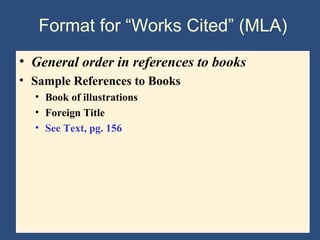
Format for “Works Cited” (MLA)
• General order in references to books
• Sample References to Books
• Book of illustrations
• Foreign Title
• See Text, pg. 156
Format for “Works Cited” (MLA)
• General order in references to Periodicals
• Author
• Title of the article
• Publication information
• Journals, magazines, newspapers
• Pages
• See Text, pg. 157-158
Format for “Works Cited” (MLA)
• Sample References to Periodicals
• Anonymous Author
• Single Author
• More than one author
• Journal with continuous pagination throughout annual
volume
• Monthly magazine
• Weekly magazine
• Newspaper
• Editorial
• See Text, pg. 159-160
Format for “Works Cited” (MLA)
• Sample References to Periodicals
• Letter to the editor
• Critical review
• Published interview
• Published address or lecture
• See Text, pg. 160-161
Format for “Works Cited” (MLA)
• References to Electronic Sources
• General order in references to electronic
sources
• See Text, pg. 162-163
Format for “Works Cited” (MLA)
• References to Electronic Sources
• Sample references to electronic sources
• Abstract online or on CD-ROM
• CD-ROM
• Computer Program
• Corporate Website
• E-Mail
• FTP Source
• Gopher
• Government website
• See Text, pg. 164-165
Format for “Works Cited” (MLA)
• References to Electronic Sources
• Sample references to electronic sources
• Electronic mailing list
• Online book
• Online database
• Online dictionary
• Online encyclopedia
• Online magazine article author listed
• Online magazines article, no author listed
• Telnet, usenet, website
• See Text, pg. 165-167
Format for “Works Cited” (MLA)
• Sample references to nonprint materials
• Address or lecture
• Artwork
• Film, videotape, DVD
• Interview
• Musical composition
• Radio or television program
• Sound recording (CD)
• Performance
• See Text, pg. 167-170
Format for “Works Cited” (MLA)
• Sample references to special items
• Artwork, published
• Bible and other sacred texts
• Classical works in general
• Dissertation
• Footnote or endnote citation
• Manuscript or typescript
• Pamphlet or brochure
• Personal letter
• See Text, pg. 170-173
Format for “Works Cited” (MLA)
• Sample references to special items
• Plays
• Poems
• Public Documents
• Quotations used as a source
• Report
• Table, graph, chart, map or other illustrations
• See Text, pg. 173-178
Format for “Works Cited” (MLA)
• Content Notes
• Consists of explanation, additional information,
reference to other sources, acklnowledgement of
special help
• Content Notes: Text pg. 178-180
• Explaining a term
• Expanding on an idea
• Referring to another source
• Explaining procedure
• Acknowledging help, consolidating references
Format for “Works Cited” (MLA)
• Finished Form of the Paper
•Appearance
•Title Page
•Abstract
•Pagination and headings
•Spacing of text
•Font
•Illustrations, tables and other Graphs
See Text, pg. 181-188
Format for “Works Cited” (MLA)
• Finished Form of the Paper
•Use of Numbers
•Bibliography (Titled “Works Cited”)
•Peer Review Checlist
•Submit Paper electronically
See Text, pg. 188-189

Writing The Research Paper A Handbook (7th ed) - Ch 9 mla system

  • 1.
    99 The MLA Systemof Documentation
  • 2.
    Parenthetical documentation: Author –work (MLA) • Modern language Association - sponsor of MLA style • An association of over 30,000 American and international scholars and writers in a hundred countries • MLA was founded in 1883 as a group advocating the study of literature and modern languages • Style is widely used by literature and language scholars worldwide
  • 3.
    Parenthetical documentation: Author –work (MLA) • MLA style requires every source you use be documented twice: • First: in an in-text citation in the body of the work • Specifies the source • Second: in an entry in the bibliography at the end of the paper • Lists complete publication details • Formula Name of author inverted (period) + title of book or work underlined (period) + city of publication (colon) + publisher + year of publication (period) • Read text example, pg. 143
  • 4.
    Parenthetical documentation: Author –work (MLA) • What to document • General knowledge, common sayings and self-evident opinions do not need to be documented • Specific eye-witness accounts do need to be documented • Err on the side of caution • Read/review text example pg.144
  • 5.
    Parenthetical documentation: Author –work (MLA) • Guidelines for in-text citations (Read text pg. 145) 1. Keep in Brief • parenthetical references should be brief as possible, only information to clearly identify source • Don’t need parenthetical citation if your “Works Cited” includes only one work by that particular author 1. Introduce the authority • Introduce paraphrases or quotations by giving the authority’s name – first name and surname the first time the authority is cited • Subsequent citations simply use authority’s surname
  • 6.
    Parenthetical documentation: Author –work (MLA) • Guidelines for in-text citations (Read text pg. 145) 3. Identify the source • Identify what makes the source important 3. Mention both author and work • If you can do it smoothly, mention both the author and the work in your introduction Read text pg. 145
  • 7.
    Parenthetical documentation: Author –work (MLA) • Guidelines for in-text citations (Read text pg. 145) 5. Document parenthetically • If you do not mention the authority behind a paraphrase, or quotation in your text, place the information in parenthesis 5. Material by two or three authors • Mention the names of all the authors Read text pg. 145-146
  • 8.
    Parenthetical documentation: Author –work (MLA) • Guidelines for in-text citations 7. Material by more than 3 authors • Use the first name followed by et al. and others (no comma following the name) 7. Anonymous author • Mention it is anonymous in the text and place in parenthesis the title of the work from which the piece was taken (or abbreviated it title is very long) Read text pg. 146
  • 9.
    Parenthetical documentation: Author –work (MLA) • Guidelines for in-text citations 9. No author • Cite the first two or three significant words from the title 9. More than one work by the same author • Use a shortened version of the title in each citation Read text pg. 146
  • 10.
    Parenthetical documentation: Author –work (MLA) • Guidelines for in-text citations 11.Work in a collection • State the name of the person who wrote the opinion you are citing • Place the title of the piece within quotation marks 11.Multivolume works • When referring to a specific passage in a multivolume work, give the author, volume number, followed by a colon and a space and the page reference • When referring to entire volume, give name of author, followed by a comma, the then abbreviation vol. followed by volume number Read text pg. 146-147
  • 11.
    Parenthetical documentation: Author –work (MLA) • Guidelines for in-text citations 13.Double reference • A quotation within a cited work 13.Short passages of poetry • Set off the passage with quotation marks • Use slash (space before after slash) to indicate line breaks • Place proper documentation in parentheses immediately following quotation, inside the period because the reference is part of your basic sentence • Reference should be to the lines of the poem Read text pg. 147
  • 12.
    Parenthetical documentation: Author –work (MLA) • Guidelines for in-text citations 15.Use Arabic numerals • Use Arabic numerals for books, parts, volumes, an chapters of works; for acts, scenes, and lines of plays; and for cantos, stanzas and lines of poetry 15.Vary your introductions • You will find a number of ways to introduce authors and their works • Some places will be easier to mention source in your text, • In others, mentioning author’s name will be more natural Read text pg. 147-148
  • 13.
    Format for “WorksCited” (MLA) • MLA calls the bibliography “Works Cited” • Will list every source you actually used in your paper, in alphabetical order by surname of the first author
  • 14.
    Format for “WorksCited” (MLA) • Rules for preparing the “Works Cited” page 1. Use a new page for your “Works Cited” page 2. Alphabetize the surnames of cited author 3. Alphabetize according to the prefix/ preposition 4. Put single-author entries before multiple-author entries Read text pg. 148
  • 15.
    Format for “WorksCited” (MLA) • Rules for preparing the “Works Cited” page 5. Entries by same author(s) in same order are arranged alphabetically by title, excluding A, An, or The • Use a row of three hyphens followed by a period to replace the name of the repeated author(s) 5. Alphabetize works by authors with the same surname by the first letter of the first name Read text pg. 149
  • 16.
    Format for “WorksCited” (MLA) • Rules for preparing the “Works Cited” page 7. Alphabetize corporate authors - associations, government agencies, intuitions – by the first significant word of the name. Use the full name, not an abbreviation 8. Place a parent body before a subdivision Read text pg. 149
  • 17.
    Format for “WorksCited” (MLA) • Rules for preparing the “Works Cited” page 9. If work is anonymous, move title into the author’s place, and alphabetize it by the first significant word in the title 10.Alphabetize legal references by the first significant word Read text pg. 149
  • 18.
    Format for “WorksCited” (MLA) • General order in references to books • Basic template for an MLA citation (presented earlier) – Text Pg. 149 • Center the “Works Cited” on a new page, with a one-inch top margin and double spacing throughout • Put page number in the upper right-hand corner, one half inch from the top • Begin first entry flush with left margin, and subsequent lines one-half inch or five spaces (known as hanging indent) See Text, pg. 150 – Figure 9-1
  • 19.
    Format for “WorksCited” (MLA) • General order in references to books • Author • The name of the author comes first, alphabetized by surname, and followed by a period • If a book has more than one author, invert the name of only the first and follow with a comma • For more than three authors, use the name of the fist followed by et al.: • Or, you may list all names as they occur in full • In some cases, name of the editor, translator, or compiler is cited before the name of the author See Text, pg. 150
  • 20.
    Format for “WorksCited” (MLA) • General order in references to books • Title • Exactly as it appears on title page, Period follows title, MLA underlines • Name of editor, compiler or translator • Edition (Other than first) • Series name and number • Volume number • Publication facts • Page Numbers • See Text, pg. 151-152
  • 21.
    Format for “WorksCited” (MLA) • General order in references to books • Sample References to Books • Book by a single author • Books by two or more authors • Book by a corporate author • Books by an anonymous or pseudonymous author • Work in several volumes or parts • Work within a collection of pieces, all the same author • Collections: Anthologies, casebooks, readers • Double reference – a quotation within a cited work • See Text, pg. 153-155
  • 22.
    Format for “WorksCited” (MLA) • General order in references to books • Sample References to Books • Reference Works • Work in a Series • Reprint • Edition • Edited Work • Book published in foreign country • Introduction, preface, forward, afterword • translation • See Text, pg. 155-156
  • 23.
    Format for “WorksCited” (MLA) • General order in references to books • Sample References to Books • Book of illustrations • Foreign Title • See Text, pg. 156
  • 24.
    Format for “WorksCited” (MLA) • General order in references to Periodicals • Author • Title of the article • Publication information • Journals, magazines, newspapers • Pages • See Text, pg. 157-158
  • 25.
    Format for “WorksCited” (MLA) • Sample References to Periodicals • Anonymous Author • Single Author • More than one author • Journal with continuous pagination throughout annual volume • Monthly magazine • Weekly magazine • Newspaper • Editorial • See Text, pg. 159-160
  • 26.
    Format for “WorksCited” (MLA) • Sample References to Periodicals • Letter to the editor • Critical review • Published interview • Published address or lecture • See Text, pg. 160-161
  • 27.
    Format for “WorksCited” (MLA) • References to Electronic Sources • General order in references to electronic sources • See Text, pg. 162-163
  • 28.
    Format for “WorksCited” (MLA) • References to Electronic Sources • Sample references to electronic sources • Abstract online or on CD-ROM • CD-ROM • Computer Program • Corporate Website • E-Mail • FTP Source • Gopher • Government website • See Text, pg. 164-165
  • 29.
    Format for “WorksCited” (MLA) • References to Electronic Sources • Sample references to electronic sources • Electronic mailing list • Online book • Online database • Online dictionary • Online encyclopedia • Online magazine article author listed • Online magazines article, no author listed • Telnet, usenet, website • See Text, pg. 165-167
  • 30.
    Format for “WorksCited” (MLA) • Sample references to nonprint materials • Address or lecture • Artwork • Film, videotape, DVD • Interview • Musical composition • Radio or television program • Sound recording (CD) • Performance • See Text, pg. 167-170
  • 31.
    Format for “WorksCited” (MLA) • Sample references to special items • Artwork, published • Bible and other sacred texts • Classical works in general • Dissertation • Footnote or endnote citation • Manuscript or typescript • Pamphlet or brochure • Personal letter • See Text, pg. 170-173
  • 32.
    Format for “WorksCited” (MLA) • Sample references to special items • Plays • Poems • Public Documents • Quotations used as a source • Report • Table, graph, chart, map or other illustrations • See Text, pg. 173-178
  • 33.
    Format for “WorksCited” (MLA) • Content Notes • Consists of explanation, additional information, reference to other sources, acklnowledgement of special help • Content Notes: Text pg. 178-180 • Explaining a term • Expanding on an idea • Referring to another source • Explaining procedure • Acknowledging help, consolidating references
  • 34.
    Format for “WorksCited” (MLA) • Finished Form of the Paper •Appearance •Title Page •Abstract •Pagination and headings •Spacing of text •Font •Illustrations, tables and other Graphs See Text, pg. 181-188
  • 35.
    Format for “WorksCited” (MLA) • Finished Form of the Paper •Use of Numbers •Bibliography (Titled “Works Cited”) •Peer Review Checlist •Submit Paper electronically See Text, pg. 188-189