Research 3: The MLA Format Avoiding Plagiarism and Documenting Sources Amy Ferguson Richland College Library Fall 2009
Receive the Information Literacy Certificate Attend all 3 workshops in the Library Instruction Program Research 1 : Introduction to College Research Research 2 : Electronic Research - Sources and Strategies Research 3 : MLA - Avoiding Plagiarism and Documenting Sources.
Computer Use Anyone using computers for other purposes ( e-mail, games, etc. ) will be asked to leave and will NOT receive credit for this workshop. Only use computers as I direct.
Goals Use proper MLA  in-text documentation Prepare a properly formatted  Works Cited list . A+
Agenda Attendance What is MLA? Works Cited in NoodleBib In-text documentation
What is the MLA Format? See “Essentials of the MLA Format” Handout.
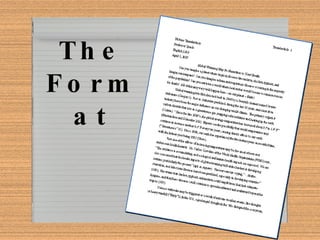
The Format
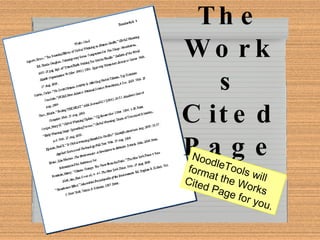
The Works Cited Page NoodleTools will format the Works Cited Page for you.
Online Punctuation Guide www.virtualsalt.com/punctu8.htm . ? “ ” !
Why Must We Cite Our Sources? To lend authority and credibility to our work. To allow your readers to cross-reference your sources easily To provide consistent format for writing papers within a discipline To acknowledge our academic debts Avoid Plagiarism
PLAGIARISM  To plagiarize is to give the impression that you have written or thought something that you have borrowed from someone else.   From the Latin word  plagiarius  — kidnapper
Why Does Plagiarism Matter?   You may fail your class or be expelled. Plagiarism in your professional career can result in being sued, fired, and publicly embarrassed.
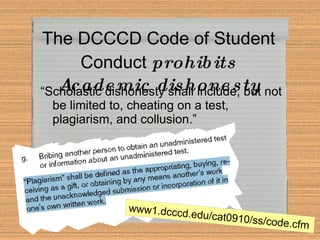
“ Scholastic dishonesty shall include, but not be limited to, cheating on a test, plagiarism, and collusion.” The DCCCD Code of Student Conduct  prohibits Academic dishonesty www1.dcccd.edu/cat0910/ss/code.cfm
Cite your Sources! 1. Provide  in-text documentation 2. Provide a citation in the  “Works Cited”  list for every source cited in the paper.
You Must Cite Your Source When… Quoting  any words that are not your own Summarizing  facts and ideas from a source Paraphrasing  a source When using factual information that is  not   common knowledge
COMMON KNOWLEDGE: Examples : General Custer lost the battle at Little Big Horn. Franklin Pierce, 14th President of the United States, was born in 1804 and died in 1869. Information that appears in  5 or more  sources
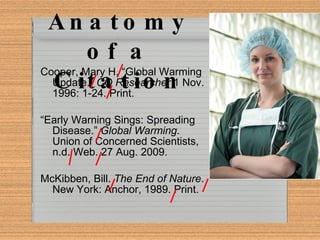
Anatomy of a Citation Cooper, Mary H. “Global Warming Update.”  CQ Researcher  1 Nov. 1996: 1-24. Print. “ Early Warning Sings: Spreading Disease.”  Global Warming . Union of Concerned Scientists, n.d. Web. 27 Aug. 2009. McKibben, Bill.  The End of Nature . New York: Anchor, 1989. Print.
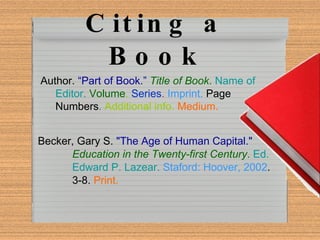
Citing a Book Becker, Gary S.   "The Age of Human Capital."   Education in the Twenty-first Century .   Ed. Edward P. Lazear.   Staford: Hoover, 2002 . 3-8.  Print. Author.   “Part of Book.”   Title of Book .   Name of Editor.   Volume .  Series .   Imprint.  Page  Numbers .   Additional info.  Medium.
Periodicals Newspapers Magazines Journals
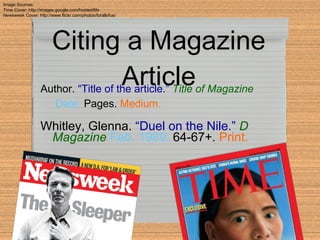
Citing a Magazine Article Whitley, Glenna.   “Duel on the Nile.”   D Magazine   Feb. 1989:  64-67+.  Print. Author.   “Title of the article.”   Title of Magazine   Date:  Pages.  Medium . Image Sources Time Cover: http://images.google.com/hosted/life Newsweek Cover: http://www.flickr.com/photos/forallofus/
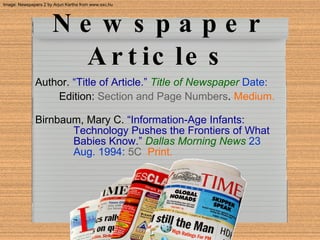
Newspaper Articles Birnbaum, Mary C.   “Information-Age Infants: Technology Pushes the Frontiers of What Babies Know.”   Dallas Morning News   23 Aug. 1994:   5C .  Print. Author.   “Title of Article.”   Title of Newspaper   Date:   Edition:  Section and Page Numbers .  Medium. Image: Newspapers 2 by Arjun Kartha from www.sxc.hu
Citing a Journal Article Author.   “Title of Article.”   Title of Journal   Volume.Issue (Date):   Page Numbers.   Badami, Mary Kenny.   “A Feminist Critique of Science Fiction.”   Extrapolation   18.1 (1976):   236-59. Image by James w Davis from en.wikipedia.org
Articles from Full Text Databases Citation.  Database .   Medium.   Date of Access . Bessieres, Michel. "Global Warming: Ignorance Is Not Bliss."  UNESCO Courier  June 2001: 10.  Academic Search Complete.   Web.   20 July 2003
Citing World Wide Web Sources Author.   “Title of Page.”  Additional Info.  Title of Site .   Date.  Page Numbers. Publisher.  Medium.   Access Date . Newhall, Brent P.   "Beowulf."   Encyclopedia Mythica .   17 Mar. 2002.   Web.  20 Sep. 2005
Reprints Author.  Reprint Source.   Rpt. of  Original Source.  Medium. Chadwick, Douglas.   “Private Property Regulation is Necessary to save Endgandered Species.”  Endangered Species . Ed. Helen  Cothran. Opposing Viewpoints Ser. San Diego: Greenhaven, 2001. 88-93.   Rpt. of   “Strength in Humilty.” Sierra Jan./Feb. 1996:  :n. pag.  Print.
NoodleTools www.noodletools.com/login.php
Parenthetical (In-Text) Documentation Points to the  specific source  in your Works cited list and the  location of information  in source Provide The Author (or Title) Page number
Parenthetical Documentation The education and ability of the people provide the United States with its greatest asset  (Becker 3) . Source: Becker, Gary S. "The Age of Human Capital."  Education in the  Twenty-first Century . Ed. by Edward P. Lazear. Staford: Hoover,  2002. 3-8. Print. According to Gary S.  Becker , human capital is the greatest form of capital in the 21st century  (3) .
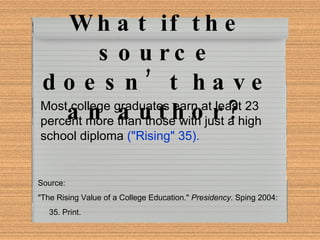
What if the source doesn’t have an author? Most college graduates earn at least 23 percent more than those with just a high school diploma  ("Rising" 35).  Source: "The Rising Value of a College Education."  Presidency . Sping 2004:  35. Print.
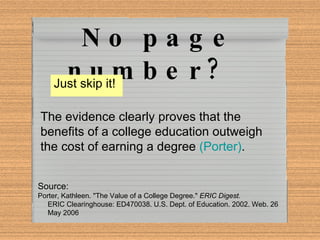
No page number?  Just skip it!  The evidence clearly proves that the benefits of a college education outweigh the cost of earning a degree  (Porter) .   Source: Porter, Kathleen. "The Value of a College Degree."  ERIC Digest.   ERIC Clearinghouse: ED470038. U.S. Dept. of Education. 2002. Web. 26  May 2006
Remember Always write down complete information about your sources while you are at the library. You can ask a reference librarian for assistance with MLA format.
How Can I Get Information about MLA Format? Refer to the handouts at  http://libguides.richlandcollege.edu/libraryclasses OR Ask a Librarian!

MLA Format

  • 1.
    Research 3: TheMLA Format Avoiding Plagiarism and Documenting Sources Amy Ferguson Richland College Library Fall 2009
  • 2.
    Receive the InformationLiteracy Certificate Attend all 3 workshops in the Library Instruction Program Research 1 : Introduction to College Research Research 2 : Electronic Research - Sources and Strategies Research 3 : MLA - Avoiding Plagiarism and Documenting Sources.
  • 3.
    Computer Use Anyoneusing computers for other purposes ( e-mail, games, etc. ) will be asked to leave and will NOT receive credit for this workshop. Only use computers as I direct.
  • 4.
    Goals Use properMLA in-text documentation Prepare a properly formatted Works Cited list . A+
  • 5.
    Agenda Attendance Whatis MLA? Works Cited in NoodleBib In-text documentation
  • 6.
    What is theMLA Format? See “Essentials of the MLA Format” Handout.
  • 7.
  • 8.
    The Works CitedPage NoodleTools will format the Works Cited Page for you.
  • 9.
    Online Punctuation Guidewww.virtualsalt.com/punctu8.htm . ? “ ” !
  • 10.
    Why Must WeCite Our Sources? To lend authority and credibility to our work. To allow your readers to cross-reference your sources easily To provide consistent format for writing papers within a discipline To acknowledge our academic debts Avoid Plagiarism
  • 11.
    PLAGIARISM Toplagiarize is to give the impression that you have written or thought something that you have borrowed from someone else. From the Latin word plagiarius — kidnapper
  • 12.
    Why Does PlagiarismMatter? You may fail your class or be expelled. Plagiarism in your professional career can result in being sued, fired, and publicly embarrassed.
  • 13.
    “ Scholastic dishonestyshall include, but not be limited to, cheating on a test, plagiarism, and collusion.” The DCCCD Code of Student Conduct prohibits Academic dishonesty www1.dcccd.edu/cat0910/ss/code.cfm
  • 14.
    Cite your Sources!1. Provide in-text documentation 2. Provide a citation in the “Works Cited” list for every source cited in the paper.
  • 15.
    You Must CiteYour Source When… Quoting any words that are not your own Summarizing facts and ideas from a source Paraphrasing a source When using factual information that is not common knowledge
  • 16.
    COMMON KNOWLEDGE: Examples: General Custer lost the battle at Little Big Horn. Franklin Pierce, 14th President of the United States, was born in 1804 and died in 1869. Information that appears in 5 or more sources
  • 17.
    Anatomy of aCitation Cooper, Mary H. “Global Warming Update.” CQ Researcher 1 Nov. 1996: 1-24. Print. “ Early Warning Sings: Spreading Disease.” Global Warming . Union of Concerned Scientists, n.d. Web. 27 Aug. 2009. McKibben, Bill. The End of Nature . New York: Anchor, 1989. Print.
  • 18.
    Citing a BookBecker, Gary S. "The Age of Human Capital." Education in the Twenty-first Century . Ed. Edward P. Lazear. Staford: Hoover, 2002 . 3-8. Print. Author. “Part of Book.” Title of Book . Name of Editor. Volume . Series . Imprint. Page Numbers . Additional info. Medium.
  • 19.
  • 20.
    Citing a MagazineArticle Whitley, Glenna. “Duel on the Nile.” D Magazine Feb. 1989: 64-67+. Print. Author. “Title of the article.” Title of Magazine Date: Pages. Medium . Image Sources Time Cover: http://images.google.com/hosted/life Newsweek Cover: http://www.flickr.com/photos/forallofus/
  • 21.
    Newspaper Articles Birnbaum,Mary C. “Information-Age Infants: Technology Pushes the Frontiers of What Babies Know.” Dallas Morning News 23 Aug. 1994: 5C . Print. Author. “Title of Article.” Title of Newspaper Date: Edition: Section and Page Numbers . Medium. Image: Newspapers 2 by Arjun Kartha from www.sxc.hu
  • 22.
    Citing a JournalArticle Author. “Title of Article.” Title of Journal Volume.Issue (Date): Page Numbers. Badami, Mary Kenny. “A Feminist Critique of Science Fiction.” Extrapolation 18.1 (1976): 236-59. Image by James w Davis from en.wikipedia.org
  • 23.
    Articles from FullText Databases Citation. Database . Medium. Date of Access . Bessieres, Michel. "Global Warming: Ignorance Is Not Bliss." UNESCO Courier June 2001: 10. Academic Search Complete. Web. 20 July 2003
  • 24.
    Citing World WideWeb Sources Author. “Title of Page.” Additional Info. Title of Site . Date. Page Numbers. Publisher. Medium. Access Date . Newhall, Brent P. "Beowulf." Encyclopedia Mythica . 17 Mar. 2002. Web. 20 Sep. 2005
  • 25.
    Reprints Author. Reprint Source. Rpt. of Original Source. Medium. Chadwick, Douglas. “Private Property Regulation is Necessary to save Endgandered Species.” Endangered Species . Ed. Helen Cothran. Opposing Viewpoints Ser. San Diego: Greenhaven, 2001. 88-93. Rpt. of “Strength in Humilty.” Sierra Jan./Feb. 1996: :n. pag. Print.
  • 26.
  • 27.
    Parenthetical (In-Text) DocumentationPoints to the specific source in your Works cited list and the location of information in source Provide The Author (or Title) Page number
  • 28.
    Parenthetical Documentation Theeducation and ability of the people provide the United States with its greatest asset (Becker 3) . Source: Becker, Gary S. "The Age of Human Capital." Education in the Twenty-first Century . Ed. by Edward P. Lazear. Staford: Hoover, 2002. 3-8. Print. According to Gary S. Becker , human capital is the greatest form of capital in the 21st century (3) .
  • 29.
    What if thesource doesn’t have an author? Most college graduates earn at least 23 percent more than those with just a high school diploma ("Rising" 35).  Source: "The Rising Value of a College Education." Presidency . Sping 2004: 35. Print.
  • 30.
    No page number? Just skip it! The evidence clearly proves that the benefits of a college education outweigh the cost of earning a degree (Porter) . Source: Porter, Kathleen. "The Value of a College Degree." ERIC Digest. ERIC Clearinghouse: ED470038. U.S. Dept. of Education. 2002. Web. 26 May 2006
  • 31.
    Remember Always writedown complete information about your sources while you are at the library. You can ask a reference librarian for assistance with MLA format.
  • 32.
    How Can IGet Information about MLA Format? Refer to the handouts at http://libguides.richlandcollege.edu/libraryclasses OR Ask a Librarian!

Editor's Notes

  • #7 An organization, founded in 1883, of over 30,000 teachers and scholars. Writing Style that governs Format, Punctuation, Quotations Documentations of Sources and Works Cited Used for Research Papers in many Undergraduate classes, including English Not the only format for research papers. Others: APA, Chicago, Turabian, and more!
  • #8 1 inch margins all around Double-spaced A header on each page in the upper right-hand corner, ½ inch below the top edge, that includes: Your last name The page number
  • #9 Begin each entry at the left margin . Indent the second and all subsequent lines in a citation 1/2 inch (5 spaces if using a typewriter). This is called a hanging indention. Alphabetize citations by author’s last name if the author’s name is unknown, alphabetize by the first word in the title other than a definite or an indefinite article (“a”, “an”, “the”). End each citation with a period .
  • #16 Quoting means to repeat another source word for word, using quotation marks “” Summarizing means to take the key ideas from another source and shorten them, using your own words Paraphrasing means to use the ideas from another source but put into your own words
  • #17 Don’t fall into the trap of plagiarism! If the idea or information you are using did not originate in your own mind . . .
  • #19 What type of source is this? Is it a whole book or part of a book? How do you know? Who is the author? Title? Etc.
  • #25 Named author or editor (if given) Title of article or project accessed (in quotes) Any additional information required for a comparable type of source (e.g., title of online magazine) Title of database, periodical, or professional site (underlined). For site with no title use the designation Home Page. Date of material (if given) Page numbers or the number of paragraphs or numbered sections Page publisher, computer service, or organization sponsoring Web site Date you accessed the information URL (address of Web page) in angle brackets < >
  • #26 Series that gather articles from other sources and combine them into one source. You will provide information about the source you found the article in and its original source. Questions to ask about the source: What type of source was the original? Has the original title been changed? NoodleTools can help you. When selecting the citation type, pick the original source’s type.