Works Cited MLA Format
MLA
 Modern Language Association
 Founded in 1883
 Primarily used in language and literature
 Format: works cited has replaced the term
“bibliography.” (This is the list of sources
you’ve used in your paper.)
Rules of a Works Cited page
 Title the page "Works Cited";
 Center the title on top of the page;
 It must be on a separate page;
 Double- space both within and between enteries on your list;
 They are not numbered;
 Arrange the entries in alphabetical order by the author’s last
name;
 Authors with the same last name: alphabetize by the first
name;
 Tow or more works by the same author: alphabetize by the
first work of the title;
 Use also three hyphens followed by a period in subsequent
entries;
 When there is no identified author, begin with the title;
 Indent all lines AFTER the first line of each entry;
 Separate the three main parts of an entry- author’s name, title,
work, and publication data- with periods followed by space;
 Give the author’s name, last name first;
 For sources with two or three authors, use normal order of all
the names after the first, using commas to seperate the names;
 Provide complete titles, and capitalize all important words;
 Underline titles of books, journals, magazines, and
newspapers;
 Use quotation marks for titles of periodical articles, chapters
and essays, within books, short stories, and poems;
 Give the publisher, place, and date of publication for books;
 Give the volume or issue number, date, and page number;
 For electronic sources; be sure to include the date of online
posting or last updating, the date you consulted the web- site,
and the exact electronic address;
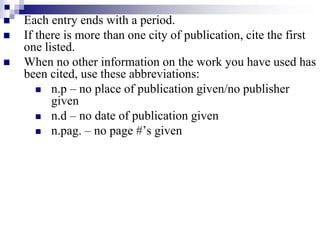
 Each entry ends with a period.
 If there is more than one city of publication, cite the first
one listed.
 When no other information on the work you have used has
been cited, use these abbreviations:
 n.p – no place of publication given/no publisher
given
 n.d – no date of publication given
 n.pag. – no page #’s given
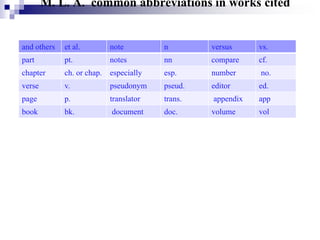
M. L. A. common abbreviations in works cited
and others et al. note n versus vs.
part pt. notes nn compare cf.
chapter ch. or chap. especially esp. number no.
verse v. pseudonym pseud. editor ed.
page p. translator trans. appendix app
book bk. document doc. volume vol
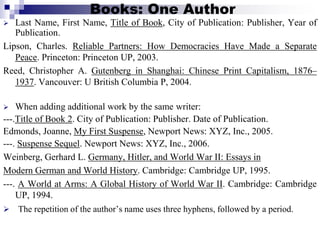
Books: One Author
 Last Name, First Name, Title of Book, City of Publication: Publisher, Year of
Publication.
Lipson, Charles. Reliable Partners: How Democracies Have Made a Separate
Peace. Princeton: Princeton UP, 2003.
Reed, Christopher A. Gutenberg in Shanghai: Chinese Print Capitalism, 1876–
1937. Vancouver: U British Columbia P, 2004.
 When adding additional work by the same writer:
---.Title of Book 2. City of Publication: Publisher. Date of Publication.
Edmonds, Joanne, My First Suspense, Newport News: XYZ, Inc., 2005.
---. Suspense Sequel. Newport News: XYZ, Inc., 2006.
Weinberg, Gerhard L. Germany, Hitler, and World War II: Essays in
Modern German and World History. Cambridge: Cambridge UP, 1995.
---. A World at Arms: A Global History of World War II. Cambridge: Cambridge
UP, 1994.
 The repetition of the author’s name uses three hyphens, followed by a period.
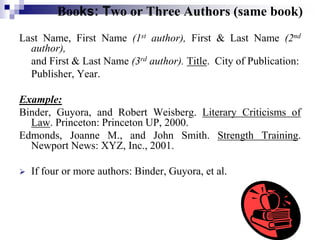
Books: Two or Three Authors (same book)
Last Name, First Name (1st author), First & Last Name (2nd
author),
and First & Last Name (3rd author). Title. City of Publication:
Publisher, Year.
Example:
Binder, Guyora, and Robert Weisberg. Literary Criticisms of
Law. Princeton: Princeton UP, 2000.
Edmonds, Joanne M., and John Smith. Strength Training.
Newport News: XYZ, Inc., 2001.
 If four or more authors: Binder, Guyora, et al.
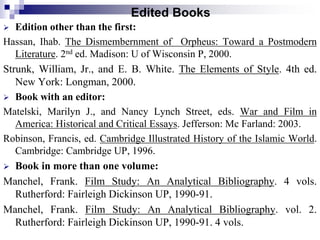
Edited Books
 Edition other than the first:
Hassan, Ihab. The Dismembernment of Orpheus: Toward a Postmodern
Literature. 2nd ed. Madison: U of Wisconsin P, 2000.
Strunk, William, Jr., and E. B. White. The Elements of Style. 4th ed.
New York: Longman, 2000.
 Book with an editor:
Matelski, Marilyn J., and Nancy Lynch Street, eds. War and Film in
America: Historical and Critical Essays. Jefferson: Mc Farland: 2003.
Robinson, Francis, ed. Cambridge Illustrated History of the Islamic World.
Cambridge: Cambridge UP, 1996.
 Book in more than one volume:
Manchel, Frank. Film Study: An Analytical Bibliography. 4 vols.
Rutherford: Fairleigh Dickinson UP, 1990-91.
Manchel, Frank. Film Study: An Analytical Bibliography. vol. 2.
Rutherford: Fairleigh Dickinson UP, 1990-91. 4 vols.
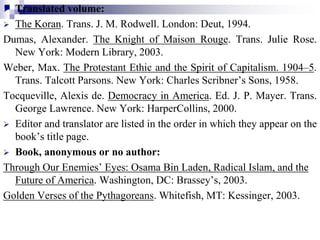
 Translated volume:
 The Koran. Trans. J. M. Rodwell. London: Deut, 1994.
Dumas, Alexander. The Knight of Maison Rouge. Trans. Julie Rose.
New York: Modern Library, 2003.
Weber, Max. The Protestant Ethic and the Spirit of Capitalism. 1904–5.
Trans. Talcott Parsons. New York: Charles Scribner’s Sons, 1958.
Tocqueville, Alexis de. Democracy in America. Ed. J. P. Mayer. Trans.
George Lawrence. New York: HarperCollins, 2000.
 Editor and translator are listed in the order in which they appear on the
book’s title page.
 Book, anonymous or no author:
Through Our Enemies’ Eyes: Osama Bin Laden, Radical Islam, and the
Future of America. Washington, DC: Brassey’s, 2003.
Golden Verses of the Pythagoreans. Whitefish, MT: Kessinger, 2003.
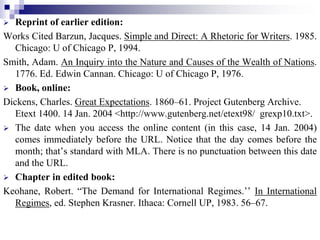
 Reprint of earlier edition:
Works Cited Barzun, Jacques. Simple and Direct: A Rhetoric for Writers. 1985.
Chicago: U of Chicago P, 1994.
Smith, Adam. An Inquiry into the Nature and Causes of the Wealth of Nations.
1776. Ed. Edwin Cannan. Chicago: U of Chicago P, 1976.
 Book, online:
Dickens, Charles. Great Expectations. 1860–61. Project Gutenberg Archive.
Etext 1400. 14 Jan. 2004 <http://www.gutenberg.net/etext98/ grexp10.txt>.
 The date when you access the online content (in this case, 14 Jan. 2004)
comes immediately before the URL. Notice that the day comes before the
month; that’s standard with MLA. There is no punctuation between this date
and the URL.
 Chapter in edited book:
Keohane, Robert. “The Demand for International Regimes.’’ In International
Regimes, ed. Stephen Krasner. Ithaca: Cornell UP, 1983. 56–67.
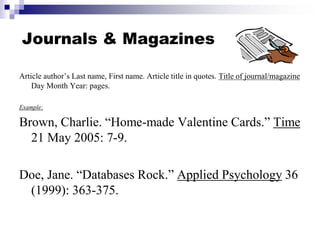
Journals & Magazines
Article author’s Last name, First name. Article title in quotes. Title of journal/magazine
Day Month Year: pages.
Example:
Brown, Charlie. “Home-made Valentine Cards.” Time
21 May 2005: 7-9.
Doe, Jane. “Databases Rock.” Applied Psychology 36
(1999): 363-375.
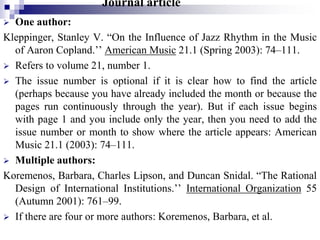
Journal article
 One author:
Kleppinger, Stanley V. “On the Influence of Jazz Rhythm in the Music
of Aaron Copland.’’ American Music 21.1 (Spring 2003): 74–111.
 Refers to volume 21, number 1.
 The issue number is optional if it is clear how to find the article
(perhaps because you have already included the month or because the
pages run continuously through the year). But if each issue begins
with page 1 and you include only the year, then you need to add the
issue number or month to show where the article appears: American
Music 21.1 (2003): 74–111.
 Multiple authors:
Koremenos, Barbara, Charles Lipson, and Duncan Snidal. “The Rational
Design of International Institutions.’’ International Organization 55
(Autumn 2001): 761–99.
 If there are four or more authors: Koremenos, Barbara, et al.
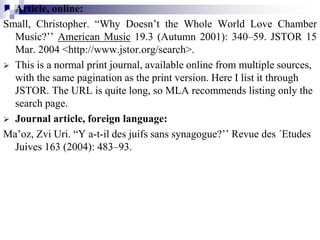
 Article, online:
Small, Christopher. “Why Doesn’t the Whole World Love Chamber
Music?’’ American Music 19.3 (Autumn 2001): 340–59. JSTOR 15
Mar. 2004 <http://www.jstor.org/search>.
 This is a normal print journal, available online from multiple sources,
with the same pagination as the print version. Here I list it through
JSTOR. The URL is quite long, so MLA recommends listing only the
search page.
 Journal article, foreign language:
Ma’oz, Zvi Uri. “Y a-t-il des juifs sans synagogue?’’ Revue des ´Etudes
Juives 163 (2004): 483–93.
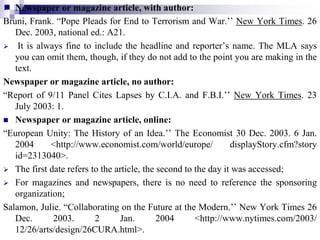
 Newspaper or magazine article, with author:
Bruni, Frank. “Pope Pleads for End to Terrorism and War.’’ New York Times. 26
Dec. 2003, national ed.: A21.
 It is always fine to include the headline and reporter’s name. The MLA says
you can omit them, though, if they do not add to the point you are making in the
text.
Newspaper or magazine article, no author:
“Report of 9/11 Panel Cites Lapses by C.I.A. and F.B.I.’’ New York Times. 23
July 2003: 1.
 Newspaper or magazine article, online:
“European Unity: The History of an Idea.’’ The Economist 30 Dec. 2003. 6 Jan.
2004 <http://www.economist.com/world/europe/ displayStory.cfm?story
id=2313040>.
 The first date refers to the article, the second to the day it was accessed;
 For magazines and newspapers, there is no need to reference the sponsoring
organization;
Salamon, Julie. “Collaborating on the Future at the Modern.’’ New York Times 26
Dec. 2003. 2 Jan. 2004 <http://www.nytimes.com/2003/
12/26/arts/design/26CURA.html>.
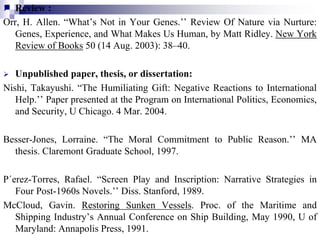
 Review :
Orr, H. Allen. “What’s Not in Your Genes.’’ Review Of Nature via Nurture:
Genes, Experience, and What Makes Us Human, by Matt Ridley. New York
Review of Books 50 (14 Aug. 2003): 38–40.
 Unpublished paper, thesis, or dissertation:
Nishi, Takayushi. “The Humiliating Gift: Negative Reactions to International
Help.’’ Paper presented at the Program on International Politics, Economics,
and Security, U Chicago. 4 Mar. 2004.
Besser-Jones, Lorraine. “The Moral Commitment to Public Reason.’’ MA
thesis. Claremont Graduate School, 1997.
P´erez-Torres, Rafael. “Screen Play and Inscription: Narrative Strategies in
Four Post-1960s Novels.’’ Diss. Stanford, 1989.
McCloud, Gavin. Restoring Sunken Vessels. Proc. of the Maritime and
Shipping Industry’s Annual Conference on Ship Building, May 1990, U of
Maryland: Annapolis Press, 1991.
Essays, Short Stories, Poems, etc.
Last Name, First Name. “Title of Work.” Title of Book. Editor First &
Last Name. City of Publication: Publisher, Year of Publication.
Page #’s.
Edmonds, Joanne. “The Sky is Blue.” Collection of Essays.
Jane Doe. New York City: Book Worm Press, 2000. 68-72.
Encyclopedias Author of article’s Last name, First Name. Title of article in quotes. Title of
Encyclopedia. Year of Edition.
Austen, Emma. “Romantic Poetry.” Encyclopedia of Literature. 2005 ed.
“African Arts.’’ Encyclopedia Britannica. 15th ed. 1987. 13: 134–80.
“Art, African.’’ Encyclopaedia Britannica Online. 2004. Encyclopaedia Britannica.
5 Jan. 2004 <http://search.eb.com/eb/article?eu= 119483>.
 Why does the name, Encyclopaedia Britannica, appear twice? Because it is both
the publication and the “sponsoring organization,” and MLA rules currently
require that you list both.
Chanda, Jacqueline. “African Art and Architecture,’’ Microsoft Encarta Online
Encyclopedia. 2004. Microsoft Corporation. 7 Jan. 2004
<http://encarta.msn.com/ encyclopedia 761574805/African Art.html>.
Newspaper Article
Last Name, First Name (if known). “Title of Article.” Title of
Newspaper City (if not already part of the title). Day Month Year,
Edition (known): Section Page.
Example:
Edmonds, Joanne. “Preventing Obesity in Children.”
Los Angeles Times 19 June 2003, late ed.: A10.
Personal Interview
Last Name, First Name of Interviewee. Kind of Interview.
Day Month Year.
Example:
Keidis, Anthony. Personal Interview. 14 Feb. 2004.
Handke, Peter. Interview. The New York Time Magazine. July, 2,
2006: 13.
Videocassette, DVD,
Filmstrip, Slide Program
Title. Director, Producer, and/or Writer. Medium. Distributor, Year.
Example:
Monet: Legacy of Light. Writ., Dir., and Prod.
Michael Gill. Videocassette. Home Vision.
1989.
Television & Radio Programs
[ Title of episode in quotes. Title of program or series. Credit (performer, writer, etc.).
Name of network. Call letters, City of Local Station. Day Month Year of Broadcast
Date. ]
Examples:
The First Americans. NBC News Special. NBC, Syracuse. 21 Feb. 2000.
“Episode 1.” Civil War Journal. Narr. Danny DeVito. Dir. Steven
Spielberg. A&E Network. 6 Apr. 1999.
“Shakespearean Putdowns”. Narr. Robert Siegel and Linda Wertheimer.
All Things Considered. Natt. Public Radio. WBUR, Boston. Apr. 6,
1994.
Internet / Web
Last Name, First Name of Site Creator (if given). Site Title. (or description,
such as homepage, if there is none). Day Month Year of latest update (if
given). Name of Institution or Organization Associated with Site (if given).
Day Month Year of access <URL or web address>.
Example:
"Grooming." Wonderful World of Poodles. 25 Apr 1998
<http://www.geocities.com/Heartland/2826/groom.html>.
Email
Writer’s name. Subject line from the posting in quotes. Description of the
message that includes the recipient. Day Month Year of message.
Examples:
Kamaka, Kimo. “New audio program.” E-mail to Keoni Silva. 5
Jan. 2006.
 Dictionary, hard copy, online, and CD-ROM:
“Historiography.’’ Merriam-Webster’s Collegiate Dictionary. 11th ed. 2003.
 You can omit the publisher information.
“Protest, v.’’ Compact Edition of the Oxford English Dictionary. 1971 ed. 2: 2335.
 The word “protest” is both a noun and a verb, and I am citing the verb here.
“Pluck, n.’’ Def. 1. Oxford English Dictionary. Ed. J. A. Simpson and E. S. C. Weiner.
2nd ed. Oxford: Clarendon P, 1989. Oxford UP. 5 Jan. 2004
<http://dictionary.oed.com/cgi/ entry/00181836>.
 There are two separate entries for the noun pluck, and I am citing the first, hence n.
Def. 1. The second is for an obscure fish.
“Balustrade.’’ Microsoft Encarta Online Dictionary. 2004. Microsoft. 5 Jan. 2004
<http://encarta.msn.com/dictionary / balustrade.html>.
“Citation.’’ American Heritage Dictionary of the English Language. 4th ed. CD-ROM.
Boston: Houghton Mifflin, 2000.
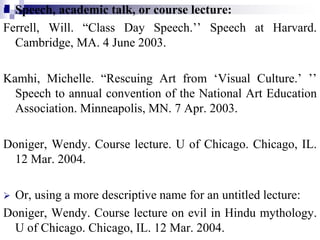
 Speech, academic talk, or course lecture:
Ferrell, Will. “Class Day Speech.’’ Speech at Harvard.
Cambridge, MA. 4 June 2003.
Kamhi, Michelle. “Rescuing Art from ‘Visual Culture.’ ’’
Speech to annual convention of the National Art Education
Association. Minneapolis, MN. 7 Apr. 2003.
Doniger, Wendy. Course lecture. U of Chicago. Chicago, IL.
12 Mar. 2004.
 Or, using a more descriptive name for an untitled lecture:
Doniger, Wendy. Course lecture on evil in Hindu mythology.
U of Chicago. Chicago, IL. 12 Mar. 2004.
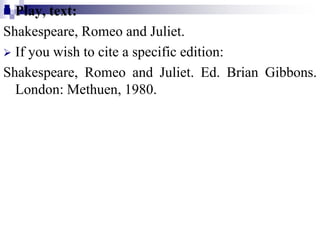
 Play, text:
Shakespeare, Romeo and Juliet.
 If you wish to cite a specific edition:
Shakespeare, Romeo and Juliet. Ed. Brian Gibbons.
London: Methuen, 1980.
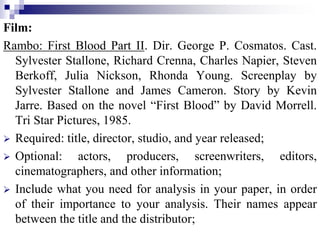
Film:
Rambo: First Blood Part II. Dir. George P. Cosmatos. Cast.
Sylvester Stallone, Richard Crenna, Charles Napier, Steven
Berkoff, Julia Nickson, Rhonda Young. Screenplay by
Sylvester Stallone and James Cameron. Story by Kevin
Jarre. Based on the novel “First Blood” by David Morrell.
Tri Star Pictures, 1985.
 Required: title, director, studio, and year released;
 Optional: actors, producers, screenwriters, editors,
cinematographers, and other information;
 Include what you need for analysis in your paper, in order
of their importance to your analysis. Their names appear
between the title and the distributor;
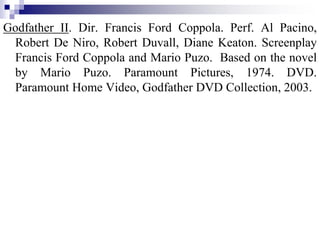
Godfather II. Dir. Francis Ford Coppola. Perf. Al Pacino,
Robert De Niro, Robert Duvall, Diane Keaton. Screenplay
Francis Ford Coppola and Mario Puzo. Based on the novel
by Mario Puzo. Paramount Pictures, 1974. DVD.
Paramount Home Video, Godfather DVD Collection, 2003.
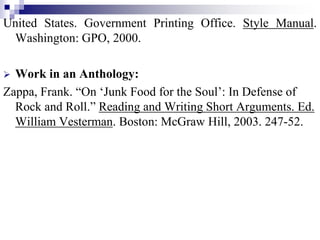
United States. Government Printing Office. Style Manual.
Washington: GPO, 2000.
 Work in an Anthology:
Zappa, Frank. “On ‘Junk Food for the Soul’: In Defense of
Rock and Roll.” Reading and Writing Short Arguments. Ed.
William Vesterman. Boston: McGraw Hill, 2003. 247-52.
Questions or Comments,
Please . . . .?
‫هد‬‫ش‬‫فا‬ ‫هم‬‫لل‬‫ا‬
‫بلغت‬ ‫قد‬ ‫فاين‬
MLA works cited list

MLA works cited list

  • 1.
  • 2.
    MLA  Modern LanguageAssociation  Founded in 1883  Primarily used in language and literature  Format: works cited has replaced the term “bibliography.” (This is the list of sources you’ve used in your paper.)
  • 3.
    Rules of aWorks Cited page  Title the page "Works Cited";  Center the title on top of the page;  It must be on a separate page;  Double- space both within and between enteries on your list;  They are not numbered;  Arrange the entries in alphabetical order by the author’s last name;  Authors with the same last name: alphabetize by the first name;  Tow or more works by the same author: alphabetize by the first work of the title;  Use also three hyphens followed by a period in subsequent entries;  When there is no identified author, begin with the title;  Indent all lines AFTER the first line of each entry;
  • 4.
     Separate thethree main parts of an entry- author’s name, title, work, and publication data- with periods followed by space;  Give the author’s name, last name first;  For sources with two or three authors, use normal order of all the names after the first, using commas to seperate the names;  Provide complete titles, and capitalize all important words;  Underline titles of books, journals, magazines, and newspapers;  Use quotation marks for titles of periodical articles, chapters and essays, within books, short stories, and poems;  Give the publisher, place, and date of publication for books;  Give the volume or issue number, date, and page number;  For electronic sources; be sure to include the date of online posting or last updating, the date you consulted the web- site, and the exact electronic address;
  • 5.
     Each entryends with a period.  If there is more than one city of publication, cite the first one listed.  When no other information on the work you have used has been cited, use these abbreviations:  n.p – no place of publication given/no publisher given  n.d – no date of publication given  n.pag. – no page #’s given
  • 6.
    M. L. A.common abbreviations in works cited and others et al. note n versus vs. part pt. notes nn compare cf. chapter ch. or chap. especially esp. number no. verse v. pseudonym pseud. editor ed. page p. translator trans. appendix app book bk. document doc. volume vol
  • 7.
    Books: One Author Last Name, First Name, Title of Book, City of Publication: Publisher, Year of Publication. Lipson, Charles. Reliable Partners: How Democracies Have Made a Separate Peace. Princeton: Princeton UP, 2003. Reed, Christopher A. Gutenberg in Shanghai: Chinese Print Capitalism, 1876– 1937. Vancouver: U British Columbia P, 2004.  When adding additional work by the same writer: ---.Title of Book 2. City of Publication: Publisher. Date of Publication. Edmonds, Joanne, My First Suspense, Newport News: XYZ, Inc., 2005. ---. Suspense Sequel. Newport News: XYZ, Inc., 2006. Weinberg, Gerhard L. Germany, Hitler, and World War II: Essays in Modern German and World History. Cambridge: Cambridge UP, 1995. ---. A World at Arms: A Global History of World War II. Cambridge: Cambridge UP, 1994.  The repetition of the author’s name uses three hyphens, followed by a period.
  • 8.
    Books: Two orThree Authors (same book) Last Name, First Name (1st author), First & Last Name (2nd author), and First & Last Name (3rd author). Title. City of Publication: Publisher, Year. Example: Binder, Guyora, and Robert Weisberg. Literary Criticisms of Law. Princeton: Princeton UP, 2000. Edmonds, Joanne M., and John Smith. Strength Training. Newport News: XYZ, Inc., 2001.  If four or more authors: Binder, Guyora, et al.
  • 9.
    Edited Books  Editionother than the first: Hassan, Ihab. The Dismembernment of Orpheus: Toward a Postmodern Literature. 2nd ed. Madison: U of Wisconsin P, 2000. Strunk, William, Jr., and E. B. White. The Elements of Style. 4th ed. New York: Longman, 2000.  Book with an editor: Matelski, Marilyn J., and Nancy Lynch Street, eds. War and Film in America: Historical and Critical Essays. Jefferson: Mc Farland: 2003. Robinson, Francis, ed. Cambridge Illustrated History of the Islamic World. Cambridge: Cambridge UP, 1996.  Book in more than one volume: Manchel, Frank. Film Study: An Analytical Bibliography. 4 vols. Rutherford: Fairleigh Dickinson UP, 1990-91. Manchel, Frank. Film Study: An Analytical Bibliography. vol. 2. Rutherford: Fairleigh Dickinson UP, 1990-91. 4 vols.
  • 10.
     Translated volume: The Koran. Trans. J. M. Rodwell. London: Deut, 1994. Dumas, Alexander. The Knight of Maison Rouge. Trans. Julie Rose. New York: Modern Library, 2003. Weber, Max. The Protestant Ethic and the Spirit of Capitalism. 1904–5. Trans. Talcott Parsons. New York: Charles Scribner’s Sons, 1958. Tocqueville, Alexis de. Democracy in America. Ed. J. P. Mayer. Trans. George Lawrence. New York: HarperCollins, 2000.  Editor and translator are listed in the order in which they appear on the book’s title page.  Book, anonymous or no author: Through Our Enemies’ Eyes: Osama Bin Laden, Radical Islam, and the Future of America. Washington, DC: Brassey’s, 2003. Golden Verses of the Pythagoreans. Whitefish, MT: Kessinger, 2003.
  • 11.
     Reprint ofearlier edition: Works Cited Barzun, Jacques. Simple and Direct: A Rhetoric for Writers. 1985. Chicago: U of Chicago P, 1994. Smith, Adam. An Inquiry into the Nature and Causes of the Wealth of Nations. 1776. Ed. Edwin Cannan. Chicago: U of Chicago P, 1976.  Book, online: Dickens, Charles. Great Expectations. 1860–61. Project Gutenberg Archive. Etext 1400. 14 Jan. 2004 <http://www.gutenberg.net/etext98/ grexp10.txt>.  The date when you access the online content (in this case, 14 Jan. 2004) comes immediately before the URL. Notice that the day comes before the month; that’s standard with MLA. There is no punctuation between this date and the URL.  Chapter in edited book: Keohane, Robert. “The Demand for International Regimes.’’ In International Regimes, ed. Stephen Krasner. Ithaca: Cornell UP, 1983. 56–67.
  • 12.
    Journals & Magazines Articleauthor’s Last name, First name. Article title in quotes. Title of journal/magazine Day Month Year: pages. Example: Brown, Charlie. “Home-made Valentine Cards.” Time 21 May 2005: 7-9. Doe, Jane. “Databases Rock.” Applied Psychology 36 (1999): 363-375.
  • 13.
    Journal article  Oneauthor: Kleppinger, Stanley V. “On the Influence of Jazz Rhythm in the Music of Aaron Copland.’’ American Music 21.1 (Spring 2003): 74–111.  Refers to volume 21, number 1.  The issue number is optional if it is clear how to find the article (perhaps because you have already included the month or because the pages run continuously through the year). But if each issue begins with page 1 and you include only the year, then you need to add the issue number or month to show where the article appears: American Music 21.1 (2003): 74–111.  Multiple authors: Koremenos, Barbara, Charles Lipson, and Duncan Snidal. “The Rational Design of International Institutions.’’ International Organization 55 (Autumn 2001): 761–99.  If there are four or more authors: Koremenos, Barbara, et al.
  • 14.
     Article, online: Small,Christopher. “Why Doesn’t the Whole World Love Chamber Music?’’ American Music 19.3 (Autumn 2001): 340–59. JSTOR 15 Mar. 2004 <http://www.jstor.org/search>.  This is a normal print journal, available online from multiple sources, with the same pagination as the print version. Here I list it through JSTOR. The URL is quite long, so MLA recommends listing only the search page.  Journal article, foreign language: Ma’oz, Zvi Uri. “Y a-t-il des juifs sans synagogue?’’ Revue des ´Etudes Juives 163 (2004): 483–93.
  • 15.
     Newspaper ormagazine article, with author: Bruni, Frank. “Pope Pleads for End to Terrorism and War.’’ New York Times. 26 Dec. 2003, national ed.: A21.  It is always fine to include the headline and reporter’s name. The MLA says you can omit them, though, if they do not add to the point you are making in the text. Newspaper or magazine article, no author: “Report of 9/11 Panel Cites Lapses by C.I.A. and F.B.I.’’ New York Times. 23 July 2003: 1.  Newspaper or magazine article, online: “European Unity: The History of an Idea.’’ The Economist 30 Dec. 2003. 6 Jan. 2004 <http://www.economist.com/world/europe/ displayStory.cfm?story id=2313040>.  The first date refers to the article, the second to the day it was accessed;  For magazines and newspapers, there is no need to reference the sponsoring organization; Salamon, Julie. “Collaborating on the Future at the Modern.’’ New York Times 26 Dec. 2003. 2 Jan. 2004 <http://www.nytimes.com/2003/ 12/26/arts/design/26CURA.html>.
  • 16.
     Review : Orr,H. Allen. “What’s Not in Your Genes.’’ Review Of Nature via Nurture: Genes, Experience, and What Makes Us Human, by Matt Ridley. New York Review of Books 50 (14 Aug. 2003): 38–40.  Unpublished paper, thesis, or dissertation: Nishi, Takayushi. “The Humiliating Gift: Negative Reactions to International Help.’’ Paper presented at the Program on International Politics, Economics, and Security, U Chicago. 4 Mar. 2004. Besser-Jones, Lorraine. “The Moral Commitment to Public Reason.’’ MA thesis. Claremont Graduate School, 1997. P´erez-Torres, Rafael. “Screen Play and Inscription: Narrative Strategies in Four Post-1960s Novels.’’ Diss. Stanford, 1989. McCloud, Gavin. Restoring Sunken Vessels. Proc. of the Maritime and Shipping Industry’s Annual Conference on Ship Building, May 1990, U of Maryland: Annapolis Press, 1991.
  • 17.
    Essays, Short Stories,Poems, etc. Last Name, First Name. “Title of Work.” Title of Book. Editor First & Last Name. City of Publication: Publisher, Year of Publication. Page #’s. Edmonds, Joanne. “The Sky is Blue.” Collection of Essays. Jane Doe. New York City: Book Worm Press, 2000. 68-72.
  • 18.
    Encyclopedias Author ofarticle’s Last name, First Name. Title of article in quotes. Title of Encyclopedia. Year of Edition. Austen, Emma. “Romantic Poetry.” Encyclopedia of Literature. 2005 ed. “African Arts.’’ Encyclopedia Britannica. 15th ed. 1987. 13: 134–80. “Art, African.’’ Encyclopaedia Britannica Online. 2004. Encyclopaedia Britannica. 5 Jan. 2004 <http://search.eb.com/eb/article?eu= 119483>.  Why does the name, Encyclopaedia Britannica, appear twice? Because it is both the publication and the “sponsoring organization,” and MLA rules currently require that you list both. Chanda, Jacqueline. “African Art and Architecture,’’ Microsoft Encarta Online Encyclopedia. 2004. Microsoft Corporation. 7 Jan. 2004 <http://encarta.msn.com/ encyclopedia 761574805/African Art.html>.
  • 19.
    Newspaper Article Last Name,First Name (if known). “Title of Article.” Title of Newspaper City (if not already part of the title). Day Month Year, Edition (known): Section Page. Example: Edmonds, Joanne. “Preventing Obesity in Children.” Los Angeles Times 19 June 2003, late ed.: A10.
  • 20.
    Personal Interview Last Name,First Name of Interviewee. Kind of Interview. Day Month Year. Example: Keidis, Anthony. Personal Interview. 14 Feb. 2004. Handke, Peter. Interview. The New York Time Magazine. July, 2, 2006: 13.
  • 21.
    Videocassette, DVD, Filmstrip, SlideProgram Title. Director, Producer, and/or Writer. Medium. Distributor, Year. Example: Monet: Legacy of Light. Writ., Dir., and Prod. Michael Gill. Videocassette. Home Vision. 1989.
  • 22.
    Television & RadioPrograms [ Title of episode in quotes. Title of program or series. Credit (performer, writer, etc.). Name of network. Call letters, City of Local Station. Day Month Year of Broadcast Date. ] Examples: The First Americans. NBC News Special. NBC, Syracuse. 21 Feb. 2000. “Episode 1.” Civil War Journal. Narr. Danny DeVito. Dir. Steven Spielberg. A&E Network. 6 Apr. 1999. “Shakespearean Putdowns”. Narr. Robert Siegel and Linda Wertheimer. All Things Considered. Natt. Public Radio. WBUR, Boston. Apr. 6, 1994.
  • 23.
    Internet / Web LastName, First Name of Site Creator (if given). Site Title. (or description, such as homepage, if there is none). Day Month Year of latest update (if given). Name of Institution or Organization Associated with Site (if given). Day Month Year of access <URL or web address>. Example: "Grooming." Wonderful World of Poodles. 25 Apr 1998 <http://www.geocities.com/Heartland/2826/groom.html>.
  • 24.
    Email Writer’s name. Subjectline from the posting in quotes. Description of the message that includes the recipient. Day Month Year of message. Examples: Kamaka, Kimo. “New audio program.” E-mail to Keoni Silva. 5 Jan. 2006.
  • 25.
     Dictionary, hardcopy, online, and CD-ROM: “Historiography.’’ Merriam-Webster’s Collegiate Dictionary. 11th ed. 2003.  You can omit the publisher information. “Protest, v.’’ Compact Edition of the Oxford English Dictionary. 1971 ed. 2: 2335.  The word “protest” is both a noun and a verb, and I am citing the verb here. “Pluck, n.’’ Def. 1. Oxford English Dictionary. Ed. J. A. Simpson and E. S. C. Weiner. 2nd ed. Oxford: Clarendon P, 1989. Oxford UP. 5 Jan. 2004 <http://dictionary.oed.com/cgi/ entry/00181836>.  There are two separate entries for the noun pluck, and I am citing the first, hence n. Def. 1. The second is for an obscure fish. “Balustrade.’’ Microsoft Encarta Online Dictionary. 2004. Microsoft. 5 Jan. 2004 <http://encarta.msn.com/dictionary / balustrade.html>. “Citation.’’ American Heritage Dictionary of the English Language. 4th ed. CD-ROM. Boston: Houghton Mifflin, 2000.
  • 26.
     Speech, academictalk, or course lecture: Ferrell, Will. “Class Day Speech.’’ Speech at Harvard. Cambridge, MA. 4 June 2003. Kamhi, Michelle. “Rescuing Art from ‘Visual Culture.’ ’’ Speech to annual convention of the National Art Education Association. Minneapolis, MN. 7 Apr. 2003. Doniger, Wendy. Course lecture. U of Chicago. Chicago, IL. 12 Mar. 2004.  Or, using a more descriptive name for an untitled lecture: Doniger, Wendy. Course lecture on evil in Hindu mythology. U of Chicago. Chicago, IL. 12 Mar. 2004.
  • 27.
     Play, text: Shakespeare,Romeo and Juliet.  If you wish to cite a specific edition: Shakespeare, Romeo and Juliet. Ed. Brian Gibbons. London: Methuen, 1980.
  • 28.
    Film: Rambo: First BloodPart II. Dir. George P. Cosmatos. Cast. Sylvester Stallone, Richard Crenna, Charles Napier, Steven Berkoff, Julia Nickson, Rhonda Young. Screenplay by Sylvester Stallone and James Cameron. Story by Kevin Jarre. Based on the novel “First Blood” by David Morrell. Tri Star Pictures, 1985.  Required: title, director, studio, and year released;  Optional: actors, producers, screenwriters, editors, cinematographers, and other information;  Include what you need for analysis in your paper, in order of their importance to your analysis. Their names appear between the title and the distributor;
  • 29.
    Godfather II. Dir.Francis Ford Coppola. Perf. Al Pacino, Robert De Niro, Robert Duvall, Diane Keaton. Screenplay Francis Ford Coppola and Mario Puzo. Based on the novel by Mario Puzo. Paramount Pictures, 1974. DVD. Paramount Home Video, Godfather DVD Collection, 2003.
  • 30.
    United States. GovernmentPrinting Office. Style Manual. Washington: GPO, 2000.  Work in an Anthology: Zappa, Frank. “On ‘Junk Food for the Soul’: In Defense of Rock and Roll.” Reading and Writing Short Arguments. Ed. William Vesterman. Boston: McGraw Hill, 2003. 247-52.
  • 31.
  • 33.