Using MLA Format
Why Use MLA Format? Allows readers to see your sources easily Provides consistent format within a discipline Gives you credibility as a writer Protects yourself from plagiarism
Cross-Referencing Your Sources Cross-referencing allows readers to locate the publication information of source material.  This is of great value for researchers who may want to locate your sources for their own research projects.
Using a Consistent Format Using a consistent format helps your reader understand your arguments and the sources they’re built on.  It also helps you keep track of your sources as you build arguments.
Establishing Credibility The proper use of MLA style shows the credibility of writers; such writers show accountability to their source material.
Avoiding Plagiarism Proper citation of your sources in MLA style can help you avoid plagiarism, which is a serious offense. It may result in anything from failure of the assignment to expulsion from school.
Where Do I Find MLA Format? MLA Handbook for Writers of Research Papers , 5th ed. Composition textbooks http://www.dianahacker.com/resdoc/ OWL website:  owl.english.purdue.edu
MLA Style: Two Parts Works Cited Page  Parenthetical Citations
Works Cited Page A complete alphabetical  list of every source that you make reference to in your essay Provides the information necessary for a reader to locate and retrieve any sources cited in your essay.
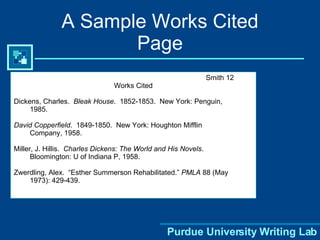
A Sample Works Cited Page Smith 12 Works Cited Dickens, Charles.  Bleak House .  1852-1853.  New York: Penguin, 1985. David Copperfield .  1849-1850.  New York: Houghton Mifflin  Company, 1958. Miller, J. Hillis.  Charles Dickens: The World and His Novels .  Bloomington: U of Indiana P, 1958. Zwerdling, Alex.  “Esther Summerson Rehabilitated.”  PMLA  88 (May 1973): 429-439.
Most citations should contain the following basic information: Author’s name Title of work Publication information Works Cited
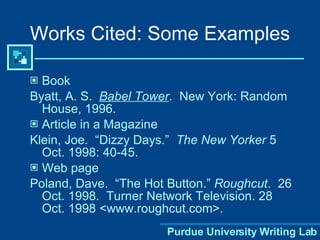
Book Byatt, A. S.  Babel Tower .  New York: Random House, 1996. Article in a Magazine Klein, Joe.  “Dizzy Days.”  The New Yorker  5 Oct. 1998: 40-45. Web page Poland, Dave.  “The Hot Button.”  Roughcut .  26 Oct. 1998.  Turner Network Television. 28 Oct. 1998 <www.roughcut.com>. Works Cited: Some Examples
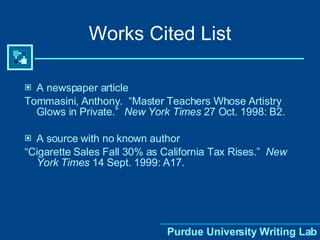
Works Cited List A newspaper article Tommasini, Anthony.  “Master Teachers Whose Artistry Glows in Private.”  New York Times  27 Oct. 1998: B2. A source with no known author “ Cigarette Sales Fall 30% as California Tax Rises.”  New York Times  14 Sept. 1999: A17.
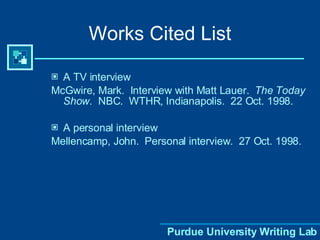
Works Cited List A TV interview McGwire, Mark.  Interview with Matt Lauer.  The Today Show .  NBC.  WTHR, Indianapolis.  22 Oct. 1998. A personal interview Mellencamp, John.  Personal interview.  27 Oct. 1998.
Where can you go for additional help with MLA documentation? ASA Learning Center 4 th  floor 31 st   street Check web site:  http://owl.english.purdue.edu Email brief questions:  [email_address] ME!!!!!!! Purdue University Writing Lab

Mla

  • 1.
  • 2.
    Why Use MLAFormat? Allows readers to see your sources easily Provides consistent format within a discipline Gives you credibility as a writer Protects yourself from plagiarism
  • 3.
    Cross-Referencing Your SourcesCross-referencing allows readers to locate the publication information of source material. This is of great value for researchers who may want to locate your sources for their own research projects.
  • 4.
    Using a ConsistentFormat Using a consistent format helps your reader understand your arguments and the sources they’re built on. It also helps you keep track of your sources as you build arguments.
  • 5.
    Establishing Credibility Theproper use of MLA style shows the credibility of writers; such writers show accountability to their source material.
  • 6.
    Avoiding Plagiarism Propercitation of your sources in MLA style can help you avoid plagiarism, which is a serious offense. It may result in anything from failure of the assignment to expulsion from school.
  • 7.
    Where Do IFind MLA Format? MLA Handbook for Writers of Research Papers , 5th ed. Composition textbooks http://www.dianahacker.com/resdoc/ OWL website: owl.english.purdue.edu
  • 8.
    MLA Style: TwoParts Works Cited Page Parenthetical Citations
  • 9.
    Works Cited PageA complete alphabetical list of every source that you make reference to in your essay Provides the information necessary for a reader to locate and retrieve any sources cited in your essay.
  • 10.
    A Sample WorksCited Page Smith 12 Works Cited Dickens, Charles. Bleak House . 1852-1853. New York: Penguin, 1985. David Copperfield . 1849-1850. New York: Houghton Mifflin Company, 1958. Miller, J. Hillis. Charles Dickens: The World and His Novels . Bloomington: U of Indiana P, 1958. Zwerdling, Alex. “Esther Summerson Rehabilitated.” PMLA 88 (May 1973): 429-439.
  • 11.
    Most citations shouldcontain the following basic information: Author’s name Title of work Publication information Works Cited
  • 12.
    Book Byatt, A.S. Babel Tower . New York: Random House, 1996. Article in a Magazine Klein, Joe. “Dizzy Days.” The New Yorker 5 Oct. 1998: 40-45. Web page Poland, Dave. “The Hot Button.” Roughcut . 26 Oct. 1998. Turner Network Television. 28 Oct. 1998 <www.roughcut.com>. Works Cited: Some Examples
  • 13.
    Works Cited ListA newspaper article Tommasini, Anthony. “Master Teachers Whose Artistry Glows in Private.” New York Times 27 Oct. 1998: B2. A source with no known author “ Cigarette Sales Fall 30% as California Tax Rises.” New York Times 14 Sept. 1999: A17.
  • 14.
    Works Cited ListA TV interview McGwire, Mark. Interview with Matt Lauer. The Today Show . NBC. WTHR, Indianapolis. 22 Oct. 1998. A personal interview Mellencamp, John. Personal interview. 27 Oct. 1998.
  • 15.
    Where can yougo for additional help with MLA documentation? ASA Learning Center 4 th floor 31 st street Check web site: http://owl.english.purdue.edu Email brief questions: [email_address] ME!!!!!!! Purdue University Writing Lab

Editor's Notes

  • #2 Rationale: Welcome to “Cross-referencing: Using MLA Format.” This presentation is designed to introduce your students to the purposes of documentation, as well as methods for effectively using parenthetical citations and a Works Cited page. The twenty-two slides presented here are designed to aid the facilitator in an interactive presentation of strategies for using MLA style. This presentation is ideal for the beginning of a research unit in a humanities course or any assignment that requires MLA documentation. This presentation may be supplemented with OWL handouts, including “Using MLA Format.” (http://owl.english.purdue.edu/handouts/research/r_mla.html), “Paraphrase: Write It in Your Own Words” (http://owl.english.purdue.edu/handouts/research/r_paraphr.html), “Quoting, Paraphrasing, and Summarizing” (http://owl.english.purdue.edu/handouts/research/r_quotprsum.html), and “Avoiding Plagiarism” (http://owl.english.purdue.edu/handouts/research/r_plagiar.html). Directions: Each slide is activated by a single mouse click, unless otherwise noted in bold at the bottom of each notes page. Writer and Designer: Jennifer Liethen Kunka Contributors: Muriel Harris, Karen Bishop, Bryan Kopp, Matthew Mooney, David Neyhart, and Andrew Kunka Developed with resources courtesy of the Purdue University Writing Lab Grant funding courtesy of the Multimedia Instructional Development Center at Purdue University © Copyright Purdue University, 2000.