
APA: In-text Citations Presented by: Pamela M. Veroy RN, MAN SOURCE UNC University Libraries. (2009, October 09).  APA: In-Text Citation.  Retrieved from: http://www.lib.unc.edu/instruct/citations/apa/in_text.html
APA: In-text Citations For all in-text citations except for those following block quotations, the reference is placed immediately before the final punctuation mark of the sentence that refers to that source.  In all citations, elements (such as author, publication year, and page number) are separated from each other by commas.
For Exact Quotations: the citations indicate page number (using the abbreviation "p.").  One may also use chapter numbers (abbreviated "chap."),  section numbers,  equation numbers,  table numbers,  or any other organizational numbering that exists in the source to indicate the reference for a citation.
For Exact Quotations: Rule:  Introduce the quotation with a signal phrase that includes the author's last name followed by the date of publication in parentheses. Put the page number in parentheses at the end of the quotation before the ending punctuation mark. Example: As Davis (1978) reported, "If the existence of a signing ape was unsettling for linguists, it was also startling news for animal behaviorists" (p. 26).
For Exact Quotations: Rule: When the author's name does not appear in the signal phrase, place the author's name, the date, and the page number in parentheses at the end of the quotation. Use commas between items in the parentheses. Example: "If the existence of a signing ape was unsettling for linguists, it was also startling news for animal behaviorists" (Davis, 1978, p. 26).
For Exact Quotations: Rule:  When the quotation is more than 40 words in text, do not use quotation marks, but indent the quotation into its own block of text. Note that for blocks of text, the citation follows the final punctuation of the quoted text.
For Exact Quotations: Example: Students having a hard time finding databases isn't a new phenomenon. At the University of Washington, they have problems too. With the addition of so many new databases to the campus online system, many students were having difficulty locating the database they needed. At the same time, the role of Session Manager had evolved. The increased importance of the Session Manager as a selection tool made it a part of the navigation process itself. (Eliasen, 1997, p. 510)
For Paraphrased Ideas: In general, no quotation marks are required when paraphrasing ideas. Likewise, page numbers or other indication of specific parts of a source are not necessary unless a specific part of the text is being referenced. Examples: According to Davis (1978), when they learned of an ape's ability to use sign language, both linguists and animal behaviorists were taken by surprise. When they learned of an ape's ability to use sign language, both linguists and animal behaviorists were taken by surprise (Davis, 1978).
Additional Circumstances: Rule: Work with two authors Examples: Patterson and Linden (1981) agreed that the gorilla Koko acquired language more slowly than a normal speaking child. Koko acquired language more slowly than a normal speaking child (Patterson & Linden, 1981).
Additional Circumstances: Rule: Work with 3-5 authors: In the first reference to such a work, list all authors. Example: The study noted a fluctuating divorce rate in Middletown between the 1920s and the 1970s (Caplow, Bahr, Chadwick, Hill, & Williamson, 1982). In subsequent citations, use the first author's name followed by "et al." (note the period after the word "al"). Example: While the incidence of wife abuse may not be higher than in the past, the researchers found that women were more willing to report it (Caplow et al., 1982).
Additional Circumstances: Rule: Work with 6+ authors (for first and subsequent citations) Example: Communes in the late 1960s functioned like extended families, with child-rearing responsibilities shared by all adult members (Berger et al., 1971).
Additional Circumstances: Rule: Work by an association, government agency, or corporation Examples: First citation: (National Institute of Mental Health [NIMH], 1996) Later citations: (NIMH, 1996)
Additional Circumstances: Rule: When citing from a source that does not provide page numbers (such as an electronic source), use paragraph numbers if available, or the name of the section followed by the number of the paragraph within that section. Examples: (Myers, 2000, para. 5) (Beutler, 2000, Conclusion section, para. 1)
Additional Circumstances: Rule:  When citing from a source with no author given, or when citing from legal materials, use the first few words of the reference list entry (usually the title) and the year as your citation. Place article, web page, chapter, and section titles in double quotation marks, and  italicize  the titles of books, periodicals, reports, and websites. Examples: ("Former FBI Agent," 2007) ...as seen in Preparing for the GRE (2003).
Additional Circumstances: When a work's author is designated as  "Anonymous,"  cite in text the word  Anonymous   followed by a comma and the date: Examples:  (Anonymous, 1998).
APA: Print Sources Note that titles of periodicals (newspapers, journals, magazines) are  capitalized  as they normally are; book titles and article titles have only the first word of the title (and of any subtitles), as well as proper nouns,  capitalized.  Use  single spaces  between all words/items within each citation.
SAMPLE BIBLIOGRAPHY FORMAT
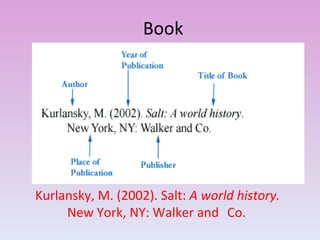
Book  Kurlansky, M. (2002). Salt:  A world history.  New York, NY: Walker and  Co.
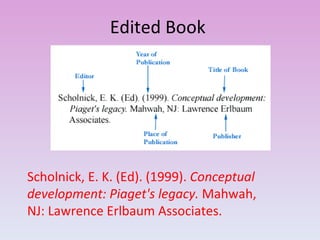
Edited Book  Scholnick, E. K. (Ed). (1999).  Conceptual  development: Piaget's legacy.  Mahwah,  NJ: Lawrence Erlbaum Associates.
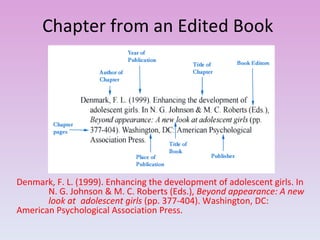
Chapter from an Edited Book  Denmark, F. L. (1999). Enhancing the development of adolescent girls. In  N. G. Johnson & M. C. Roberts (Eds.),  Beyond appearance: A new  look at  adolescent girls  (pp. 377-404). Washington, DC:  American Psychological Association Press.
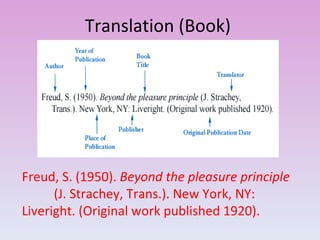
Translation (Book)  Freud, S. (1950).  Beyond the pleasure principle  (J. Strachey, Trans.). New York, NY:  Liveright. (Original work published 1920).
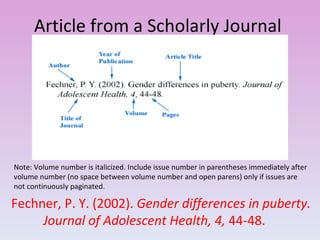
Article from a Scholarly Journal  Fechner, P. Y. (2002).  Gender differences in puberty.  Journal of Adolescent Health, 4,  44-48. Note: Volume number is italicized. Include issue number in parentheses immediately after volume number (no space between volume number and open parens) only if issues are not continuously paginated.
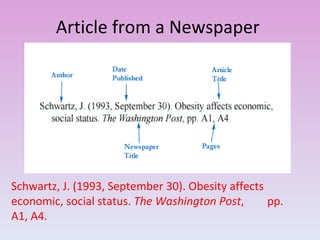
Article from a Newspaper  Schwartz, J. (1993, September 30). Obesity affects  economic, social status.  The Washington Post ,  pp. A1, A4.
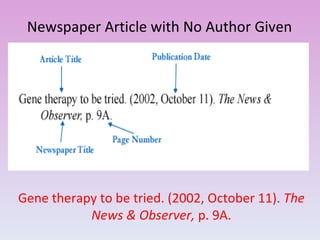
Newspaper Article with No Author Given  Gene therapy to be tried. (2002, October 11).  The News & Observer,  p. 9A.
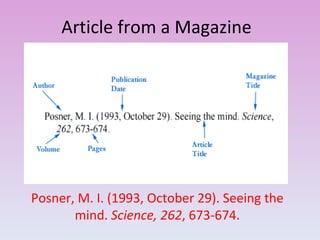
Article from a Magazine  Posner, M. I. (1993, October 29). Seeing the mind.  Science, 262 , 673-674.
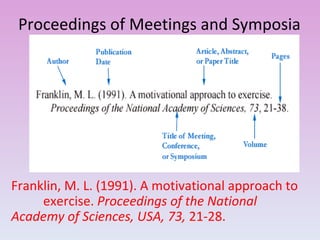
Proceedings of Meetings and Symposia  Franklin, M. L. (1991). A motivational approach to  exercise.  Proceedings of the National  Academy of Sciences, USA, 73,  21-28.
www.slideshare.net/pamelaveroy

APA: In-text Citations

  • 1.
    APA: In-text CitationsPresented by: Pamela M. Veroy RN, MAN SOURCE UNC University Libraries. (2009, October 09). APA: In-Text Citation. Retrieved from: http://www.lib.unc.edu/instruct/citations/apa/in_text.html
  • 2.
    APA: In-text CitationsFor all in-text citations except for those following block quotations, the reference is placed immediately before the final punctuation mark of the sentence that refers to that source. In all citations, elements (such as author, publication year, and page number) are separated from each other by commas.
  • 3.
    For Exact Quotations:the citations indicate page number (using the abbreviation "p."). One may also use chapter numbers (abbreviated "chap."), section numbers, equation numbers, table numbers, or any other organizational numbering that exists in the source to indicate the reference for a citation.
  • 4.
    For Exact Quotations:Rule: Introduce the quotation with a signal phrase that includes the author's last name followed by the date of publication in parentheses. Put the page number in parentheses at the end of the quotation before the ending punctuation mark. Example: As Davis (1978) reported, "If the existence of a signing ape was unsettling for linguists, it was also startling news for animal behaviorists" (p. 26).
  • 5.
    For Exact Quotations:Rule: When the author's name does not appear in the signal phrase, place the author's name, the date, and the page number in parentheses at the end of the quotation. Use commas between items in the parentheses. Example: "If the existence of a signing ape was unsettling for linguists, it was also startling news for animal behaviorists" (Davis, 1978, p. 26).
  • 6.
    For Exact Quotations:Rule: When the quotation is more than 40 words in text, do not use quotation marks, but indent the quotation into its own block of text. Note that for blocks of text, the citation follows the final punctuation of the quoted text.
  • 7.
    For Exact Quotations:Example: Students having a hard time finding databases isn't a new phenomenon. At the University of Washington, they have problems too. With the addition of so many new databases to the campus online system, many students were having difficulty locating the database they needed. At the same time, the role of Session Manager had evolved. The increased importance of the Session Manager as a selection tool made it a part of the navigation process itself. (Eliasen, 1997, p. 510)
  • 8.
    For Paraphrased Ideas:In general, no quotation marks are required when paraphrasing ideas. Likewise, page numbers or other indication of specific parts of a source are not necessary unless a specific part of the text is being referenced. Examples: According to Davis (1978), when they learned of an ape's ability to use sign language, both linguists and animal behaviorists were taken by surprise. When they learned of an ape's ability to use sign language, both linguists and animal behaviorists were taken by surprise (Davis, 1978).
  • 9.
    Additional Circumstances: Rule:Work with two authors Examples: Patterson and Linden (1981) agreed that the gorilla Koko acquired language more slowly than a normal speaking child. Koko acquired language more slowly than a normal speaking child (Patterson & Linden, 1981).
  • 10.
    Additional Circumstances: Rule:Work with 3-5 authors: In the first reference to such a work, list all authors. Example: The study noted a fluctuating divorce rate in Middletown between the 1920s and the 1970s (Caplow, Bahr, Chadwick, Hill, & Williamson, 1982). In subsequent citations, use the first author's name followed by "et al." (note the period after the word "al"). Example: While the incidence of wife abuse may not be higher than in the past, the researchers found that women were more willing to report it (Caplow et al., 1982).
  • 11.
    Additional Circumstances: Rule:Work with 6+ authors (for first and subsequent citations) Example: Communes in the late 1960s functioned like extended families, with child-rearing responsibilities shared by all adult members (Berger et al., 1971).
  • 12.
    Additional Circumstances: Rule:Work by an association, government agency, or corporation Examples: First citation: (National Institute of Mental Health [NIMH], 1996) Later citations: (NIMH, 1996)
  • 13.
    Additional Circumstances: Rule:When citing from a source that does not provide page numbers (such as an electronic source), use paragraph numbers if available, or the name of the section followed by the number of the paragraph within that section. Examples: (Myers, 2000, para. 5) (Beutler, 2000, Conclusion section, para. 1)
  • 14.
    Additional Circumstances: Rule: When citing from a source with no author given, or when citing from legal materials, use the first few words of the reference list entry (usually the title) and the year as your citation. Place article, web page, chapter, and section titles in double quotation marks, and italicize the titles of books, periodicals, reports, and websites. Examples: ("Former FBI Agent," 2007) ...as seen in Preparing for the GRE (2003).
  • 15.
    Additional Circumstances: Whena work's author is designated as "Anonymous," cite in text the word Anonymous followed by a comma and the date: Examples: (Anonymous, 1998).
  • 16.
    APA: Print SourcesNote that titles of periodicals (newspapers, journals, magazines) are capitalized as they normally are; book titles and article titles have only the first word of the title (and of any subtitles), as well as proper nouns, capitalized. Use single spaces between all words/items within each citation.
  • 17.
  • 18.
    Book Kurlansky,M. (2002). Salt: A world history. New York, NY: Walker and Co.
  • 19.
    Edited Book Scholnick, E. K. (Ed). (1999). Conceptual development: Piaget's legacy. Mahwah, NJ: Lawrence Erlbaum Associates.
  • 20.
    Chapter from anEdited Book Denmark, F. L. (1999). Enhancing the development of adolescent girls. In N. G. Johnson & M. C. Roberts (Eds.), Beyond appearance: A new look at adolescent girls (pp. 377-404). Washington, DC: American Psychological Association Press.
  • 21.
    Translation (Book) Freud, S. (1950). Beyond the pleasure principle (J. Strachey, Trans.). New York, NY: Liveright. (Original work published 1920).
  • 22.
    Article from aScholarly Journal Fechner, P. Y. (2002). Gender differences in puberty. Journal of Adolescent Health, 4, 44-48. Note: Volume number is italicized. Include issue number in parentheses immediately after volume number (no space between volume number and open parens) only if issues are not continuously paginated.
  • 23.
    Article from aNewspaper Schwartz, J. (1993, September 30). Obesity affects economic, social status. The Washington Post , pp. A1, A4.
  • 24.
    Newspaper Article withNo Author Given Gene therapy to be tried. (2002, October 11). The News & Observer, p. 9A.
  • 25.
    Article from aMagazine Posner, M. I. (1993, October 29). Seeing the mind. Science, 262 , 673-674.
  • 26.
    Proceedings of Meetingsand Symposia Franklin, M. L. (1991). A motivational approach to exercise. Proceedings of the National Academy of Sciences, USA, 73, 21-28.
  • 27.