Masahiro Akaishi
Format is very  IMPORTANT … However, many students do not pay attention to formatting so much There are always rules to write something If you overlook formatting correctly, your essay might not be as good as it should be
There are two main format styles MLA & APA style … in most case, professors tend to prefer MLA format style including in your upper courses of your major Even though the point of format in First Year Composition Assessment Rubric is small, do not under estimate the format; it is always important to be consistent in your essay
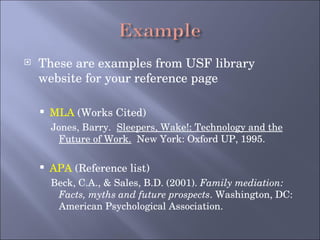
These are examples from USF library website for your reference page MLA  (Works Cited) Jones, Barry.   Sleepers, Wake!: Technology and the Future of Work.   New York: Oxford UP, 1995. APA  (Reference list) Beck, C.A., & Sales, B.D. (2001).  Family mediation:  Facts, myths and future prospects . Washington, DC:  American Psychological Association.
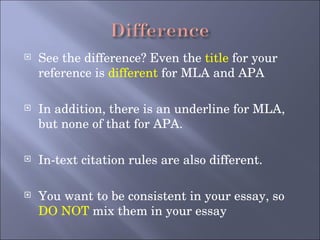
See the difference? Even the  title  for your reference is  different  for MLA and APA In addition, there is an underline for MLA, but none of that for APA. In-text citation rules are also different.  You want to be consistent in your essay, so  DO NOT  mix them in your essay
Let’s see what else you need to be careful about major MLA style formats!
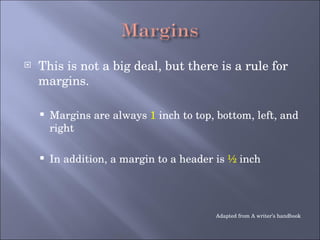
This is not a big deal, but there is a rule for margins. Margins are always  1  inch to top, bottom, left, and right In addition, a margin to a header is  ½  inch  Adapted from A writer’s handbook
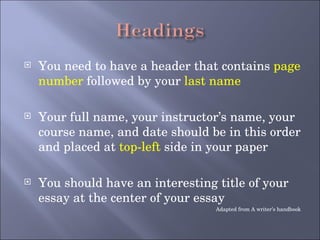
You need to have a header that contains  page number  followed by your  last name Your full name, your instructor’s name, your course name, and date should be in this order and placed at  top-left  side in your paper You should have an interesting title of your essay at the center of your essay Adapted from A writer’s handbook
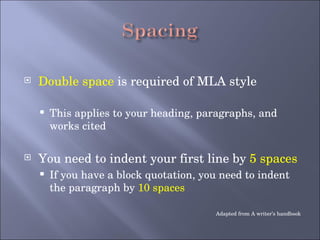
Double space  is required of MLA style This applies to your heading, paragraphs, and works cited You need to indent your first line by  5 spaces If you have a block quotation, you need to indent the paragraph by  10 spaces Adapted from A writer’s handbook
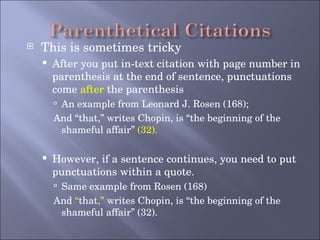
This is sometimes tricky After you put in-text citation with page number in parenthesis at the end of sentence, punctuations come  after  the parenthesis An example from Leonard J. Rosen (168); And “that,” writes Chopin, is “the beginning of the shameful affair”  (32). However, if a sentence continues, you need to put punctuations within a quote.  Same example from Rosen (168) And  “ that ,”  writes Chopin, is “the beginning of the shameful affair” (32).
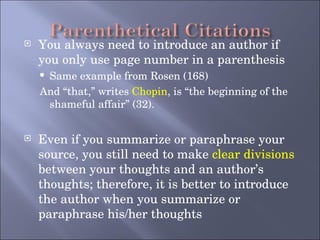
You always need to introduce an author if you only use page number in a parenthesis Same example from Rosen (168) And “that,” writes  Chopin , is “the beginning of the shameful affair” (32). Even if you summarize or paraphrase your source, you still need to make  clear divisions  between your thoughts and an author’s thoughts; therefore, it is better to introduce the author when you summarize or paraphrase his/her thoughts
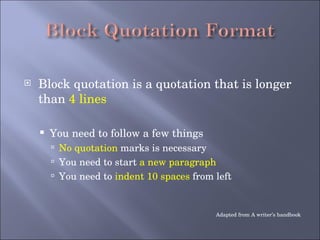
Block quotation is a quotation that is longer than  4 lines You need to follow a few things No quotation  marks is necessary You need to start  a new paragraph You need to  indent 10 spaces  from left Adapted from A writer’s handbook
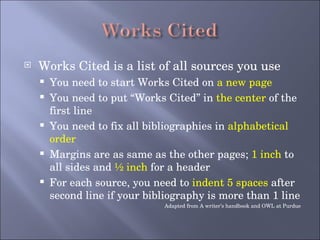
Works Cited is a list of all sources you use You need to start Works Cited on  a new page You need to put “Works Cited” in  the center  of the first line You need to fix all bibliographies in  alphabetical order Margins are as same as the other pages;  1 inch  to all sides and  ½ inch  for a header For each source, you need to  indent 5 spaces  after second line if your bibliography is more than 1 line Adapted from A writer’s handbook and OWL at Purdue
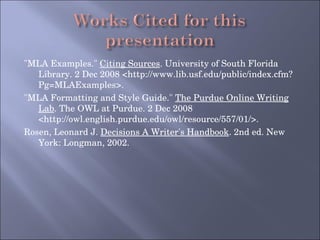
&quot;MLA Examples.&quot;  Citing Sources . University of South Florida Library. 2 Dec 2008 <http://www.lib.usf.edu/public/index.cfm?Pg=MLAExamples>.  &quot;MLA Formatting and Style Guide.&quot;  The Purdue Online Writing Lab . The OWL at Purdue. 2 Dec 2008 <http://owl.english.purdue.edu/owl/resource/557/01/>.  Rosen, Leonard J.  Decisions A Writer's Handbook . 2nd ed. New York: Longman, 2002.

MLA Format

  • 1.
  • 2.
    Format is very IMPORTANT … However, many students do not pay attention to formatting so much There are always rules to write something If you overlook formatting correctly, your essay might not be as good as it should be
  • 3.
    There are twomain format styles MLA & APA style … in most case, professors tend to prefer MLA format style including in your upper courses of your major Even though the point of format in First Year Composition Assessment Rubric is small, do not under estimate the format; it is always important to be consistent in your essay
  • 4.
    These are examplesfrom USF library website for your reference page MLA (Works Cited) Jones, Barry.  Sleepers, Wake!: Technology and the Future of Work.   New York: Oxford UP, 1995. APA (Reference list) Beck, C.A., & Sales, B.D. (2001). Family mediation: Facts, myths and future prospects . Washington, DC:  American Psychological Association.
  • 5.
    See the difference?Even the title for your reference is different for MLA and APA In addition, there is an underline for MLA, but none of that for APA. In-text citation rules are also different. You want to be consistent in your essay, so DO NOT mix them in your essay
  • 6.
    Let’s see whatelse you need to be careful about major MLA style formats!
  • 7.
    This is nota big deal, but there is a rule for margins. Margins are always 1 inch to top, bottom, left, and right In addition, a margin to a header is ½ inch Adapted from A writer’s handbook
  • 8.
    You need tohave a header that contains page number followed by your last name Your full name, your instructor’s name, your course name, and date should be in this order and placed at top-left side in your paper You should have an interesting title of your essay at the center of your essay Adapted from A writer’s handbook
  • 9.
    Double space is required of MLA style This applies to your heading, paragraphs, and works cited You need to indent your first line by 5 spaces If you have a block quotation, you need to indent the paragraph by 10 spaces Adapted from A writer’s handbook
  • 10.
    This is sometimestricky After you put in-text citation with page number in parenthesis at the end of sentence, punctuations come after the parenthesis An example from Leonard J. Rosen (168); And “that,” writes Chopin, is “the beginning of the shameful affair” (32). However, if a sentence continues, you need to put punctuations within a quote. Same example from Rosen (168) And “ that ,” writes Chopin, is “the beginning of the shameful affair” (32).
  • 11.
    You always needto introduce an author if you only use page number in a parenthesis Same example from Rosen (168) And “that,” writes Chopin , is “the beginning of the shameful affair” (32). Even if you summarize or paraphrase your source, you still need to make clear divisions between your thoughts and an author’s thoughts; therefore, it is better to introduce the author when you summarize or paraphrase his/her thoughts
  • 12.
    Block quotation isa quotation that is longer than 4 lines You need to follow a few things No quotation marks is necessary You need to start a new paragraph You need to indent 10 spaces from left Adapted from A writer’s handbook
  • 13.
    Works Cited isa list of all sources you use You need to start Works Cited on a new page You need to put “Works Cited” in the center of the first line You need to fix all bibliographies in alphabetical order Margins are as same as the other pages; 1 inch to all sides and ½ inch for a header For each source, you need to indent 5 spaces after second line if your bibliography is more than 1 line Adapted from A writer’s handbook and OWL at Purdue
  • 14.
    &quot;MLA Examples.&quot; Citing Sources . University of South Florida Library. 2 Dec 2008 <http://www.lib.usf.edu/public/index.cfm?Pg=MLAExamples>. &quot;MLA Formatting and Style Guide.&quot; The Purdue Online Writing Lab . The OWL at Purdue. 2 Dec 2008 <http://owl.english.purdue.edu/owl/resource/557/01/>. Rosen, Leonard J. Decisions A Writer's Handbook . 2nd ed. New York: Longman, 2002.