SHRI GOVINDRAM SEKSARIA INSTITUTE OF TECHNOLOGY AND SCIENCE
Submitted by,
Shubham Khandale
Submitted to,
Ast. Prof. Anupama Paliwaal
Topic :- Use of Computers In Controlling and decision making
Fundamentals of Management
Contents
• Introduction
• Importance of computer
• What is Controlling?
• Use of computer in controlling the business
• What is decision making?
• TPS (Transactions Support System)
• MIS (Management Support System)
• DSS (Decision Support System)
• Conclusion
Introduction
Importance of Computers.
• Inventory management.
• Presentations and Documentation.
• Electronic Communications.
• Internet Access.
• Advertisement.
• Multi- Site Network.
What is
Controlling ???
• Controlling is a managerial activity to monitor the implementation
of the plan and to make corrective actions whenever required.
• Controlling is checking current performance against pre-
determined standards contained in the plans, with a view to ensure
adequate progress and satisfactory performance.
According to Harold Koontz
Controlling is the measurement and correction of performance in
order to make sure that enterprise objectives and the plans devised
to attain them are accomplished.
Use Computers in Controlling the
Business.
• Receipt of goods.
• Shipping and Logistics.
• Formulation of Business plans.
Decision Making ??
• Decision making is a process to choose the best
solution among many alternatives.
• Decision-making is the process of identifying
and choosing alternatives based on the values,
preferences and beliefs of the decision-maker.
• Decision-making can be regarded as a problem-
solving activity terminated by a solution
deemed to be optimal, or at least satisfactory.
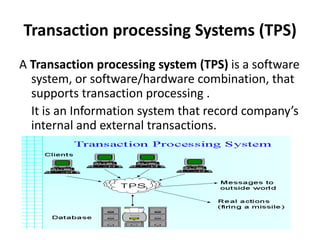
Transaction processing Systems (TPS)
A Transaction processing system (TPS) is a software
system, or software/hardware combination, that
supports transaction processing .
It is an Information system that record company’s
internal and external transactions.
Types of TPS
• Processing in a batch:-
Transactions may be collected and processed as in batch
processing. Transactions will be collected and later updated as
a batch when it's convenient or economical to process them.
• Processing in real-time:-
This is the immediate processing of data. It provides instant
confirmation of a transaction. It may involve a large number
of users who are simultaneously performing transactions
which change data.
TPS must have:-
• Performance
• Continuous availability
• Data integrity
• Ease of use
• Modular growth
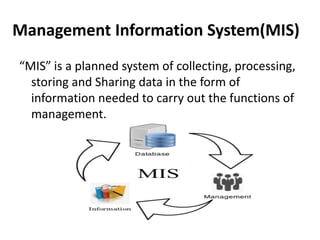
Management Information System(MIS)
“MIS” is a planned system of collecting, processing,
storing and Sharing data in the form of
information needed to carry out the functions of
management.
Advantages of MIS
• Companies are able to identify their strengths and
weaknesses due to the presence of revenue reports,
employees performance record etc.
• Giving an overall picture of the company.
• It act as a planning tool.
• The availability of customer data and feedback can help
the company to align its business processes according
to the needs of its customers.
• MIS report help to take decision and action on certain
object with quick time.
Decision support system (DSS)
• A decision support system (DSS) is a computer-
based information system that supports business
or organizational decision-making activities.
• DSSs serve at the management, operations, and
planning levels of an organization.
• Decision support systems can be either fully
computerized, human-powered or a combination
of both.
Advantages Disadvantages
1. Time saving 1. Skilled employees
required
2. Cost Reduction 2. Initial cost is high
3. Competitive
advantage
3. Regular maintenance
required
4. Increase decision
maker satisfaction.
4. Obscuring responsibility
5. Enhance effectiveness
Advantages and Disadvantages of DSS
Conclusion
• Controlling and decision making are important
aspects of management and thus they need to be
carried out effectively.
• With introduction to computers in management,
controlling and decision making processes
becomes faster.
Thank You…

MIS and TPS

  • 1.
    SHRI GOVINDRAM SEKSARIAINSTITUTE OF TECHNOLOGY AND SCIENCE Submitted by, Shubham Khandale Submitted to, Ast. Prof. Anupama Paliwaal Topic :- Use of Computers In Controlling and decision making Fundamentals of Management
  • 2.
    Contents • Introduction • Importanceof computer • What is Controlling? • Use of computer in controlling the business • What is decision making? • TPS (Transactions Support System) • MIS (Management Support System) • DSS (Decision Support System) • Conclusion
  • 3.
  • 4.
    Importance of Computers. •Inventory management. • Presentations and Documentation. • Electronic Communications. • Internet Access. • Advertisement. • Multi- Site Network.
  • 5.
  • 6.
    • Controlling isa managerial activity to monitor the implementation of the plan and to make corrective actions whenever required. • Controlling is checking current performance against pre- determined standards contained in the plans, with a view to ensure adequate progress and satisfactory performance. According to Harold Koontz Controlling is the measurement and correction of performance in order to make sure that enterprise objectives and the plans devised to attain them are accomplished.
  • 7.
    Use Computers inControlling the Business. • Receipt of goods. • Shipping and Logistics. • Formulation of Business plans.
  • 8.
  • 9.
    • Decision makingis a process to choose the best solution among many alternatives. • Decision-making is the process of identifying and choosing alternatives based on the values, preferences and beliefs of the decision-maker. • Decision-making can be regarded as a problem- solving activity terminated by a solution deemed to be optimal, or at least satisfactory.
  • 10.
    Transaction processing Systems(TPS) A Transaction processing system (TPS) is a software system, or software/hardware combination, that supports transaction processing . It is an Information system that record company’s internal and external transactions.
  • 11.
    Types of TPS •Processing in a batch:- Transactions may be collected and processed as in batch processing. Transactions will be collected and later updated as a batch when it's convenient or economical to process them. • Processing in real-time:- This is the immediate processing of data. It provides instant confirmation of a transaction. It may involve a large number of users who are simultaneously performing transactions which change data.
  • 12.
    TPS must have:- •Performance • Continuous availability • Data integrity • Ease of use • Modular growth
  • 13.
    Management Information System(MIS) “MIS”is a planned system of collecting, processing, storing and Sharing data in the form of information needed to carry out the functions of management.
  • 14.
    Advantages of MIS •Companies are able to identify their strengths and weaknesses due to the presence of revenue reports, employees performance record etc. • Giving an overall picture of the company. • It act as a planning tool. • The availability of customer data and feedback can help the company to align its business processes according to the needs of its customers. • MIS report help to take decision and action on certain object with quick time.
  • 15.
    Decision support system(DSS) • A decision support system (DSS) is a computer- based information system that supports business or organizational decision-making activities. • DSSs serve at the management, operations, and planning levels of an organization. • Decision support systems can be either fully computerized, human-powered or a combination of both.
  • 17.
    Advantages Disadvantages 1. Timesaving 1. Skilled employees required 2. Cost Reduction 2. Initial cost is high 3. Competitive advantage 3. Regular maintenance required 4. Increase decision maker satisfaction. 4. Obscuring responsibility 5. Enhance effectiveness Advantages and Disadvantages of DSS
  • 18.
    Conclusion • Controlling anddecision making are important aspects of management and thus they need to be carried out effectively. • With introduction to computers in management, controlling and decision making processes becomes faster.
  • 19.