What is managementinformation system?
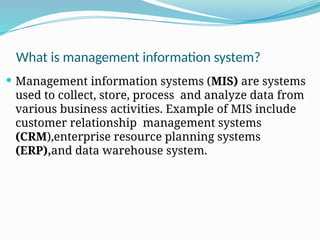
Management information systems (MIS) are systems
used to collect, store, process and analyze data from
various business activities. Example of MIS include
customer relationship management systems
(CRM),enterprise resource planning systems
(ERP),and data warehouse system.
3.
The needs formanagement information
system
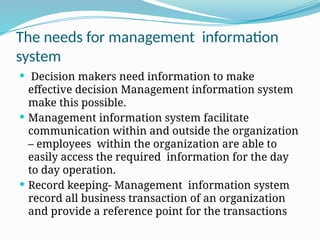
Decision makers need information to make
effective decision Management information system
make this possible.
Management information system facilitate
communication within and outside the organization
– employees within the organization are able to
easily access the required information for the day
to day operation.
Record keeping- Management information system
record all business transaction of an organization
and provide a reference point for the transactions
4.
Components of managementinformation
system
The major components of a typical MIS long-form
management information system are:
People- people who use the information system.
Data- the data that the information system records.
Business procedures- procedures put in place on
how to record , store and analyze data.
Hardware –these include servers, workstations ,
networking equipment ,printers , etc.
Software- these are programs used to handle the
data. These include programs such as spreadsheet
programs, database software, etc.
5.
Types of informationsystem
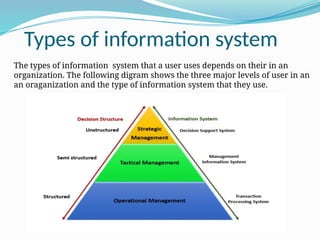
The types of information system that a user uses depends on their in an
organization. The following digram shows the three major levels of user in an
an oraganization and the type of information system that they use.
6.
• Transaction processingsystem (TPS)
This type of information system is used to record the day to day
Transactions of a business . An example of a transactions of processing
system is a point scale (POS) system .A POS system is used to record the
daily scales.
• Management information system (MIS)
Management information systems abbreviated as MIS, are used to guide
tactic managers to make semi- structured decision . The output form the
transaction processing system is used as input to the MIS system.
•Decision support system(DSS)
Decision support systems are used by top level managers to make semi-
structured decisions . The output from the management information system
is used as input to the decision support system. DSS system also get data
input form external sources such as current market forces, competition, etc.
7.
Advantages and Dis-advantage
ofinformation system
Advantages of information system
Storage and protection of information
The storing components of information system are created to collect and store an enormous amount of data .
These stored data can be accessed by the users whenever necessary. Maintaining the security of company
records is very vital to the integrity of the company . Moreover, hackers can be blocked with intense
security . Even the virtual vault limits the loss or damage of electronic information during a system
breakdown.
More efficiency and greater productivity
Most businesses are now highly dependent on information system for more efficiency and
increased productivity. The automated processes enable the completion of more work in
shorter amount of time . This allows the employees to handle a greater workload with more
efficiency and accuracy and less human error . Many task are completed by the computer .
This provides more free time and flexibility to the employees to focus on other tasks to
improve the company’s efficiency as well.
8.
•Reduced risk oferrors
As information systems employ automated processes so users can get the
most accurate information needed to perform an activity . It is better to
say that all the steps- from input to organizing , storing , and processing
of data and finally output- are done with great accuracy.
•Better communication
Communication is very essential to personal as well as business
relationships . the success of a company depends highly on
communication between supervisors and employees ,as well as between
employees and clients . Telecommunication in the form of video
conferences , email , fax , and so on allow easier exchanges of
information and opinions.
9.
Disadvantages of informationsystem
• Expensive
At the primary level , some
technologies ,hardware ,tools , and means of
communication require great expenses. Then the
setup of the information system can also be very
costly. Regular maintenance and repair of these
types of equipment are also required .Updating and
upgrading the devices, software , and other
components associated with additional costs. Apart
from the technological side , people should also be
employed to operate the system and thus should be
paid wages .Training of these people again requires
10.
•Reduction in job
Astasks are completed quickly and efficiently using an information system
so employees get more time . So , to operate fully companies are trying to
combine jobs in order to reduce the number of employees. In some cases,
machines are replacing human labor and eliminating jobs .
• Security breaches
Electronic information is highly prone to security breaches. Hackers are
constantly updating and upgrading themselves along with the technology .
So ,companies should keep security specialist employed all the time to
prevent any threat to security of their vital information . This interrupts the
smooth functioning of the system ,causing customer dissatisfaction and
other problems for the company.