https://www.slideshare.net/DrOth
manAlsalloum/information-
systems-in-the-enterprise
https://www.toppers4u.com/2020
/11/information-systems-
introduction.html
https://www.linkedin.com/pulse/
major-impacts-information-
technology-businesses-
managed-it-hub
Transaction Processing System
Explained
Transaction processing system meaning refers to an information
processing system that processes all transactions taking place
within the business. Such transactions include modification,
collection, and retrieval of transaction data. A TPS is highly
consistent, efficient, and dependable. It is the same system that
online businesses utilize for e-commerce.
A TPS has the following four components. One must understand
them to know how the system works.
1. Inputs: Inputs are original requests for payments or products
outside parties send to an organization’s TPS. Typically, inputs
include bills, coupons, custom orders, and invoices.
2. Output: Outputs are the documents a TPS generates after it
processes all inputs, for example, the receipts stored by companies
in their records. Such documents help validate transactions and
offer crucial reference details for tax and multiple official purposes.
3. Storage: A TPS’s storage component is where organizations keep
their output and input data. Some businesses store the documents
in a database. This component ensures the security, accessibility,
and organization of all documents for late use.
4. Processing System: The processing system goes through every
input and establishes a useful output, for example, a receipt. It helps
outline the input data and defines what the outputs must be. One
must remember that the processing time varies depending on the
type of TPS an organization uses.
Features
The following are some crucial features of a TPS:
 Controlled Access: TPSs are powerful business tools. Hence, only
authorized employees can access it. In other words, it allows only
certain employees to control and process transactions.
 Connection With The External Environment: TPS establishes a
relationship with the external environment by distributing
information to suppliers and customers.
 Fast Response: This feature is crucial for a TPS as organizations
cannot afford to keep their customers waiting long before
completing a transaction.
 Inflexibility: A TPS processes all transactions in the same way,
irrespective of the time of day, user, or customer, to maximize
efficiency.
 Reliability: A TPS must be reliable as customers do not tolerate
errors; it must have adequate security and safety measures.
 Distribution Of Details To Other Systems: A TPS produces and
distributes information to different systems. For instance, sales
processing systems provide information to general ledger systems.

 Types
TPSs are of two types. Let us look at them.
#1 – Batch Processing
A TPS interprets batches or sets of data by categorizing items by
similarities via batch processing. This can cause delays as it involves
reviewing various data sets simultaneously. However, the delay is
acceptable as the TPS does not interpret the sets regularly.
Businesses may customize the batches according to their
requirement. For example, a company may want to process its
workers’ wages once every two weeks.
#2 – Real-Time Processing
This type of TPS processes transactions with immediate effect, thus
preventing delays. This is an ideal technique when businesses deal
with singular transactions.
What is a management information system?
An MIS is a system that provides managers with the necessary information
to make decisions about an organization's operations. The MIS gathers data
from various sources and processes it to provide information tailored to the
managers' and their staff's needs.
While businesses use different types of systems, they all share one common
goal: to provide managers with the information to make better decisions. In
today's fast-paced business environment, having access to accurate and
timely information is critical for success. MIS allows managers to track
performance indicators, identify trends, and make informed decisions about
where to allocate resources
Importance of management information systems for
businesses
MISs allow businesses to have access to accurate data and powerful
analytical tools to identify problems and opportunities quickly and make
decisions accordingly. A management information system should do the
following:
 Provide you with information you need to make decisions
 Can give you a competitive edge by providing timely, accurate information
 Can help you improve operational efficiency and productivity
 Allows you to keep track of customer activity and preferences
 Enables you to develop targeted marketing campaigns and improve
customer service
What is Management Information System?
Management information systems (MIS) are an organized method of collecting
information from various sources, compiling it, and presenting it in a readable format.
It helps business leaders and managers make strategic management decisions.
Types of MIS
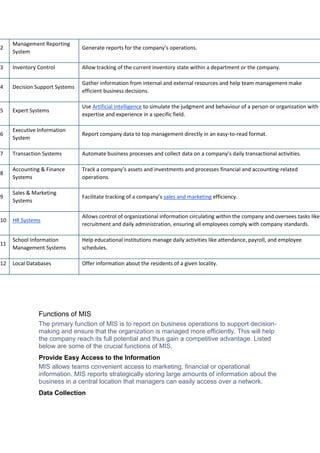
Type of MIS Description
1 Process Control Gather data to create reports based on the performance of systems and processes.
2
Management Reporting
System
Generate reports for the company’s operations.
3 Inventory Control Allow tracking of the current inventory state within a department or the company.
4 Decision Support Systems
Gather information from internal and external resources and help team management make
efficient business decisions.
5 Expert Systems
Use Artificial Intelligence to simulate the judgment and behaviour of a person or organization with
expertise and experience in a specific field.
6
Executive Information
System
Report company data to top management directly in an easy-to-read format.
7 Transaction Systems Automate business processes and collect data on a company’s daily transactional activities.
8
Accounting & Finance
Systems
Track a company’s assets and investments and processes financial and accounting-related
operations.
9
Sales & Marketing
Systems
Facilitate tracking of a company’s sales and marketing efficiency.
10 HR Systems
Allows control of organizational information circulating within the company and oversees tasks like
recruitment and daily administration, ensuring all employees comply with company standards.
11
School Information
Management Systems
Help educational institutions manage daily activities like attendance, payroll, and employee
schedules.
12 Local Databases Offer information about the residents of a given locality.
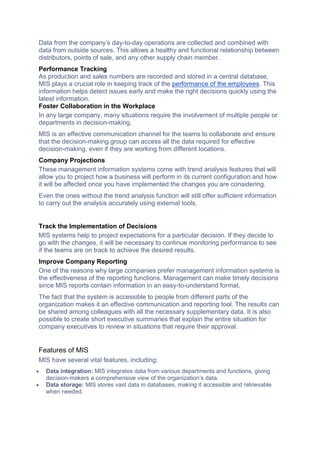
Functions of MIS
The primary function of MIS is to report on business operations to support decision-
making and ensure that the organization is managed more efficiently. This will help
the company reach its full potential and thus gain a competitive advantage. Listed
below are some of the crucial functions of MIS.
Provide Easy Access to the Information
MIS allows teams convenient access to marketing, financial or operational
information. MIS reports strategically storing large amounts of information about the
business in a central location that managers can easily access over a network.
Data Collection
Data from the company’s day-to-day operations are collected and combined with
data from outside sources. This allows a healthy and functional relationship between
distributors, points of sale, and any other supply chain member.
Performance Tracking
As production and sales numbers are recorded and stored in a central database,
MIS plays a crucial role in keeping track of the performance of the employees. This
information helps detect issues early and make the right decisions quickly using the
latest information.
Foster Collaboration in the Workplace
In any large company, many situations require the involvement of multiple people or
departments in decision-making.
MIS is an effective communication channel for the teams to collaborate and ensure
that the decision-making group can access all the data required for effective
decision-making, even if they are working from different locations.
Company Projections
These management information systems come with trend analysis features that will
allow you to project how a business will perform in its current configuration and how
it will be affected once you have implemented the changes you are considering.
Even the ones without the trend analysis function will still offer sufficient information
to carry out the analysis accurately using external tools.
Track the Implementation of Decisions
MIS systems help to project expectations for a particular decision. If they decide to
go with the changes, it will be necessary to continue monitoring performance to see
if the teams are on track to achieve the desired results.
Improve Company Reporting
One of the reasons why large companies prefer management information systems is
the effectiveness of the reporting functions. Management can make timely decisions
since MIS reports contain information in an easy-to-understand format.
The fact that the system is accessible to people from different parts of the
organization makes it an effective communication and reporting tool. The results can
be shared among colleagues with all the necessary supplementary data. It is also
possible to create short executive summaries that explain the entire situation for
company executives to review in situations that require their approval.
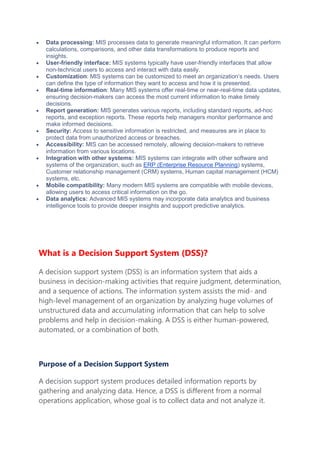
Features of MIS
MIS have several vital features, including:
 Data integration: MIS integrates data from various departments and functions, giving
decision-makers a comprehensive view of the organization’s data.
 Data storage: MIS stores vast data in databases, making it accessible and retrievable
when needed.
 Data processing: MIS processes data to generate meaningful information. It can perform
calculations, comparisons, and other data transformations to produce reports and
insights.
 User-friendly interface: MIS systems typically have user-friendly interfaces that allow
non-technical users to access and interact with data easily.
 Customization: MIS systems can be customized to meet an organization’s needs. Users
can define the type of information they want to access and how it is presented.
 Real-time information: Many MIS systems offer real-time or near-real-time data updates,
ensuring decision-makers can access the most current information to make timely
decisions.
 Report generation: MIS generates various reports, including standard reports, ad-hoc
reports, and exception reports. These reports help managers monitor performance and
make informed decisions.
 Security: Access to sensitive information is restricted, and measures are in place to
protect data from unauthorized access or breaches.
 Accessibility: MIS can be accessed remotely, allowing decision-makers to retrieve
information from various locations.
 Integration with other systems: MIS systems can integrate with other software and
systems of the organization, such as ERP (Enterprise Resource Planning) systems,
Customer relationship management (CRM) systems, Human capital management (HCM)
systems, etc.
 Mobile compatibility: Many modern MIS systems are compatible with mobile devices,
allowing users to access critical information on the go.
 Data analytics: Advanced MIS systems may incorporate data analytics and business
intelligence tools to provide deeper insights and support predictive analytics.
What is a Decision Support System (DSS)?
A decision support system (DSS) is an information system that aids a
business in decision-making activities that require judgment, determination,
and a sequence of actions. The information system assists the mid- and
high-level management of an organization by analyzing huge volumes of
unstructured data and accumulating information that can help to solve
problems and help in decision-making. A DSS is either human-powered,
automated, or a combination of both.
Purpose of a Decision Support System
A decision support system produces detailed information reports by
gathering and analyzing data. Hence, a DSS is different from a normal
operations application, whose goal is to collect data and not analyze it.
In an organization, a DSS is used by the planning departments – such as the
operations department – which collects data and creates a report that can
be used by managers for decision-making. Mainly, a DSS is used in sales
projection, for inventory and operations-related data, and to present
information to customers in an easy-to-understand manner.
Theoretically, a DSS can be employed in various knowledge domains from
an organization to forest management and the medical field. One of the
main applications of a DSS in an organization is real-time reporting. It can
be very helpful for organizations that take part in just-in-time
(JIT) inventory management.
In a JIT inventory system, the organization requires real-time data of their
inventory levels to place orders “just in time” to prevent delays in
production and cause a negative domino effect. Therefore, a DSS is more
tailored to the individual or organization making the decision than a
traditional system.
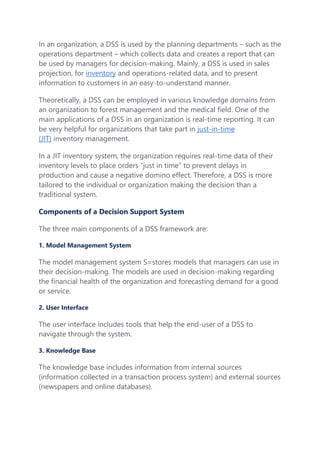
Components of a Decision Support System
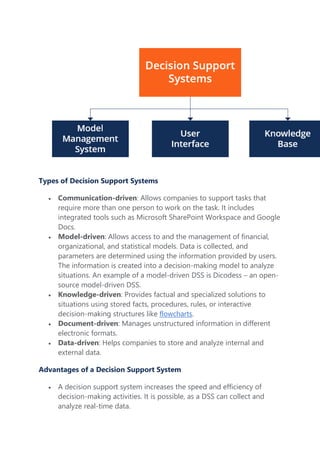
The three main components of a DSS framework are:
1. Model Management System
The model management system S=stores models that managers can use in
their decision-making. The models are used in decision-making regarding
the financial health of the organization and forecasting demand for a good
or service.
2. User Interface
The user interface includes tools that help the end-user of a DSS to
navigate through the system.
3. Knowledge Base
The knowledge base includes information from internal sources
(information collected in a transaction process system) and external sources
(newspapers and online databases).
Types of Decision Support Systems
 Communication-driven: Allows companies to support tasks that
require more than one person to work on the task. It includes
integrated tools such as Microsoft SharePoint Workspace and Google
Docs.
 Model-driven: Allows access to and the management of financial,
organizational, and statistical models. Data is collected, and
parameters are determined using the information provided by users.
The information is created into a decision-making model to analyze
situations. An example of a model-driven DSS is Dicodess – an open-
source model-driven DSS.
 Knowledge-driven: Provides factual and specialized solutions to
situations using stored facts, procedures, rules, or interactive
decision-making structures like flowcharts.
 Document-driven: Manages unstructured information in different
electronic formats.
 Data-driven: Helps companies to store and analyze internal and
external data.
Advantages of a Decision Support System
 A decision support system increases the speed and efficiency of
decision-making activities. It is possible, as a DSS can collect and
analyze real-time data.
 It promotes training within the organization, as specific skills must be
developed to implement and run a DSS within an organization.
 It automates monotonous managerial processes, which means more
of the manager’s time can be spent on decision-making.
 It improves interpersonal communication within the organization.
Disadvantages of a Decision Support System
 The cost to develop and implement a DSS is a huge capital
investment, which makes it less accessible to smaller organizations.
 A company can develop a dependence on a DSS, as it is integrated
into daily decision-making processes to improve efficiency and
speed. However, managers tend to rely on the system too much,
which takes away the subjectivity aspect of decision-making.
 A DSS may lead to information overload because an information
system tends to consider all aspects of a problem. It creates a
dilemma for end-users, as they are left with multiple choices.
 Implementation of a DSS can cause fear and backlash from lower-
level employees. Many of them are not comfortable with new
technology and are afraid of losing their jobs to technology.
Related Readings
Thank you for reading CFI’s guide on Decision Support System (DSS). To
keep advancing your career, the additional CFI resources below will be
useful

web content management system for bca students bldea college

  • 1.
  • 2.
    within the business.Such transactions include modification, collection, and retrieval of transaction data. A TPS is highly consistent, efficient, and dependable. It is the same system that online businesses utilize for e-commerce. A TPS has the following four components. One must understand them to know how the system works. 1. Inputs: Inputs are original requests for payments or products outside parties send to an organization’s TPS. Typically, inputs include bills, coupons, custom orders, and invoices. 2. Output: Outputs are the documents a TPS generates after it processes all inputs, for example, the receipts stored by companies in their records. Such documents help validate transactions and offer crucial reference details for tax and multiple official purposes. 3. Storage: A TPS’s storage component is where organizations keep their output and input data. Some businesses store the documents in a database. This component ensures the security, accessibility, and organization of all documents for late use. 4. Processing System: The processing system goes through every input and establishes a useful output, for example, a receipt. It helps outline the input data and defines what the outputs must be. One must remember that the processing time varies depending on the type of TPS an organization uses. Features The following are some crucial features of a TPS:  Controlled Access: TPSs are powerful business tools. Hence, only authorized employees can access it. In other words, it allows only certain employees to control and process transactions.
  • 3.
     Connection WithThe External Environment: TPS establishes a relationship with the external environment by distributing information to suppliers and customers.  Fast Response: This feature is crucial for a TPS as organizations cannot afford to keep their customers waiting long before completing a transaction.  Inflexibility: A TPS processes all transactions in the same way, irrespective of the time of day, user, or customer, to maximize efficiency.  Reliability: A TPS must be reliable as customers do not tolerate errors; it must have adequate security and safety measures.  Distribution Of Details To Other Systems: A TPS produces and distributes information to different systems. For instance, sales processing systems provide information to general ledger systems.   Types TPSs are of two types. Let us look at them. #1 – Batch Processing A TPS interprets batches or sets of data by categorizing items by similarities via batch processing. This can cause delays as it involves reviewing various data sets simultaneously. However, the delay is acceptable as the TPS does not interpret the sets regularly. Businesses may customize the batches according to their requirement. For example, a company may want to process its workers’ wages once every two weeks. #2 – Real-Time Processing This type of TPS processes transactions with immediate effect, thus preventing delays. This is an ideal technique when businesses deal with singular transactions.
  • 4.
    What is amanagement information system? An MIS is a system that provides managers with the necessary information to make decisions about an organization's operations. The MIS gathers data from various sources and processes it to provide information tailored to the managers' and their staff's needs. While businesses use different types of systems, they all share one common goal: to provide managers with the information to make better decisions. In today's fast-paced business environment, having access to accurate and timely information is critical for success. MIS allows managers to track performance indicators, identify trends, and make informed decisions about where to allocate resources Importance of management information systems for businesses MISs allow businesses to have access to accurate data and powerful analytical tools to identify problems and opportunities quickly and make decisions accordingly. A management information system should do the following:  Provide you with information you need to make decisions  Can give you a competitive edge by providing timely, accurate information  Can help you improve operational efficiency and productivity  Allows you to keep track of customer activity and preferences  Enables you to develop targeted marketing campaigns and improve customer service What is Management Information System? Management information systems (MIS) are an organized method of collecting information from various sources, compiling it, and presenting it in a readable format. It helps business leaders and managers make strategic management decisions. Types of MIS Type of MIS Description 1 Process Control Gather data to create reports based on the performance of systems and processes.
  • 5.
    2 Management Reporting System Generate reportsfor the company’s operations. 3 Inventory Control Allow tracking of the current inventory state within a department or the company. 4 Decision Support Systems Gather information from internal and external resources and help team management make efficient business decisions. 5 Expert Systems Use Artificial Intelligence to simulate the judgment and behaviour of a person or organization with expertise and experience in a specific field. 6 Executive Information System Report company data to top management directly in an easy-to-read format. 7 Transaction Systems Automate business processes and collect data on a company’s daily transactional activities. 8 Accounting & Finance Systems Track a company’s assets and investments and processes financial and accounting-related operations. 9 Sales & Marketing Systems Facilitate tracking of a company’s sales and marketing efficiency. 10 HR Systems Allows control of organizational information circulating within the company and oversees tasks like recruitment and daily administration, ensuring all employees comply with company standards. 11 School Information Management Systems Help educational institutions manage daily activities like attendance, payroll, and employee schedules. 12 Local Databases Offer information about the residents of a given locality. Functions of MIS The primary function of MIS is to report on business operations to support decision- making and ensure that the organization is managed more efficiently. This will help the company reach its full potential and thus gain a competitive advantage. Listed below are some of the crucial functions of MIS. Provide Easy Access to the Information MIS allows teams convenient access to marketing, financial or operational information. MIS reports strategically storing large amounts of information about the business in a central location that managers can easily access over a network. Data Collection
  • 6.
    Data from thecompany’s day-to-day operations are collected and combined with data from outside sources. This allows a healthy and functional relationship between distributors, points of sale, and any other supply chain member. Performance Tracking As production and sales numbers are recorded and stored in a central database, MIS plays a crucial role in keeping track of the performance of the employees. This information helps detect issues early and make the right decisions quickly using the latest information. Foster Collaboration in the Workplace In any large company, many situations require the involvement of multiple people or departments in decision-making. MIS is an effective communication channel for the teams to collaborate and ensure that the decision-making group can access all the data required for effective decision-making, even if they are working from different locations. Company Projections These management information systems come with trend analysis features that will allow you to project how a business will perform in its current configuration and how it will be affected once you have implemented the changes you are considering. Even the ones without the trend analysis function will still offer sufficient information to carry out the analysis accurately using external tools. Track the Implementation of Decisions MIS systems help to project expectations for a particular decision. If they decide to go with the changes, it will be necessary to continue monitoring performance to see if the teams are on track to achieve the desired results. Improve Company Reporting One of the reasons why large companies prefer management information systems is the effectiveness of the reporting functions. Management can make timely decisions since MIS reports contain information in an easy-to-understand format. The fact that the system is accessible to people from different parts of the organization makes it an effective communication and reporting tool. The results can be shared among colleagues with all the necessary supplementary data. It is also possible to create short executive summaries that explain the entire situation for company executives to review in situations that require their approval. Features of MIS MIS have several vital features, including:  Data integration: MIS integrates data from various departments and functions, giving decision-makers a comprehensive view of the organization’s data.  Data storage: MIS stores vast data in databases, making it accessible and retrievable when needed.
  • 7.
     Data processing:MIS processes data to generate meaningful information. It can perform calculations, comparisons, and other data transformations to produce reports and insights.  User-friendly interface: MIS systems typically have user-friendly interfaces that allow non-technical users to access and interact with data easily.  Customization: MIS systems can be customized to meet an organization’s needs. Users can define the type of information they want to access and how it is presented.  Real-time information: Many MIS systems offer real-time or near-real-time data updates, ensuring decision-makers can access the most current information to make timely decisions.  Report generation: MIS generates various reports, including standard reports, ad-hoc reports, and exception reports. These reports help managers monitor performance and make informed decisions.  Security: Access to sensitive information is restricted, and measures are in place to protect data from unauthorized access or breaches.  Accessibility: MIS can be accessed remotely, allowing decision-makers to retrieve information from various locations.  Integration with other systems: MIS systems can integrate with other software and systems of the organization, such as ERP (Enterprise Resource Planning) systems, Customer relationship management (CRM) systems, Human capital management (HCM) systems, etc.  Mobile compatibility: Many modern MIS systems are compatible with mobile devices, allowing users to access critical information on the go.  Data analytics: Advanced MIS systems may incorporate data analytics and business intelligence tools to provide deeper insights and support predictive analytics. What is a Decision Support System (DSS)? A decision support system (DSS) is an information system that aids a business in decision-making activities that require judgment, determination, and a sequence of actions. The information system assists the mid- and high-level management of an organization by analyzing huge volumes of unstructured data and accumulating information that can help to solve problems and help in decision-making. A DSS is either human-powered, automated, or a combination of both. Purpose of a Decision Support System A decision support system produces detailed information reports by gathering and analyzing data. Hence, a DSS is different from a normal operations application, whose goal is to collect data and not analyze it.
  • 8.
    In an organization,a DSS is used by the planning departments – such as the operations department – which collects data and creates a report that can be used by managers for decision-making. Mainly, a DSS is used in sales projection, for inventory and operations-related data, and to present information to customers in an easy-to-understand manner. Theoretically, a DSS can be employed in various knowledge domains from an organization to forest management and the medical field. One of the main applications of a DSS in an organization is real-time reporting. It can be very helpful for organizations that take part in just-in-time (JIT) inventory management. In a JIT inventory system, the organization requires real-time data of their inventory levels to place orders “just in time” to prevent delays in production and cause a negative domino effect. Therefore, a DSS is more tailored to the individual or organization making the decision than a traditional system. Components of a Decision Support System The three main components of a DSS framework are: 1. Model Management System The model management system S=stores models that managers can use in their decision-making. The models are used in decision-making regarding the financial health of the organization and forecasting demand for a good or service. 2. User Interface The user interface includes tools that help the end-user of a DSS to navigate through the system. 3. Knowledge Base The knowledge base includes information from internal sources (information collected in a transaction process system) and external sources (newspapers and online databases).
  • 9.
    Types of DecisionSupport Systems  Communication-driven: Allows companies to support tasks that require more than one person to work on the task. It includes integrated tools such as Microsoft SharePoint Workspace and Google Docs.  Model-driven: Allows access to and the management of financial, organizational, and statistical models. Data is collected, and parameters are determined using the information provided by users. The information is created into a decision-making model to analyze situations. An example of a model-driven DSS is Dicodess – an open- source model-driven DSS.  Knowledge-driven: Provides factual and specialized solutions to situations using stored facts, procedures, rules, or interactive decision-making structures like flowcharts.  Document-driven: Manages unstructured information in different electronic formats.  Data-driven: Helps companies to store and analyze internal and external data. Advantages of a Decision Support System  A decision support system increases the speed and efficiency of decision-making activities. It is possible, as a DSS can collect and analyze real-time data.
  • 10.
     It promotestraining within the organization, as specific skills must be developed to implement and run a DSS within an organization.  It automates monotonous managerial processes, which means more of the manager’s time can be spent on decision-making.  It improves interpersonal communication within the organization. Disadvantages of a Decision Support System  The cost to develop and implement a DSS is a huge capital investment, which makes it less accessible to smaller organizations.  A company can develop a dependence on a DSS, as it is integrated into daily decision-making processes to improve efficiency and speed. However, managers tend to rely on the system too much, which takes away the subjectivity aspect of decision-making.  A DSS may lead to information overload because an information system tends to consider all aspects of a problem. It creates a dilemma for end-users, as they are left with multiple choices.  Implementation of a DSS can cause fear and backlash from lower- level employees. Many of them are not comfortable with new technology and are afraid of losing their jobs to technology. Related Readings Thank you for reading CFI’s guide on Decision Support System (DSS). To keep advancing your career, the additional CFI resources below will be useful