Unit I
Core Concepts in Information
Systems
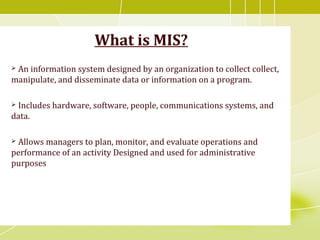
What is MIS?
 An information system designed by an organization to collect collect,
manipulate, and disseminate data or information on a program.
 Includes hardware, software, people, communications systems, and
data.
 Allows managers to plan, monitor, and evaluate operations and
performance of an activity Designed and used for administrative
purposes
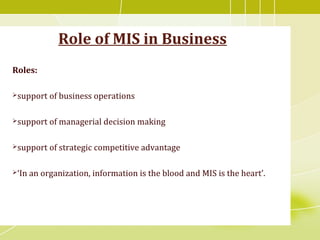
Role of MIS in Business
Roles:
support of business operations
support of managerial decision making
support of strategic competitive advantage
‘In an organization, information is the blood and MIS is the heart’.
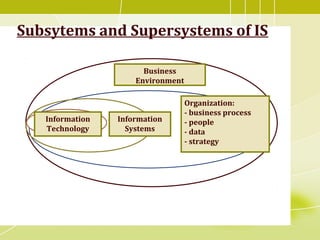
Subsytems and Supersystems of IS
I
Organization:
- business process
- people
- data
- strategy
ISITITInformation
Technology
Information
Systems
Business
Environment
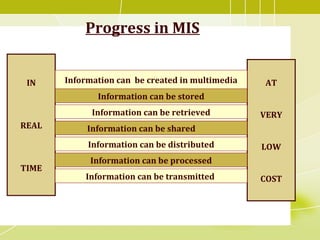
Progress in MIS
IN
REAL
TIME
AT
VERY
LOW
COST
Information can be created in multimedia
Information can be stored
Information can be retrieved
Information can be shared
Information can be distributed
Information can be processed
Information can be transmitted
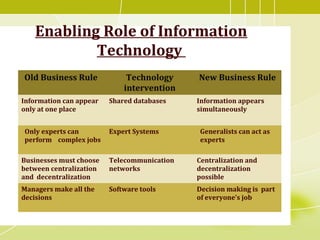
Enabling Role of Information
Technology
Old Business Rule Technology
intervention
New Business Rule
Information can appear
only at one place
Shared databases Information appears
simultaneously
Only experts can
perform complex jobs
Expert Systems Generalists can act as
experts
Businesses must choose
between centralization
and decentralization
Telecommunication
networks
Centralization and
decentralization
possible
Managers make all the
decisions
Software tools Decision making is part
of everyone’s job
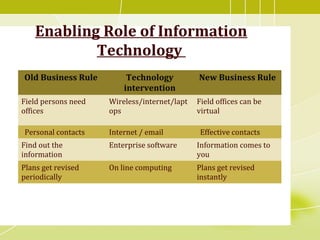
Enabling Role of Information
Technology
Old Business Rule Technology
intervention
New Business Rule
Field persons need
offices
Wireless/internet/lapt
ops
Field offices can be
virtual
Personal contacts Internet / email Effective contacts
Find out the
information
Enterprise software Information comes to
you
Plans get revised
periodically
On line computing Plans get revised
instantly
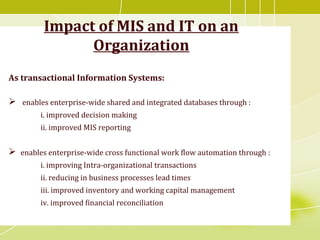
Impact of MIS and IT on an
Organization
As transactional Information Systems:
 enables enterprise-wide shared and integrated databases through :
i. improved decision making
ii. improved MIS reporting
 enables enterprise-wide cross functional work flow automation through :
i. improving Intra-organizational transactions
ii. reducing in business processes lead times
iii. improved inventory and working capital management
iv. improved financial reconciliation
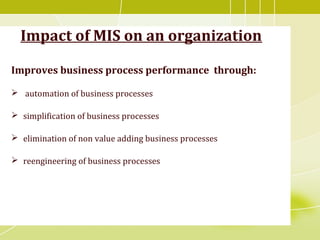
Impact of MIS on an organization
Improves business process performance through:
 automation of business processes
 simplification of business processes
 elimination of non value adding business processes
 reengineering of business processes
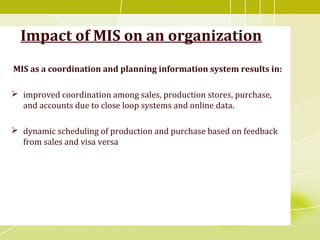
Impact of MIS on an organization
MIS as a coordination and planning information system results in:
 improved coordination among sales, production stores, purchase,
and accounts due to close loop systems and online data.
 dynamic scheduling of production and purchase based on feedback
from sales and visa versa
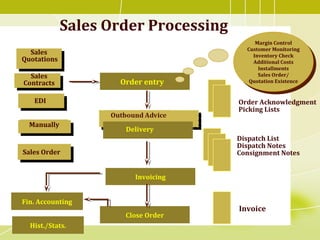
Sales Order Processing
Fin. Accounting
Hist./Stats.
Sales
Quotations
Sales
Contracts
EDI
Manually
Order entry
Invoicing
Delivery
Close Order
Dispatch List
Dispatch Notes
Consignment Notes
Invoice
Margin Control
Customer Monitoring
Inventory Check
Additional Costs
Installments
Sales Order/
Quotation Existence
Margin Control
Customer Monitoring
Inventory Check
Additional Costs
Installments
Sales Order/
Quotation Existence
Sales Order
Order Acknowledgment
Picking Lists
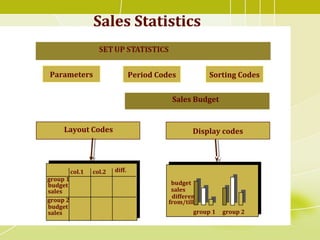
Sales Statistics
Display codes
Period Codes
Layout Codes
Sales Budget
Sorting CodesParameters
group 1
budget
sales
col.1 diff.
group 2
budget
sales
col.2
budget
sales
difference
from/till
group 1 group 2
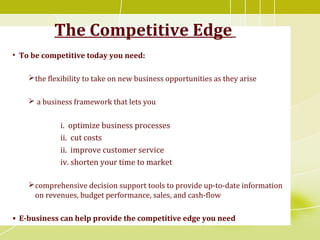
The Competitive Edge
• To be competitive today you need:
the flexibility to take on new business opportunities as they arise
 a business framework that lets you
i. optimize business processes
ii. cut costs
ii. improve customer service
iv. shorten your time to market
comprehensive decision support tools to provide up-to-date information
on revenues, budget performance, sales, and cash-flow
• E-business can help provide the competitive edge you need
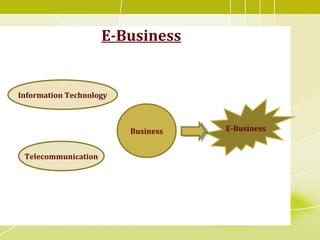
E-Business
Telecommunication
Information Technology
Business E-Business
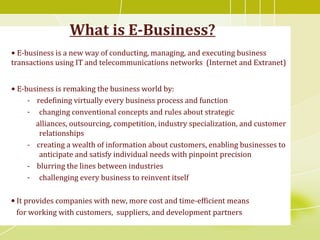
What is E-Business?
• E-business is a new way of conducting, managing, and executing business
transactions using IT and telecommunications networks (Internet and Extranet)
• E-business is remaking the business world by:
- redefining virtually every business process and function
- changing conventional concepts and rules about strategic
alliances, outsourcing, competition, industry specialization, and customer
relationships
- creating a wealth of information about customers, enabling businesses to
anticipate and satisfy individual needs with pinpoint precision
- blurring the lines between industries
- challenging every business to reinvent itself
• It provides companies with new, more cost and time-efficient means
for working with customers, suppliers, and development partners

Core Concepts in Information Systems

  • 1.
    Unit I Core Conceptsin Information Systems
  • 2.
    What is MIS? An information system designed by an organization to collect collect, manipulate, and disseminate data or information on a program.  Includes hardware, software, people, communications systems, and data.  Allows managers to plan, monitor, and evaluate operations and performance of an activity Designed and used for administrative purposes
  • 3.
    Role of MISin Business Roles: support of business operations support of managerial decision making support of strategic competitive advantage ‘In an organization, information is the blood and MIS is the heart’.
  • 4.
    Subsytems and Supersystemsof IS I Organization: - business process - people - data - strategy ISITITInformation Technology Information Systems Business Environment
  • 5.
    Progress in MIS IN REAL TIME AT VERY LOW COST Informationcan be created in multimedia Information can be stored Information can be retrieved Information can be shared Information can be distributed Information can be processed Information can be transmitted
  • 6.
    Enabling Role ofInformation Technology Old Business Rule Technology intervention New Business Rule Information can appear only at one place Shared databases Information appears simultaneously Only experts can perform complex jobs Expert Systems Generalists can act as experts Businesses must choose between centralization and decentralization Telecommunication networks Centralization and decentralization possible Managers make all the decisions Software tools Decision making is part of everyone’s job
  • 7.
    Enabling Role ofInformation Technology Old Business Rule Technology intervention New Business Rule Field persons need offices Wireless/internet/lapt ops Field offices can be virtual Personal contacts Internet / email Effective contacts Find out the information Enterprise software Information comes to you Plans get revised periodically On line computing Plans get revised instantly
  • 8.
    Impact of MISand IT on an Organization As transactional Information Systems:  enables enterprise-wide shared and integrated databases through : i. improved decision making ii. improved MIS reporting  enables enterprise-wide cross functional work flow automation through : i. improving Intra-organizational transactions ii. reducing in business processes lead times iii. improved inventory and working capital management iv. improved financial reconciliation
  • 9.
    Impact of MISon an organization Improves business process performance through:  automation of business processes  simplification of business processes  elimination of non value adding business processes  reengineering of business processes
  • 10.
    Impact of MISon an organization MIS as a coordination and planning information system results in:  improved coordination among sales, production stores, purchase, and accounts due to close loop systems and online data.  dynamic scheduling of production and purchase based on feedback from sales and visa versa
  • 11.
    Sales Order Processing Fin.Accounting Hist./Stats. Sales Quotations Sales Contracts EDI Manually Order entry Invoicing Delivery Close Order Dispatch List Dispatch Notes Consignment Notes Invoice Margin Control Customer Monitoring Inventory Check Additional Costs Installments Sales Order/ Quotation Existence Margin Control Customer Monitoring Inventory Check Additional Costs Installments Sales Order/ Quotation Existence Sales Order Order Acknowledgment Picking Lists
  • 12.
    Sales Statistics Display codes PeriodCodes Layout Codes Sales Budget Sorting CodesParameters group 1 budget sales col.1 diff. group 2 budget sales col.2 budget sales difference from/till group 1 group 2
  • 13.
    The Competitive Edge •To be competitive today you need: the flexibility to take on new business opportunities as they arise  a business framework that lets you i. optimize business processes ii. cut costs ii. improve customer service iv. shorten your time to market comprehensive decision support tools to provide up-to-date information on revenues, budget performance, sales, and cash-flow • E-business can help provide the competitive edge you need
  • 14.
  • 15.
    What is E-Business? •E-business is a new way of conducting, managing, and executing business transactions using IT and telecommunications networks (Internet and Extranet) • E-business is remaking the business world by: - redefining virtually every business process and function - changing conventional concepts and rules about strategic alliances, outsourcing, competition, industry specialization, and customer relationships - creating a wealth of information about customers, enabling businesses to anticipate and satisfy individual needs with pinpoint precision - blurring the lines between industries - challenging every business to reinvent itself • It provides companies with new, more cost and time-efficient means for working with customers, suppliers, and development partners