To Study the Effect of particle size
reduction on Valuable and precious
material in E – Waste.
Electronic waste or E- waste is the term used to
describe old, end of life electronic appliances such
as computers , laptops, TVs, DVD players, mobile
phones, mp3 players, etc. which have been
disposed by their original users.
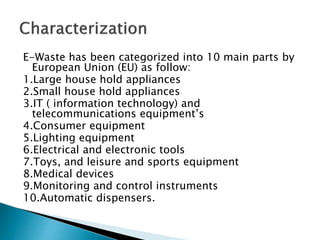
E-Waste has been categorized into 10 main parts by
European Union (EU) as follow:
1.Large house hold appliances
2.Small house hold appliances
3.IT ( information technology) and
telecommunications equipment’s
4.Consumer equipment
5.Lighting equipment
6.Electrical and electronic tools
7.Toys, and leisure and sports equipment
8.Medical devices
9.Monitoring and control instruments
10.Automatic dispensers.
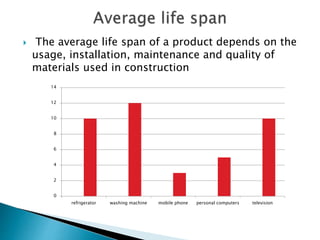
 The average life span of a product depends on the
usage, installation, maintenance and quality of
materials used in construction
0
2
4
6
8
10
12
14
refrigerator washing machine mobile phone personal computers television
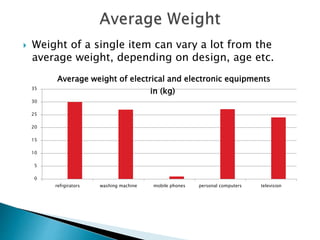
 Weight of a single item can vary a lot from the
average weight, depending on design, age etc.
0
5
10
15
20
25
30
35
refrgirators washing machine mobile phones personal computers television
Average weight of electrical and electronic equipments
in (kg)
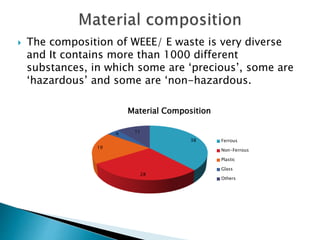
 The composition of WEEE/ E waste is very diverse
and It contains more than 1000 different
substances, in which some are ‘precious’, some are
‘hazardous’ and some are ‘non-hazardous.
38
28
19
4
11
Material Composition
Ferrous
Non-Ferrous
Plastic
Glass
Others
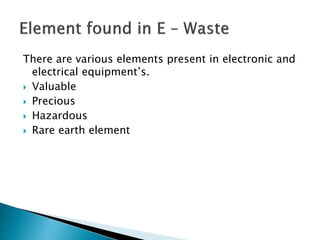
There are various elements present in electronic and
electrical equipment’s.
 Valuable
 Precious
 Hazardous
 Rare earth element
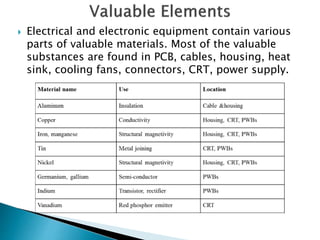
 Electrical and electronic equipment contain various
parts of valuable materials. Most of the valuable
substances are found in PCB, cables, housing, heat
sink, cooling fans, connectors, CRT, power supply.
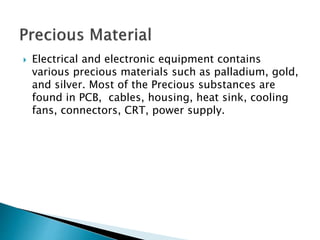
 Electrical and electronic equipment contains
various precious materials such as palladium, gold,
and silver. Most of the Precious substances are
found in PCB, cables, housing, heat sink, cooling
fans, connectors, CRT, power supply.
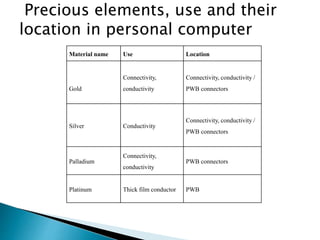
Material name Use Location
Gold
Connectivity,
conductivity
Connectivity, conductivity /
PWB connectors
Silver Conductivity
Connectivity, conductivity /
PWB connectors
Palladium
Connectivity,
conductivity
PWB connectors
Platinum Thick film conductor PWB
Precious elements, use and their
location in personal computer
 EEEs are made of multitude of components, in
which some are toxic.
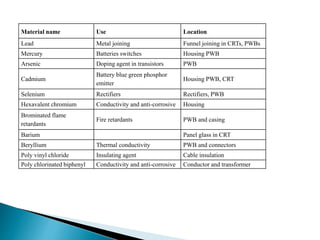
Material name Use Location
Lead Metal joining Funnel joining in CRTs, PWBs
Mercury Batteries switches Housing PWB
Arsenic Doping agent in transistors PWB
Cadmium
Battery blue green phosphor
emitter
Housing PWB, CRT
Selenium Rectifiers Rectifiers, PWB
Hexavalent chromium Conductivity and anti-corrosive Housing
Brominated flame
retardants
Fire retardants PWB and casing
Barium Panel glass in CRT
Beryllium Thermal conductivity PWB and connectors
Poly vinyl chloride Insulating agent Cable insulation
Poly chlorinated biphenyl Conductivity and anti-corrosive Conductor and transformer
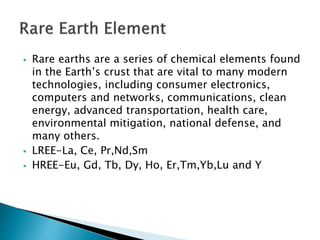
 Rare earths are a series of chemical elements found
in the Earth’s crust that are vital to many modern
technologies, including consumer electronics,
computers and networks, communications, clean
energy, advanced transportation, health care,
environmental mitigation, national defense, and
many others.
 LREE-La, Ce, Pr,Nd,Sm
 HREE-Eu, Gd, Tb, Dy, Ho, Er,Tm,Yb,Lu and Y
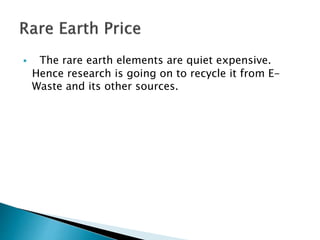
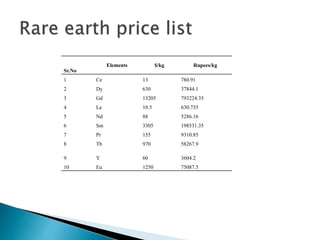
 The rare earth elements are quiet expensive.
Hence research is going on to recycle it from E-
Waste and its other sources.
Sr.No
Elements $/kg Rupees/kg
1 Ce 13 780.91
2 Dy 630 37844.1
3 Gd 13205 793224.35
4 La 10.5 630.735
5 Nd 88 5286.16
6 Sm 3305 198531.35
7 Pr 155 9310.85
8 Tb 970 58267.9
9 Y 60 3604.2
10 Eu 1250 75087.5
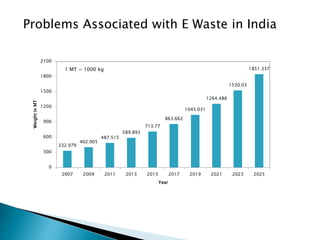
Problems Associated with E Waste in India
332.979
402.905
487.515
589.893
713.77
863.662
1045.031
1264.488
1530.03
1851.337
0
300
600
900
1200
1500
1800
2100
2007 2009 2011 2013 2015 2017 2019 2021 2023 2025
WeightinMT
Year
1 MT = 1000 kg
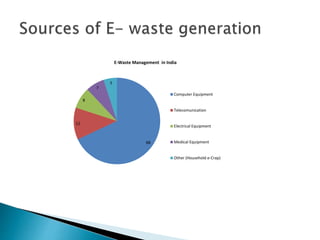
68
12
8
7
5
E-Waste Management in India
Computer Equipment
Telecomunication
Electrical Equipment
Medical Equipment
Other (Household e-Crap)
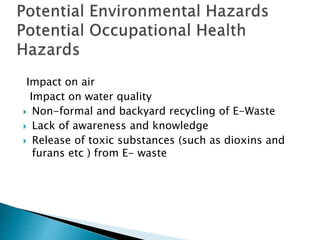
Impact on air
Impact on water quality
 Non-formal and backyard recycling of E-Waste
 Lack of awareness and knowledge
 Release of toxic substances (such as dioxins and
furans etc ) from E- waste
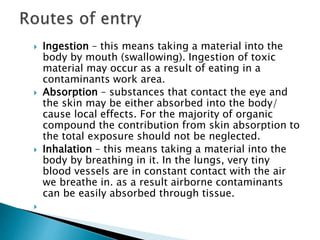
 Ingestion – this means taking a material into the
body by mouth (swallowing). Ingestion of toxic
material may occur as a result of eating in a
contaminants work area.
 Absorption – substances that contact the eye and
the skin may be either absorbed into the body/
cause local effects. For the majority of organic
compound the contribution from skin absorption to
the total exposure should not be neglected.
 Inhalation – this means taking a material into the
body by breathing in it. In the lungs, very tiny
blood vessels are in constant contact with the air
we breathe in. as a result airborne contaminants
can be easily absorbed through tissue.

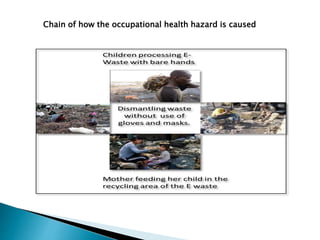
Chain of how the occupational health hazard is caused
 Responsibility of the Government
 Responsibility of the Industries
 Responsibility of the citizens
 Responsibility of the Recycler
 Governments should set up regulatory agencies
in each district,
 Governments should enforce strict regulations
and heavy fines levied on industries,
 Governments must encourage research into the
development and standard of hazardous waste
Management, environmental monitoring and the
regulation of hazardous waste-disposal
 Polluter pays principle and extended producer
responsibility should be adopted.
 Inventory management
 Production Process modification
 are made with fewer toxic constituents: use
recycled content;
 are energy efficient?
 Are designed for easy upgrading or disassembly.
 Utilize minimal packaging offer leasing or take
back options have been certified by regulatory
authorities.
 Customers should opt for upgrading their
computers or
 Other electronic items to the latest versions rather
than buying new equipment’s.

 NGOs should adopt a participatory approach in
 Volume Reduction
 Recovery and Reuse
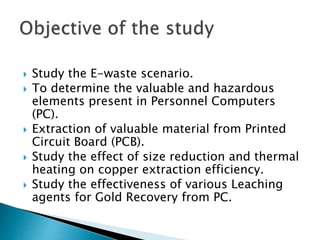
 Study the E-waste scenario.
 To determine the valuable and hazardous
elements present in Personnel Computers
(PC).
 Extraction of valuable material from Printed
Circuit Board (PCB).
 Study the effect of size reduction and thermal
heating on copper extraction efficiency.
 Study the effectiveness of various Leaching
agents for Gold Recovery from PC.
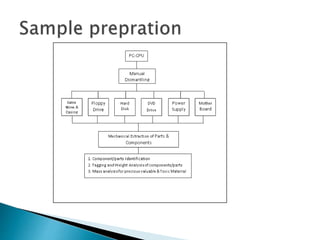
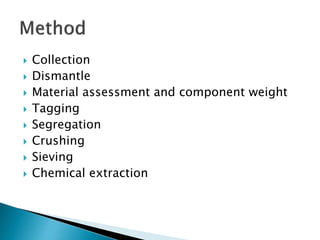
 Collection
 Dismantle
 Material assessment and component weight
 Tagging
 Segregation
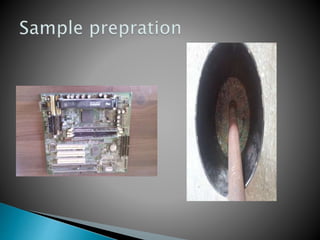
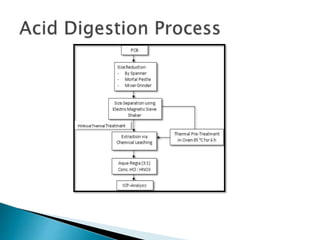
 Crushing
 Sieving
 Chemical extraction
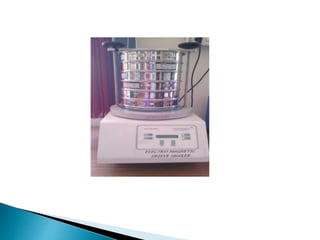
 Sieving is the method done to segregate the
larger and smaller particles. The
Electromagnetic sieve shaker is used for
segregation of larger particles. Then the
sample of PCB is ready for the acid digestion
process.
 Continuous mode Time-5min Power-10
 Intermittent mode Time-2min Power-10
The Hydro-metallurgical methods are more
exact, more predictable and more easily
controlled in comparison to the Pyro-
metallurgical processes for metal recovery
from the computer main boards
Aqua regia was used to fully leach out the
metals from the samples.
 Study of the Mother board PCB
 Study of the DVD PCB
 Gold analysis of MB and DVD printed circuit
Board (PCB)
 Gold Analysis
 The crushed MB sample was segregated into
4 size fractions namely 2mm, 4mm, 6mm
and 8mm using electromagnetic sieve shaker.
This sample was utilized for chemical
extraction using Aqua Regia.
 Two alternative methods has been used for
chemical extraction of MB PCB
 1. Heated Sample 2. Non- heated Sample
 The particle size fraction 2mm, 4mm, 6mm,
and 8mm .The maximum Cu extract is 2mm
size because availability of higher surface
area for small particle size
 PCB heated at 85deg on 6 hours
 Heated show the efficiency is lower than the
Non – heated sample
 This is the fact of MB PCB Contains FR4 resin
consisting of metal sheet embedded in epoxy
resin and Glass Fibers sheet which has high
thermal, shearing and tensile strength.
 The crushed DVD sample was segregated into
4 size fractions namely 0.15mm, 0.3mm,
0.5mm and 0.71mm using electromagnetic
sieve shaker. This sample was utilized for
chemical extraction using Aqua Regia.
 Two alternative methods have been used for
sample preparation of DVD
1. Heated Sample 2.Non heated Sample
 0.3mm size fraction showed the maximum
copper recovery followed by 0.71mm, 0.15
mm and least for 0.5mm size fraction.
 Higher concentrations occur in intermediate
fractions in particle size range of 0.3-0.71
mm for both heated and non-heated
samples.
 Firstly PCB heated with 85 deg temperature
into the oven for 6 hr
 DVD heated sample are high efficiency to
extract the metal compare to non heated
sample
 Heating removed the non-metallic parts of
the samples, resulting in a more effective
dissolution.
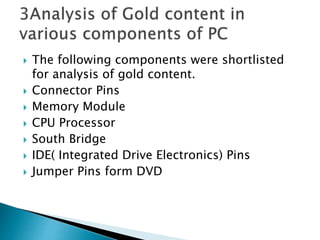
 The following components were shortlisted
for analysis of gold content.
 Connector Pins
 Memory Module
 CPU Processor
 South Bridge
 IDE( Integrated Drive Electronics) Pins
 Jumper Pins form DVD
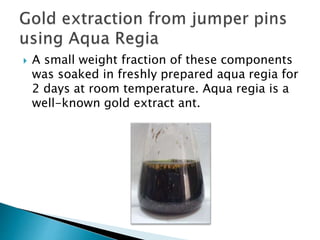
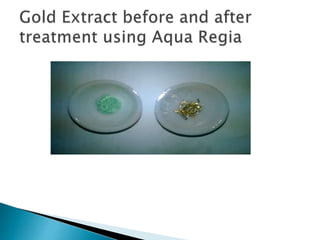
 A small weight fraction of these components
was soaked in freshly prepared aqua regia for
2 days at room temperature. Aqua regia is a
well-known gold extract ant.
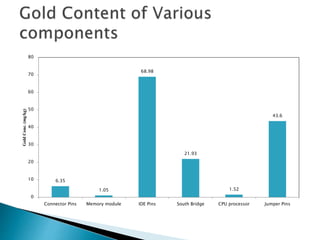
6.35
1.05
68.98
21.93
1.52
43.6
0
10
20
30
40
50
60
70
80
Connector Pins Memory module IDE Pins South Bridge CPU processor Jumper Pins
GoldConc.(mg/kg)
 The problem of E-Waste is growing in alarming proportions in India as also in the world.

 From material assessment and identification it was observed that Up to90-95 wt. % of the Al
present in CPU can be recovered easily via manual dismantling. Whereas 15-20 wt. % of copper
is available in motor windings, transformers, wires and cables which can be recovered easily
the remaining 30-35 wt. % are embedded in PCBs.

 Hydrometallurgical metal extraction technique was utilized for the study.

 DVD could be crushed easily compared to MB-PCB . This is due to the fact that MB-PCB
contains FR4 resin consisting of metal sheet embedded in epoxy resin and Glass Fibers sheet
which has high thermal, shearing and tensile strength.

 Size reduction plays an important role in extraction efficiency for both MB and DVD PCBs.2mm
particle size showed the highest copper extraction rate for MB-sample and 0.3 mm size
fraction in case of DVD fraction.

 PCBs of Mother Boards must be separately processed from other PCBs for optimizing valuable
material recovery and ease of process operation.

 From the various components identified IDE pins in MB and jumper pins from DVD contains a
higher gold content.
 Finding optimum process conditions for
maximum recovery of valuable material.
 To focus on recovery method for Rare earth
element apart from valuable and precious.
 Eco friendly recovery options
 Increasing utilization of resources and reuse
of equipment
 Increasing public, scientific and business
knowledge
M.Tech Project_Power Point Presentation

M.Tech Project_Power Point Presentation

  • 1.
    To Study theEffect of particle size reduction on Valuable and precious material in E – Waste.
  • 2.
    Electronic waste orE- waste is the term used to describe old, end of life electronic appliances such as computers , laptops, TVs, DVD players, mobile phones, mp3 players, etc. which have been disposed by their original users.
  • 3.
    E-Waste has beencategorized into 10 main parts by European Union (EU) as follow: 1.Large house hold appliances 2.Small house hold appliances 3.IT ( information technology) and telecommunications equipment’s 4.Consumer equipment 5.Lighting equipment 6.Electrical and electronic tools 7.Toys, and leisure and sports equipment 8.Medical devices 9.Monitoring and control instruments 10.Automatic dispensers.
  • 4.
     The averagelife span of a product depends on the usage, installation, maintenance and quality of materials used in construction 0 2 4 6 8 10 12 14 refrigerator washing machine mobile phone personal computers television
  • 5.
     Weight ofa single item can vary a lot from the average weight, depending on design, age etc. 0 5 10 15 20 25 30 35 refrgirators washing machine mobile phones personal computers television Average weight of electrical and electronic equipments in (kg)
  • 6.
     The compositionof WEEE/ E waste is very diverse and It contains more than 1000 different substances, in which some are ‘precious’, some are ‘hazardous’ and some are ‘non-hazardous. 38 28 19 4 11 Material Composition Ferrous Non-Ferrous Plastic Glass Others
  • 7.
    There are variouselements present in electronic and electrical equipment’s.  Valuable  Precious  Hazardous  Rare earth element
  • 8.
     Electrical andelectronic equipment contain various parts of valuable materials. Most of the valuable substances are found in PCB, cables, housing, heat sink, cooling fans, connectors, CRT, power supply.
  • 9.
     Electrical andelectronic equipment contains various precious materials such as palladium, gold, and silver. Most of the Precious substances are found in PCB, cables, housing, heat sink, cooling fans, connectors, CRT, power supply.
  • 10.
    Material name UseLocation Gold Connectivity, conductivity Connectivity, conductivity / PWB connectors Silver Conductivity Connectivity, conductivity / PWB connectors Palladium Connectivity, conductivity PWB connectors Platinum Thick film conductor PWB Precious elements, use and their location in personal computer
  • 11.
     EEEs aremade of multitude of components, in which some are toxic.
  • 12.
    Material name UseLocation Lead Metal joining Funnel joining in CRTs, PWBs Mercury Batteries switches Housing PWB Arsenic Doping agent in transistors PWB Cadmium Battery blue green phosphor emitter Housing PWB, CRT Selenium Rectifiers Rectifiers, PWB Hexavalent chromium Conductivity and anti-corrosive Housing Brominated flame retardants Fire retardants PWB and casing Barium Panel glass in CRT Beryllium Thermal conductivity PWB and connectors Poly vinyl chloride Insulating agent Cable insulation Poly chlorinated biphenyl Conductivity and anti-corrosive Conductor and transformer
  • 13.
     Rare earthsare a series of chemical elements found in the Earth’s crust that are vital to many modern technologies, including consumer electronics, computers and networks, communications, clean energy, advanced transportation, health care, environmental mitigation, national defense, and many others.  LREE-La, Ce, Pr,Nd,Sm  HREE-Eu, Gd, Tb, Dy, Ho, Er,Tm,Yb,Lu and Y
  • 14.
     The rareearth elements are quiet expensive. Hence research is going on to recycle it from E- Waste and its other sources.
  • 15.
    Sr.No Elements $/kg Rupees/kg 1Ce 13 780.91 2 Dy 630 37844.1 3 Gd 13205 793224.35 4 La 10.5 630.735 5 Nd 88 5286.16 6 Sm 3305 198531.35 7 Pr 155 9310.85 8 Tb 970 58267.9 9 Y 60 3604.2 10 Eu 1250 75087.5
  • 16.
    Problems Associated withE Waste in India 332.979 402.905 487.515 589.893 713.77 863.662 1045.031 1264.488 1530.03 1851.337 0 300 600 900 1200 1500 1800 2100 2007 2009 2011 2013 2015 2017 2019 2021 2023 2025 WeightinMT Year 1 MT = 1000 kg
  • 17.
    68 12 8 7 5 E-Waste Management inIndia Computer Equipment Telecomunication Electrical Equipment Medical Equipment Other (Household e-Crap)
  • 18.
    Impact on air Impacton water quality  Non-formal and backyard recycling of E-Waste  Lack of awareness and knowledge  Release of toxic substances (such as dioxins and furans etc ) from E- waste
  • 19.
     Ingestion –this means taking a material into the body by mouth (swallowing). Ingestion of toxic material may occur as a result of eating in a contaminants work area.  Absorption – substances that contact the eye and the skin may be either absorbed into the body/ cause local effects. For the majority of organic compound the contribution from skin absorption to the total exposure should not be neglected.  Inhalation – this means taking a material into the body by breathing in it. In the lungs, very tiny blood vessels are in constant contact with the air we breathe in. as a result airborne contaminants can be easily absorbed through tissue. 
  • 20.
    Chain of howthe occupational health hazard is caused
  • 21.
     Responsibility ofthe Government  Responsibility of the Industries  Responsibility of the citizens  Responsibility of the Recycler
  • 22.
     Governments shouldset up regulatory agencies in each district,  Governments should enforce strict regulations and heavy fines levied on industries,  Governments must encourage research into the development and standard of hazardous waste Management, environmental monitoring and the regulation of hazardous waste-disposal  Polluter pays principle and extended producer responsibility should be adopted.
  • 23.
     Inventory management Production Process modification
  • 24.
     are madewith fewer toxic constituents: use recycled content;  are energy efficient?  Are designed for easy upgrading or disassembly.  Utilize minimal packaging offer leasing or take back options have been certified by regulatory authorities.  Customers should opt for upgrading their computers or  Other electronic items to the latest versions rather than buying new equipment’s.   NGOs should adopt a participatory approach in
  • 25.
     Volume Reduction Recovery and Reuse
  • 26.
     Study theE-waste scenario.  To determine the valuable and hazardous elements present in Personnel Computers (PC).  Extraction of valuable material from Printed Circuit Board (PCB).  Study the effect of size reduction and thermal heating on copper extraction efficiency.  Study the effectiveness of various Leaching agents for Gold Recovery from PC.
  • 28.
     Collection  Dismantle Material assessment and component weight  Tagging  Segregation  Crushing  Sieving  Chemical extraction
  • 30.
     Sieving isthe method done to segregate the larger and smaller particles. The Electromagnetic sieve shaker is used for segregation of larger particles. Then the sample of PCB is ready for the acid digestion process.  Continuous mode Time-5min Power-10  Intermittent mode Time-2min Power-10
  • 32.
    The Hydro-metallurgical methodsare more exact, more predictable and more easily controlled in comparison to the Pyro- metallurgical processes for metal recovery from the computer main boards Aqua regia was used to fully leach out the metals from the samples.
  • 34.
     Study ofthe Mother board PCB  Study of the DVD PCB  Gold analysis of MB and DVD printed circuit Board (PCB)  Gold Analysis
  • 35.
     The crushedMB sample was segregated into 4 size fractions namely 2mm, 4mm, 6mm and 8mm using electromagnetic sieve shaker. This sample was utilized for chemical extraction using Aqua Regia.  Two alternative methods has been used for chemical extraction of MB PCB  1. Heated Sample 2. Non- heated Sample
  • 36.
     The particlesize fraction 2mm, 4mm, 6mm, and 8mm .The maximum Cu extract is 2mm size because availability of higher surface area for small particle size
  • 37.
     PCB heatedat 85deg on 6 hours  Heated show the efficiency is lower than the Non – heated sample  This is the fact of MB PCB Contains FR4 resin consisting of metal sheet embedded in epoxy resin and Glass Fibers sheet which has high thermal, shearing and tensile strength.
  • 38.
     The crushedDVD sample was segregated into 4 size fractions namely 0.15mm, 0.3mm, 0.5mm and 0.71mm using electromagnetic sieve shaker. This sample was utilized for chemical extraction using Aqua Regia.  Two alternative methods have been used for sample preparation of DVD 1. Heated Sample 2.Non heated Sample
  • 39.
     0.3mm sizefraction showed the maximum copper recovery followed by 0.71mm, 0.15 mm and least for 0.5mm size fraction.  Higher concentrations occur in intermediate fractions in particle size range of 0.3-0.71 mm for both heated and non-heated samples.
  • 40.
     Firstly PCBheated with 85 deg temperature into the oven for 6 hr  DVD heated sample are high efficiency to extract the metal compare to non heated sample  Heating removed the non-metallic parts of the samples, resulting in a more effective dissolution.
  • 41.
     The followingcomponents were shortlisted for analysis of gold content.  Connector Pins  Memory Module  CPU Processor  South Bridge  IDE( Integrated Drive Electronics) Pins  Jumper Pins form DVD
  • 42.
     A smallweight fraction of these components was soaked in freshly prepared aqua regia for 2 days at room temperature. Aqua regia is a well-known gold extract ant.
  • 44.
    6.35 1.05 68.98 21.93 1.52 43.6 0 10 20 30 40 50 60 70 80 Connector Pins Memorymodule IDE Pins South Bridge CPU processor Jumper Pins GoldConc.(mg/kg)
  • 45.
     The problemof E-Waste is growing in alarming proportions in India as also in the world.   From material assessment and identification it was observed that Up to90-95 wt. % of the Al present in CPU can be recovered easily via manual dismantling. Whereas 15-20 wt. % of copper is available in motor windings, transformers, wires and cables which can be recovered easily the remaining 30-35 wt. % are embedded in PCBs.   Hydrometallurgical metal extraction technique was utilized for the study.   DVD could be crushed easily compared to MB-PCB . This is due to the fact that MB-PCB contains FR4 resin consisting of metal sheet embedded in epoxy resin and Glass Fibers sheet which has high thermal, shearing and tensile strength.   Size reduction plays an important role in extraction efficiency for both MB and DVD PCBs.2mm particle size showed the highest copper extraction rate for MB-sample and 0.3 mm size fraction in case of DVD fraction.   PCBs of Mother Boards must be separately processed from other PCBs for optimizing valuable material recovery and ease of process operation.   From the various components identified IDE pins in MB and jumper pins from DVD contains a higher gold content.
  • 46.
     Finding optimumprocess conditions for maximum recovery of valuable material.  To focus on recovery method for Rare earth element apart from valuable and precious.  Eco friendly recovery options  Increasing utilization of resources and reuse of equipment  Increasing public, scientific and business knowledge