Mining and Mineral Resources
Nonrenewable Mineral Resources 
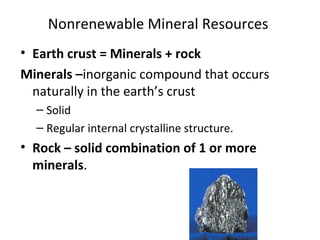
• Earth crust = Minerals + rock 
Minerals –inorganic compound that occurs 
naturally in the earth’s crust 
– Solid 
– Regular internal crystalline structure. 
• Rock – solid combination of 1 or more 
minerals.
• Mineral Resource: Any mineral useful to humans 
– Metallic Minerals: Iron Oxide, Gold 
– Non-metallic mineral: Limestone, sand 
– Fossil Fuel; Coal, Petroleum 
• Ore: A rock that can be profitably mined for a 
mineral (often a metal) or for minerals (metals) 
– High Grade Ore; has high concentration of the mineral 
– Low Grade Ore: smaller concentration 
• Gangue: Minerals other than ore present in a rock
Types of Metals 
• Abundant Metals: concentration >0.1% in the 
earth’s crust 
– Iron, Aluminum, Silicon, Magnesium, Titatnium, 
Manganese 
• Scarce Metals: <0.01% in the crust 
– Ferro-alloys: Nickel, Chromium 
– Base Metals: Copper, Lead, Zinc 
– Precious or Noble Metals: Gold, Silver, Platinum 
– Special Metals: Gallium, Arsenic, Germanium, Rare 
earths, Berrylium, Scandium etc..
• PBT = Persistent, bio-accumulative and toxic. 
– 5 nutrient metals: Cu, Cr, Ni, Al, Zn 
– 6 non-nutrient metals: Sb, As, Be, Cd, Pb, Hg 
• Metals cannot be banned and are present in 
nature, in soil, in food and in water 
• Pb, Cd, As and Hg pose special problem
Highly Uneven Distribution 
S Africa 50% Gold 
75% Chromium 
90% Platinum Group 
USA 50% Molybdenum 
15% Lead 
Chile 30% Copper 
Cuba 40% Nickel 
Guinea and Australia 25% each of Aluminum 
Zaire 50% cobalt
Mineral Supply and Demand 
• World Scenario: 
– Assumptions: 
• Present demand = present production 
• Future projection is based on constant 1995 figures 
• Unrestricted distribution 
– Iron, Aluminum, Chromium, Cobalt and Platinum will 
last centuries 
– Copper, Lead, Zinc, Gold and Silver will last several 
decades only 
– Ditto for phosphates and sulfur 
• Alleviating Factors: 
– More exploration 
– Better technology 
– Reclassification of sub-economic resources to reserve
Other options 
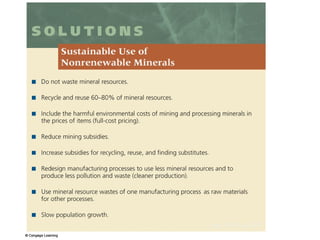
• Reduce consumptions 
– Smaller households, more leisure and travel, convenience, 
status etc. make it unlikely even in developed economies 
– New technology adds to the existing needs e.g., cellular 
phones, computers, microwave oven 
– In the US, population grew by 65% and consumption grew by 
130% between 1950-1990 
– Great demand for resources in the developing countries 
where there is a genuine need and where the great majority 
lives 
• If demand cannot be reduced, supplies must be 
increased or extended
New Methods in Exploration 
• Geophysics 
• Geochemistry 
• Remote sensing: Landsat 
• Better understanding of geology 
• Marine Mineral Resources 
– sea water, placers, hydrothermal deposits (Red Sea Mud), 
– Manganese Nodules(Mn, Cu, Ni, Co, Pt) 
– International Law of the Sea Conference
Conservation 
• Substitution 
– Increases consumption of the substituting metal or nonmetal 
(often petroleum) which itself might be limited in amount 
• Recycling 
– In USA 60% of lead, 40% of copper, 1/3rd of nickel and almost ¼ 
of Al, Cr, Co and Zn is recycled 
– Recycled Al requires 20 times less energy than new Al 
– Difficult to do with finished products like cars or fridges 
– Special problem with alloys 
– Road salt, fertilizers, lead in gasoline gets too disperse 
– Reduces waste disposal problem
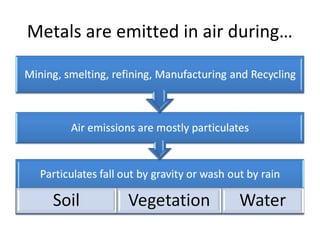
Metals are emitted in air during…
Impact of Mining Activities
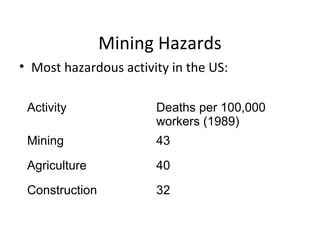
Mining Hazards 
• Most hazardous activity in the US: 
Activity Deaths per 100,000 
workers (1989) 
Mining 43 
Agriculture 40 
Construction 32
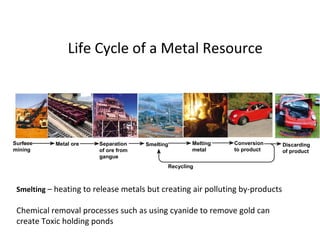
Life Cycle of a Metal Resource 
Conversion 
to product 
Surface 
mining 
Metal ore Separation 
of ore from 
gangue 
Smelting Melting 
metal 
Discarding 
of product 
Recycling 
Smelting – heating to release metals but creating air polluting by-products 
Chemical removal processes such as using cyanide to remove gold can 
create Toxic holding ponds
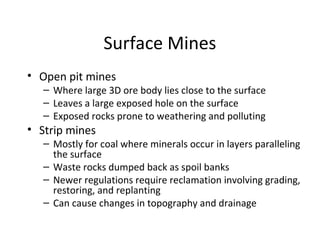
Surface Mines 
• Open pit mines 
– Where large 3D ore body lies close to the surface 
– Leaves a large exposed hole on the surface 
– Exposed rocks prone to weathering and polluting 
• Strip mines 
– Mostly for coal where minerals occur in layers paralleling 
the surface 
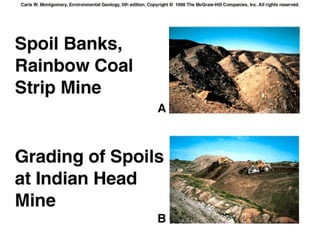
– Waste rocks dumped back as spoil banks 
– Newer regulations require reclamation involving grading, 
restoring, and replanting 
– Can cause changes in topography and drainage
Extracting Mineral Deposits 
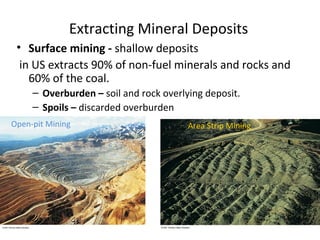
• Surface mining - shallow deposits 
in US extracts 90% of non-fuel minerals and rocks and 
60% of the coal. 
– Overburden – soil and rock overlying deposit. 
– Spoils – discarded overburden 
Open-pit Mining Area Strip Mining
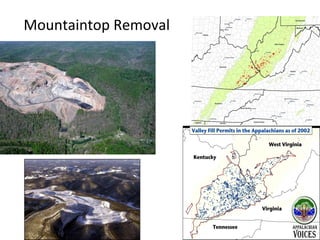
Mountaintop Removal 
FFiigguurree 1155--1144
Extracting Mineral Deposits 
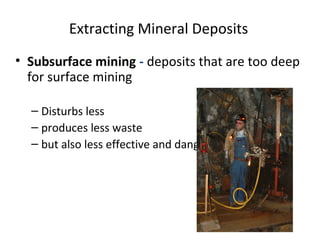
• Subsurface mining - deposits that are too deep 
for surface mining 
– Disturbs less 
– produces less waste 
– but also less effective and dangerous.
Underground Mines 
• Generally less disruptive than surface mines 
• Tunnels closely follow the ore body 
• Some waste rock on the surface 
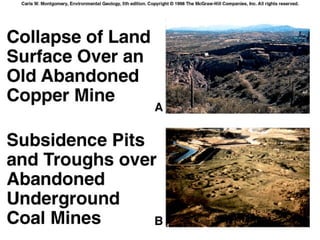
• Shallow abandoned mines can cause collapse
Sources of Metal Pollution 
• Mining 
– Air 
– Water 
– Land 
• Fossil Fuel Combustion 
– Air 
– Water 
– Land 
• Other sources 
• Natural Sources
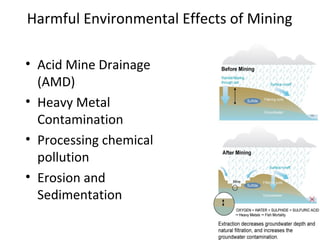
Harmful Environmental Effects of Mining 
• Acid Mine Drainage 
(AMD) 
• Heavy Metal 
Contamination 
• Processing chemical 
pollution 
• Erosion and 
Sedimentation
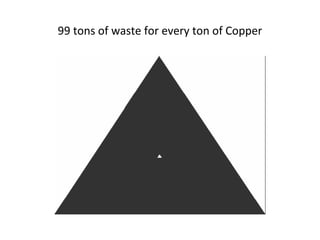
99 tons of waste for every ton of Copper
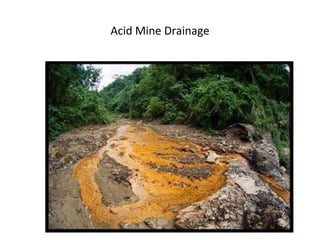
• Acid Mine Drainage (AMD) 
– Sulfur in ores react with water and oxygen to form 
sulfuric acid which leaks out from the mine 
– Thiobacillus ferroxidans bacteria in acid water 
hastens the process 
– Acid is carried off the mine site by rainwater or 
surface drainage and deposited into nearby 
streams, rivers, lakes and groundwater. AMD 
severely degrades water quality, and can kill 
aquatic life and make water virtually unusable.
Acid Mine Drainage
• 2. Heavy Metal Contamination & Leaching 
– Heavy metal pollution is caused when such metals 
as arsenic, cobalt, copper, cadmium, lead, silver 
and zinc contained in excavated rock or exposed 
in an underground mine come in contact with 
water. 
– Metals are leached out and carried downstream 
as water washes over the rock surface. 
– leaching is particularly accelerated in the low pH 
conditions such as are created by Acid Mine 
Drainage.
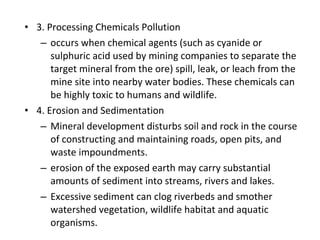
• 3. Processing Chemicals Pollution 
– occurs when chemical agents (such as cyanide or 
sulphuric acid used by mining companies to separate the 
target mineral from the ore) spill, leak, or leach from the 
mine site into nearby water bodies. These chemicals can 
be highly toxic to humans and wildlife. 
• 4. Erosion and Sedimentation 
– Mineral development disturbs soil and rock in the course 
of constructing and maintaining roads, open pits, and 
waste impoundments. 
– erosion of the exposed earth may carry substantial 
amounts of sediment into streams, rivers and lakes. 
– Excessive sediment can clog riverbeds and smother 
watershed vegetation, wildlife habitat and aquatic 
organisms.
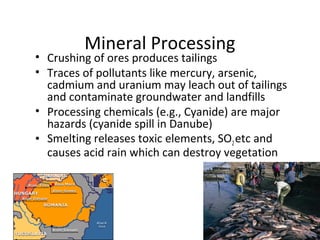
Mineral Processing 
• Crushing of ores produces tailings 
• Traces of pollutants like mercury, arsenic, 
cadmium and uranium may leach out of tailings 
and contaminate groundwater and landfills 
• Processing chemicals (e.g., Cyanide) are major 
hazards (cyanide spill in Danube) 
• Smelting releases toxic elements, SO2 etc and 
causes acid rain which can destroy vegetation
Fig. 12-14, p. 275
Four PBT Metals 
• PBT: Persistent, Bio-accumulative, Toxic 
• Lead 
• Mercury 
• Cadmium 
• Arsenic
Lead 
• Present Scenario compared to 100 yrs ago 
– 4X in Antarctica Ice 
– 15X greater in Coral 
– 500X greater in household dusts 
• Was used in 
– Plumbing 
– soldering 
– Paint 
– Gasoline 
– Lead types for printing, Lead in printing ink
Lead; Adverse Effects 
• Affects Nervous system of human fetus and 
small children 
• Most of the lead is stored in bones and along 
with Calcium, is released in mother’s milk 
• Affects IQ, causes delinquency, kidney cancer 
• In adults: High BP, affects nervous system and 
kidney, anemia, infertility
Sources of Lead 
• Similar to other metals: mining, smelting, coal 
burning power plants, incinerators 
• Lead paints , lead contaminated soil, plumbing 
– affects children in poorer households 
– Made worse by poor diet low in Ca and Fe 
• For people living in Lead free environment: 
– Food is the major source
Sources of Lead 
• Gasoline 
– Lead level in exhausts fell 90% after banning of lead in 
gasoline – the substitute, Benzene, is carcinogen 
– Lead in the blood of Children fell to 4 -6 microgram/lt 
(threshold: 10 micrograms/lt) 
– Major problem now in China 
• Incinerator: 
• P2 measures: the following are banned: 
– Lead in gasoline, in paint, in printing ink, in solders in 
plumbing and cans, in sealing wine bottles, in toys 
– Imported products can still have lead 
– Car batteries still contain lead
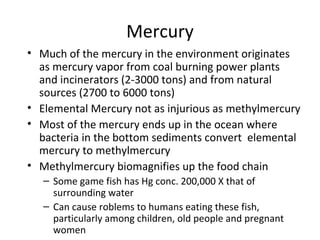
Mercury 
• Much of the mercury in the environment originates 
as mercury vapor from coal burning power plants 
and incinerators (2-3000 tons) and from natural 
sources (2700 to 6000 tons) 
• Elemental Mercury not as injurious as methylmercury 
• Most of the mercury ends up in the ocean where 
bacteria in the bottom sediments convert elemental 
mercury to methylmercury 
• Methylmercury biomagnifies up the food chain 
– Some game fish has Hg conc. 200,000 X that of 
surrounding water 
– Can cause roblems to humans eating these fish, 
particularly among children, old people and pregnant 
women
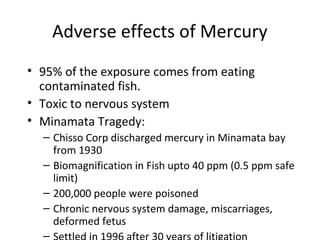
Adverse effects of Mercury 
• 95% of the exposure comes from eating 
contaminated fish. 
• Toxic to nervous system 
• Minamata Tragedy: 
– Chisso Corp discharged mercury in Minamata bay 
from 1930 
– Biomagnification in Fish upto 40 ppm (0.5 ppm safe 
limit) 
– 200,000 people were poisoned 
– Chronic nervous system damage, miscarriages, 
deformed fetus 
– Settled in 1996 after 30 years of litigation
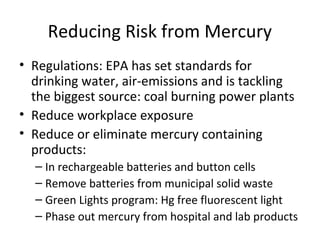
Reducing Risk from Mercury 
• Regulations: EPA has set standards for 
drinking water, air-emissions and is tackling 
the biggest source: coal burning power plants 
• Reduce workplace exposure 
• Reduce or eliminate mercury containing 
products: 
– In rechargeable batteries and button cells 
– Remove batteries from municipal solid waste 
– Green Lights program: Hg free fluorescent light 
– Phase out mercury from hospital and lab products
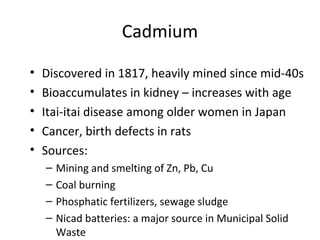
Cadmium 
• Discovered in 1817, heavily mined since mid-40s 
• Bioaccumulates in kidney – increases with age 
• Itai-itai disease among older women in Japan 
• Cancer, birth defects in rats 
• Sources: 
– Mining and smelting of Zn, Pb, Cu 
– Coal burning 
– Phosphatic fertilizers, sewage sludge 
– Nicad batteries: a major source in Municipal Solid 
Waste
Cadmium… 
• 90% of the exposure (of non-smokers) is 
through food 
– Fish, scallops and oysters 
– Liver and kidneys of larger animals : beef, 
venison 
– Readily taken up by plants – concentrated in 
Tobaccos. 90% of inhaled Cd is absorbed by the 
body 
• Control: EPA regulations 
• Power plants still not controlled 
• Nicad batteries still a major problem
Arsenic 
• Metal smelting of Copper and Lead 
• Used to be common weed killer 
• Emitted by volcanoes 
• Naturally present in soil 
– Major environmental problem in Bangladesh 
• Level in seafoods higher than in land-grown 
food. 
• Much of the Arsenic in Food is not bioavailable 
• CCA (Chromated Copper Arsenate) used to treat 
wood including playground equipments – can 
contaminate soil

Mining

  • 1.
  • 2.
    Nonrenewable Mineral Resources • Earth crust = Minerals + rock Minerals –inorganic compound that occurs naturally in the earth’s crust – Solid – Regular internal crystalline structure. • Rock – solid combination of 1 or more minerals.
  • 3.
    • Mineral Resource:Any mineral useful to humans – Metallic Minerals: Iron Oxide, Gold – Non-metallic mineral: Limestone, sand – Fossil Fuel; Coal, Petroleum • Ore: A rock that can be profitably mined for a mineral (often a metal) or for minerals (metals) – High Grade Ore; has high concentration of the mineral – Low Grade Ore: smaller concentration • Gangue: Minerals other than ore present in a rock
  • 4.
    Types of Metals • Abundant Metals: concentration >0.1% in the earth’s crust – Iron, Aluminum, Silicon, Magnesium, Titatnium, Manganese • Scarce Metals: <0.01% in the crust – Ferro-alloys: Nickel, Chromium – Base Metals: Copper, Lead, Zinc – Precious or Noble Metals: Gold, Silver, Platinum – Special Metals: Gallium, Arsenic, Germanium, Rare earths, Berrylium, Scandium etc..
  • 5.
    • PBT =Persistent, bio-accumulative and toxic. – 5 nutrient metals: Cu, Cr, Ni, Al, Zn – 6 non-nutrient metals: Sb, As, Be, Cd, Pb, Hg • Metals cannot be banned and are present in nature, in soil, in food and in water • Pb, Cd, As and Hg pose special problem
  • 6.
    Highly Uneven Distribution S Africa 50% Gold 75% Chromium 90% Platinum Group USA 50% Molybdenum 15% Lead Chile 30% Copper Cuba 40% Nickel Guinea and Australia 25% each of Aluminum Zaire 50% cobalt
  • 7.
    Mineral Supply andDemand • World Scenario: – Assumptions: • Present demand = present production • Future projection is based on constant 1995 figures • Unrestricted distribution – Iron, Aluminum, Chromium, Cobalt and Platinum will last centuries – Copper, Lead, Zinc, Gold and Silver will last several decades only – Ditto for phosphates and sulfur • Alleviating Factors: – More exploration – Better technology – Reclassification of sub-economic resources to reserve
  • 8.
    Other options •Reduce consumptions – Smaller households, more leisure and travel, convenience, status etc. make it unlikely even in developed economies – New technology adds to the existing needs e.g., cellular phones, computers, microwave oven – In the US, population grew by 65% and consumption grew by 130% between 1950-1990 – Great demand for resources in the developing countries where there is a genuine need and where the great majority lives • If demand cannot be reduced, supplies must be increased or extended
  • 9.
    New Methods inExploration • Geophysics • Geochemistry • Remote sensing: Landsat • Better understanding of geology • Marine Mineral Resources – sea water, placers, hydrothermal deposits (Red Sea Mud), – Manganese Nodules(Mn, Cu, Ni, Co, Pt) – International Law of the Sea Conference
  • 10.
    Conservation • Substitution – Increases consumption of the substituting metal or nonmetal (often petroleum) which itself might be limited in amount • Recycling – In USA 60% of lead, 40% of copper, 1/3rd of nickel and almost ¼ of Al, Cr, Co and Zn is recycled – Recycled Al requires 20 times less energy than new Al – Difficult to do with finished products like cars or fridges – Special problem with alloys – Road salt, fertilizers, lead in gasoline gets too disperse – Reduces waste disposal problem
  • 11.
    Metals are emittedin air during…
  • 12.
    Impact of MiningActivities
  • 13.
    Mining Hazards •Most hazardous activity in the US: Activity Deaths per 100,000 workers (1989) Mining 43 Agriculture 40 Construction 32
  • 14.
    Life Cycle ofa Metal Resource Conversion to product Surface mining Metal ore Separation of ore from gangue Smelting Melting metal Discarding of product Recycling Smelting – heating to release metals but creating air polluting by-products Chemical removal processes such as using cyanide to remove gold can create Toxic holding ponds
  • 15.
    Surface Mines •Open pit mines – Where large 3D ore body lies close to the surface – Leaves a large exposed hole on the surface – Exposed rocks prone to weathering and polluting • Strip mines – Mostly for coal where minerals occur in layers paralleling the surface – Waste rocks dumped back as spoil banks – Newer regulations require reclamation involving grading, restoring, and replanting – Can cause changes in topography and drainage
  • 16.
    Extracting Mineral Deposits • Surface mining - shallow deposits in US extracts 90% of non-fuel minerals and rocks and 60% of the coal. – Overburden – soil and rock overlying deposit. – Spoils – discarded overburden Open-pit Mining Area Strip Mining
  • 17.
  • 19.
    Extracting Mineral Deposits • Subsurface mining - deposits that are too deep for surface mining – Disturbs less – produces less waste – but also less effective and dangerous.
  • 20.
    Underground Mines •Generally less disruptive than surface mines • Tunnels closely follow the ore body • Some waste rock on the surface • Shallow abandoned mines can cause collapse
  • 22.
    Sources of MetalPollution • Mining – Air – Water – Land • Fossil Fuel Combustion – Air – Water – Land • Other sources • Natural Sources
  • 23.
    Harmful Environmental Effectsof Mining • Acid Mine Drainage (AMD) • Heavy Metal Contamination • Processing chemical pollution • Erosion and Sedimentation
  • 24.
    99 tons ofwaste for every ton of Copper
  • 25.
    • Acid MineDrainage (AMD) – Sulfur in ores react with water and oxygen to form sulfuric acid which leaks out from the mine – Thiobacillus ferroxidans bacteria in acid water hastens the process – Acid is carried off the mine site by rainwater or surface drainage and deposited into nearby streams, rivers, lakes and groundwater. AMD severely degrades water quality, and can kill aquatic life and make water virtually unusable.
  • 26.
  • 27.
    • 2. HeavyMetal Contamination & Leaching – Heavy metal pollution is caused when such metals as arsenic, cobalt, copper, cadmium, lead, silver and zinc contained in excavated rock or exposed in an underground mine come in contact with water. – Metals are leached out and carried downstream as water washes over the rock surface. – leaching is particularly accelerated in the low pH conditions such as are created by Acid Mine Drainage.
  • 28.
    • 3. ProcessingChemicals Pollution – occurs when chemical agents (such as cyanide or sulphuric acid used by mining companies to separate the target mineral from the ore) spill, leak, or leach from the mine site into nearby water bodies. These chemicals can be highly toxic to humans and wildlife. • 4. Erosion and Sedimentation – Mineral development disturbs soil and rock in the course of constructing and maintaining roads, open pits, and waste impoundments. – erosion of the exposed earth may carry substantial amounts of sediment into streams, rivers and lakes. – Excessive sediment can clog riverbeds and smother watershed vegetation, wildlife habitat and aquatic organisms.
  • 29.
    Mineral Processing •Crushing of ores produces tailings • Traces of pollutants like mercury, arsenic, cadmium and uranium may leach out of tailings and contaminate groundwater and landfills • Processing chemicals (e.g., Cyanide) are major hazards (cyanide spill in Danube) • Smelting releases toxic elements, SO2 etc and causes acid rain which can destroy vegetation
  • 30.
  • 31.
    Four PBT Metals • PBT: Persistent, Bio-accumulative, Toxic • Lead • Mercury • Cadmium • Arsenic
  • 32.
    Lead • PresentScenario compared to 100 yrs ago – 4X in Antarctica Ice – 15X greater in Coral – 500X greater in household dusts • Was used in – Plumbing – soldering – Paint – Gasoline – Lead types for printing, Lead in printing ink
  • 33.
    Lead; Adverse Effects • Affects Nervous system of human fetus and small children • Most of the lead is stored in bones and along with Calcium, is released in mother’s milk • Affects IQ, causes delinquency, kidney cancer • In adults: High BP, affects nervous system and kidney, anemia, infertility
  • 34.
    Sources of Lead • Similar to other metals: mining, smelting, coal burning power plants, incinerators • Lead paints , lead contaminated soil, plumbing – affects children in poorer households – Made worse by poor diet low in Ca and Fe • For people living in Lead free environment: – Food is the major source
  • 35.
    Sources of Lead • Gasoline – Lead level in exhausts fell 90% after banning of lead in gasoline – the substitute, Benzene, is carcinogen – Lead in the blood of Children fell to 4 -6 microgram/lt (threshold: 10 micrograms/lt) – Major problem now in China • Incinerator: • P2 measures: the following are banned: – Lead in gasoline, in paint, in printing ink, in solders in plumbing and cans, in sealing wine bottles, in toys – Imported products can still have lead – Car batteries still contain lead
  • 36.
    Mercury • Muchof the mercury in the environment originates as mercury vapor from coal burning power plants and incinerators (2-3000 tons) and from natural sources (2700 to 6000 tons) • Elemental Mercury not as injurious as methylmercury • Most of the mercury ends up in the ocean where bacteria in the bottom sediments convert elemental mercury to methylmercury • Methylmercury biomagnifies up the food chain – Some game fish has Hg conc. 200,000 X that of surrounding water – Can cause roblems to humans eating these fish, particularly among children, old people and pregnant women
  • 37.
    Adverse effects ofMercury • 95% of the exposure comes from eating contaminated fish. • Toxic to nervous system • Minamata Tragedy: – Chisso Corp discharged mercury in Minamata bay from 1930 – Biomagnification in Fish upto 40 ppm (0.5 ppm safe limit) – 200,000 people were poisoned – Chronic nervous system damage, miscarriages, deformed fetus – Settled in 1996 after 30 years of litigation
  • 38.
    Reducing Risk fromMercury • Regulations: EPA has set standards for drinking water, air-emissions and is tackling the biggest source: coal burning power plants • Reduce workplace exposure • Reduce or eliminate mercury containing products: – In rechargeable batteries and button cells – Remove batteries from municipal solid waste – Green Lights program: Hg free fluorescent light – Phase out mercury from hospital and lab products
  • 39.
    Cadmium • Discoveredin 1817, heavily mined since mid-40s • Bioaccumulates in kidney – increases with age • Itai-itai disease among older women in Japan • Cancer, birth defects in rats • Sources: – Mining and smelting of Zn, Pb, Cu – Coal burning – Phosphatic fertilizers, sewage sludge – Nicad batteries: a major source in Municipal Solid Waste
  • 40.
    Cadmium… • 90%of the exposure (of non-smokers) is through food – Fish, scallops and oysters – Liver and kidneys of larger animals : beef, venison – Readily taken up by plants – concentrated in Tobaccos. 90% of inhaled Cd is absorbed by the body • Control: EPA regulations • Power plants still not controlled • Nicad batteries still a major problem
  • 41.
    Arsenic • Metalsmelting of Copper and Lead • Used to be common weed killer • Emitted by volcanoes • Naturally present in soil – Major environmental problem in Bangladesh • Level in seafoods higher than in land-grown food. • Much of the Arsenic in Food is not bioavailable • CCA (Chromated Copper Arsenate) used to treat wood including playground equipments – can contaminate soil

Editor's Notes

  • #15 Figure 12.7: Life cycle of a metal resource. Each step in this process uses large amounts of energy and produces some pollution and waste.