Minimal Invasive Endodontics:
The New Revolution
PRESENTED BY – DR AKSHAY JAISWAL
DR MEGHNA DUGAR
Vivian d’ costa et al, International Journal of Dental Science
and Innovative Research (IJDSIR), 2020
CONTENTS
 INTRODUCTION
 MINIMAL INVASIVE ENDODONTICS
 DIAGNOSIS AND TREATMENT PLANNING
 CONCLUSION
 REFERENCES
Introduction
 Preserving the mother nature promises our longer survival.
 Similarly preserving the natural tooth tissue is gifted with its extended survival.
 This is the principle of minimal invasive endodontics (MIE) .
 MIE refers to the minimally removal of dentin during the all three
phases of a root canal procedure:
1. Coronal access preparation,
2. Radicular apical preparation; and
3. Flaring of the canal that connects the coronal to the apical preparations.
 Utilizing advanced imaging modalities and computer software for understanding the
complexities of the root canal system,
 employing increased magnification, and lighting for visualizing the pulpal space
 working with new instruments, irrigants for cleaning and shaping the canal system and
 applying newer materials that increase the prognosis for restoring structure and
retaining the natural dentition.
Various stepping stone to minimal invasive endodontics-
 Long-term endodontic treatment success must integrate respect for the concept of
MIE while fulfilling treatment objectives by mechanically and biologically.
 Dr. Herb Schilder, in 1974, precisely described the mechanical objectives for the
preparation of a canal that, when filled, would ensure the biological goals for
longterm success.
 In the goal of destroying the microorganism from the root canal ,we have been
increasing the apical width and taper of the canal which result in destruction of the
remaining tooth structure.
 Eliminating the maximum microorganism with minimal invasion is a challenge.
Preservation of what remains matters
 This article highlights on the various minimal invasive strategies during the
endodontic procedures and its restoration.
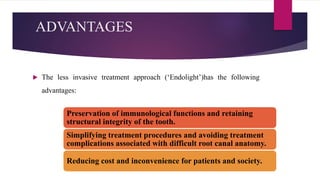
ADVANTAGES
 The less invasive treatment approach (‘Endolight’)has the following
advantages:
Preservation of immunological functions and retaining
structural integrity of the tooth.
Simplifying treatment procedures and avoiding treatment
complications associated with difficult root canal anatomy.
Reducing cost and inconvenience for patients and society.
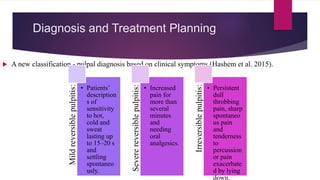
Diagnosis and Treatment Planning
 A new classification - pulpal diagnosis based on clinical symptoms (Hashem et al. 2015).
Mild
reversible
pulpitis:
• Patients’
description
s of
sensitivity
to hot,
cold and
sweat
lasting up
to 15–20 s
and
settling
spontaneo
usly.
Severe
reversible
pulpitis:
• Increased
pain for
more than
several
minutes
and
needing
oral
analgesics.
Irreversible
pulpitis:
• Persistent
dull
throbbing
pain, sharp
spontaneo
us pain
and
tenderness
to
percussion
or pain
exacerbate
d by lying
down.
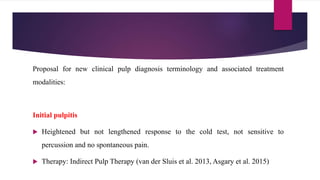
Proposal for new clinical pulp diagnosis terminology and associated treatment
modalities:
Initial pulpitis
 Heightened but not lengthened response to the cold test, not sensitive to
percussion and no spontaneous pain.
 Therapy: Indirect Pulp Therapy (van der Sluis et al. 2013, Asgary et al. 2015)
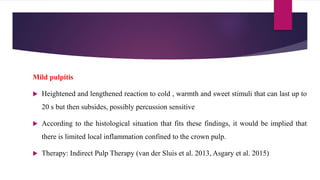
Mild pulpitis
 Heightened and lengthened reaction to cold , warmth and sweet stimuli that can last up to
20 s but then subsides, possibly percussion sensitive
 According to the histological situation that fits these findings, it would be implied that
there is limited local inflammation confined to the crown pulp.
 Therapy: Indirect Pulp Therapy (van der Sluis et al. 2013, Asgary et al. 2015)
Moderate pulpitis
 Clear symptoms, strong, heightened and prolonged reaction to cold, which can last
for minutes, possibly percussion sensitive and spontaneous dull pain that can be more
or less suppressed with pain medication.
 According to the histological situation that fits these would be implied that there is
extensive local inflammation confined to the crown pulp.
 Therapy: Coronal pulpotomy – partly/completely
Severe pulpitis
 Severe spontaneous pain and clear pain reaction to warmth and cold stimuli,
often, sharp to dull throbbing pain, patients have trouble sleeping because of the
pain (gets worse when lying down).
 Tooth is very sensitive to touch and percussion.
 According to the histological situation that fits these findings, it would be implied that
there is extensive local inflammation in the crown pulp that possibly extends into the
root canals.
 Therapy: Coronal pulpotomy – if there is no prolonged bleeding of pulp stumps in the
orifices of the canals, these will be covered with MTA in mature teeth, followed by
restoration (Alqaderi et al. 2014).
 If one or more of the pulp stumps keeps bleeding after rinsing with 2 mL 2% NaOCl, a
superficial pulpotomy can be carried out, whereby more inflamed tissue is removed
from the canal up to 3–4 mm from the radiographic apex.
 If bleeding ceases, then the root canal up to the vital pulp tissue is filled with gutta-
percha and sealer at this working length.
 If bleeding persists, a full pulpectomy needs to be performed in order to remove all
inflamed tissue from the canal(Matsuo et al. 1996).
Structural Integrity
 Preserving the remaining tooth structure plays an important role in the structural integrity
of tooth.
 Reeh et al., in 1989, did a study to assess the stiffness of cusps when comparing
conventional cavity preparations to endodontic access openings on bicuspid teeth.
 It was shown that endodontic procedures reduced the relative cuspal stiffness of premolar
teeth by only 5%, in contrast to an occlusal cavity preparation (20%) and an MOD cavity
preparation (63%)
 Marginal ridges are a key factor in retaining tooth strength as per above studies.
 There is a perception that endodontically treated teeth becomes dessicated and are
prone to fracture.
 While Rosen described the dentin of endodontically treated teeth as "desiccated and
inelastic,” Johnson et at. additionally speculated that the elasticity of dentin
decreased with time following endodontic treatment.
 Alternatively, it has been suggested that, rather than endodontic treatment,
loss of tooth structure associated with restorative procedures was the
major factor in weakening teeth.
 Collectively, various studies show minimum dehydration effects due to pulpal
removal and demonstrate biomechanical behaviors in strength and toughness testing
that are similar to vital dentin.
 Factors which can cause the dentinal fatigue resulting cracks are chemical factors
such as irrigants and medicaments on dentin; the bacterial effect on the matrix of
dentin; structural loss due to the effect of post and core restorations and the results of
age changes in dentin.
Failed endodontic tooth has mainly two causes:
 1.How much stress a tooth under load experiences
 2.The biomechanical properties that help the remaining tooth structure to
resist fracture
Three ways to attain biological success are:
 By removal of canal microbes from the apical 3 mm
 Long term survivability of the tooth is achieved by minimal tooth tissue
removal from the coronal two thirds of the root.
 Access to the root canal is difficult.
Minimally Invasive Access Strategies
The main features to be aware in minimal invasive endodontics are:
 Pericervical dentin
 3D ferrule
 3D Soffit
PERICERVICAL DENTIN
 It is the dentin present 4 mm above the alveolar crest and 4 mm below the
crest.
 Preservation of this area is important a s it reinforces the tooth.
3D Ferrule
 Axial wall of dentin covered by axial wall of crown.
 3D refers to the components of ferrule namely:
 1. Vertical component - around 1.5 to 2.5 mm
 2. Dentin thickness (Girth) - Absolute minimum thickness – 1-2 mm
 Total occlusal convergence/ Net Taper-Total draw of 2 opposing axial
walls to receive a fixed crown which is 10° in 3mm of vertical ferrule,
20° in 4mm, possible in the traditional stainless-steel crowns whereas the
newer porcelain crowns demands 50° or more taper owing to its deep
chamfer marginal zones.
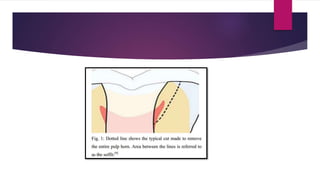
Soffit/Banking
 A small border of the chamber roof is maintained where it curves 90° to
the wall. In the tooth, this tiny “lip” or “cornice” could be as small as 0.5
mm, or as large as 3.0 mm in some cases (where extra strength is needed,
or when the anatomy allows it).
 The primary reason to maintain the soffit is to avoid the collateral damage
that usually occurs, namely the gouging of the lateral wall.
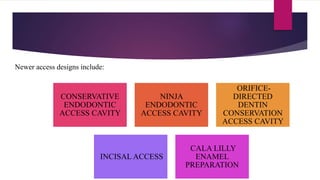
Newer access designs include:
CONSERVATIVE
ENDODONTIC
ACCESS CAVITY
NINJA
ENDODONTIC
ACCESS CAVITY
ORIFICE-
DIRECTED
DENTIN
CONSERVATION
ACCESS CAVITY
INCISAL ACCESS
CALA LILLY
ENAMEL
PREPARATION
Conservative Endodontic Access Cavity
(CECs)
 John Khademi and David Clark(2002) modified traditional access cavities and developed the
constricted or conservative endodontic access cavities to minimize the tooth structure
removal while maintaining the mechanical stability of the tooth for long-term survival and
function of the endodontically treated teeth.
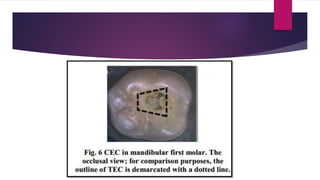
 Here, teeth are accessed at central fossa and extended only as necessary to detect canal
orifices, thus preserves the pericervical dentin and part of the chamber floor.
Ninja Endodontic Access Cavity (NECs)
 An access with a ‘Ninja’ outline, the oblique projection is towards the
central fossa of the root orifices in an occlusal plane.
 It is parallel with the enamel cut of 90 ⁰ or mothe occlusal plane, making
it easier to trace the root canal orifices from the varying visual
angulations.
Orifice-Directed Dentin Conservation
Access Cavity /
‘Truss’ Access Cavity
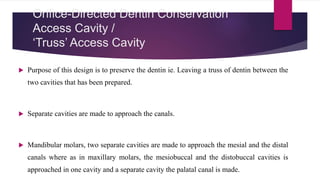
 Purpose of this design is to preserve the dentin ie. Leaving a truss of dentin between the
two cavities that has been prepared.
 Separate cavities are made to approach the canals.
 Mandibular molars, two separate cavities are made to approach the mesial and the distal
canals where as in maxillary molars, the mesiobuccal and the distobuccal cavities is
approached in one cavity and a separate cavity the palatal canal is made.
Incisal Access
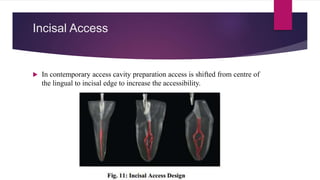
 In contemporary access cavity preparation access is shifted from centre of
the lingual to incisal edge to increase the accessibility.
Blind Tunnelling
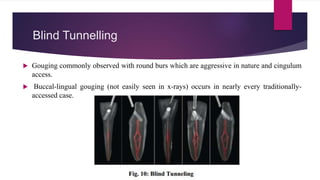
 Gouging commonly observed with round burs which are aggressive in nature and cingulum
access.
 Buccal-lingual gouging (not easily seen in x-rays) occurs in nearly every traditionally-
accessed case.
The Inverse Funnel
 As the access grows internally, an inverse funnel is created.
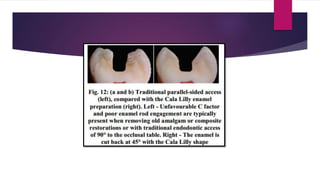
Cala Lilly Enamel Preparation
 Traditional parallel-sided access compared with the Cala Lilly enamel
preparation.
 Unfavourable C factor and poor enamel rod engagement are typically
present when removing old amalgam or composite restorations or with
traditional endodontic access 90 degree to the occlusal table.
 The enamel is cut back at 45 degree with the Cala Lilly shape.
Dynamically Guided Access
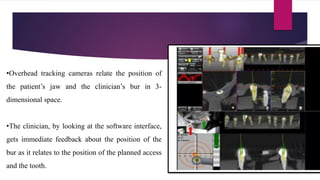
 Dynamic guidance used for dental implants.
 In endodontics - first introduced by Dr. Charles M.
 It use information from the patient’s CBCT volume to plan an access cavity.
•Overhead tracking cameras relate the position of
the patient’s jaw and the clinician’s bur in 3-
dimensional space.
•The clinician, by looking at the software interface,
gets immediate feedback about the position of the
bur as it relates to the position of the planned access
and the tooth.
Microguided Endodontic Access
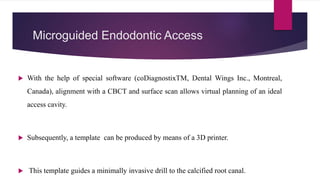
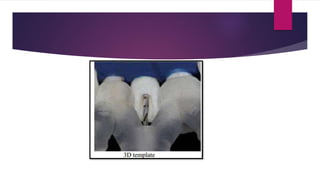
 With the help of special software (coDiagnostixTM, Dental Wings Inc., Montreal,
Canada), alignment with a CBCT and surface scan allows virtual planning of an ideal
access cavity.
 Subsequently, a template can be produced by means of a 3D printer.
 This template guides a minimally invasive drill to the calcified root canal.
Modern Endodontic Burs
 Traditionally used round bur technique relied on tactile feedback as the round
bur drops into pulp chamber.
 Round burs are aggressive in nature, the walls are overextended and gouged in
other areas.
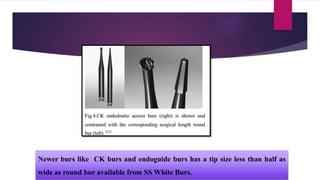
Newer burs like CK burs and endoguide burs has a tip size less than half as
wide as round bur available from SS White Burs.
Shaping The Root Canal Space
A 3-D cleaning and shaping by minimal invasion can be achieved through a thorough
irrigation protocol.
A. Apical Preparation Geometry:
 Significant difference was not found in intracanal bacterial reduction used with or
without apical enlargement preparation, stating it is not necessitated to remove
excessive dentin in the apex if sufficient coronal taper is present which allows enough
irrigation.
B. Self
 Adjusting File System: Hollow file -compressible, thin-walled, pointed cylinder of 1.5
mm or 2.0 mm diameter and composed of 120-μm-thick Ni-Ti lattice.
 File adapts itself to the three-dimensional canal morphology both longitudinally and
cross-sectionally.
 Effectively shapes up to 92% of the of root canal walls, while allowing for the
continuous flow of fresh NaOCl through the hollow file by using a peristaltic irrigation
device
C. TruNatomy rotary file:
 Recently, TruNatomy (Dentsply Sirona), a new generation of rotary files was launched.
 TruNatomy files are prepackaged, pre-sterilised rotary instruments, designed to shape
root canal systems to a continuously tapering preparation with maximum preservation of
peri-cervical dentine.
 Offers- More simplicity, safety, improved cutting efficiency and mechanical properties
compared to previous generations of rotating instruments.
D. Endo-Eze anatomic endodontic technology:
 Introduced as a minimally invasive endodontic preparation system.
 Used in a special reciprocating/ oscillating handpiece for instrumentation of the coronal
part of the root canal about 3 mm short of the apex.
 Apical files are hand files with shortened cutting flutes to cut only in the apical region
of the canal and are used in a clockwise turn and pull motion.
Disinfection
ENDOACTIVATOR SYSTEM
 In a root canal system, Endoactivator activates the intracanal reagents thereby
produces a vigorous hydrodynamic phenomenon utilizing sonic energy.
 Acoustic streaming creates sufficient shear forces to dislodge debris in instrumented
canals.
 Files activated with ultrasonic energy acoustic streaming was sufficient to produce
significantly cleaner canals compared with hand filing alone.
 The flushing action of irrigants is enhanced.
 Improves the efficacy of irrigation solutions in removing organic and inorganic debris
from root canal walls.
ULTRASONIC
 Requires any given canal which is prepared upto size 20 files.
 Striped and tapered tip of PIPS is placed still in the pulp chamber alone.
 Upon activation of the tip, it creates non-thermal photoacoustic shockwaves, that travel
3 -Dimensionally, also into the complex apical regions.
 It eradicates both biofilm and planktonic contaminates, sterilizing more than 1000
μm depth into the dentinal tubules.
PHOTON INDUCED PHOTOACOUSTIC STREAMING (PIPS)
 It is a multisonic technology with a specific wide spectrum wavelength with different
frequencies.
 The reagents flow through the closed system.
 With this a 3-dimensional cleaning of canal is achieved including the complex areas like
isthmuses, lateral canals and dentinal tubules.
 Moreover, it has the technological capabilities to debride and disinfect these integral
complex anatomies which are often inaccessible through standard endodontic therapies.
GENTLEWAVE
Post Endodontic Restoration Strategies
For Minimal Invasion
 Traditional post space preparation resulted in excessive tooth preparation with the use
of peeso reamers which in turn leads to loss of structural integrity.
 The newer posts like Ribbond and Everstick increases the flexibility and requires
minimal tooth preparation.
 Fibre-reinforced resin posts are more elastic support to core.
POST
ENDOCROWN
 The limitations to the use of intraradicular posts, such a calcified root
canals, narrow canals, or a fracture of an instrument, have led dentists to
think of other alternatives, as the use of endocrowns, an adhesive
endodontic crown.
 It prevents inadvertent destruction of dental tissues.
 The resolution of human eye is 0.2mm.
 This can be enhanced upto 6 micrometre with the help of Surgical Operative
Microscope Loupes and microscopes have led to another era of minimal invasion.
MAGNIFICATION
5 catalyst forces that will change the future of endodontic access and coronal
shaping are:
 1. Implant success rates
 2. Operating microscopes and micro-endodontics
 3. Biomimetic dentistry
 4. Minimally invasive dentistry
 5. Esthetic demands of patients.
Conclusion
 Minimal invasive endodontics plays a great role in preservation of what remains.
 It reinforces and improves the mechanical behavior of a tooth.
 This review should instill in the reader that endodontically treated teeth are not weak by
itself but it is the various procedures carried out that contributes to it.
 So as a dentist it is our duty to follow and provide ethical treatment to the patients for
the entended survival of the tooth.
References
 1. Tang W, Wu Y, Smales RJ. Identifying and reducing risks for potential fractures in
endodontically treated teeth. J Endod 2010;36:609-17.
 2. Mukherjee P, Patel A, Chandak M, Kashikar R. Minimally Invasive Endodontics a
Promising Future Concept: A Review Article. Int J Sci Stud 2017;5(1):245-251.
 3. Wolters WJ, Duncan HF, Tomson PL, Karim IE, McKenna G, Dorri M,
Stangvaltaite L, van der Sluis LW. Minimally invasive endodontics: a new diagnostic
system for assessing pulpitis and subsequent treatment needs. Int Endod J. 2017 Sep
1;50(9):825-9.
 4. Reeh ES, Messer HH, Douglas WH. Reduction in tooth stiffness as a result of
endodontic and restorative procedures. J Endodon 1989;15:512-6.
 5. Sedgley CM, Messer HH. Are endodontically treated teeth more brittle? J Endod
1992;18:332-5.
 6. Huang TJ, Schilder H, Nathanson D. Effects of moisture content and endodontic
treatment on some mechanical properties of human dentin. J Endod 1992;18:209-15.
 THANKYOU

Minimal Invasive Endodontics (1).pptx seminar

  • 1.
    Minimal Invasive Endodontics: TheNew Revolution PRESENTED BY – DR AKSHAY JAISWAL DR MEGHNA DUGAR Vivian d’ costa et al, International Journal of Dental Science and Innovative Research (IJDSIR), 2020
  • 2.
    CONTENTS  INTRODUCTION  MINIMALINVASIVE ENDODONTICS  DIAGNOSIS AND TREATMENT PLANNING  CONCLUSION  REFERENCES
  • 3.
    Introduction  Preserving themother nature promises our longer survival.  Similarly preserving the natural tooth tissue is gifted with its extended survival.  This is the principle of minimal invasive endodontics (MIE) .
  • 4.
     MIE refersto the minimally removal of dentin during the all three phases of a root canal procedure: 1. Coronal access preparation, 2. Radicular apical preparation; and 3. Flaring of the canal that connects the coronal to the apical preparations.
  • 5.
     Utilizing advancedimaging modalities and computer software for understanding the complexities of the root canal system,  employing increased magnification, and lighting for visualizing the pulpal space  working with new instruments, irrigants for cleaning and shaping the canal system and  applying newer materials that increase the prognosis for restoring structure and retaining the natural dentition. Various stepping stone to minimal invasive endodontics-
  • 6.
     Long-term endodontictreatment success must integrate respect for the concept of MIE while fulfilling treatment objectives by mechanically and biologically.  Dr. Herb Schilder, in 1974, precisely described the mechanical objectives for the preparation of a canal that, when filled, would ensure the biological goals for longterm success.
  • 7.
     In thegoal of destroying the microorganism from the root canal ,we have been increasing the apical width and taper of the canal which result in destruction of the remaining tooth structure.  Eliminating the maximum microorganism with minimal invasion is a challenge. Preservation of what remains matters  This article highlights on the various minimal invasive strategies during the endodontic procedures and its restoration.
  • 8.
    ADVANTAGES  The lessinvasive treatment approach (‘Endolight’)has the following advantages: Preservation of immunological functions and retaining structural integrity of the tooth. Simplifying treatment procedures and avoiding treatment complications associated with difficult root canal anatomy. Reducing cost and inconvenience for patients and society.
  • 9.
    Diagnosis and TreatmentPlanning  A new classification - pulpal diagnosis based on clinical symptoms (Hashem et al. 2015). Mild reversible pulpitis: • Patients’ description s of sensitivity to hot, cold and sweat lasting up to 15–20 s and settling spontaneo usly. Severe reversible pulpitis: • Increased pain for more than several minutes and needing oral analgesics. Irreversible pulpitis: • Persistent dull throbbing pain, sharp spontaneo us pain and tenderness to percussion or pain exacerbate d by lying down.
  • 10.
    Proposal for newclinical pulp diagnosis terminology and associated treatment modalities: Initial pulpitis  Heightened but not lengthened response to the cold test, not sensitive to percussion and no spontaneous pain.  Therapy: Indirect Pulp Therapy (van der Sluis et al. 2013, Asgary et al. 2015)
  • 11.
    Mild pulpitis  Heightenedand lengthened reaction to cold , warmth and sweet stimuli that can last up to 20 s but then subsides, possibly percussion sensitive  According to the histological situation that fits these findings, it would be implied that there is limited local inflammation confined to the crown pulp.  Therapy: Indirect Pulp Therapy (van der Sluis et al. 2013, Asgary et al. 2015)
  • 12.
    Moderate pulpitis  Clearsymptoms, strong, heightened and prolonged reaction to cold, which can last for minutes, possibly percussion sensitive and spontaneous dull pain that can be more or less suppressed with pain medication.  According to the histological situation that fits these would be implied that there is extensive local inflammation confined to the crown pulp.  Therapy: Coronal pulpotomy – partly/completely
  • 13.
    Severe pulpitis  Severespontaneous pain and clear pain reaction to warmth and cold stimuli, often, sharp to dull throbbing pain, patients have trouble sleeping because of the pain (gets worse when lying down).  Tooth is very sensitive to touch and percussion.
  • 14.
     According tothe histological situation that fits these findings, it would be implied that there is extensive local inflammation in the crown pulp that possibly extends into the root canals.  Therapy: Coronal pulpotomy – if there is no prolonged bleeding of pulp stumps in the orifices of the canals, these will be covered with MTA in mature teeth, followed by restoration (Alqaderi et al. 2014).
  • 15.
     If oneor more of the pulp stumps keeps bleeding after rinsing with 2 mL 2% NaOCl, a superficial pulpotomy can be carried out, whereby more inflamed tissue is removed from the canal up to 3–4 mm from the radiographic apex.  If bleeding ceases, then the root canal up to the vital pulp tissue is filled with gutta- percha and sealer at this working length.  If bleeding persists, a full pulpectomy needs to be performed in order to remove all inflamed tissue from the canal(Matsuo et al. 1996).
  • 16.
    Structural Integrity  Preservingthe remaining tooth structure plays an important role in the structural integrity of tooth.  Reeh et al., in 1989, did a study to assess the stiffness of cusps when comparing conventional cavity preparations to endodontic access openings on bicuspid teeth.  It was shown that endodontic procedures reduced the relative cuspal stiffness of premolar teeth by only 5%, in contrast to an occlusal cavity preparation (20%) and an MOD cavity preparation (63%)
  • 17.
     Marginal ridgesare a key factor in retaining tooth strength as per above studies.  There is a perception that endodontically treated teeth becomes dessicated and are prone to fracture.  While Rosen described the dentin of endodontically treated teeth as "desiccated and inelastic,” Johnson et at. additionally speculated that the elasticity of dentin decreased with time following endodontic treatment.
  • 18.
     Alternatively, ithas been suggested that, rather than endodontic treatment, loss of tooth structure associated with restorative procedures was the major factor in weakening teeth.
  • 19.
     Collectively, variousstudies show minimum dehydration effects due to pulpal removal and demonstrate biomechanical behaviors in strength and toughness testing that are similar to vital dentin.  Factors which can cause the dentinal fatigue resulting cracks are chemical factors such as irrigants and medicaments on dentin; the bacterial effect on the matrix of dentin; structural loss due to the effect of post and core restorations and the results of age changes in dentin.
  • 20.
    Failed endodontic toothhas mainly two causes:  1.How much stress a tooth under load experiences  2.The biomechanical properties that help the remaining tooth structure to resist fracture
  • 21.
    Three ways toattain biological success are:  By removal of canal microbes from the apical 3 mm  Long term survivability of the tooth is achieved by minimal tooth tissue removal from the coronal two thirds of the root.  Access to the root canal is difficult.
  • 22.
    Minimally Invasive AccessStrategies The main features to be aware in minimal invasive endodontics are:  Pericervical dentin  3D ferrule  3D Soffit
  • 23.
    PERICERVICAL DENTIN  Itis the dentin present 4 mm above the alveolar crest and 4 mm below the crest.  Preservation of this area is important a s it reinforces the tooth.
  • 24.
    3D Ferrule  Axialwall of dentin covered by axial wall of crown.  3D refers to the components of ferrule namely:  1. Vertical component - around 1.5 to 2.5 mm  2. Dentin thickness (Girth) - Absolute minimum thickness – 1-2 mm
  • 25.
     Total occlusalconvergence/ Net Taper-Total draw of 2 opposing axial walls to receive a fixed crown which is 10° in 3mm of vertical ferrule, 20° in 4mm, possible in the traditional stainless-steel crowns whereas the newer porcelain crowns demands 50° or more taper owing to its deep chamfer marginal zones.
  • 26.
    Soffit/Banking  A smallborder of the chamber roof is maintained where it curves 90° to the wall. In the tooth, this tiny “lip” or “cornice” could be as small as 0.5 mm, or as large as 3.0 mm in some cases (where extra strength is needed, or when the anatomy allows it).  The primary reason to maintain the soffit is to avoid the collateral damage that usually occurs, namely the gouging of the lateral wall.
  • 28.
    Newer access designsinclude: CONSERVATIVE ENDODONTIC ACCESS CAVITY NINJA ENDODONTIC ACCESS CAVITY ORIFICE- DIRECTED DENTIN CONSERVATION ACCESS CAVITY INCISAL ACCESS CALA LILLY ENAMEL PREPARATION
  • 29.
    Conservative Endodontic AccessCavity (CECs)  John Khademi and David Clark(2002) modified traditional access cavities and developed the constricted or conservative endodontic access cavities to minimize the tooth structure removal while maintaining the mechanical stability of the tooth for long-term survival and function of the endodontically treated teeth.  Here, teeth are accessed at central fossa and extended only as necessary to detect canal orifices, thus preserves the pericervical dentin and part of the chamber floor.
  • 31.
    Ninja Endodontic AccessCavity (NECs)  An access with a ‘Ninja’ outline, the oblique projection is towards the central fossa of the root orifices in an occlusal plane.  It is parallel with the enamel cut of 90 ⁰ or mothe occlusal plane, making it easier to trace the root canal orifices from the varying visual angulations.
  • 32.
    Orifice-Directed Dentin Conservation AccessCavity / ‘Truss’ Access Cavity  Purpose of this design is to preserve the dentin ie. Leaving a truss of dentin between the two cavities that has been prepared.  Separate cavities are made to approach the canals.  Mandibular molars, two separate cavities are made to approach the mesial and the distal canals where as in maxillary molars, the mesiobuccal and the distobuccal cavities is approached in one cavity and a separate cavity the palatal canal is made.
  • 33.
    Incisal Access  Incontemporary access cavity preparation access is shifted from centre of the lingual to incisal edge to increase the accessibility.
  • 34.
    Blind Tunnelling  Gougingcommonly observed with round burs which are aggressive in nature and cingulum access.  Buccal-lingual gouging (not easily seen in x-rays) occurs in nearly every traditionally- accessed case.
  • 35.
    The Inverse Funnel As the access grows internally, an inverse funnel is created.
  • 36.
    Cala Lilly EnamelPreparation  Traditional parallel-sided access compared with the Cala Lilly enamel preparation.  Unfavourable C factor and poor enamel rod engagement are typically present when removing old amalgam or composite restorations or with traditional endodontic access 90 degree to the occlusal table.  The enamel is cut back at 45 degree with the Cala Lilly shape.
  • 38.
    Dynamically Guided Access Dynamic guidance used for dental implants.  In endodontics - first introduced by Dr. Charles M.  It use information from the patient’s CBCT volume to plan an access cavity.
  • 39.
    •Overhead tracking camerasrelate the position of the patient’s jaw and the clinician’s bur in 3- dimensional space. •The clinician, by looking at the software interface, gets immediate feedback about the position of the bur as it relates to the position of the planned access and the tooth.
  • 40.
    Microguided Endodontic Access With the help of special software (coDiagnostixTM, Dental Wings Inc., Montreal, Canada), alignment with a CBCT and surface scan allows virtual planning of an ideal access cavity.  Subsequently, a template can be produced by means of a 3D printer.  This template guides a minimally invasive drill to the calcified root canal.
  • 42.
    Modern Endodontic Burs Traditionally used round bur technique relied on tactile feedback as the round bur drops into pulp chamber.  Round burs are aggressive in nature, the walls are overextended and gouged in other areas.
  • 43.
    Newer burs likeCK burs and endoguide burs has a tip size less than half as wide as round bur available from SS White Burs.
  • 44.
    Shaping The RootCanal Space A 3-D cleaning and shaping by minimal invasion can be achieved through a thorough irrigation protocol. A. Apical Preparation Geometry:  Significant difference was not found in intracanal bacterial reduction used with or without apical enlargement preparation, stating it is not necessitated to remove excessive dentin in the apex if sufficient coronal taper is present which allows enough irrigation.
  • 45.
    B. Self  AdjustingFile System: Hollow file -compressible, thin-walled, pointed cylinder of 1.5 mm or 2.0 mm diameter and composed of 120-μm-thick Ni-Ti lattice.  File adapts itself to the three-dimensional canal morphology both longitudinally and cross-sectionally.  Effectively shapes up to 92% of the of root canal walls, while allowing for the continuous flow of fresh NaOCl through the hollow file by using a peristaltic irrigation device
  • 46.
    C. TruNatomy rotaryfile:  Recently, TruNatomy (Dentsply Sirona), a new generation of rotary files was launched.  TruNatomy files are prepackaged, pre-sterilised rotary instruments, designed to shape root canal systems to a continuously tapering preparation with maximum preservation of peri-cervical dentine.  Offers- More simplicity, safety, improved cutting efficiency and mechanical properties compared to previous generations of rotating instruments.
  • 47.
    D. Endo-Eze anatomicendodontic technology:  Introduced as a minimally invasive endodontic preparation system.  Used in a special reciprocating/ oscillating handpiece for instrumentation of the coronal part of the root canal about 3 mm short of the apex.  Apical files are hand files with shortened cutting flutes to cut only in the apical region of the canal and are used in a clockwise turn and pull motion.
  • 48.
    Disinfection ENDOACTIVATOR SYSTEM  Ina root canal system, Endoactivator activates the intracanal reagents thereby produces a vigorous hydrodynamic phenomenon utilizing sonic energy.
  • 49.
     Acoustic streamingcreates sufficient shear forces to dislodge debris in instrumented canals.  Files activated with ultrasonic energy acoustic streaming was sufficient to produce significantly cleaner canals compared with hand filing alone.  The flushing action of irrigants is enhanced.  Improves the efficacy of irrigation solutions in removing organic and inorganic debris from root canal walls. ULTRASONIC
  • 50.
     Requires anygiven canal which is prepared upto size 20 files.  Striped and tapered tip of PIPS is placed still in the pulp chamber alone.  Upon activation of the tip, it creates non-thermal photoacoustic shockwaves, that travel 3 -Dimensionally, also into the complex apical regions.  It eradicates both biofilm and planktonic contaminates, sterilizing more than 1000 μm depth into the dentinal tubules. PHOTON INDUCED PHOTOACOUSTIC STREAMING (PIPS)
  • 51.
     It isa multisonic technology with a specific wide spectrum wavelength with different frequencies.  The reagents flow through the closed system.  With this a 3-dimensional cleaning of canal is achieved including the complex areas like isthmuses, lateral canals and dentinal tubules.  Moreover, it has the technological capabilities to debride and disinfect these integral complex anatomies which are often inaccessible through standard endodontic therapies. GENTLEWAVE
  • 52.
    Post Endodontic RestorationStrategies For Minimal Invasion  Traditional post space preparation resulted in excessive tooth preparation with the use of peeso reamers which in turn leads to loss of structural integrity.  The newer posts like Ribbond and Everstick increases the flexibility and requires minimal tooth preparation.  Fibre-reinforced resin posts are more elastic support to core. POST
  • 53.
    ENDOCROWN  The limitationsto the use of intraradicular posts, such a calcified root canals, narrow canals, or a fracture of an instrument, have led dentists to think of other alternatives, as the use of endocrowns, an adhesive endodontic crown.  It prevents inadvertent destruction of dental tissues.
  • 54.
     The resolutionof human eye is 0.2mm.  This can be enhanced upto 6 micrometre with the help of Surgical Operative Microscope Loupes and microscopes have led to another era of minimal invasion. MAGNIFICATION
  • 55.
    5 catalyst forcesthat will change the future of endodontic access and coronal shaping are:  1. Implant success rates  2. Operating microscopes and micro-endodontics  3. Biomimetic dentistry  4. Minimally invasive dentistry  5. Esthetic demands of patients.
  • 56.
    Conclusion  Minimal invasiveendodontics plays a great role in preservation of what remains.  It reinforces and improves the mechanical behavior of a tooth.  This review should instill in the reader that endodontically treated teeth are not weak by itself but it is the various procedures carried out that contributes to it.  So as a dentist it is our duty to follow and provide ethical treatment to the patients for the entended survival of the tooth.
  • 57.
    References  1. TangW, Wu Y, Smales RJ. Identifying and reducing risks for potential fractures in endodontically treated teeth. J Endod 2010;36:609-17.  2. Mukherjee P, Patel A, Chandak M, Kashikar R. Minimally Invasive Endodontics a Promising Future Concept: A Review Article. Int J Sci Stud 2017;5(1):245-251.  3. Wolters WJ, Duncan HF, Tomson PL, Karim IE, McKenna G, Dorri M, Stangvaltaite L, van der Sluis LW. Minimally invasive endodontics: a new diagnostic system for assessing pulpitis and subsequent treatment needs. Int Endod J. 2017 Sep 1;50(9):825-9.
  • 58.
     4. ReehES, Messer HH, Douglas WH. Reduction in tooth stiffness as a result of endodontic and restorative procedures. J Endodon 1989;15:512-6.  5. Sedgley CM, Messer HH. Are endodontically treated teeth more brittle? J Endod 1992;18:332-5.  6. Huang TJ, Schilder H, Nathanson D. Effects of moisture content and endodontic treatment on some mechanical properties of human dentin. J Endod 1992;18:209-15.
  • 59.

Editor's Notes

  • #9 • Suggested procedures cause little pain (Simon et al. 2013)