PRESENTED BY:
Dr Ashwan S Uke
III rd MDS
CONTENTS
▹ INTRODUCTION
▹ DEFINITION
▹ HISTORY
▹ CLASSIFICATION OF VENEERS
▹ INDICATIONS
▹ CONTRAINDICATIONS
▹ ADVANTAGES
2
▹ DISADVANTAGES
▹ CERAMICS
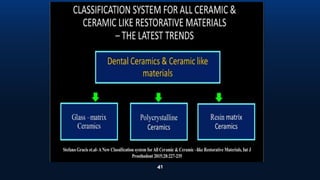
▹ CLASSIFICATION OF CERAMICS
▹ MATERIAL ADVANCES
▹ CONCLUSION
▹ REFERENCES
3
1.
INTRODUCTION
▹ Significant improvements in tooth-colored restorative
materials and adhesive techniques have resulted in numerous
conservative esthetic treatment possibilities.
▹ Although restorative dentistry is a blend of art and science,
conservative esthetic dentistry truly emphasizes the artistic
component.
5
▹ Aesthetically pleasing restorations of young fractured,
malformed or discoloured teeth has been a confusing
problem for dentists.
▹ In past few years a conservative approach to improve the
aesthetic appearance has led widespread use of the veneering
system.
6
2.
DEFINITIONS
▹ A veneer is a layer of tooth-colored material that is applied
to a tooth to restore localized or generalized defects and
intrinsic discolorations.
▹ A laminate a thin layer of restorative material replacing the
enamel.
8
Sturdevant
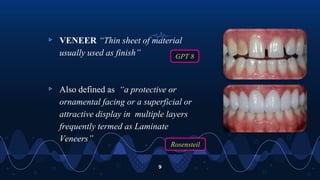
▹ VENEER “Thin sheet of material
usually used as finish”
▹ Also defined as “a protective or
ornamental facing or a superficial or
attractive display in multiple layers
frequently termed as Laminate
Veneers”
9
GPT 8
Rosensteil
10
Laminates and Veneers.
The Difference??..
 “A laminate is done to maintain the color, where as a veneer is made to
change the color.”
Sandesh M Mayekar , Shades of a colour – illusion or reality?. DCNA. January 2001, 45 (1) 155 -173.
3.
HISTORY
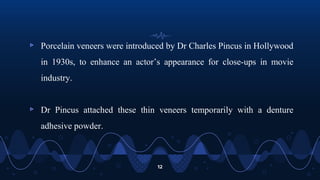
▹ Porcelain veneers were introduced by Dr Charles Pincus in Hollywood
in 1930s, to enhance an actor’s appearance for close-ups in movie
industry.
▹ Dr Pincus attached these thin veneers temporarily with a denture
adhesive powder.
12
13
▹ Buonocore’s discovery of acid etching enamel (1955).
▹ The first major improvement in esthetic materials, especially
in the translucency of all porcelain crowns, was introduced
by Vines et al. in 1958.
▹ In 1960, Bowen’s introduction of BISGMA resin made possible the use of
composite resin as direct veneers. They exhibited poor color stability and
wear resistance.
▹ Weinstein et al. first discovered the bonding of porcelain-to- gold alloys by
means of vacuum firing in the early 1960s.
▹ . 14
▹ The first commercial porcelain was marketed in 1966.
▹ In 1968, MacCulloch, who first described the methods used for making
artificial teeth, veneers and crowns in glass ceramic, utilized this
approach.
▹ 1970: Faunce described a one-piece acrylic resin veneer as an improved
alternative to direct composite resin.
15
▹ 1975: Rochette introduced the use of silane coupling agent with porcelain
laminate veneers - repairing fractured incisors
▹ In 1983, Simonsen and Calamia demonstrated that etching porcelain
veneer allowed it to be retained better than composite resins or acrylic
resin.
16
▹ In 1993 , Anderson and Oden described a technique for manufacturing
individual all-ceramic crowns made up of densely sintered high-purity
alumina.
▹ 2000-Dumfahrt Herbert and Herbert Schaffer did a retrospective evaluation
after one to ten years of service of porcelain laminate veneers (PLVs).
17
They concluded that:
18
The survival probability of PLVs was 97% at 5 years and 91%
at 10years.
The failure rate increased when the finish line was within an
existing filling or when the veneer was partially bonded to
dentin.
Occlusion played a major role in most failures.
4.
CLASSIFICATION OF VENEERS
20
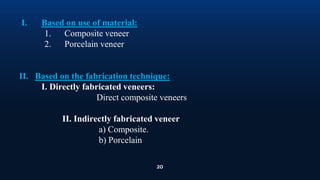
I. Based on use of material:
1. Composite veneer
2. Porcelain veneer
II. Based on the fabrication technique:
I. Directly fabricated veneers:
Direct composite veneers
II. Indirectly fabricated veneer
a) Composite.
b) Porcelain
21
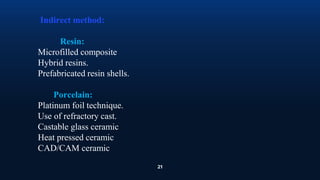
Indirect method:
Resin:
Microfilled composite
Hybrid resins.
Prefabricated resin shells.
Porcelain:
Platinum foil technique.
Use of refractory cast.
Castable glass ceramic
Heat pressed ceramic
CAD/CAM ceramic
22
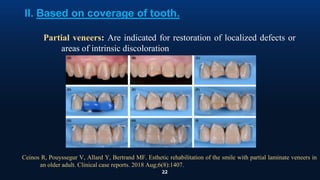
II. Based on coverage of tooth.
Partial veneers: Are indicated for restoration of localized defects or
areas of intrinsic discoloration
Ceinos R, Pouyssegur V, Allard Y, Bertrand MF. Esthetic rehabilitation of the smile with partial laminate veneers in
an older adult. Clinical case reports. 2018 Aug;6(8):1407.
23
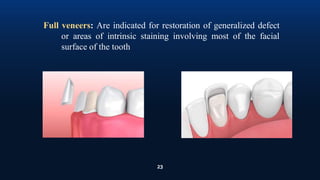
Full veneers: Are indicated for restoration of generalized defect
or areas of intrinsic staining involving most of the facial
surface of the tooth
24
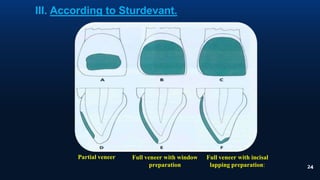
III. According to Sturdevant.
Partial veneer Full veneer with window
preparation
Full veneer with incisal
lapping preparation:
5.
INDICATIONS
Magne P, Belser UC. Bonded Porcelain Restorations in the Anterior Dentition-a Biomimetic Approach. Chicago:
Quintessence Publishing Co; 2002.
26
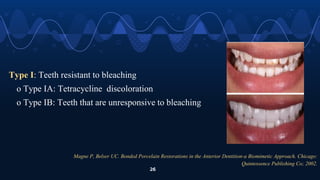
Type I: Teeth resistant to bleaching
o Type IA: Tetracycline discoloration
o Type IB: Teeth that are unresponsive to bleaching
Magne P, Belser UC. Bonded Porcelain Restorations in the Anterior Dentition-a Biomimetic Approach. Chicago:
Quintessence Publishing Co; 2002.
27
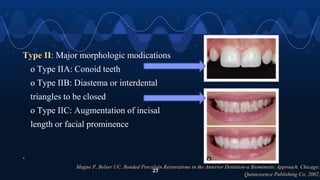
Type II: Major morphologic modications
o Type IIA: Conoid teeth
o Type IIB: Diastema or interdental
triangles to be closed
o Type IIC: Augmentation of incisal
length or facial prominence
.
Magne P, Belser UC. Bonded Porcelain Restorations in the Anterior Dentition-a Biomimetic Approach. Chicago:
Quintessence Publishing Co; 2002.
28
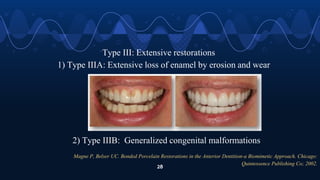
Type III: Extensive restorations
1) Type IIIA: Extensive loss of enamel by erosion and wear
2) Type IIIB: Generalized congenital malformations
6.
CONTRAINDICATIONS
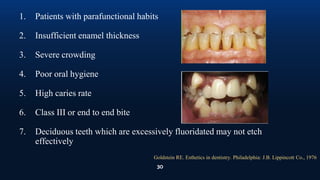
30
1. Patients with parafunctional habits
2. Insufficient enamel thickness
3. Severe crowding
4. Poor oral hygiene
5. High caries rate
6. Class III or end to end bite
7. Deciduous teeth which are excessively fluoridated may not etch
effectively
Goldstein RE. Esthetics in dentistry. Philadelphia: J.B. Lippincott Co., 1976
7.
ADVANTAGES
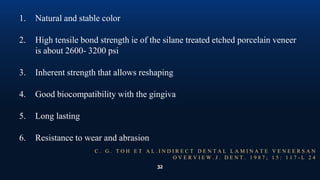
32
1. Natural and stable color
2. High tensile bond strength ie of the silane treated etched porcelain veneer
is about 2600- 3200 psi
3. Inherent strength that allows reshaping
4. Good biocompatibility with the gingiva
5. Long lasting
6. Resistance to wear and abrasion
C . G . T O H E T A L . I N D I R E C T D E N T A L L A M I N A T E V E N E E R S A N
O V E R V I E W . J . D E N T . 1 9 8 7 ; 1 5 : 1 1 7 - L 2 4
33
7. Resistance to stain
8. More resistant to deleterious effects of solvents such as alcohol and
medications than composite veneers
9. Less absorption of the fluids
C . G . T O H E T A L . I N D I R E C T D E N T A L L A M I N A T E V E N E E R S A N
O V E R V I E W . J . D E N T . 1 9 8 7 ; 1 5 : 1 1 7 - L 2 4
8.
DISADVANTAGES
35
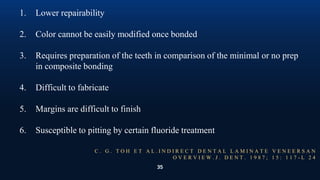
1. Lower repairability
2. Color cannot be easily modified once bonded
3. Requires preparation of the teeth in comparison of the minimal or no prep
in composite bonding
4. Difficult to fabricate
5. Margins are difficult to finish
6. Susceptible to pitting by certain fluoride treatment
C . G . T O H E T A L . I N D I R E C T D E N T A L L A M I N A T E V E N E E R S A N
O V E R V I E W . J . D E N T . 1 9 8 7 ; 1 5 : 1 1 7 - L 2 4
9.
CERAMICS
37
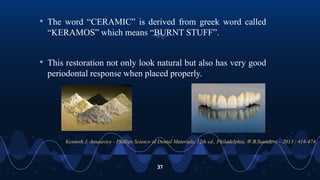
• The word “CERAMIC” is derived from greek word called
“KERAMOS” which means “BURNT STUFF”.
• This restoration not only look natural but also has very good
periodontal response when placed properly.
Kenneth J. Anusavice - Phillips Science of Dental Materials, 12th ed., Philadelphia, W.B.Saunders – 2013 : 418-474.
38
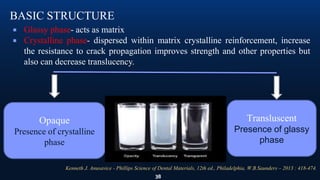
BASIC STRUCTURE
 Glassy phase- acts as matrix
 Crystalline phase- dispersed within matrix crystalline reinforcement, increase
the resistance to crack propagation improves strength and other properties but
also can decrease translucency.
Opaque
Presence of crystalline
phase
Transluscent
Presence of glassy
phase
Kenneth J. Anusavice - Phillips Science of Dental Materials, 12th ed., Philadelphia, W.B.Saunders – 2013 : 418-474.
39
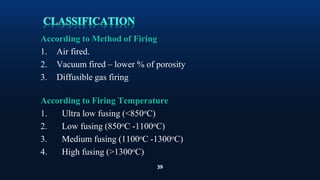
According to Method of Firing
1. Air fired.
2. Vacuum fired – lower % of porosity
3. Diffusible gas firing
According to Firing Temperature
1. Ultra low fusing (<850oC)
2. Low fusing (850oC -1100oC)
3. Medium fusing (1100oC -1300oC)
4. High fusing (>1300oC)
40
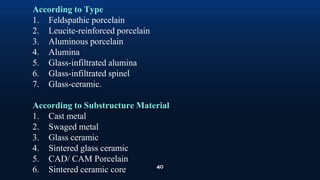
According to Type
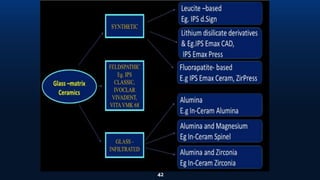
1. Feldspathic porcelain
2. Leucite-reinforced porcelain
3. Aluminous porcelain
4. Alumina
5. Glass-infiltrated alumina
6. Glass-infiltrated spinel
7. Glass-ceramic.
According to Substructure Material
1. Cast metal
2. Swaged metal
3. Glass ceramic
4. Sintered glass ceramic
5. CAD/ CAM Porcelain
6. Sintered ceramic core
41
42
43
44
45
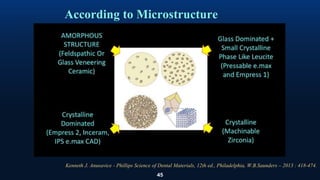
According to Microstructure
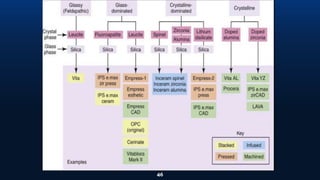
Kenneth J. Anusavice - Phillips Science of Dental Materials, 12th ed., Philadelphia, W.B.Saunders – 2013 : 418-474.
46
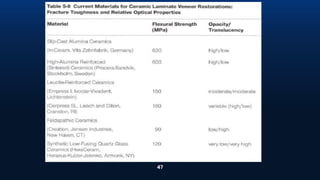
47
10.
MATERIAL ADVANCES
Glass Based Ceramics
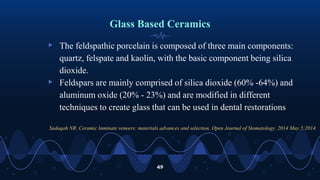
▹ The feldspathic porcelain is composed of three main components:
quartz, felspate and kaolin, with the basic component being silica
dioxide.
▹ Feldspars are mainly comprised of silica dioxide (60% -64%) and
aluminum oxide (20% - 23%) and are modified in different
techniques to create glass that can be used in dental restorations
49
Sadaqah NR. Ceramic laminate veneers: materials advances and selection. Open Journal of Stomatology. 2014 May 5;2014.
▹ Traditionally feldspathic ceramic veneers are fabricated using
layering technique which incorporates refractory dies used to
support the condensed layers or ceramic slurry.
▹ This technique gives the technician full control over the layers
incorporated resulting in a naturally looking restoration.
▹ On the contrary, it requires investing time and effort in order to
produce accurately fitting restorations.
50
Sadaqah NR. Ceramic laminate veneers: materials advances and selection. Open Journal of Stomatology. 2014 May 5;2014.
CAD/CAM Fabricated
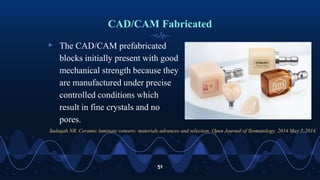
▹ The CAD/CAM prefabricated
blocks initially present with good
mechanical strength because they
are manufactured under precise
controlled conditions which
result in fine crystals and no
pores.
51
Sadaqah NR. Ceramic laminate veneers: materials advances and selection. Open Journal of Stomatology. 2014 May 5;2014.
Machinable Feldspathic Porcelain
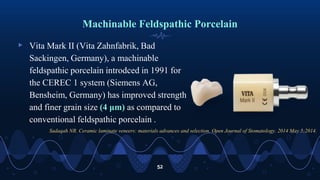
▹ Vita Mark II (Vita Zahnfabrik, Bad
Sackingen, Germany), a machinable
feldspathic porcelain introdced in 1991 for
the CEREC 1 system (Siemens AG,
Bensheim, Germany) has improved strength
and finer grain size (4 μm) as compared to
conventional feldspathic porcelain .
52
Sadaqah NR. Ceramic laminate veneers: materials advances and selection. Open Journal of Stomatology. 2014 May 5;2014.
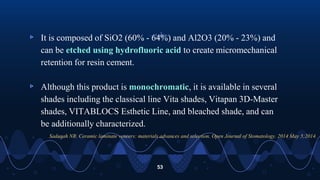
▹ It is composed of SiO2 (60% - 64%) and Al2O3 (20% - 23%) and
can be etched using hydrofluoric acid to create micromechanical
retention for resin cement.
▹ Although this product is monochromatic, it is available in several
shades including the classical line Vita shades, Vitapan 3D-Master
shades, VITABLOCS Esthetic Line, and bleached shade, and can
be additionally characterized.
53
Sadaqah NR. Ceramic laminate veneers: materials advances and selection. Open Journal of Stomatology. 2014 May 5;2014.
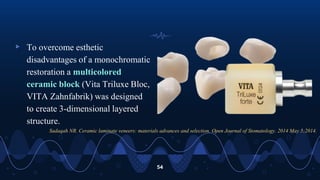
▹ To overcome esthetic
disadvantages of a monochromatic
restoration a multicolored
ceramic block (Vita Triluxe Bloc,
VITA Zahnfabrik) was designed
to create 3-dimensional layered
structure.
54
Sadaqah NR. Ceramic laminate veneers: materials advances and selection. Open Journal of Stomatology. 2014 May 5;2014.
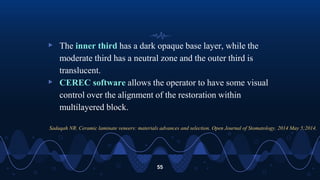
▹ The inner third has a dark opaque base layer, while the
moderate third has a neutral zone and the outer third is
translucent.
▹ CEREC software allows the operator to have some visual
control over the alignment of the restoration within
multilayered block.
55
Sadaqah NR. Ceramic laminate veneers: materials advances and selection. Open Journal of Stomatology. 2014 May 5;2014.
Lithium disilicate reinforced ceramics
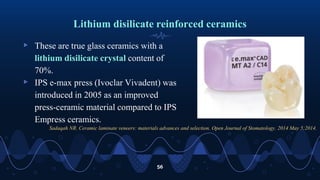
▹ These are true glass ceramics with a
lithium disilicate crystal content of
70%.
▹ IPS e-max press (Ivoclar Vivadent) was
introduced in 2005 as an improved
press-ceramic material compared to IPS
Empress ceramics.

56
Sadaqah NR. Ceramic laminate veneers: materials advances and selection. Open Journal of Stomatology. 2014 May 5;2014.
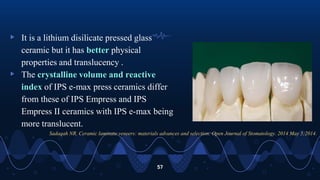
▹ It is a lithium disilicate pressed glass
ceramic but it has better physical
properties and translucency .
▹ The crystalline volume and reactive
index of IPS e-max press ceramics differ
from these of IPS Empress and IPS
Empress II ceramics with IPS e-max being
more translucent.
57
Sadaqah NR. Ceramic laminate veneers: materials advances and selection. Open Journal of Stomatology. 2014 May 5;2014.
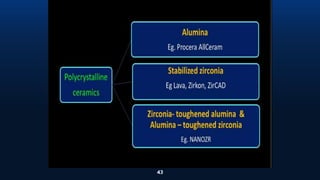
Zirconia Based Ceramics
▹ Zirconia based ceramic is polycrystalline material that contain no glass, all the
atoms are packed into regular crystalline arrays through which it is much more
difficult to drive a crack than it is in the less dense and irregular network found
in glasses.
▹ So polycrystalline ceramics are much tougher and stronger than glass-based
ceramics
58
Sadaqah NR. Ceramic laminate veneers: materials advances and selection. Open Journal of Stomatology. 2014 May 5;2014.
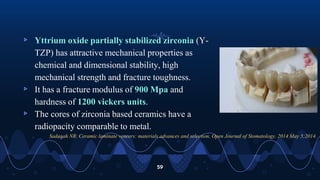
▹ Yttrium oxide partially stabilized zirconia (Y-
TZP) has attractive mechanical properties as
chemical and dimensional stability, high
mechanical strength and fracture toughness.
▹ It has a fracture modulus of 900 Mpa and
hardness of 1200 vickers units.
▹ The cores of zirconia based ceramics have a
radiopacity comparable to metal.
59
Sadaqah NR. Ceramic laminate veneers: materials advances and selection. Open Journal of Stomatology. 2014 May 5;2014.
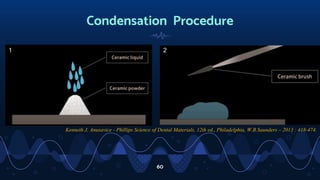
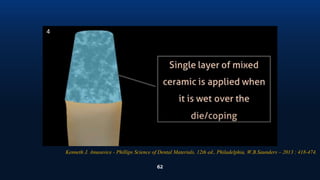
Condensation Procedure
60
1 2
Kenneth J. Anusavice - Phillips Science of Dental Materials, 12th ed., Philadelphia, W.B.Saunders – 2013 : 418-474.
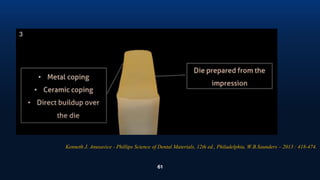
61
3
Kenneth J. Anusavice - Phillips Science of Dental Materials, 12th ed., Philadelphia, W.B.Saunders – 2013 : 418-474.
62
4
Kenneth J. Anusavice - Phillips Science of Dental Materials, 12th ed., Philadelphia, W.B.Saunders – 2013 : 418-474.
63
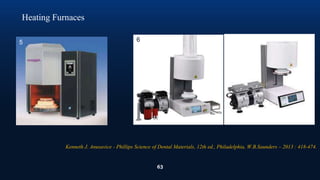
5 6
Heating Furnaces
Kenneth J. Anusavice - Phillips Science of Dental Materials, 12th ed., Philadelphia, W.B.Saunders – 2013 : 418-474.
64
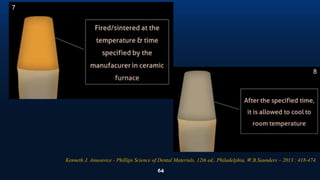
7
8
Kenneth J. Anusavice - Phillips Science of Dental Materials, 12th ed., Philadelphia, W.B.Saunders – 2013 : 418-474.
65
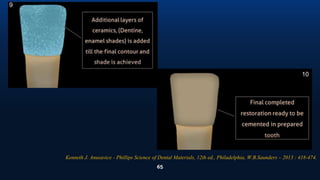
9
10
Kenneth J. Anusavice - Phillips Science of Dental Materials, 12th ed., Philadelphia, W.B.Saunders – 2013 : 418-474.
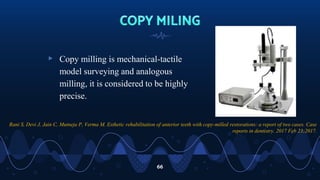
▹ Copy milling is mechanical-tactile
model surveying and analogous
milling, it is considered to be highly
precise.
66
Rani S, Devi J, Jain C, Mutneja P, Verma M. Esthetic rehabilitation of anterior teeth with copy-milled restorations: a report of two cases. Case
reports in dentistry. 2017 Feb 23;2017.
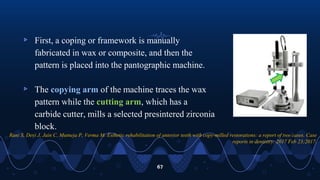
▹ First, a coping or framework is manually
fabricated in wax or composite, and then the
pattern is placed into the pantographic machine.
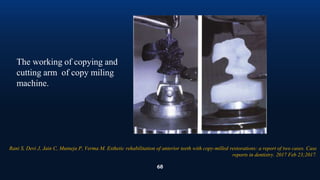
▹ The copying arm of the machine traces the wax
pattern while the cutting arm, which has a
carbide cutter, mills a selected presintered zirconia
block.
67
Rani S, Devi J, Jain C, Mutneja P, Verma M. Esthetic rehabilitation of anterior teeth with copy-milled restorations: a report of two cases. Case
reports in dentistry. 2017 Feb 23;2017.
68
The working of copying and
cutting arm of copy miling
machine.
Rani S, Devi J, Jain C, Mutneja P, Verma M. Esthetic rehabilitation of anterior teeth with copy-milled restorations: a report of two cases. Case
reports in dentistry. 2017 Feb 23;2017.
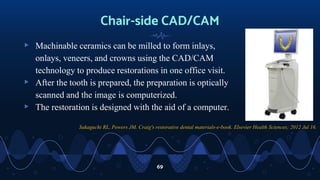
Chair-side CAD/CAM
▹ Machinable ceramics can be milled to form inlays,
onlays, veneers, and crowns using the CAD/CAM
technology to produce restorations in one office visit.
▹ After the tooth is prepared, the preparation is optically
scanned and the image is computerized.
▹ The restoration is designed with the aid of a computer.
69
Sakaguchi RL, Powers JM. Craig's restorative dental materials-e-book. Elsevier Health Sciences; 2012 Jul 16.
▹ The restoration is then machined from ceramic blocks by a
computer controlled milling machine.
▹ The milling process takes only a few minutes.
▹ Restorations are bonded to the tooth preparation with resin
cements
70
Sakaguchi RL, Powers JM. Craig's restorative dental materials-e-book. Elsevier Health Sciences; 2012 Jul 16.
71
Ceramic laminate veneers can be fabricated using glass
based ceramics, aluminum oxide or zirconium oxide
ceramics.
Successful ceramic laminate veneers depend upon
clinician ability to select the appropriate material to
match intraoral conditions and esthetic demands.
REFERENCES
72
1. The Science and Art of Porcelain Laminate Veneers; Galip Gurel; 1st edition.
2. Sturdevant’s Art and science of operative dentistry, Fifth edition.
3. Rosenstiel SF, Land MF, Walter R, editors. Contemporary fixed prosthodontics-e-
book. Elsevier Health Sciences; 2022 Jun 22.
4. Sandesh M Mayekar , Shades of a colour – illusion or reality?. DCNA. January 2001, 45 (1)
155 -173.
5. Ceinos R, Pouyssegur V, Allard Y, Bertrand MF. Esthetic rehabilitation of the smile with
partial laminate veneers in an older adult. Clinical case reports. 2018 Aug;6(8):1407.
6. Magne P, Belser UC. Bonded Porcelain Restorations in the Anterior Dentition-a Biomimetic
Approach. Chicago: Quintessence Publishing Co; 2002.
7. Goldstein RE. Esthetics in dentistry. Philadelphia: J.B. Lippincott Co., 1976
73
8. C. G. Toh et al.Indirect dental laminate veneersan overview.J. Dent. 1987; 15: 117-l 24.
9. Kenneth J. Anusavice - Phillips Science of Dental Materials, 12th ed., Philadelphia, W.B.Saunders –
2013 : 418-474.
10. Sadaqah NR. Ceramic laminate veneers: materials advances and selection. Open Journal of
Stomatology. 2014 May 5;2014.
11. Rani S, Devi J, Jain C, Mutneja P, Verma M. Esthetic rehabilitation of anterior teeth with copy-
milled restorations: a report of two cases. Case reports in dentistry. 2017 Feb 23;2017.
74

Veneer Materials.pptx conservative dentistry

  • 1.
    PRESENTED BY: Dr AshwanS Uke III rd MDS
  • 2.
    CONTENTS ▹ INTRODUCTION ▹ DEFINITION ▹HISTORY ▹ CLASSIFICATION OF VENEERS ▹ INDICATIONS ▹ CONTRAINDICATIONS ▹ ADVANTAGES 2
  • 3.
    ▹ DISADVANTAGES ▹ CERAMICS ▹CLASSIFICATION OF CERAMICS ▹ MATERIAL ADVANCES ▹ CONCLUSION ▹ REFERENCES 3
  • 4.
  • 5.
    ▹ Significant improvementsin tooth-colored restorative materials and adhesive techniques have resulted in numerous conservative esthetic treatment possibilities. ▹ Although restorative dentistry is a blend of art and science, conservative esthetic dentistry truly emphasizes the artistic component. 5
  • 6.
    ▹ Aesthetically pleasingrestorations of young fractured, malformed or discoloured teeth has been a confusing problem for dentists. ▹ In past few years a conservative approach to improve the aesthetic appearance has led widespread use of the veneering system. 6
  • 7.
  • 8.
    ▹ A veneeris a layer of tooth-colored material that is applied to a tooth to restore localized or generalized defects and intrinsic discolorations. ▹ A laminate a thin layer of restorative material replacing the enamel. 8 Sturdevant
  • 9.
    ▹ VENEER “Thinsheet of material usually used as finish” ▹ Also defined as “a protective or ornamental facing or a superficial or attractive display in multiple layers frequently termed as Laminate Veneers” 9 GPT 8 Rosensteil
  • 10.
    10 Laminates and Veneers. TheDifference??..  “A laminate is done to maintain the color, where as a veneer is made to change the color.” Sandesh M Mayekar , Shades of a colour – illusion or reality?. DCNA. January 2001, 45 (1) 155 -173.
  • 11.
  • 12.
    ▹ Porcelain veneerswere introduced by Dr Charles Pincus in Hollywood in 1930s, to enhance an actor’s appearance for close-ups in movie industry. ▹ Dr Pincus attached these thin veneers temporarily with a denture adhesive powder. 12
  • 13.
    13 ▹ Buonocore’s discoveryof acid etching enamel (1955). ▹ The first major improvement in esthetic materials, especially in the translucency of all porcelain crowns, was introduced by Vines et al. in 1958.
  • 14.
    ▹ In 1960,Bowen’s introduction of BISGMA resin made possible the use of composite resin as direct veneers. They exhibited poor color stability and wear resistance. ▹ Weinstein et al. first discovered the bonding of porcelain-to- gold alloys by means of vacuum firing in the early 1960s. ▹ . 14
  • 15.
    ▹ The firstcommercial porcelain was marketed in 1966. ▹ In 1968, MacCulloch, who first described the methods used for making artificial teeth, veneers and crowns in glass ceramic, utilized this approach. ▹ 1970: Faunce described a one-piece acrylic resin veneer as an improved alternative to direct composite resin. 15
  • 16.
    ▹ 1975: Rochetteintroduced the use of silane coupling agent with porcelain laminate veneers - repairing fractured incisors ▹ In 1983, Simonsen and Calamia demonstrated that etching porcelain veneer allowed it to be retained better than composite resins or acrylic resin. 16
  • 17.
    ▹ In 1993, Anderson and Oden described a technique for manufacturing individual all-ceramic crowns made up of densely sintered high-purity alumina. ▹ 2000-Dumfahrt Herbert and Herbert Schaffer did a retrospective evaluation after one to ten years of service of porcelain laminate veneers (PLVs). 17
  • 18.
    They concluded that: 18 Thesurvival probability of PLVs was 97% at 5 years and 91% at 10years. The failure rate increased when the finish line was within an existing filling or when the veneer was partially bonded to dentin. Occlusion played a major role in most failures.
  • 19.
  • 20.
    20 I. Based onuse of material: 1. Composite veneer 2. Porcelain veneer II. Based on the fabrication technique: I. Directly fabricated veneers: Direct composite veneers II. Indirectly fabricated veneer a) Composite. b) Porcelain
  • 21.
    21 Indirect method: Resin: Microfilled composite Hybridresins. Prefabricated resin shells. Porcelain: Platinum foil technique. Use of refractory cast. Castable glass ceramic Heat pressed ceramic CAD/CAM ceramic
  • 22.
    22 II. Based oncoverage of tooth. Partial veneers: Are indicated for restoration of localized defects or areas of intrinsic discoloration Ceinos R, Pouyssegur V, Allard Y, Bertrand MF. Esthetic rehabilitation of the smile with partial laminate veneers in an older adult. Clinical case reports. 2018 Aug;6(8):1407.
  • 23.
    23 Full veneers: Areindicated for restoration of generalized defect or areas of intrinsic staining involving most of the facial surface of the tooth
  • 24.
    24 III. According toSturdevant. Partial veneer Full veneer with window preparation Full veneer with incisal lapping preparation:
  • 25.
  • 26.
    Magne P, BelserUC. Bonded Porcelain Restorations in the Anterior Dentition-a Biomimetic Approach. Chicago: Quintessence Publishing Co; 2002. 26 Type I: Teeth resistant to bleaching o Type IA: Tetracycline discoloration o Type IB: Teeth that are unresponsive to bleaching
  • 27.
    Magne P, BelserUC. Bonded Porcelain Restorations in the Anterior Dentition-a Biomimetic Approach. Chicago: Quintessence Publishing Co; 2002. 27 Type II: Major morphologic modications o Type IIA: Conoid teeth o Type IIB: Diastema or interdental triangles to be closed o Type IIC: Augmentation of incisal length or facial prominence .
  • 28.
    Magne P, BelserUC. Bonded Porcelain Restorations in the Anterior Dentition-a Biomimetic Approach. Chicago: Quintessence Publishing Co; 2002. 28 Type III: Extensive restorations 1) Type IIIA: Extensive loss of enamel by erosion and wear 2) Type IIIB: Generalized congenital malformations
  • 29.
  • 30.
    30 1. Patients withparafunctional habits 2. Insufficient enamel thickness 3. Severe crowding 4. Poor oral hygiene 5. High caries rate 6. Class III or end to end bite 7. Deciduous teeth which are excessively fluoridated may not etch effectively Goldstein RE. Esthetics in dentistry. Philadelphia: J.B. Lippincott Co., 1976
  • 31.
  • 32.
    32 1. Natural andstable color 2. High tensile bond strength ie of the silane treated etched porcelain veneer is about 2600- 3200 psi 3. Inherent strength that allows reshaping 4. Good biocompatibility with the gingiva 5. Long lasting 6. Resistance to wear and abrasion C . G . T O H E T A L . I N D I R E C T D E N T A L L A M I N A T E V E N E E R S A N O V E R V I E W . J . D E N T . 1 9 8 7 ; 1 5 : 1 1 7 - L 2 4
  • 33.
    33 7. Resistance tostain 8. More resistant to deleterious effects of solvents such as alcohol and medications than composite veneers 9. Less absorption of the fluids C . G . T O H E T A L . I N D I R E C T D E N T A L L A M I N A T E V E N E E R S A N O V E R V I E W . J . D E N T . 1 9 8 7 ; 1 5 : 1 1 7 - L 2 4
  • 34.
  • 35.
    35 1. Lower repairability 2.Color cannot be easily modified once bonded 3. Requires preparation of the teeth in comparison of the minimal or no prep in composite bonding 4. Difficult to fabricate 5. Margins are difficult to finish 6. Susceptible to pitting by certain fluoride treatment C . G . T O H E T A L . I N D I R E C T D E N T A L L A M I N A T E V E N E E R S A N O V E R V I E W . J . D E N T . 1 9 8 7 ; 1 5 : 1 1 7 - L 2 4
  • 36.
  • 37.
    37 • The word“CERAMIC” is derived from greek word called “KERAMOS” which means “BURNT STUFF”. • This restoration not only look natural but also has very good periodontal response when placed properly. Kenneth J. Anusavice - Phillips Science of Dental Materials, 12th ed., Philadelphia, W.B.Saunders – 2013 : 418-474.
  • 38.
    38 BASIC STRUCTURE  Glassyphase- acts as matrix  Crystalline phase- dispersed within matrix crystalline reinforcement, increase the resistance to crack propagation improves strength and other properties but also can decrease translucency. Opaque Presence of crystalline phase Transluscent Presence of glassy phase Kenneth J. Anusavice - Phillips Science of Dental Materials, 12th ed., Philadelphia, W.B.Saunders – 2013 : 418-474.
  • 39.
    39 According to Methodof Firing 1. Air fired. 2. Vacuum fired – lower % of porosity 3. Diffusible gas firing According to Firing Temperature 1. Ultra low fusing (<850oC) 2. Low fusing (850oC -1100oC) 3. Medium fusing (1100oC -1300oC) 4. High fusing (>1300oC)
  • 40.
    40 According to Type 1.Feldspathic porcelain 2. Leucite-reinforced porcelain 3. Aluminous porcelain 4. Alumina 5. Glass-infiltrated alumina 6. Glass-infiltrated spinel 7. Glass-ceramic. According to Substructure Material 1. Cast metal 2. Swaged metal 3. Glass ceramic 4. Sintered glass ceramic 5. CAD/ CAM Porcelain 6. Sintered ceramic core
  • 41.
  • 42.
  • 43.
  • 44.
  • 45.
    45 According to Microstructure KennethJ. Anusavice - Phillips Science of Dental Materials, 12th ed., Philadelphia, W.B.Saunders – 2013 : 418-474.
  • 46.
  • 47.
  • 48.
  • 49.
    Glass Based Ceramics ▹The feldspathic porcelain is composed of three main components: quartz, felspate and kaolin, with the basic component being silica dioxide. ▹ Feldspars are mainly comprised of silica dioxide (60% -64%) and aluminum oxide (20% - 23%) and are modified in different techniques to create glass that can be used in dental restorations 49 Sadaqah NR. Ceramic laminate veneers: materials advances and selection. Open Journal of Stomatology. 2014 May 5;2014.
  • 50.
    ▹ Traditionally feldspathicceramic veneers are fabricated using layering technique which incorporates refractory dies used to support the condensed layers or ceramic slurry. ▹ This technique gives the technician full control over the layers incorporated resulting in a naturally looking restoration. ▹ On the contrary, it requires investing time and effort in order to produce accurately fitting restorations. 50 Sadaqah NR. Ceramic laminate veneers: materials advances and selection. Open Journal of Stomatology. 2014 May 5;2014.
  • 51.
    CAD/CAM Fabricated ▹ TheCAD/CAM prefabricated blocks initially present with good mechanical strength because they are manufactured under precise controlled conditions which result in fine crystals and no pores. 51 Sadaqah NR. Ceramic laminate veneers: materials advances and selection. Open Journal of Stomatology. 2014 May 5;2014.
  • 52.
    Machinable Feldspathic Porcelain ▹Vita Mark II (Vita Zahnfabrik, Bad Sackingen, Germany), a machinable feldspathic porcelain introdced in 1991 for the CEREC 1 system (Siemens AG, Bensheim, Germany) has improved strength and finer grain size (4 μm) as compared to conventional feldspathic porcelain . 52 Sadaqah NR. Ceramic laminate veneers: materials advances and selection. Open Journal of Stomatology. 2014 May 5;2014.
  • 53.
    ▹ It iscomposed of SiO2 (60% - 64%) and Al2O3 (20% - 23%) and can be etched using hydrofluoric acid to create micromechanical retention for resin cement. ▹ Although this product is monochromatic, it is available in several shades including the classical line Vita shades, Vitapan 3D-Master shades, VITABLOCS Esthetic Line, and bleached shade, and can be additionally characterized. 53 Sadaqah NR. Ceramic laminate veneers: materials advances and selection. Open Journal of Stomatology. 2014 May 5;2014.
  • 54.
    ▹ To overcomeesthetic disadvantages of a monochromatic restoration a multicolored ceramic block (Vita Triluxe Bloc, VITA Zahnfabrik) was designed to create 3-dimensional layered structure. 54 Sadaqah NR. Ceramic laminate veneers: materials advances and selection. Open Journal of Stomatology. 2014 May 5;2014.
  • 55.
    ▹ The innerthird has a dark opaque base layer, while the moderate third has a neutral zone and the outer third is translucent. ▹ CEREC software allows the operator to have some visual control over the alignment of the restoration within multilayered block. 55 Sadaqah NR. Ceramic laminate veneers: materials advances and selection. Open Journal of Stomatology. 2014 May 5;2014.
  • 56.
    Lithium disilicate reinforcedceramics ▹ These are true glass ceramics with a lithium disilicate crystal content of 70%. ▹ IPS e-max press (Ivoclar Vivadent) was introduced in 2005 as an improved press-ceramic material compared to IPS Empress ceramics. 56 Sadaqah NR. Ceramic laminate veneers: materials advances and selection. Open Journal of Stomatology. 2014 May 5;2014.

  • 57.
    ▹ It isa lithium disilicate pressed glass ceramic but it has better physical properties and translucency . ▹ The crystalline volume and reactive index of IPS e-max press ceramics differ from these of IPS Empress and IPS Empress II ceramics with IPS e-max being more translucent. 57 Sadaqah NR. Ceramic laminate veneers: materials advances and selection. Open Journal of Stomatology. 2014 May 5;2014.
  • 58.
    Zirconia Based Ceramics ▹Zirconia based ceramic is polycrystalline material that contain no glass, all the atoms are packed into regular crystalline arrays through which it is much more difficult to drive a crack than it is in the less dense and irregular network found in glasses. ▹ So polycrystalline ceramics are much tougher and stronger than glass-based ceramics 58 Sadaqah NR. Ceramic laminate veneers: materials advances and selection. Open Journal of Stomatology. 2014 May 5;2014.
  • 59.
    ▹ Yttrium oxidepartially stabilized zirconia (Y- TZP) has attractive mechanical properties as chemical and dimensional stability, high mechanical strength and fracture toughness. ▹ It has a fracture modulus of 900 Mpa and hardness of 1200 vickers units. ▹ The cores of zirconia based ceramics have a radiopacity comparable to metal. 59 Sadaqah NR. Ceramic laminate veneers: materials advances and selection. Open Journal of Stomatology. 2014 May 5;2014.
  • 60.
    Condensation Procedure 60 1 2 KennethJ. Anusavice - Phillips Science of Dental Materials, 12th ed., Philadelphia, W.B.Saunders – 2013 : 418-474.
  • 61.
    61 3 Kenneth J. Anusavice- Phillips Science of Dental Materials, 12th ed., Philadelphia, W.B.Saunders – 2013 : 418-474.
  • 62.
    62 4 Kenneth J. Anusavice- Phillips Science of Dental Materials, 12th ed., Philadelphia, W.B.Saunders – 2013 : 418-474.
  • 63.
    63 5 6 Heating Furnaces KennethJ. Anusavice - Phillips Science of Dental Materials, 12th ed., Philadelphia, W.B.Saunders – 2013 : 418-474.
  • 64.
    64 7 8 Kenneth J. Anusavice- Phillips Science of Dental Materials, 12th ed., Philadelphia, W.B.Saunders – 2013 : 418-474.
  • 65.
    65 9 10 Kenneth J. Anusavice- Phillips Science of Dental Materials, 12th ed., Philadelphia, W.B.Saunders – 2013 : 418-474.
  • 66.
    ▹ Copy millingis mechanical-tactile model surveying and analogous milling, it is considered to be highly precise. 66 Rani S, Devi J, Jain C, Mutneja P, Verma M. Esthetic rehabilitation of anterior teeth with copy-milled restorations: a report of two cases. Case reports in dentistry. 2017 Feb 23;2017.
  • 67.
    ▹ First, acoping or framework is manually fabricated in wax or composite, and then the pattern is placed into the pantographic machine. ▹ The copying arm of the machine traces the wax pattern while the cutting arm, which has a carbide cutter, mills a selected presintered zirconia block. 67 Rani S, Devi J, Jain C, Mutneja P, Verma M. Esthetic rehabilitation of anterior teeth with copy-milled restorations: a report of two cases. Case reports in dentistry. 2017 Feb 23;2017.
  • 68.
    68 The working ofcopying and cutting arm of copy miling machine. Rani S, Devi J, Jain C, Mutneja P, Verma M. Esthetic rehabilitation of anterior teeth with copy-milled restorations: a report of two cases. Case reports in dentistry. 2017 Feb 23;2017.
  • 69.
    Chair-side CAD/CAM ▹ Machinableceramics can be milled to form inlays, onlays, veneers, and crowns using the CAD/CAM technology to produce restorations in one office visit. ▹ After the tooth is prepared, the preparation is optically scanned and the image is computerized. ▹ The restoration is designed with the aid of a computer. 69 Sakaguchi RL, Powers JM. Craig's restorative dental materials-e-book. Elsevier Health Sciences; 2012 Jul 16.
  • 70.
    ▹ The restorationis then machined from ceramic blocks by a computer controlled milling machine. ▹ The milling process takes only a few minutes. ▹ Restorations are bonded to the tooth preparation with resin cements 70 Sakaguchi RL, Powers JM. Craig's restorative dental materials-e-book. Elsevier Health Sciences; 2012 Jul 16.
  • 71.
    71 Ceramic laminate veneerscan be fabricated using glass based ceramics, aluminum oxide or zirconium oxide ceramics. Successful ceramic laminate veneers depend upon clinician ability to select the appropriate material to match intraoral conditions and esthetic demands.
  • 72.
    REFERENCES 72 1. The Scienceand Art of Porcelain Laminate Veneers; Galip Gurel; 1st edition. 2. Sturdevant’s Art and science of operative dentistry, Fifth edition. 3. Rosenstiel SF, Land MF, Walter R, editors. Contemporary fixed prosthodontics-e- book. Elsevier Health Sciences; 2022 Jun 22. 4. Sandesh M Mayekar , Shades of a colour – illusion or reality?. DCNA. January 2001, 45 (1) 155 -173. 5. Ceinos R, Pouyssegur V, Allard Y, Bertrand MF. Esthetic rehabilitation of the smile with partial laminate veneers in an older adult. Clinical case reports. 2018 Aug;6(8):1407. 6. Magne P, Belser UC. Bonded Porcelain Restorations in the Anterior Dentition-a Biomimetic Approach. Chicago: Quintessence Publishing Co; 2002. 7. Goldstein RE. Esthetics in dentistry. Philadelphia: J.B. Lippincott Co., 1976
  • 73.
    73 8. C. G.Toh et al.Indirect dental laminate veneersan overview.J. Dent. 1987; 15: 117-l 24. 9. Kenneth J. Anusavice - Phillips Science of Dental Materials, 12th ed., Philadelphia, W.B.Saunders – 2013 : 418-474. 10. Sadaqah NR. Ceramic laminate veneers: materials advances and selection. Open Journal of Stomatology. 2014 May 5;2014. 11. Rani S, Devi J, Jain C, Mutneja P, Verma M. Esthetic rehabilitation of anterior teeth with copy- milled restorations: a report of two cases. Case reports in dentistry. 2017 Feb 23;2017.
  • 74.