ENDODONTICS
Contents
 Definition
 History
 Aims and objectives
 Scope of Endodontics
 Anatomy of the pulp cavity
 Pulp Functions
 Cells of the Pulp
 Extra cellular components
 Blood vessels, lymphatics, innervations
 Age changes in the dental pulp
INTRODUTION TO ENDODONTICS
 Endo is a Greek word for “Inside” and Odont is Greek for “Tooth”.
Endodontic treatment treats inside of the tooth.
 Endodontics is the specialty of dentistry that deals with the
prevention, diagnosis, and treatment of the diseases and injuries
of dental pulp and the periradicular tissues that surround the
root of the tooth.
 American association of endodontic define (endodontics)as:
Branch of dentistry concerned with the morphology, physiology,
and pathology of human dental pulp and periradicular tissues.
 That is, the main aim of the endodontic therapy involves to:
I . Maintain vitality of the pulp.
II . Preserve and store the tooth with damaged and necrotic pulp.
III . Preserve and restore the teeth which have failed to the previous
endodontic therapy, to allow the tooth to remain functional in the dental
arch.
• It includes the study of basic sciences like biology of normal pulp, etiology
for the various diseases and pathology of human dental pulp along with
morphology and physiology.
HISTORY
 Endodontics has been practiced as early as second or third
century BC.
 A skull found in the Negev Desert in Israel had a bronze wire
in one of its teeth.
 Researchers believe the wire may have been used to treat
an infected pulp.
 Other evidence shows that pulp chambers were drained to
relieve pain and pressure in the first century A.D.
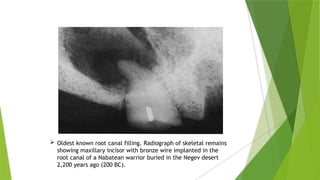
 Oldest known root canal filling. Radiograph of skeletal remains
showing maxillary incisor with bronze wire implanted in the
root canal of a Nabatean warrior buried in the Negev desert
2,200 years ago (200 BC).
A Leap Into the Future: X-rays and Anesthetics
 The greatest leap in Endodontic history came with the
introduction of x-rays and effective anesthetics in the first part
of the last century.
 These advances made Endodontic treatment more predictable
and more comfortable for the patient.
Steady Progress
 Interest in Endodontics grew quickly as scientists began to
research Endodontic treatment.
 Their efforts and simultaneous scientific and technological
advances, such as culturing and other modern methods, proved
the safety and efficacy of root canal treatment, allowing
hundreds of millions of patients to save teeth that otherwise
would have been lost to extraction, the only alternative of the
day.
Dr. Grossman, the pioneer of endodontics divided the evolution of
endodontics in four eras from 1776 to 1976, each consisting of 50 years.
 Pre science (1776 to 1826): In this era, endodontic therapy mainly
consisted of crude modalities like abscesses were being treated with
poultices or leeches and pulps were being cauterized using hot cauteria.
 Age of discovery (1826 to 1876): In this era there occurred the
development of anesthesia, gutta-percha and barbed broaches. Also the
medications were created for treating pulpal infections and the cements
and pastes were discovered to fill them.
 The dark age (1876 to 1926): In spite of introduction of X-rays and general
anesthesia, extractions was the choice of treatment than endodontics in
most of the cases of damaged teeth because theory of the focal infection
was main concern at that time.
 The renaissance (1926 to 1976): In this era, endodontics was established as
science and therapy, forming its golden era. It showed the improvement in
anesthesia and radiographs for better treatment results. The theory of focal
infection was also fading out, resulting in more of endodontics being
practiced and in 1943, because of growing interest in endodontics, the AAE,
that is, the American Association of Endodontists was found.
 Innovation era: It is the period from 1977 onwards in which tremendous
advancements at very fast rate are being introduced in the endodontics. The
better vision, better techniques of biomechanical preparations, and
obturation are being developed resulting in the simpler, easier and faster
endodontics with more of the successful results.
Professional Recognition:
 Endodontics Becomes an Official Dental Specialty
In 1963, the American Dental Association officially recognized
Endodontics as a dental specialty.
Aims and objectives
 Dx of the diseases of the pulp
 Identification and determination of etiological factors responsible
for pulpal and periapical disease
 Measures to prevent diseases of the pulp and periapical tissues
 Selection of cases for Rx
 To provide care which is proper and consistent with the
knowledge and experience
 To determine reasonable prognosis for the cases selected for the
treatment
 To evaluate or assess the completed endodontic procedures
Scope of Endodontics
 Formerly, confined to root canal filling techniques by conventional
methods.
 Modern Endodontics includes:
 Dx of oral pain
 Protection of healthy pulp from disease or injury
 Pulp capping
 Pulpotomy
 RCT of infected root canals
 Bleaching
 Surgical endodontics (apicoectomy,hemi-section,root amputation,and
replantation)
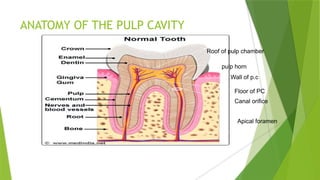
ANATOMY OF THE PULP CAVITY
pulp horn
Roof of pulp chamber
Wall of p.c
Floor of PC
Canal orifice
Apical foramen
 The pulp is the soft tissue that is located inside the tooth
structure.
 It contains nerves, arteries, veins, and lymph tissue.
 It is contained in the canals located in thin tube-like spaces in the
roots and in the pulp chamber located within the crown of the
tooth.
THE DENTAL PULP
 PULP CAVITY
 Pulp chamber
 Root canal
 Pulp cavity: Is the central cavity within a tooth and is entirely
enclosed by dentin except at the apical foramen.
 Pulp cavity may be divided in to coronal portion, pulp chamber
and radicular portion, root canal.
 In anterior teeth the pulp chamber gradually merges into the
root canal and this division becomes indistinct.
 In multirooted teeth the pulp cavity consists of a single pulp
chamber and usually three root canals although the number of
canals can vary from one to five.
 Roof of the pulp chamber consists of dentin covering the pulp
chamber occlusally or incisally.
 A pulp horn is an accentuation of the roof of the pulp chamber
directly under a cusp or developmental lobe.
 The floor of the pulp chamber runs parallel to the roof and
consists of dentin bounding the pulp chamber near the cervix of
the tooth particularly dentin forming the furcation area.
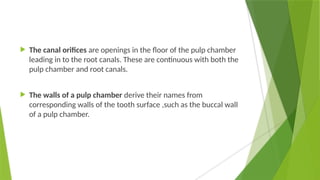
 The canal orifices are openings in the floor of the pulp chamber
leading in to the root canals. These are continuous with both the
pulp chamber and root canals.
 The walls of a pulp chamber derive their names from
corresponding walls of the tooth surface ,such as the buccal wall
of a pulp chamber.
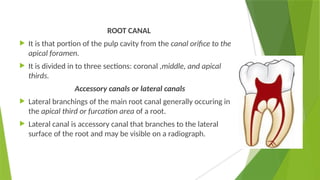
ROOT CANAL
 It is that portion of the pulp cavity from the canal orifice to the
apical foramen.
 It is divided in to three sections: coronal ,middle, and apical
thirds.
Accessory canals or lateral canals
 Lateral branchings of the main root canal generally occuring in
the apical third or furcation area of a root.
 Lateral canal is accessory canal that branches to the lateral
surface of the root and may be visible on a radiograph.
 Apical foramen: an aperture at or near apex of a root through
which the blood vessels and the nerves of the pulp enter or leave
the pulp cavity.
 Accessory foramina: an orifice on the surface of the root
communicating with lateral or accessory canal.
 Apical stop: a barrier at the preparation end is an apical
stop(major diameter) and assumes a funnel shape.
Morphology
 Consists of richly vascularized and highly innervated connective
tissue.
 It is surrounded by dentin.
 The pulp tissue is in communication with the periodontium and
the rest of the body through the apical foramen and accessory
canals near the apex of the root.
Pulp Functions: (induction, formation, nutrition,
defense and sensation)
1.Induction: pulp participate in the induction and development of
Odontoblast and dentin, which, when formed, induce enamel
formation.
 These processes are interdependent activities in that
ameloblasts influence differentiation of Odontoblast, and
odontoblasts and dentin influence formation of enamel.
2)Formation: odontoblasts form dentin. These highly specialized cells
participate in dentin formation. Odontoblasts can also form a unique
type of dentin in response to injury, such as occurs with caries,
trauma, and restorative procedures. This formation is localized to the
site of injury and is referred to as tertiary dentinogenesis.
3)Nutrition: via dentinal tubules, pulp supplies nutrients that are
essential for dentin formation (e.g. peritubular dentin) and hydration.
4) Defense: as mentioned previously, odontoblasts form dentin in response to
injury, particularly when the original dentin thickness has been compromised by
caries, wear, trauma, or restorative procedures.
The pulp galvanizes odontoblasts into action or produces new odontoblasts to form
needed hard tissue.
 HOWEVER, the quality of dentin produced in response to injury may not mimic
that produced physiologically and may not provide protection for the underlying
pulpal tissue.
5)Sensation: through the nerves system, pulp transmits sensation
mediated through enamel or dentin to the higher nerve centers;
usually expressed clinically as pain, although physiologic and
psychophysiology studies indicate pulp also senses temperature and
touch.
Cells of the Pulp:
 Odontoblast: are the most distinctive cells of pulp.
 They form a single layer at the periphery and synthesize the
matrix (The formative portion of a tooth or a nail), which
becomes mineralized and is called dentin.
 In the pulp chamber, odontoblasts are relatively large and
columnar. The cervical and mid-portions of the root demonstrate
more cuboidal odontoblasts: the apical canal tends to have
flattened (squamous) -appearing odontoblasts
 Preodontoblasts: the long-known fact that new odontoblasts
arise subsequent to a pulp injury that results in a loss of the
original odontoblasts.
 Fibroblasts: are the most common cell type in the pulp and are
responsible for collagen production.
 Undifferentiated (reserve) Cells: represent the cell pool from
which connective tissue cells of the pulp are derived.
 Depending on the stimulus they may give rise to fibroblasts and
possibly odontoblasts.
 Cells of the Immune System: macrophages, T lymphocytes, and
dendritic cells (embryonic ectoderm, cell's of neural crest origin
with extensive processes; they early develop melanin) are also
normal inhabitants.
Extracellular components
 The pulp has two main types of fibers (collagen and elastic)
 Elastic fibers always being confined to the walls of larger blood
vessels
 The fibers of the young pulp are small: they are distributed
diffusely within the tissue and are often covered by a
glycosaminoglycan sheath
 In the mature pulp larger fiber bundles can be seen , especially
along blood vessels in the root pulp
BLOOD VESSELS
 afferent(af‚er-ent) [L. afferens, fr. af-fero, to bring to] centripetal
(1); esodic;toward a center, denoting certain arteries, veins,
lymphatics, and nerves.
 efferent(ef‚er-ent) [L. efferens, fr. effero, to bring out]
 Conducting (fluid or a nerve impulse) outward from a given
organ or part thereof; e.g., the efferent connections of a group
of nerve cells, efferent blood vessels, or the excretory duct of an
organ.
Afferent blood vessels (Arteriole)
 One and sometimes two afferent vessels enter the canal via each
apical foramen.
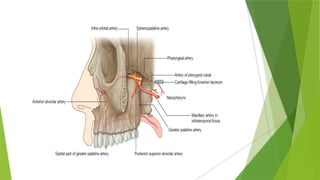
 These vessels are small branches of the dental artery.
 The dental artery is branch of the inferior alveolar artery, the
superior posterior alveolar artery or the infraorbital artery,
branches of the internal maxillary artery.
 Inside the pulp the main arterioles are seen in a central location
extending to the coronal pulp. They give of branches that spread
in the tissue, diminish in size and finally become capillaries.
 The capillaries provide the odontoblasts and other cells of the
pulp with an adequate supply of nutrients, the blood then passes
from the capillaries to post capillary venules and to gradually
larger venules towards the central region of the pulp where they
are seen along side the arterioles.
Efferent blood vessels (Venules)
 Venules constitute the efferent (exit) side of the pulpal circulation and
slightly larger than the corresponding arterioles
 Efferent vessels are thin-walled and show only an occasional smooth
muscle. Because they are not innervated they are largely passive and
nonconstrictive
 The blood that passes from the capillaries to post capillary venules
towards the central region of the pulp here they are seen alongside the
arterioles
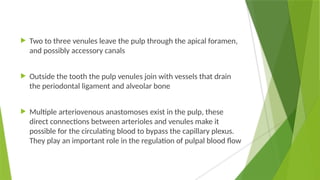
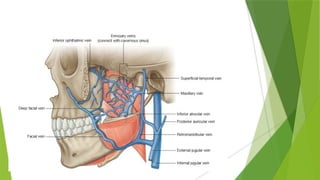
 Two to three venules leave the pulp through the apical foramen,
and possibly accessory canals
 Outside the tooth the pulp venules join with vessels that drain
the periodontal ligament and alveolar bone
 Multiple arteriovenous anastomoses exist in the pulp, these
direct connections between arterioles and venules make it
possible for the circulating blood to bypass the capillary plexus.
They play an important role in the regulation of pulpal blood flow
Lymphatics
 Arise as small, thin walled vessels in the coronal region and then
pass through the middle and apical regions to exit through one
or two layer vessels in the apical foramen
 There is evidence of anastomoses between lymphatics from the
pulp, the periodontal ligament, and the alveolar bone in the
periapical area
INNERVATION
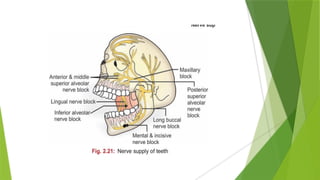
 The second and third divisions (V2 and V3) of the trigeminal nerve
provide the principal sensory innervation to the pulp of maxillary and
mandibular teeth.
 Occasionally mandibular premolars also receive sensory branches from
V3 via the mylohyoid nerve, which is principally a motor nerve.
 In addition, mandibular molars occasionally receive sensory
innervation from cervical spinal nerves (C2 and C3).
 Cell bodies of trigeminal nerves are located in the trigeminal ganglion.
 Pulp also receives sympathetic (motor) innervation from T1 and
to some extent C8 and T2 via the superior cervical ganglion.
These nerves enter the pulp space along with the blood vessels.
 Other nerves from the superior cervical ganglion supply the
periodontium, oral mucosa, and skin.
 Activation of these nerves causes vasoconstriction and regulation
of pulpal blood flow
Neuroanatomy
Pulpal and Dentinal nerves
 Sensory nerves supplying the dental pulp are mixed nerves containing both
myelinated and unmyelinated.
 Myelinated nerves are classified according to diameter and conduction
velocity: the majority are A delta fibers and are relatively fast conducting: a
small percentage are A beta fibers and are even faster.
 A beta fibers may be touch or pressure sensitive.
 Nonmyelinated axons are designated C fibers.
 Stimulation of A delta fibers results in fast, sharp, and relatively localized pain.
 Stimulation of C fibers produces pain that is slower in onset and duller and
more diffuse in character.
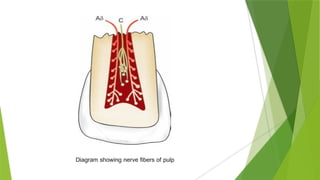
A – delta Fibers
 Myelinated (having a myelin sheath)
 Large diameter (2-5 microns)
 More peripheral
 Afferent fibers for pain and temperature
 Low threshold
C- Fibers
 Non – myelinated
 Small diameter (0.3-1.2 microns)
 More central; terminate near blood vessels resulting in visceral
efferent effects
 Afferent fibers for pain and temperature
 High threshold
 Stimulation is associated with tissue damage and the
inflammatory process
AGE CHANGES IN THE DENTAL PULP
 Pulp, like other connective tissues, undergoes gradual age
changes
 Some of these: Natural (chronologic), result of injury
(pathophysiologic) to the dentin-pulp complex from factors such
as caries, periodontal disease, trauma, or restorative dental
procedures.
 Changes caused by natural aging or injury, altered pulp
appearance (morphologic changes) and function (physiologic
changes)
Morphologic changes:
 Progressive reduction in volume pulp space due to continued
deposition of dentin in response to Odontoblast injury
 Reduction in number of pulp cells
 The number of nerves and blood vessels is also decreased
 Blood vessels often display arteriosclerotic changes.
Calcifications
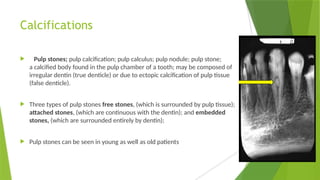
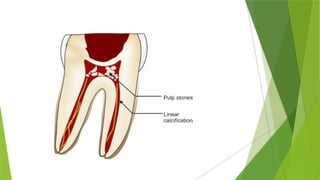
 Pulp stones; pulp calcification; pulp calculus; pulp nodule; pulp stone;
a calcified body found in the pulp chamber of a tooth; may be composed of
irregular dentin (true denticle) or due to ectopic calcification of pulp tissue
(false denticle).
 Three types of pulp stones free stones, (which is surrounded by pulp tissue);
attached stones, (which are continuous with the dentin); and embedded
stones, (which are surrounded entirely by dentin);
 Pulp stones can be seen in young as well as old patients
 May occur in one or several teeth, in normal uninflamed pulp as well as in
chronically inflamed pulp
 They are not responsible for painful symptoms, regardless of size
 Depending on shape and size, pulp calcifications may or may not be detected
radiographically
 Large pulp stones are clinically significant in that they may block access to
canals or the root apex during root canal treatment
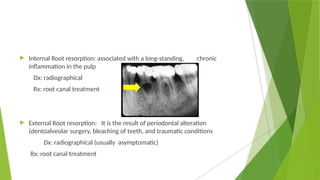
 Internal Root resorption: associated with a long-standing, chronic
inflammation in the pulp
Dx: radiographical
Rx: root canal treatment
 External Root resorption: It is the result of periodontal alteration
(dentoalveolar surgery, bleaching of teeth, and traumatic conditions
Dx: radiographical (usually asymptomatic)
Rx: root canal treatment
Physiologic changes:
 Aging of the pulp-dentin complex results in a decrease in dentin
permeability.
 This decrease provides a more protected environment for the
pulp and diminishes the effect of irritating, such as caries,
attrition, and periodontal disease
Thank you

1. Introduction to endodontics .pptx

  • 1.
  • 2.
    Contents  Definition  History Aims and objectives  Scope of Endodontics  Anatomy of the pulp cavity  Pulp Functions  Cells of the Pulp  Extra cellular components  Blood vessels, lymphatics, innervations  Age changes in the dental pulp
  • 3.
    INTRODUTION TO ENDODONTICS Endo is a Greek word for “Inside” and Odont is Greek for “Tooth”. Endodontic treatment treats inside of the tooth.  Endodontics is the specialty of dentistry that deals with the prevention, diagnosis, and treatment of the diseases and injuries of dental pulp and the periradicular tissues that surround the root of the tooth.  American association of endodontic define (endodontics)as: Branch of dentistry concerned with the morphology, physiology, and pathology of human dental pulp and periradicular tissues.
  • 4.
     That is,the main aim of the endodontic therapy involves to: I . Maintain vitality of the pulp. II . Preserve and store the tooth with damaged and necrotic pulp. III . Preserve and restore the teeth which have failed to the previous endodontic therapy, to allow the tooth to remain functional in the dental arch. • It includes the study of basic sciences like biology of normal pulp, etiology for the various diseases and pathology of human dental pulp along with morphology and physiology.
  • 5.
    HISTORY  Endodontics hasbeen practiced as early as second or third century BC.  A skull found in the Negev Desert in Israel had a bronze wire in one of its teeth.  Researchers believe the wire may have been used to treat an infected pulp.  Other evidence shows that pulp chambers were drained to relieve pain and pressure in the first century A.D.
  • 6.
     Oldest knownroot canal filling. Radiograph of skeletal remains showing maxillary incisor with bronze wire implanted in the root canal of a Nabatean warrior buried in the Negev desert 2,200 years ago (200 BC).
  • 7.
    A Leap Intothe Future: X-rays and Anesthetics  The greatest leap in Endodontic history came with the introduction of x-rays and effective anesthetics in the first part of the last century.  These advances made Endodontic treatment more predictable and more comfortable for the patient.
  • 8.
    Steady Progress  Interestin Endodontics grew quickly as scientists began to research Endodontic treatment.  Their efforts and simultaneous scientific and technological advances, such as culturing and other modern methods, proved the safety and efficacy of root canal treatment, allowing hundreds of millions of patients to save teeth that otherwise would have been lost to extraction, the only alternative of the day.
  • 9.
    Dr. Grossman, thepioneer of endodontics divided the evolution of endodontics in four eras from 1776 to 1976, each consisting of 50 years.  Pre science (1776 to 1826): In this era, endodontic therapy mainly consisted of crude modalities like abscesses were being treated with poultices or leeches and pulps were being cauterized using hot cauteria.  Age of discovery (1826 to 1876): In this era there occurred the development of anesthesia, gutta-percha and barbed broaches. Also the medications were created for treating pulpal infections and the cements and pastes were discovered to fill them.  The dark age (1876 to 1926): In spite of introduction of X-rays and general anesthesia, extractions was the choice of treatment than endodontics in most of the cases of damaged teeth because theory of the focal infection was main concern at that time.
  • 10.
     The renaissance(1926 to 1976): In this era, endodontics was established as science and therapy, forming its golden era. It showed the improvement in anesthesia and radiographs for better treatment results. The theory of focal infection was also fading out, resulting in more of endodontics being practiced and in 1943, because of growing interest in endodontics, the AAE, that is, the American Association of Endodontists was found.  Innovation era: It is the period from 1977 onwards in which tremendous advancements at very fast rate are being introduced in the endodontics. The better vision, better techniques of biomechanical preparations, and obturation are being developed resulting in the simpler, easier and faster endodontics with more of the successful results.
  • 11.
    Professional Recognition:  EndodonticsBecomes an Official Dental Specialty In 1963, the American Dental Association officially recognized Endodontics as a dental specialty.
  • 12.
    Aims and objectives Dx of the diseases of the pulp  Identification and determination of etiological factors responsible for pulpal and periapical disease  Measures to prevent diseases of the pulp and periapical tissues  Selection of cases for Rx  To provide care which is proper and consistent with the knowledge and experience  To determine reasonable prognosis for the cases selected for the treatment  To evaluate or assess the completed endodontic procedures
  • 13.
    Scope of Endodontics Formerly, confined to root canal filling techniques by conventional methods.  Modern Endodontics includes:  Dx of oral pain  Protection of healthy pulp from disease or injury  Pulp capping  Pulpotomy  RCT of infected root canals  Bleaching  Surgical endodontics (apicoectomy,hemi-section,root amputation,and replantation)
  • 14.
    ANATOMY OF THEPULP CAVITY pulp horn Roof of pulp chamber Wall of p.c Floor of PC Canal orifice Apical foramen
  • 15.
     The pulpis the soft tissue that is located inside the tooth structure.  It contains nerves, arteries, veins, and lymph tissue.  It is contained in the canals located in thin tube-like spaces in the roots and in the pulp chamber located within the crown of the tooth.
  • 16.
    THE DENTAL PULP PULP CAVITY  Pulp chamber  Root canal
  • 17.
     Pulp cavity:Is the central cavity within a tooth and is entirely enclosed by dentin except at the apical foramen.  Pulp cavity may be divided in to coronal portion, pulp chamber and radicular portion, root canal.  In anterior teeth the pulp chamber gradually merges into the root canal and this division becomes indistinct.  In multirooted teeth the pulp cavity consists of a single pulp chamber and usually three root canals although the number of canals can vary from one to five.
  • 18.
     Roof ofthe pulp chamber consists of dentin covering the pulp chamber occlusally or incisally.  A pulp horn is an accentuation of the roof of the pulp chamber directly under a cusp or developmental lobe.  The floor of the pulp chamber runs parallel to the roof and consists of dentin bounding the pulp chamber near the cervix of the tooth particularly dentin forming the furcation area.
  • 19.
     The canalorifices are openings in the floor of the pulp chamber leading in to the root canals. These are continuous with both the pulp chamber and root canals.  The walls of a pulp chamber derive their names from corresponding walls of the tooth surface ,such as the buccal wall of a pulp chamber.
  • 20.
    ROOT CANAL  Itis that portion of the pulp cavity from the canal orifice to the apical foramen.  It is divided in to three sections: coronal ,middle, and apical thirds. Accessory canals or lateral canals  Lateral branchings of the main root canal generally occuring in the apical third or furcation area of a root.  Lateral canal is accessory canal that branches to the lateral surface of the root and may be visible on a radiograph.
  • 21.
     Apical foramen:an aperture at or near apex of a root through which the blood vessels and the nerves of the pulp enter or leave the pulp cavity.  Accessory foramina: an orifice on the surface of the root communicating with lateral or accessory canal.  Apical stop: a barrier at the preparation end is an apical stop(major diameter) and assumes a funnel shape.
  • 22.
    Morphology  Consists ofrichly vascularized and highly innervated connective tissue.  It is surrounded by dentin.  The pulp tissue is in communication with the periodontium and the rest of the body through the apical foramen and accessory canals near the apex of the root.
  • 23.
    Pulp Functions: (induction,formation, nutrition, defense and sensation) 1.Induction: pulp participate in the induction and development of Odontoblast and dentin, which, when formed, induce enamel formation.  These processes are interdependent activities in that ameloblasts influence differentiation of Odontoblast, and odontoblasts and dentin influence formation of enamel.
  • 24.
    2)Formation: odontoblasts formdentin. These highly specialized cells participate in dentin formation. Odontoblasts can also form a unique type of dentin in response to injury, such as occurs with caries, trauma, and restorative procedures. This formation is localized to the site of injury and is referred to as tertiary dentinogenesis. 3)Nutrition: via dentinal tubules, pulp supplies nutrients that are essential for dentin formation (e.g. peritubular dentin) and hydration.
  • 25.
    4) Defense: asmentioned previously, odontoblasts form dentin in response to injury, particularly when the original dentin thickness has been compromised by caries, wear, trauma, or restorative procedures. The pulp galvanizes odontoblasts into action or produces new odontoblasts to form needed hard tissue.  HOWEVER, the quality of dentin produced in response to injury may not mimic that produced physiologically and may not provide protection for the underlying pulpal tissue.
  • 26.
    5)Sensation: through thenerves system, pulp transmits sensation mediated through enamel or dentin to the higher nerve centers; usually expressed clinically as pain, although physiologic and psychophysiology studies indicate pulp also senses temperature and touch.
  • 27.
    Cells of thePulp:  Odontoblast: are the most distinctive cells of pulp.  They form a single layer at the periphery and synthesize the matrix (The formative portion of a tooth or a nail), which becomes mineralized and is called dentin.  In the pulp chamber, odontoblasts are relatively large and columnar. The cervical and mid-portions of the root demonstrate more cuboidal odontoblasts: the apical canal tends to have flattened (squamous) -appearing odontoblasts
  • 28.
     Preodontoblasts: thelong-known fact that new odontoblasts arise subsequent to a pulp injury that results in a loss of the original odontoblasts.  Fibroblasts: are the most common cell type in the pulp and are responsible for collagen production.
  • 29.
     Undifferentiated (reserve)Cells: represent the cell pool from which connective tissue cells of the pulp are derived.  Depending on the stimulus they may give rise to fibroblasts and possibly odontoblasts.  Cells of the Immune System: macrophages, T lymphocytes, and dendritic cells (embryonic ectoderm, cell's of neural crest origin with extensive processes; they early develop melanin) are also normal inhabitants.
  • 30.
    Extracellular components  Thepulp has two main types of fibers (collagen and elastic)  Elastic fibers always being confined to the walls of larger blood vessels  The fibers of the young pulp are small: they are distributed diffusely within the tissue and are often covered by a glycosaminoglycan sheath  In the mature pulp larger fiber bundles can be seen , especially along blood vessels in the root pulp
  • 31.
    BLOOD VESSELS  afferent(af‚er-ent)[L. afferens, fr. af-fero, to bring to] centripetal (1); esodic;toward a center, denoting certain arteries, veins, lymphatics, and nerves.  efferent(ef‚er-ent) [L. efferens, fr. effero, to bring out]  Conducting (fluid or a nerve impulse) outward from a given organ or part thereof; e.g., the efferent connections of a group of nerve cells, efferent blood vessels, or the excretory duct of an organ.
  • 32.
    Afferent blood vessels(Arteriole)  One and sometimes two afferent vessels enter the canal via each apical foramen.  These vessels are small branches of the dental artery.  The dental artery is branch of the inferior alveolar artery, the superior posterior alveolar artery or the infraorbital artery, branches of the internal maxillary artery.
  • 33.
     Inside thepulp the main arterioles are seen in a central location extending to the coronal pulp. They give of branches that spread in the tissue, diminish in size and finally become capillaries.  The capillaries provide the odontoblasts and other cells of the pulp with an adequate supply of nutrients, the blood then passes from the capillaries to post capillary venules and to gradually larger venules towards the central region of the pulp where they are seen along side the arterioles.
  • 35.
    Efferent blood vessels(Venules)  Venules constitute the efferent (exit) side of the pulpal circulation and slightly larger than the corresponding arterioles  Efferent vessels are thin-walled and show only an occasional smooth muscle. Because they are not innervated they are largely passive and nonconstrictive  The blood that passes from the capillaries to post capillary venules towards the central region of the pulp here they are seen alongside the arterioles
  • 36.
     Two tothree venules leave the pulp through the apical foramen, and possibly accessory canals  Outside the tooth the pulp venules join with vessels that drain the periodontal ligament and alveolar bone  Multiple arteriovenous anastomoses exist in the pulp, these direct connections between arterioles and venules make it possible for the circulating blood to bypass the capillary plexus. They play an important role in the regulation of pulpal blood flow
  • 38.
    Lymphatics  Arise assmall, thin walled vessels in the coronal region and then pass through the middle and apical regions to exit through one or two layer vessels in the apical foramen  There is evidence of anastomoses between lymphatics from the pulp, the periodontal ligament, and the alveolar bone in the periapical area
  • 39.
    INNERVATION  The secondand third divisions (V2 and V3) of the trigeminal nerve provide the principal sensory innervation to the pulp of maxillary and mandibular teeth.  Occasionally mandibular premolars also receive sensory branches from V3 via the mylohyoid nerve, which is principally a motor nerve.  In addition, mandibular molars occasionally receive sensory innervation from cervical spinal nerves (C2 and C3).  Cell bodies of trigeminal nerves are located in the trigeminal ganglion.
  • 41.
     Pulp alsoreceives sympathetic (motor) innervation from T1 and to some extent C8 and T2 via the superior cervical ganglion. These nerves enter the pulp space along with the blood vessels.  Other nerves from the superior cervical ganglion supply the periodontium, oral mucosa, and skin.  Activation of these nerves causes vasoconstriction and regulation of pulpal blood flow
  • 42.
    Neuroanatomy Pulpal and Dentinalnerves  Sensory nerves supplying the dental pulp are mixed nerves containing both myelinated and unmyelinated.  Myelinated nerves are classified according to diameter and conduction velocity: the majority are A delta fibers and are relatively fast conducting: a small percentage are A beta fibers and are even faster.  A beta fibers may be touch or pressure sensitive.  Nonmyelinated axons are designated C fibers.  Stimulation of A delta fibers results in fast, sharp, and relatively localized pain.  Stimulation of C fibers produces pain that is slower in onset and duller and more diffuse in character.
  • 44.
    A – deltaFibers  Myelinated (having a myelin sheath)  Large diameter (2-5 microns)  More peripheral  Afferent fibers for pain and temperature  Low threshold
  • 45.
    C- Fibers  Non– myelinated  Small diameter (0.3-1.2 microns)  More central; terminate near blood vessels resulting in visceral efferent effects  Afferent fibers for pain and temperature  High threshold  Stimulation is associated with tissue damage and the inflammatory process
  • 46.
    AGE CHANGES INTHE DENTAL PULP  Pulp, like other connective tissues, undergoes gradual age changes  Some of these: Natural (chronologic), result of injury (pathophysiologic) to the dentin-pulp complex from factors such as caries, periodontal disease, trauma, or restorative dental procedures.  Changes caused by natural aging or injury, altered pulp appearance (morphologic changes) and function (physiologic changes)
  • 47.
    Morphologic changes:  Progressivereduction in volume pulp space due to continued deposition of dentin in response to Odontoblast injury  Reduction in number of pulp cells  The number of nerves and blood vessels is also decreased  Blood vessels often display arteriosclerotic changes.
  • 48.
    Calcifications  Pulp stones;pulp calcification; pulp calculus; pulp nodule; pulp stone; a calcified body found in the pulp chamber of a tooth; may be composed of irregular dentin (true denticle) or due to ectopic calcification of pulp tissue (false denticle).  Three types of pulp stones free stones, (which is surrounded by pulp tissue); attached stones, (which are continuous with the dentin); and embedded stones, (which are surrounded entirely by dentin);  Pulp stones can be seen in young as well as old patients
  • 50.
     May occurin one or several teeth, in normal uninflamed pulp as well as in chronically inflamed pulp  They are not responsible for painful symptoms, regardless of size  Depending on shape and size, pulp calcifications may or may not be detected radiographically  Large pulp stones are clinically significant in that they may block access to canals or the root apex during root canal treatment
  • 51.
     Internal Rootresorption: associated with a long-standing, chronic inflammation in the pulp Dx: radiographical Rx: root canal treatment  External Root resorption: It is the result of periodontal alteration (dentoalveolar surgery, bleaching of teeth, and traumatic conditions Dx: radiographical (usually asymptomatic) Rx: root canal treatment
  • 52.
    Physiologic changes:  Agingof the pulp-dentin complex results in a decrease in dentin permeability.  This decrease provides a more protected environment for the pulp and diminishes the effect of irritating, such as caries, attrition, and periodontal disease
  • 53.